Romance and the Internet The EMergence of EDating












- Slides: 38
“Romance and the Internet: The E-Mergence of E-Dating” Presented to ACR 2003, Toronto ON Angeline Grace Close & George M. Zinkhan University of Georgia
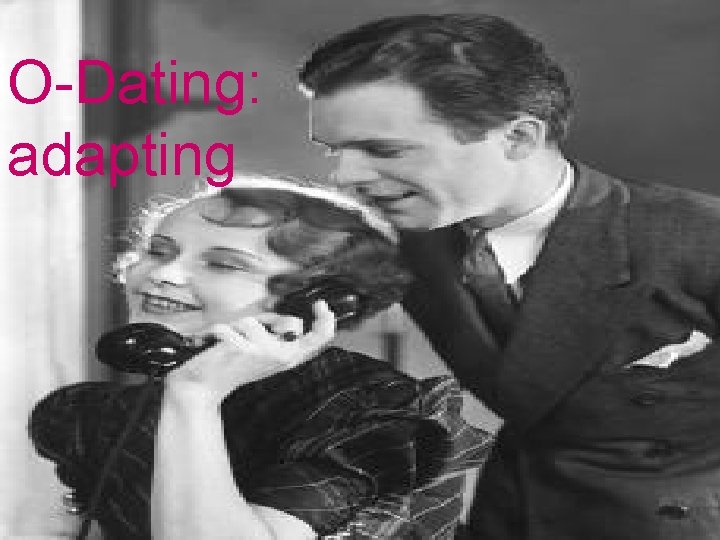
O-Dating: adapting
E-Dating
E-Dating Figures • Revenue from dating sites is expected to rise >100% in next 5 years • $313 million(2002) $642 million (2007) • Online dating= $304 million annual industry • market for paid Web content jumped 105% (2002) • In 2002(3 Q), personals saw a 387% gain, earning higher revenues than any other segment of online paid content
#1 Site: match. com 5. 7 million hits per month all financial, economic, social backgrounds
#2 Site: matchmaker. com 3. 2 million hits per month
#3 Site: kiss. com Udate Properties has ten-million individual subscribers *5 other sites are in the million-plus range.
religion (e. g. , catholicsingles. com) region (e. g. , chicagosingles. com) cultural background(e. g. , globalrishta. com) career (e. g. , dateaflightattendant. com)
Research Questions 1. “What themes are salient among young (college-aged) daters in the U. S. , who use the Internet to initiate and/or facilitate dating relationships? 2. “What concerns and outcomes do daters experience before, during, and after searching, posting, and/or joining an Internet dating/singles site? ”
Objectives In pursuing these questions, we seek: • to understand the emergence of Internet dating via informants’ experiences • to present qualitative data that illustrate key themes related to Internet dating
Concepts Defined Emergence of Netiquette-Based E-Dating O-Dater E-Dater Date E-Date Dating Etiquette Dating Success Dating Netiquette E-Dating Success
Concepts Defined, cont. Date: an engagement to go out socially with another person, often out of romantic interest, or one's companion on such an outing. E-Date: the pre-set time to “meet” in a chatroom or on a dating/singles website to instant message (IM), or the actual online social exchange. The initiation of an E-Date may result via a personal posting, a chat room conversation, an email, some other computer-mediated communication, or even from offline correspondence. E-Dating: the process of contact, courtship, and subsequent emotional, psychological, or spiritual bonding/ exchange at any level between persons via a singles, matchmaking, or online dating website/chatroom.
Theoretical Background • Economic theory social behavior- economic exchanges associated with dating (e. g. , gift giving). • Dating is a market exchange- ritualistically exchange and spend money as a symbolic vehicle • Viewing dating as an exchange “may threaten to commoditize and destroy the illusions provided by the romantic model of love. ” (Belk and Coon 1991 p 521) • Social theory of exchange suggests that such exchanges are associated with prestige. • We consider E-Dating as primarily a social exchange.
Methodology • Pilot study • Multiple methods to explore E-Dating • Triangulation -corroborating evidence
Methodology a) Questionnaires questionnaire to all focus group informants, prior to any moderated discussion. three questions on the questionnaire asked about security, the definition of E-Dating, and e-mail. provided a place to write any feelings, elaborations, or comments
Methodology b) In-depth interviews trained qualitative researcher interviewed E-Daters preliminary feel of the individual perspective transcribed
Methodology c) Focus Group Interviews (FGI) Formed temporary “small communities” to explore dating perceptions and practices accounts for the social nature of dating 2 rounds of group interviewing, over a year elapsing between the rounds.
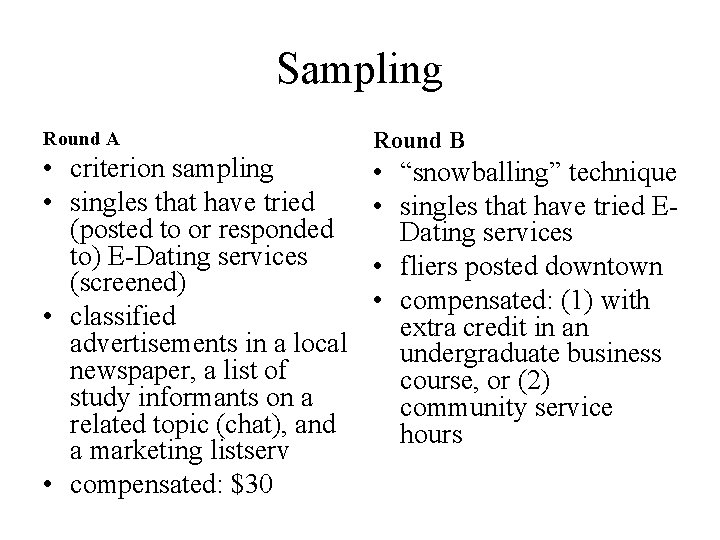
Sampling Round A • criterion sampling • singles that have tried (posted to or responded to) E-Dating services (screened) • classified advertisements in a local newspaper, a list of study informants on a related topic (chat), and a marketing listserv • compensated: $30 Round B • “snowballing” technique • singles that have tried EDating services • fliers posted downtown • compensated: (1) with extra credit in an undergraduate business course, or (2) community service hours
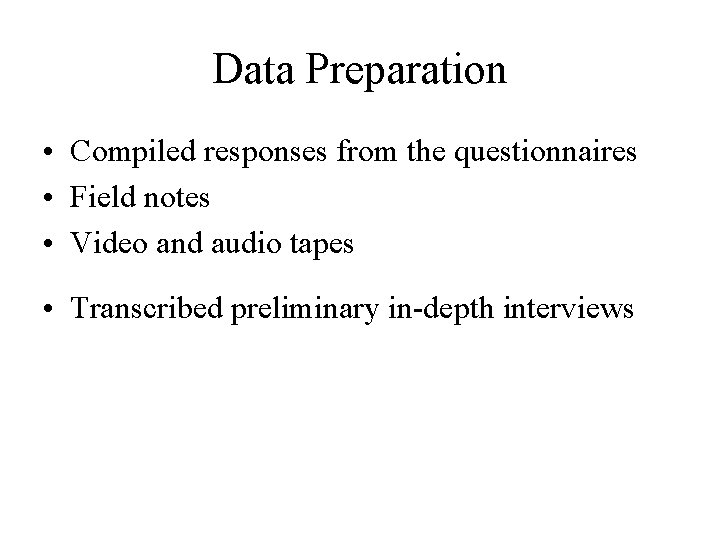
Data Preparation • Compiled responses from the questionnaires • Field notes • Video and audio tapes • Transcribed preliminary in-depth interviews
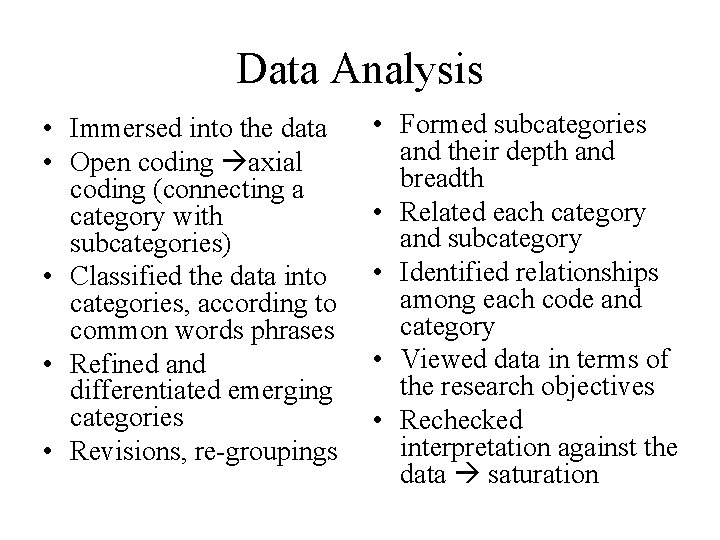
Data Analysis • Immersed into the data • Open coding axial coding (connecting a category with subcategories) • Classified the data into categories, according to common words phrases • Refined and differentiated emerging categories • Revisions, re-groupings • Formed subcategories and their depth and breadth • Related each category and subcategory • Identified relationships among each code and category • Viewed data in terms of the research objectives • Rechecked interpretation against the data saturation
E-dating: What are people thinking? . . . Or, what are people admitting to thinking?
Findings Establishing Relationships • (A 2, M) utilized an “online matchmaking service”, attempt to meet new people—not necessarily romantic, moved to a new city • Males dominated sharing personal E-Dating experiences, brag-like manner • (A 3, M) “met” a woman in a chat room after seeing a woman on an E-Dating site. This woman lived in Tennessee, although he lives in Georgia. The two had not previously met; however, he made the trip to Tennessee to see her (twice).
Findings E-Dating Advances Friendships • Informants noted that the Internet often does keep a pre-established friendly relationship intact via computer-mediated-communication (CMC) • CMC contributes towards making a friend into potential romantic partner
Findings It’s a Small, Small World • Coworker in a satellite office Intranet “Eaffairs” a) Facilitating offline encounters b) Creating Online Relationships
Findings The Electronic Edge • Extra edge • Confidence-builder for creating romantic relationships • “I was scared out of my mind…but I was enough of a hopeless romantic to do it” (A 6, F). She felt the Internet aided her decision to “go for it”.
Findings E-Dating Geographical Barrier • Best for finding singles living in or near the same city • Brings new daters together from local communities more frequently than any other search option. • Informants claim a key attribute of the Internet is that it “reduces geographic boundaries in both relationship formation and maintenance” (A 9, F), but they do not report this in their actions. • Rarely positive long distance mentions
Findings Time Wasted, Time Saved • All of the focus-group informants in round A mentioned severe time constraints in their lives • a) Matching Services • b) E-Dating Screener robust scalability, data archiving of personal pages , time-efficient EDating experience.
Findings Recurring E-Dating Patterns a) Less Intimacy “I like the intimacy of the whole person, not a cold screen” (B 7, M). b) Community Based Self–Disclosure candid disclosure occurs most with E-Dating in one’s community “We had a lot in common, so I didn’t waste time explaining about my background; I could quickly tell he understood” (B 8, F).
Findings Recurring E-Dating Patterns, cont. c) Looks May Be Deceiving A submitted photo may by outdated, doctored up, or actually represent someone else all together. d) Lies, Lies Men reported lying about their athletic condition, income, and relationship status & “entertainment value of it”. “included in the drinking scene”
Findings E-Dating’s Dark Side • negative perceptions did not outweigh the potential benefits of E-Dating • none of the participants spoke of a negative experience that has prevented continuation of EDating. • “very fruitful and positive learning experiences” Potential Danger in E-Dating • “Not a true stranger. ” “I felt as if I had known him for years, just after a few chat sessions” (A 6, F).
Findings Risky Business “Far exceeds the risks in recent history” (B 1, F). a) Social risks Unknown Audience Reputation: “socially ascending vs descending” “Anytime I type personal information, there is no telling where it may end up. My picture as well, may end up on someone’s desktop or even printed and framed on their bedside table. ” (B 11, F) b) Security Risk “I’m very much aware of the temptation many have to use their networking skills to look at online transactions and information that they are not privy to” (B 4, M). Identity stealing is also a concern (B 4, M; B 11, F; B 3, M).
Implications • Internet may cause every power relationship on the planet to be renegotiated • revolutionary and evolutionary force in a variety of human endeavors • profound consequences for human dating rituals • consider the profound impact of the automobile on human courtship. • postmodern perspective, the Internet will have a strong influence on human consciousness and relationships • E-Dating may prove to be just one example of how the Internet transforms human behavior
Implications for Social Exchange Theory • SET assumes E-Daters may accurately anticipate the payoffs of different decisions • Daters often do not know what they are looking for. • Not always looking for a commitment (e. g. , just to chat). • Interactions may cause “instant attraction”. • E-Daters make impulsive choices (e. g. , no children, only blondes, medium build).
E- dating sites provide virtual opportunity for consumers to interact and, in the process, re-invent dating patterns, rituals, scripts, and motivations.
Limitations • There may be important differences in EDating perceptions depending on age, gender, occupation, motivations, interests, and geography. • International comparisons, as well as crossnational differences may present further insight, especially in terms of consumer confidence.
Future Research • Our working definitions (e. g. , E-Date, netiquette) may aid in understanding this new phenomenon. • Future researchers may wish to validate or amend our definitions. • What is the degree of intimacy E-Daters allow online? • How do online relationships progress to offline relationships? • Our study is a pilot designed to stimulate such future inquiries.
Thank you! Dr. Zinkhan and I welcome your feedback/questions! • aclose@terry. uga. edu • gzinkhan@terry. uga. edu