Role of the Qualified or Competent Person Mark

- Slides: 16
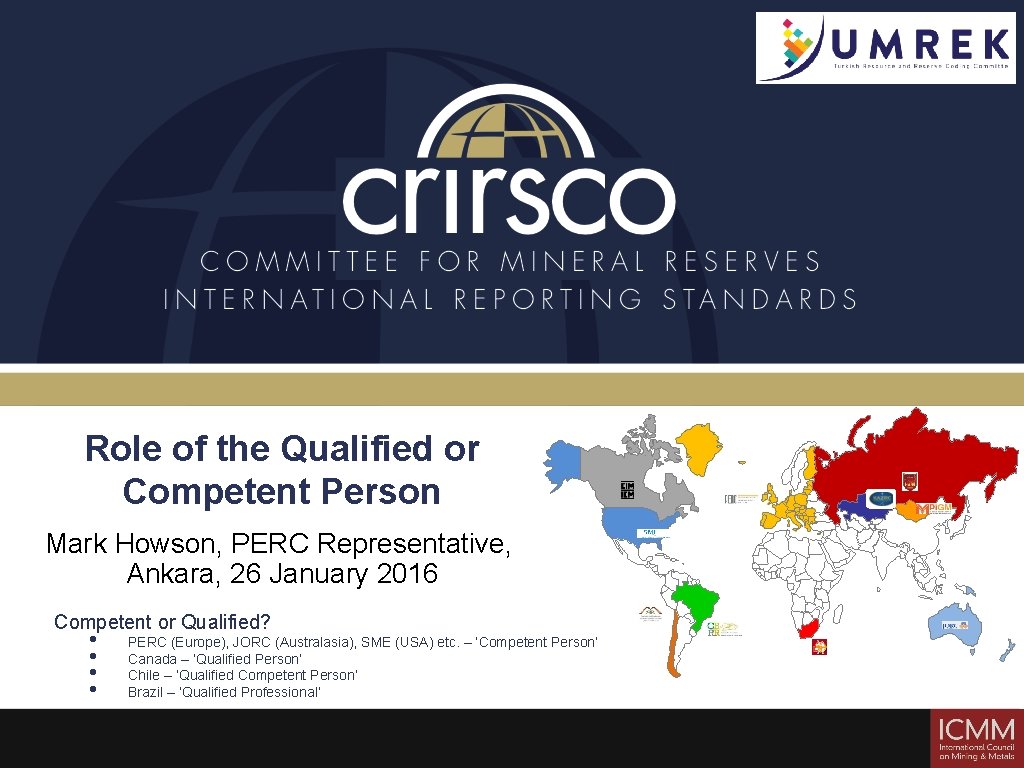
Role of the Qualified or Competent Person Mark Howson, PERC Representative, Ankara, 26 January 2016 Competent or Qualified? • • PERC (Europe), JORC (Australasia), SME (USA) etc. – ‘Competent Person’ Canada – ‘Qualified Person’ Chile – ‘Qualified Competent Person’ Brazil – ‘Qualified Professional’
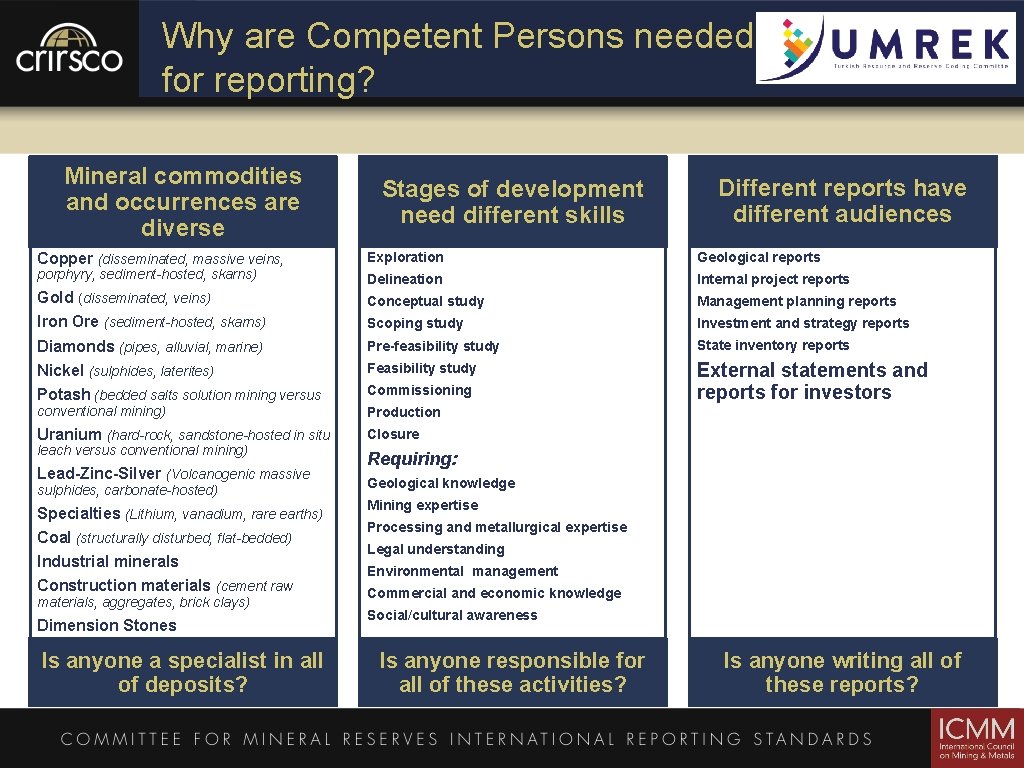
Why are Competent Persons needed for reporting? Mineral commodities and occurrences are diverse Stages of development need different skills Different reports have different audiences Exploration Geological reports porphyry, sediment-hosted, skarns) Delineation Internal project reports Gold (disseminated, veins) Conceptual study Management planning reports Iron Ore (sediment-hosted, skarns) Scoping study Investment and strategy reports Diamonds (pipes, alluvial, marine) Pre-feasibility study State inventory reports Nickel (sulphides, laterites) Feasibility study Potash (bedded salts solution mining versus Commissioning External statements and reports for investors Copper (disseminated, massive veins, conventional mining) Production Uranium (hard-rock, sandstone-hosted in situ Closure leach versus conventional mining) Lead-Zinc-Silver (Volcanogenic massive sulphides, carbonate-hosted) Specialties (Lithium, vanadium, rare earths) Coal (structurally disturbed, flat-bedded) Industrial minerals Construction materials (cement raw materials, aggregates, brick clays) Dimension Stones Is anyone a specialist in all of deposits? Requiring: Geological knowledge Mining expertise Processing and metallurgical expertise Legal understanding Environmental management Commercial and economic knowledge Social/cultural awareness Is anyone responsible for all of these activities? Is anyone writing all of these reports?
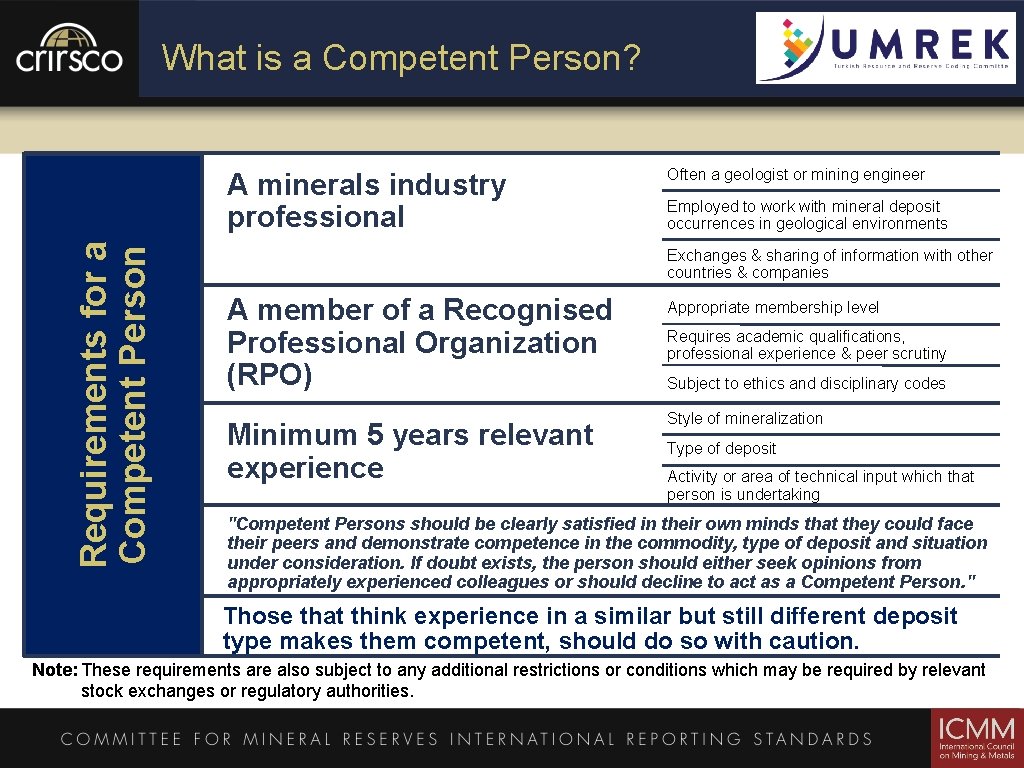
What is a Competent Person? Requirements for a Competent Person A minerals industry professional Often a geologist or mining engineer Employed to work with mineral deposit occurrences in geological environments Exchanges & sharing of information with other countries & companies A member of a Recognised Professional Organization (RPO) Minimum 5 years relevant experience Appropriate membership level Requires academic qualifications, professional experience & peer scrutiny Subject to ethics and disciplinary codes Style of mineralization Type of deposit Activity or area of technical input which that person is undertaking "Competent Persons should be clearly satisfied in their own minds that they could face their peers and demonstrate competence in the commodity, type of deposit and situation under consideration. If doubt exists, the person should either seek opinions from appropriately experienced colleagues or should decline to act as a Competent Person. " Those that think experience in a similar but still different deposit type makes them competent, should do so with caution. Note: These requirements are also subject to any additional restrictions or conditions which may be required by relevant stock exchanges or regulatory authorities.
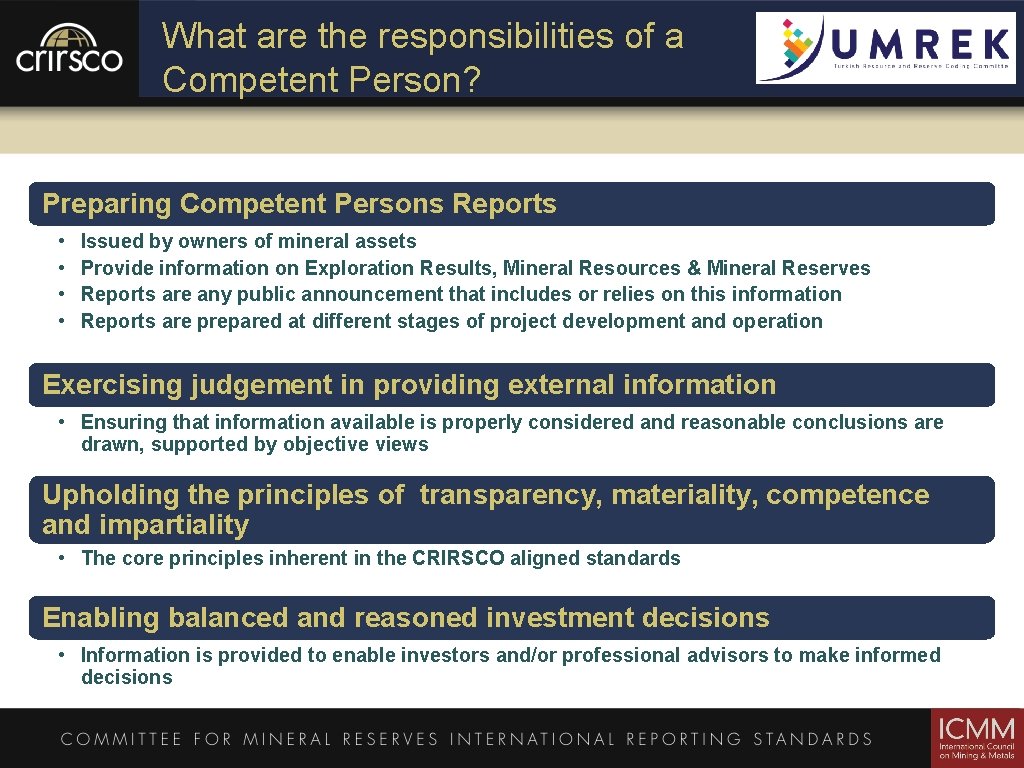
What are the responsibilities of a Competent Person? Preparing Competent Persons Reports • • Issued by owners of mineral assets Provide information on Exploration Results, Mineral Resources & Mineral Reserves Reports are any public announcement that includes or relies on this information Reports are prepared at different stages of project development and operation Exercising judgement in providing external information • Ensuring that information available is properly considered and reasonable conclusions are drawn, supported by objective views Upholding the principles of transparency, materiality, competence and impartiality • The core principles inherent in the CRIRSCO aligned standards Enabling balanced and reasoned investment decisions • Information is provided to enable investors and/or professional advisors to make informed decisions
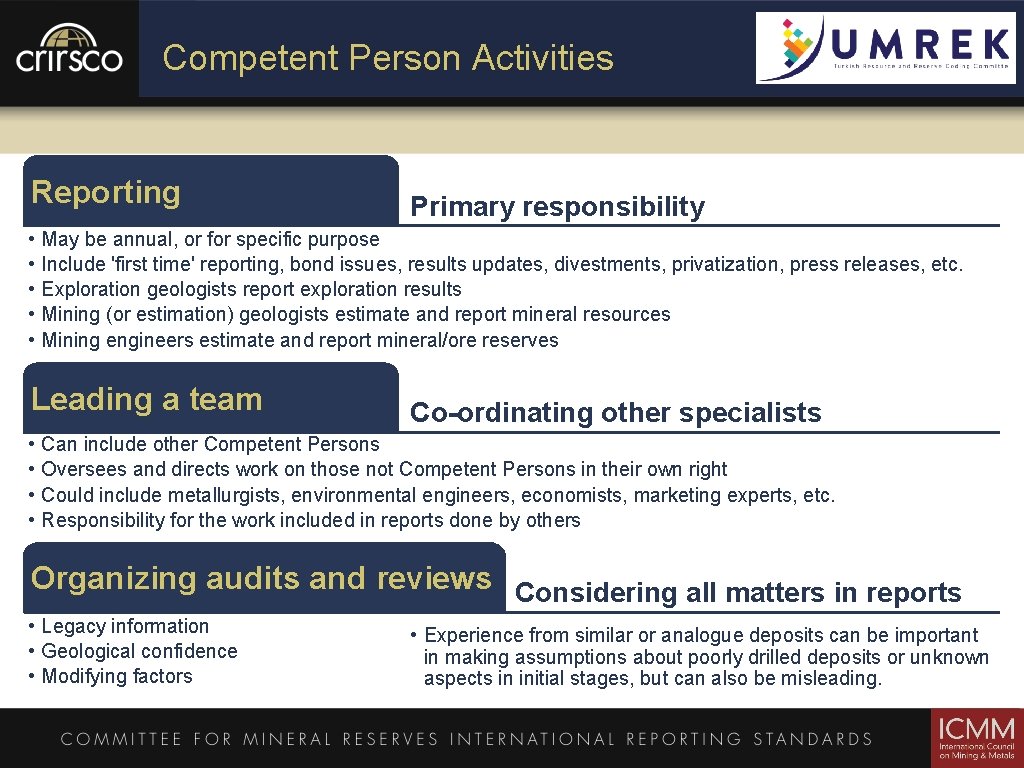
Competent Person Activities Reporting • • • May be annual, or for specific purpose Include 'first time' reporting, bond issues, results updates, divestments, privatization, press releases, etc. Exploration geologists report exploration results Mining (or estimation) geologists estimate and report mineral resources Mining engineers estimate and report mineral/ore reserves Leading a team • • Primary responsibility Co-ordinating other specialists Can include other Competent Persons Oversees and directs work on those not Competent Persons in their own right Could include metallurgists, environmental engineers, economists, marketing experts, etc. Responsibility for the work included in reports done by others Organizing audits and reviews Considering all matters in reports • Legacy information • Geological confidence • Modifying factors • Experience from similar or analogue deposits can be important in making assumptions about poorly drilled deposits or unknown aspects in initial stages, but can also be misleading.
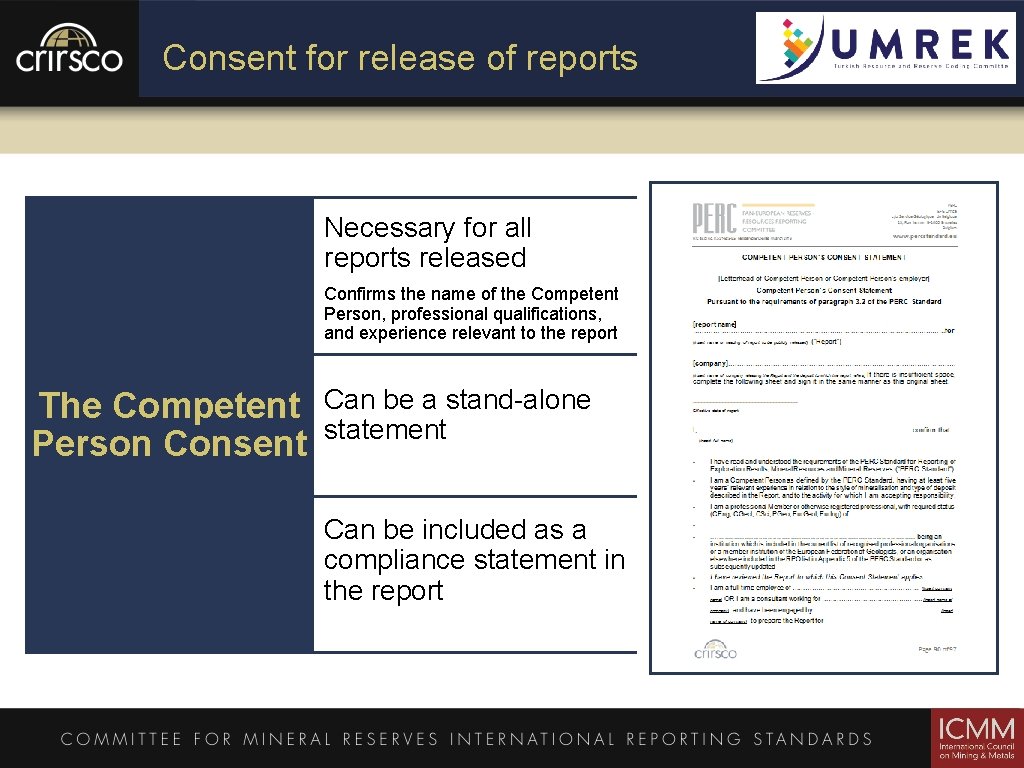
Consent for release of reports Necessary for all reports released Confirms the name of the Competent Person, professional qualifications, and experience relevant to the report The Competent Person Consent Can be a stand-alone statement Can be included as a compliance statement in the report
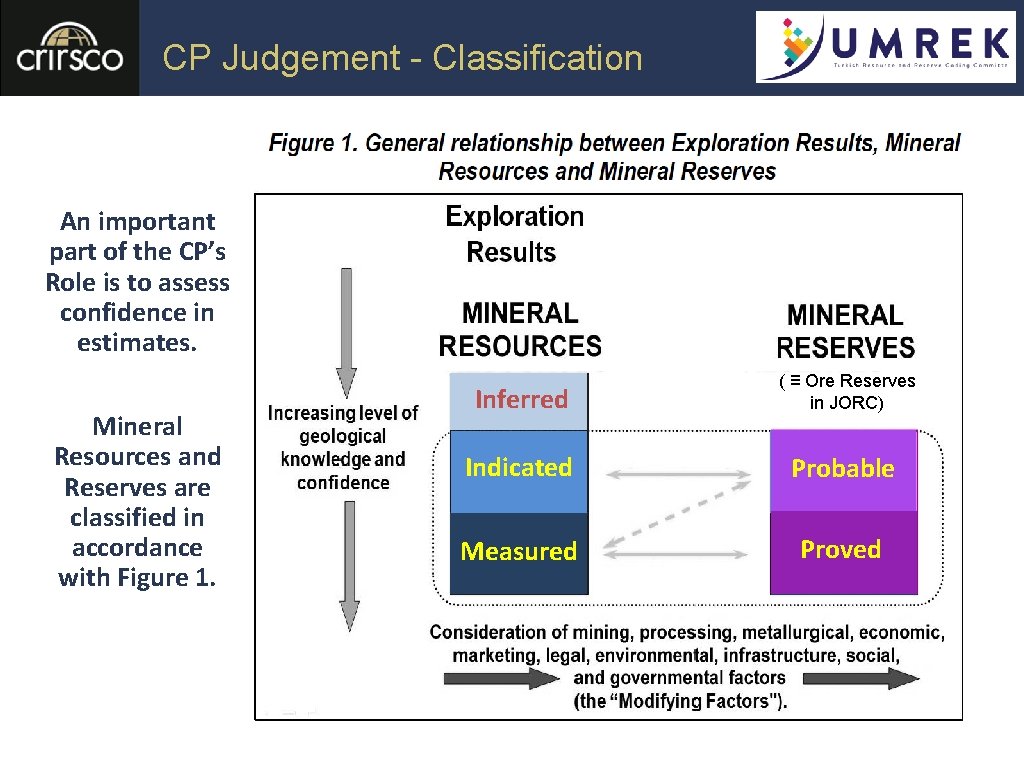
CP Judgement - Classification An important part of the CP’s Role is to assess confidence in estimates. Mineral Resources and Reserves are classified in accordance with Figure 1. Inferred ( ≡ Ore Reserves in JORC) Indicated Probable Measured Proved
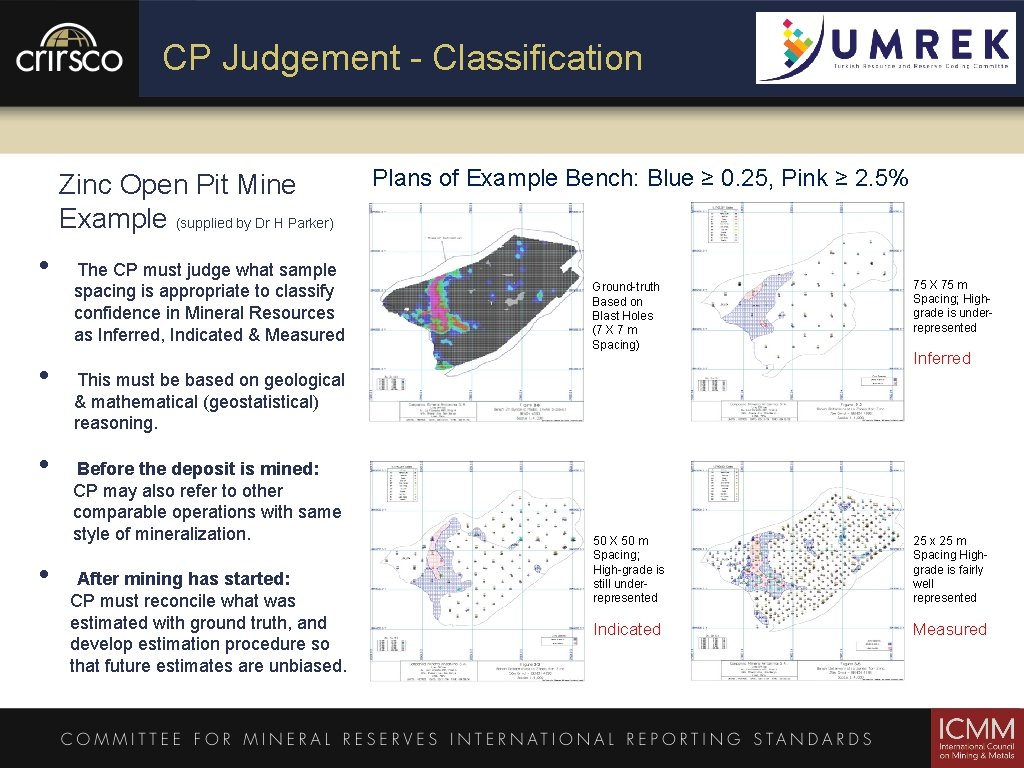
CP Judgement - Classification Zinc Open Pit Mine Example (supplied by Dr H Parker) • • The CP must judge what sample spacing is appropriate to classify confidence in Mineral Resources as Inferred, Indicated & Measured Plans of Example Bench: Blue ≥ 0. 25, Pink ≥ 2. 5% Ground-truth Based on Blast Holes (7 X 7 m Spacing) 75 X 75 m Spacing; Highgrade is underrepresented 50 X 50 m Spacing; High-grade is still underrepresented 25 x 25 m Spacing Highgrade is fairly well represented Indicated Measured Inferred This must be based on geological & mathematical (geostatistical) reasoning. Before the deposit is mined: CP may also refer to other comparable operations with same style of mineralization. After mining has started: CP must reconcile what was estimated with ground truth, and develop estimation procedure so that future estimates are unbiased.
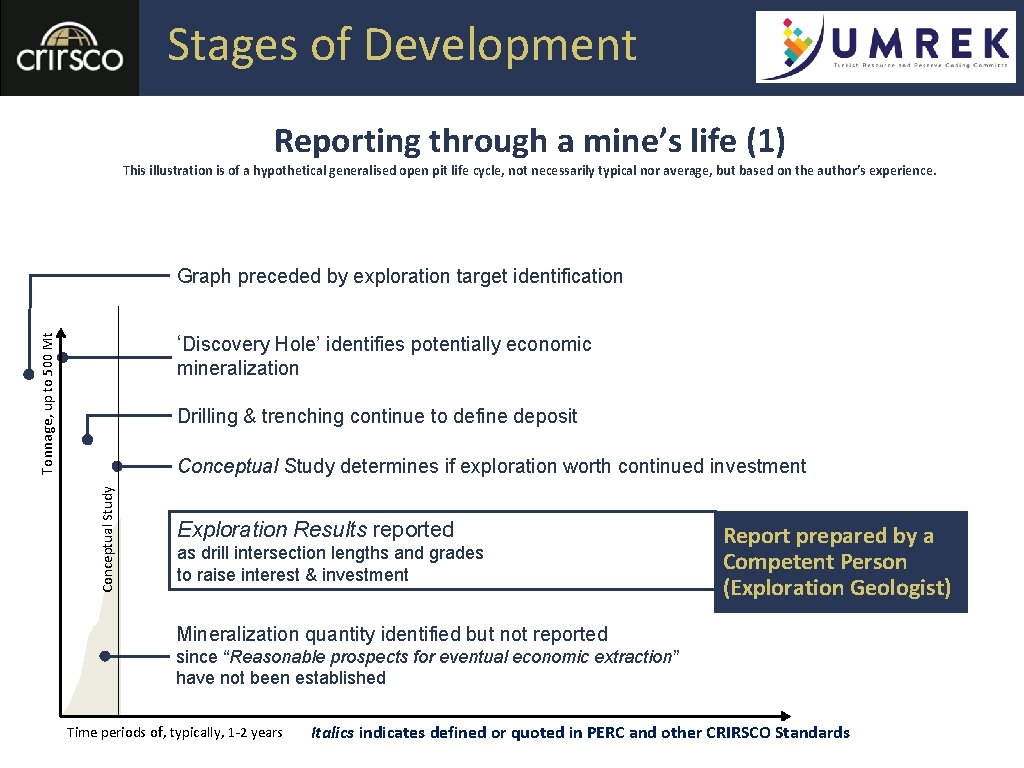
Stages of Development Reporting through a mine’s life (1) This illustration is of a hypothetical generalised open pit life cycle, not necessarily typical nor average, but based on the author’s experience. ‘Discovery Hole’ identifies potentially economic mineralization Closure Full production Commissioning Ramp-up Feasibility Study engineering & construction Tonnage, up to 500 Mt Scoping Study Graph preceded by exploration target identification Drilling & trenching continue to define deposit Conceptual Study determines if exploration worth continued investment Exploration Results reported as drill intersection lengths and grades to raise interest & investment Report prepared by a Competent Person (Exploration Geologist) Mineralization quantity identified but not reported since “Reasonable prospects for eventual economic extraction” have not been established Time periods of, typically, 1 -2 years Italics indicates defined or quoted in PERC and other CRIRSCO Standards
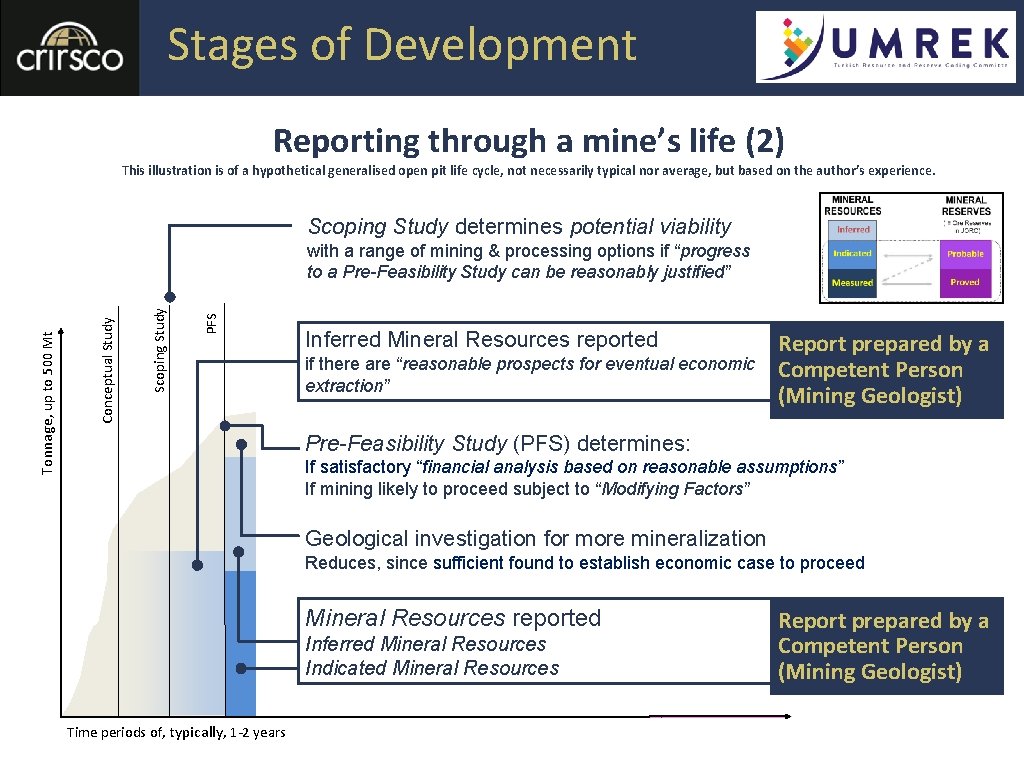
Stages of Development Reporting through a mine’s life (2) This illustration is of a hypothetical generalised open pit life cycle, not necessarily typical nor average, but based on the author’s experience. Scoping Study determines potential viability Inferred Mineral Resources reported if there are “reasonable prospects for eventual economic extraction” Closure Full production Commissioning Ramp-up Feasibility Study engineering & construction PFS Scoping Study Conceptual Study Tonnage, up to 500 Mt with a range of mining & processing options if “progress to a Pre-Feasibility Study can be reasonably justified” Report prepared by a Competent Person (Mining Geologist) Pre-Feasibility Study (PFS) determines: If satisfactory “financial analysis based on reasonable assumptions” If mining likely to proceed subject to “Modifying Factors” Geological investigation for more mineralization Reduces, since sufficient found to establish economic case to proceed Mineral Resources reported Inferred Mineral Resources Indicated Mineral Resources Time periods of, typically, 1 -2 years Report prepared by a Competent Person (Mining Geologist)
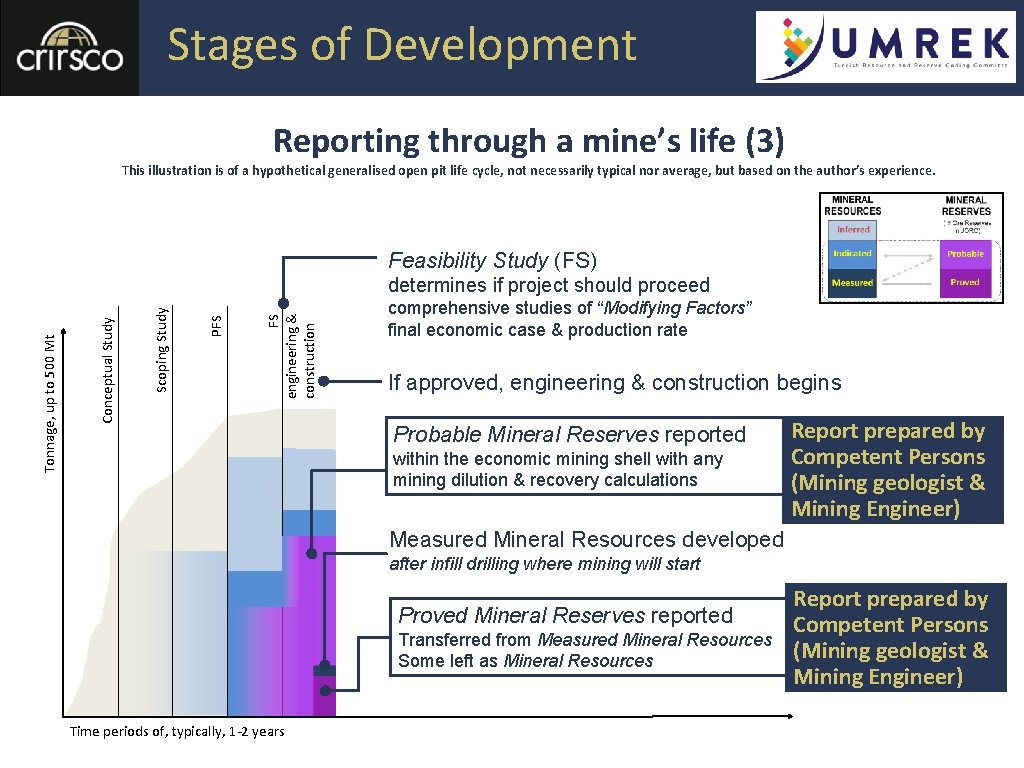
Stages of Development Reporting through a mine’s life (3) This illustration is of a hypothetical generalised open pit life cycle, not necessarily typical nor average, but based on the author’s experience. Feasibility Study (FS) comprehensive studies of “Modifying Factors” final economic case & production rate Closure Full production FS engineering & construction PFS Scoping Study Conceptual Study Tonnage, up to 500 Mt determines if project should proceed If approved, engineering & construction begins Probable Mineral Reserves reported within the economic mining shell with any mining dilution & recovery calculations Report prepared by Competent Persons (Mining geologist & Mining Engineer) Measured Mineral Resources developed after infill drilling where mining will start Proved Mineral Reserves reported Transferred from Measured Mineral Resources Some left as Mineral Resources Time periods of, typically, 1 -2 years Report prepared by Competent Persons (Mining geologist & Mining Engineer)
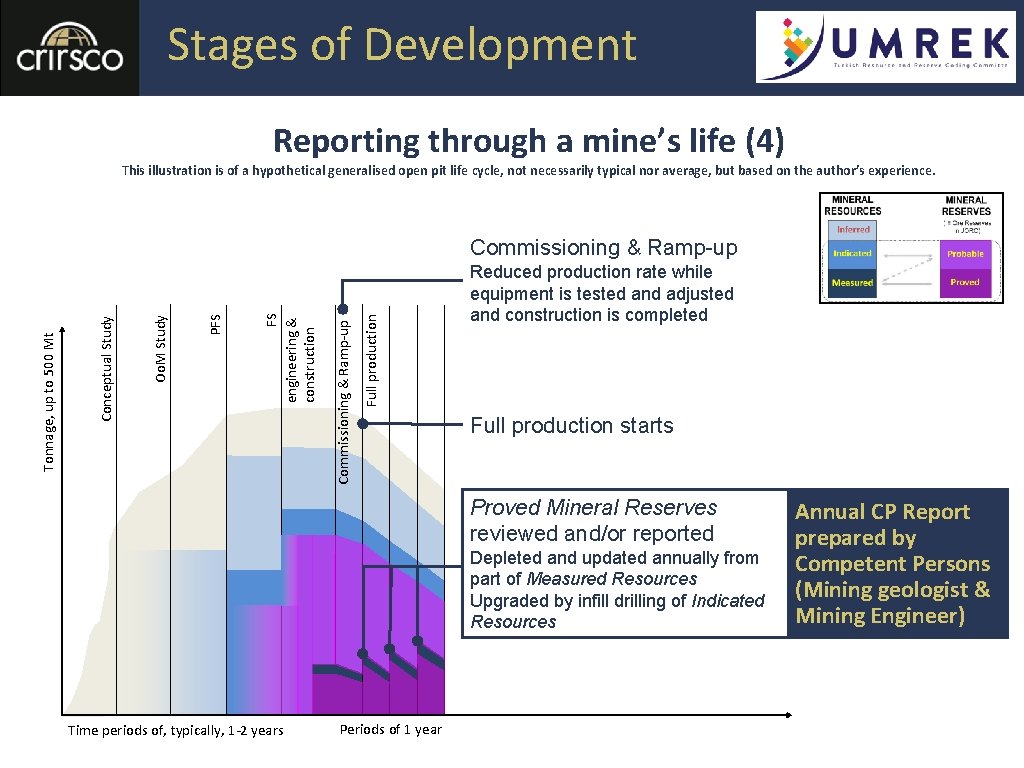
Stages of Development Reporting through a mine’s life (4) This illustration is of a hypothetical generalised open pit life cycle, not necessarily typical nor average, but based on the author’s experience. Reduced production rate while equipment is tested and adjusted and construction is completed Full production starts Proved Mineral Reserves reviewed and/or reported Depleted and updated annually from part of Measured Resources Upgraded by infill drilling of Indicated Resources Time periods of, typically, 1 -2 years Periods of 1 year Closure Full production Commissioning & Ramp-up FS engineering & construction PFS Oo. M Study Conceptual Study Tonnage, up to 500 Mt Commissioning & Ramp-up Annual CP Report prepared by Competent Persons (Mining geologist & Mining Engineer)
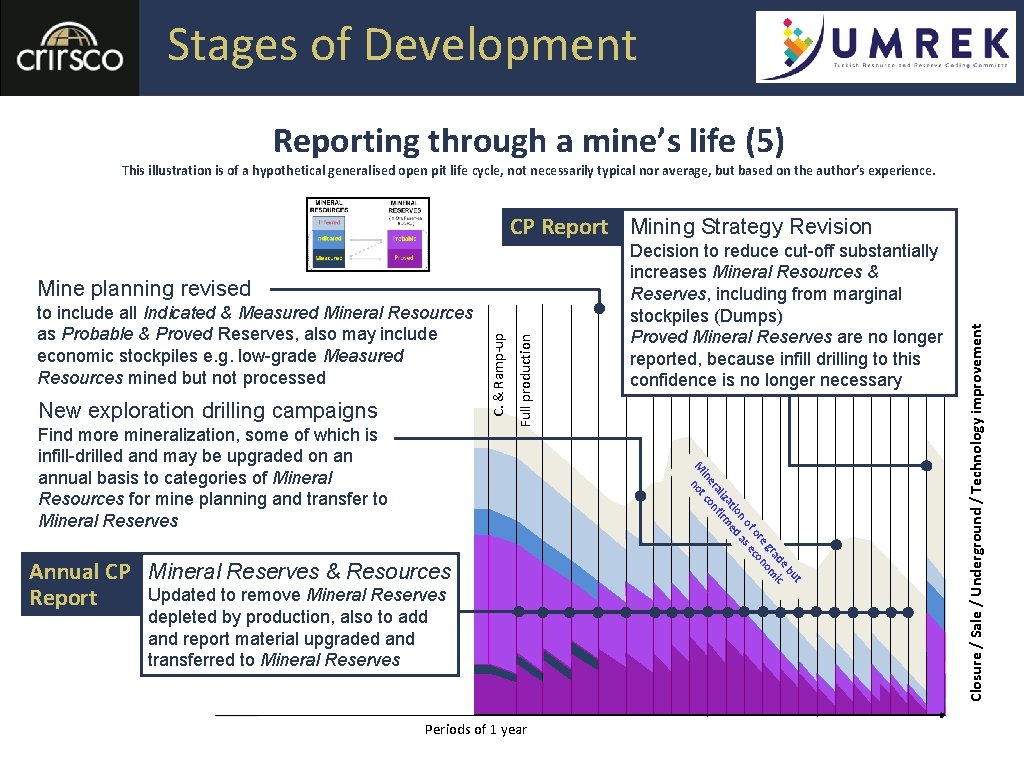
Stages of Development Reporting through a mine’s life (5) This illustration is of a hypothetical generalised open pit life cycle, not necessarily typical nor average, but based on the author’s experience. t bu de c ra mi e g no or co of as e n tio ed za m ali nfir er in co M not Find more mineralization, some of which is infill-drilled and may be upgraded on an annual basis to categories of Mineral Resources for mine planning and transfer to Mineral Reserves Full production New exploration drilling campaigns FS engineering & construction PFS Oo. M Study Conceptual Study Tonnage, up to 500 Mt to include all Indicated & Measured Mineral Resources as Probable & Proved Reserves, also may include economic stockpiles e. g. low-grade Measured Resources mined but not processed C. & Ramp-up Mine planning revised Decision to reduce cut-off substantially increases Mineral Resources & Reserves, including from marginal stockpiles (Dumps) Proved Mineral Reserves are no longer reported, because infill drilling to this confidence is no longer necessary Annual CP Mineral Reserves & Resources Updated to remove Mineral Reserves Report depleted by production, also to add and report material upgraded and transferred to Mineral Reserves Periods of 1 year Closure / Sale / Underground / Technology improvement CP Report Mining Strategy Revision
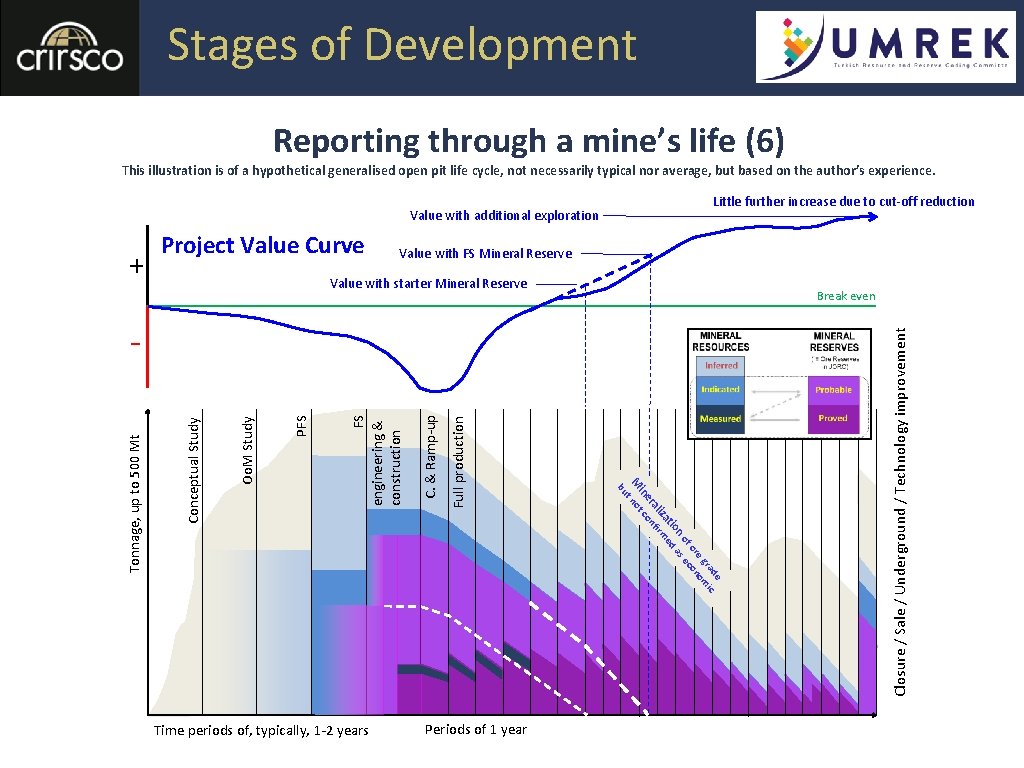
Stages of Development Reporting through a mine’s life (6) This illustration is of a hypothetical generalised open pit life cycle, not necessarily typical nor average, but based on the author’s experience. Little further increase due to cut-off reduction Value with additional exploration Value with FS Mineral Reserve Value with starter Mineral Reserve C. & Ramp-up PFS Oo. M Study FS engineering & construction b Conceptual Study Break even de ra ic e g om or on of s ec Time periods of, typically, 1 -2 years Periods of 1 year Closure / Sale / Underground / Technology improvement Break even n a tio d za me ali fir er on in c M t not u Tonnage, up to 500 Mt - Full production + Project Value Curve
Teşekkürler