
Trenching Competent Person BLRBusiness Legal Resources 1408 What
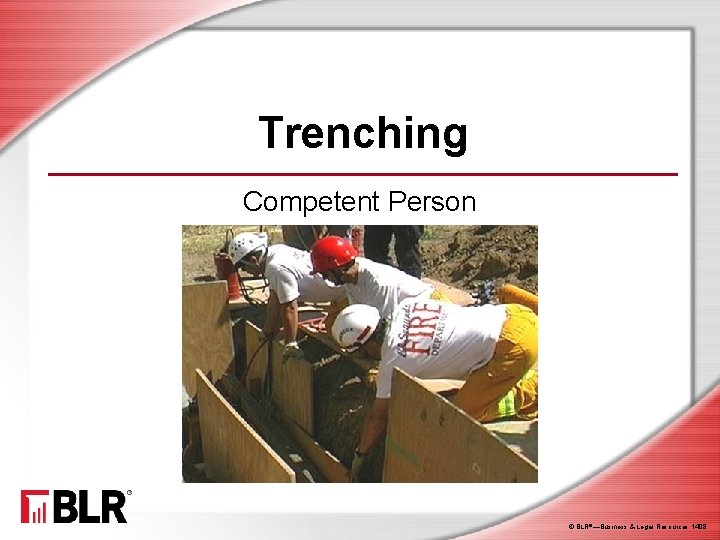
Trenching Competent Person © BLR®—Business & Legal Resources 1408
What Is a Competent Person? • Identifies trench hazards • Is authorized to take prompt corrective measures to eliminate hazards • Is responsible for daily trenching inspections • Is knowledgeable about soils, protective systems, and OSHA rules • Determines which protective systems to use © BLR®—Business & Legal Resources 1408
Session Objectives As a “competent person, ” you will be able to: Recognize trenching hazards Choose protective systems for trenches Identify hazards and preventive measures for activities associated with excavation © BLR®—Business & Legal Resources 1408
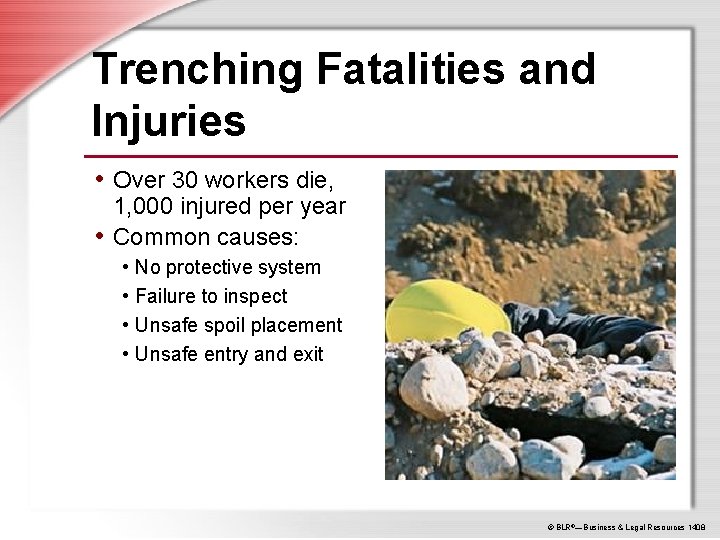
Trenching Fatalities and Injuries • Over 30 workers die, 1, 000 injured per year • Common causes: • No protective system • Failure to inspect • Unsafe spoil placement • Unsafe entry and exit © BLR®—Business & Legal Resources 1408
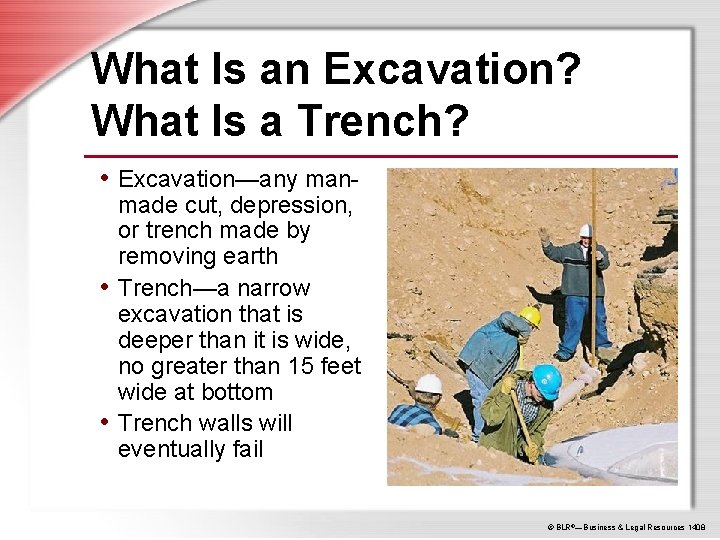
What Is an Excavation? What Is a Trench? • Excavation—any man- made cut, depression, or trench made by removing earth • Trench—a narrow excavation that is deeper than it is wide, no greater than 15 feet wide at bottom • Trench walls will eventually fail © BLR®—Business & Legal Resources 1408
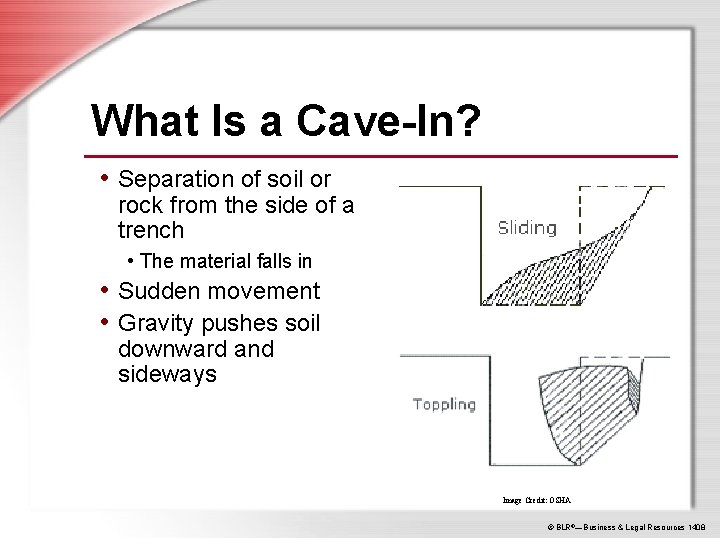
What Is a Cave-In? • Separation of soil or rock from the side of a trench • The material falls in • Sudden movement • Gravity pushes soil downward and sideways Image Credit: OSHA © BLR®—Business & Legal Resources 1408
Consequences of a Cave-In • Soil is dense and heavy • Cave-ins can entrap, bury, injure, or immobilize • Suffocation—soil prevents chest expansion • The worker becomes immobilized © BLR®—Business & Legal Resources 1408
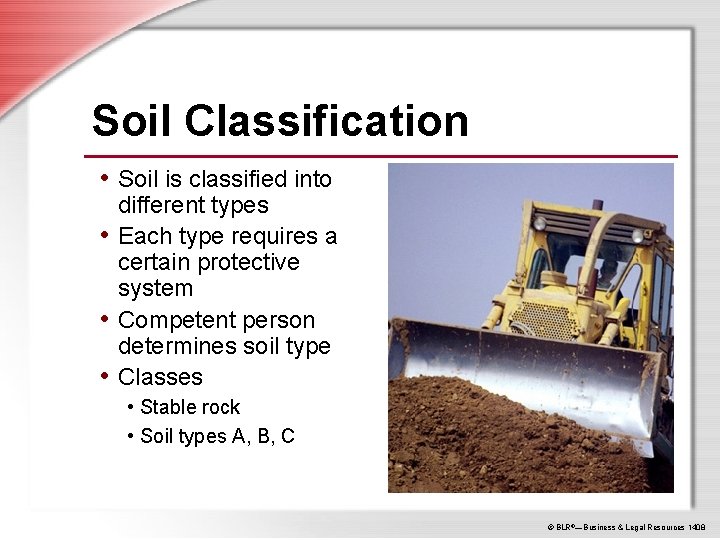
Soil Classification • Soil is classified into different types • Each type requires a certain protective system • Competent person determines soil type • Classes • Stable rock • Soil types A, B, C © BLR®—Business & Legal Resources 1408
Soil Stability • Grain size—small is better • Water saturation • Cohesiveness—how well soil sticks together • Unconfined compressive strength (UCS)— how easily the soil will shear © BLR®—Business & Legal Resources 1408
Soil Types—Type A • The most stable soil type • Cohesive soil with a UCS of 1. 5 tons per square foot (tsf) or more • Cohesive soil that is predominantly clay • Not fissured or subject to vibrations • Not previously excavated or disturbed © BLR®—Business & Legal Resources 1408
Soil Types—Type B • Cohesive soil with a UCS >0. 5 but <1. 5 tsf • Granular, cohesionless soil • Previously disturbed soils except those which would otherwise be classified as Type C soil • An “A” soil that is fissured or subject to vibration • Dry rock that is not stable © BLR®—Business & Legal Resources 1408
Soil Types—Type C • Cohesive soil with a UCS of less than 0. 5 tsf • Granular soil, including gravels and sand • Submerged soil or soil with seeping water • Unstable submerged rock • Sloped, layered system of material • Steeply sloped material © BLR®—Business & Legal Resources 1408
Soil Tests • Plasticity Test • Dry Strength Test • Thumb Penetration Test • Pocket Penetrometer and Shear Vane Tests © BLR®—Business & Legal Resources 1408
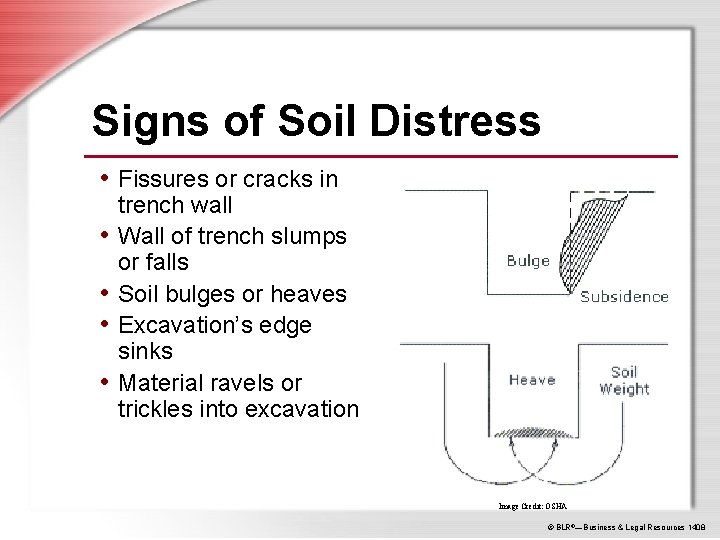
Signs of Soil Distress • Fissures or cracks in • • trench wall Wall of trench slumps or falls Soil bulges or heaves Excavation’s edge sinks Material ravels or trickles into excavation Image Credit: OSHA © BLR®—Business & Legal Resources 1408
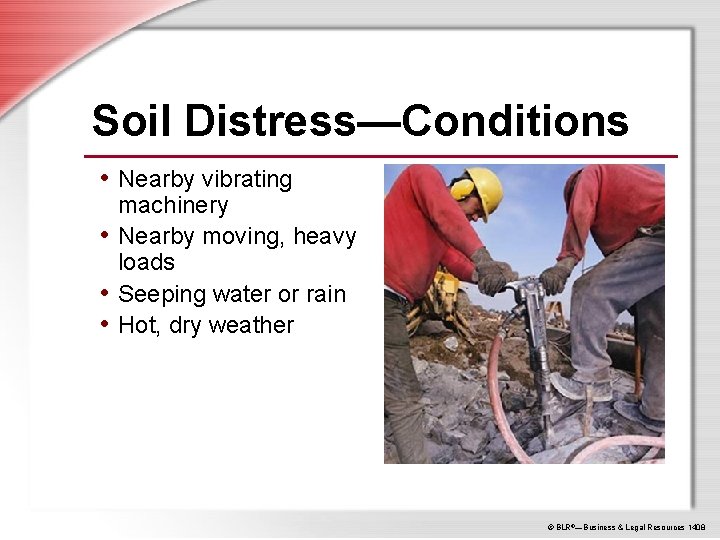
Soil Distress—Conditions • Nearby vibrating machinery • Nearby moving, heavy loads • Seeping water or rain • Hot, dry weather © BLR®—Business & Legal Resources 1408
Trenching Hazards Do you understand: • Specific trenching hazards? • Cave-ins? • Hazards related to soil types? © BLR®—Business & Legal Resources 1408

Trench Protective Systems • Sloping and benching • Shoring • Shielding Temporary Spoil 2 Feet Minimum Image Credit: OSHA © BLR®—Business & Legal Resources 1408
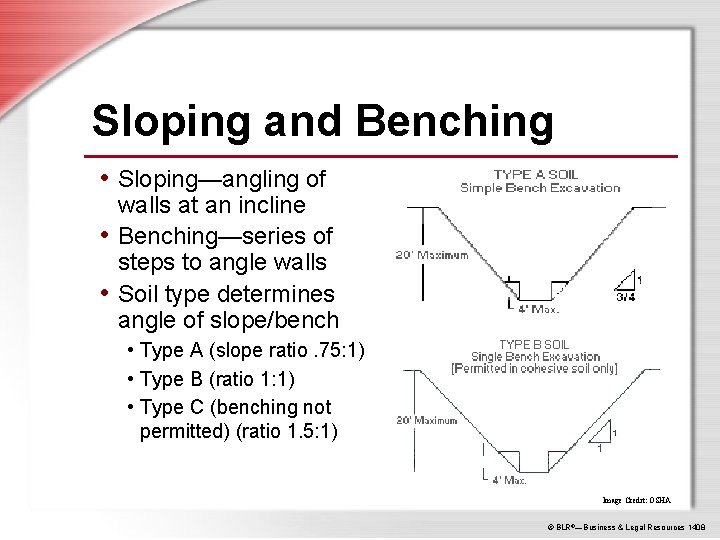
Sloping and Benching • Sloping—angling of walls at an incline • Benching—series of steps to angle walls • Soil type determines angle of slope/bench • Type A (slope ratio. 75: 1) • Type B (ratio 1: 1) • Type C (benching not permitted) (ratio 1. 5: 1) Image Credit: OSHA © BLR®—Business & Legal Resources 1408
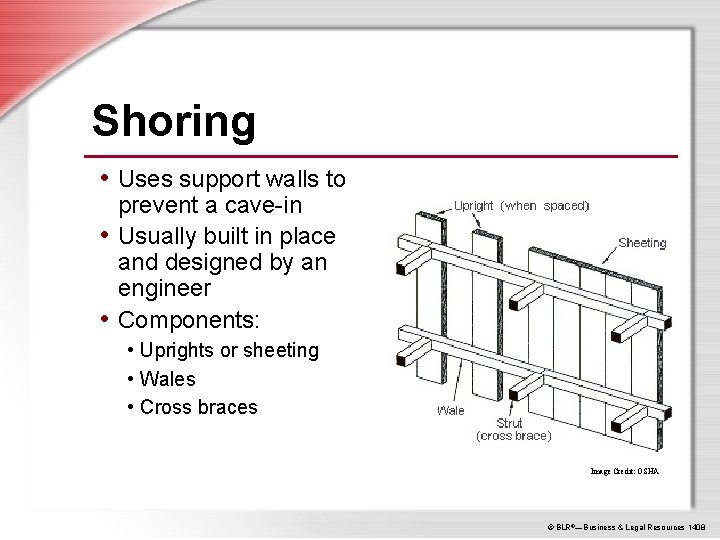
Shoring • Uses support walls to prevent a cave-in • Usually built in place and designed by an engineer • Components: • Uprights or sheeting • Wales • Cross braces Image Credit: OSHA © BLR®—Business & Legal Resources 1408
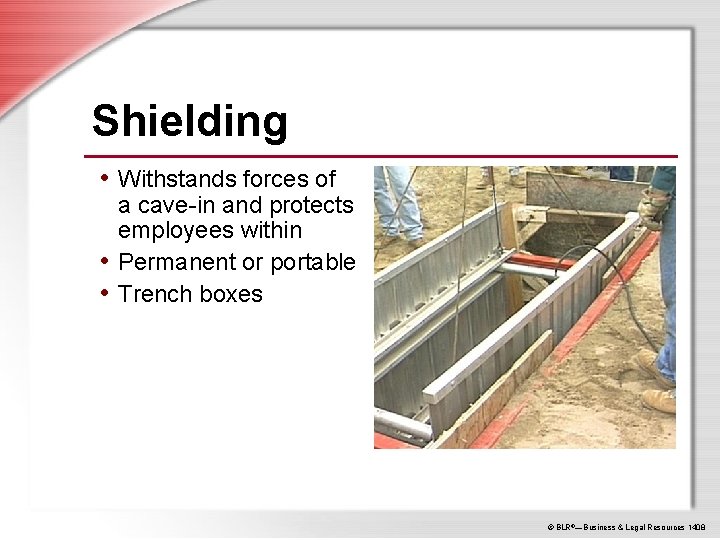
Shielding • Withstands forces of a cave-in and protects employees within • Permanent or portable • Trench boxes © BLR®—Business & Legal Resources 1408
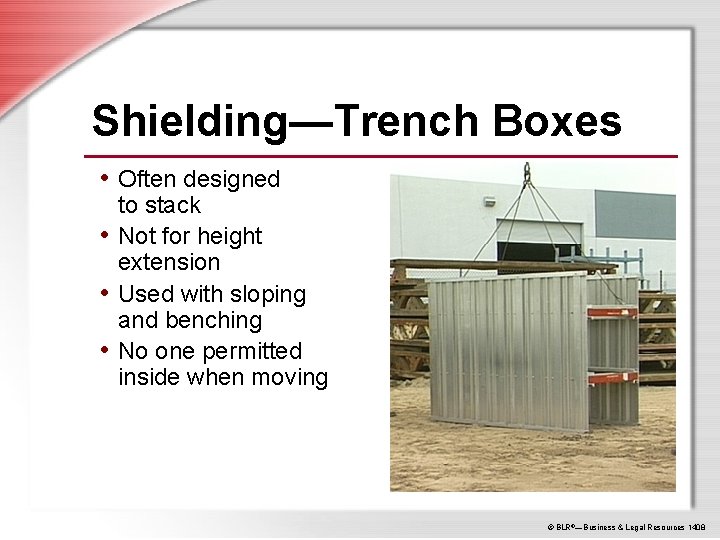
Shielding—Trench Boxes • Often designed to stack • Not for height extension • Used with sloping and benching • No one permitted inside when moving © BLR®—Business & Legal Resources 1408
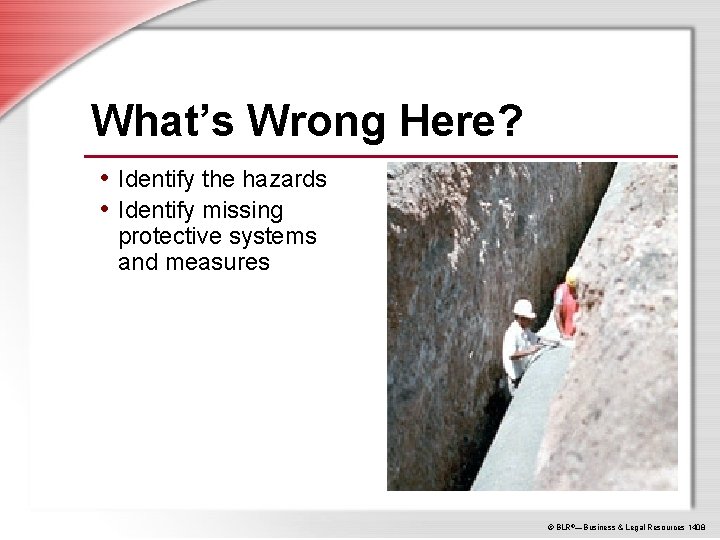
What’s Wrong Here? • Identify the hazards • Identify missing protective systems and measures Osha. gov © BLR®—Business & Legal Resources 1408
Trench Protective Systems Do you understand trenching hazards? • The types of soil? • The types of protective systems? © BLR®—Business & Legal Resources 1408
Hazardous Atmospheres At excavations near sewers, landfills, and other potentially hazardous atmospheres: • Test atmosphere • Ventilate • Use appropriate PPE • Maintain rescue and emergency equipment on-site © BLR®—Business & Legal Resources 1408
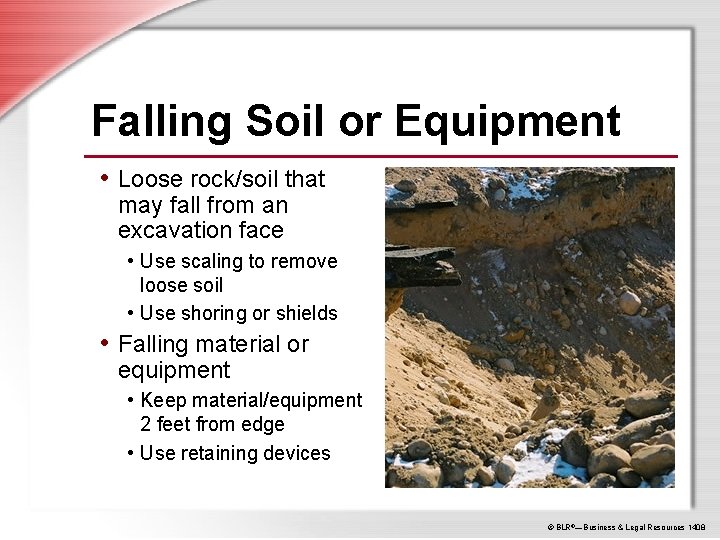
Falling Soil or Equipment • Loose rock/soil that may fall from an excavation face • Use scaling to remove loose soil • Use shoring or shields • Falling material or equipment • Keep material/equipment 2 feet from edge • Use retaining devices © BLR®—Business & Legal Resources 1408
Adjacent Structures • Excavations might endanger stability of buildings, walls, and other structures • Sidewalks and pavements must not be undermined unless supported to prevent collapse onto excavation workers • Use shoring, bracing, or underpinning to ensure stability of nearby structures © BLR®—Business & Legal Resources 1408
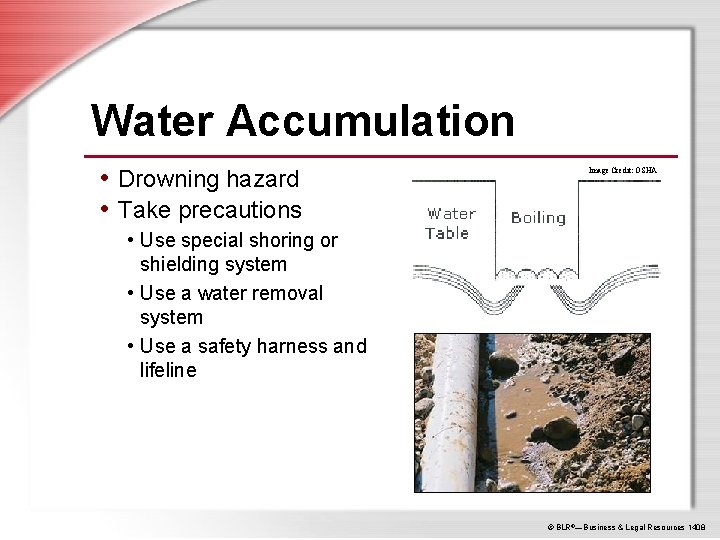
Water Accumulation • Drowning hazard • Take precautions Image Credit: OSHA • Use special shoring or shielding system • Use a water removal system • Use a safety harness and lifeline © BLR®—Business & Legal Resources 1408
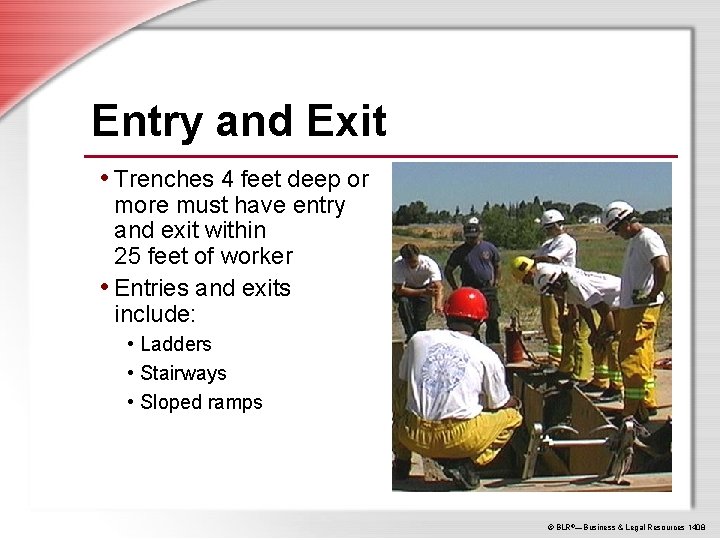
Entry and Exit • Trenches 4 feet deep or more must have entry and exit within 25 feet of worker • Entries and exits include: • Ladders • Stairways • Sloped ramps © BLR®—Business & Legal Resources 1408
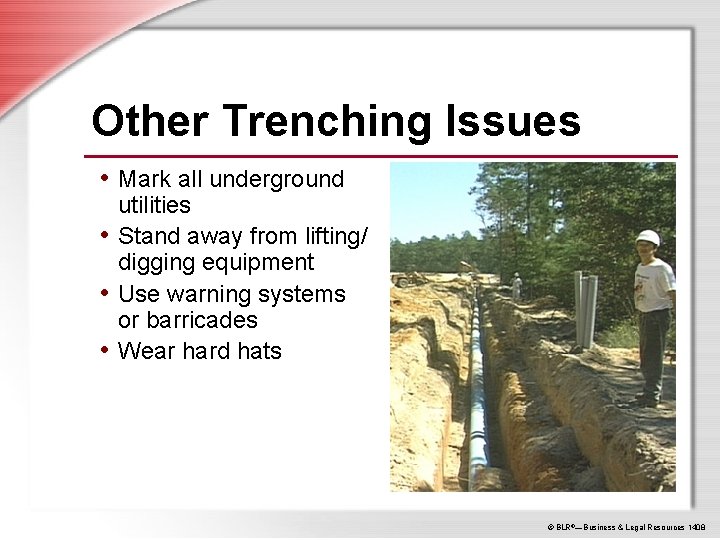
Other Trenching Issues • Mark all underground utilities • Stand away from lifting/ digging equipment • Use warning systems or barricades • Wear hard hats © BLR®—Business & Legal Resources 1408
Other Trenching Issues (cont. ) • Use fall protection systems • No work above other workers • Monitor excavation work © BLR®—Business & Legal Resources 1408
Trench Inspections • Inspect before work starts, throughout shift, and after rainstorms • Inspect for: • Evidence of possible cave-ins • Indications of failure of protective systems • Potential hazardous atmospheres • Remove workers if a hazardous condition exists © BLR®—Business & Legal Resources 1408
Key Points to Remember Be aware of all the hazards associated with working around trenches. Cave-ins occur suddenly and can entrap, bury, or injure. Always use protection systems. © BLR®—Business & Legal Resources 1408
- Slides: 32