Role of government in promoting technology development Sanjaya
- Slides: 27
Role of government in promoting technology development Sanjaya Lall Oxford University sanjaya. lall@economics. ox. ac. uk
Why do developing countries need government policy for technology development ? üUsual case for technology policy in economics is to remedy market failures due to externalities (under-investment in R&D), public goods (basic research, standards), information and scale problems (SME support) üThis requires generic ‘market friendly’ policies üThis is useful but inadequate for developing countries: selective policies are also required to overcome problems of multiple growth paths üChoosing feasible path requires ‘vision’ üImplementing it needs government capabilities
Technology market failures in developing countries is due to ‘tacitness’ of knowledge üLatecomers cannot import & use existing technology efficiently by simply opening up to technology inflows üTacit nature of technology means local learning is essential, and this is not trivial process üLearning faces market failures at 3 levels: Ø In-firm mastery: cost, uncertainty, duration, lack of information and unpredictability (infant industry) Ø Inter-firm interaction and externalities: coordination and collective action Ø Deficient factor markets and institutions: coordination and development of basic endowments
Learning is cumulative and pathdependent üEach country has a unique learning path, with complex economic and social interactions, feedback and disturbances üTechnology literature uses ‘national innovation system’, NIS, to capture individual structural (systemic) features of each country ü‘NIS’ is mainly applied to industrial countries, but it applies equally to developing countries üNational system are difficult but not impossible to change: need country specific & constantly evolving policies
Features of ‘ideal’ technology policy üUse globalization effectively: This may mean more ‘openness’ but not Ø Access new technologies promptly necessarily non-selective (neoliberal) policies on Ø Attract other mobile resources trade, FDI, skills R&D or finance Ø Enter integrated production systems Ø Link local value chains to global chains Ø Upgrade technologies and functions in value chains üBuild local capabilities to exploit globalization Ø Attract high value mobile resources Ø Build domestic skills & technological capabilities to handle dynamic activities and technologies Ø Develop strong local clusters capable of competing in global value chains
There are important choices on mode of accessing foreign technology over time. . . üHeavy dependence on internalised modes (FDI) provides rapid and efficient access to operating know-how, skills and global markets üBut it may not lead to upgrading of functions beyond those based on existing skills üAnd it may not lead to the rapid development of innovative capabilities üTo build innovative capabilities, it is necessary to Ø Either restrict FDI and promote local firms and R&D Ø Or to induce MNCs to deepen technological activity, by incentives, skill development and R&D capabilities
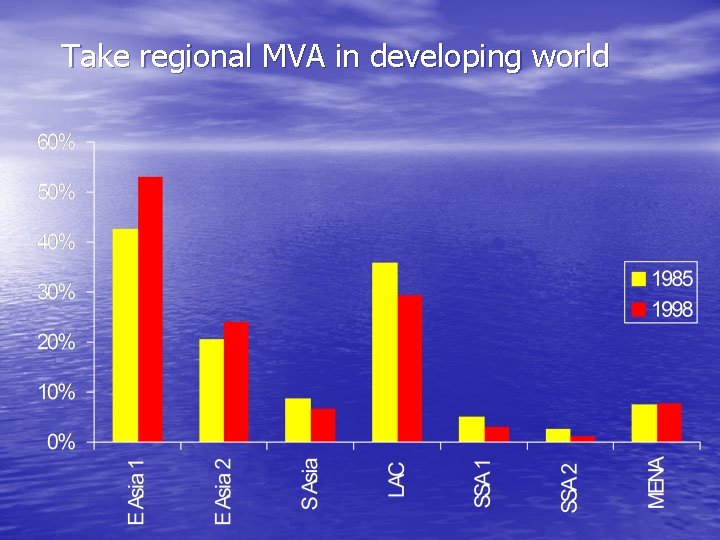
Why are the policies of Asian Tigers of interest? üAt the start of the current era of economic development (post II World War) East Asia was much poorer than Latin America, with a less developed industrial sector üMany Asian countries were also resource rich üMost also embarked on import-substituting industrialization policies üThey had better macro management but more political strife, wars, ethnic problems and so on üBut they were far more successful in sustaining high growth than Latin America
Take regional MVA in developing world
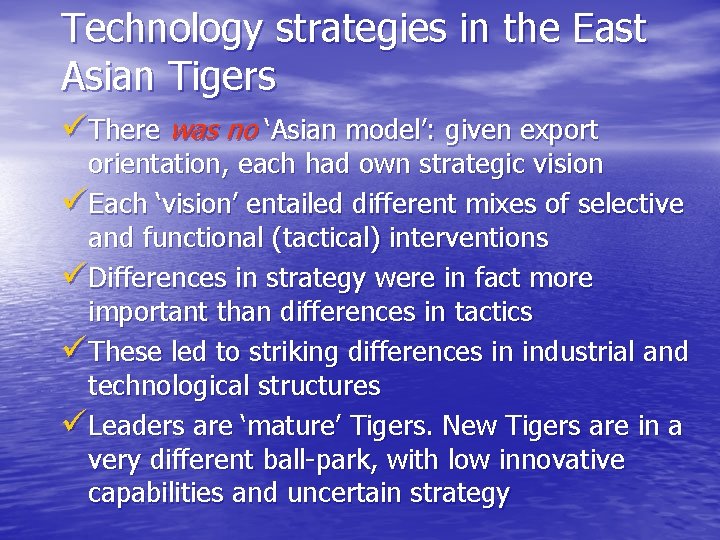
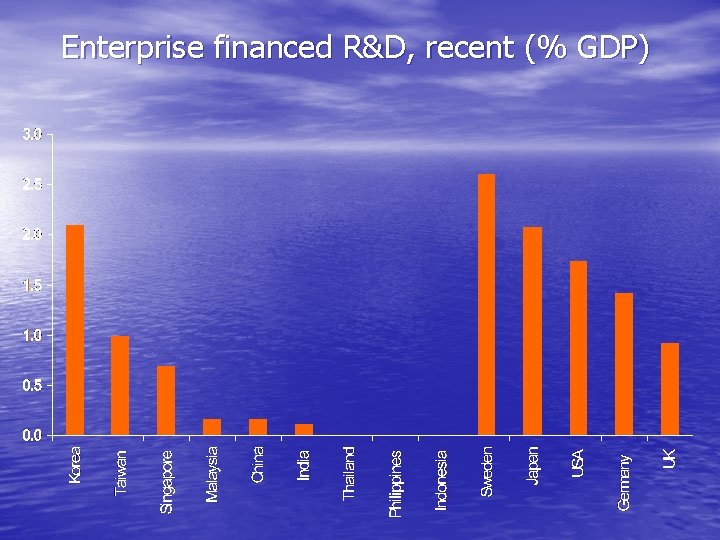
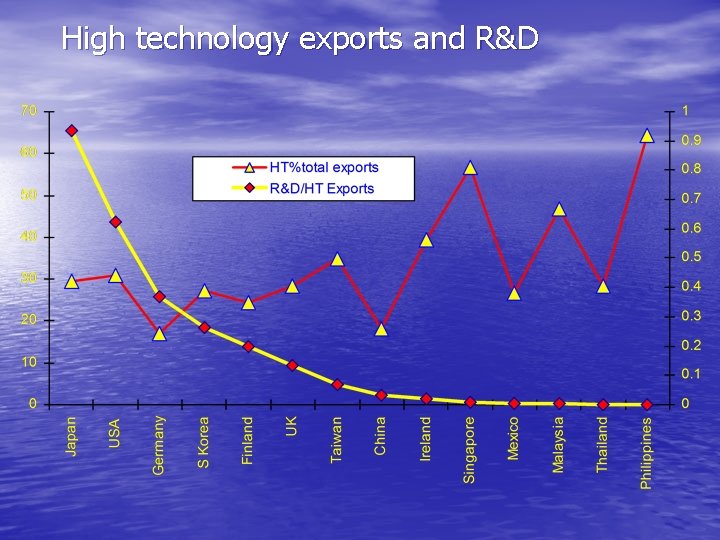
Technology strategies in the East Asian Tigers üThere was no ‘Asian model’: given export orientation, each had own strategic vision üEach ‘vision’ entailed different mixes of selective and functional (tactical) interventions üDifferences in strategy were in fact more important than differences in tactics üThese led to striking differences in industrial and technological structures üLeaders are ‘mature’ Tigers. New Tigers are in a very different ball-park, with low innovative capabilities and uncertain strategy
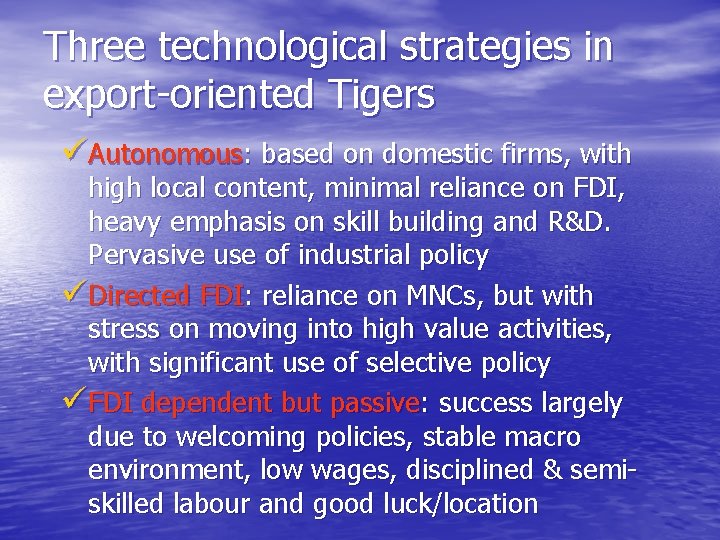
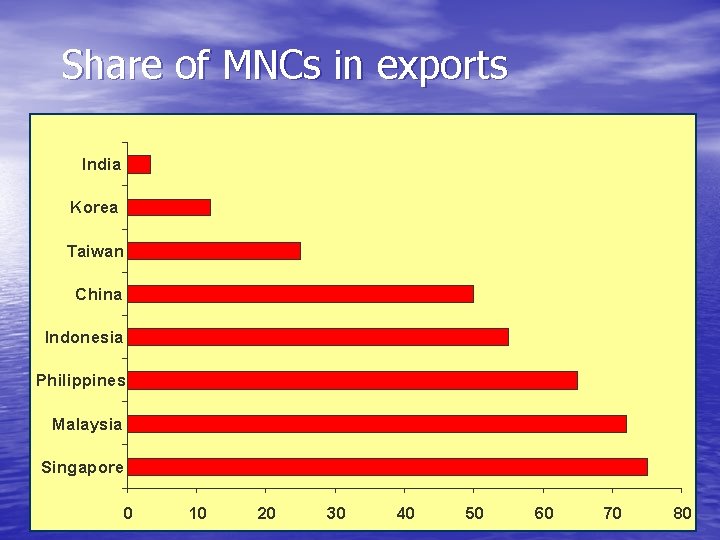
Three technological strategies in export-oriented Tigers üAutonomous: based on domestic firms, with high local content, minimal reliance on FDI, heavy emphasis on skill building and R&D. Pervasive use of industrial policy üDirected FDI: reliance on MNCs, but with stress on moving into high value activities, with significant use of selective policy üFDI dependent but passive: success largely due to welcoming policies, stable macro environment, low wages, disciplined & semiskilled labour and good luck/location
Share of MNCs in exports India Korea Taiwan China Indonesia Philippines Malaysia Singapore 0 10 20 30 40 50 60 70 80
Enterprise financed R&D, recent (% GDP)
High technology exports and R&D
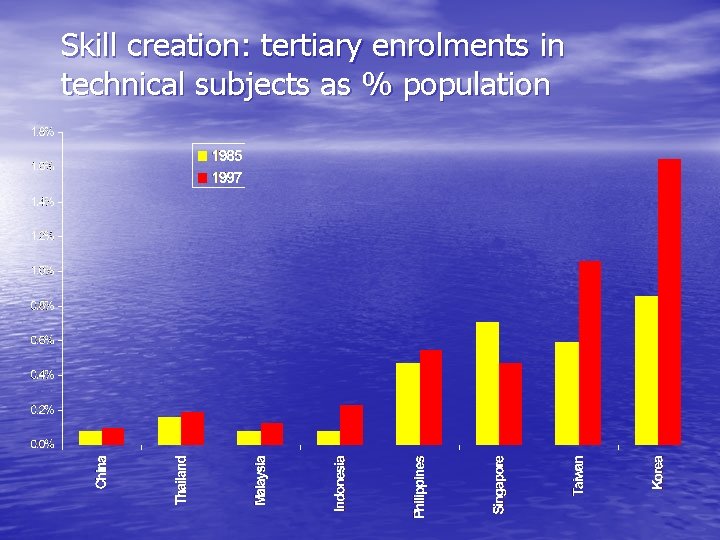
Skill creation: tertiary enrolments in technical subjects as % population
Strategic differences: cluster analysis of 1995 RCAs in hightech exports, with R&D and FDI
Now let us consider country strategies for industrial technology development. . .
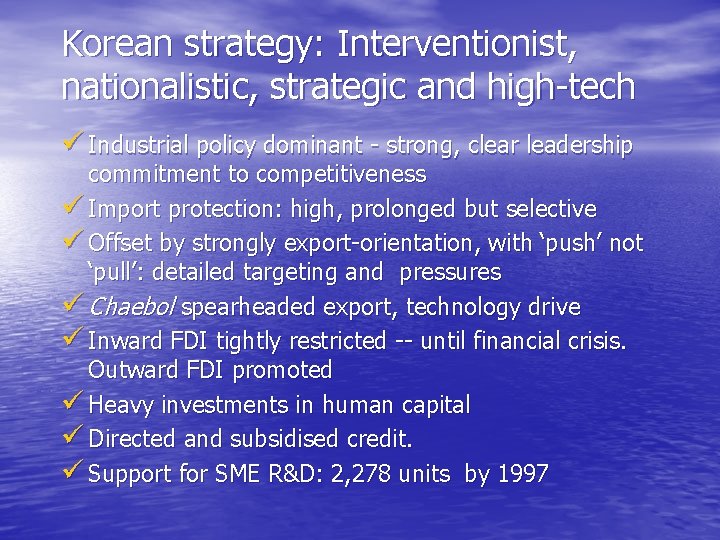
Korean strategy: Interventionist, nationalistic, strategic and high-tech ü Industrial policy dominant - strong, clear leadership commitment to competitiveness ü Import protection: high, prolonged but selective ü Offset by strongly export-orientation, with ‘push’ not ‘pull’: detailed targeting and pressures ü Chaebol spearheaded export, technology drive ü Inward FDI tightly restricted -- until financial crisis. Outward FDI promoted ü Heavy investments in human capital ü Directed and subsidised credit. ü Support for SME R&D: 2, 278 units by 1997
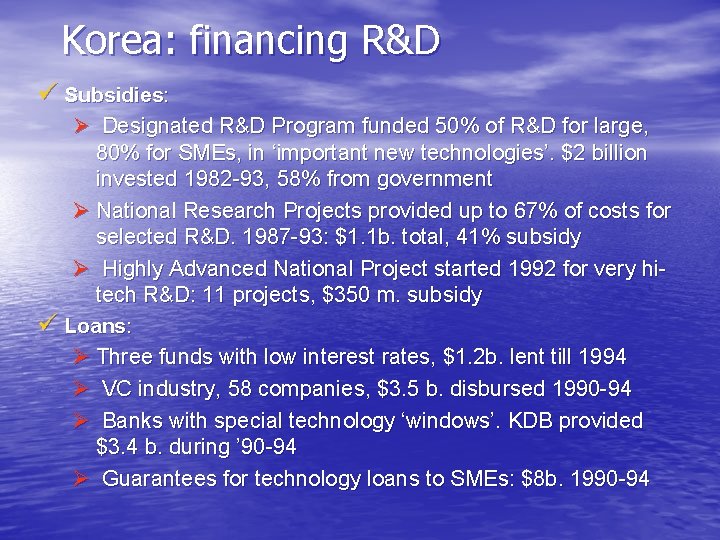
Korea: financing R&D ü Subsidies: Ø Designated R&D Program funded 50% of R&D for large, 80% for SMEs, in ‘important new technologies’. $2 billion invested 1982 -93, 58% from government Ø National Research Projects provided up to 67% of costs for selected R&D. 1987 -93: $1. 1 b. total, 41% subsidy Ø Highly Advanced National Project started 1992 for very hitech R&D: 11 projects, $350 m. subsidy ü Loans: Ø Three funds with low interest rates, $1. 2 b. lent till 1994 Ø VC industry, 58 companies, $3. 5 b. disbursed 1990 -94 Ø Banks with special technology ‘windows’. KDB provided $3. 4 b. during ’ 90 -94 Ø Guarantees for technology loans to SMEs: $8 b. 1990 -94
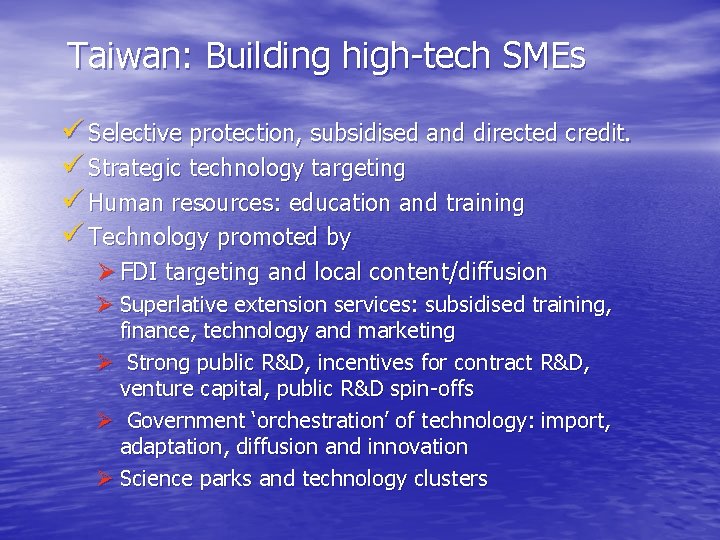
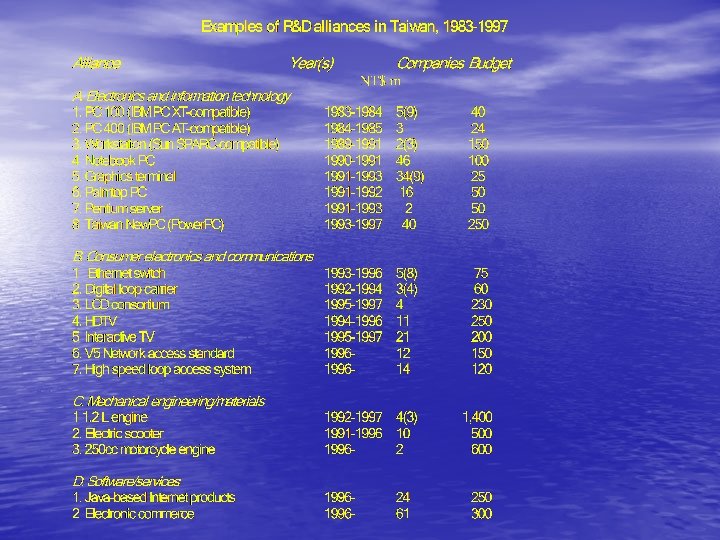
Taiwan: Building high-tech SMEs ü Selective protection, subsidised and directed credit. ü Strategic technology targeting ü Human resources: education and training ü Technology promoted by Ø FDI targeting and local content/diffusion Ø Superlative extension services: subsidised training, finance, technology and marketing Ø Strong public R&D, incentives for contract R&D, venture capital, public R&D spin-offs Ø Government ‘orchestration’ of technology: import, adaptation, diffusion and innovation Ø Science parks and technology clusters
‘Linking, leveraging and learning’ in Taiwan: Innovation consortia as leveraging tool IBM unveiled its new Power. PC microprocessor, a product made by IBM, Motorola and Apple, in New York in June 1995. It was followed one day later by the unveiling in Taipei of Power. PC based products by a group of 30 firms from Taiwan. The Taiwanese firms had not done this on their own. They were part of an innovation alliance, the Taiwan New PC Consortium formed by a government research institution, the Computing and Communications Laboratory (CCL), set up in 1993 to bring together firms from all parts of the IT industry in Taiwan. Its purpose was to transfer, master and diffuse the new Power. PC technology over the whole range of products from PCs and peripherals to software and multimedia applications as well as to semiconductor manufacturers. The firms involved were relatively small by international standards, and CCL brought them together and negotiated on their behalf with IBM and Motorola. John Mathews
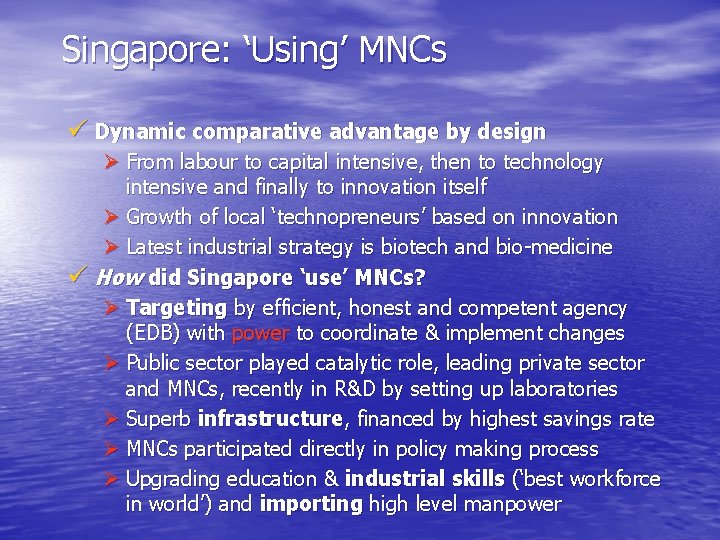
Singapore: ‘Using’ MNCs ü Dynamic comparative advantage by design Ø From labour to capital intensive, then to technology intensive and finally to innovation itself Ø Growth of local ‘technopreneurs’ based on innovation Ø Latest industrial strategy is biotech and bio-medicine ü How did Singapore ‘use’ MNCs? Ø Targeting by efficient, honest and competent agency (EDB) with power to coordinate & implement changes Ø Public sector played catalytic role, leading private sector and MNCs, recently in R&D by setting up laboratories Ø Superb infrastructure, financed by highest savings rate Ø MNCs participated directly in policy making process Ø Upgrading education & industrial skills (‘best workforce in world’) and importing high level manpower
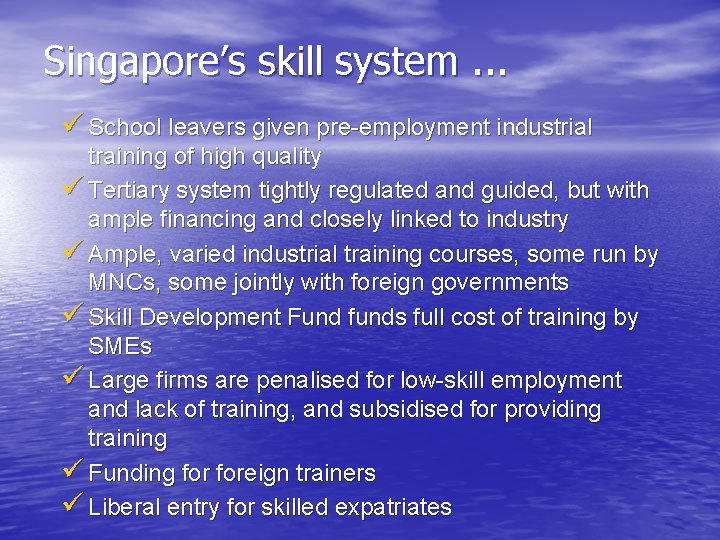
Singapore’s skill system. . . ü School leavers given pre-employment industrial training of high quality ü Tertiary system tightly regulated and guided, but with ample financing and closely linked to industry ü Ample, varied industrial training courses, some run by MNCs, some jointly with foreign governments ü Skill Development Fund funds full cost of training by SMEs ü Large firms are penalised for low-skill employment and lack of training, and subsidised for providing training ü Funding foreign trainers ü Liberal entry for skilled expatriates
Hong Kong: Nearly Laissez Faire ü Interventions for SME upgrading and export marketing; land subsidies for manufacturing ü Unique initial advantages: Hongs, entrepôt experience, financial and physical infrastructure, influx of skills from Mainland China ü High initial export growth, but lack of deepening forced industry to relocate ü Manufacturing and export growth now negative: only Asian Tiger to go into industrial decline ü Some late attempts at technology promotion ü Growth based on servicing China -- but Shanghai taking over important functions ü Few lessons for other countries in technology policy
New Tigers: Malaysia, Thailand, Indonesia and the Philippines üWeak skills and technology, but Philippines is best in skills and Malaysia in R&D üDomestic entrepreneurship (led by Chinese) is weakest in Malaysia and strongest in Thailand üActive industrial policy in domestic oriented sectors, but not advanced capabilities üHigh-tech strategies in Malaysia and Indonesia not successful üFacing severe competitive threat from China üMoving to FDI targeting, but lack authority of IPA to design and implement strategy
Conclusions üTechnology policy has taken very different forms in Asian Tigers üKorea and Taiwan have strong domestic innovative bases, with skills & institutions to cope with technical change and new competitive challenges (though China will be major threat as it upgrades) üSingapore is building technology base, but remains vulnerable to external forces
üNew Tigers have to match domestic skills and technological capabilities to high technology export structures. If they cannot they will be extremely vulnerable to new competition, especially from China üPolicies are converging: Autonomous ones are now more open and market oriented. Passive FDI strategies are becoming more targeted. And all countries are trying to build local capabilities, enterprises and innovation systems. üBut history matters -- there will not be rapid convergence