Revolutionary Aerospace System Concepts Human Outer Planet Exploration



- Slides: 26
Revolutionary Aerospace System Concepts Human Outer Planet Exploration FY 02 – Concept Catalog NASA Design Team January 31, 2003 RASC / HOPE Transportation 1
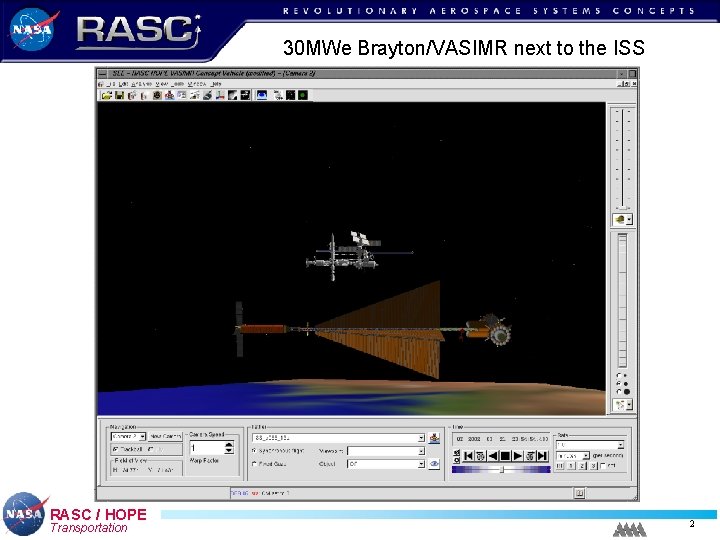
30 MWe Brayton/VASIMR next to the ISS RASC / HOPE Transportation 2
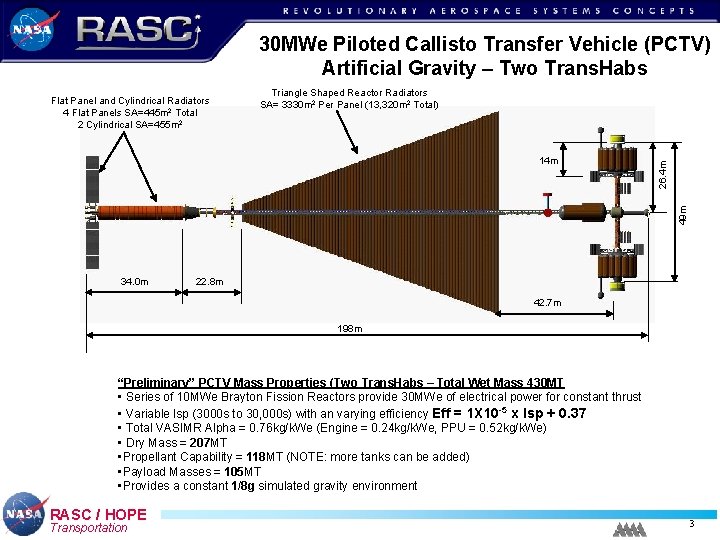
30 MWe Piloted Callisto Transfer Vehicle (PCTV) Artificial Gravity – Two Trans. Habs Triangle Shaped Reactor Radiators SA= 3330 m 2 Per Panel (13, 320 m 2 Total) 49 m 14 m 26. 4 m Flat Panel and Cylindrical Radiators 4 Flat Panels SA=445 m 2 Total 2 Cylindrical SA=455 m 2 34. 0 m 22. 8 m 42. 7 m 198 m “Preliminary” PCTV Mass Properties (Two Trans. Habs – Total Wet Mass 430 MT • Series of 10 MWe Brayton Fission Reactors provide 30 MWe of electrical power for constant thrust • Variable Isp (3000 s to 30, 000 s) with an varying efficiency Eff = 1 X 10 -5 x Isp + 0. 37 • Total VASIMR Alpha = 0. 76 kg/k. We (Engine = 0. 24 kg/k. We, PPU = 0. 52 kg/k. We) • Dry Mass = 207 MT • Propellant Capability = 118 MT (NOTE: more tanks can be added) • Payload Masses = 105 MT • Provides a constant 1/8 g simulated gravity environment RASC / HOPE Transportation 3
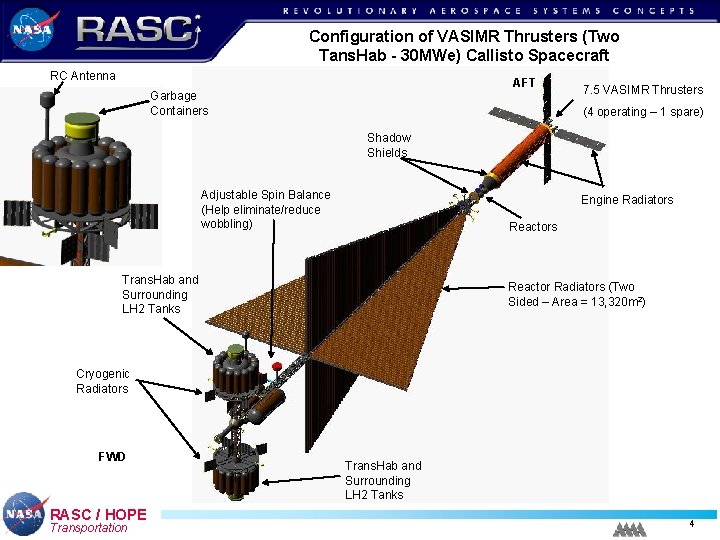
Configuration of VASIMR Thrusters (Two Tans. Hab - 30 MWe) Callisto Spacecraft RC Antenna AFT Garbage Containers 7. 5 VASIMR Thrusters (4 operating – 1 spare) Shadow Shields Adjustable Spin Balance (Help eliminate/reduce wobbling) Engine Radiators Reactors Trans. Hab and Surrounding LH 2 Tanks Reactor Radiators (Two Sided – Area = 13, 320 m 2) Cryogenic Radiators FWD RASC / HOPE Transportation Trans. Hab and Surrounding LH 2 Tanks 4
Configuration of 30 MWe VASIMR Cargo Spacecraft Same Configuration as Piloted Ship IRSU Assembly Surface. Hab Tanker Section (189 MT LH 2) ction Se Cargo Lander “Preliminary” PCTV Mass Properties (Cargo) – Total Wet Mass = 506 MT • Dry Mass = 185 MT • Propellant Capability = 83 MT • Payload Masses = 238 MT (118 MT is return fuel) RASC / HOPE Transportation 5
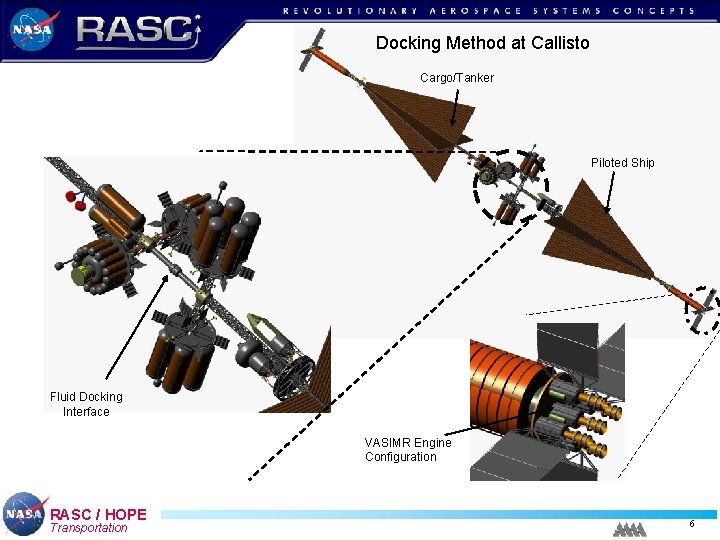
Docking Method at Callisto Cargo/Tanker Piloted Ship Fluid Docking Interface VASIMR Engine Configuration RASC / HOPE Transportation 6
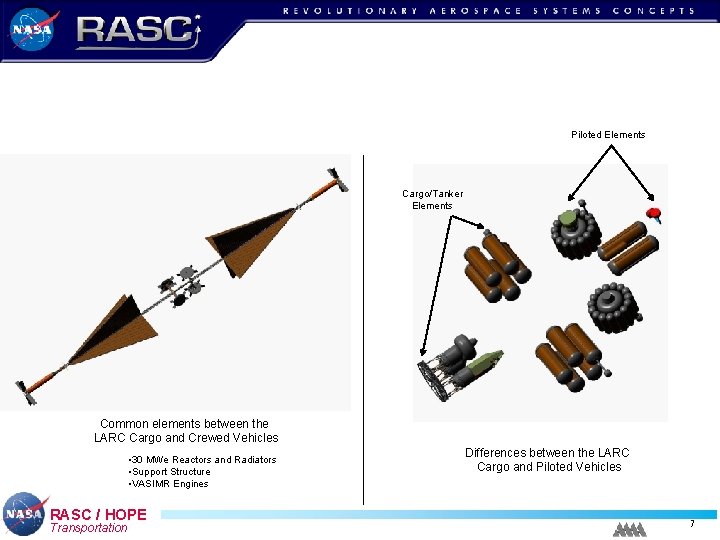
Piloted Elements Cargo/Tanker Elements Common elements between the LARC Cargo and Crewed Vehicles • 30 MWe Reactors and Radiators • Support Structure • VASIMR Engines RASC / HOPE Transportation Differences between the LARC Cargo and Piloted Vehicles 7
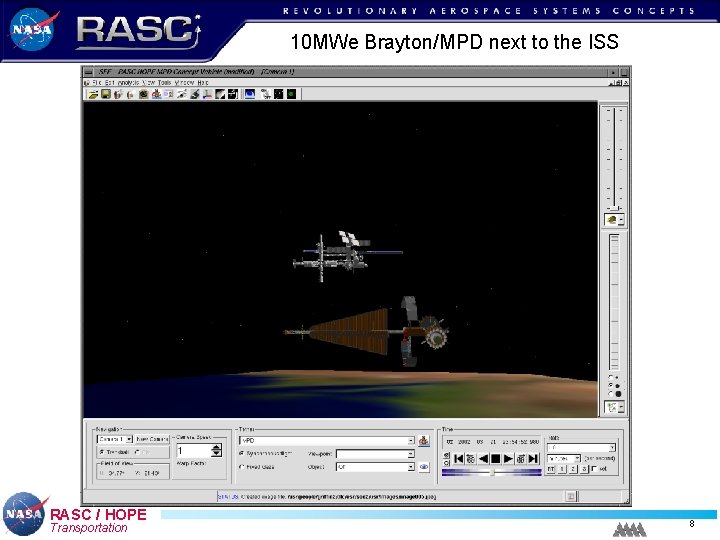
10 MWe Brayton/MPD next to the ISS RASC / HOPE Transportation 8
Dimensions 5 MPD Thrusters per side Reactors Triangle Shaped Reactor Radiators (3725 m 2 Total) 14 m Shadow Shield 12. 5 m Brayton Unit Feed Lines: • Propellant • Cooling • Power 16. 0 m 52. 5 m 3. 0 m 15. 0 27. 5 m “Preliminary” PCTV Mass Properties (Two Trans. Habs) • Brayton Fission Reactor 8 – 10 MW electrical power • Isp 8000 s with efficiency of 64. 5% • Propellant Capability = 118 MT • Payload Masses = 105 MT • Provides a constant 1/8 g simulated gravity environment RASC / HOPE Transportation 9
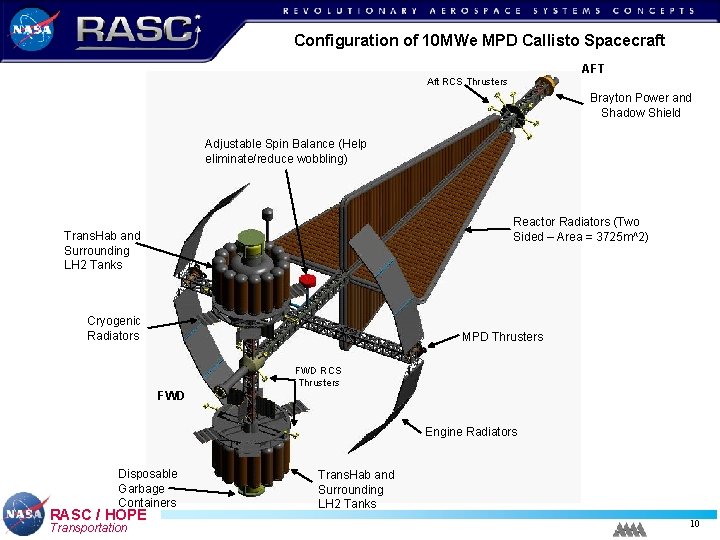
Configuration of 10 MWe MPD Callisto Spacecraft AFT Aft RCS Thrusters Brayton Power and Shadow Shield Adjustable Spin Balance (Help eliminate/reduce wobbling) Reactor Radiators (Two Sided – Area = 3725 m^2) Trans. Hab and Surrounding LH 2 Tanks Cryogenic Radiators MPD Thrusters FWD RCS Thrusters FWD Engine Radiators Disposable Garbage Containers RASC / HOPE Transportation Trans. Hab and Surrounding LH 2 Tanks 10
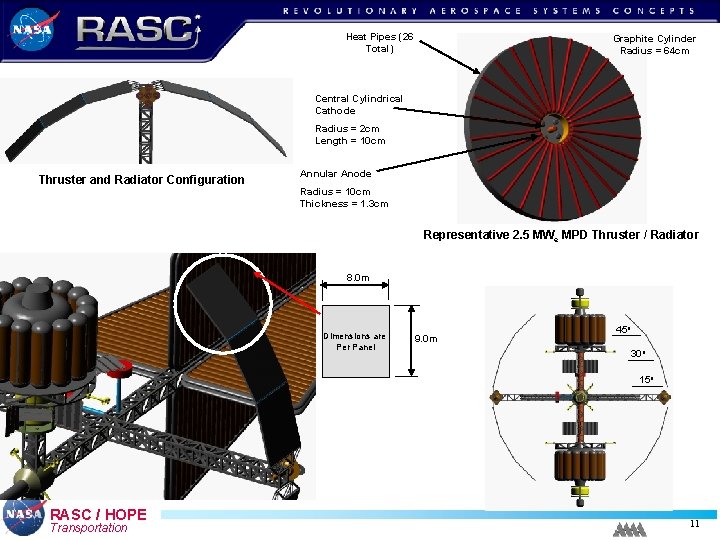
Heat Pipes (26 Total) Graphite Cylinder Radius = 64 cm Central Cylindrical Cathode Radius = 2 cm Length = 10 cm Thruster and Radiator Configuration Annular Anode Radius = 10 cm Thickness = 1. 3 cm Representative 2. 5 MWe MPD Thruster / Radiator 8. 0 m Dimensions are Per Panel 9. 0 m 45 o 30 o 15 o RASC / HOPE Transportation 11
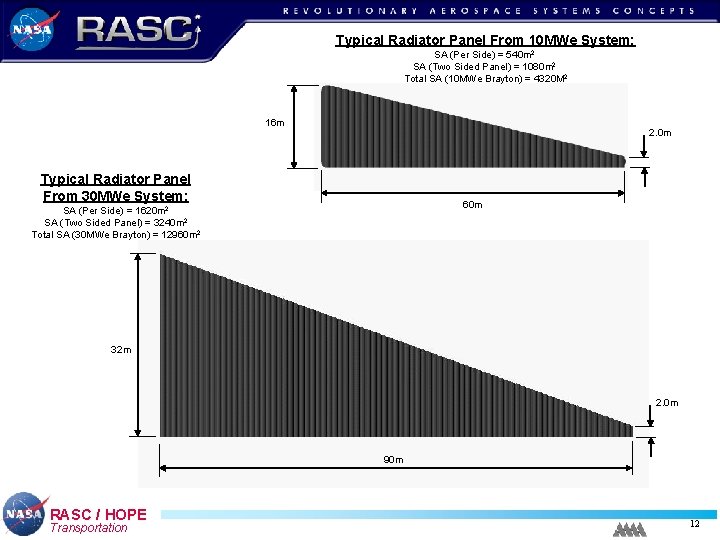
Typical Radiator Panel From 10 MWe System: SA (Per Side) = 540 m 2 SA (Two Sided Panel) = 1080 m 2 Total SA (10 MWe Brayton) = 4320 M 2 16 m 2. 0 m Typical Radiator Panel From 30 MWe System: 60 m SA (Per Side) = 1620 m 2 SA (Two Sided Panel) = 3240 m 2 Total SA (30 MWe Brayton) = 12960 m 2 32 m 2. 0 m 90 m RASC / HOPE Transportation 12
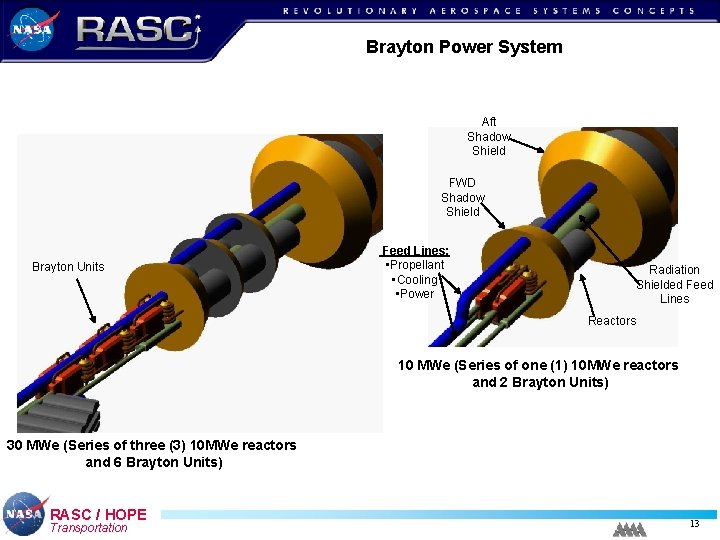
Brayton Power System Aft Shadow Shield FWD Shadow Shield Brayton Units Feed Lines: • Propellant • Cooling • Power Radiation Shielded Feed Lines Reactors 10 MWe (Series of one (1) 10 MWe reactors and 2 Brayton Units) 30 MWe (Series of three (3) 10 MWe reactors and 6 Brayton Units) RASC / HOPE Transportation 13
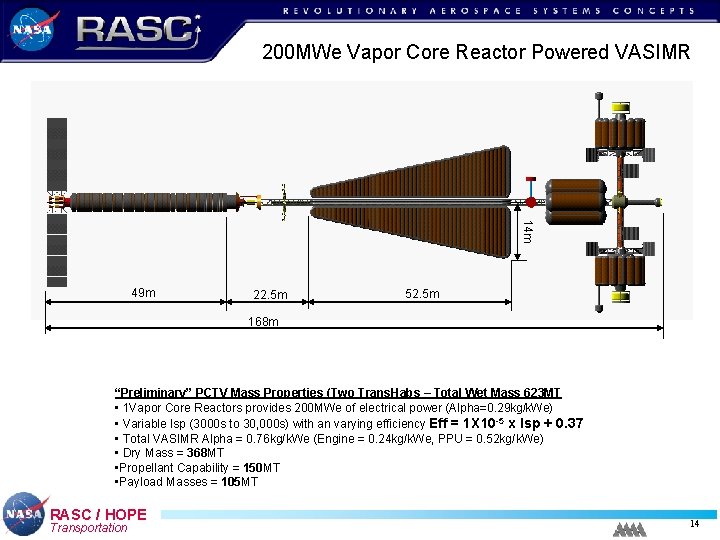
200 MWe Vapor Core Reactor Powered VASIMR 14 m 49 m 22. 5 m 52. 5 m 168 m “Preliminary” PCTV Mass Properties (Two Trans. Habs – Total Wet Mass 623 MT • 1 Vapor Core Reactors provides 200 MWe of electrical power (Alpha=0. 29 kg/k. We) • Variable Isp (3000 s to 30, 000 s) with an varying efficiency Eff = 1 X 10 -5 x Isp + 0. 37 • Total VASIMR Alpha = 0. 76 kg/k. We (Engine = 0. 24 kg/k. We, PPU = 0. 52 kg/k. We) • Dry Mass = 368 MT • Propellant Capability = 150 MT • Payload Masses = 105 MT RASC / HOPE Transportation 14
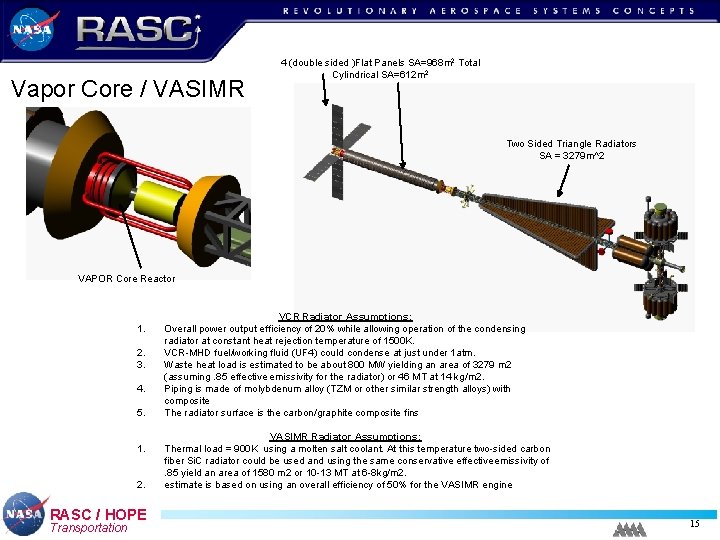
Vapor Core / VASIMR 4 (double sided )Flat Panels SA=968 m 2 Total Cylindrical SA=612 m 2 Two Sided Triangle Radiators SA = 3279 m^2 VAPOR Core Reactor 1. 2. 3. 4. 5. 1. 2. RASC / HOPE Transportation VCR Radiator Assumptions: Overall power output efficiency of 20% while allowing operation of the condensing radiator at constant heat rejection temperature of 1500 K. VCR-MHD fuel/working fluid (UF 4) could condense at just under 1 atm. Waste heat load is estimated to be about 800 MW yielding an area of 3279 m 2 (assuming. 85 effective emissivity for the radiator) or 46 MT at 14 kg/m 2. Piping is made of molybdenum alloy (TZM or other similar strength alloys) with composite The radiator surface is the carbon/graphite composite fins VASIMR Radiator Assumptions: Thermal load = 900 K using a molten salt coolant. At this temperature two-sided carbon fiber Si. C radiator could be used and using the same conservative effective emissivity of. 85 yield an area of 1580 m 2 or 10 -13 MT at 6 -8 kg/m 2. estimate is based on using an overall efficiency of 50% for the VASIMR engine 15
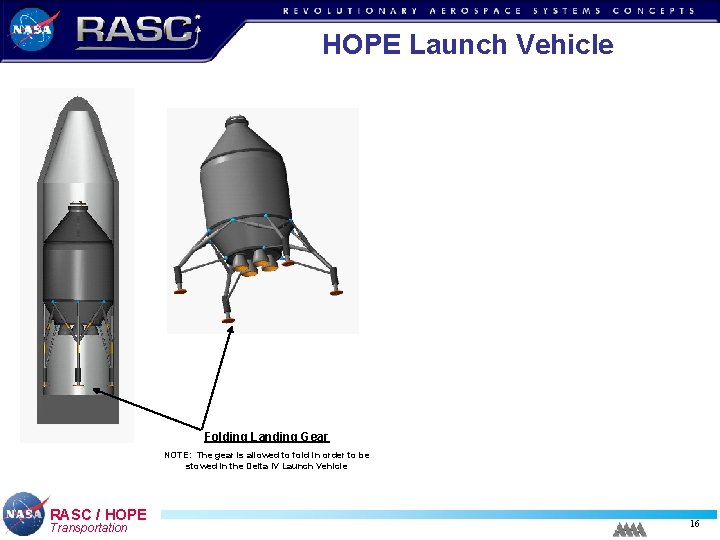
HOPE Launch Vehicle Folding Landing Gear NOTE: The gear is allowed to fold in order to be stowed in the Delta IV Launch Vehicle RASC / HOPE Transportation 16
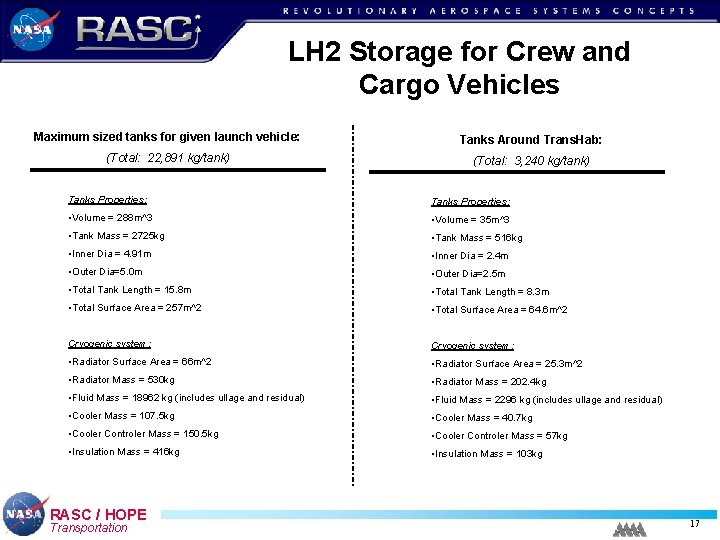
LH 2 Storage for Crew and Cargo Vehicles Maximum sized tanks for given launch vehicle: Tanks Around Trans. Hab: (Total: 22, 891 kg/tank) (Total: 3, 240 kg/tank) Tanks Properties: • Volume = 288 m^3 • Volume = 35 m^3 • Tank Mass = 2725 kg • Tank Mass = 516 kg • Inner Dia = 4. 91 m • Inner Dia = 2. 4 m • Outer Dia=5. 0 m • Outer Dia=2. 5 m • Total Tank Length = 15. 8 m • Total Tank Length = 8. 3 m • Total Surface Area = 257 m^2 • Total Surface Area = 64. 6 m^2 Cryogenic system: • Radiator Surface Area = 66 m^2 • Radiator Surface Area = 25. 3 m^2 • Radiator Mass = 530 kg • Radiator Mass = 202. 4 kg • Fluid Mass = 18962 kg (includes ullage and residual) • Fluid Mass = 2296 kg (includes ullage and residual) • Cooler Mass = 107. 5 kg • Cooler Mass = 40. 7 kg • Cooler Controler Mass = 150. 5 kg • Cooler Controler Mass = 57 kg • Insulation Mass = 416 kg • Insulation Mass = 103 kg RASC / HOPE Transportation 17
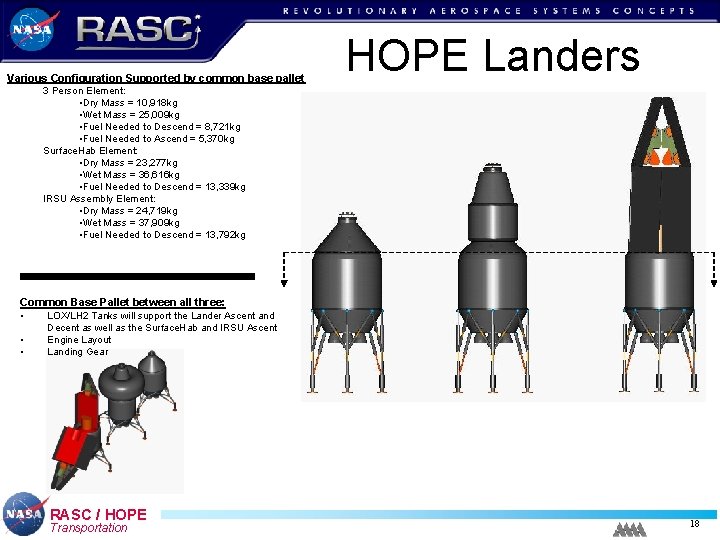
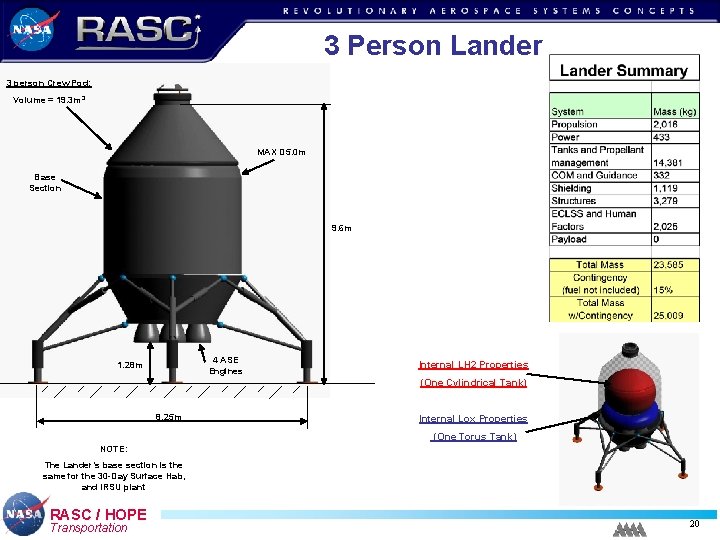
Various Configuration Supported by common base pallet HOPE Landers 3 Person Element: • Dry Mass = 10, 918 kg • Wet Mass = 25, 009 kg • Fuel Needed to Descend = 8, 721 kg • Fuel Needed to Ascend = 5, 370 kg Surface. Hab Element: • Dry Mass = 23, 277 kg • Wet Mass = 36, 616 kg • Fuel Needed to Descend = 13, 339 kg IRSU Assembly Element: • Dry Mass = 24, 719 kg • Wet Mass = 37, 909 kg • Fuel Needed to Descend = 13, 792 kg Common Base Pallet between all three: • LOX/LH 2 Tanks will support the Lander Ascent and • • Decent as well as the Surface. Hab and IRSU Ascent Engine Layout Landing Gear RASC / HOPE Transportation 18
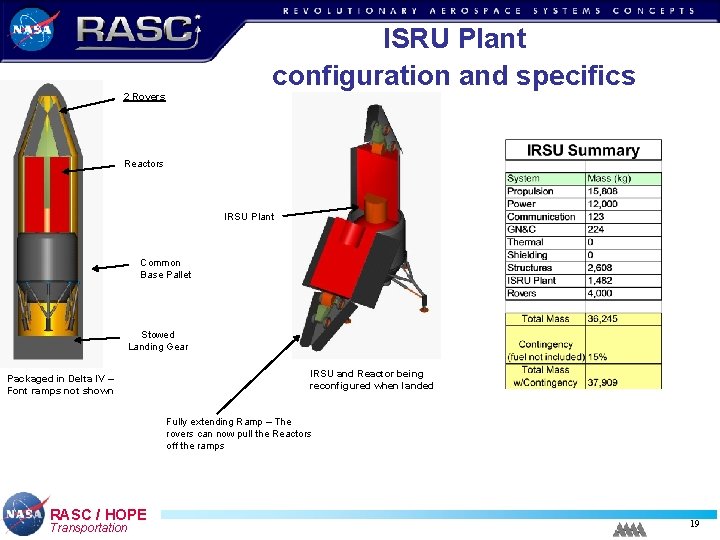
2 Rovers ISRU Plant configuration and specifics Reactors IRSU Plant Common Base Pallet Stowed Landing Gear Packaged in Delta IV – Font ramps not shown IRSU and Reactor being reconfigured when landed Fully extending Ramp – The rovers can now pull the Reactors off the ramps RASC / HOPE Transportation 19
3 Person Lander 3 person Crew Pod: Volume = 19. 3 m 3 MAX D 5. 0 m Base Section 9. 6 m 4 ASE Engines 1. 28 m Internal LH 2 Properties (One Cylindrical Tank) 8. 25 m Internal Lox Properties (One Torus Tank) NOTE: The Lander’s base section is the same for the 30 -Day Surface Hab, and IRSU plant RASC / HOPE Transportation 20
(30 -Day) Surface Facility Habitat configuration specifics Stowed Position 13. 25 m Common Base Section of the Lander, IRSU and 30 -Day Surface Hab Inflated Surface Hab (Assumes the same technology as the Mars Trans Hab): Total Inflated Volume: = 127 m 3 Head Room (Floor to Ceiling) = 2. 5 m Max Inner Dia = 7. 6 m Max Outer Dia = 8. 0 m Stowed Dia = Same as Trans Hab RASC / HOPE Transportation 21
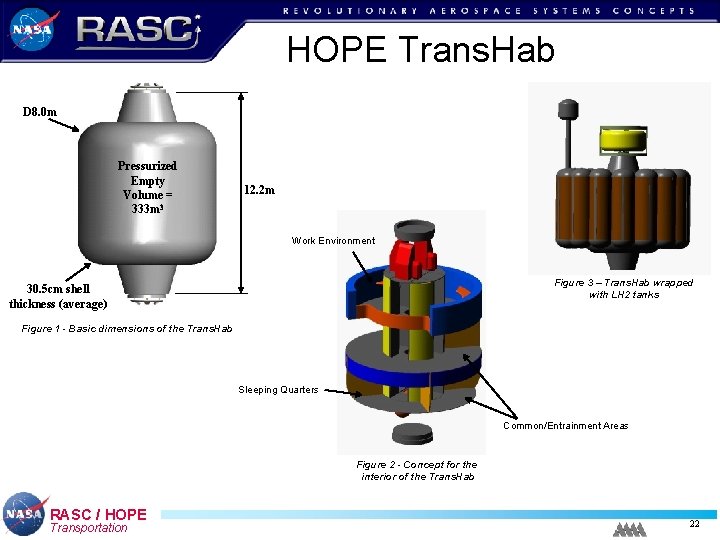
HOPE Trans. Hab D 8. 0 m Pressurized Empty Volume = 333 m 3 12. 2 m Work Environment Figure 3 – Trans. Hab wrapped with LH 2 tanks 30. 5 cm shell thickness (average) Figure 1 - Basic dimensions of the Trans. Hab Sleeping Quarters Common/Entrainment Areas Figure 2 - Concept for the interior of the Trans. Hab RASC / HOPE Transportation 22
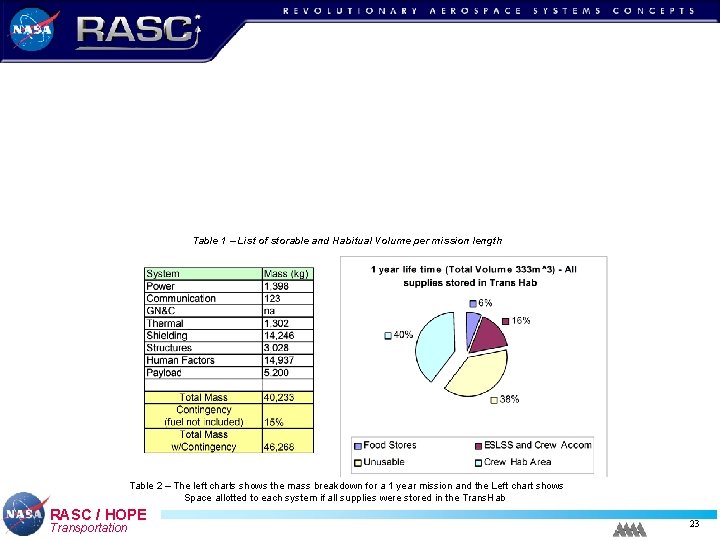
Table 1 – List of storable and Habitual Volume per mission length Table 2 – The left charts shows the mass breakdown for a 1 year mission and the Left chart shows Space allotted to each system if all supplies were stored in the Trans. Hab RASC / HOPE Transportation 23
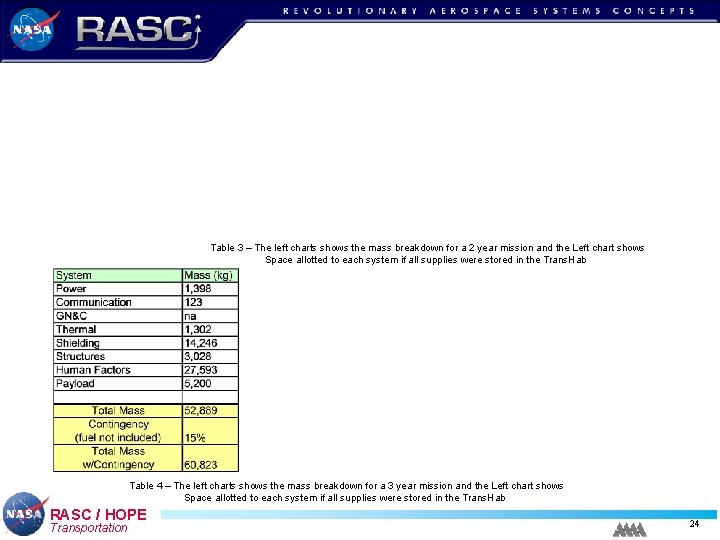
Table 3 – The left charts shows the mass breakdown for a 2 year mission and the Left chart shows Space allotted to each system if all supplies were stored in the Trans. Hab Table 4 – The left charts shows the mass breakdown for a 3 year mission and the Left chart shows Space allotted to each system if all supplies were stored in the Trans. Hab RASC / HOPE Transportation 24
Table 5 – The left charts shows the mass breakdown for a 4 year mission and the Left chart shows Space allotted to each system if all supplies were stored in the Trans. Hab Table 6 – The left charts shows the mass breakdown for a 5 year mission and the Left chart shows Space allotted to each system if all supplies were stored in the Trans. Hab RASC / HOPE Transportation 25
A quick look at Mass Savings by grown food during the mission – Please note this is only a first cut based off data from JSC 38672 Assumptions: 1) 1 year mission ECLSS mass is held constant for all missions (0% food grown on site). If all food is brought from Earth, missions longer than 1 year, require an additional storage area within or outside the current Trans Hab design. This extra storage space can be used for a BRLSS system that would also reduce the ECLSS recycling mass. 2) FAR Term Technology - Plant Chambers would provide a 25% ECLSS mass reduction for missions over one year. The 25% mass reduction also represents 50% in plant productivity in the 50 year time frame; the mass reduction can go a high as a 50% in ECLSS mass reduction if a 200% increase in plant productivity is assumed. 3) BRLSS Numbers are for 55% food grown in transit RASC / HOPE Transportation 26