
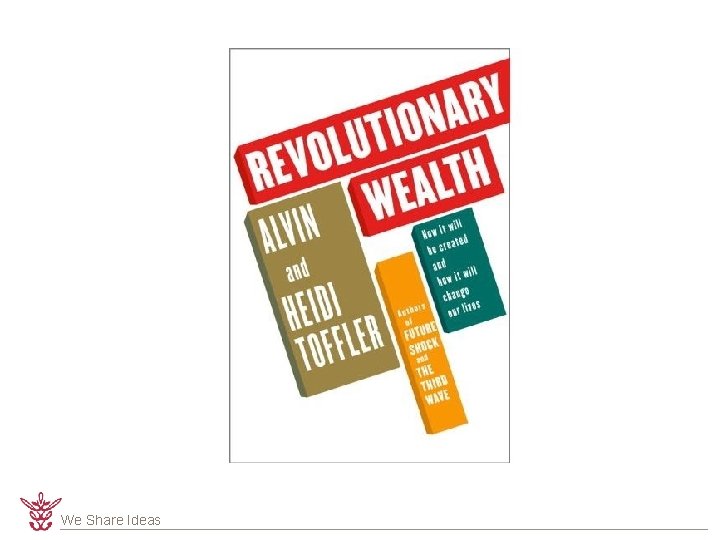
REVOLUTIONARY WEALTH by Alvin and Heidi Toffler We

REVOLUTIONARY WEALTH by Alvin and Heidi Toffler
We Share Ideas
Wealth 1. 2. This book is about the future of wealth, visible and invisible a. Invisible wealth is a revolutionary form of wealth that will redesign our lives, our companies and the world b. Invisible wealth cannot be measured in financial terms Wealth usually refers to financial assets, and often carries a connotation of excess a. For some, having wealth may mean having more than they need b. For some, no amount of wealth suffices c. For the mother who is starving, a daily handful of rice may be wealth beyond measure We Share Ideas
Definition of Wealth 1. 2. 3. 4. Money is not synonymous with wealth Wealth is any possession, shared or not, that has what economists call “utility”—it provides us with some form of well being Wealth is the child of desire. Desire begets wealth For centuries, eastern religions and philosophies taught that happiness comes from reducing, not fulfilling, our desires a. The Buddha said that the source of all suffering is desire b. As a result of their value systems many of these societies lived in unbelievable poverty and misery We Share Ideas
Definition of Wealth 5. 6. Protestantism in the West taught through hard work, thrift and virtue, God would help you to fulfill your desires a. These values created a tremendous amount of financial wealth Advertising is the machine that creates even more desire a. 3500 times a day Americans are told the key to happiness is to acquire more things We Share Ideas
Wealth Systems 1. Wealth is anything that fulfills needs or wants 2. A wealth system is the way wealth is created 3. True wealth occurs when man is able to create an economic surplus We Share Ideas
Three Wealth Systems 1. Agriculture a. Ten millennia ago, a woman planted the first seed in what is now known as Turkey b. Instead of waiting for nature to provide, man could make nature do what he wished c. Agriculture allowed man to settle into communities d. Agriculture created trade, barter, buying and selling e. In some years, there was an excess of food f. War lords, nobles and kings were able to become rich by stealing the excess wealth created by agriculture We Share Ideas
* Three Wealth Systems 2. Industrialism a. This second wave of wealth creation brought mass production, mass education, mass media and mass culture Knowledge a. This third wave substitutes knowledge for the traditional factors of industrial production – land, labor and capital b. This third wave de-massifies production, markets and society 3. * The first wave was based on growing things, the second was based on making things and the third is based on serving, thinking, knowing and experiencing We Share Ideas
Changes in Deep Fundamentals 1. Work a. Until field labor was replaced by factory work, few people ever held a job b. A “job” in today’s sense of formally committed work in return for pay is a recent innovation c. For centuries, most labor was forced labor (slavery for example) d. Work has moved from outdoors to indoors e. More people will work in the future but there will be fewer jobs We Share Ideas
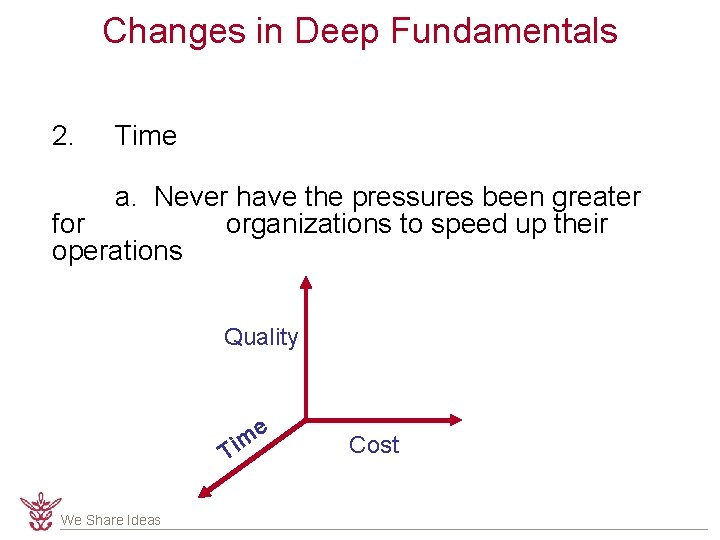
Changes in Deep Fundamentals 2. Time a. Never have the pressures been greater for organizations to speed up their operations Quality e im T We Share Ideas Cost
Changes in Deep Fundamentals 2. Time b. Relative speed of current organizations 100 mph – American business 90 mph – Non-governmental organizations (NGOs) 60 mph – American family -- Fewer than 25% of American families have a working father, stay-at-home mom and two children under the age of eighteen 30 mph – Labor unions 25 mph – Government bureaucracies 10 mph – American school system 5 mph – Intergovernmental organizations (IGOs) such as the United Nations, IMF and WTO 3 mph – US Congress and White House We Share Ideas
Changes in Deep Fundamentals 3. Place a. Wealth creation in the world continues to move west b. Cleveland, a second wave city, is listed as the poorest large city in the US We Share Ideas
Unique Characteristics of Knowledge 1. Knowledge is inherently non-rival a. Millions of people can use the same chunk of knowledge without diminishing it b. The more knowledge is used, the more knowledge is created. This is not true of food or “things” 2. Knowledge is intangible a. We can’t touch, fondle or slap it, but we can (and do) manipulate it We Share Ideas
Unique Characteristics of Knowledge 3. Knowledge is non-linear a. Tiny insights can yield huge outputs b. Yahoo was started when two college students simply categorized their three favorite websites 4. Knowledge is relational a. Any individual piece of knowledge attains meaning only when juxtaposed with other pieces that provide its context We Share Ideas
Unique Characteristics of Knowledge 5. Knowledge mates with other knowledge a. The more there is, the more promiscuous and the more numerous and varied the possible useful combinations b. Giving rise to “Meta-solutions” 6. Knowledge is more portable than any other product a. It can be distributed for a very small price 7. Knowledge can be compressed into symbols and abstractions a. Try compressing a toaster We Share Ideas
Unique Characteristics of Knowledge 8. Knowledge can be stored in smaller and smaller spaces 9. Knowledge can be explicit or implicit, expressed or not expressed, shared or tacit 10. Knowledge is hard to contain -- it wants to be free of boundaries We Share Ideas
The Storage of Knowledge 1. Thirty five thousand years ago an unremembered genius drew the first pictograph on a stone to memorialize an event, person or thing a. This was the beginning of the storage of non-oral memories outside the human brain 2. The invention of writing led to the invention of libraries, indexing and printing We Share Ideas
The Storage of Knowledge 3. The Web has led to the creation of a “mega brain” outside of human brains a. This mega brain is expanding at unbelievable speeds b. Will human memory become irrelevant? We Share Ideas
Knowledge Obsolescence 1. Every chunk of knowledge has a limited shelf life a. Despite the floods of data, information and knowledge crashing over us every day, a greater percentage of what we know is, in fact, less and less true 2. Hunters and gatherers needed some knowledge to be effective, but once it was learned it could be used for centuries a. The cycle time of biological evolution is millions of times longer than the cycle time of human learning We Share Ideas
Knowledge Obsolescence 3. Factory workers needed knowledge to run their machines, but that knowledge changed very little over time 4. For knowledge workers, learning is a necessary and continuous endeavor 5. All the greatest thinkers in the past were limited by what they knew at the time We Share Ideas
The Information/Knowledge System is Unique 1. The information/knowledge wealth system is the first system to be driven by an inexhaustible and unlimited resource a. All other wealth systems were based on scarce resources such as food and raw materials We Share Ideas
Prosumers 1. More than a billion humans live on less than a dollar a day — they consume only what they are to produce – Many live without money at all We Share Ideas able
Prosumers 2. Ways to move into the money economy: a. Create something saleable — grow excess corn, make a pair of sandals b. Get a job — work and get paid money in return c. Inherit — your rich uncle d. Obtain a gift e. Marry f. Get on Welfare g. Steal We Share Ideas
The Prosumer Economy 1. 2. The prosumer economy is a massive “hidden” economy in which large amounts of mostly untreated, unmeasured and unpaid economic activity occurs Just a few of these activities are: a. Baking a pie — when a commercial baker makes a pie it is included in the GDP. When a housewife bakes a pie it is not included b. Caring for an ill parent — when a nurse does it, it is counted. When a son or daughter does it, it is not counted c. Fixing a leaky faucet—professional plumbers are counted — Do-it-yourselfers are not d. All volunteer activities are excluded We Share Ideas
Nongovernmental Organizations (NGOs) 1. The Internet makes it possible for people with common interests to find, communicate and organize each other throughout the world 2. NGOs need not be tied to any geographic areas or governments 3. The most threatening and menacing NGOs are militant religions and their spin-off terrorist organizations We Share Ideas
Our Third Job 1. 2. 3. Job one is paid work Job two is unpaid household work Job three is work that has been outsourced to the consumer a. Many companies now require their customers to do work that was previously done by their employees b. Bank of America used to have eight hundred employees locating cancelled checks for customers (1) The customers are now required to look up cancelled checks themselves, either online or at an ATM We Share Ideas
Our Third Job c. In the United States, bank customers in 2002 executed nearly 14 billion ATM transactions (1) Assume that, on average, a simple face-to-face transaction at the bank might have taken two minutes (2) That means customers performed 28 billion minutes of unpaid work that would otherwise have required banks to hire more than 200, 000 additional full-time tellers (3) Banks frequently charge customers an extra fee for the privilege of doing the extra unpaid work We Share Ideas
Our Third Job d. In l 977 there were zero personal computers. By the year 2003 there were 190 million in use in the United States and 150 million people knew how to use them. They learned outside the formal educational system (1) The learning process was controlled by nobody, led by nobody and organized by nobody (2) It took a long time for schools to buy computers, develop curricula, reorganize schedules, train teachers and raise money even after they “got the word” We Share Ideas
The End of Capitalism 1. No human creation lasts forever a. Could capitalism cease to function as a viable economic system? b. Every key feature of capitalism, from property, capital and markets to money itself, is becoming nearly unrecognizable 2. Property a. Property is often defined as “a thing or things belonging to someone” b. But property has an intangible aspect as well. There must We Share Ideas be property rights laws because
The End of Capitalism 3. 4. c. In 2004, hordes of people clamored to buy into Google, a company whose property and operations are almost entirely intangible d. Spending is shifting from produced goods (tangible) to services (intangible) The capitalist law of supply and demand assumes a limited supply a. Knowledge and information is unlimited Whole industries are in trouble when new technologies make it possible to end-run the traditional intellectualproperty protectionism copyrights, patents and trademarks a. File sharing of music is an example We Share Ideas
The End of Capitalism 5. 6. John Barlow, once a lyricist for the Grateful Dead, says “otherwise intelligent people think that there’s no difference between stealing my horse and stealing my song” a. As property, the horse is both tangible and rival. The song is neither What if someone claimed the rights to the numeral “ 0” or the whole alphabet? We Share Ideas
Customized Pricing 1. 2. 3. In mass-production economies, “one size fits all” was paralleled by “one price fits all” a. There is now a move to customize with products and flexible, personal pricing US airline ticket prices vary depending on distribution channel, time and individual customer characteristics Prices are now often set by auction (e. Bay) and reverse auctions (Priceline) We Share Ideas
Tomorrow’s Money 1. Money, a key element in capitalism, is undergoing significant change with new forms of money, new ways to pay and more business opportunities that use no money at all 2. Money has costs that include the cost to collect it, store it and keep track of it 3. The amount of money traded in the global currency market is thirty times the amount traded on the New York Stock Exchange We Share Ideas
Tomorrow’s Money 4. Para-money a. Americans spend more with credit cards than they do with cash b. Frequent Flyer points and other legal programs have created a whole new system of para-money c. Consider Pay. Pal – a “currency” with no substance whatsoever d. Payments can now be made by cell phones rather than credit cards We Share Ideas
Nongovernmental Organizations 1. In recenturies, nations have been responsible for how wealth is distributed in the world a. Nations form economic blocks, play currency games, impose tariffs, grant subsidies and wage wars to gain access to natural resources b. In the future, nations will lose a lot of their power to NGOs 2. The proliferation of NGOs is just beginning a. The Internet, the Web, mobile phones and improved connectivity make it easier and cheaper for people to identify common goals or grievances, to find one another, link up and organize We Share Ideas
Nongovernmental Organizations 3. NGOs can permeate every part of the world and society because they are not constrained by physical borders 4. NGOs can act much faster than the bureaucracies of nation states We Share Ideas
Religio-Economics 1. While the rate of increase in global population is slowing, the rates of growth for the world’s two largest religions—Christianity and Islam—are escalating a. All religions will be influenced by technology and the radical redistribution of world wealth 2. The World Christian Encyclopedia forecasts that 2 billion Christians in the world today will grow to 2. 6 billion by 2025 We Share Ideas
Religio-Economics a. Islam is growing at a much faster rate. It is expected to go from 553 million in 1970 to 1. 8 billion by 2025 b. A third of all Muslims live as minorities in non-Muslim countries 3. The critical centers of Christianity have moved to Africa, Latin America and Asia, each of which has many more Christians today than North America We Share Ideas
Religio-Economics 4. The Muslim population is growing most quickly in the East—especially in Malaysia and Indonesia a. These countries have a more moderate form of Islam compared to the countries in the Middle East 5. As the price of oil continues to rise, new energy technologies will be developed and the power of the oil producing countries will decrease We Share Ideas
Observations • • • Businesses confined to “tangible” products are limited by scarcity of people, property and capital Knowledge-based businesses are built on an inexhaustible and unlimited resource Which are likely to grow faster? We Share Ideas
Questions • What are the “knowledge” components of my business vs. the “tangible” components? • What can I do to move my business to a “richer mix” of knowledge vs. tangible? • How can I protect and leverage my company’s knowledge base? • What can I do to reduce cycle times of both “learning” and “doing” in my company? We Share Ideas
Questions • Blue Ocean question – How can I add or raise the importance of knowledge-based deliverables in my product/service offerings? We Share Ideas
- Slides: 42