RETICULAR FORMATIONR F R F is one of

- Slides: 16
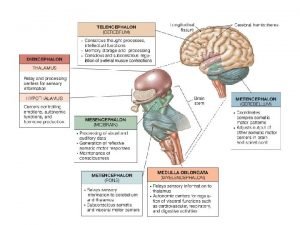
RETICULAR FORMATION(R. F) -R. F is one of the most important regulatory systems in C. N. S. -It is located in brain stem, extending upwards to the diencephalons (thalamus, hypothalamus&subthalamus) and downwards to the upper part of the spinal cord, where it merges with its interneuron
RETICULAR FORMATION(R. F) o o Many nuclei and centers are present within its meshes e. g. cardiac and respiratory centers, substantia nigra&vestibular, red&raphe nuclei. R. F is divided into: A-Sensory part. B-Motor part.
RETICULAR FORMATION(R. F) o o o o o A-The sensory part This is consist of large number of small neurons that have multiple connections with each other. It receives a rich polysensory input ( afferent fibers) from: 1 -all ascending lemnisci. 2 -the visual, auditory&olfactory nervous pathways. 3 -the basal ganglia. 4 -the cerebellum 5 -the cerebral cortex 6 -the hypothalamus 7 -the vestibular apparatus.
RETICULAR FORMATION(R. F) o o B-The motor part This consists of large neurons, which receive signals from the sensory part, and their axons constitute the output (efferent) fibers from the R. F. It contain facilitatory and inhibitory parts:
RETICULAR FORMATION(R. F) o o o I-Fcilitatory (excitatory) reticular formation This is located mainly in the pons and midbrain. It has an inherent activity and the axons of its neurons divide into : a-An ascending branch which excites the C. C and is called the ascending reticular activating system(ARAS)
RETICULAR FORMATION(R. F) o o o b-A descending branch (ventral reticulospinal tract) which facilitates the spinal centers. II- Inhibitory reticular formation This is located mainly in the M. O. It has no inherent activity and its axons descend as the lateral reticulospinal tract which inhibits the spinal centers.
FUNCTIONS OF THE R. F o o o 1 -Control of the level of consciousness via the ascending reticular activating system(ARAS). 2 -Regulation of the stretch reflex and muscle tone via the reticulospinal tracts. 3 -Pain inhibition via the raphe magnus nucleus. 4 -Control of visceral functions(e. g. cardiac activity )by controlling the lateral horn cells. 4 -Control of sleep.
Ascending Reticular Activating System(A. RAS) o This is a multineuronal polysynaptic system of nerve fibers that originate at the facilitatory reticular formation. Its fibers extend upwards , then some project directly to the C. C. , while the majority relay first at the nonspecific thalamic nuclei, from which other fibers arise and project diffusely to almost all parts of the cerebral cortex this pathway is called the reticulothalamo- cortical pathway.
Ascending Reticular Activating System(A. R. A. S)
Ascending Reticular Activating System(A. R. A. S) o o Functions of the ARAS The ARAS controls the electric activity of the C. C, and is concerned with consciousness and production of the alert response, so reduction of its activity leads to sleep.
Ascending Reticular Activating System(A. R. A. S) o o o Factors affecting the activity of the ARAS I-Factors that increase the ARAS activity a-Sensory signals. b-Signals from the cerebral cortex which increase alertness and resist the desire to sleep. c-Certain drugs called the analeptic drugs(e. g. catecholamines, amphetamine& caffeine)
Ascending Reticular Activating System(A. R. A. S) o o o II-Factors that decrease the ARAS activity a-Reduction of signals from either the sensory pathways or the C. C. b-Stimulation of the sleep centers. c-Extensive damage of the ARAS. d-General anesthetic drugs: These drugs lead to unconsciousness through depressing the ARAS activity. They inhibit the synaptic transmission between its neurons (by producing a state of hyperpolarization in these neurons, which prevents development of EPSPs to the firing level)
MECHANISM OF CONSCIOUSNESS o The initiation and maintenance of consciousness is the function of the ARAS Activation of this system leads to consciousness through excitation of the cerebral cortex by signals discharged via the reticulo thalamo cortical pathway. Consciousness is the maintained by a +ve feedback mechanism through reexcitation of the ARAS by signals discharged from the activated cortex.
MECHANISMS (THEORIES)OF SLEEP o o o Sleep primarily results from depression of the C. C secondary to inhibition of the ARAS activity, via : 1 -Passive mechanism(theory) This assumes that sleep occurs as a result of passive inhibition of the ARAS which can be induced by either its fatigue or by decreasing its activity(by elimination of its exciting stimuli e. g. the visual, auditory, painful&other stimuli).
MECHANISMS (THEORIES)OF SLEEP o o II-Active mechanism(theory) This seems to be the real mechanism of sleep. It was found that excitation of certain centers in the brain stem inhibits the ARAS and it is believed that sleep occurs as a result of active inhibition of the ARAS by signals discharged from such centers. Some of these sleep centers include the following:
MECHANISMS (THEORIES)OF SLEEP o o a-The raphe nuclei in the medulla and lower pons. Stimulation of these nuclei depresses the ARAS and produces sleep. The neurons of these nuclei release serotonin. b-The reticular formation in the upper brain stem. Stimulation of this area produces sleep by discharging cholinergic signals directly to the C. C.