Research Orientation for New Faculty Hires Monica Toca

- Slides: 17
Research Orientation for New Faculty Hires Monica Toca Manager, Research Ethics
Overview § § Background Principles Scope Process § Q&A
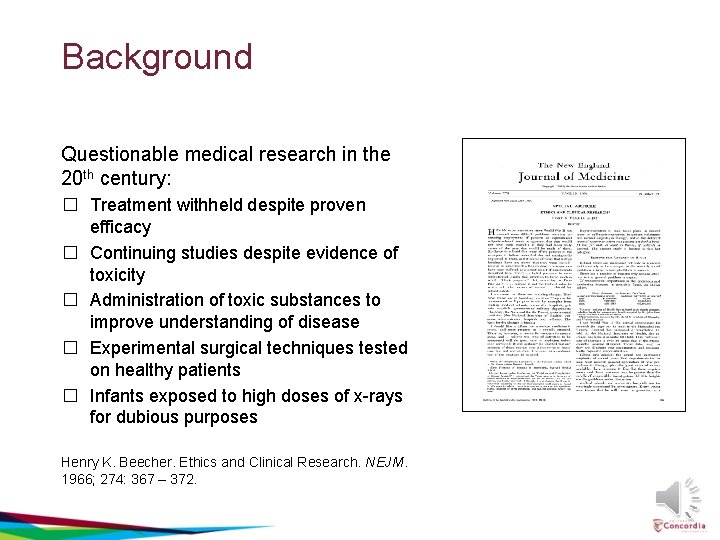
Background Questionable medical research in the 20 th century: � Treatment withheld despite proven efficacy � Continuing studies despite evidence of toxicity � Administration of toxic substances to improve understanding of disease � Experimental surgical techniques tested on healthy patients � Infants exposed to high doses of x-rays for dubious purposes Henry K. Beecher. Ethics and Clinical Research. NEJM. 1966; 274: 367 – 372.
The Three Principles - TCPS 2 (2010) § Respect for persons § Concern for welfare § Justice
Respect for Persons �Respect for persons ◦ Typically framed as an issue of autonomy and of informed consent ◦ Special protections for individuals with reduced autonomy: �Children �Mentally incapacitated adults �Prisoners �Employees ◦ Other considerations: �Relationship with the participant �Relationship with the community
Respect for Persons Elements of informed consent • An ongoing process • Information • • Comprehension • • How will participating affect me? Voluntariness • • Such as the objective, risks, benefits, methods etc. At a minimum, lack of coercion Articulation of a choice • • Written consent forms most common. Other means of obtaining and documenting consent may be appropriate. (See TCPS Art. 3. 12)
Concern for Welfare § Broad conception of harms and benefits § E. g. physical harm, but also psychological harm, risk to privacy, financial well-being § Maximize benefits § To the participant § To society at large § Minimize risks § Reasonable risk-benefit ratio
Justice § Minimally, justice requires fair subject selection § Not choosing subjects on a convenience basis § Inclusiveness in subject selection § Other considerations § Access to the fruits of research § Research priorities
Scope What research is subject to ethics review? § Research: “an undertaking intended to extend knowledge through a disciplined inquiry or systematic investigation. ” (TCPS 2 p. 15) § Participant: “those individuals whose data, or responses to interventions, stimuli or questions by the researcher, are relevant to answering the research question. ” (TCPS 2 p. 16) § Disciplined inquiry: “an inquiry that is conducted with the expectation that the method, results, and conclusions will be able to withstand the scrutiny of the relevant research community. ” (http: //pre. ethics. gc. ca/eng/policy-politique/interpretations/scope-portee/) § See the “Cheat Sheet”
Scope Secondary use of information § “REB review is not required for research that relies exclusively on secondary use of anonymous information… so long as the process of data linkage or recording or dissemination or results does not generate identifiable information” (TCPS art. 2. 4)
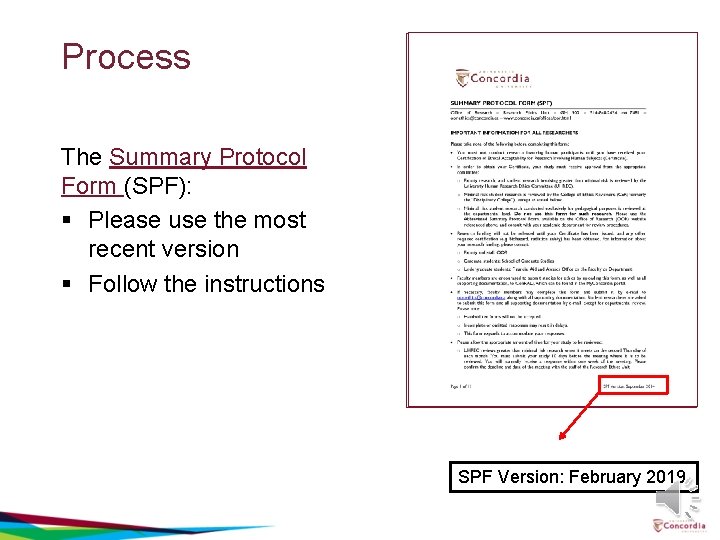
Process The Summary Protocol Form (SPF): § Please use the most recent version § Follow the instructions SPF Version: February 2019
Other supporting documentation § § § Scholarly Review Form (only if you are conducting greater than minimal risk research) Recruitment materials to be used, such as advertisements or letters to participants Instruments to be used to gather data, such as questionnaires or interview guides Consent Form Oral Consent script Debriefing script List of resources to whom participants can be referred if necessary Letters of support from participating organizations § Submit on Con. RAD or via e-mail: oor. ethics@concordia. ca § §
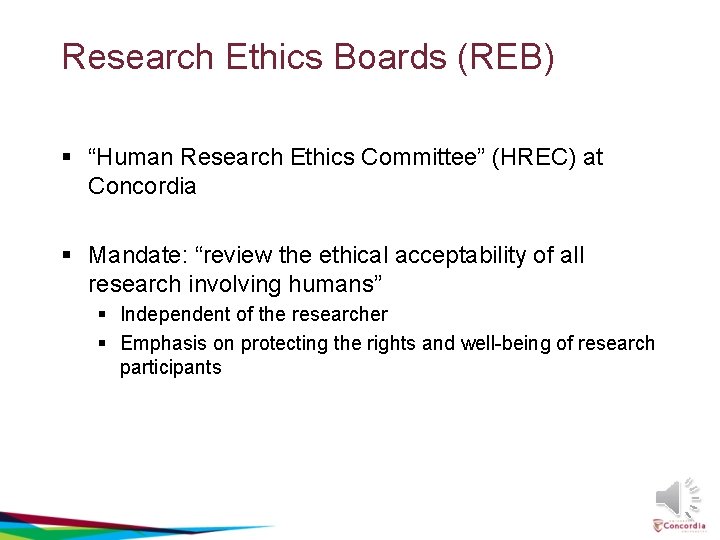
Research Ethics Boards (REB) § “Human Research Ethics Committee” (HREC) at Concordia § Mandate: “review the ethical acceptability of all research involving humans” § Independent of the researcher § Emphasis on protecting the rights and well-being of research participants
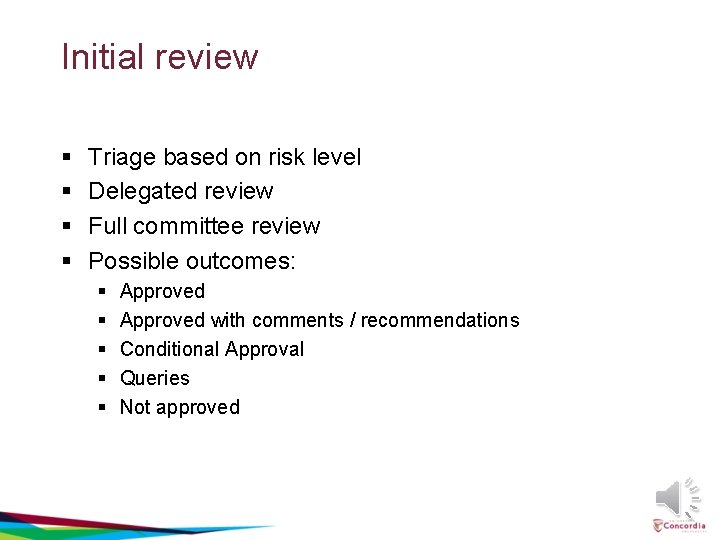
Initial review § § Triage based on risk level Delegated review Full committee review Possible outcomes: § § § Approved with comments / recommendations Conditional Approval Queries Not approved
Normative Texts § Among the most important: § TCPS 2 (2018) - Tri-Council Policy Statement: Ethical Conduct for Research Involving Humans § Civil Code of Quebec § Professional codes of ethics
Contact Information § Initial review of faculty/staff research, and general inquiries: Monica Toca Manager, Research Ethics monica. toca@concordia. ca 514 -848 -2424 ext. 2425 § Our website: http: //www. concordia. ca/research/forresearchers/ethics. html