
Onboarding New Teachers What they Need to Succeed
Onboarding New Teachers: What they Need to Succeed
Objectives © TNTP 2012 Understand onboarding as an integral part of teacher effectiveness and teacher retention Become familiar with effective cultivation strategies and ensure your new hires have the information they need to begin teaching Identify what quality onboarding looks like Develop an onboarding plan for new hires 2
Agenda Introduction to onboarding Cultivating teachers before school starts School-site orientation Supporting teachers during the first months of school © TNTP 2012 3
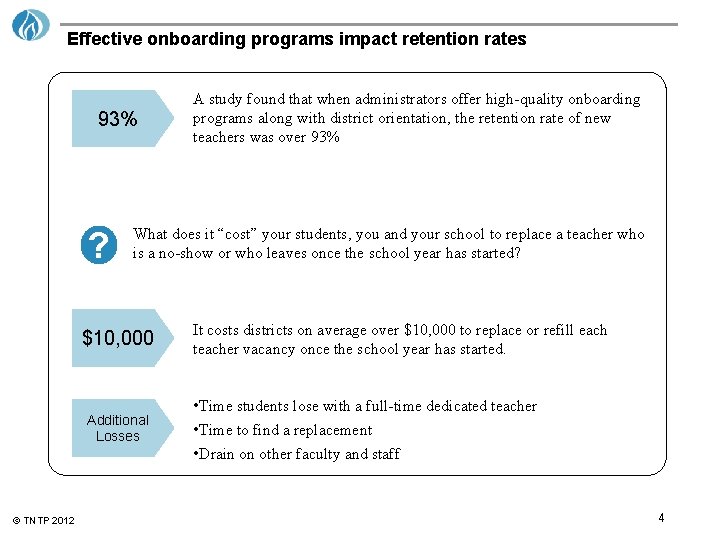
Effective onboarding programs impact retention rates 93% ? What does it “cost” your students, you and your school to replace a teacher who is a no-show or who leaves once the school year has started? $10, 000 Additional Losses © TNTP 2012 A study found that when administrators offer high-quality onboarding programs along with district orientation, the retention rate of new teachers was over 93% It costs districts on average over $10, 000 to replace or refill each teacher vacancy once the school year has started. • Time students lose with a full-time dedicated teacher • Time to find a replacement • Drain on other faculty and staff 4
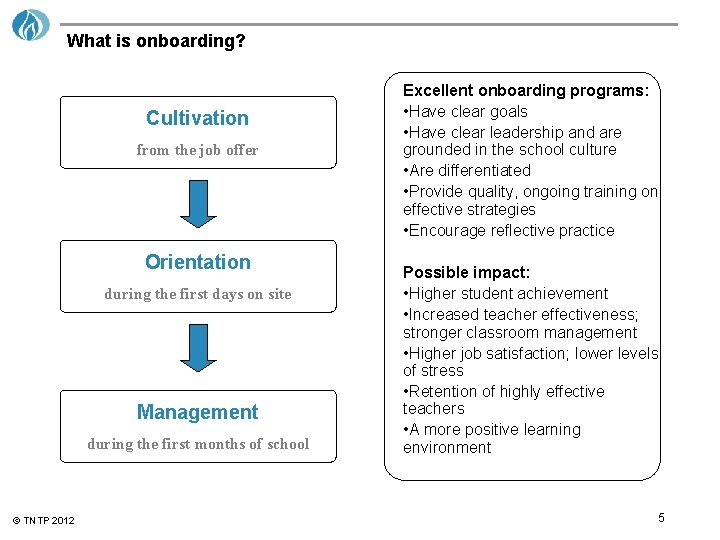
What is onboarding? Cultivation from the job offer Orientation during the first days on site Management during the first months of school © TNTP 2012 Excellent onboarding programs: • Have clear goals • Have clear leadership and are grounded in the school culture • Are differentiated • Provide quality, ongoing training on effective strategies • Encourage reflective practice Possible impact: • Higher student achievement • Increased teacher effectiveness; stronger classroom management • Higher job satisfaction; lower levels of stress • Retention of highly effective teachers • A more positive learning environment 5

Onboarding Timeline Cultivation Job Offer Cultivation Orientation Management Start of School Orientation Management Keep the candidate engaged and build excitement. Address teachers’ needs in order of priority. Deliver specific and actionable feedback. Start to set expectations. Review specific performance expectations and teacher evaluation rubrics. Give timely feedback consistently reinforcing the language of the evaluation rubric. Build investment in school culture and philosophy. Set specific academic goals based on end-of-year assessments. Track student progress against academic goals using interim assessments. Connect with a strong buddy Set specific professional or mentor. development goals. © TNTP 2012 Set specific milestones to review and re-set PD goals. 6
Agenda Introduction to onboarding Cultivating teachers before school starts School-site orientation Supporting teachers during the first months of school © TNTP 2012 7

Onboarding begins with cultivation - high-quality, meaningful, targeted contact ensures school expectations are understood early • Helps ensure that candidates begin teaching despite competition from other school districts or challenges Purpose • Provides the opportunity to start building excitement and energy around your school culture • Allows new teachers to start the year feeling informed and supported • Encourages staff members to arrive informed and prepared for the first few weeks of school When? • Begins when you interview a teacher • Ends when teacher starts at your school • It allows you to predict and plan for any potential vacancies and last minute withdrawals Why? • It ensures candidates continue to understand your commitment to them from the time of hire to when the school year starts • It allows the opportunity to continue set clear expectations for teachers in your building What effective cultivation strategies have you seen implemented? © TNTP 2012 8

There are four common red flags that may indicate that a new hire may be a no-show New Hire or returning teacher does not reply to your e-mails or phone calls Teacher delays or does not have a clear plan for their move to the area. Be aware of signs of apprehension Teacher does not attend the district’s orientation or new teacher training Teacher does not complete the district’s pre-employment processing (generally certification, fingerprinting, contract signing, etc) © TNTP 2012 9
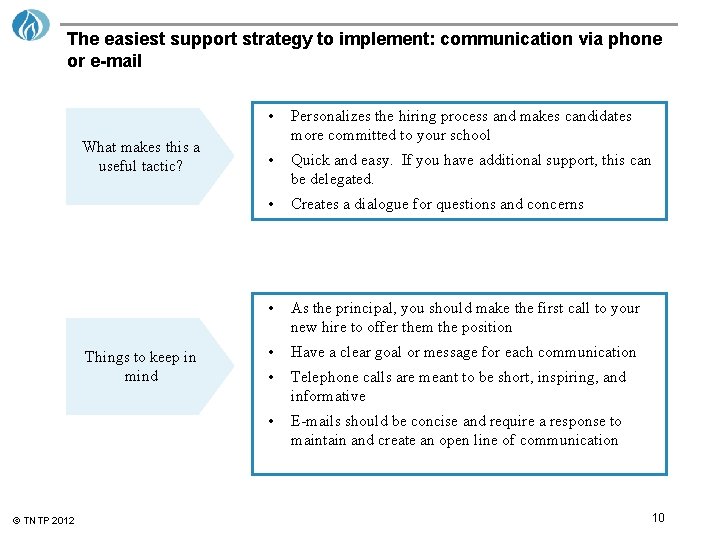
The easiest support strategy to implement: communication via phone or e-mail What makes this a useful tactic? Things to keep in mind © TNTP 2012 • Personalizes the hiring process and makes candidates more committed to your school • Quick and easy. If you have additional support, this can be delegated. • Creates a dialogue for questions and concerns • As the principal, you should make the first call to your new hire to offer them the position • Have a clear goal or message for each communication • Telephone calls are meant to be short, inspiring, and informative • E-mails should be concise and require a response to maintain and create an open line of communication 10
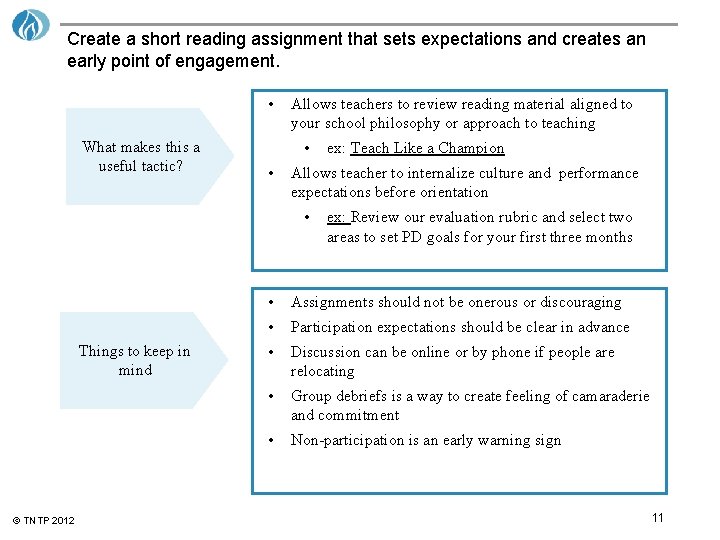
Create a short reading assignment that sets expectations and creates an early point of engagement. • What makes this a useful tactic? Allows teachers to review reading material aligned to your school philosophy or approach to teaching • • Allows teacher to internalize culture and performance expectations before orientation • Things to keep in mind © TNTP 2012 ex: Teach Like a Champion ex: Review our evaluation rubric and select two areas to set PD goals for your first three months • Assignments should not be onerous or discouraging • Participation expectations should be clear in advance • Discussion can be online or by phone if people are relocating • Group debriefs is a way to create feeling of camaraderie and commitment • Non-participation is an early warning sign 11
Create discussion forums for connection between teachers. What makes this a useful tactic? Things to keep in mind © TNTP 2012 • If you are hiring a large number of new teachers, this can help them connect about housing and relocation logistics • Teachers can begin to create connections to the school community • Positive leaders in your school community can monitor and contribute to the discussion • If one teacher has a question, others could benefit from the answer as well • If the discussion is monitored, information might not be correct • Be sure to set norms for what are group questions and what should be individual questions • Make sure the current voices representing your school are positive and encouraging • Be careful in linking personal social networks (Facebook). Email or Google groups are safer. 12
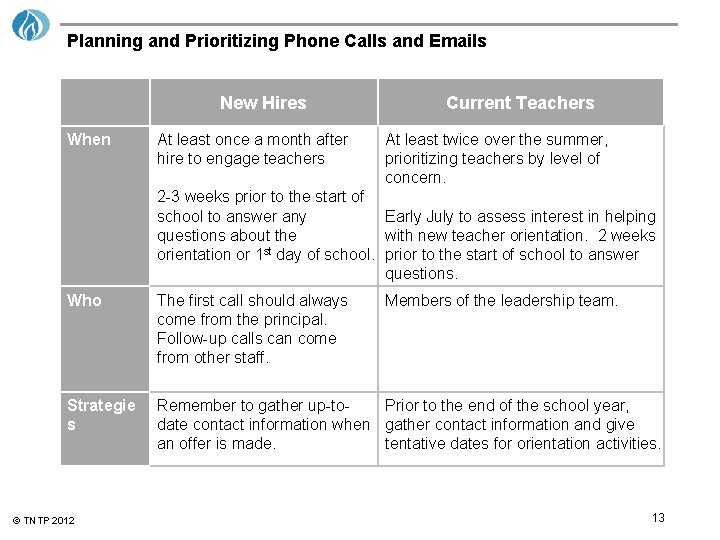
Planning and Prioritizing Phone Calls and Emails New Hires When At least once a month after hire to engage teachers Current Teachers At least twice over the summer, prioritizing teachers by level of concern. 2 -3 weeks prior to the start of school to answer any Early July to assess interest in helping questions about the with new teacher orientation. 2 weeks st orientation or 1 day of school. prior to the start of school to answer questions. Who The first call should always come from the principal. Follow-up calls can come from other staff. Strategie s Remember to gather up-to. Prior to the end of the school year, date contact information when gather contact information and give an offer is made. tentative dates for orientation activities. © TNTP 2012 Members of the leadership team. 13

Teachers have told us they want to have information about their school and school processes before school starts • Logistics Instructional Support Administrator Expectations © TNTP 2012 • • Schedule of the week prior to and the first week of school, including typical day structure and any special training sessions; when they can come in to set up their classrooms Where to park, pick up mail, location of bathrooms and lunchroom Important staff members – who do they go to for what • List of professional development opportunities – summer workshops, which ones they have to go to the first week of school, schedule for the year • Visit and set up classroom – schedule a time as early as possible • What mechanisms exist for providing instructional feedback? • List of assigned students with parent and contact information, as well as IEP’s if special ed • How will teachers be evaluated? • What are the school’s student achievement goals? • What are the other school-wide goals? 14

Onboarding plan: Outline 4 cultivation strategies for your new hires Activity/ Strategy Cultivation Ex: Phone Call © TNTP 2012 Completion date May 15 Purpose Leader Welcome phone call, outline that other staff members will be calling/emailing over the summer. Connect new hires to a positive mentor teacher. 15
Agenda Introduction to onboarding Cultivating teachers before school starts School-site orientation Supporting teachers during the first months of school © TNTP 2012 16
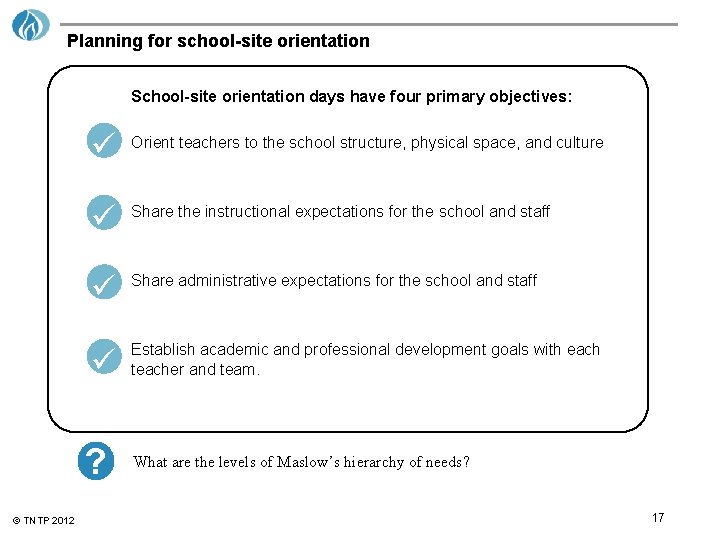
Planning for school-site orientation School-site orientation days have four primary objectives: Orient teachers to the school structure, physical space, and culture Share the instructional expectations for the school and staff Share administrative expectations for the school and staff Establish academic and professional development goals with each teacher and team. ? © TNTP 2012 What are the levels of Maslow’s hierarchy of needs? 17
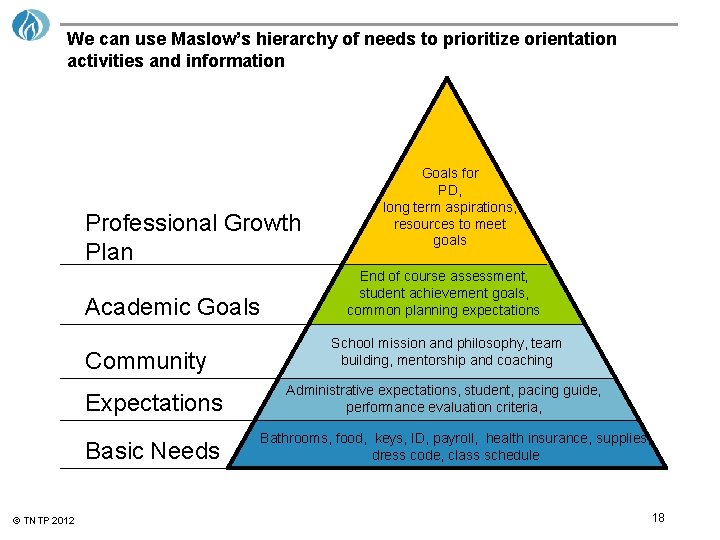
We can use Maslow’s hierarchy of needs to prioritize orientation activities and information Professional Growth Plan Academic Goals Community Expectations Basic Needs © TNTP 2012 Goals for PD, long term aspirations, resources to meet goals End of course assessment, student achievement goals, common planning expectations School mission and philosophy, team building, mentorship and coaching Administrative expectations, student, pacing guide, performance evaluation criteria, Bathrooms, food, keys, ID, payroll, health insurance, supplies, dress code, class schedule 18
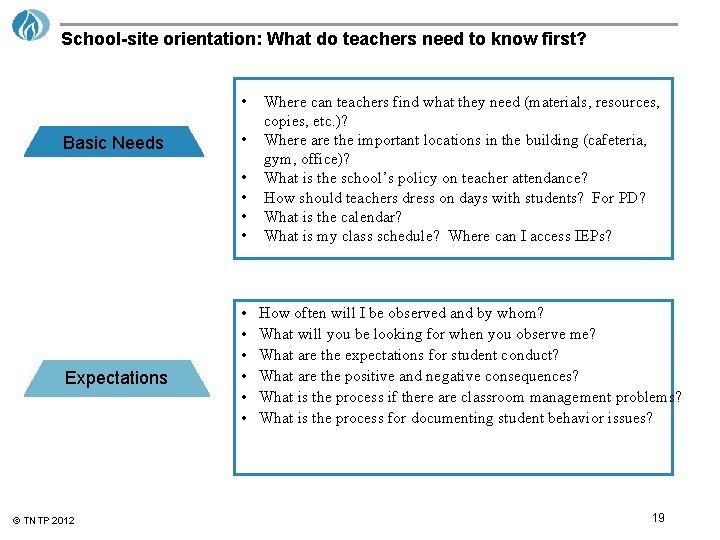
School-site orientation: What do teachers need to know first? • Basic Needs • • • Expectations © TNTP 2012 • • • Where can teachers find what they need (materials, resources, copies, etc. )? Where are the important locations in the building (cafeteria, gym, office)? What is the school’s policy on teacher attendance? How should teachers dress on days with students? For PD? What is the calendar? What is my class schedule? Where can I access IEPs? How often will I be observed and by whom? What will you be looking for when you observe me? What are the expectations for student conduct? What are the positive and negative consequences? What is the process if there are classroom management problems? What is the process for documenting student behavior issues? 19
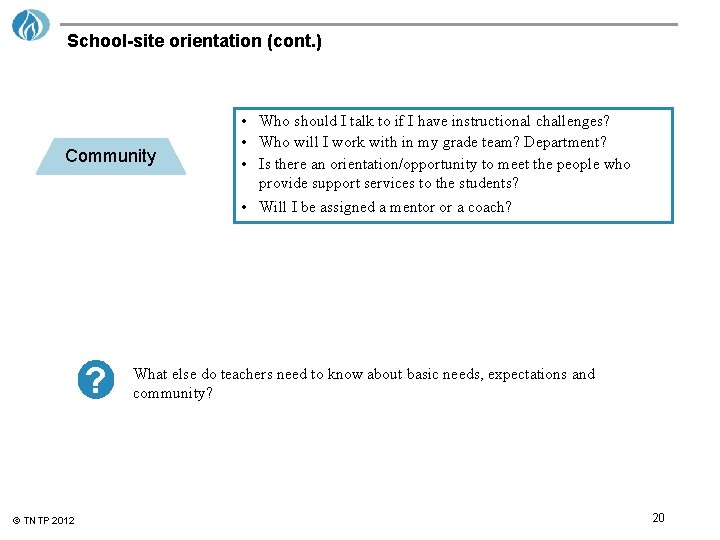
School-site orientation (cont. ) Community ? © TNTP 2012 • Who should I talk to if I have instructional challenges? • Who will I work with in my grade team? Department? • Is there an orientation/opportunity to meet the people who provide support services to the students? • Will I be assigned a mentor or a coach? What else do teachers need to know about basic needs, expectations and community? 20
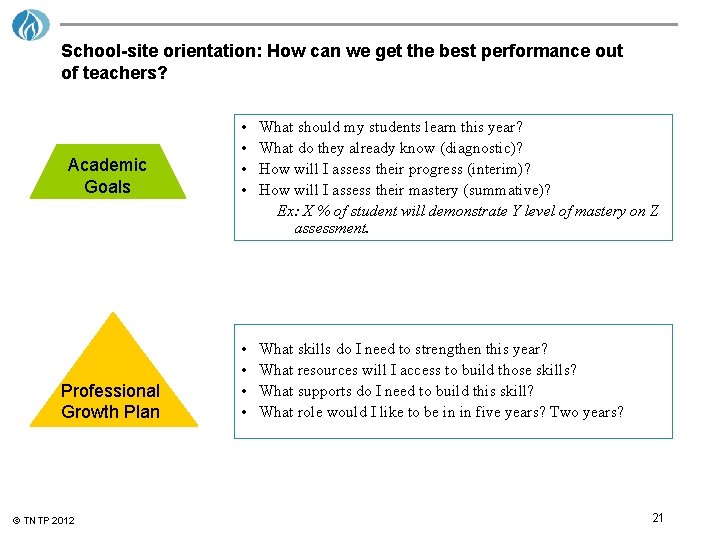
School-site orientation: How can we get the best performance out of teachers? Academic Goals • • What should my students learn this year? What do they already know (diagnostic)? How will I assess their progress (interim)? How will I assess their mastery (summative)? Ex: X % of student will demonstrate Y level of mastery on Z assessment. Professional Growth Plan • • What skills do I need to strengthen this year? What resources will I access to build those skills? What supports do I need to build this skill? What role would I like to be in in five years? Two years? © TNTP 2012 21
Questions to Consider ? What operational and administrative tasks do you anticipate will be most frustrating for staff? ? How did you learn about the instructional expectations when you began teaching or how have you shared these expectations as a principal? ? Describe how you have seen vision and culture messages shared and reinforced most effectively. ? What are some of the best practices or strategies you’ve seen for setting effective academic and professional growth goals with teachers? ? What will be your biggest challenge in creating an effective and high-quality onboarding plan? © TNTP 2012 22
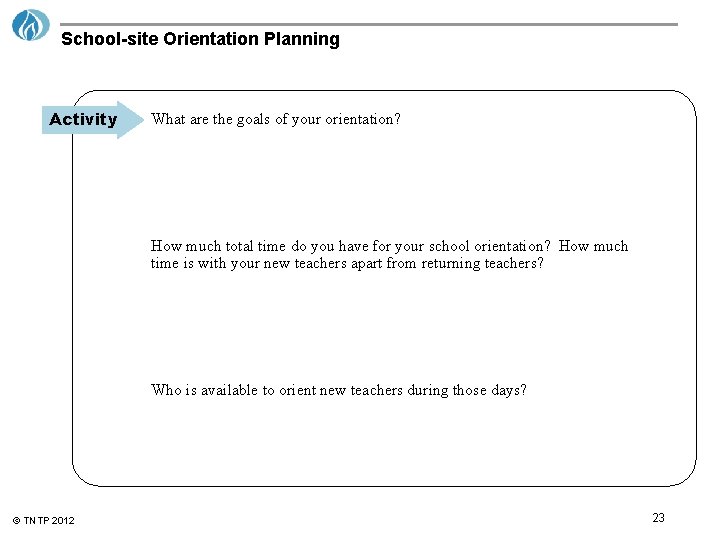
School-site Orientation Planning Activity What are the goals of your orientation? How much total time do you have for your school orientation? How much time is with your new teachers apart from returning teachers? Who is available to orient new teachers during those days? © TNTP 2012 23
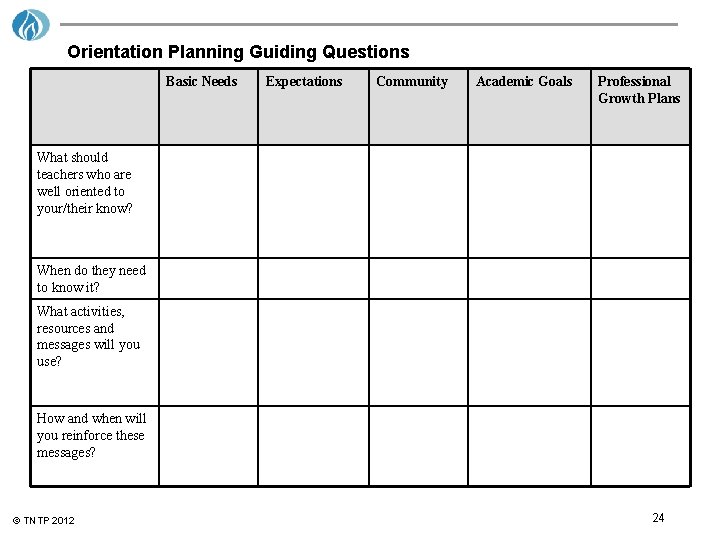
Orientation Planning Guiding Questions Basic Needs Expectations Community Academic Goals Professional Growth Plans What should teachers who are well oriented to your/their know? When do they need to know it? What activities, resources and messages will you use? How and when will you reinforce these messages? © TNTP 2012 24

Onboarding Plan: Outline School-site orientation Activities Activity/ Strategy Orientation Ex: New Teacher Staff Meeting © TNTP 2012 When should it be complete? August 28 Who will complete? John Sheppard, Principal Purpose Set expectations, assign mentors, give out first semester formal orientation schedule 25
Agenda Introduction to onboarding Cultivating teachers before school starts Setting your expectations Supporting teachers during the first months of school © TNTP 2012 26
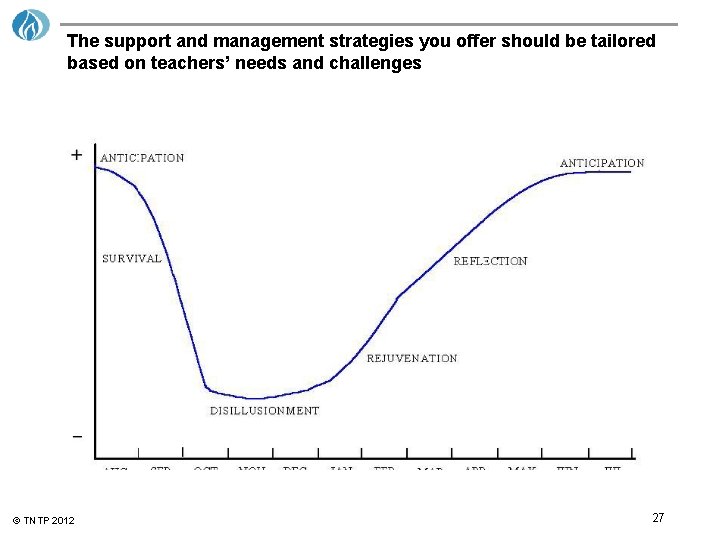
The support and management strategies you offer should be tailored based on teachers’ needs and challenges © TNTP 2012 27

During the first week, teachers need you to be visible and supportive TIPS • Pop in once students arrive to check on how things are going • Share sincere encouragement about their teaching at least twice • Identify mentors and what the support looks like • Give new teachers a welcome gift Strategies Resources 1. 2. 3. © TNTP 2012 28
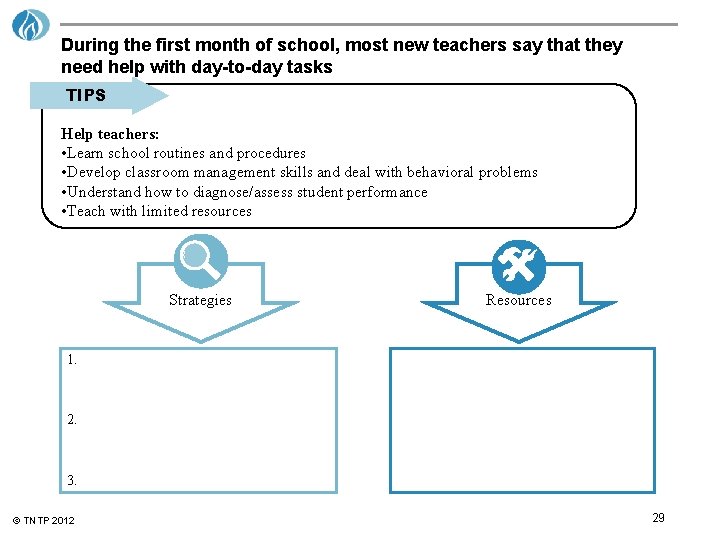
During the first month of school, most new teachers say that they need help with day-to-day tasks TIPS Help teachers: • Learn school routines and procedures • Develop classroom management skills and deal with behavioral problems • Understand how to diagnose/assess student performance • Teach with limited resources Strategies Resources 1. 2. 3. © TNTP 2012 29
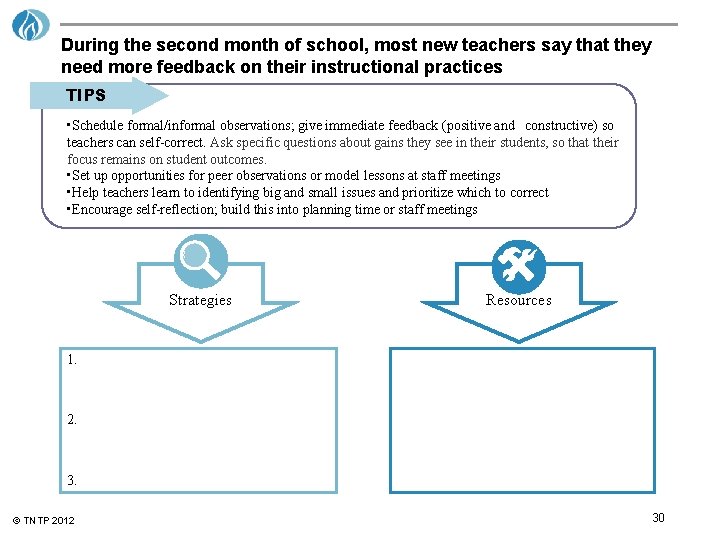
During the second month of school, most new teachers say that they need more feedback on their instructional practices TIPS • Schedule formal/informal observations; give immediate feedback (positive and constructive) so teachers can self-correct. Ask specific questions about gains they see in their students, so that their focus remains on student outcomes. • Set up opportunities for peer observations or model lessons at staff meetings • Help teachers learn to identifying big and small issues and prioritize which to correct • Encourage self-reflection; build this into planning time or staff meetings Strategies Resources 1. 2. 3. © TNTP 2012 30

Next Steps Begin planning activities for school-site orientation Gather resources for new teachers to include in emails and orientation information Complete a comprehensive onboarding work plan with clear objectives and aligned activities Draft a Mutual Expectations document for your school site and customize other relevant onboarding templates Create a comprehensive performance management plan with clear teacher performance benchmarks © TNTP 2012 31
- Slides: 31