Renormalization Group Theory SineGordon Model Mariana Malard Renormalization
- Slides: 22
Renormalization Group Theory & Sine-Gordon Model Mariana Malard
Renormalization Group Theory & Sine-Gordon Model SUMMARY OF THE LECTURES Lecture 1 January 16 th Renormalization Group Theory Ø Conceptual overview. Ø General procedure 0: Define a field theory Action. Ø General procedure I: Decompose in slow and fast modes. Ø General procedure II: Expressing S in terms of Green’s functions.
Renormalization Group Theory & Sine-Gordon Model SUMMARY OF THE LECTURES Lecture 2 January 21 st Renormalization Group Theory Ø General procedure III: Averaging in the fast modes’ ground state. Sine-Gordon Model Ø Ø Conceptual overview. The model. Re-scaled Action for the sine-Gordon model. Renormalization group flows equations of the sine-Gordon model.
Renormalization Group Theory & Sine-Gordon Model SUMMARY OF THE LECTURES Lecture 3 January 23 rd Kosterlitz-Thouless Phase Diagram Ø Gap
Renormalization Group Theory Conceptual overview RENORMALIZATION GROUP Theory of scale invariance and symmetries.
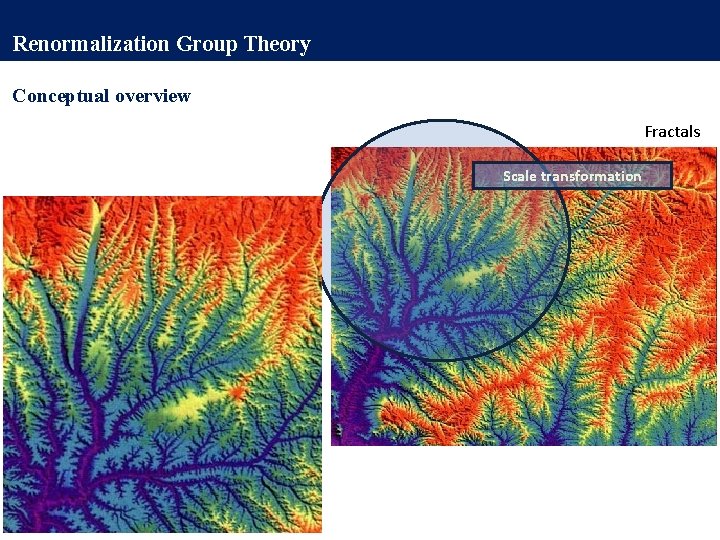
Renormalization Group Theory Conceptual overview Fractals Scale transformation RENORMALIZATION GROUP Theory of scale invariance and symmetries.
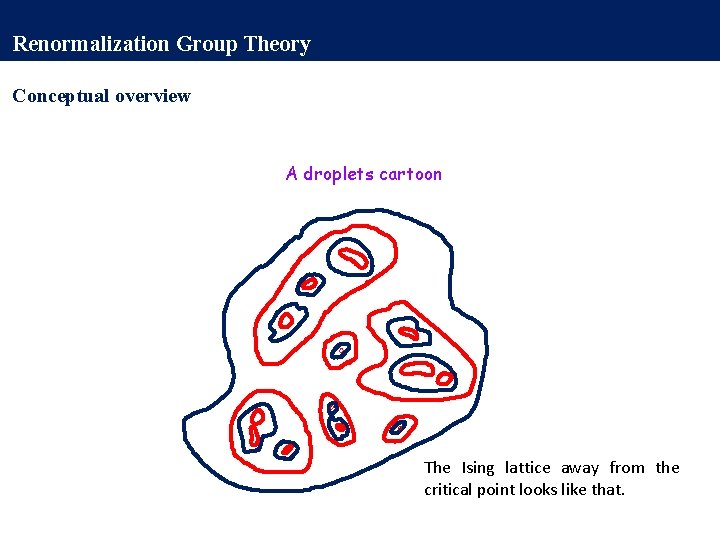
Renormalization Group Theory Conceptual overview A droplets cartoon The Ising lattice away from the critical point looks like that.
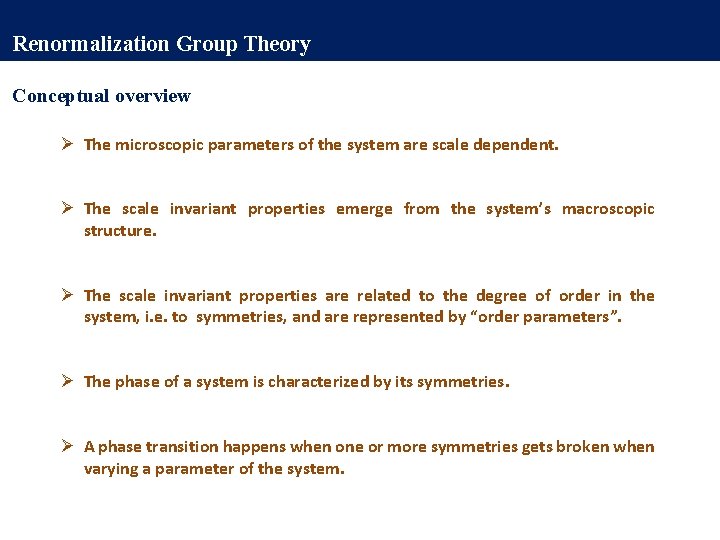
Renormalization Group Theory Conceptual overview Ø The microscopic parameters of the system are scale dependent. Ø The scale invariant properties emerge from the system’s macroscopic structure. Ø The scale invariant properties are related to the degree of order in the system, i. e. to symmetries, and are represented by “order parameters”. Ø The phase of a system is characterized by its symmetries. Ø A phase transition happens when one or more symmetries gets broken when varying a parameter of the system.
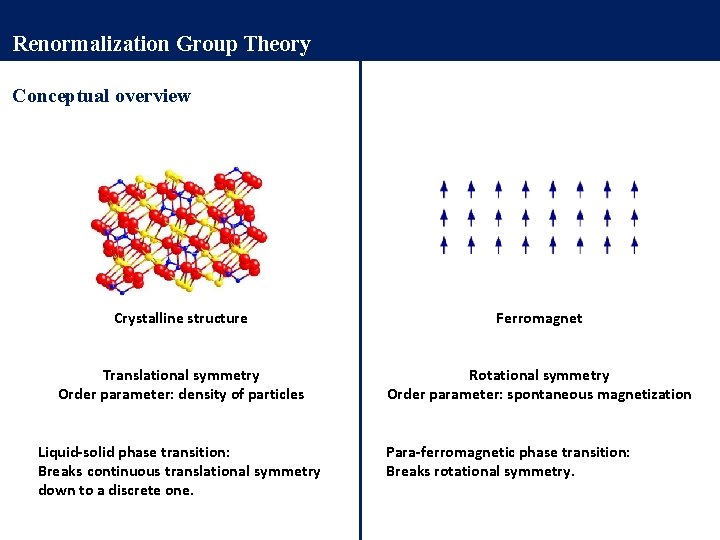
Renormalization Group Theory Conceptual overview Crystalline structure Ferromagnet Translational symmetry Order parameter: density of particles Rotational symmetry Order parameter: spontaneous magnetization Liquid-solid phase transition: Breaks continuous translational symmetry down to a discrete one. Para-ferromagnetic phase transition: Breaks rotational symmetry.
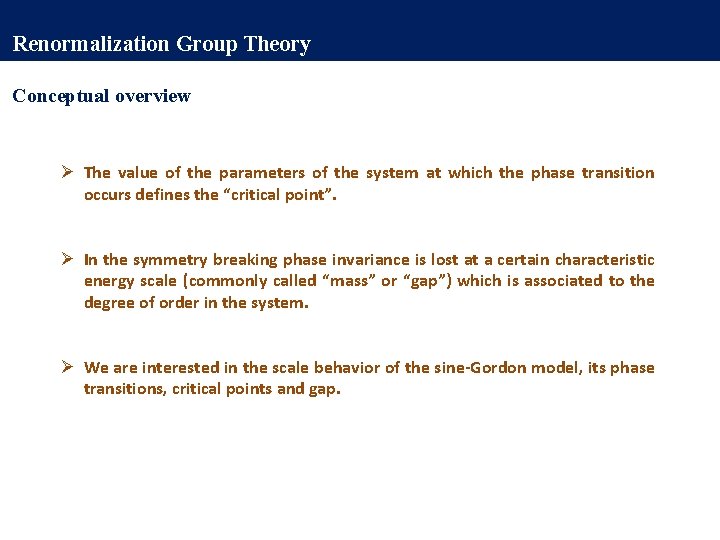
Renormalization Group Theory Conceptual overview Ø The value of the parameters of the system at which the phase transition occurs defines the “critical point”. Ø In the symmetry breaking phase invariance is lost at a certain characteristic energy scale (commonly called “mass” or “gap”) which is associated to the degree of order in the system. Ø We are interested in the scale behavior of the sine-Gordon model, its phase transitions, critical points and gap.
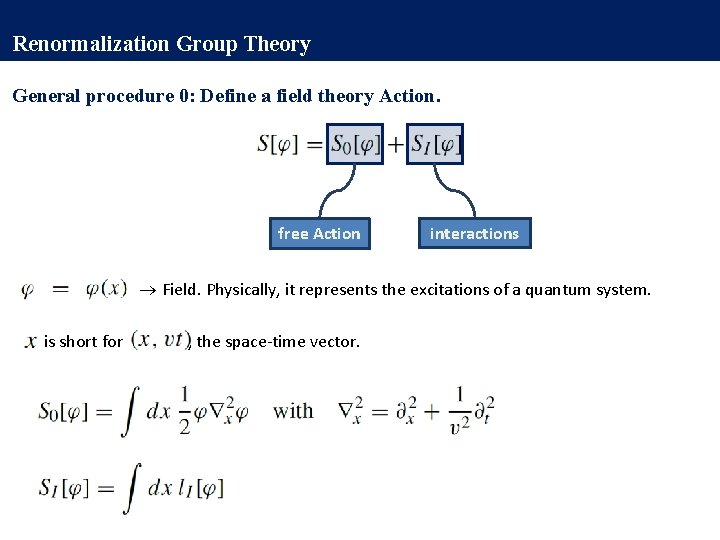
Renormalization Group Theory General procedure 0: Define a field theory Action. free Action interactions ® Field. Physically, it represents the excitations of a quantum system. is short for , the space-time vector.
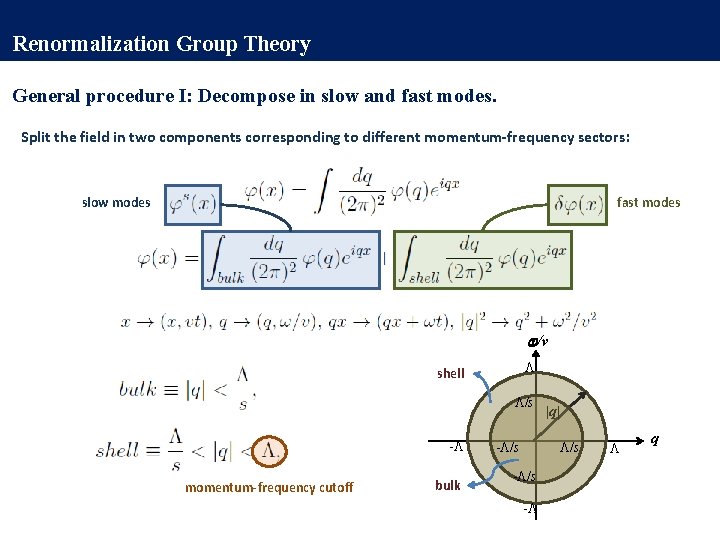
Renormalization Group Theory General procedure I: Decompose in slow and fast modes. Split the field in two components corresponding to different momentum-frequency sectors : slow modes fast modes /v shell /s - momentum-frequency cutoff bulk |q| /s - q
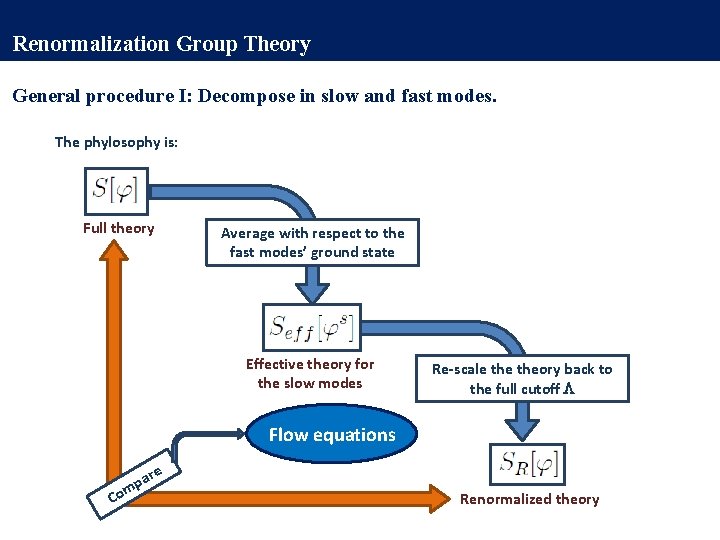
Renormalization Group Theory General procedure I: Decompose in slow and fast modes. The phylosophy is: Full theory Average with respect to the fast modes’ ground state Effective theory for the slow modes Re-scale theory back to the full cutoff Flow equations re a mp o C Renormalized theory
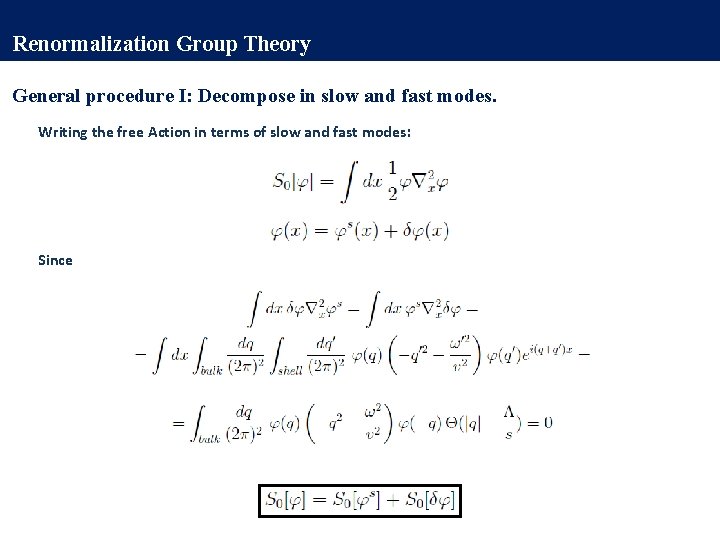
Renormalization Group Theory General procedure I: Decompose in slow and fast modes. Writing the free Action in terms of slow and fast modes: Since
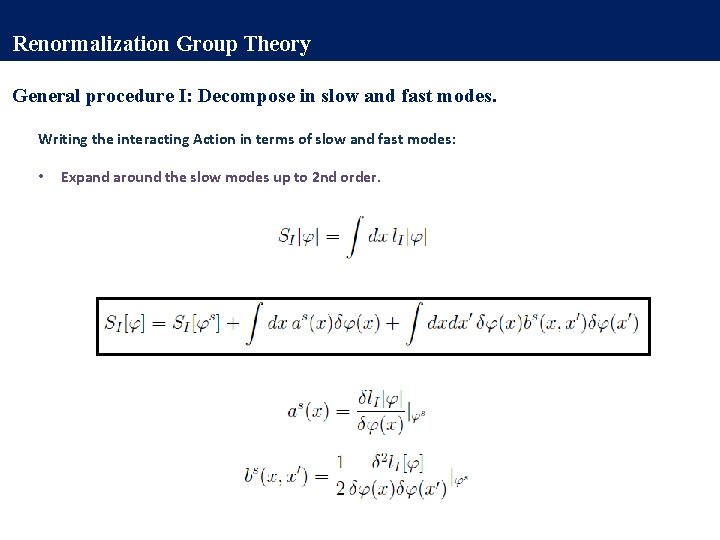
Renormalization Group Theory General procedure I: Decompose in slow and fast modes. Writing the interacting Action in terms of slow and fast modes: • Expand around the slow modes up to 2 nd order.
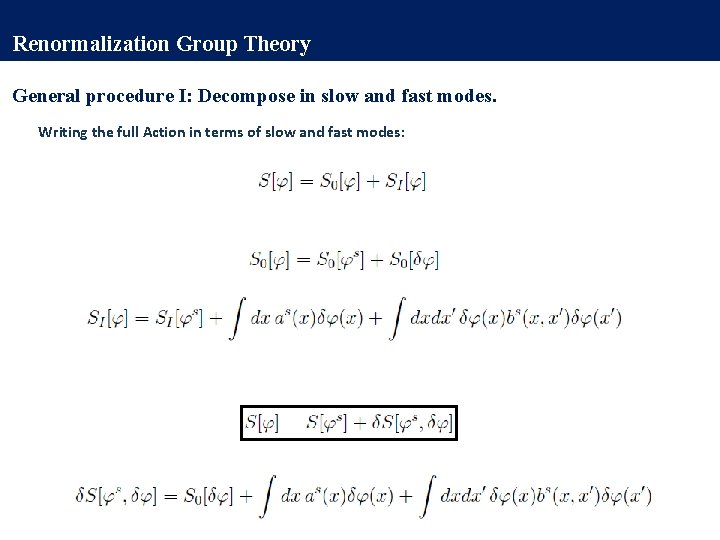
Renormalization Group Theory General procedure I: Decompose in slow and fast modes. Writing the full Action in terms of slow and fast modes:
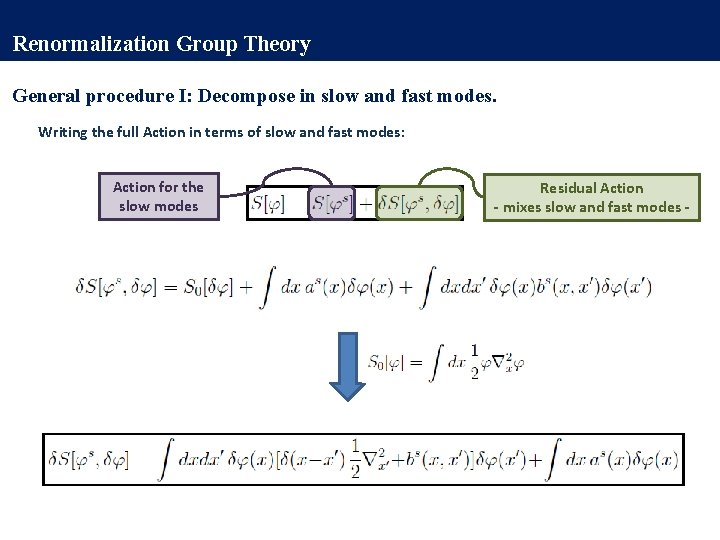
Renormalization Group Theory General procedure I: Decompose in slow and fast modes. Writing the full Action in terms of slow and fast modes: Action for the slow modes Residual Action - mixes slow and fast modes -
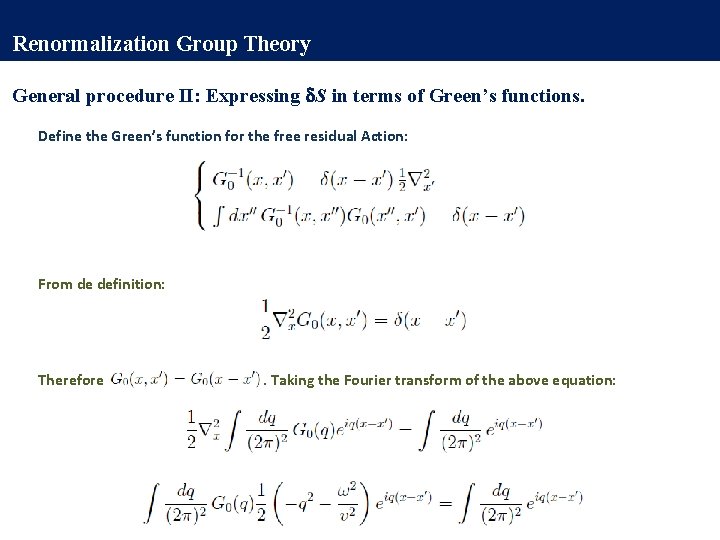
Renormalization Group Theory General procedure II: Expressing S in terms of Green’s functions. Define the Green’s function for the free residual Action: From de definition: Therefore . Taking the Fourier transform of the above equation:
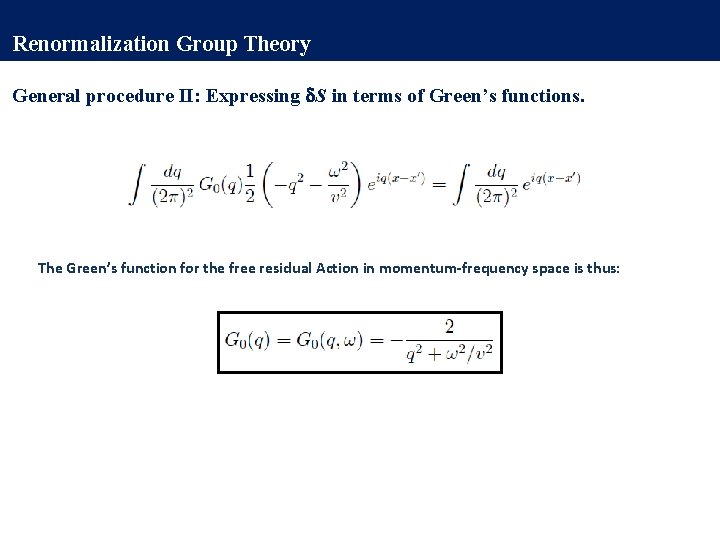
Renormalization Group Theory General procedure II: Expressing S in terms of Green’s functions. The Green’s function for the free residual Action in momentum-frequency space is thus:
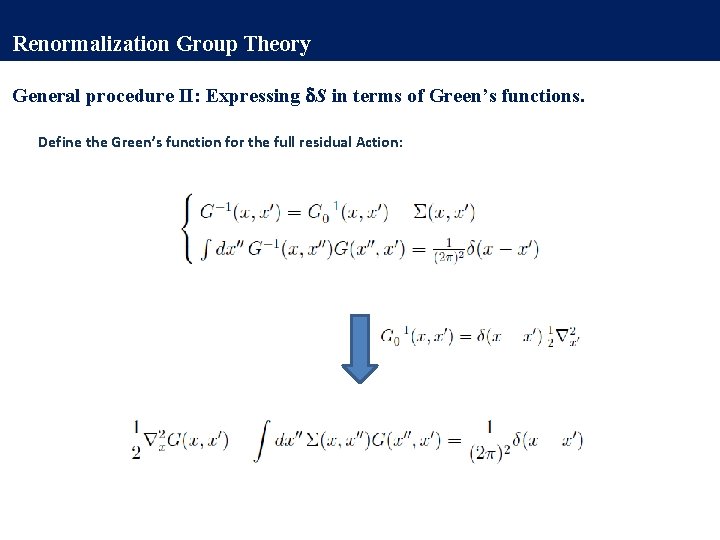
Renormalization Group Theory General procedure II: Expressing S in terms of Green’s functions. Define the Green’s function for the full residual Action:
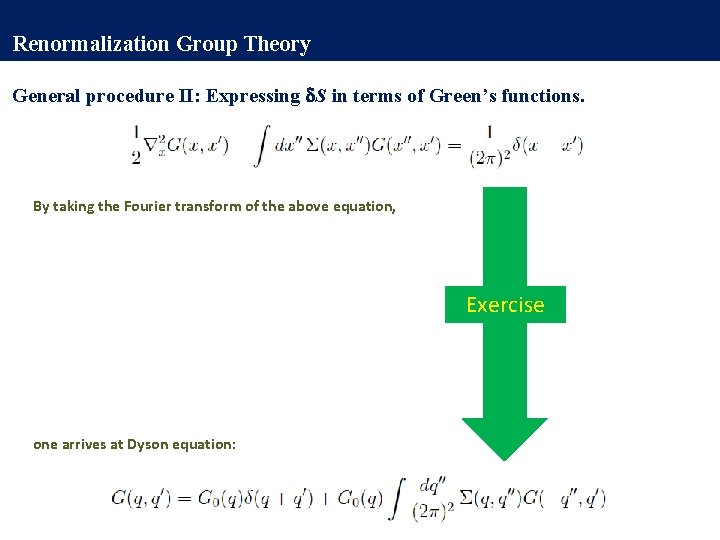
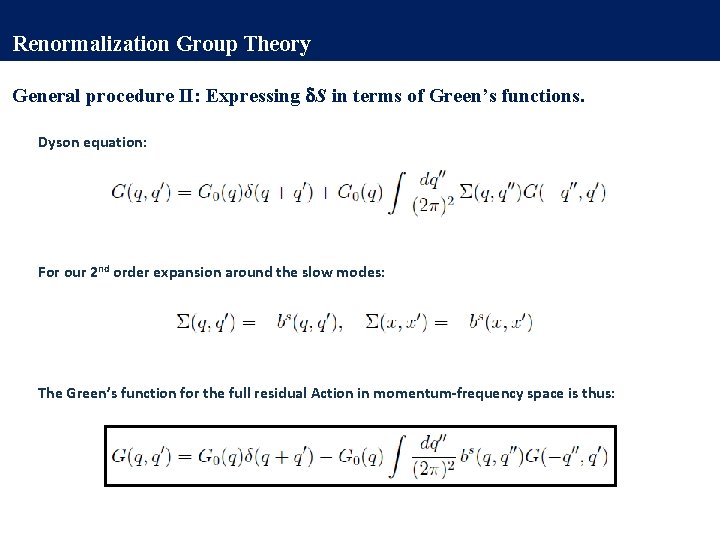
Renormalization Group Theory General procedure II: Expressing S in terms of Green’s functions. By taking the Fourier transform of the above equation, Exercise one arrives at Dyson equation:
Renormalization Group Theory General procedure II: Expressing S in terms of Green’s functions. Dyson equation: For our 2 nd order expansion around the slow modes: The Green’s function for the full residual Action in momentum-frequency space is thus: