Removing the Guesswork from Furnace Atmosphere Control with
- Slides: 24
Removing the Guesswork from Furnace Atmosphere Control with Laser Gas Analysis Atmosphere Recovery, Inc. 15800 32 nd Avenue North, Suite 110 Plymouth, MN 55447 Ph: (763) 557 -8675 Fax: (763) 557 -8668 Web: www. atmrcv. com E-mail: rrr@atmrcv. com 1
Presentation Outline ® Application Introduction ® Existing Technology Limitations ® Laser Gas Analyzer Technology ® Economic Benefits of LGA ® Example Process Applications ® Standard Carburizing ® Rapid Carburizing ® Exothermic Annealing 2
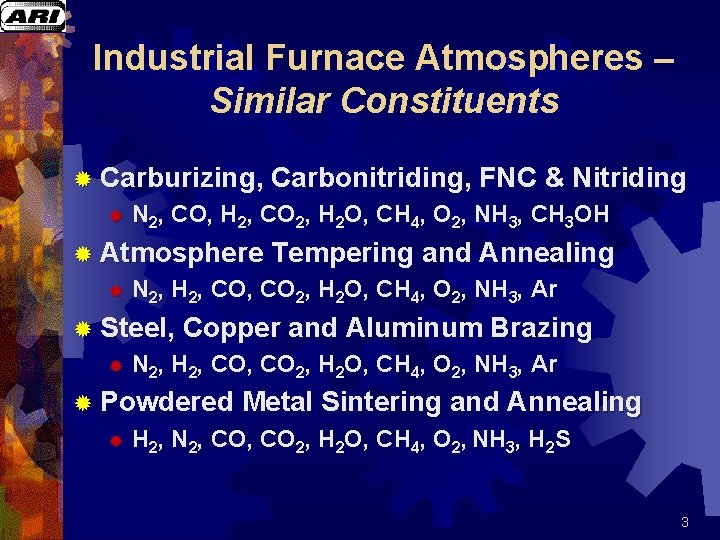
Industrial Furnace Atmospheres – Similar Constituents ® Carburizing, Carbonitriding, FNC & Nitriding ® N 2, CO, H 2, CO 2, H 2 O, CH 4, O 2, NH 3, CH 3 OH ® Atmosphere Tempering and Annealing ® N 2, H 2, CO 2, H 2 O, CH 4, O 2, NH 3, Ar ® Steel, Copper and Aluminum Brazing ® N 2, H 2, CO 2, H 2 O, CH 4, O 2, NH 3, Ar ® Powdered Metal Sintering and Annealing ® H 2, N 2, CO 2, H 2 O, CH 4, O 2, NH 3, H 2 S 3
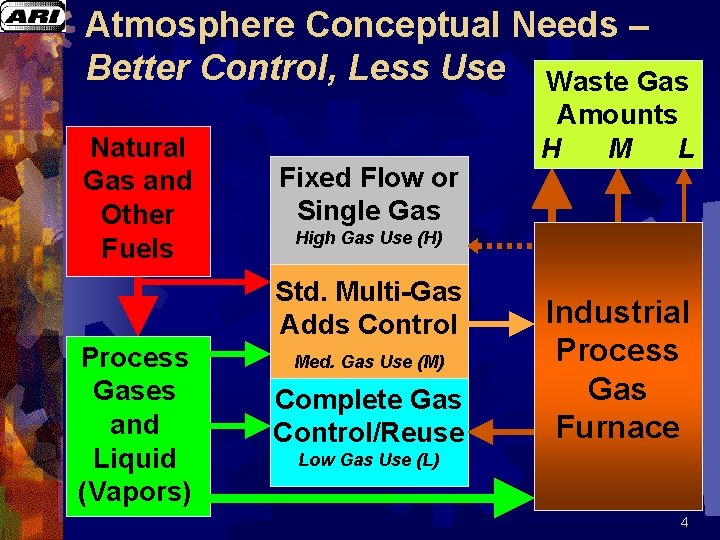
Atmosphere Conceptual Needs – Better Control, Less Use Waste Gas Natural Gas and Other Fuels Fixed Flow or Single Gas High Gas Use (H) Std. Multi-Gas Adds Control Process Gases and Liquid (Vapors) Amounts H M L Med. Gas Use (M) Complete Gas Control/Reuse Industrial Process Gas Furnace Low Gas Use (L) 4
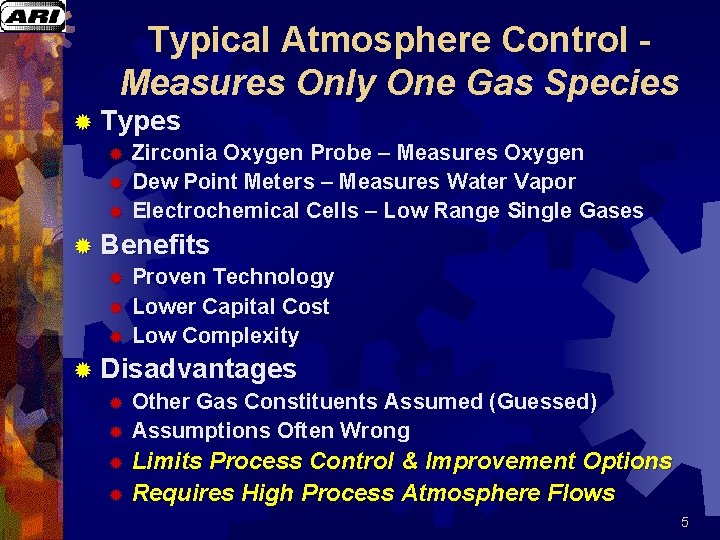
Typical Atmosphere Control - Measures Only One Gas Species ® Types ® Zirconia Oxygen Probe – Measures Oxygen ® Dew Point Meters – Measures Water Vapor ® Electrochemical Cells – Low Range Single Gases ® Benefits ® Proven Technology ® Lower Capital Cost ® Low Complexity ® Disadvantages ® Other Gas Constituents Assumed (Guessed) ® Assumptions Often Wrong ® Limits Process Control & Improvement Options ® Requires High Process Atmosphere Flows 5
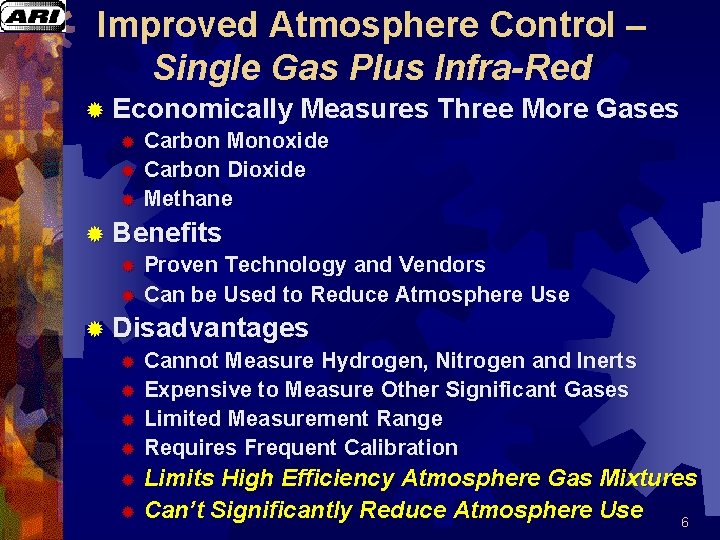
Improved Atmosphere Control – Single Gas Plus Infra-Red ® Economically Measures Three More Gases ® Carbon Monoxide ® Carbon Dioxide ® Methane ® Benefits ® Proven Technology and Vendors ® Can be Used to Reduce Atmosphere Use ® Disadvantages ® Cannot Measure Hydrogen, Nitrogen and Inerts ® Expensive to Measure Other Significant Gases ® Limited Measurement Range ® Requires Frequent Calibration ® Limits High Efficiency Atmosphere Gas Mixtures ® Can’t Significantly Reduce Atmosphere Use 6
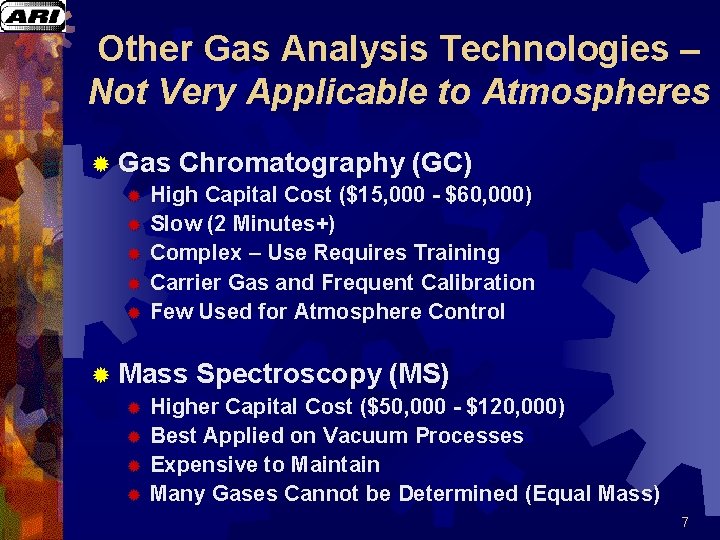
Other Gas Analysis Technologies – Not Very Applicable to Atmospheres ® Gas Chromatography (GC) ® High Capital Cost ($15, 000 - $60, 000) ® Slow (2 Minutes+) ® Complex – Use Requires Training ® Carrier Gas and Frequent Calibration ® Few Used for Atmosphere Control ® Mass Spectroscopy (MS) ® Higher Capital Cost ($50, 000 - $120, 000) ® Best Applied on Vacuum Processes ® Expensive to Maintain ® Many Gases Cannot be Determined (Equal Mass) 7
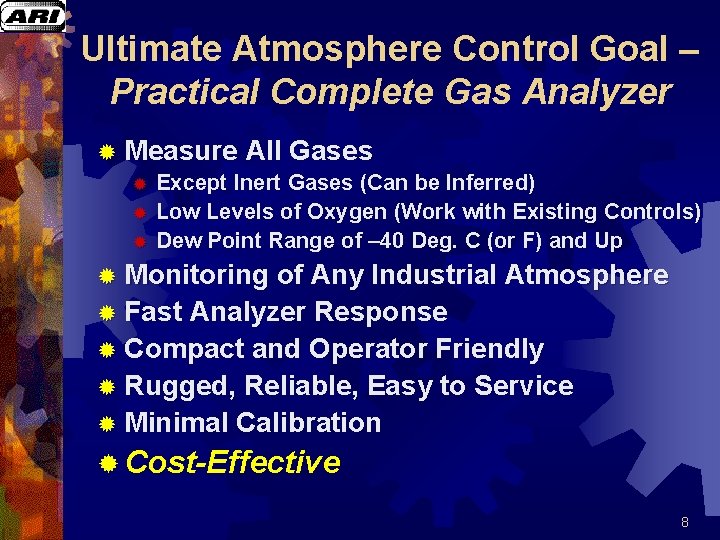
Ultimate Atmosphere Control Goal – Practical Complete Gas Analyzer ® Measure All Gases ® Except Inert Gases (Can be Inferred) ® Low Levels of Oxygen (Work with Existing Controls) ® Dew Point Range of – 40 Deg. C (or F) and Up ® Monitoring of Any Industrial Atmosphere ® Fast Analyzer Response ® Compact and Operator Friendly ® Rugged, Reliable, Easy to Service ® Minimal Calibration ® Cost-Effective 8
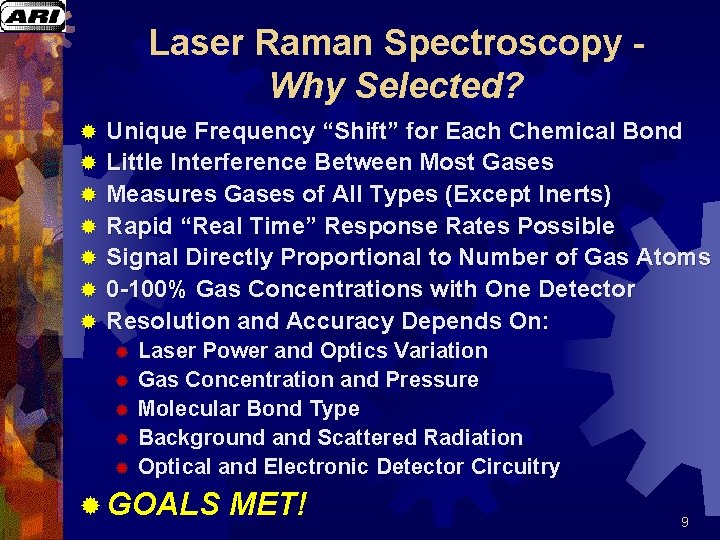
Laser Raman Spectroscopy - Why Selected? ® ® ® ® Unique Frequency “Shift” for Each Chemical Bond Little Interference Between Most Gases Measures Gases of All Types (Except Inerts) Rapid “Real Time” Response Rates Possible Signal Directly Proportional to Number of Gas Atoms 0 -100% Gas Concentrations with One Detector Resolution and Accuracy Depends On: ® ® ® Laser Power and Optics Variation Gas Concentration and Pressure Molecular Bond Type Background and Scattered Radiation Optical and Electronic Detector Circuitry ® GOALS MET! 9
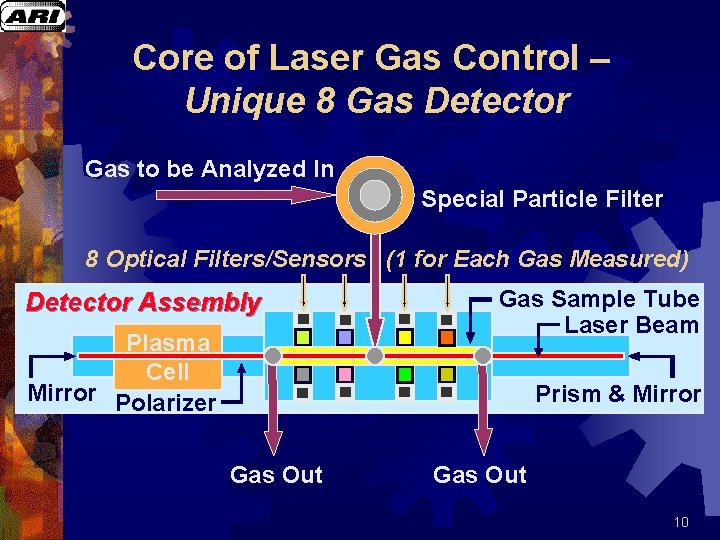
Core of Laser Gas Control – Unique 8 Gas Detector Gas to be Analyzed In Special Particle Filter 8 Optical Filters/Sensors (1 for Each Gas Measured) Detector Assembly Plasma Cell Mirror Polarizer Gas Sample Tube Laser Beam Prism & Mirror Gas Out 10
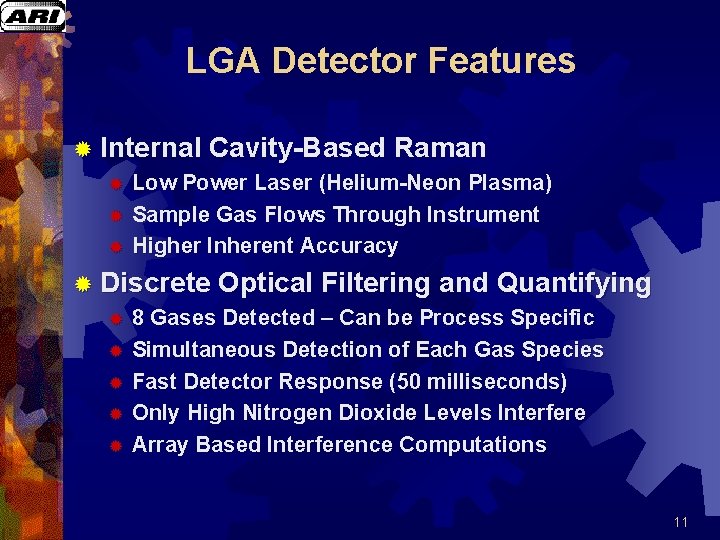
LGA Detector Features ® Internal Cavity-Based Raman ® Low Power Laser (Helium-Neon Plasma) ® Sample Gas Flows Through Instrument ® Higher Inherent Accuracy ® Discrete Optical Filtering and Quantifying ® 8 Gases Detected – Can be Process Specific ® Simultaneous Detection of Each Gas Species ® Fast Detector Response (50 milliseconds) ® Only High Nitrogen Dioxide Levels Interfere ® Array Based Interference Computations 11
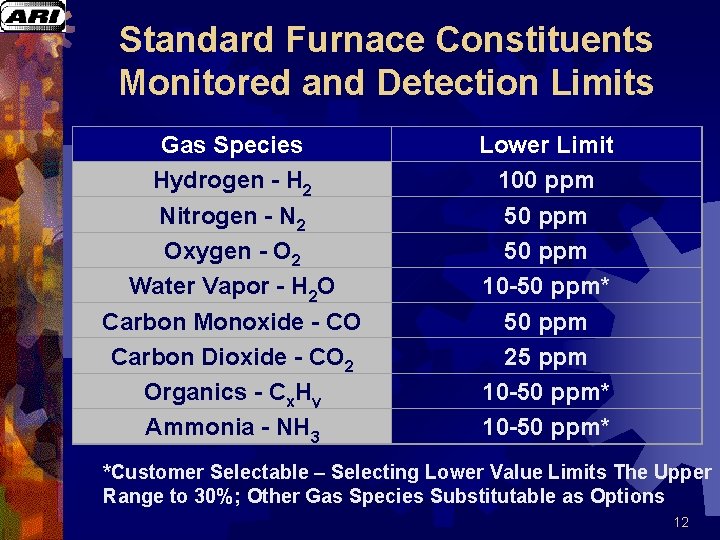
Standard Furnace Constituents Monitored and Detection Limits Gas Species Hydrogen - H 2 Nitrogen - N 2 Oxygen - O 2 Water Vapor - H 2 O Carbon Monoxide - CO Carbon Dioxide - CO 2 Organics - Cx. Hy Ammonia - NH 3 Lower Limit 100 ppm 50 ppm 10 -50 ppm* 50 ppm 25 ppm 10 -50 ppm* *Customer Selectable – Selecting Lower Value Limits The Upper Range to 30%; Other Gas Species Substitutable as Options 12
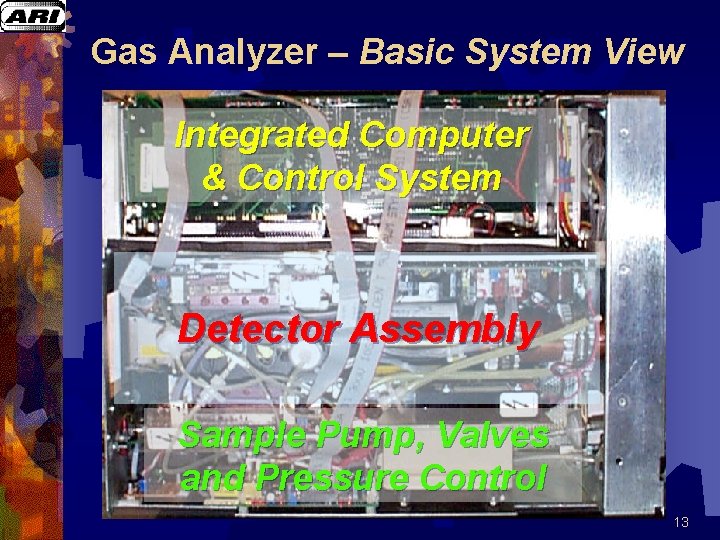
Gas Analyzer – Basic System View Integrated Computer & Control System Detector Assembly Sample Pump, Valves and Pressure Control 13
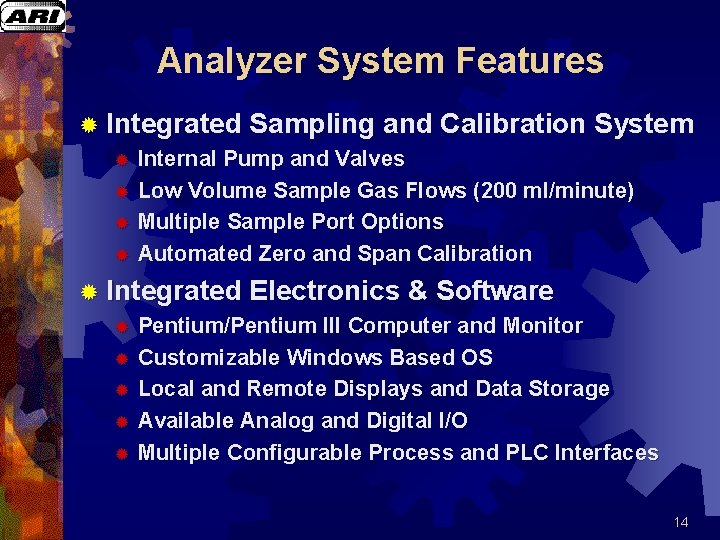
Analyzer System Features ® Integrated Sampling and Calibration System ® Internal Pump and Valves ® Low Volume Sample Gas Flows (200 ml/minute) ® Multiple Sample Port Options ® Automated Zero and Span Calibration ® Integrated Electronics & Software ® Pentium/Pentium III Computer and Monitor ® Customizable Windows Based OS ® Local and Remote Displays and Data Storage ® Available Analog and Digital I/O ® Multiple Configurable Process and PLC Interfaces 14
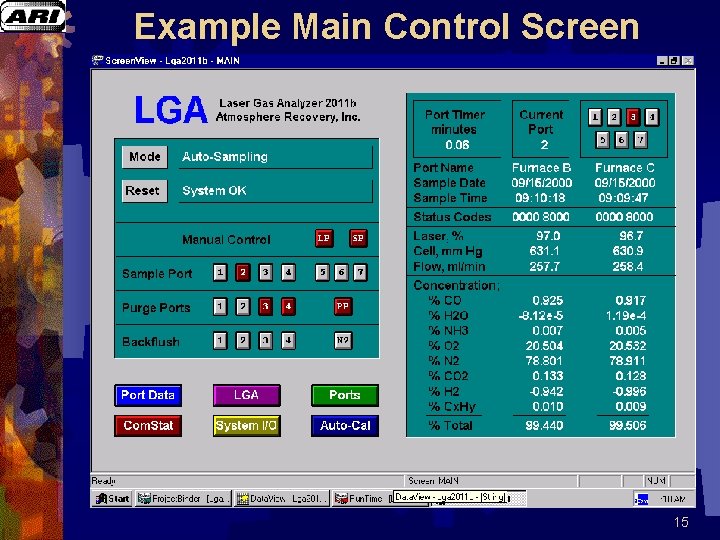
Example Main Control Screen 15
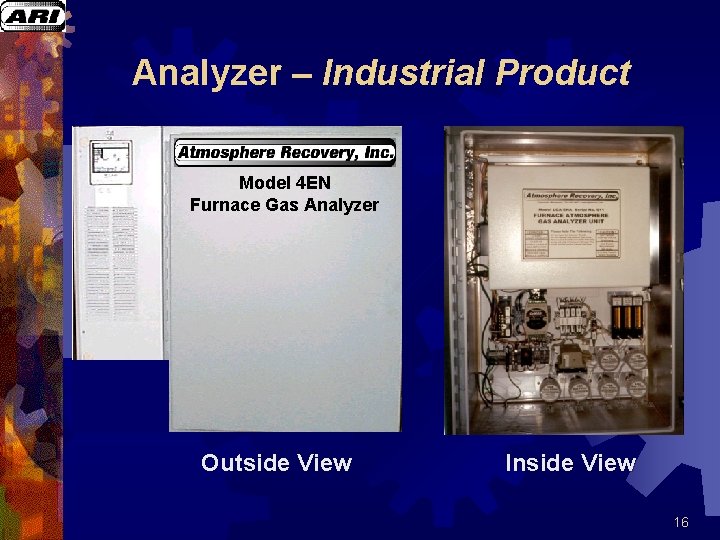
Analyzer – Industrial Product Model 4 EN Furnace Gas Analyzer Outside View Inside View 16
Industrial Product Features ® “Real Time” Process Monitoring and Control (1 to 15 Seconds - Depends on Number of Ports and Options) Operates with Existing PLCs and Sensors ® Low Volume Sample Gas Flows (200 ml/minute) ® Electronic Flow and Pressure Monitoring ® Optics and Enclosure Inerting (Standard for Heat Treating Atmosphere Analysis) ® Multiple Sample Ports (16 + Optional) ® Sample Line Purge and Back-flush (Optional) ® High Dew Point Atmosphere Operation (Optional) ® Standard NEMA Enclosures ® 17
Economic Benefits of Laser Gas Atmosphere Analysis and Control ® Multiple Gas Analysis Capability = System Versatility ® Economic Paybacks in Many Ways ® Reduce Energy Costs ® Increase Production Capacity Depends ® Improve Component Quality on System ® Improve Component Consistency ® Reduce Destructive Analysis Costs Functions ® Reduce Re-Work Costs Used ® Better Process Documentation ® Maintenance Early Warnings ® Enhanced Furnace Safety 18
Benefits of Laser Gas Analysis Surface Hardening Quality with Standard Atmospheres ® Surface Carbon (or Nitrogen) Properties ® Improved Surface Hardness ® Controlled Surface Retained Austenite ® Consistent Compressive Residual Stress ® Reduced Intergranular Oxidation ® Improved Same Batch Consistency ® Improved Batch-to-Batch Consistency ® Faster Cycle Times 19
Benefits of Laser Gas Analysis Heat Treating Energy Savings ® Atmosphere Gas Consumption Reduced Endothermic Example – 90%+ Exothermic Example – 50%+ ® Extra Gas Generators Turned Off ® Shorter Cycle Times Inherent Carburizing Example – 20% ® Total Process Savings Significant Carburizing Example – 25% of Total Furnace Exothermic Example – 15% of Total Furnace 20
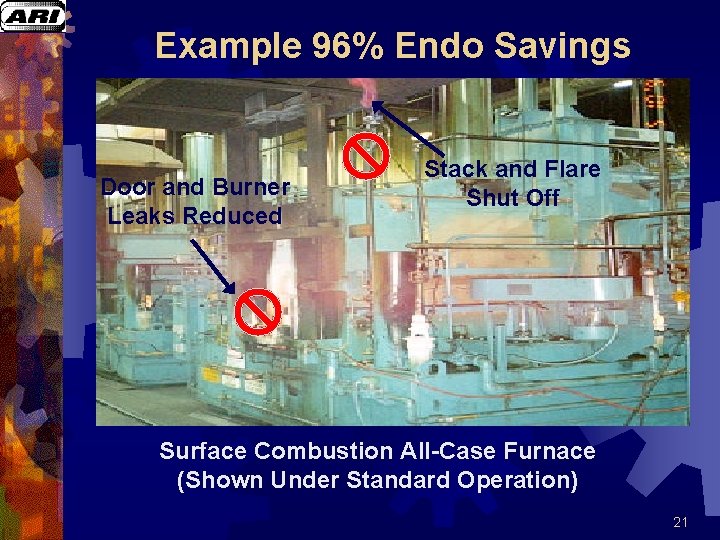
Example 96% Endo Savings Door and Burner Leaks Reduced Stack and Flare Shut Off Surface Combustion All-Case Furnace (Shown Under Standard Operation) 21
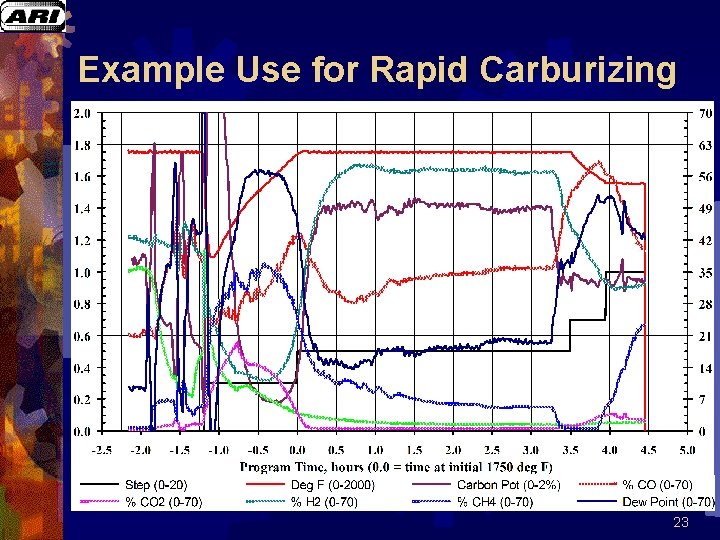
Benefits of Laser Gas Analysis – In-Situ Rapid Carburizing ® Greatly Increased Production Capacity Example: Cycle time for ~1 mm case reduced 50% ® Up to 40% Energy Savings ® Elimination of Endo Generators ® Further Improved Product Quality ® Reduced Sooting and Furnace Maintenance 22
Example Use for Rapid Carburizing 23
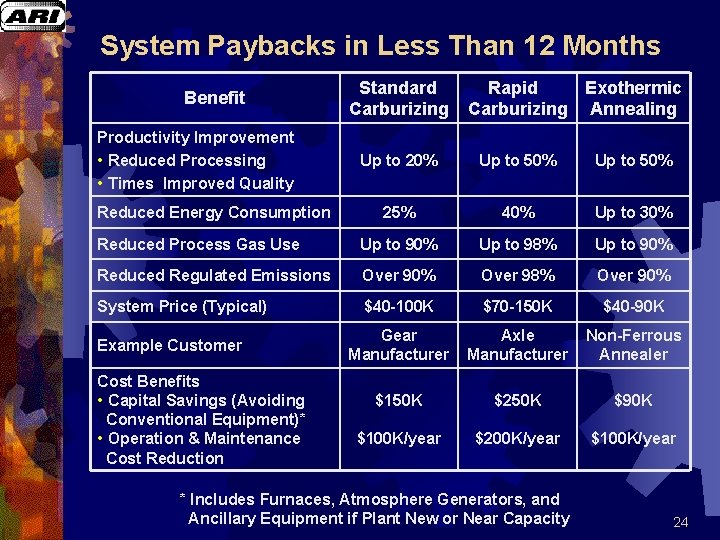
System Paybacks in Less Than 12 Months Benefit Productivity Improvement • Reduced Processing • Times Improved Quality Standard Carburizing Rapid Exothermic Carburizing Annealing Up to 20% Up to 50% 25% 40% Up to 30% Reduced Process Gas Use Up to 90% Up to 98% Up to 90% Reduced Regulated Emissions Over 90% Over 98% Over 90% System Price (Typical) $40 -100 K $70 -150 K $40 -90 K Gear Manufacturer Axle Manufacturer Non-Ferrous Annealer $150 K $250 K $90 K $100 K/year $200 K/year $100 K/year Reduced Energy Consumption Example Customer Cost Benefits • Capital Savings (Avoiding Conventional Equipment)* • Operation & Maintenance Cost Reduction * Includes Furnaces, Atmosphere Generators, and Ancillary Equipment if Plant New or Near Capacity 24