Relation Def A relation is any set of

- Slides: 36
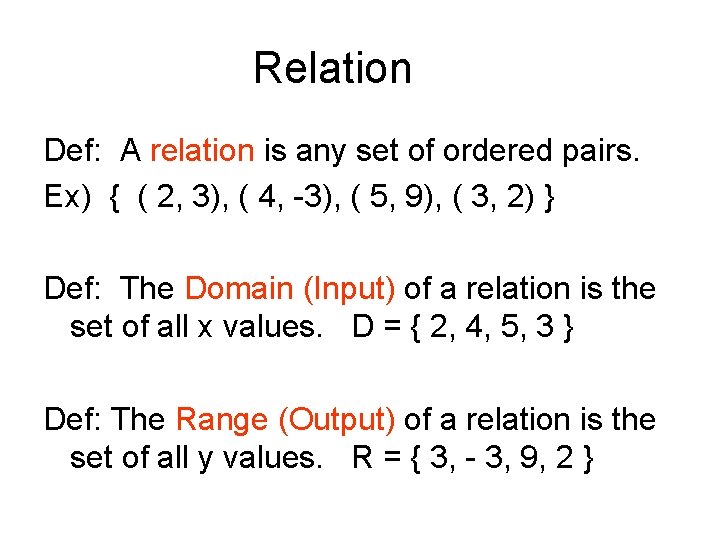
Relation Def: A relation is any set of ordered pairs. Ex) { ( 2, 3), ( 4, -3), ( 5, 9), ( 3, 2) } Def: The Domain (Input) of a relation is the set of all x values. D = { 2, 4, 5, 3 } Def: The Range (Output) of a relation is the set of all y values. R = { 3, - 3, 9, 2 }
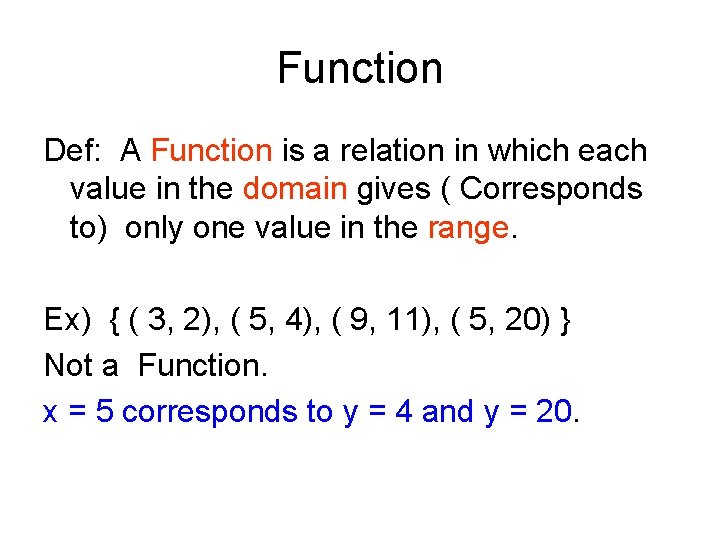
Function Def: A Function is a relation in which each value in the domain gives ( Corresponds to) only one value in the range. Ex) { ( 3, 2), ( 5, 4), ( 9, 11), ( 5, 20) } Not a Function. x = 5 corresponds to y = 4 and y = 20.
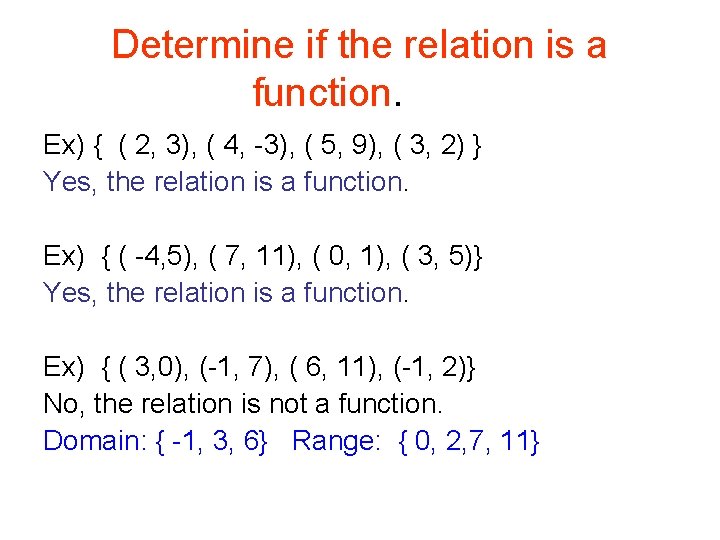
Determine if the relation is a function. Ex) { ( 2, 3), ( 4, -3), ( 5, 9), ( 3, 2) } Yes, the relation is a function. Ex) { ( -4, 5), ( 7, 11), ( 0, 1), ( 3, 5)} Yes, the relation is a function. Ex) { ( 3, 0), (-1, 7), ( 6, 11), (-1, 2)} No, the relation is not a function. Domain: { -1, 3, 6} Range: { 0, 2, 7, 11}
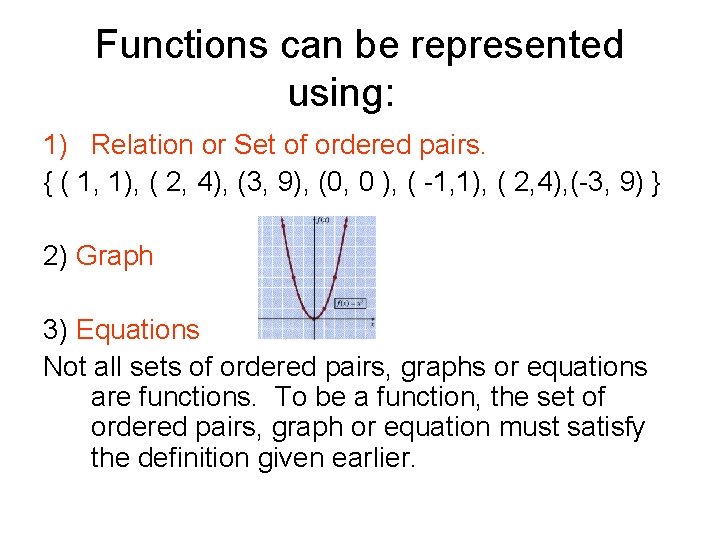
Functions can be represented using: 1) Relation or Set of ordered pairs. { ( 1, 1), ( 2, 4), (3, 9), (0, 0 ), ( -1, 1), ( 2, 4), (-3, 9) } 2) Graph 3) Equations Not all sets of ordered pairs, graphs or equations are functions. To be a function, the set of ordered pairs, graph or equation must satisfy the definition given earlier.
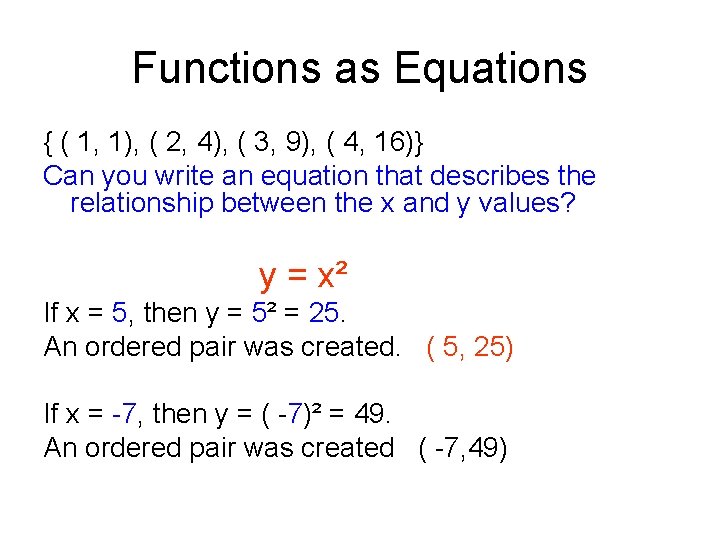
Functions as Equations { ( 1, 1), ( 2, 4), ( 3, 9), ( 4, 16)} Can you write an equation that describes the relationship between the x and y values? y = x² If x = 5, then y = 5² = 25. An ordered pair was created. ( 5, 25) If x = -7, then y = ( -7)² = 49. An ordered pair was created ( -7, 49)
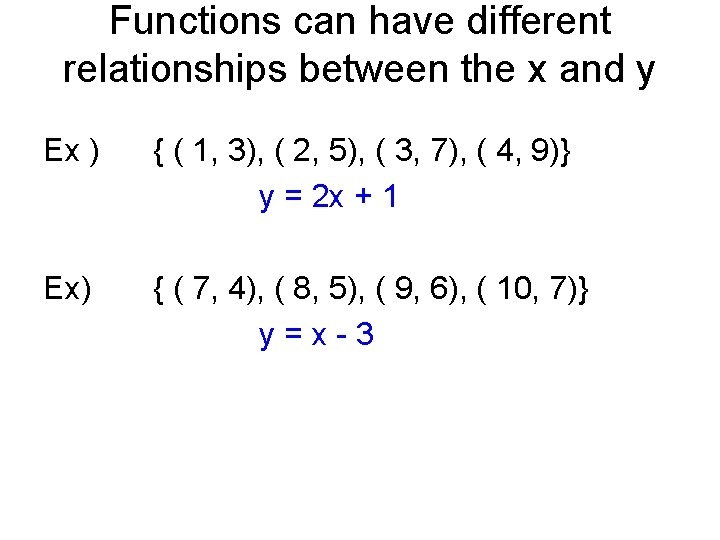
Functions can have different relationships between the x and y Ex ) { ( 1, 3), ( 2, 5), ( 3, 7), ( 4, 9)} y = 2 x + 1 Ex) { ( 7, 4), ( 8, 5), ( 9, 6), ( 10, 7)} y=x-3
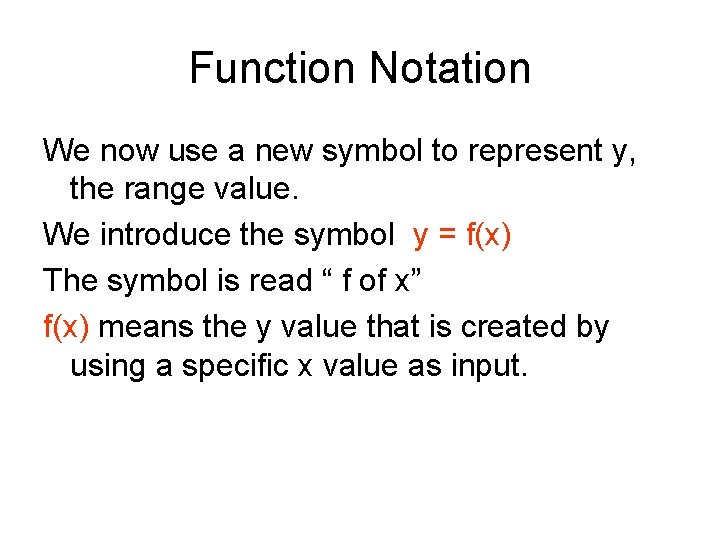
Function Notation We now use a new symbol to represent y, the range value. We introduce the symbol y = f(x) The symbol is read “ f of x” f(x) means the y value that is created by using a specific x value as input.
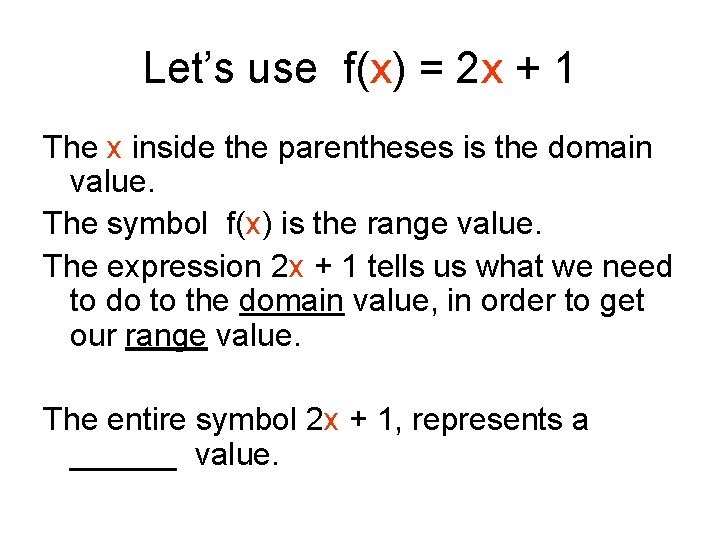
Let’s use f(x) = 2 x + 1 The x inside the parentheses is the domain value. The symbol f(x) is the range value. The expression 2 x + 1 tells us what we need to do to the domain value, in order to get our range value. The entire symbol 2 x + 1, represents a ______ value.
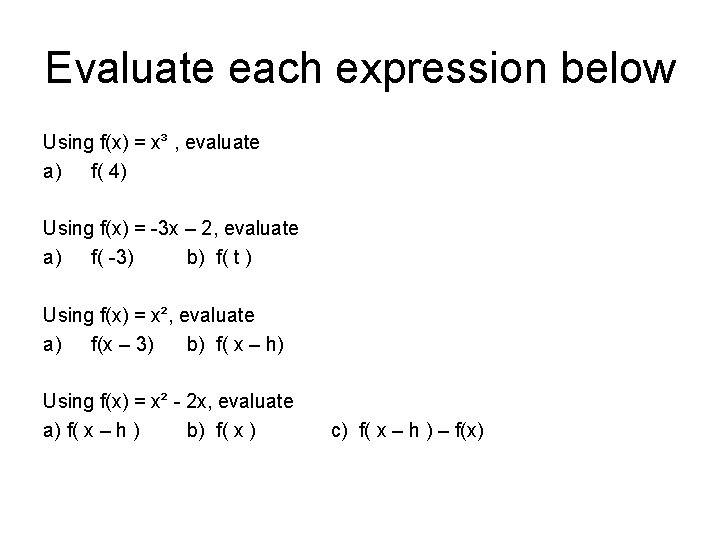
Evaluate each expression below Using f(x) = x³ , evaluate a) f( 4) Using f(x) = -3 x – 2, evaluate a) f( -3) b) f( t ) Using f(x) = x², evaluate a) f(x – 3) b) f( x – h) Using f(x) = x² - 2 x, evaluate a) f( x – h ) b) f( x ) c) f( x – h ) – f(x)
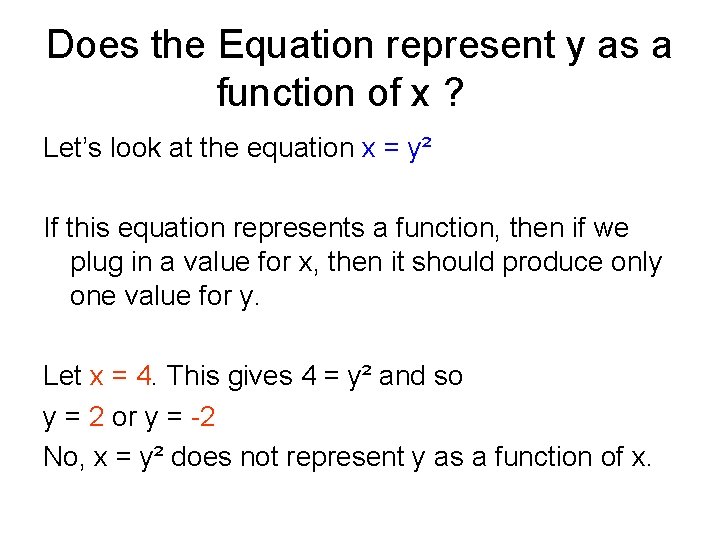
Does the Equation represent y as a function of x ? Let’s look at the equation x = y² If this equation represents a function, then if we plug in a value for x, then it should produce only one value for y. Let x = 4. This gives 4 = y² and so y = 2 or y = -2 No, x = y² does not represent y as a function of x.
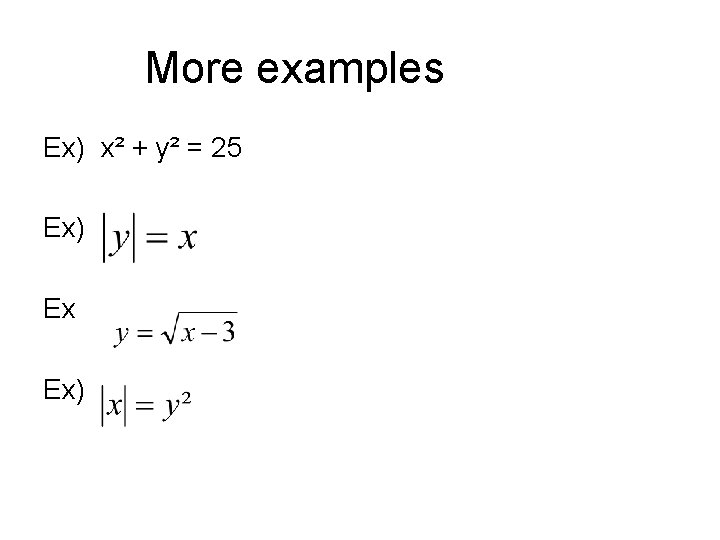
More examples Ex) x² + y² = 25 Ex) Ex Ex)
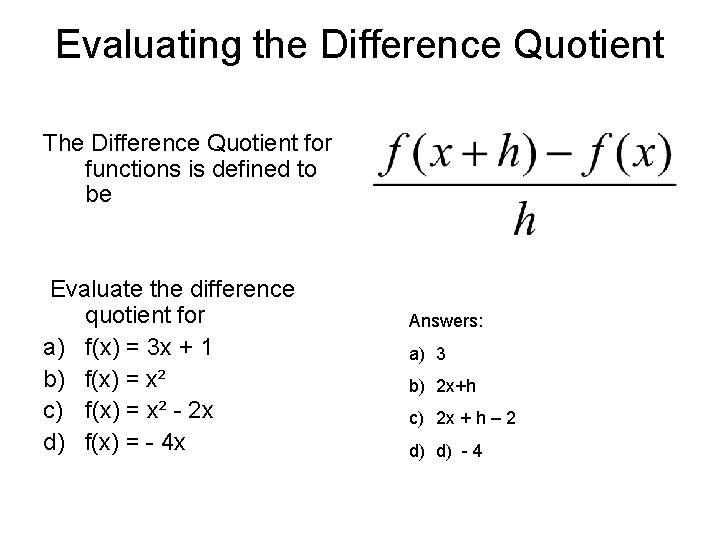
Evaluating the Difference Quotient The Difference Quotient for functions is defined to be Evaluate the difference quotient for a) f(x) = 3 x + 1 b) f(x) = x² c) f(x) = x² - 2 x d) f(x) = - 4 x Answers: a) 3 b) 2 x+h c) 2 x + h – 2 d) d) - 4
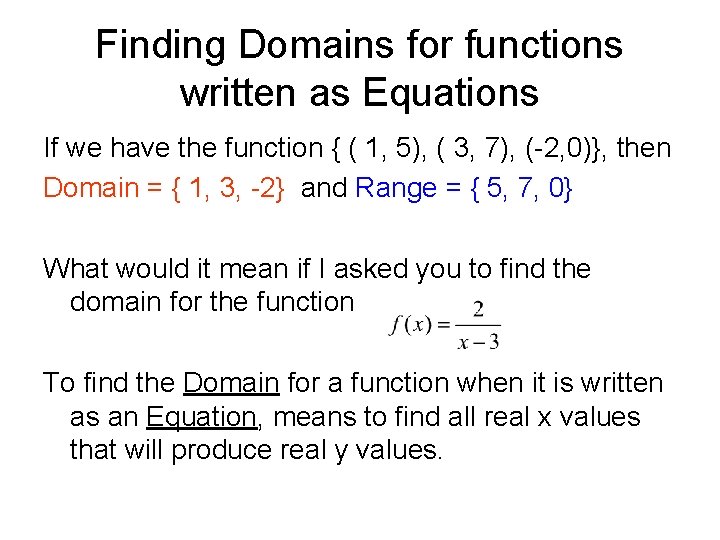
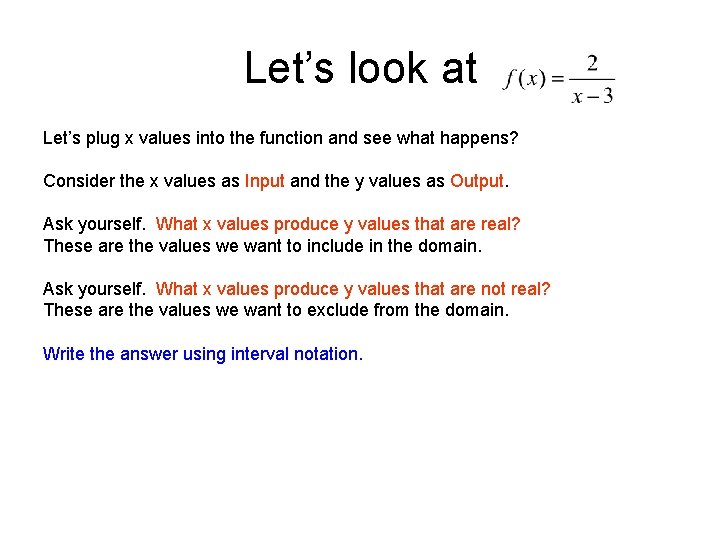
Finding Domains for functions written as Equations If we have the function { ( 1, 5), ( 3, 7), (-2, 0)}, then Domain = { 1, 3, -2} and Range = { 5, 7, 0} What would it mean if I asked you to find the domain for the function To find the Domain for a function when it is written as an Equation, means to find all real x values that will produce real y values.
Let’s look at Let’s plug x values into the function and see what happens? Consider the x values as Input and the y values as Output. Ask yourself. What x values produce y values that are real? These are the values we want to include in the domain. Ask yourself. What x values produce y values that are not real? These are the values we want to exclude from the domain. Write the answer using interval notation.
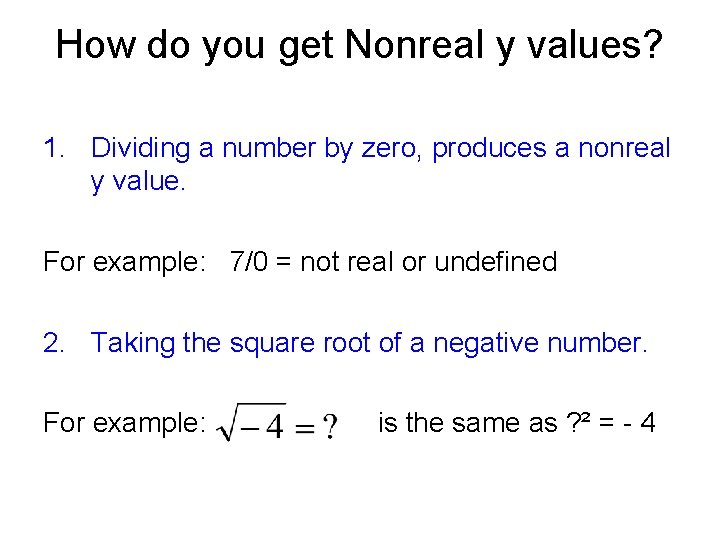
How do you get Nonreal y values? 1. Dividing a number by zero, produces a nonreal y value. For example: 7/0 = not real or undefined 2. Taking the square root of a negative number. For example: is the same as ? ² = - 4
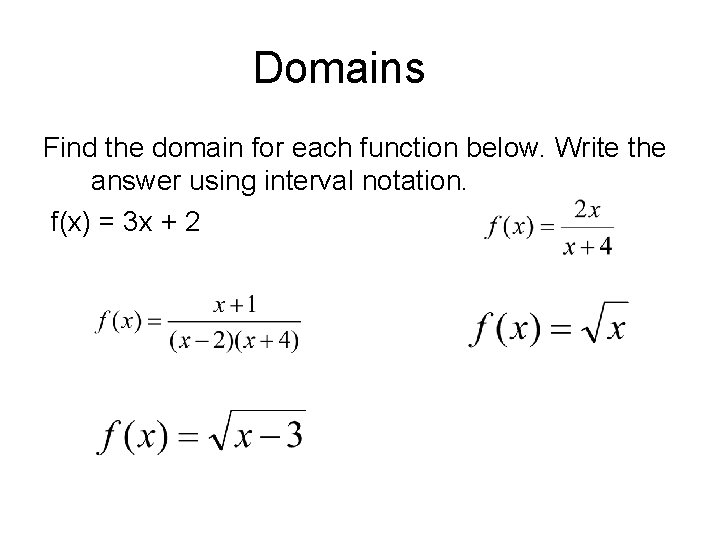
Domains Find the domain for each function below. Write the answer using interval notation. f(x) = 3 x + 2
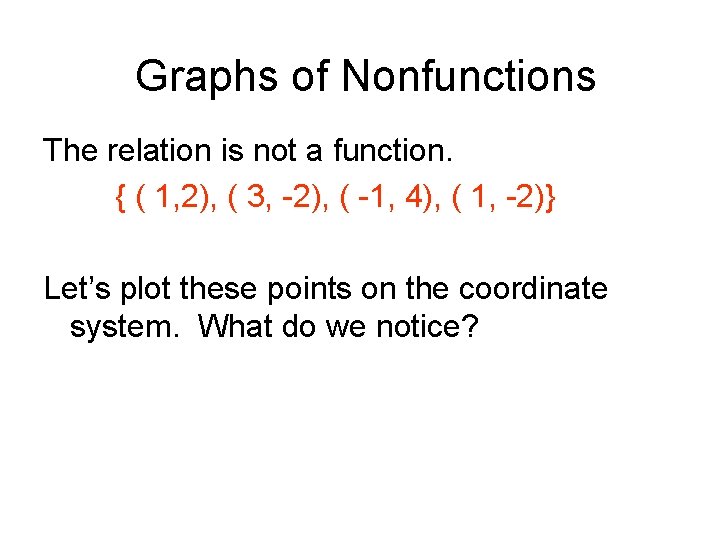
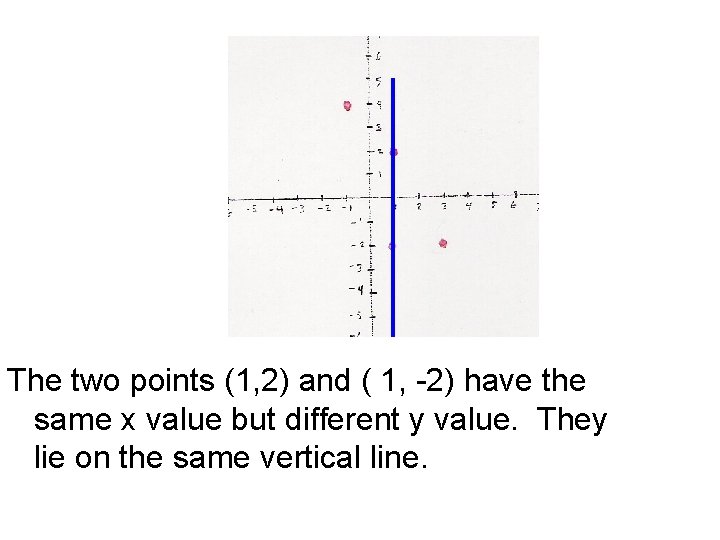
Graphs of Nonfunctions The relation is not a function. { ( 1, 2), ( 3, -2), ( -1, 4), ( 1, -2)} Let’s plot these points on the coordinate system. What do we notice?
The two points (1, 2) and ( 1, -2) have the same x value but different y value. They lie on the same vertical line.
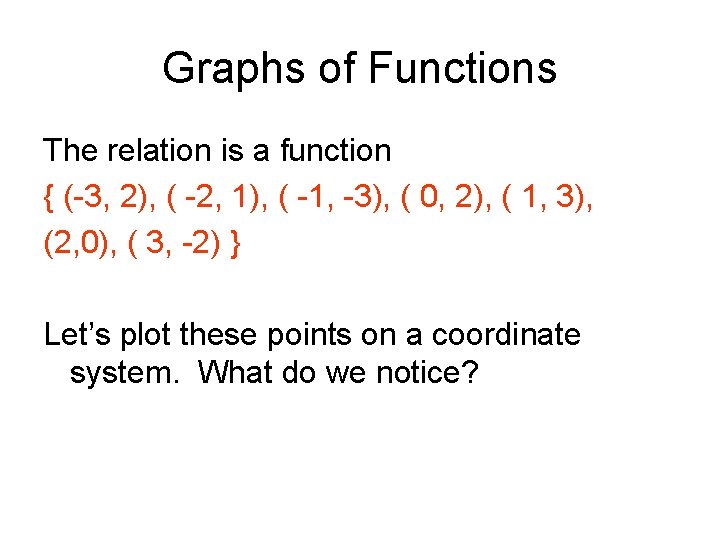
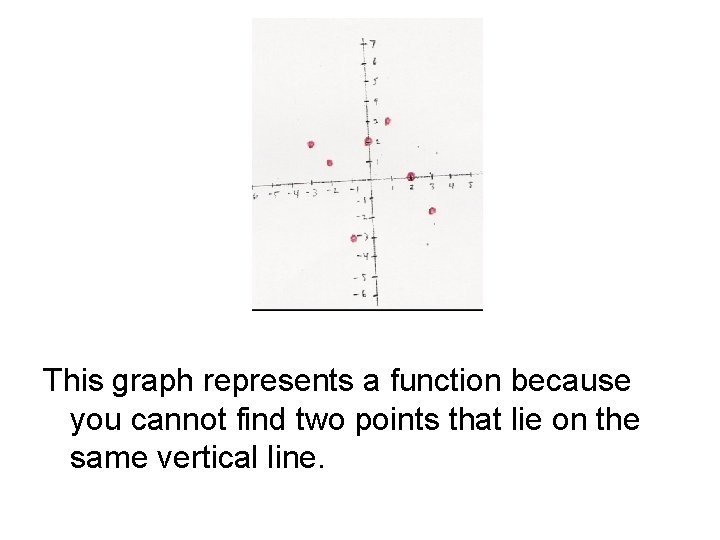
Graphs of Functions The relation is a function { (-3, 2), ( -2, 1), ( -1, -3), ( 0, 2), ( 1, 3), (2, 0), ( 3, -2) } Let’s plot these points on a coordinate system. What do we notice?
This graph represents a function because you cannot find two points that lie on the same vertical line.
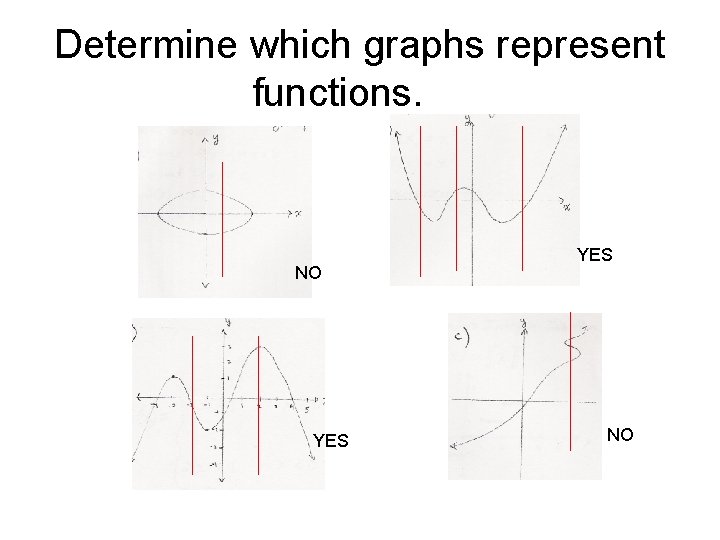
Determine which graphs represent functions. NO YES NO
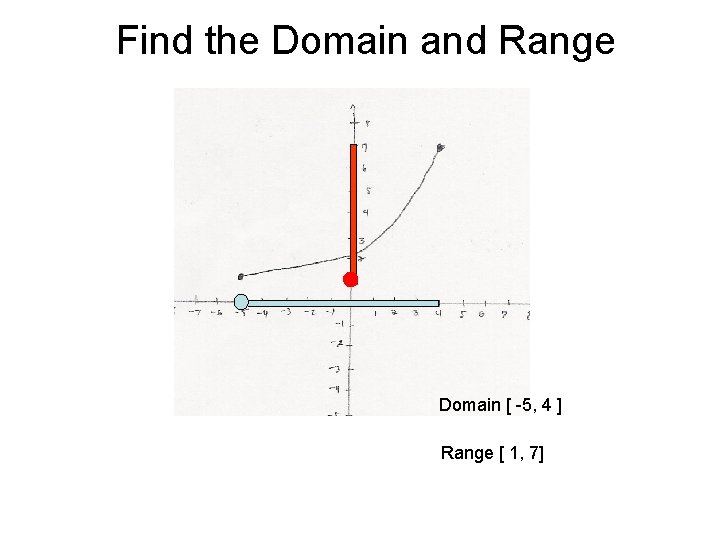
Find the Domain and Range Domain [ -5, 4 ] Range [ 1, 7]
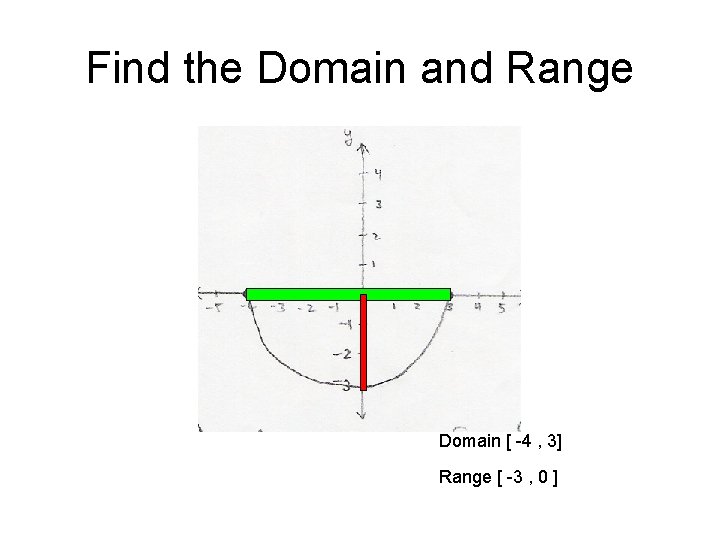
Find the Domain and Range Domain [ -4 , 3] Range [ -3 , 0 ]
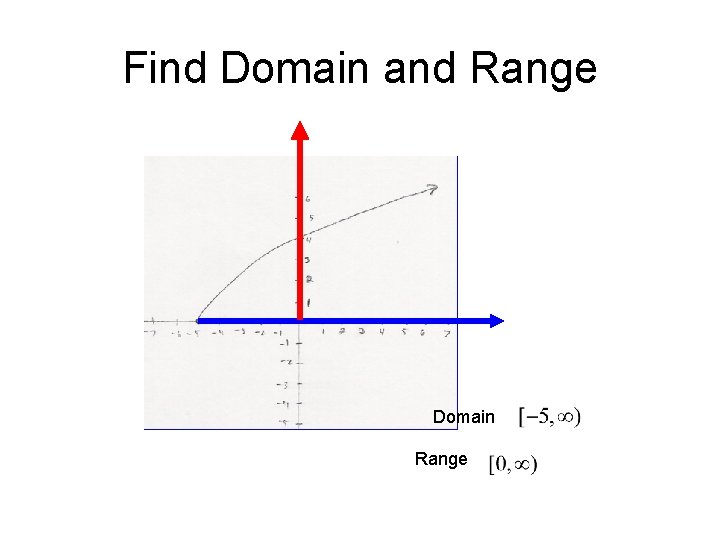
Find Domain and Range Domain Range
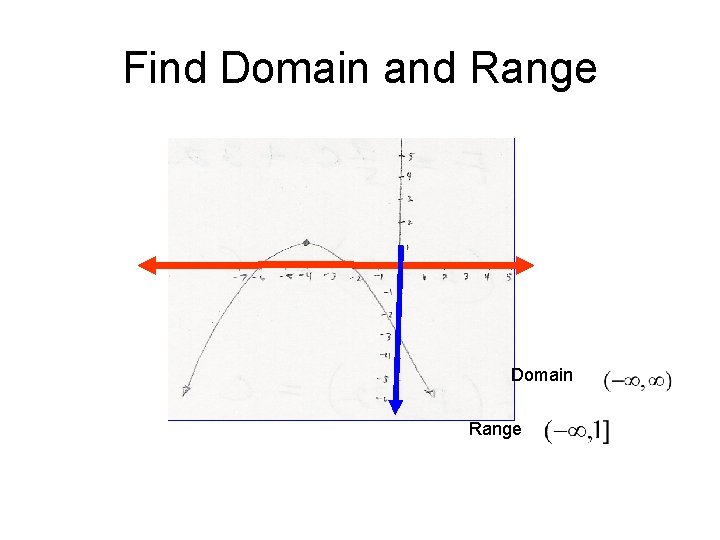
Find Domain and Range Domain Range
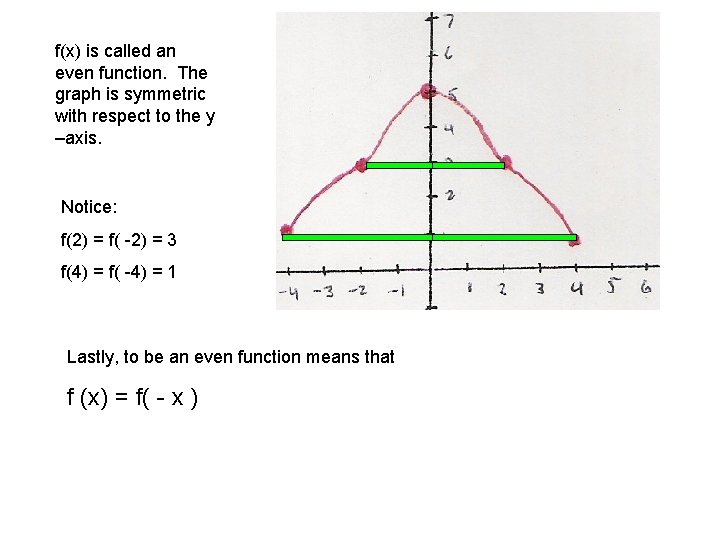
f(x) is called an even function. The graph is symmetric with respect to the y –axis. Notice: f(2) = f( -2) = 3 f(4) = f( -4) = 1 Lastly, to be an even function means that f (x) = f( - x )
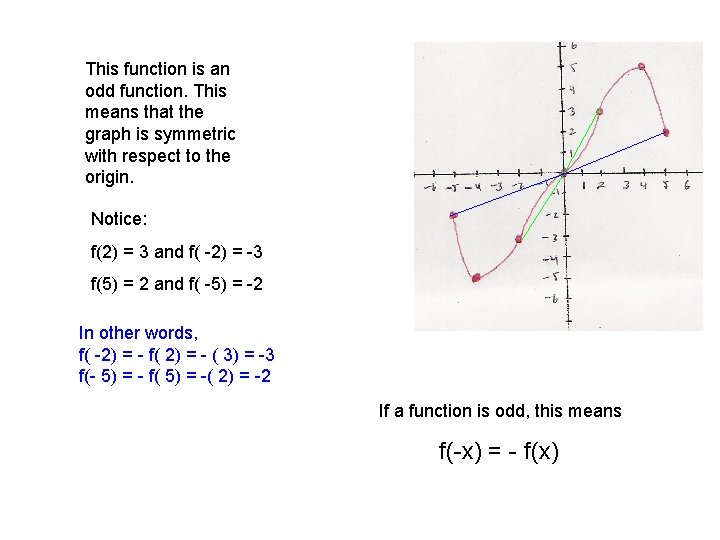
This function is an odd function. This means that the graph is symmetric with respect to the origin. Notice: f(2) = 3 and f( -2) = -3 f(5) = 2 and f( -5) = -2 In other words, f( -2) = - f( 2) = - ( 3) = -3 f(- 5) = - f( 5) = -( 2) = -2 If a function is odd, this means f(-x) = - f(x)
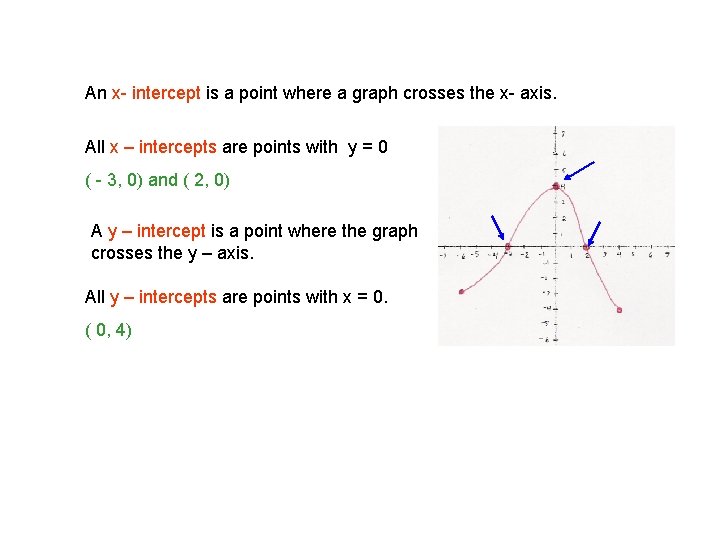
An x- intercept is a point where a graph crosses the x- axis. All x – intercepts are points with y = 0 ( - 3, 0) and ( 2, 0) A y – intercept is a point where the graph crosses the y – axis. All y – intercepts are points with x = 0. ( 0, 4)
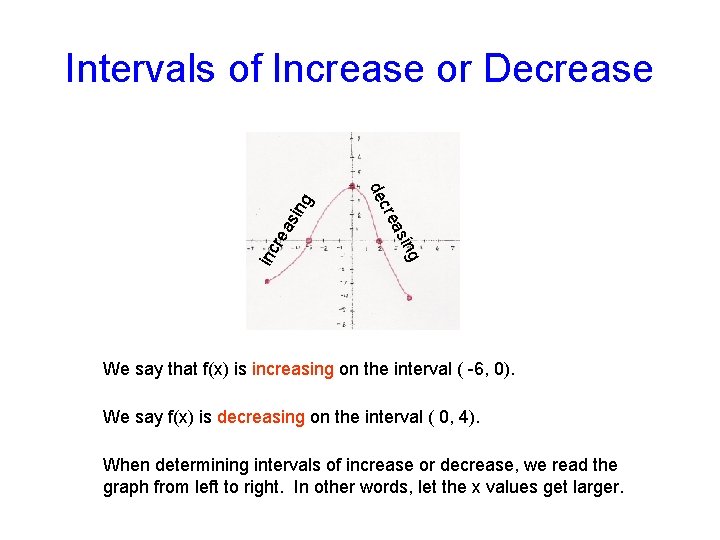
sin rea inc ing as cre de g Intervals of Increase or Decrease We say that f(x) is increasing on the interval ( -6, 0). We say f(x) is decreasing on the interval ( 0, 4). When determining intervals of increase or decrease, we read the graph from left to right. In other words, let the x values get larger.
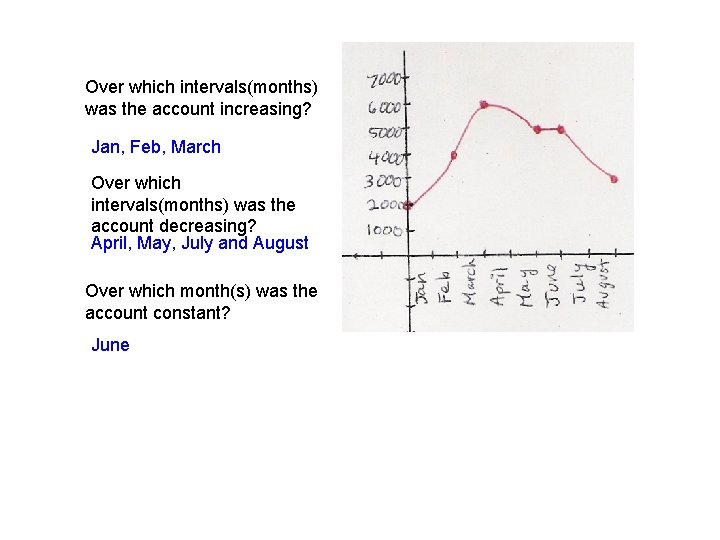
Over which intervals(months) was the account increasing? Jan, Feb, March Over which intervals(months) was the account decreasing? April, May, July and August Over which month(s) was the account constant? June
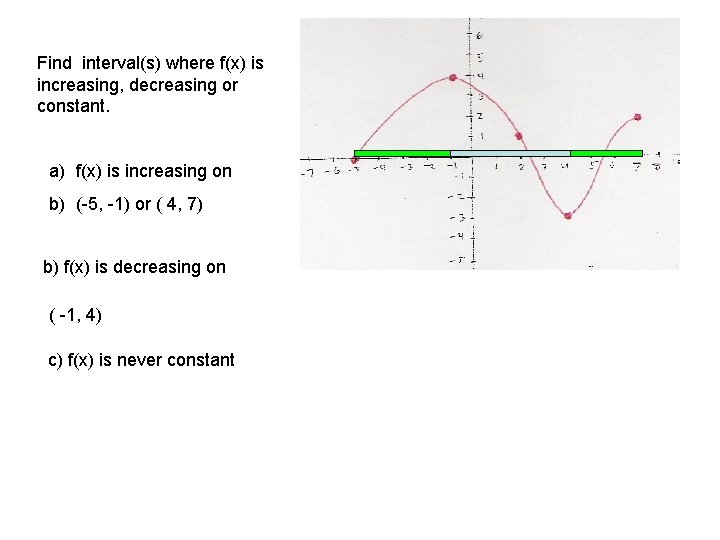
Find interval(s) where f(x) is increasing, decreasing or constant. a) f(x) is increasing on b) (-5, -1) or ( 4, 7) b) f(x) is decreasing on ( -1, 4) c) f(x) is never constant
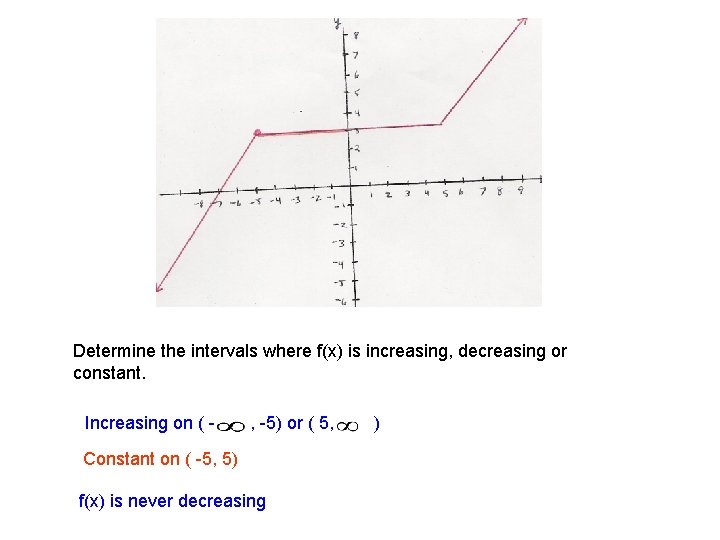
Determine the intervals where f(x) is increasing, decreasing or constant. Increasing on ( - , -5) or ( 5, Constant on ( -5, 5) f(x) is never decreasing )
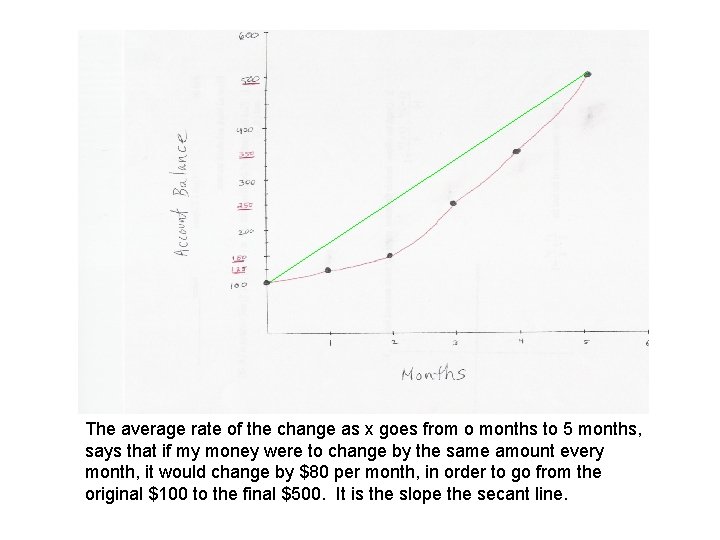
The average rate of the change as x goes from o months to 5 months, says that if my money were to change by the same amount every month, it would change by $80 per month, in order to go from the original $100 to the final $500. It is the slope the secant line.
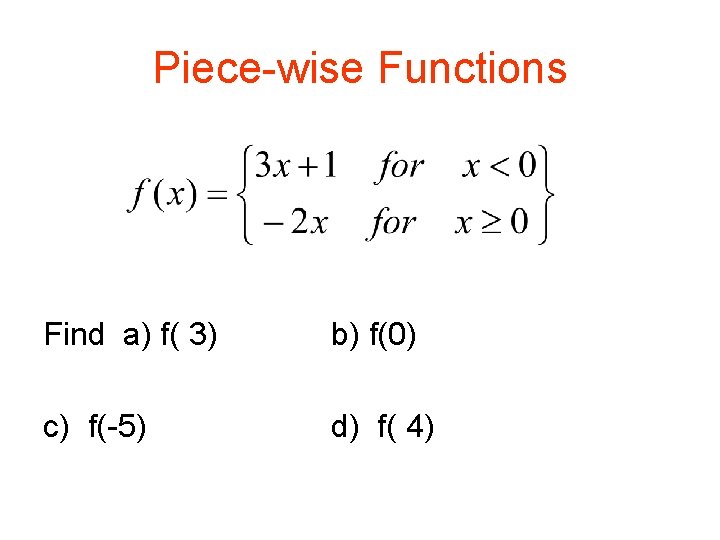
Piece-wise Functions Find a) f( 3) b) f(0) c) f(-5) d) f( 4)
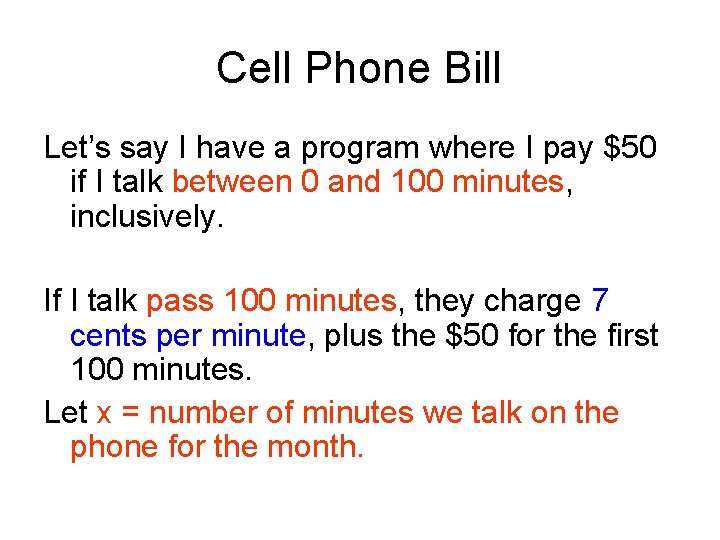
Cell Phone Bill Let’s say I have a program where I pay $50 if I talk between 0 and 100 minutes, inclusively. If I talk pass 100 minutes, they charge 7 cents per minute, plus the $50 for the first 100 minutes. Let x = number of minutes we talk on the phone for the month.