Types Systems of Government Unit 1 Foundationtheory of
- Slides: 9
Types & Systems of Government Unit 1: Foundation/theory of government & Constitutional Underpinnings
Types of government � Type of government: usually means who holds the power: ◦ Autocracy ◦ Oligarchy ◦ Democracy
Autocracy Def: Power & authority to rule are in the hands of a single individual ◦ Ex. Hitler, Stalin, Mussolini, Castro � Characteristics: ◦ Oldest & most common form of govt. ◦ Get to power by inheritance, or ruthless police/military force ◦ 2 types: � �Totalitarian Dictatorship: total control of social & economic life �Monarchy: led by king, queen, emperor exercising full power � 2 types: �Absolute monarch: complete & unlimited rule over their people; Saudi Arabia �Constitutional monarch: either share constitutional power with legislature, or are more ceremonial leaders; ex. Britain �https: //www. youtube. com/watch? v=M 2 rentf. CTAw
Oligarchy � Def: a type of government in which a small group holds power ◦ All communist countries, Iran (theocracy) � Characteristics: ◦ Group gets power from wealth, military power, social position, religion or combination of these ◦ Mostly seen in communist countries: N. Korea, Cuba, Iran ◦ Always pretending that are ruling for the people ◦ All opposition is either suppressed, or eliminated ◦ https: //www. youtube. com/watch? v=Ww. P 7 Sd 7 Rac. A
Democracy � Def. : a type of government in which rule is by the people, Greek term meaning people rule ◦ USA, Chile, India, Japan, S. Africa, France � Characteristics: ◦ ◦ ◦ People (citizens) hold sovereign power Individual liberty Majority rule w/minority rights Free elections Competing political parties 2 types: �Direct democracy: people/citizens rule themselves by voting directly on issues, can only exist in small societies �Representative Democracy (In-Direct Democracy/Republic): people/citizens elect representatives & give them responsibilities & power to make laws and conduct government, great for large countries, voters are source of power �https: //www. youtube. com/watch? v=u 6 jg. Wxkb. R 7 A
Systems of government � System of govt. refers to: how the power is distributed across the state: ◦ Unitary ◦ Federal ◦ Confederate
Unitary � Def. : All key powers & decisions given to the National/Central govt. : ◦ Ex. Britain, Italy, France (works best in small land countries) � Characteristics: ◦ Made up of central & provincial/state govt. ◦ Power goes top to bottom ◦ Power of local always checked by central govt.
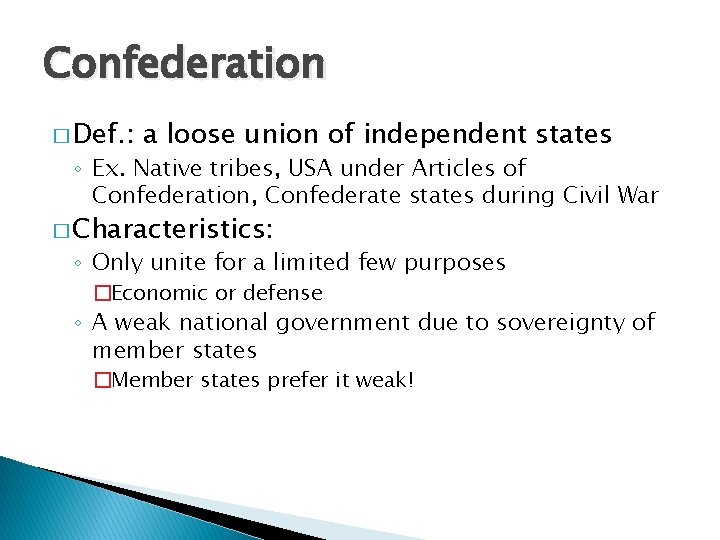
Confederation � Def. : a loose union of independent states ◦ Ex. Native tribes, USA under Articles of Confederation, Confederate states during Civil War � Characteristics: ◦ Only unite for a limited few purposes �Economic or defense ◦ A weak national government due to sovereignty of member states �Member states prefer it weak!
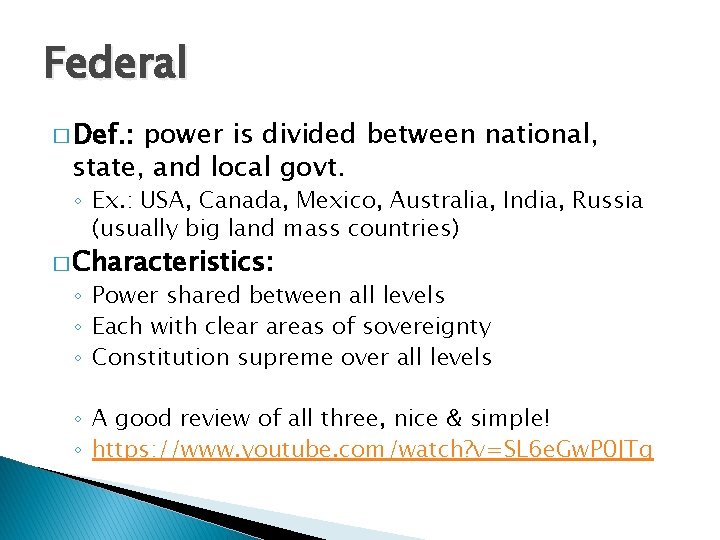
Federal � Def. : power is divided between national, state, and local govt. ◦ Ex. : USA, Canada, Mexico, Australia, India, Russia (usually big land mass countries) � Characteristics: ◦ Power shared between all levels ◦ Each with clear areas of sovereignty ◦ Constitution supreme over all levels ◦ A good review of all three, nice & simple! ◦ https: //www. youtube. com/watch? v=SL 6 e. Gw. P 0 JTg