Regionalization in Canada Gregory P Marchildon Ph D
- Slides: 21
Regionalization in Canada Gregory P. Marchildon, Ph. D Professor & Ontario Research Chair in Health Policy and System Design International Seminar on Universal Healthcare Systems: Regionalization and Contemporary Deadlocks Policy, Planning and Management of Health Care Regions and Networks in Brazil Faculty of Public Health, University of São Paulo, December 8, 2015 www. ihpme. utoronto. ca
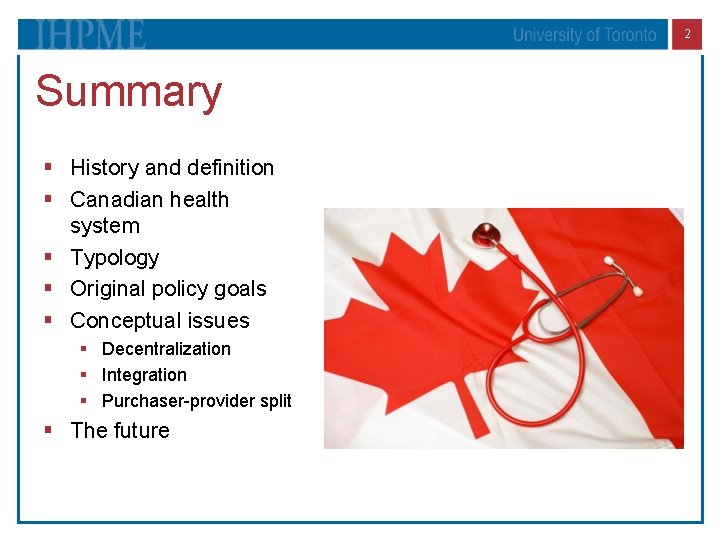
2 Summary § History and definition § Canadian health system § Typology § Original policy goals § Conceptual issues § Decentralization § Integration § Purchaser-provider split § The future
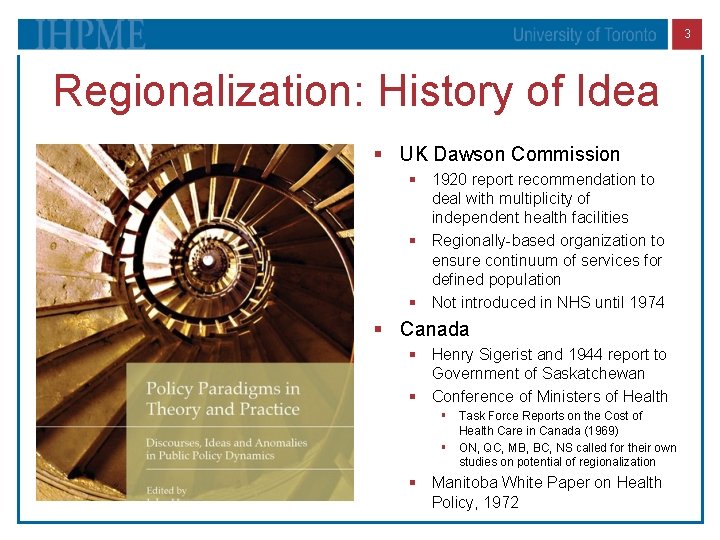
3 Regionalization: History of Idea § UK Dawson Commission § 1920 report recommendation to deal with multiplicity of independent health facilities § Regionally-based organization to ensure continuum of services for defined population § Not introduced in NHS until 1974 § Canada § Henry Sigerist and 1944 report to Government of Saskatchewan § Conference of Ministers of Health § Task Force Reports on the Cost of Health Care in Canada (1969) § ON, QC, MB, BC, NS called for their own studies on potential of regionalization § Manitoba White Paper on Health Policy, 1972
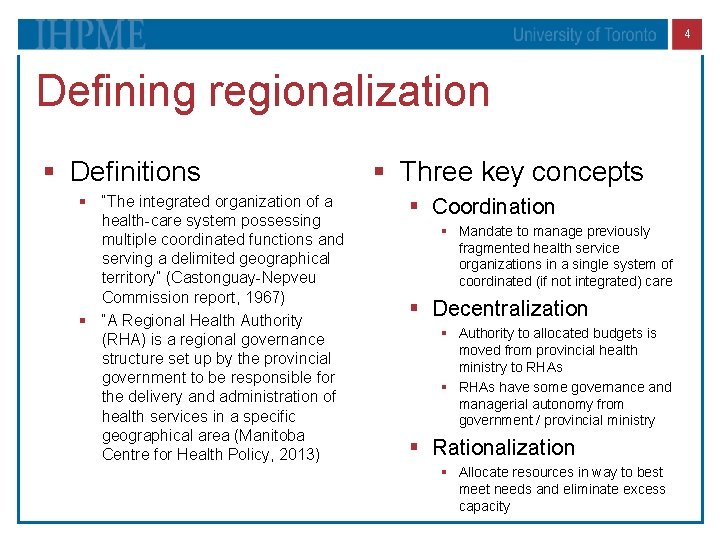
4 Defining regionalization § Definitions § “The integrated organization of a health-care system possessing multiple coordinated functions and serving a delimited geographical territory” (Castonguay-Nepveu Commission report, 1967) § “A Regional Health Authority (RHA) is a regional governance structure set up by the provincial government to be responsible for the delivery and administration of health services in a specific geographical area (Manitoba Centre for Health Policy, 2013) § Three key concepts § Coordination § Mandate to manage previously fragmented health service organizations in a single system of coordinated (if not integrated) care § Decentralization § Authority to allocated budgets is moved from provincial health ministry to RHAs § RHAs have some governance and managerial autonomy from government / provincial ministry § Rationalization § Allocate resources in way to best meet needs and eliminate excess capacity
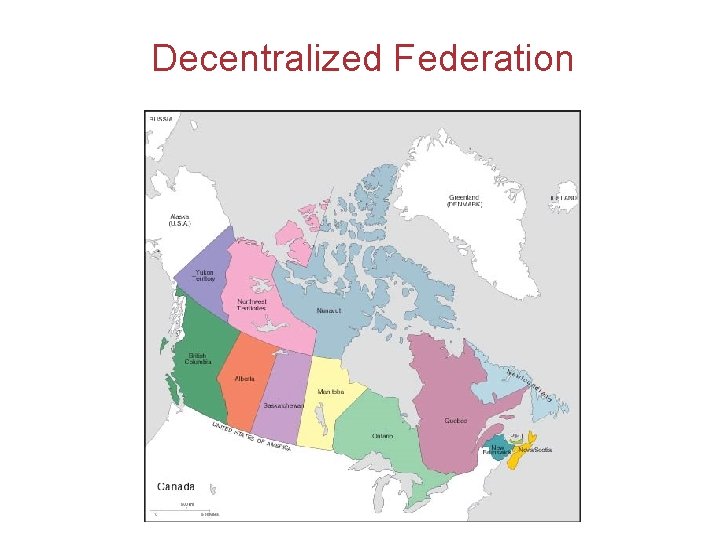
Decentralized Federation
6
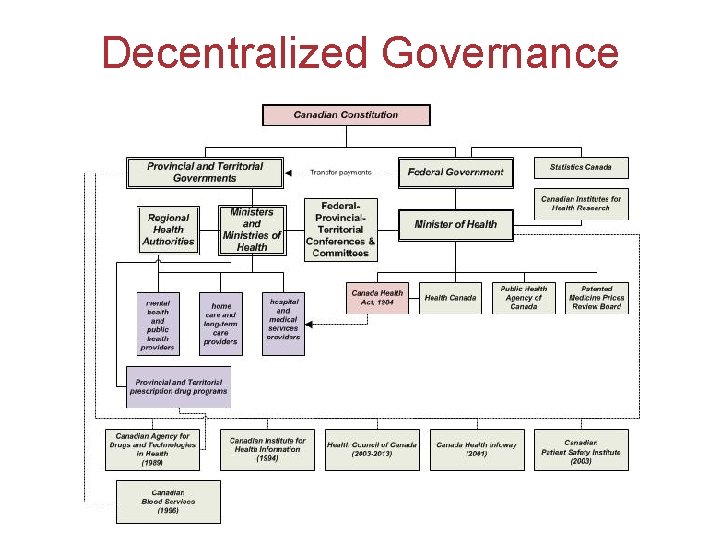
Decentralized Governance
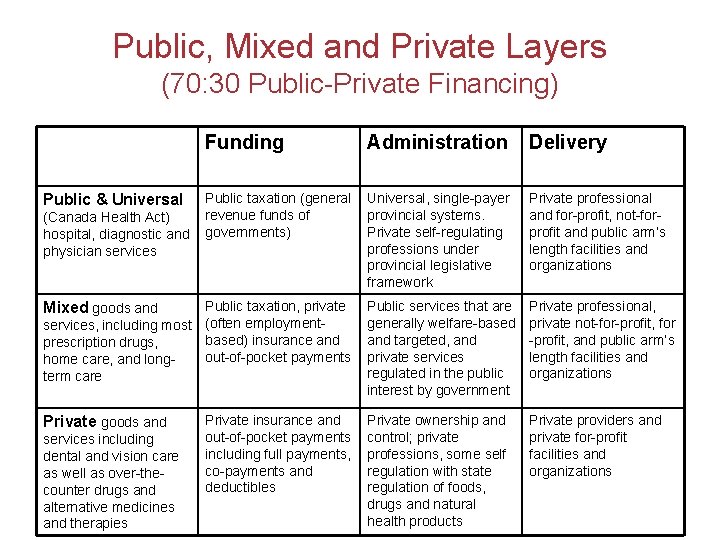
Public, Mixed and Private Layers (70: 30 Public-Private Financing) Public & Universal (Canada Health Act) hospital, diagnostic and physician services Funding Administration Delivery Public taxation (general revenue funds of governments) Universal, single-payer provincial systems. Private self-regulating professions under provincial legislative framework Private professional and for-profit, not-forprofit and public arm’s length facilities and organizations Public services that are generally welfare-based and targeted, and private services regulated in the public interest by government Private professional, private not-for-profit, for -profit, and public arm’s length facilities and organizations Private ownership and control; private professions, some self regulation with state regulation of foods, drugs and natural health products Private providers and private for-profit facilities and organizations Public taxation, private services, including most (often employmentbased) insurance and prescription drugs, out-of-pocket payments home care, and longterm care Mixed goods and Private goods and services including dental and vision care as well as over-thecounter drugs and alternative medicines and therapies Private insurance and out-of-pocket payments including full payments, co-payments and deductibles
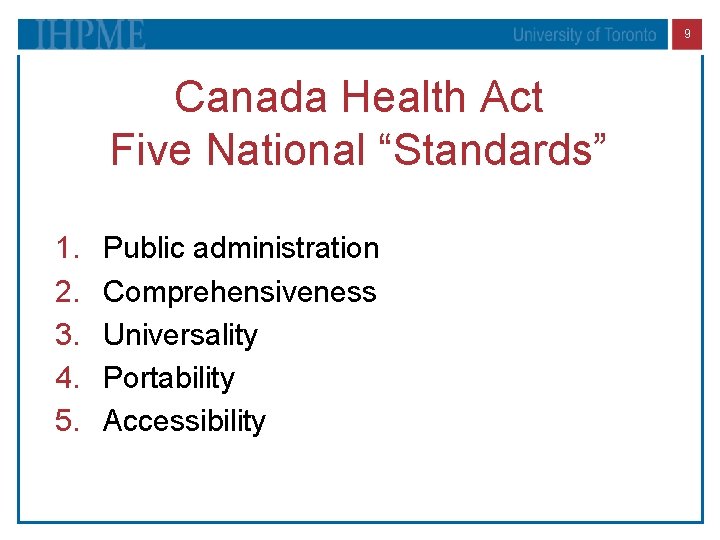
9 Canada Health Act Five National “Standards” 1. 2. 3. 4. 5. Public administration Comprehensiveness Universality Portability Accessibility
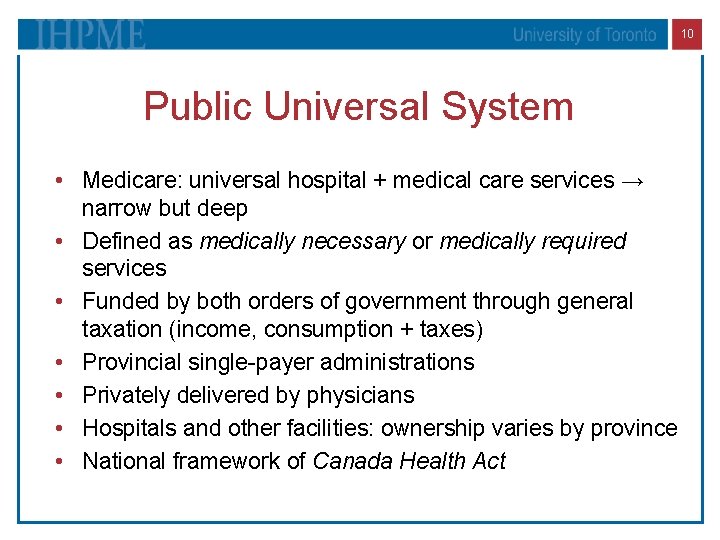
10 Public Universal System • Medicare: universal hospital + medical care services → narrow but deep • Defined as medically necessary or medically required services • Funded by both orders of government through general taxation (income, consumption + taxes) • Provincial single-payer administrations • Privately delivered by physicians • Hospitals and other facilities: ownership varies by province • National framework of Canada Health Act
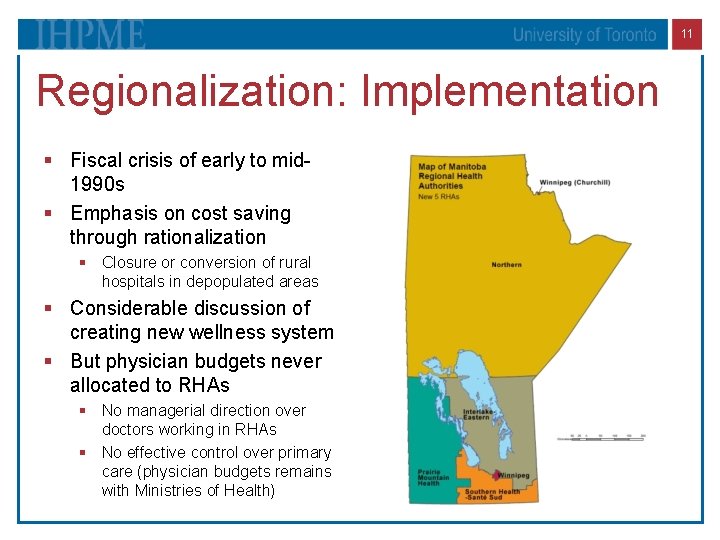
11 Regionalization: Implementation § Fiscal crisis of early to mid 1990 s § Emphasis on cost saving through rationalization § Closure or conversion of rural hospitals in depopulated areas § Considerable discussion of creating new wellness system § But physician budgets never allocated to RHAs § No managerial direction over doctors working in RHAs § No effective control over primary care (physician budgets remains with Ministries of Health)
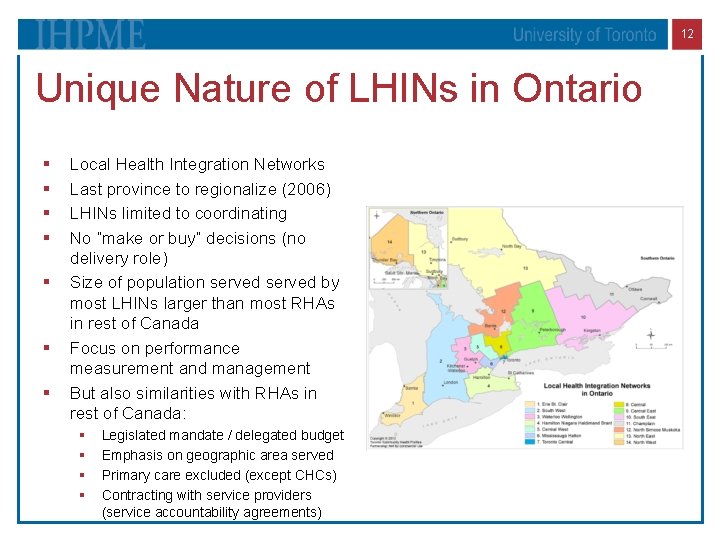
12 Unique Nature of LHINs in Ontario § § § § Local Health Integration Networks Last province to regionalize (2006) LHINs limited to coordinating No “make or buy” decisions (no delivery role) Size of population served by most LHINs larger than most RHAs in rest of Canada Focus on performance measurement and management But also similarities with RHAs in rest of Canada: § § Legislated mandate / delegated budget Emphasis on geographic area served Primary care excluded (except CHCs) Contracting with service providers (service accountability agreements)
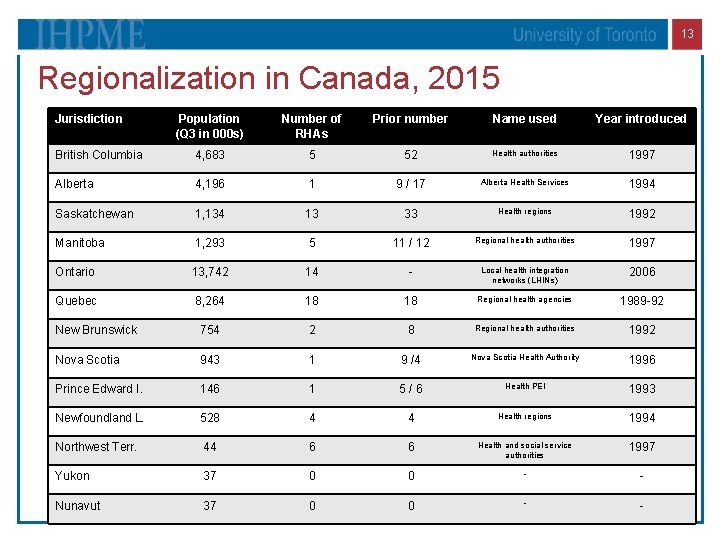
13 Regionalization in Canada, 2015 Jurisdiction Population (Q 3 in 000 s) Number of RHAs Prior number Name used Year introduced British Columbia 4, 683 5 52 Health authorities 1997 Alberta 4, 196 1 9 / 17 Alberta Health Services 1994 Saskatchewan 1, 134 13 33 Health regions 1992 Manitoba 1, 293 5 11 / 12 Regional health authorities 1997 Ontario 13, 742 14 - Local health integration networks (LHINs) 2006 Quebec 8, 264 18 18 Regional health agencies 1989 -92 New Brunswick 754 2 8 Regional health authorities 1992 Nova Scotia 943 1 9 /4 Nova Scotia Health Authority 1996 Prince Edward I. 146 1 5/6 Health PEI 1993 Newfoundland L. 528 4 4 Health regions 1994 Northwest Terr. 44 6 6 Health and social service authorities 1997 Yukon 37 0 0 - - Nunavut 37 0 0 - -
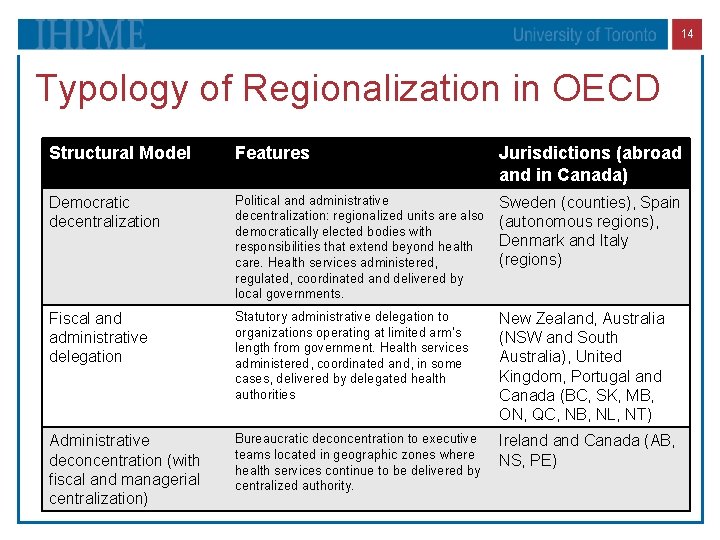
14 Typology of Regionalization in OECD Structural Model Features Jurisdictions (abroad and in Canada) Democratic decentralization Political and administrative decentralization: regionalized units are also democratically elected bodies with responsibilities that extend beyond health care. Health services administered, regulated, coordinated and delivered by local governments. Sweden (counties), Spain (autonomous regions), Denmark and Italy (regions) Fiscal and administrative delegation Statutory administrative delegation to organizations operating at limited arm’s length from government. Health services administered, coordinated and, in some cases, delivered by delegated health authorities New Zealand, Australia (NSW and South Australia), United Kingdom, Portugal and Canada (BC, SK, MB, ON, QC, NB, NL, NT) Administrative deconcentration (with fiscal and managerial centralization) Bureaucratic deconcentration to executive teams located in geographic zones where health services continue to be delivered by centralized authority. Ireland Canada (AB, NS, PE)
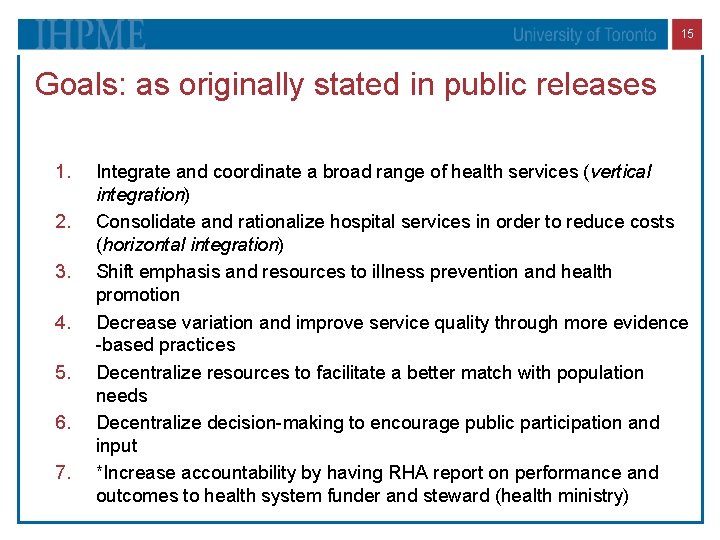
15 Goals: as originally stated in public releases 1. 2. 3. 4. 5. 6. 7. Integrate and coordinate a broad range of health services (vertical integration) Consolidate and rationalize hospital services in order to reduce costs (horizontal integration) Shift emphasis and resources to illness prevention and health promotion Decrease variation and improve service quality through more evidence -based practices Decentralize resources to facilitate a better match with population needs Decentralize decision-making to encourage public participation and input *Increase accountability by having RHA report on performance and outcomes to health system funder and steward (health ministry)
16 Current State of Regionalization in Canada § Most important policy shift since Medicare introduced § Policy consensus by 2006 § Less than decade letter consensus has evaporated § Perhaps even crisis § Division between political and administrative decision-makers § Challenge faced by provincial political leaders § Dissatisfaction § Lack of evidence
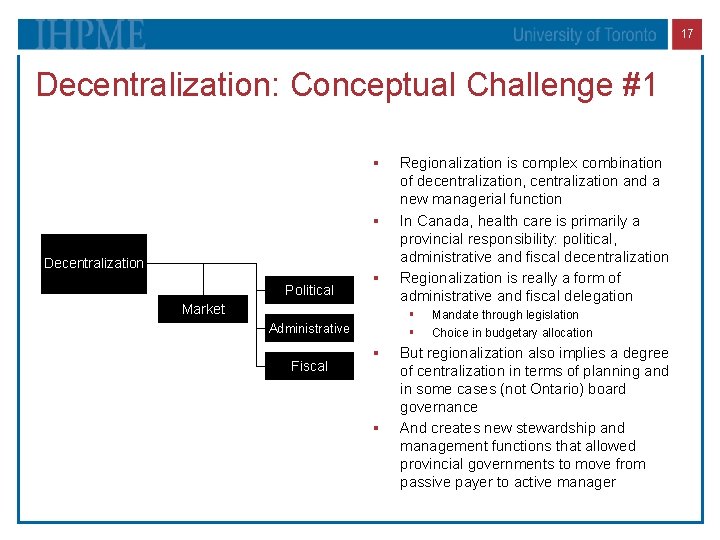
17 Decentralization: Conceptual Challenge #1 § § Decentralization Political § Market § § Administrative Fiscal Regionalization is complex combination of decentralization, centralization and a new managerial function In Canada, health care is primarily a provincial responsibility: political, administrative and fiscal decentralization Regionalization is really a form of administrative and fiscal delegation § § Mandate through legislation Choice in budgetary allocation But regionalization also implies a degree of centralization in terms of planning and in some cases (not Ontario) board governance And creates new stewardship and management functions that allowed provincial governments to move from passive payer to active manager
18 Integration: Conceptual Challenge #2 § § Main job of RHA is to integrate and/or coordinate healthcare organizations However, existing silos of service delivery can persist despite system changes through regionalization Before regionalization, Canada did “not possess most of the basic characteristics of integrated healthcare such as physician integration and rostered population” (Leatt, Pink and Guerriere, 2000, p. 13). After regionalization? § § Primary care and physician budgets Hospitals and other institutional care ICT systems and EHRs Transparency and user responsiveness
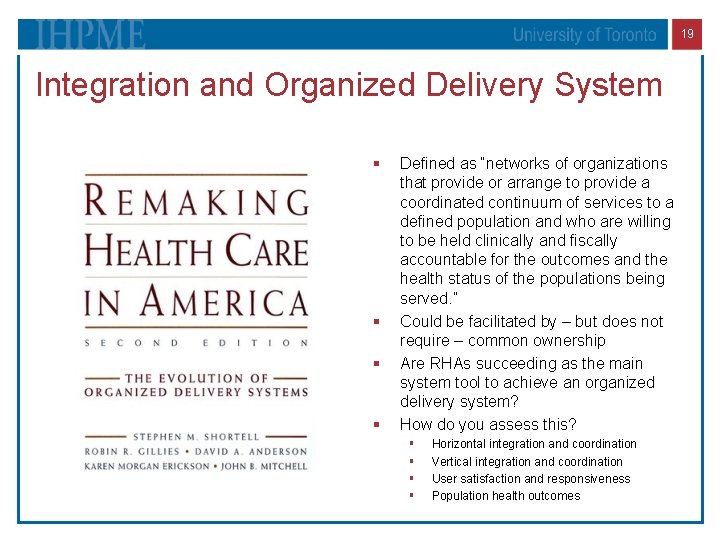
19 Integration and Organized Delivery System § § Defined as “networks of organizations that provide or arrange to provide a coordinated continuum of services to a defined population and who are willing to be held clinically and fiscally accountable for the outcomes and the health status of the populations being served. ” Could be facilitated by – but does not require – common ownership Are RHAs succeeding as the main system tool to achieve an organized delivery system? How do you assess this? § § Horizontal integration and coordination Vertical integration and coordination User satisfaction and responsiveness Population health outcomes
20 New Public Management (NPM) and Purchaser. Provider Split: Conceptual Challenge #3 § § § § NPM: market-based reforms applied to public sector in order to improve delivery of public goods and services Went furthest in UK and NZ followed by US and NL Largely absent in practice in Canadian health reform but present in rhetoric Reason? Existing medicare system of “private practice and public payment” Compare this to NHS, a large, centrallydirected state bureaucracy Contrary to NPM, regionalization increased space occupied by public hierarchy but still many private actors Ontario’s form of regionalization formed an exception to this trend § Built in purchaser-provider split
21 What does the future hold? § § Provincial ministries: health system stewards hold ultimate accountability Since early 2000 s, major trend towards centralization § § § Reducing the number of RHAs: consolidation to achieve economies of scale and scope and reduce administrative overhead Creating a single, non-geographic based RHA for entire province Division between political and bureaucratic tiers of government on way forward § § No consensus on future of regionalization Care that continues to be “fragmented, disconnected and siloed” Lack of primary care integration continues to be major problem But there is no way to return to old status quo of government being passive payer without any managerial oversight and control