REDUCING THE GENDER WAGE GAP Daina Z Green
- Slides: 15
REDUCING THE GENDER WAGE GAP Daina Z. Green, Gender Equity Specialist www. dzgreen. ca
PAY EQUITY AND OCCUPATIONAL SEGREGATION In almost all countries of the world, women tend to earn less. Why is that? Exclusion… Unequal division of family responsibilities results in many women working fewer paid hours and having less access to company-provided training opportunities -- and less access to promotion Discrimination in selection, promotion and skills training due to bias and stereotypical thinking Exclusion from highly male occupations and channelling of women to more traditional occupations, such as care of others, administration/clerical and sales. Daina Z. Green, Gender Equity Specialist/ www. dzgreen. ca
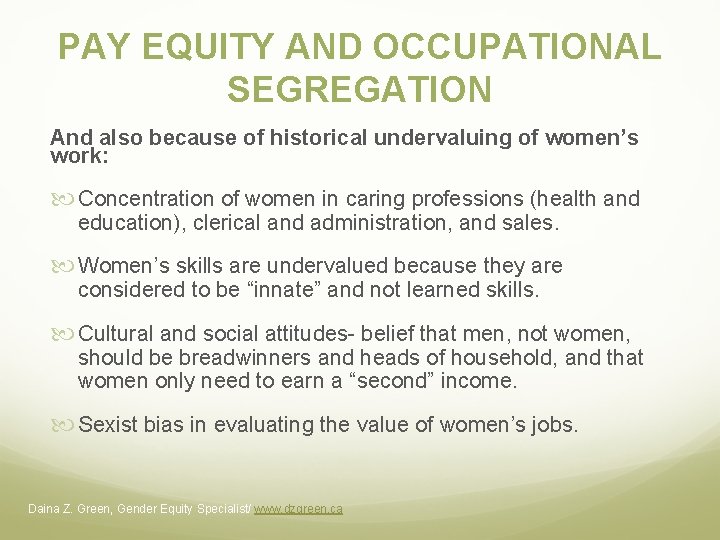
PAY EQUITY AND OCCUPATIONAL SEGREGATION And also because of historical undervaluing of women’s work: Concentration of women in caring professions (health and education), clerical and administration, and sales. Women’s skills are undervalued because they are considered to be “innate” and not learned skills. Cultural and social attitudes- belief that men, not women, should be breadwinners and heads of household, and that women only need to earn a “second” income. Sexist bias in evaluating the value of women’s jobs. Daina Z. Green, Gender Equity Specialist/ www. dzgreen. ca
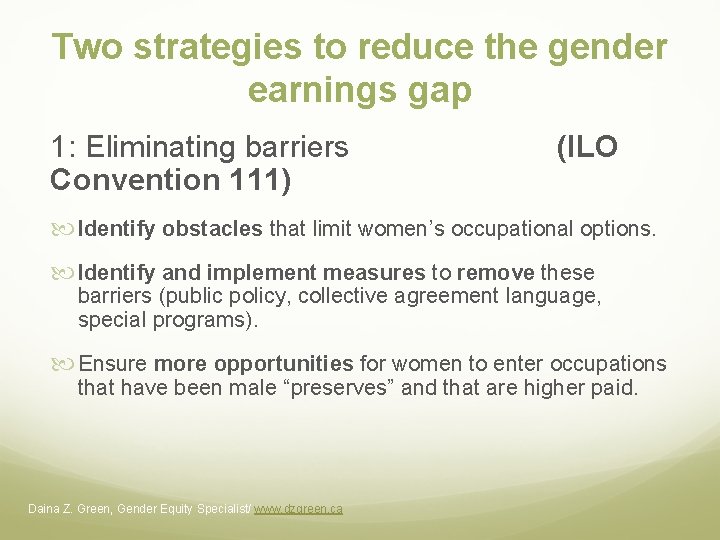
Two strategies to reduce the gender earnings gap 1: Eliminating barriers (ILO Convention 111) Identify obstacles that limit women’s occupational options. Identify and implement measures to remove these barriers (public policy, collective agreement language, special programs). Ensure more opportunities for women to enter occupations that have been male “preserves” and that are higher paid. Daina Z. Green, Gender Equity Specialist/ www. dzgreen. ca
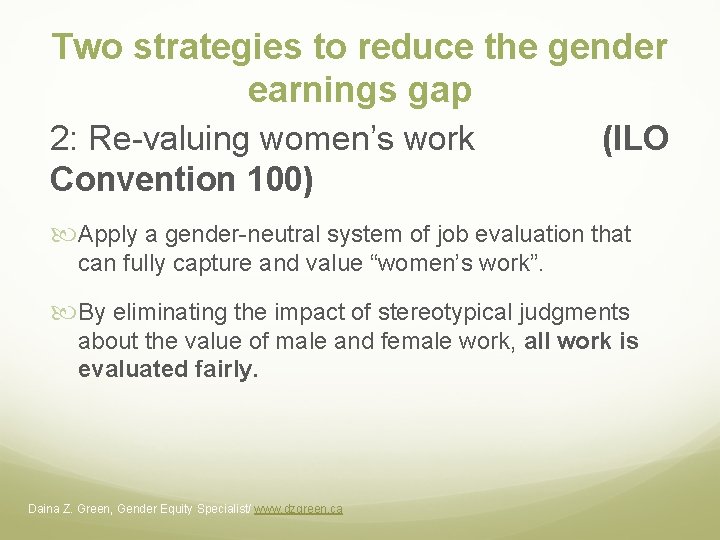
Two strategies to reduce the gender earnings gap 2: Re-valuing women’s work Convention 100) (ILO Apply a gender-neutral system of job evaluation that can fully capture and value “women’s work”. By eliminating the impact of stereotypical judgments about the value of male and female work, all work is evaluated fairly. Daina Z. Green, Gender Equity Specialist/ www. dzgreen. ca
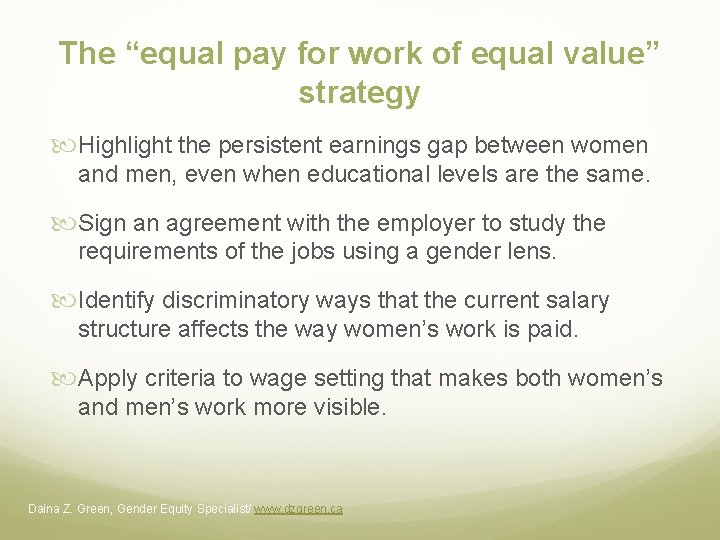
The “equal pay for work of equal value” strategy Highlight the persistent earnings gap between women and men, even when educational levels are the same. Sign an agreement with the employer to study the requirements of the jobs using a gender lens. Identify discriminatory ways that the current salary structure affects the way women’s work is paid. Apply criteria to wage setting that makes both women’s and men’s work more visible. Daina Z. Green, Gender Equity Specialist/ www. dzgreen. ca
The “equal pay for work of equal value” strategy Apply a gender-neutral job evaluation system to determine the value of every job based on its requirements (not on individual performance). Using a gender-neutral job evaluation ensures equivalencies between very diverse female-dominated jobs and male-dominated jobs Jobs with comparable total points are compared to make sure their wage levels also match. Any gap between pay for male and female jobs of equal value is corrected. Daina Z. Green, Specialist en Equidad de Género
By implementing a fair system to determine wage rates… The employer meets the human rights obligations set out in ILO convention 100 Any systemic discrimination in the relationship between the wage rates of men and women is identified to correct the under-valuing of traditional women’s work. The labour market value of those occupations is increased. The concept of equal pay for work of equal value goes beyond equal pay for equal work. It recognizes that men and women often do different, but comparable work. Daina Z. Green, Specialist en Equidad de Género
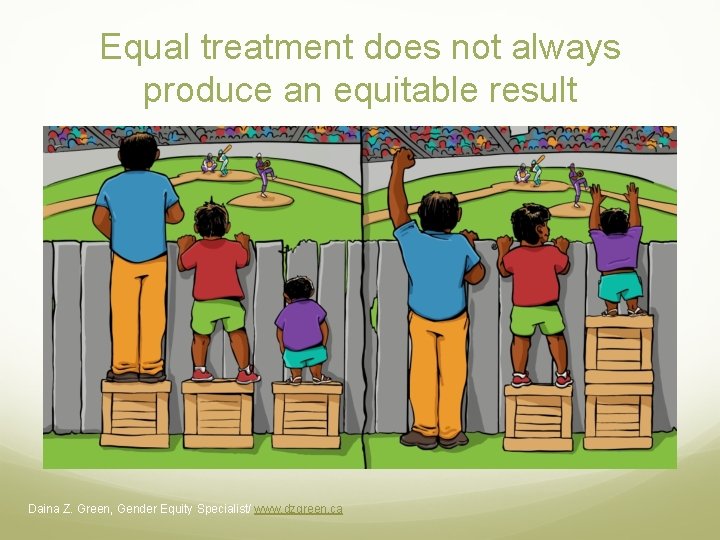
Equal treatment does not always produce an equitable result Daina Z. Green, Gender Equity Specialist/ www. dzgreen. ca
A Joint Process A Joint Committee: Manages the project Is trained on the principles of job evaluation and how to incorporate gender perspective Develops or adapts instruments to ensure evaluations free of sexist bias (capturing and valuing both “female” and “male work”) Determines which jobs are male and which are female Decides how to collect information on job requirements Evaluates the jobs Carries out comparisons between value (total points) and pay rates Daina Z. Green, Gender Equity Specialist/ www. dzgreen. ca
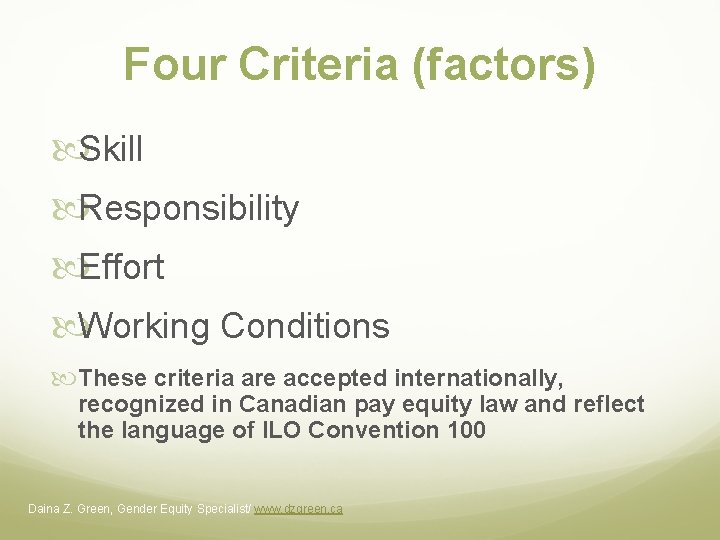
Four Criteria (factors) Skill Responsibility Effort Working Conditions These criteria are accepted internationally, recognized in Canadian pay equity law and reflect the language of ILO Convention 100 Daina Z. Green, Gender Equity Specialist/ www. dzgreen. ca
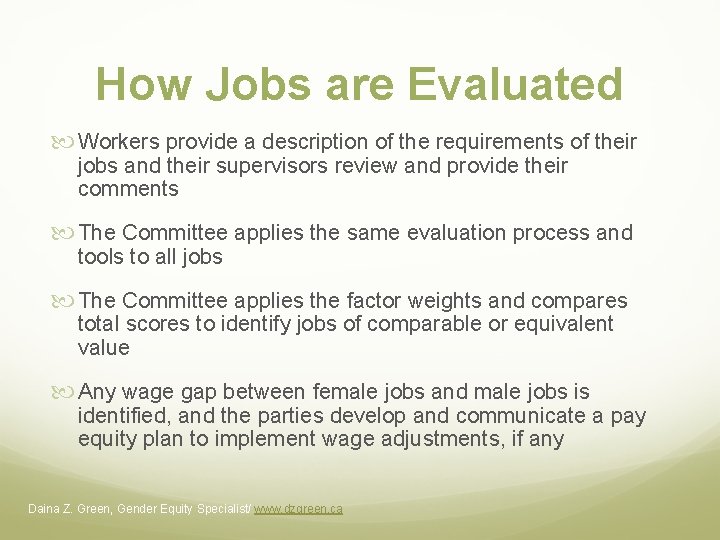
How Jobs are Evaluated Workers provide a description of the requirements of their jobs and their supervisors review and provide their comments The Committee applies the same evaluation process and tools to all jobs The Committee applies the factor weights and compares total scores to identify jobs of comparable or equivalent value Any wage gap between female jobs and male jobs is identified, and the parties develop and communicate a pay equity plan to implement wage adjustments, if any Daina Z. Green, Gender Equity Specialist/ www. dzgreen. ca
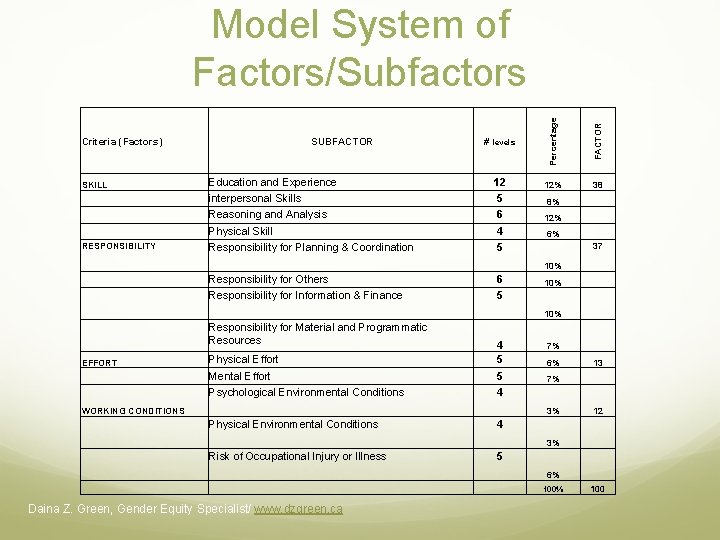
SKILL RESPONSIBILITY SUBFACTOR # levels Education and Experience interpersonal Skills Reasoning and Analysis Physical Skill Responsibility for Planning & Coordination 12 5 6 4 5 Responsibility for Others Responsibility for Information & Finance 6 5 FACTOR Criteria (Factors) Percentage Model System of Factors/Subfactors 12% 38 8% 12% 6% 37 10% EFFORT Responsibility for Material and Programmatic Resources Physical Effort Mental Effort Psychological Environmental Conditions 4 5 5 4 Physical Environmental Conditions 4 Risk of Occupational Injury or Illness 5 WORKING CONDITIONS Daina Z. Green, Gender Equity Specialist/ www. dzgreen. ca 10% 7% 6% 13 7% 3% 12 3% 6% 100
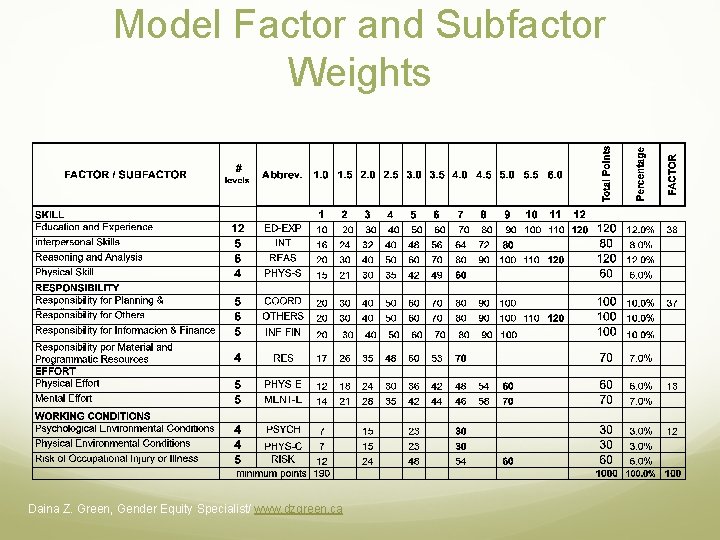
Model Factor and Subfactor Weights Daina Z. Green, Gender Equity Specialist/ www. dzgreen. ca
Resources ILO Model: http: //www. ilo. org/global/publications/ilo-bookstore/orderonline/books/WCMS_104692/lang--en/index. htm ILO Study on how to promote pay equity (2006): http: //www. ilo. org/wcmsp 5/groups/public/ ---ed_norm/---declaration/documents/publication/wcms_decl_wp_27_en. pdf Public Services International (PSI) Model – Closing the gender pay gap (2006) http: //www. world-psi. org/es/reduciendo-la-brecha-salarial-de-genero and http: //www. worldpsi. org/sites/default/files/documents/research/en_closing_the_gender_pay_gap. pdf Government of Ontario Models: http: //www. payequity. gov. on. ca/en/resources/case_tools. php Government of Québec Model (French)– Guide détaillé pour réaliser l’équité salariale et en évaluer le maintien (2015) http: //www. ces. gouv. qc. ca/documents/publications/guidedetaille. pdf Daina Z. Green, Gender Equity Specialist/ www. dzgreen. ca