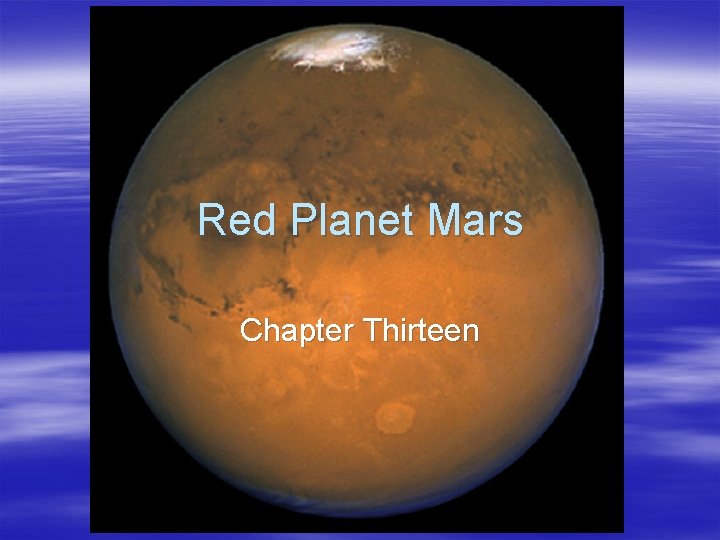
Red Planet Mars Chapter Thirteen ASTR 111 003
- Slides: 25
Red Planet Mars Chapter Thirteen
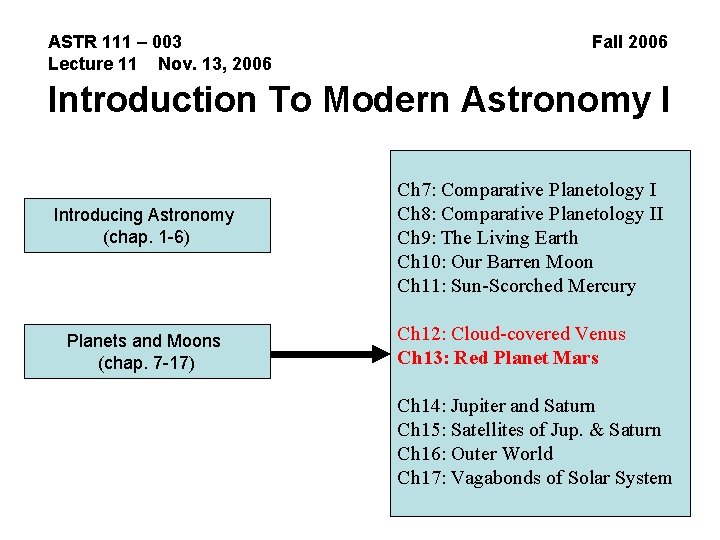
ASTR 111 – 003 Lecture 11 Nov. 13, 2006 Fall 2006 Introduction To Modern Astronomy I Introducing Astronomy (chap. 1 -6) Planets and Moons (chap. 7 -17) Ch 7: Comparative Planetology I Ch 8: Comparative Planetology II Ch 9: The Living Earth Ch 10: Our Barren Moon Ch 11: Sun-Scorched Mercury Ch 12: Cloud-covered Venus Ch 13: Red Planet Mars Ch 14: Jupiter and Saturn Ch 15: Satellites of Jup. & Saturn Ch 16: Outer World Ch 17: Vagabonds of Solar System
Guiding Questions 1. When is the best to see Mars in the night sky? 2. Why was it once thought that there are canals on Mars? 3. How are the northern and southern hemispheres of Mars different from each other? 4. What is the evidence that there was once liquid water on Mars? 5. Why is the Martian atmosphere so thin? 6. What have we learned about Mars by sending spacecraft to land on its surface? 7. What causes the seasonal color changes on Mars? 8. As seen from Mars, how do the Martian moons move across the sky?
Mars Data
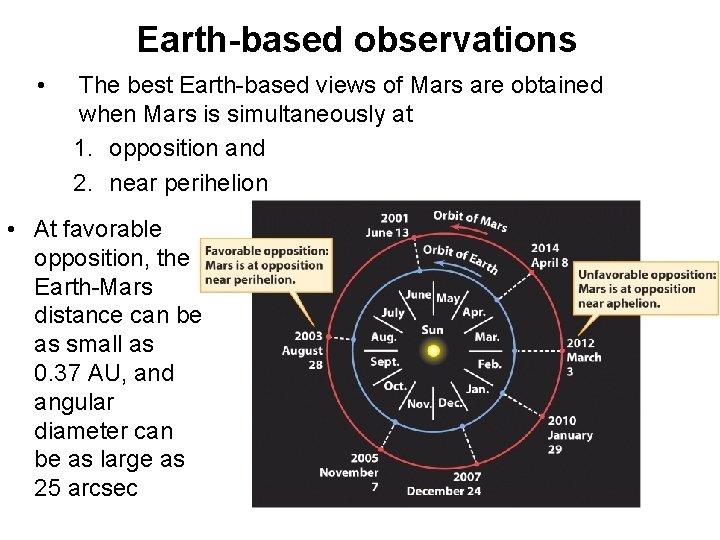
Earth-based observations • The best Earth-based views of Mars are obtained when Mars is simultaneously at 1. opposition and 2. near perihelion • At favorable opposition, the Earth-Mars distance can be as small as 0. 37 AU, and angular diameter can be as large as 25 arcsec
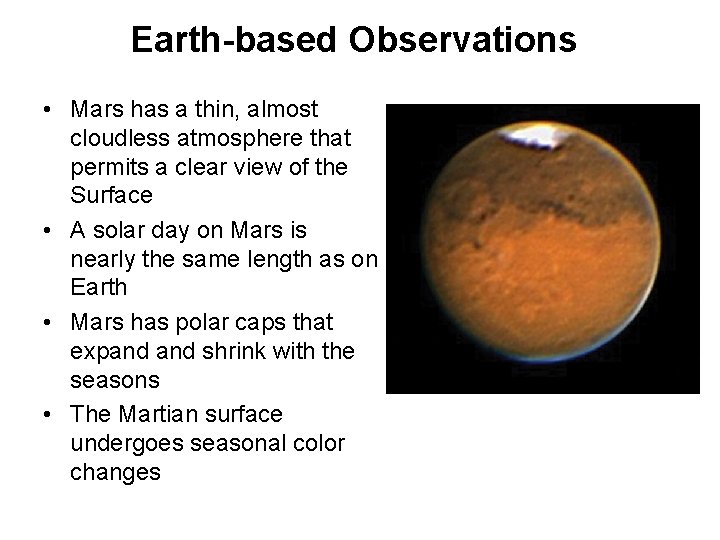
Earth-based Observations • Mars has a thin, almost cloudless atmosphere that permits a clear view of the Surface • A solar day on Mars is nearly the same length as on Earth • Mars has polar caps that expand shrink with the seasons • The Martian surface undergoes seasonal color changes
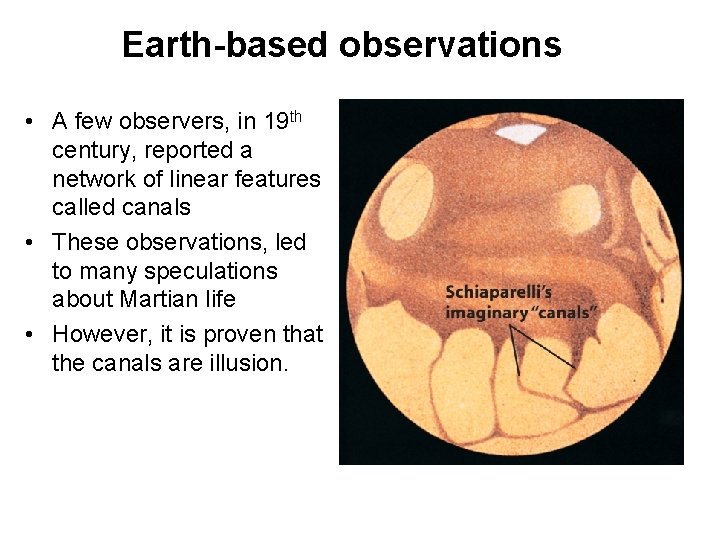
Earth-based observations • A few observers, in 19 th century, reported a network of linear features called canals • These observations, led to many speculations about Martian life • However, it is proven that the canals are illusion.
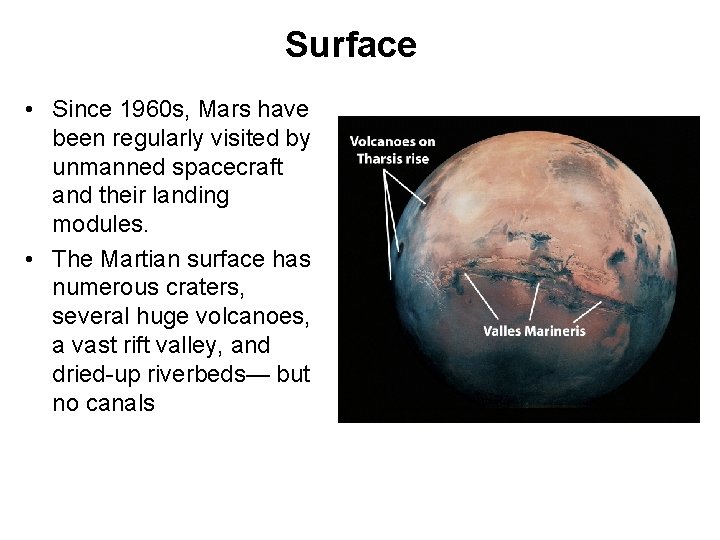
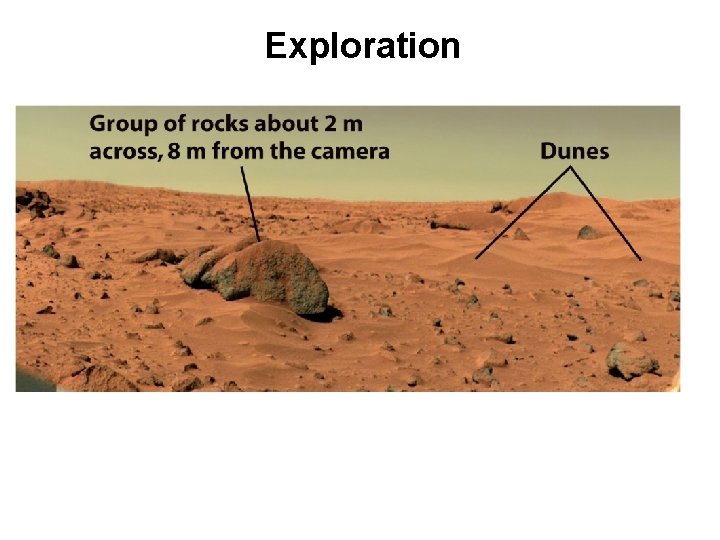
Surface • Since 1960 s, Mars have been regularly visited by unmanned spacecraft and their landing modules. • The Martian surface has numerous craters, several huge volcanoes, a vast rift valley, and dried-up riverbeds— but no canals
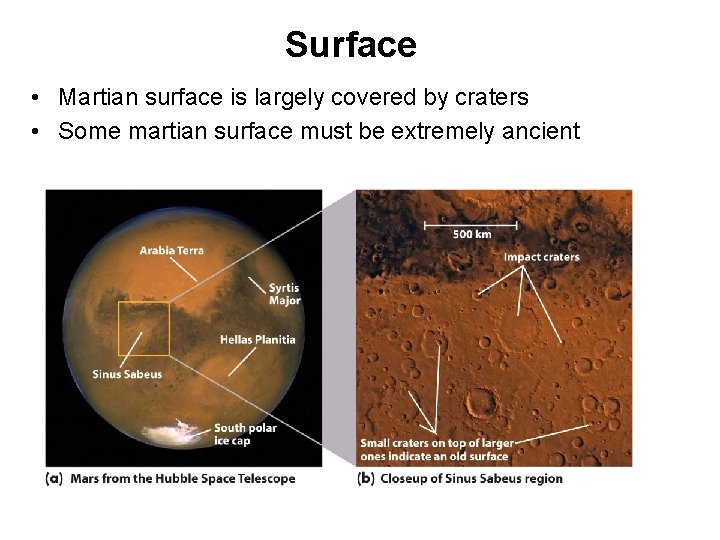
Surface • Martian surface is largely covered by craters • Some martian surface must be extremely ancient
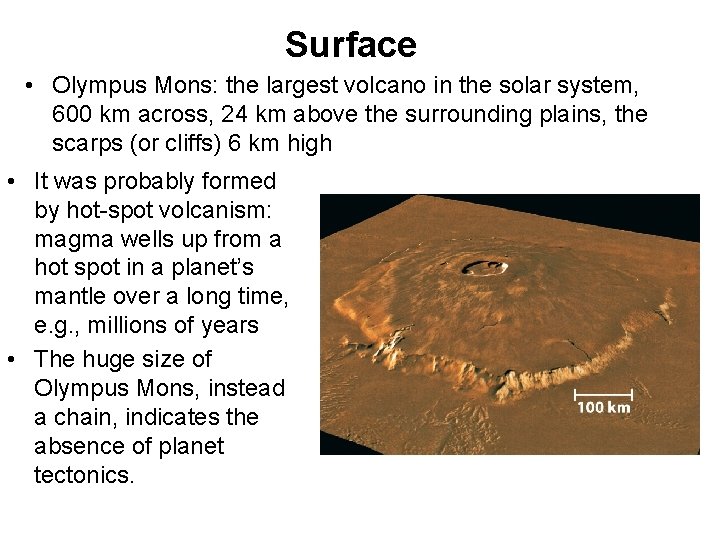
Surface • Olympus Mons: the largest volcano in the solar system, 600 km across, 24 km above the surrounding plains, the scarps (or cliffs) 6 km high • It was probably formed by hot-spot volcanism: magma wells up from a hot spot in a planet’s mantle over a long time, e. g. , millions of years • The huge size of Olympus Mons, instead a chain, indicates the absence of planet tectonics.
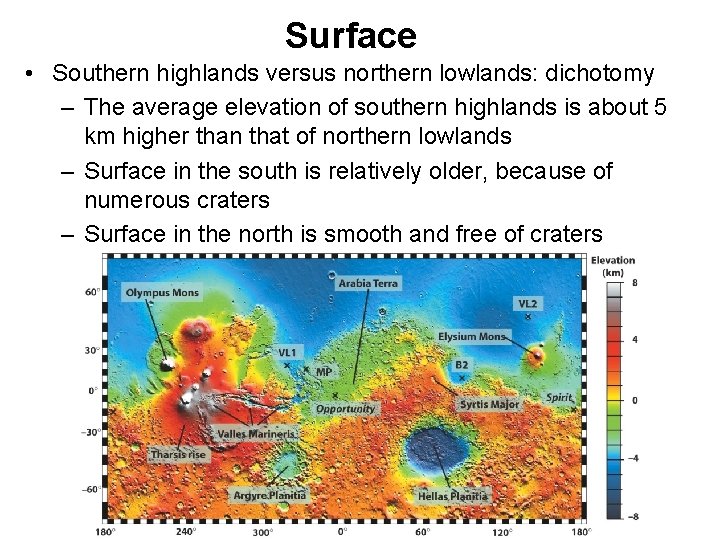
Surface • Southern highlands versus northern lowlands: dichotomy – The average elevation of southern highlands is about 5 km higher than that of northern lowlands – Surface in the south is relatively older, because of numerous craters – Surface in the north is smooth and free of craters
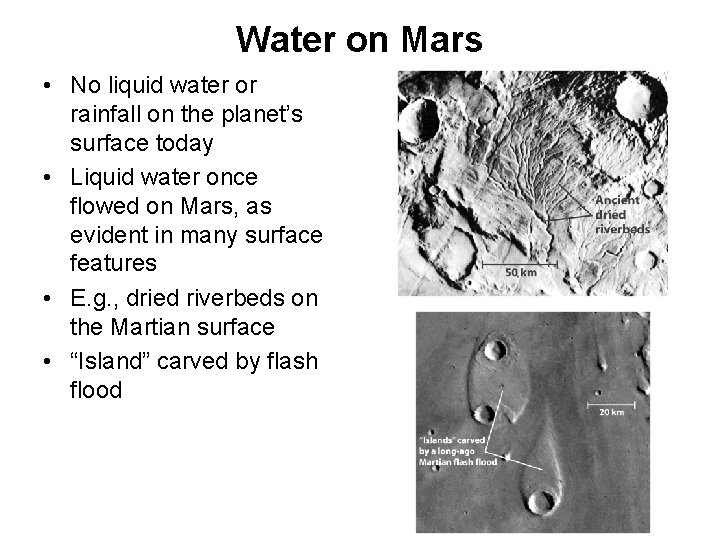
Water on Mars • No liquid water or rainfall on the planet’s surface today • Liquid water once flowed on Mars, as evident in many surface features • E. g. , dried riverbeds on the Martian surface • “Island” carved by flash flood
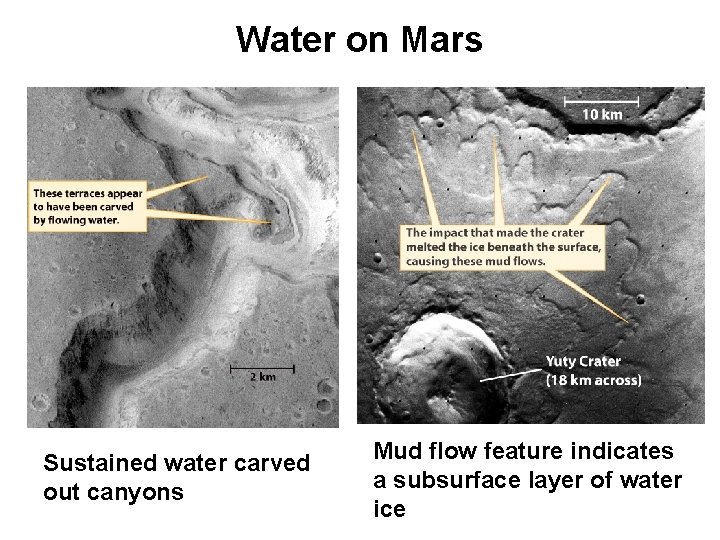
Water on Mars Sustained water carved out canyons Mud flow feature indicates a subsurface layer of water ice
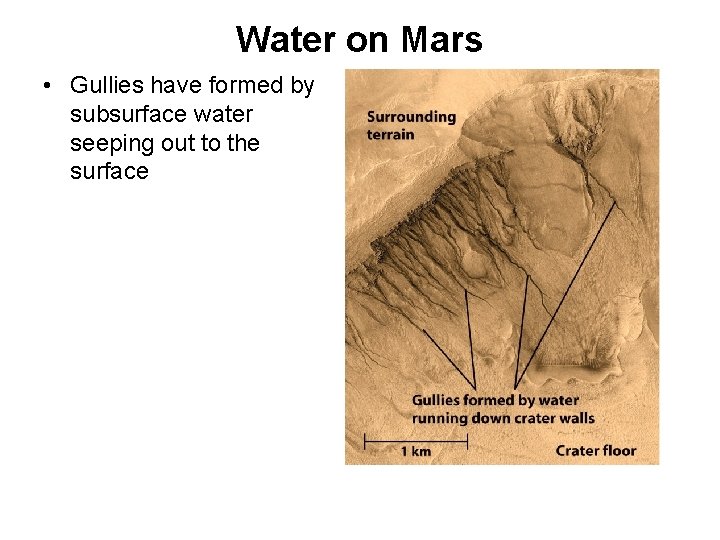
Water on Mars • Gullies have formed by subsurface water seeping out to the surface
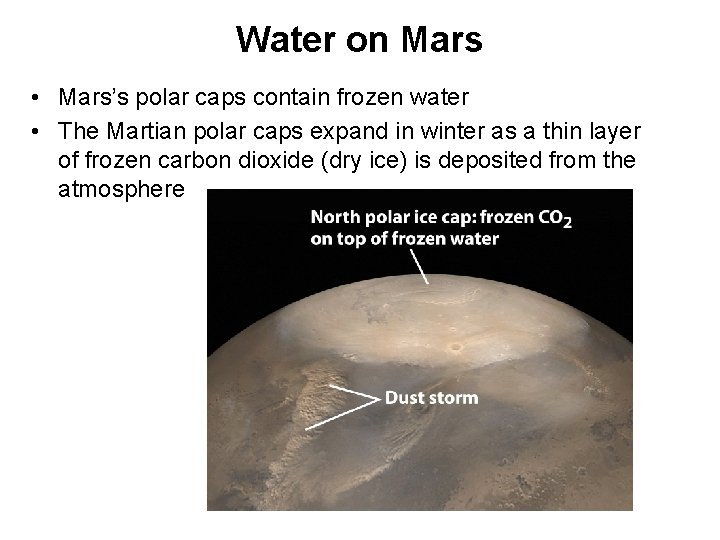
Water on Mars • Mars’s polar caps contain frozen water • The Martian polar caps expand in winter as a thin layer of frozen carbon dioxide (dry ice) is deposited from the atmosphere
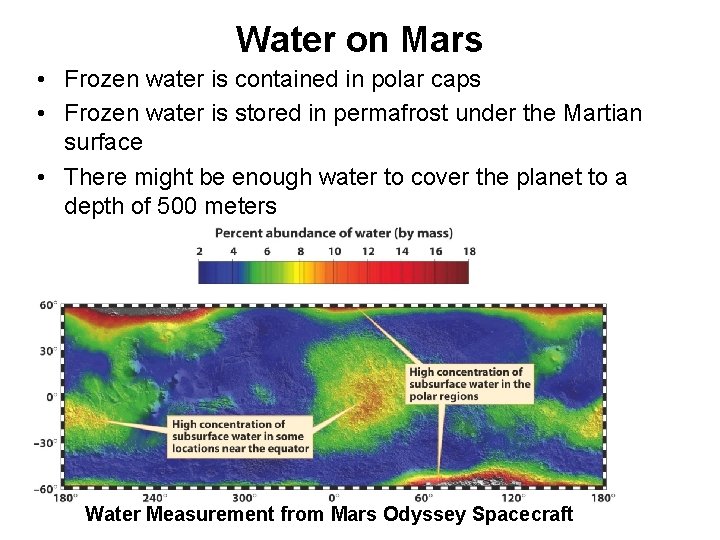
Water on Mars • Frozen water is contained in polar caps • Frozen water is stored in permafrost under the Martian surface • There might be enough water to cover the planet to a depth of 500 meters Water Measurement from Mars Odyssey Spacecraft
Atmosphere • The present Martian atmosphere is composed mostly of carbon dioxide • The atmospheric pressure on the surface is less than 1% that of the Earth and shows seasonal variations as carbon dioxide freezes onto and evaporates from the poles • Mars and Earth began with similar primordial atmosphere that evolved differently – Mars has relatively weaker gravity – Mars is geologically inactive
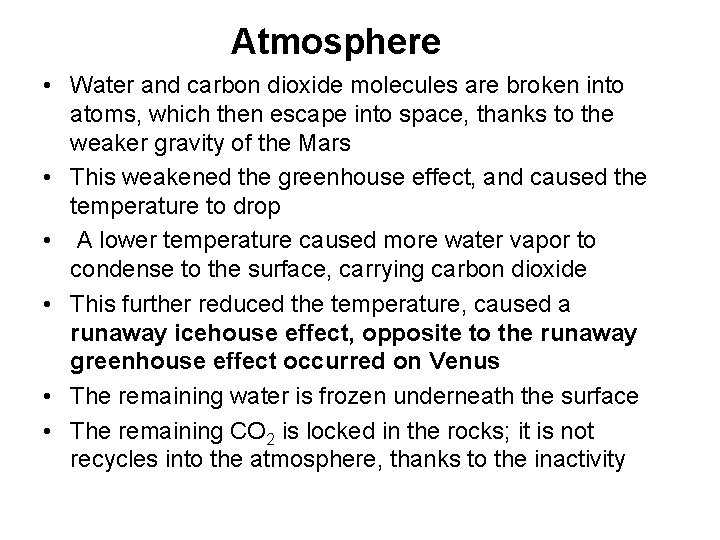
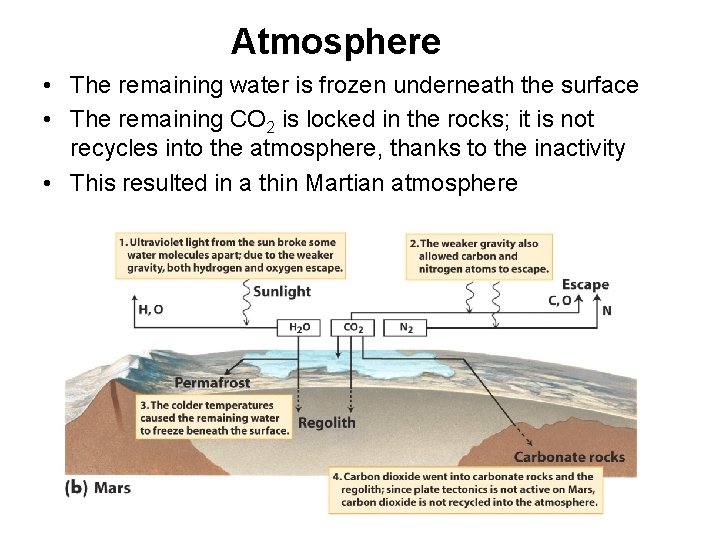
Atmosphere • Water and carbon dioxide molecules are broken into atoms, which then escape into space, thanks to the weaker gravity of the Mars • This weakened the greenhouse effect, and caused the temperature to drop • A lower temperature caused more water vapor to condense to the surface, carrying carbon dioxide • This further reduced the temperature, caused a runaway icehouse effect, opposite to the runaway greenhouse effect occurred on Venus • The remaining water is frozen underneath the surface • The remaining CO 2 is locked in the rocks; it is not recycles into the atmosphere, thanks to the inactivity
Atmosphere • The remaining water is frozen underneath the surface • The remaining CO 2 is locked in the rocks; it is not recycles into the atmosphere, thanks to the inactivity • This resulted in a thin Martian atmosphere
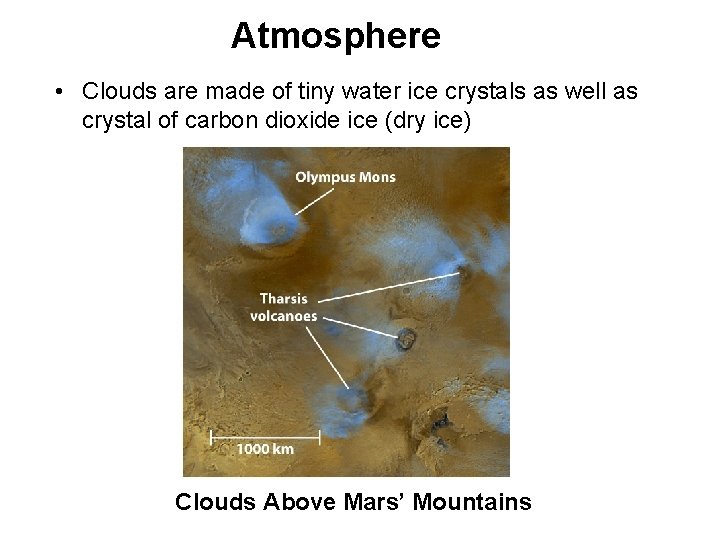
Atmosphere • Clouds are made of tiny water ice crystals as well as crystal of carbon dioxide ice (dry ice) Clouds Above Mars’ Mountains
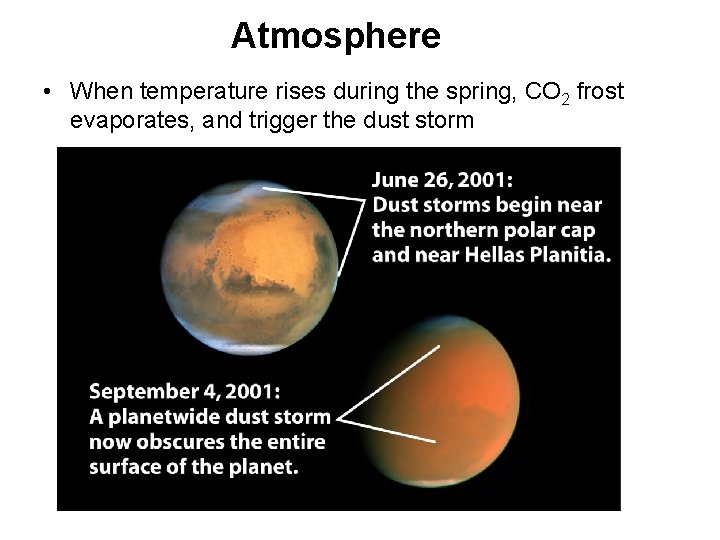
Atmosphere • When temperature rises during the spring, CO 2 frost evaporates, and trigger the dust storm
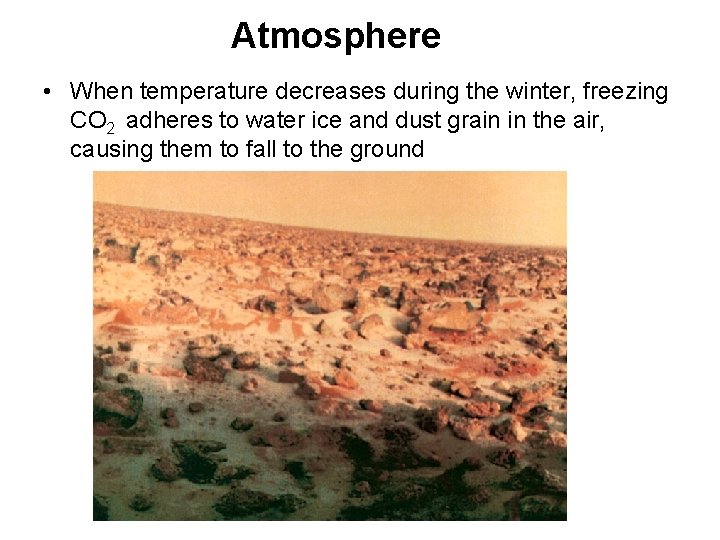
Atmosphere • When temperature decreases during the winter, freezing CO 2 adheres to water ice and dust grain in the air, causing them to fall to the ground
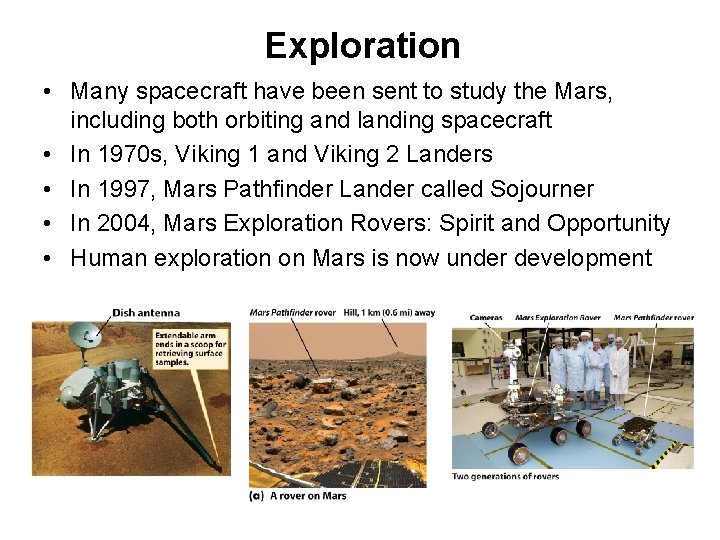
Exploration • Many spacecraft have been sent to study the Mars, including both orbiting and landing spacecraft • In 1970 s, Viking 1 and Viking 2 Landers • In 1997, Mars Pathfinder Lander called Sojourner • In 2004, Mars Exploration Rovers: Spirit and Opportunity • Human exploration on Mars is now under development
Exploration
Final Notes on Chap. 13 • • There are 8 sections in total. Section 13 -7 (on seasons) and 17 -8 (on Moons) are not studied