
Remote Worlds Chapter Fourten ASTR 111 003 Lecture
- Slides: 24
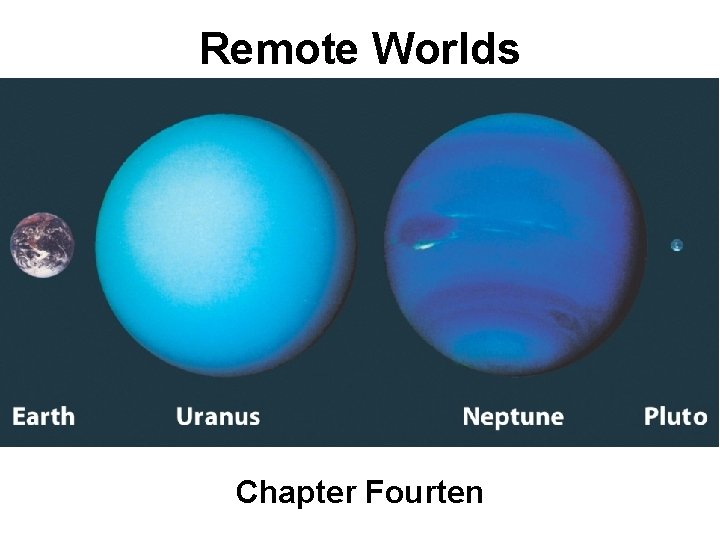
Remote Worlds Chapter Fourten
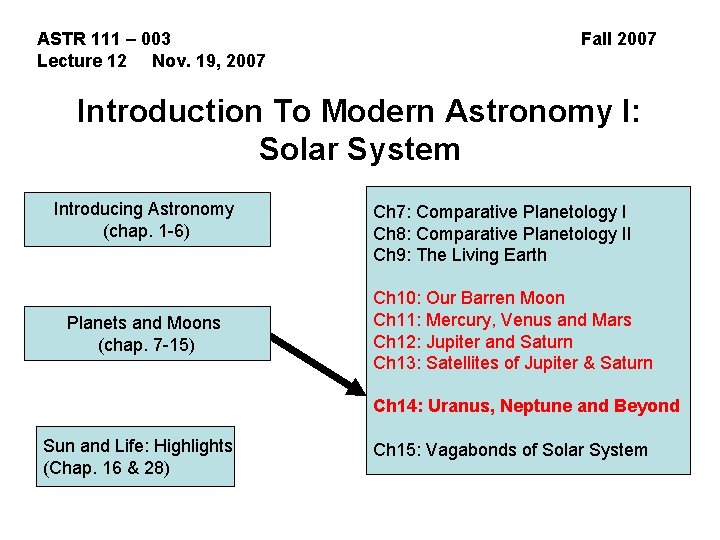
ASTR 111 – 003 Lecture 12 Nov. 19, 2007 Fall 2007 Introduction To Modern Astronomy I: Solar System Introducing Astronomy (chap. 1 -6) Planets and Moons (chap. 7 -15) Ch 7: Comparative Planetology I Ch 8: Comparative Planetology II Ch 9: The Living Earth Ch 10: Our Barren Moon Ch 11: Mercury, Venus and Mars Ch 12: Jupiter and Saturn Ch 13: Satellites of Jupiter & Saturn Ch 14: Uranus, Neptune and Beyond Sun and Life: Highlights (Chap. 16 & 28) Ch 15: Vagabonds of Solar System
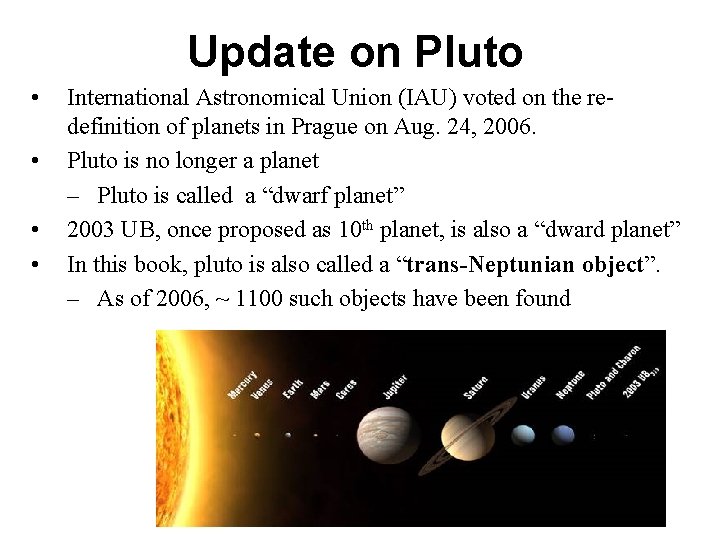
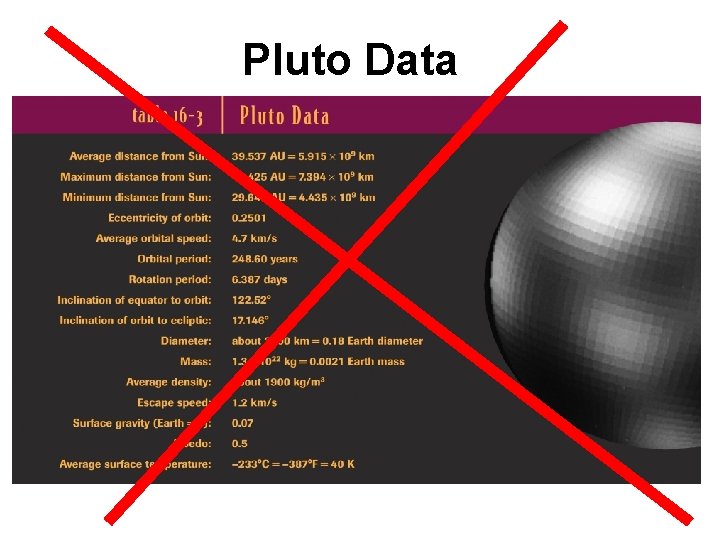
Update on Pluto • • International Astronomical Union (IAU) voted on the redefinition of planets in Prague on Aug. 24, 2006. Pluto is no longer a planet – Pluto is called a “dwarf planet” 2003 UB, once proposed as 10 th planet, is also a “dward planet” In this book, pluto is also called a “trans-Neptunian object”. – As of 2006, ~ 1100 such objects have been found
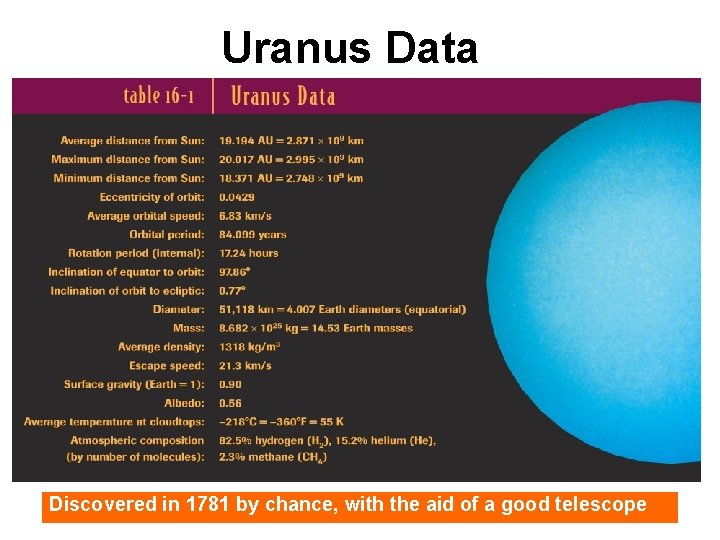
Uranus Data Discovered in 1781 by chance, with the aid of a good telescope
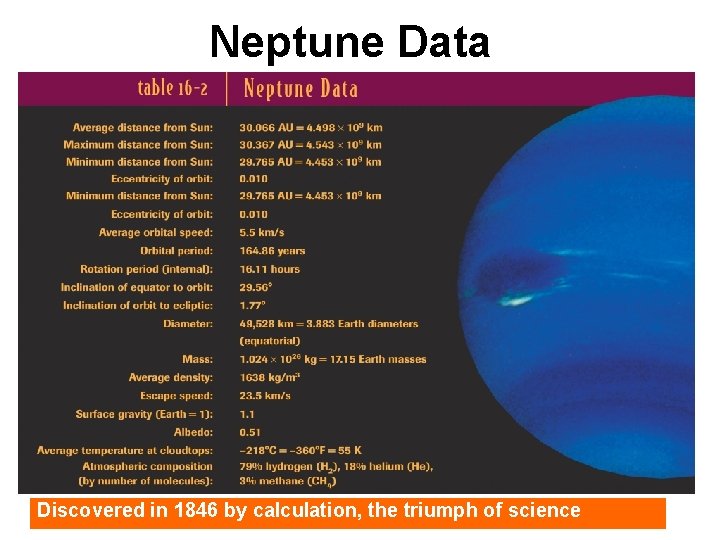
Neptune Data Discovered in 1846 by calculation, the triumph of science
Pluto Data
Discovery • Other than those planets seen by naked eyes, Uranus and Neptune were discovered by telescopes • Uranus was recognized as a planet by chance observation in 1781 by William Herschel • Neptune’s position was predicted using Newtonian laws before it was discovered in 1846 – Slight deviations in Uranus’ orbit indicated the presence of an undiscovered planet, which gravitation altered Uranus’ orbit – The position of Neptune was predicted by Le Verrier and Adams – A triumph of scientific reasoning, based on the truth of Newton’s law of universal graviation
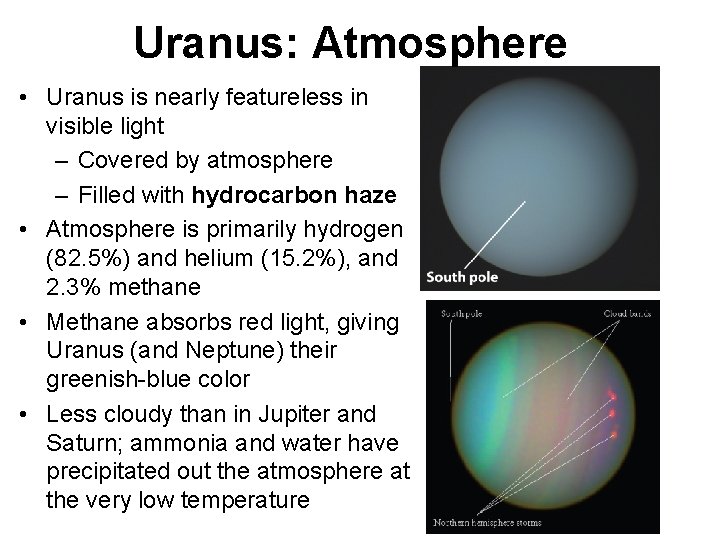
Uranus: Atmosphere • Uranus is nearly featureless in visible light – Covered by atmosphere – Filled with hydrocarbon haze • Atmosphere is primarily hydrogen (82. 5%) and helium (15. 2%), and 2. 3% methane • Methane absorbs red light, giving Uranus (and Neptune) their greenish-blue color • Less cloudy than in Jupiter and Saturn; ammonia and water have precipitated out the atmosphere at the very low temperature
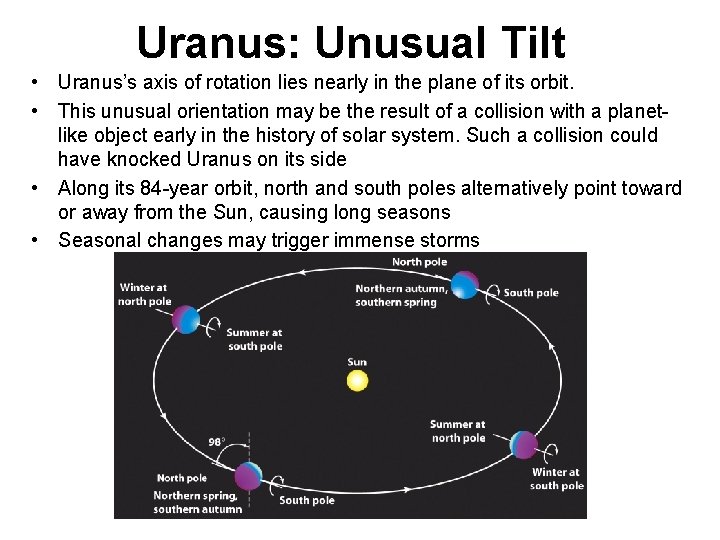
Uranus: Unusual Tilt • Uranus’s axis of rotation lies nearly in the plane of its orbit. • This unusual orientation may be the result of a collision with a planetlike object early in the history of solar system. Such a collision could have knocked Uranus on its side • Along its 84 -year orbit, north and south poles alternatively point toward or away from the Sun, causing long seasons • Seasonal changes may trigger immense storms
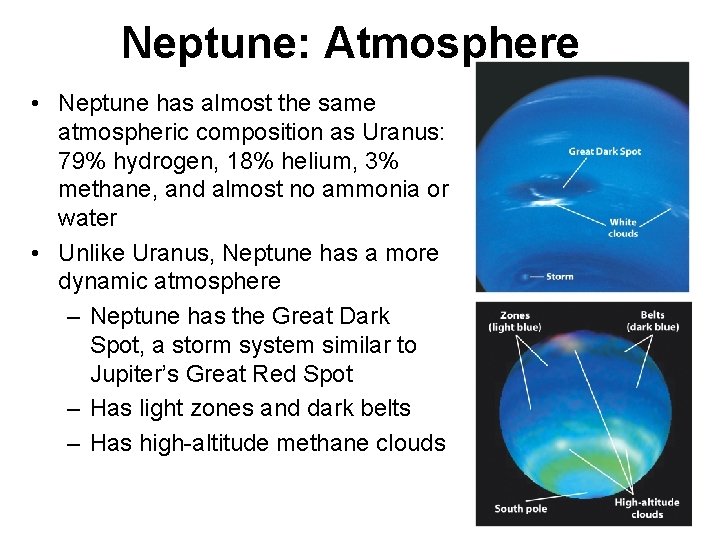
Neptune: Atmosphere • Neptune has almost the same atmospheric composition as Uranus: 79% hydrogen, 18% helium, 3% methane, and almost no ammonia or water • Unlike Uranus, Neptune has a more dynamic atmosphere – Neptune has the Great Dark Spot, a storm system similar to Jupiter’s Great Red Spot – Has light zones and dark belts – Has high-altitude methane clouds
Neptune: Atmosphere • Why does Neptune have a more dynamic atmosphere, even if it receives less sunlight than Uranus? – It has sufficient internal heat – Neptune is probably still slowly contracting, converting gravitational energy that heats the planet’s core – Observations show that Neptune emits more energy than it receives from the Sun – However, Uranus radiates as much energy into space as it receives from the Sun, indicating no internal source of thermal energy
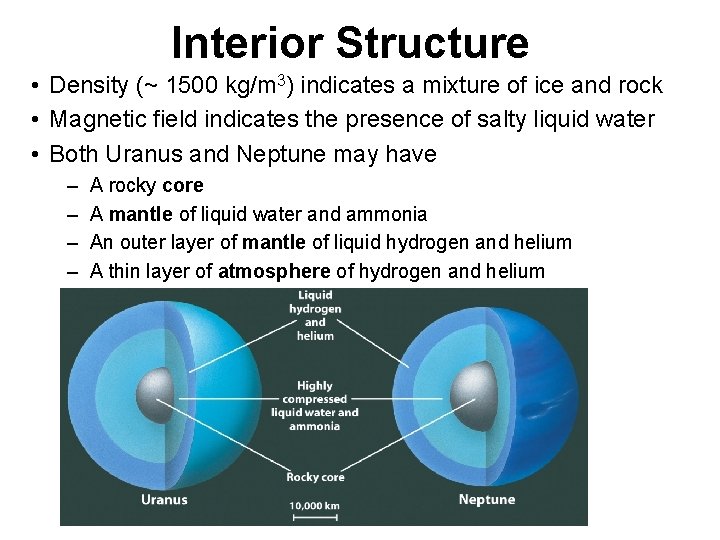
Interior Structure • Density (~ 1500 kg/m 3) indicates a mixture of ice and rock • Magnetic field indicates the presence of salty liquid water • Both Uranus and Neptune may have – – A rocky core A mantle of liquid water and ammonia An outer layer of mantle of liquid hydrogen and helium A thin layer of atmosphere of hydrogen and helium
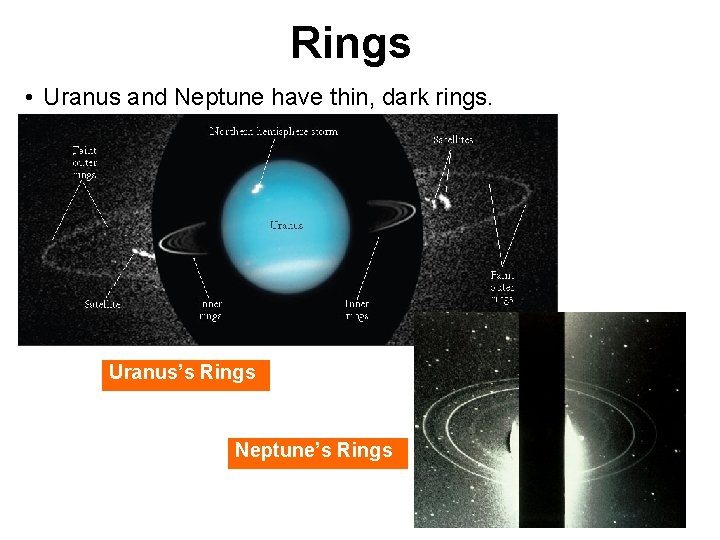
Rings • Uranus and Neptune have thin, dark rings. Uranus’s Rings Neptune’s Rings
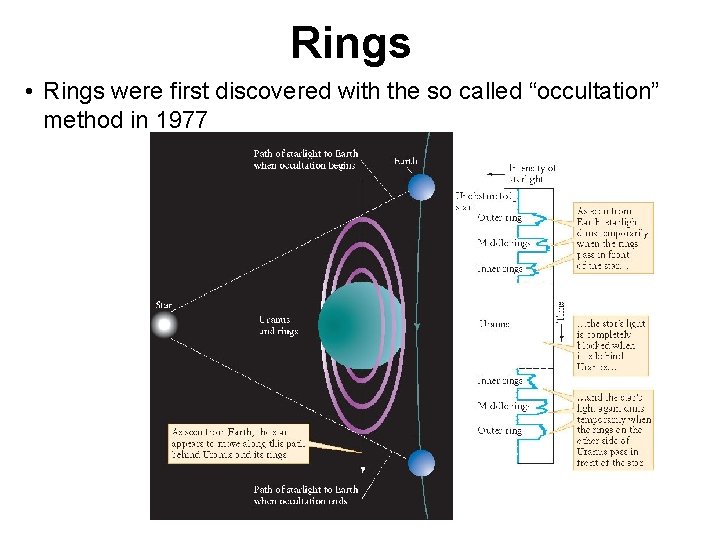
Rings • Rings were first discovered with the so called “occultation” method in 1977
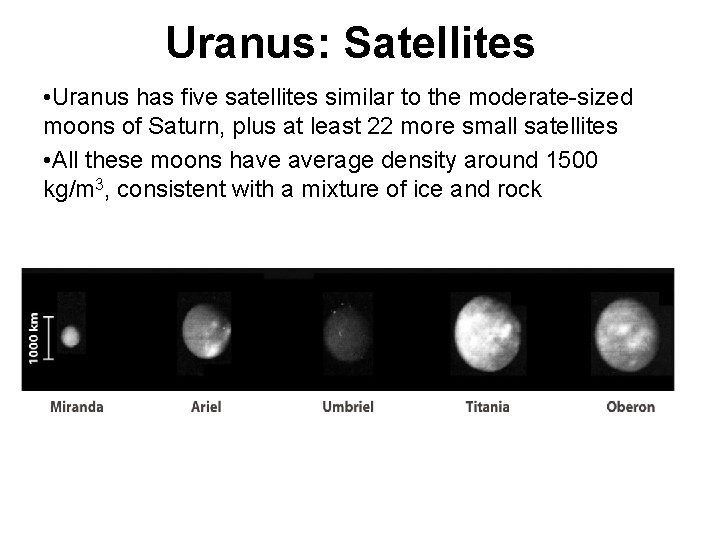
Uranus: Satellites • Uranus has five satellites similar to the moderate-sized moons of Saturn, plus at least 22 more small satellites • All these moons have average density around 1500 kg/m 3, consistent with a mixture of ice and rock
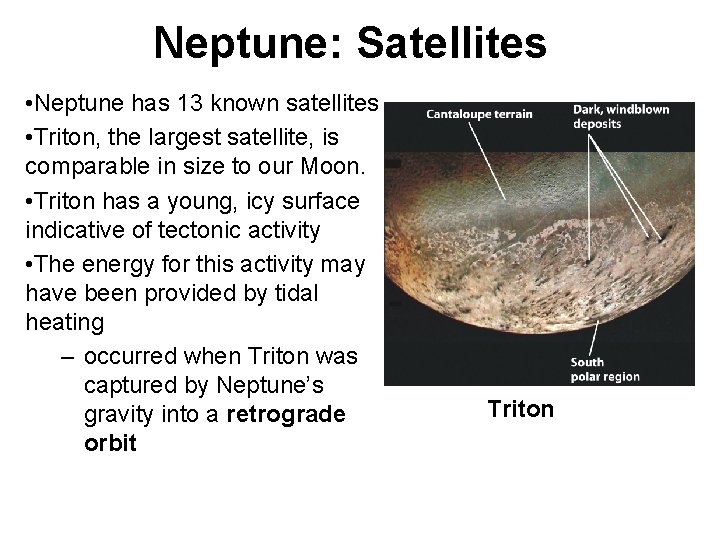
Neptune: Satellites • Neptune has 13 known satellites • Triton, the largest satellite, is comparable in size to our Moon. • Triton has a young, icy surface indicative of tectonic activity • The energy for this activity may have been provided by tidal heating – occurred when Triton was captured by Neptune’s gravity into a retrograde orbit Triton
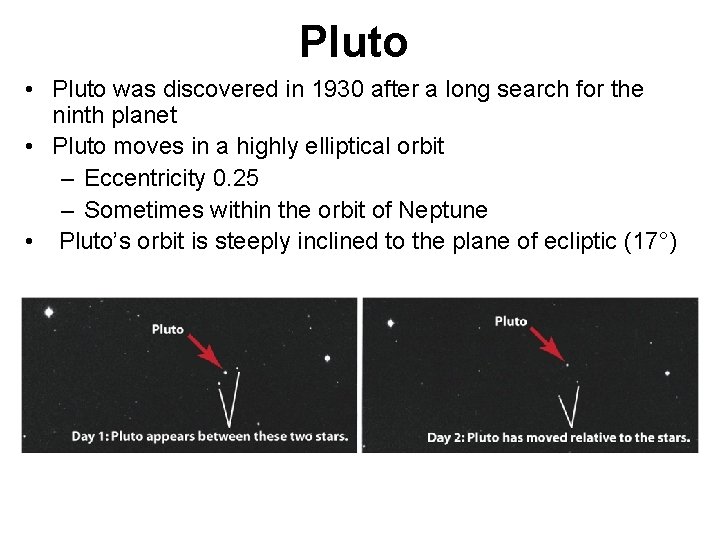
Pluto • Pluto was discovered in 1930 after a long search for the ninth planet • Pluto moves in a highly elliptical orbit – Eccentricity 0. 25 – Sometimes within the orbit of Neptune • Pluto’s orbit is steeply inclined to the plane of ecliptic (17°)
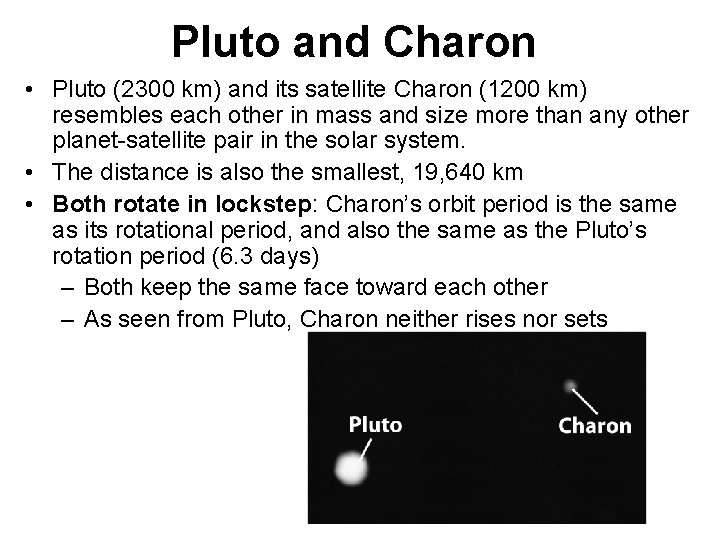
Pluto and Charon • Pluto (2300 km) and its satellite Charon (1200 km) resembles each other in mass and size more than any other planet-satellite pair in the solar system. • The distance is also the smallest, 19, 640 km • Both rotate in lockstep: Charon’s orbit period is the same as its rotational period, and also the same as the Pluto’s rotation period (6. 3 days) – Both keep the same face toward each other – As seen from Pluto, Charon neither rises nor sets
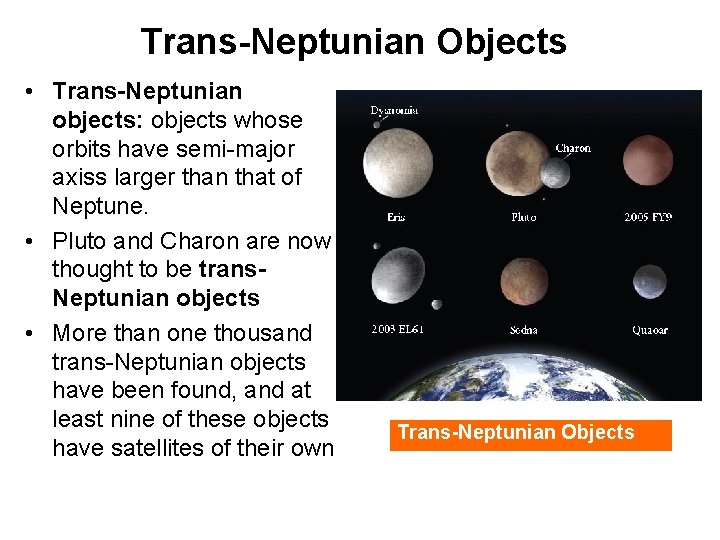
Trans-Neptunian Objects • Trans-Neptunian objects: objects whose orbits have semi-major axiss larger than that of Neptune. • Pluto and Charon are now thought to be trans. Neptunian objects • More than one thousand trans-Neptunian objects have been found, and at least nine of these objects have satellites of their own Trans-Neptunian Objects
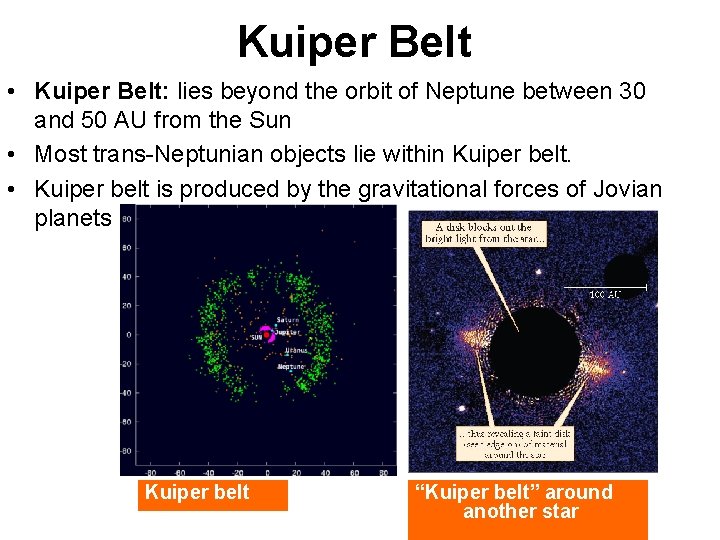
Kuiper Belt • Kuiper Belt: lies beyond the orbit of Neptune between 30 and 50 AU from the Sun • Most trans-Neptunian objects lie within Kuiper belt. • Kuiper belt is produced by the gravitational forces of Jovian planets Kuiper belt “Kuiper belt” around another star
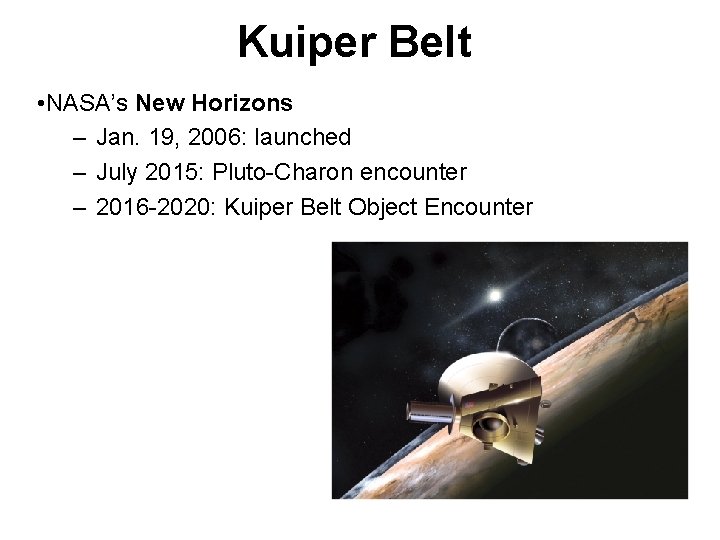
Kuiper Belt • NASA’s New Horizons – Jan. 19, 2006: launched – July 2015: Pluto-Charon encounter – 2016 -2020: Kuiper Belt Object Encounter
Final Notes on Chap. 16 • There are 10 sections in total. • The following sections are not covered – 16 -5 (magnetic field)
Advanced Question Chap. 14, Q 7 in P 372 Explain the statement “Methane” is to Uranus’s atmosphere as water is to Earth’s atmosphere?
Advanced Question Chap. 14, Q 43 in P 373 The New Horizons spacecraft will swing by Jupiter to get a boost from that planet’s gravity, enabling it to reach Pluto relatively quickly. To see what would happen if this technique were not used, consider a spacecraft trajectory that is an elliptical orbit around the Sun. The perihelion of this orbit is at 1 AU from the Sun (at the Earth) and the aphelian is at 30 AU (at Pluto’s position). Calculate how long it would take a spacecraft in this orbit to make the one-way trip from Earth to Pluto. Based on the information in section 1410, how much time is saved by making a swling by Jupiter instead?