Recursive functions ACSL A definition that defines an
- Slides: 8
Recursive functions ACSL
• A definition that defines an object in terms of itself is said to be recursive • Many expressions may be defined recursively in a very simple and elegant manner. The art of recursive thinking is an important skill. Applications of recursion appear in many areas of mathematics (factorials, compound interest, difference equations, etc. ) • In this round recursive relationships will be shown not in the context of a programming language but usually in functional notation from mathematics or in an algorithmic description. •
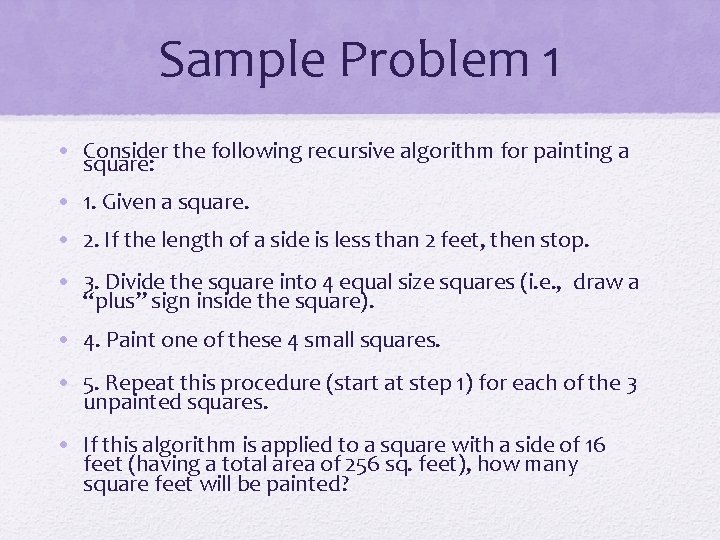
Sample Problem 1 • Consider the following recursive algorithm for painting a square: • 1. Given a square. • 2. If the length of a side is less than 2 feet, then stop. • 3. Divide the square into 4 equal size squares (i. e. , draw a “plus” sign inside the square). • 4. Paint one of these 4 small squares. • 5. Repeat this procedure (start at step 1) for each of the 3 unpainted squares. • If this algorithm is applied to a square with a side of 16 feet (having a total area of 256 sq. feet), how many square feet will be painted?
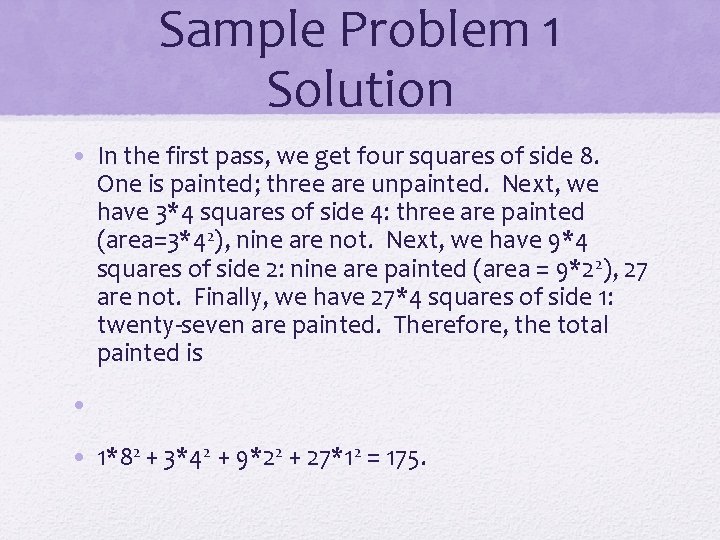
Sample Problem 1 Solution • In the first pass, we get four squares of side 8. One is painted; three are unpainted. Next, we have 3*4 squares of side 4: three are painted (area=3*42), nine are not. Next, we have 9*4 squares of side 2: nine are painted (area = 9*22), 27 are not. Finally, we have 27*4 squares of side 1: twenty-seven are painted. Therefore, the total painted is • • 1*82 + 3*42 + 9*22 + 27*12 = 175.
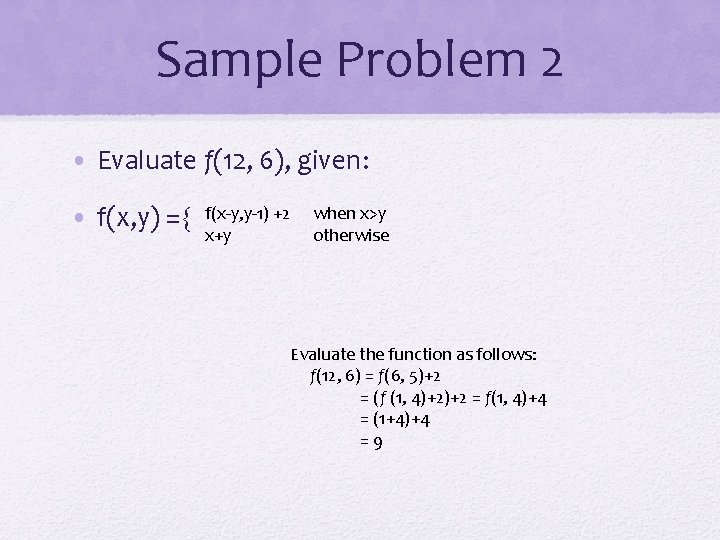
Sample Problem 2 • Evaluate f(12, 6), given: • f(x, y) = f(x-y, y-1) +2 when x>y x+y otherwise Evaluate the function as follows: f(12, 6) = f(6, 5)+2 = (f (1, 4)+2)+2 = f(1, 4)+4 = (1+4)+4 = 9
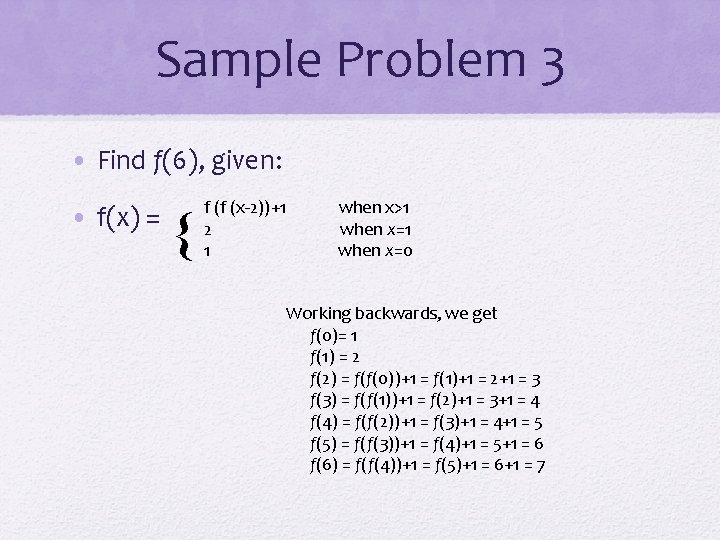
Sample Problem 3 • Find f(6), given: • f(x) = f (f (x-2))+1 when x>1 2 when x=1 1 when x=0 Working backwards, we get f(0)= 1 f(1) = 2 f(2) = f(f(0))+1 = f(1)+1 = 2+1 = 3 f(3) = f(f(1))+1 = f(2)+1 = 3+1 = 4 f(4) = f(f(2))+1 = f(3)+1 = 4+1 = 5 f(5) = f(f(3))+1 = f(4)+1 = 5+1 = 6 f(6) = f(f(4))+1 = f(5)+1 = 6+1 = 7
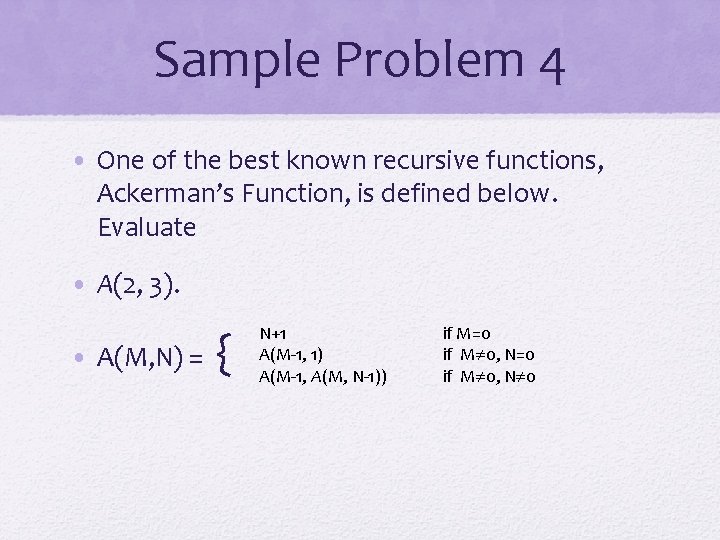
Sample Problem 4 • One of the best known recursive functions, Ackerman’s Function, is defined below. Evaluate • A(2, 3). • A(M, N) = { N+1 A(M-1, 1) A(M-1, A(M, N-1)) if M=0 if M 0, N 0
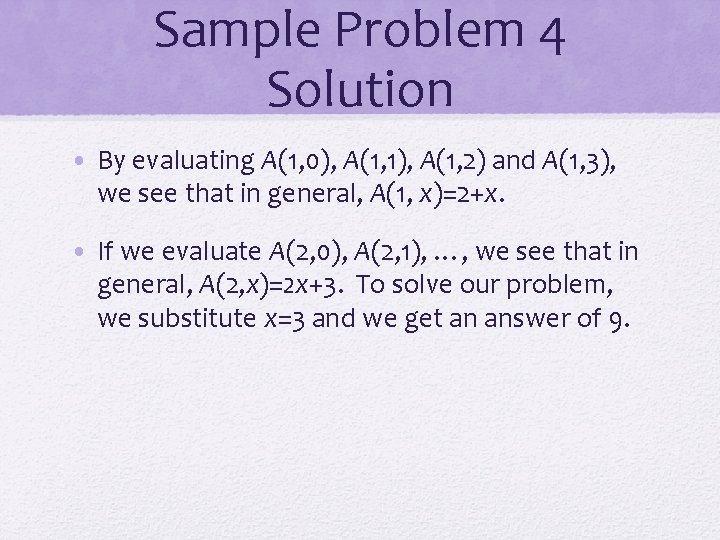
Sample Problem 4 Solution • By evaluating A(1, 0), A(1, 1), A(1, 2) and A(1, 3), we see that in general, A(1, x)=2+x. • If we evaluate A(2, 0), A(2, 1), …, we see that in general, A(2, x)=2 x+3. To solve our problem, we substitute x=3 and we get an answer of 9.