Recent progress in theory of Anderson localization Akira


- Slides: 39
Recent progress in theory of Anderson localization Akira Furusaki (RIKEN) 理化学研究所 Collaborators: Piet Brouwer (Cornell) Ilya Gruzberg (Chicago) Christopher Mudry (PSI) Andreas Ludwig (UC Santa Barbara) Shinsei Ryu (UC Santa Barbara) Hideaki Obuse (RIKEN) Arvind Subramaniam (Chicago)
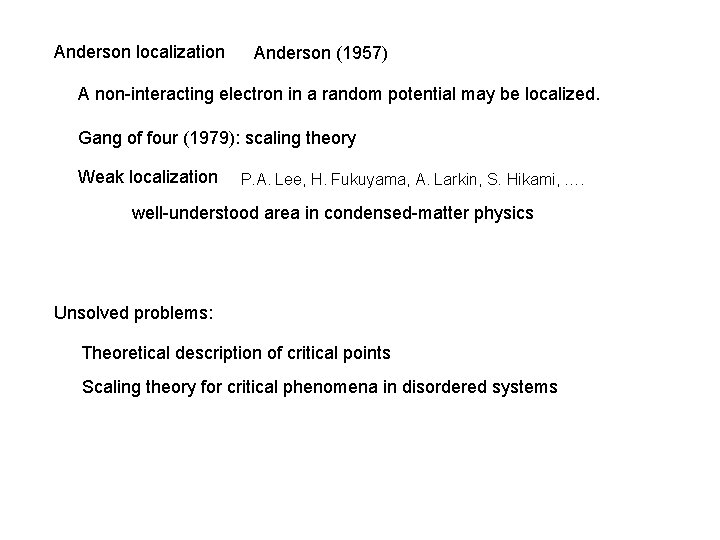
Anderson localization Anderson (1957) A non-interacting electron in a random potential may be localized. Gang of four (1979): scaling theory Weak localization P. A. Lee, H. Fukuyama, A. Larkin, S. Hikami, …. well-understood area in condensed-matter physics Unsolved problems: Theoretical description of critical points Scaling theory for critical phenomena in disordered systems
• Introduction • New universality classes • Scaling approach in 1 D • 2 D (symplectic class)
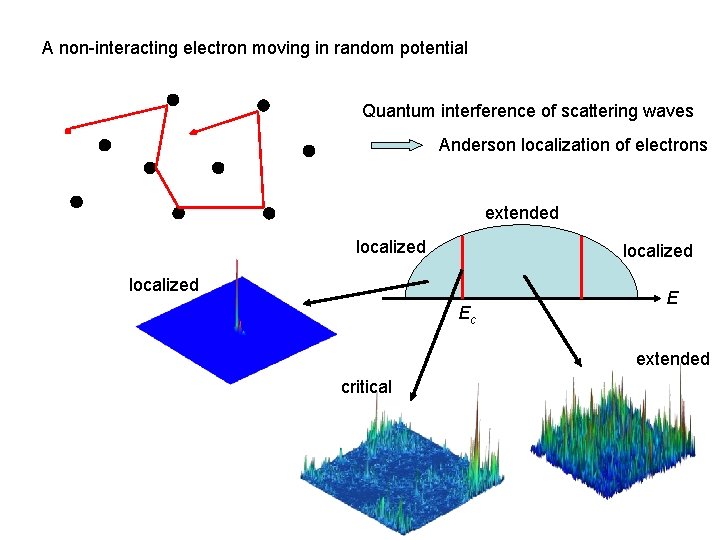
A non-interacting electron moving in random potential Quantum interference of scattering waves Anderson localization of electrons extended localized Ec E extended critical
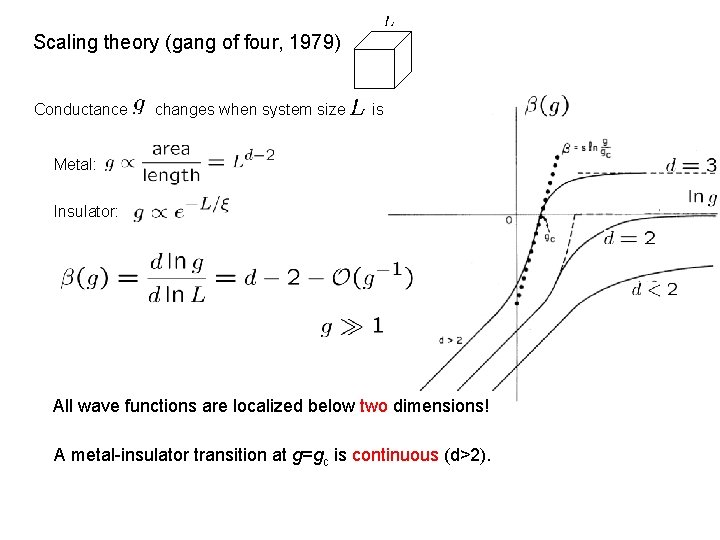
Scaling theory (gang of four, 1979) Conductance changes when system size is changed. Metal: Insulator: All wave functions are localized below two dimensions! A metal-insulator transition at g=gc is continuous (d>2).
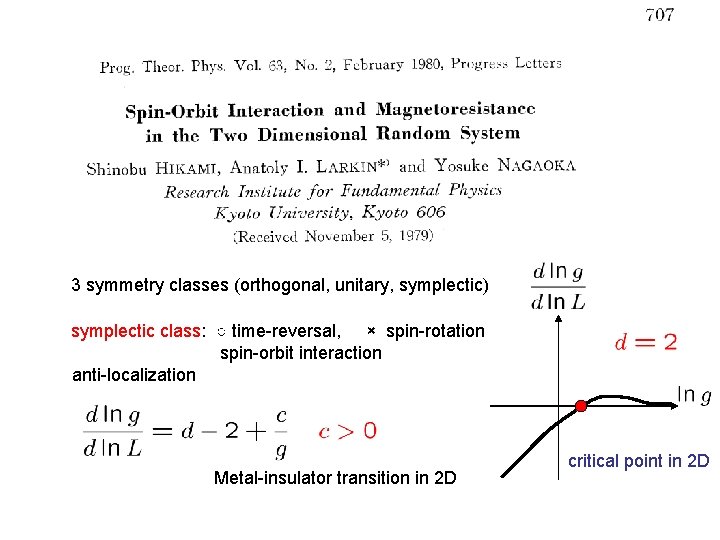
3 symmetry classes (orthogonal, unitary, symplectic) symplectic class: ○ time-reversal, × spin-rotation spin-orbit interaction anti-localization Metal-insulator transition in 2 D critical point in 2 D
Anderson metal-insulator transition is a continuous quantum phase transition driven by disorder • Dimensionality d • Symmetry of Hamiltonian time-reversal symmetry SU(2) rotation symmetry in space Wigner-Dyson ensemble of random matrices time reversal symmetry spin rotation symmetry orthogonal unitary symplectic
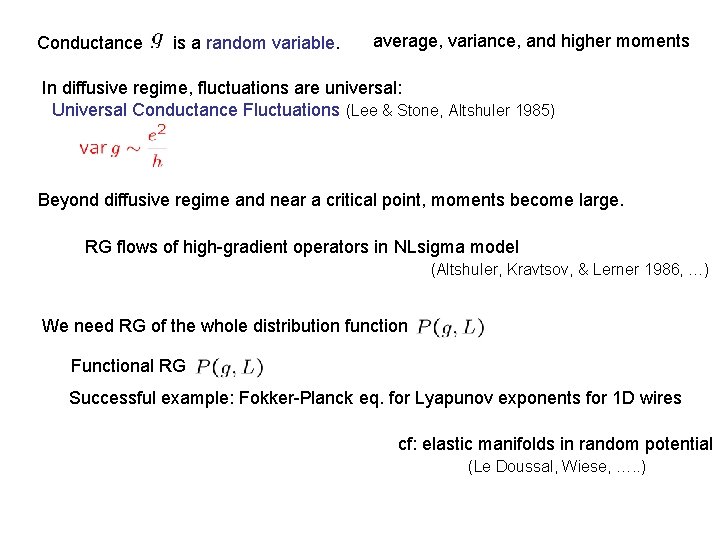
Conductance is a random variable. average, variance, and higher moments In diffusive regime, fluctuations are universal: Universal Conductance Fluctuations (Lee & Stone, Altshuler 1985) Beyond diffusive regime and near a critical point, moments become large. RG flows of high-gradient operators in NLsigma model (Altshuler, Kravtsov, & Lerner 1986, …) We need RG of the whole distribution function Functional RG Successful example: Fokker-Planck eq. for Lyapunov exponents for 1 D wires cf: elastic manifolds in random potential (Le Doussal, Wiese, …. . )
• Introduction • New universality classes • Scaling approach in 1 D • 2 D (mostly symplectic class)
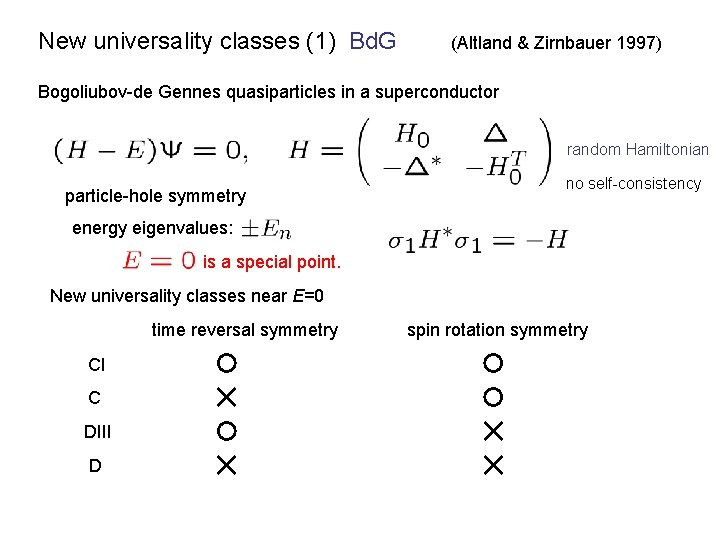
New universality classes (1) Bd. G (Altland & Zirnbauer 1997) Bogoliubov-de Gennes quasiparticles in a superconductor random Hamiltonian particle-hole symmetry no self-consistency energy eigenvalues: is a special point. New universality classes near E=0 time reversal symmetry CI C DIII D spin rotation symmetry
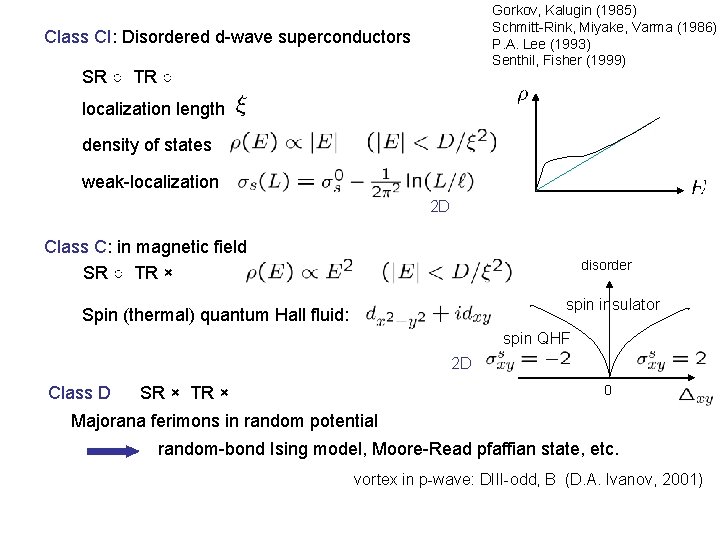
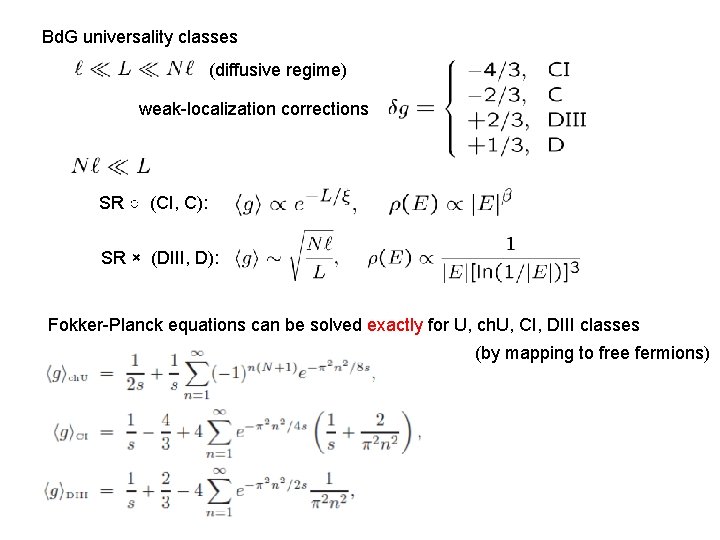
Gorkov, Kalugin (1985) Schmitt-Rink, Miyake, Varma (1986) P. A. Lee (1993) Senthil, Fisher (1999) Class CI: Disordered d-wave superconductors SR ○ TR ○ localization length density of states weak-localization 2 D Class C: in magnetic field SR ○ TR × disorder spin insulator Spin (thermal) quantum Hall fluid: spin QHF 2 D Class D 0 SR × TR × Majorana ferimons in random potential random-bond Ising model, Moore-Read pfaffian state, etc. vortex in p-wave: DIII-odd, B (D. A. Ivanov, 2001)
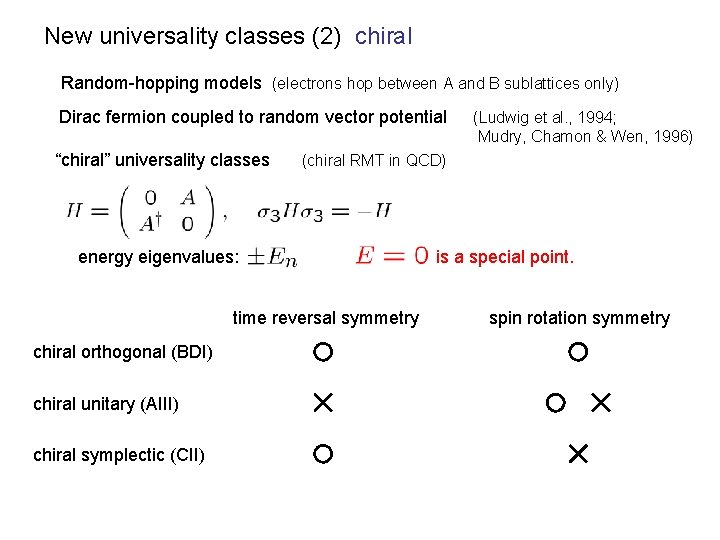
New universality classes (2) chiral Random-hopping models (electrons hop between A and B sublattices only) Dirac fermion coupled to random vector potential “chiral” universality classes (chiral RMT in QCD) energy eigenvalues: time reversal symmetry chiral orthogonal (BDI) chiral unitary (AIII) chiral symplectic (CII) (Ludwig et al. , 1994; Mudry, Chamon & Wen, 1996) is a special point. spin rotation symmetry
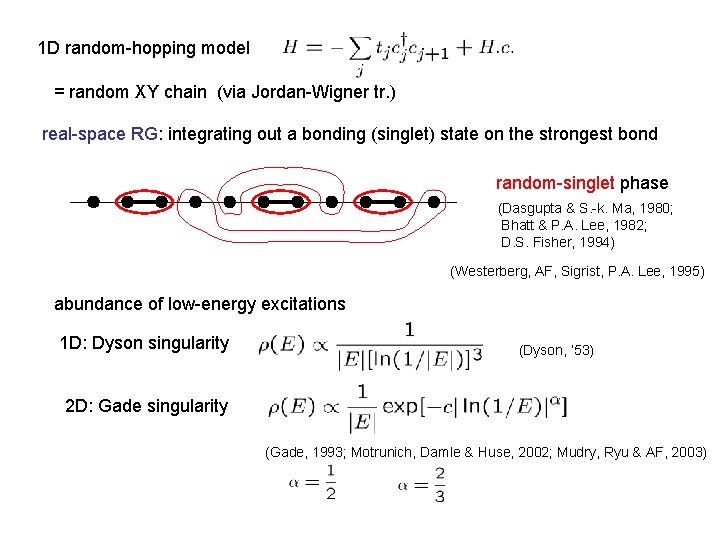
1 D random-hopping model = random XY chain (via Jordan-Wigner tr. ) real-space RG: integrating out a bonding (singlet) state on the strongest bond random-singlet phase (Dasgupta & S. -k. Ma, 1980; Bhatt & P. A. Lee, 1982; D. S. Fisher, 1994) (Westerberg, AF, Sigrist, P. A. Lee, 1995) abundance of low-energy excitations 1 D: Dyson singularity (Dyson, ’ 53) 2 D: Gade singularity (Gade, 1993; Motrunich, Damle & Huse, 2002; Mudry, Ryu & AF, 2003)
• Introduction • New universality classes • Scaling approach in 1 D (functional RG) • 2 D (mostly symplectic class)
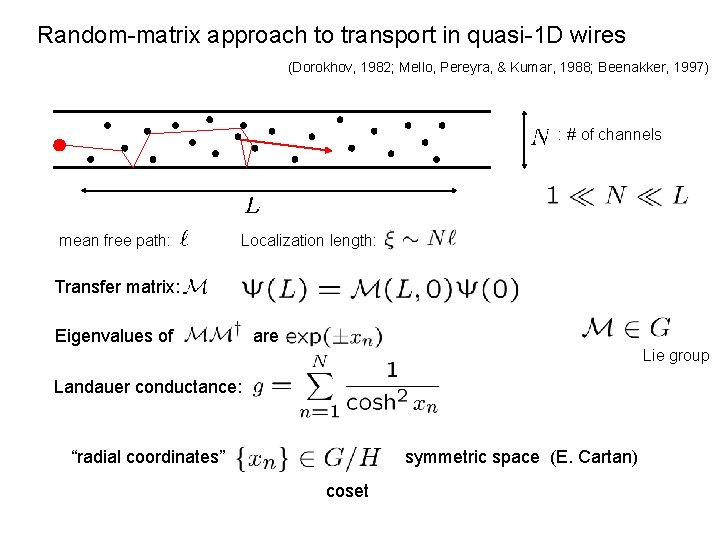
Random-matrix approach to transport in quasi-1 D wires (Dorokhov, 1982; Mello, Pereyra, & Kumar, 1988; Beenakker, 1997) : # of channels mean free path: Localization length: Transfer matrix: Eigenvalues of are Lie group Landauer conductance: “radial coordinates” symmetric space (E. Cartan) coset
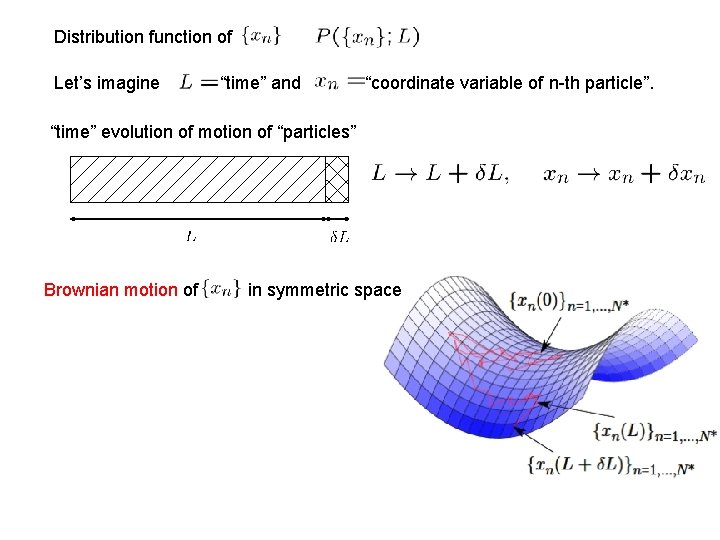
Distribution function of Let’s imagine “time” and “coordinate variable of n-th particle”. “time” evolution of motion of “particles” Brownian motion of in symmetric space
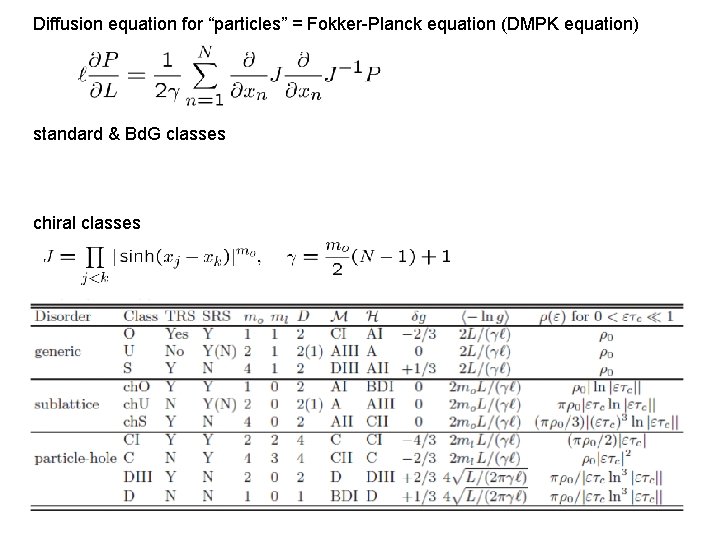
Diffusion equation for “particles” = Fokker-Planck equation (DMPK equation) standard & Bd. G classes chiral classes
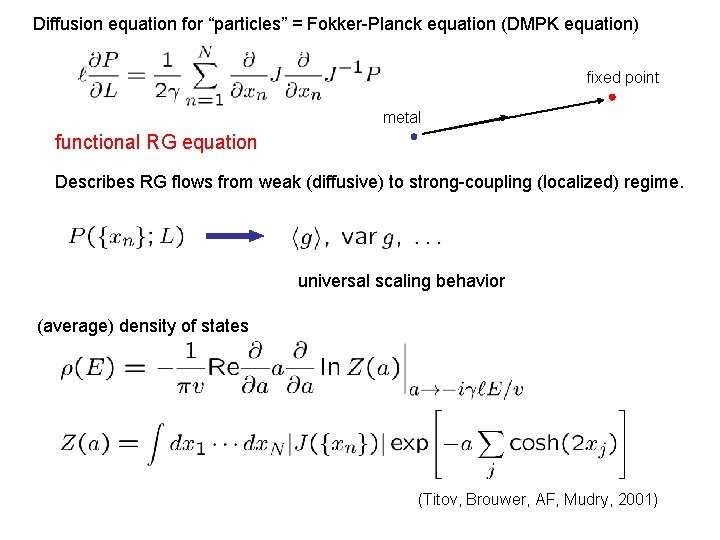
Diffusion equation for “particles” = Fokker-Planck equation (DMPK equation) fixed point metal functional RG equation Describes RG flows from weak (diffusive) to strong-coupling (localized) regime. universal scaling behavior (average) density of states (Titov, Brouwer, AF, Mudry, 2001)
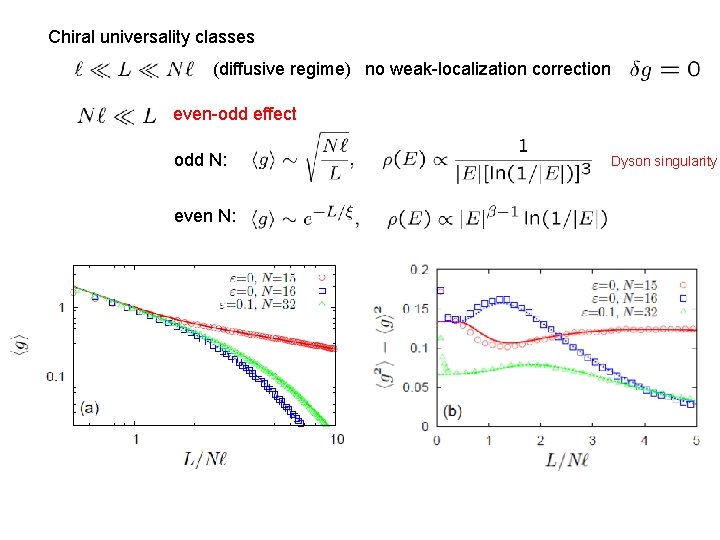
Chiral universality classes (diffusive regime) no weak-localization correction even-odd effect odd N: even N: Dyson singularity
Bd. G universality classes (diffusive regime) weak-localization corrections SR ○ (CI, C): SR × (DIII, D): Fokker-Planck equations can be solved exactly for U, ch. U, CI, DIII classes (by mapping to free fermions)
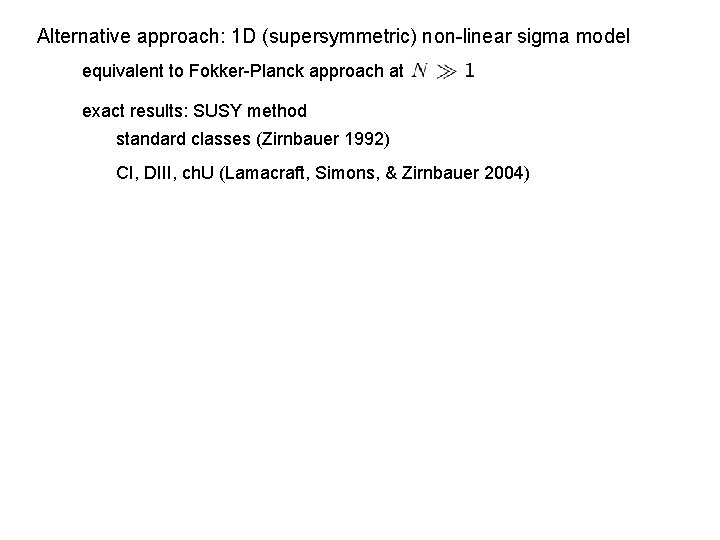
Alternative approach: 1 D (supersymmetric) non-linear sigma model equivalent to Fokker-Planck approach at exact results: SUSY method standard classes (Zirnbauer 1992) CI, DIII, ch. U (Lamacraft, Simons, & Zirnbauer 2004)
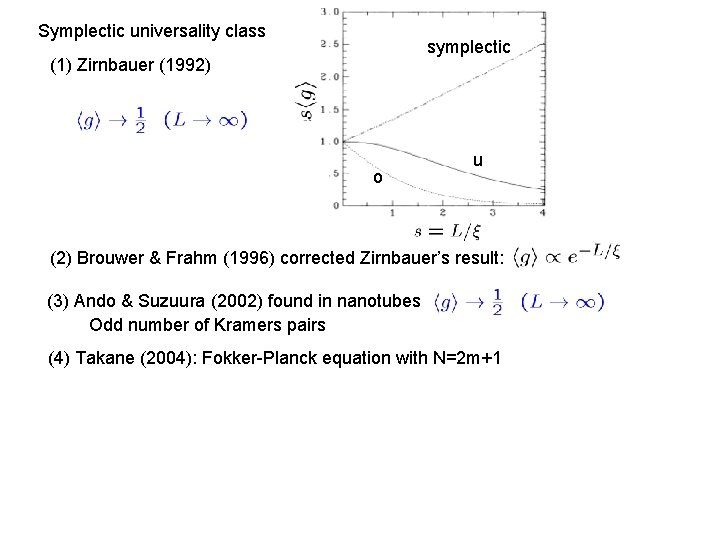
Symplectic universality class symplectic (1) Zirnbauer (1992) o u (2) Brouwer & Frahm (1996) corrected Zirnbauer’s result: (3) Ando & Suzuura (2002) found in nanotubes Odd number of Kramers pairs (4) Takane (2004): Fokker-Planck equation with N=2 m+1
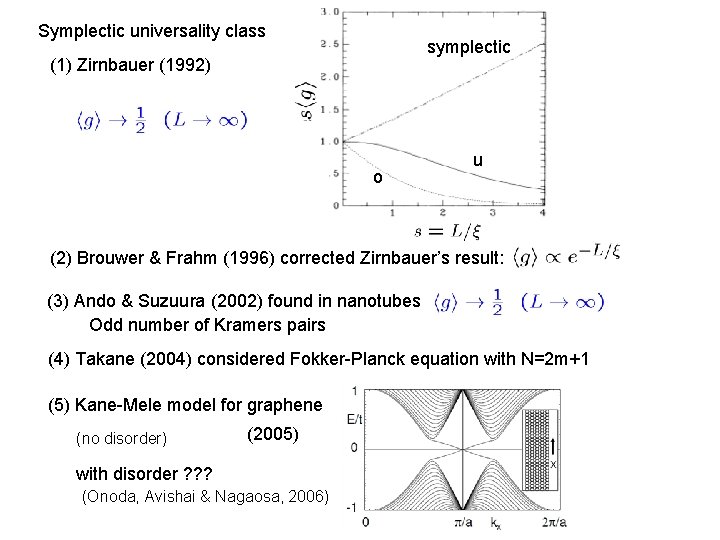
Symplectic universality class symplectic (1) Zirnbauer (1992) o u (2) Brouwer & Frahm (1996) corrected Zirnbauer’s result: (3) Ando & Suzuura (2002) found in nanotubes Odd number of Kramers pairs (4) Takane (2004) considered Fokker-Planck equation with N=2 m+1 (5) Kane-Mele model for graphene (no disorder) (2005) with disorder ? ? ? (Onoda, Avishai & Nagaosa, 2006)
• Introduction • New universality classes • Scaling approach in 1 D • 2 D (attempt to understand symplectic class)
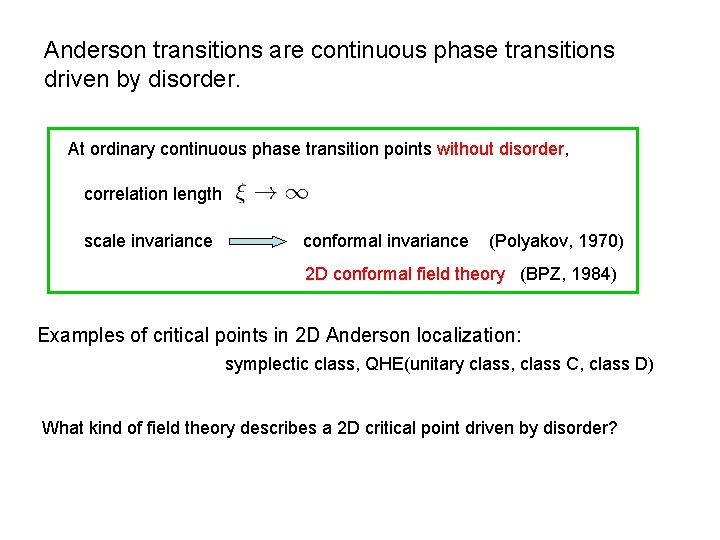
Anderson transitions are continuous phase transitions driven by disorder. At ordinary continuous phase transition points without disorder, correlation length scale invariance conformal invariance (Polyakov, 1970) 2 D conformal field theory (BPZ, 1984) Examples of critical points in 2 D Anderson localization: symplectic class, QHE(unitary class, class C, class D) What kind of field theory describes a 2 D critical point driven by disorder?
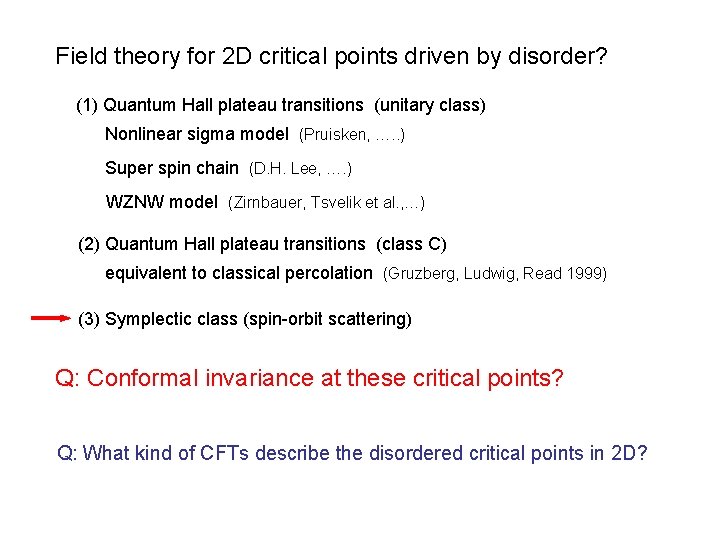
Field theory for 2 D critical points driven by disorder? (1) Quantum Hall plateau transitions (unitary class) Nonlinear sigma model (Pruisken, …. . ) Super spin chain (D. H. Lee, …. ) WZNW model (Zirnbauer, Tsvelik et al. , …) (2) Quantum Hall plateau transitions (class C) equivalent to classical percolation (Gruzberg, Ludwig, Read 1999) (3) Symplectic class (spin-orbit scattering) Q: Conformal invariance at these critical points? Q: What kind of CFTs describe the disordered critical points in 2 D?
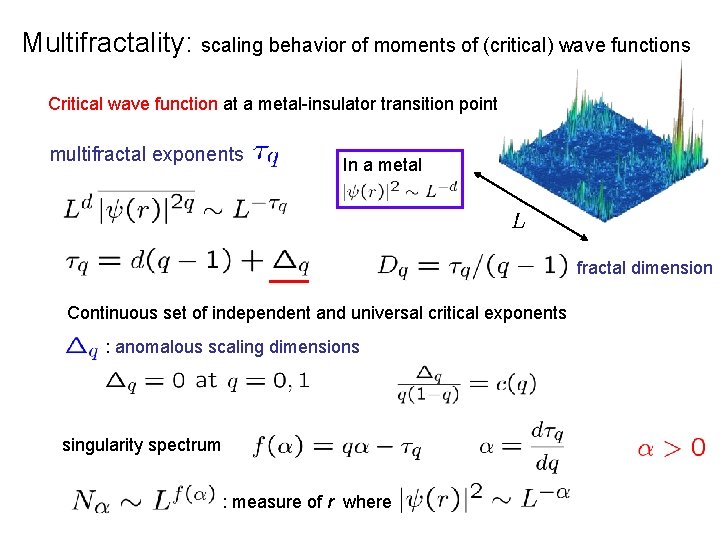
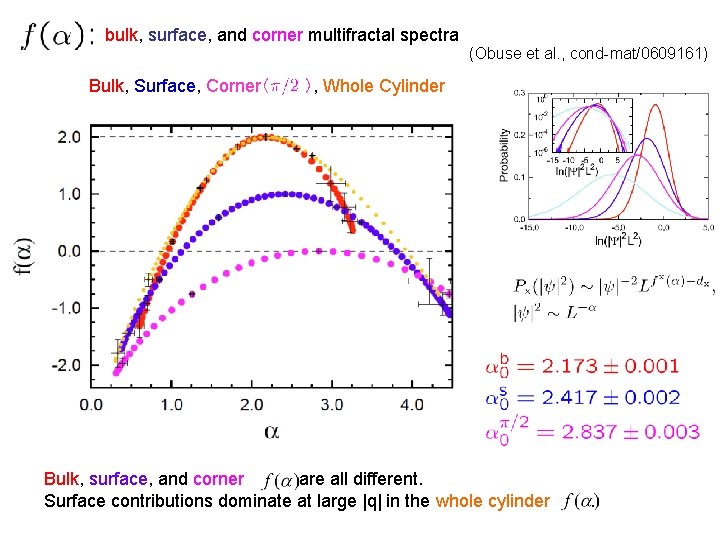
Multifractality: scaling behavior of moments of (critical) wave functions Critical wave function at a metal-insulator transition point multifractal exponents In a metal fractal dimension Continuous set of independent and universal critical exponents : anomalous scaling dimensions singularity spectrum : measure of r where
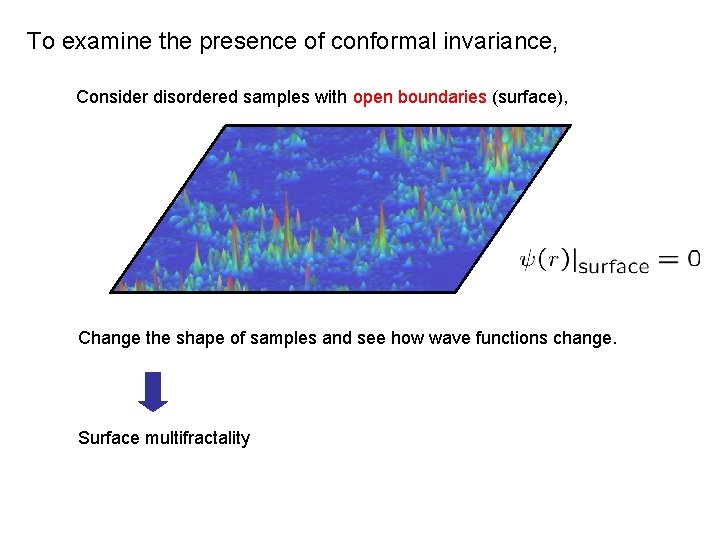
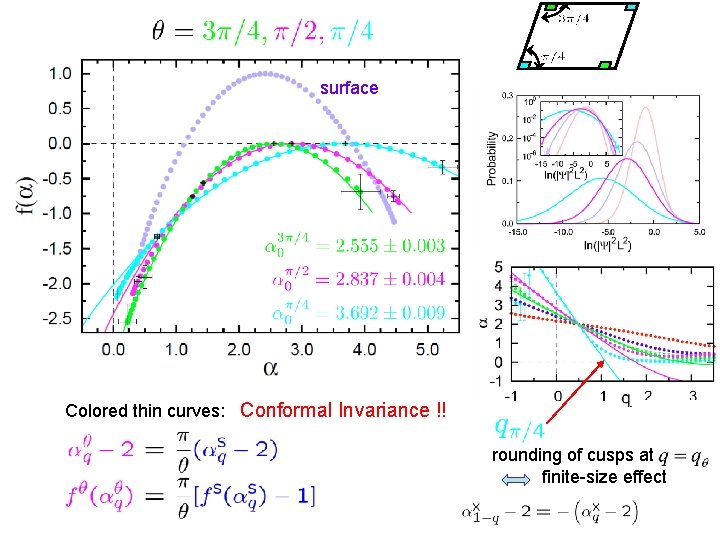
To examine the presence of conformal invariance, Consider disordered samples with open boundaries (surface), Change the shape of samples and see how wave functions change. Surface multifractality
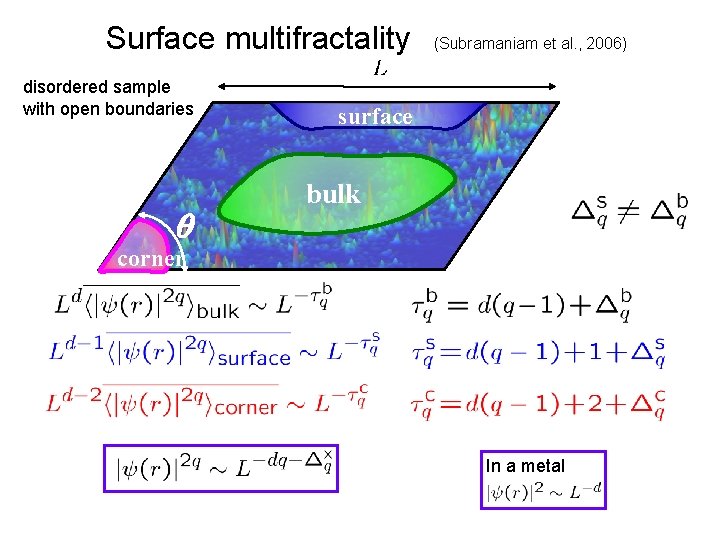
Surface multifractality disordered sample with open boundaries q (Subramaniam et al. , 2006) surface bulk corner In a metal
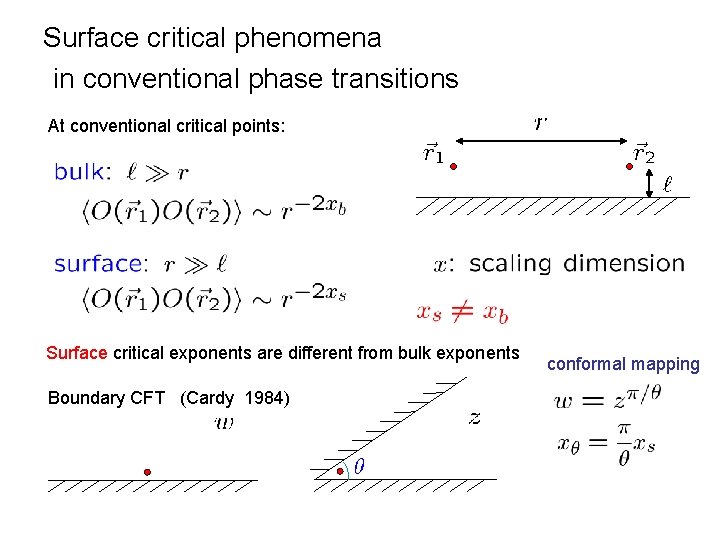
Surface critical phenomena in conventional phase transitions At conventional critical points: Surface critical exponents are different from bulk exponents Boundary CFT (Cardy 1984) conformal mapping
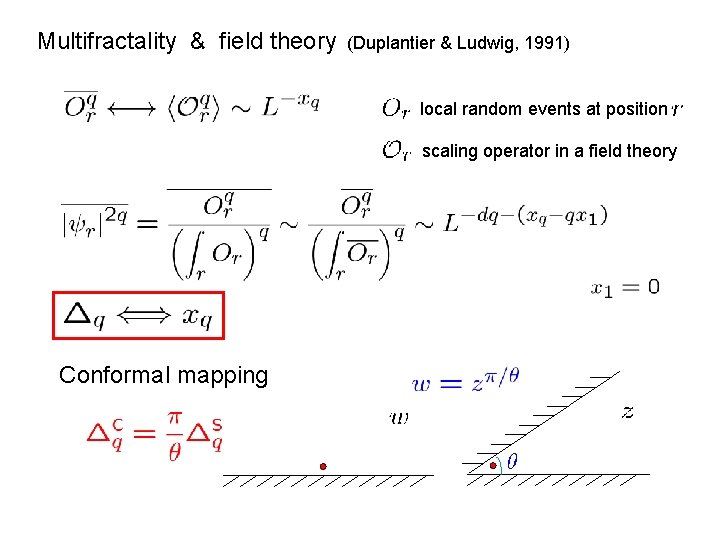
Multifractality & field theory (Duplantier & Ludwig, 1991) local random events at position scaling operator in a field theory Conformal mapping
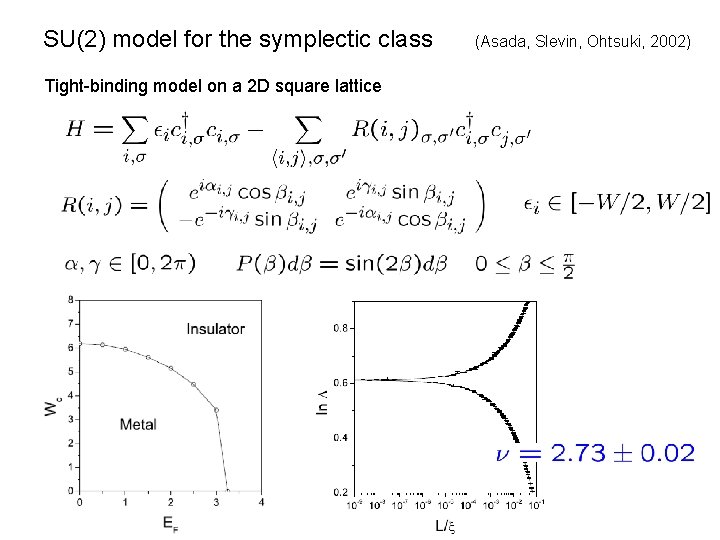
SU(2) model for the symplectic class Tight-binding model on a 2 D square lattice (Asada, Slevin, Ohtsuki, 2002)
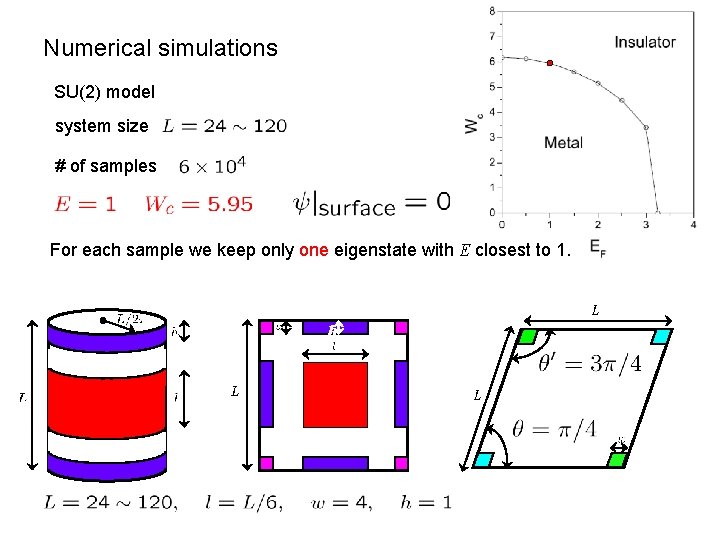
Numerical simulations SU(2) model system size # of samples For each sample we keep only one eigenstate with E closest to 1. h
bulk, surface, and corner multifractal spectra (Obuse et al. , cond-mat/0609161) Bulk, Surface, Corner( ), Whole Cylinder Bulk, surface, and corner are all different. Surface contributions dominate at large |q| in the whole cylinder .
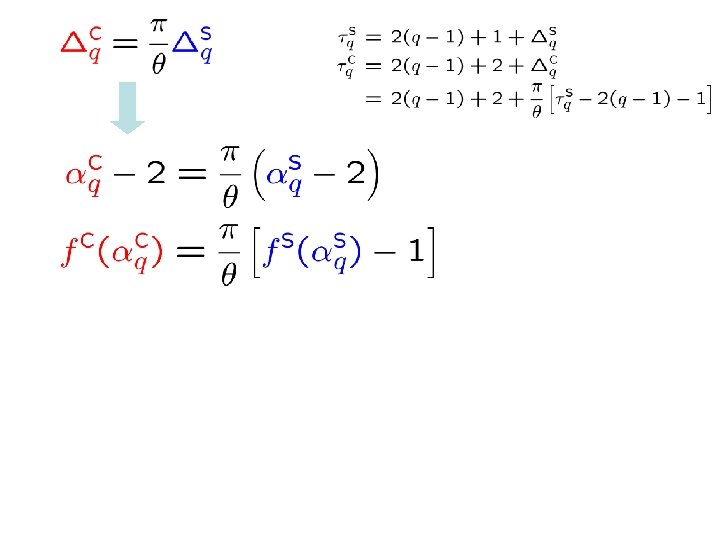
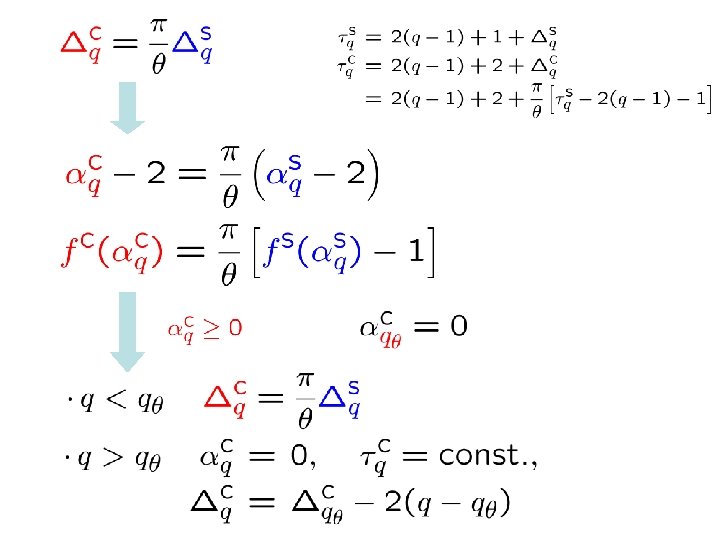
surface Colored thin curves: Conformal Invariance !! rounding of cusps at finite-size effect
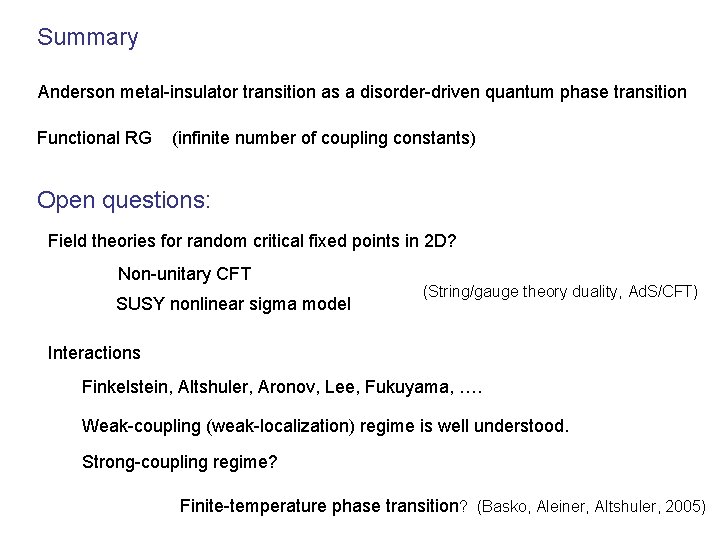
Summary Anderson metal-insulator transition as a disorder-driven quantum phase transition Functional RG (infinite number of coupling constants) Open questions: Field theories for random critical fixed points in 2 D? Non-unitary CFT SUSY nonlinear sigma model (String/gauge theory duality, Ad. S/CFT) Interactions Finkelstein, Altshuler, Aronov, Lee, Fukuyama, …. Weak-coupling (weak-localization) regime is well understood. Strong-coupling regime? Finite-temperature phase transition? (Basko, Aleiner, Altshuler, 2005)
Acknowledgments: Piet Brouwer (Cornell) Ilya Gruzberg (Chicago) Christopher Mudry (Paul Scherrer Institut) Andreas Ludwig (UC Santa Barbara) Shinsei Ryu (UC Santa Barbara) Hideaki Obuse (RIKEN)