Random Access to Wireless Networks JeanPaul M G

- Slides: 34
Random Access to Wireless Networks Jean-Paul M. G. Linnartz Nat. Lab. , Philips Research
Radio Resource Management and Random Access • Many terminals communicate to a single base station • Fixed multiple access methods (TDMA, FDMA, CDMA) become inefficient when the traffic is bursty. • Random Access works better for – many users, where. . – each user only occasionally sends a message Jean-Paul Linnartz 1
Radio Resource Management and Random Access Suitable Protocols • ALOHA • Carrier Sense • Inhibit Sense • Collision Resolution – Stack Algorithm – Tree Algorithm • Reservation methods – Reservation ALOHA – Packet Reservation Multiple Access Jean-Paul Linnartz 2
Radio Resource Management and Random Access ALOHA Protocol • Any terminal is allowed to transmit without considering whether channel is idle or busy • If packet is received correctly, the base station transmits an acknowledgement. • If no acknowledgement is received by the mobile, 1) it assumes the packet to be lost 2) it retransmits the packet after waiting a random time Jean-Paul Linnartz 3
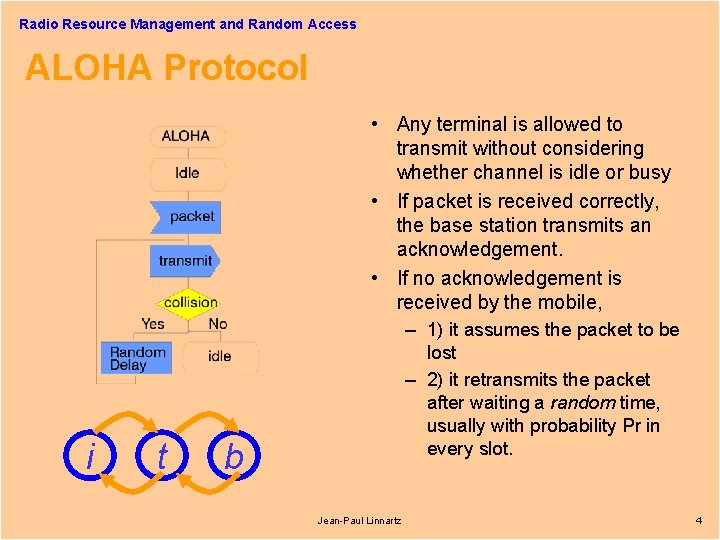
Radio Resource Management and Random Access ALOHA Protocol • Any terminal is allowed to transmit without considering whether channel is idle or busy • If packet is received correctly, the base station transmits an acknowledgement. • If no acknowledgement is received by the mobile, – 1) it assumes the packet to be i t lost – 2) it retransmits the packet after waiting a random time, usually with probability Pr in every slot. b Jean-Paul Linnartz 4
Radio Resource Management and Random Access ALOHA Protocol • Unslotted ALOHA: transmission may start anytime • Slotted ALOHA: packets are transmitted in time slots • Critical performance issue: "How to choose the retransmission parameter? " – Too long: leads to excessive delay – Too short: stirs instability Instability: Number of terminals in backlog grows without bounds Jean-Paul Linnartz 5
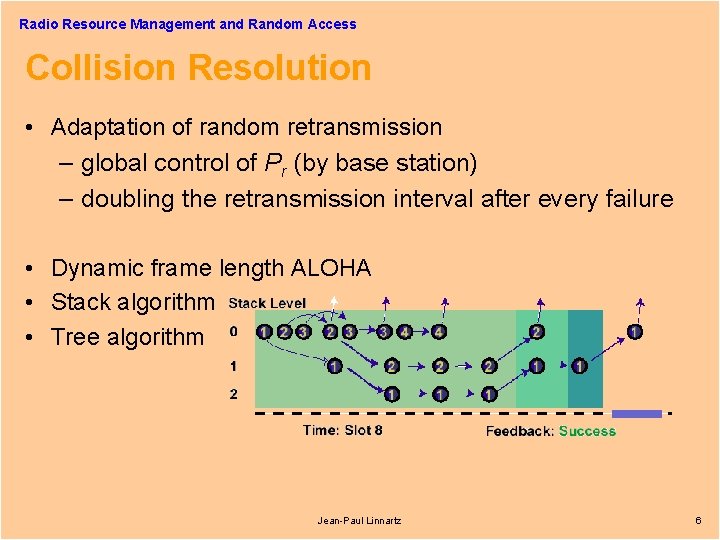
Radio Resource Management and Random Access Collision Resolution • Adaptation of random retransmission – global control of Pr (by base station) – doubling the retransmission interval after every failure • Dynamic frame length ALOHA • Stack algorithm • Tree algorithm Jean-Paul Linnartz 6
Radio Resource Management and Random Access Carrier Sense Multiple Access : CSMA – – – " Listen before talk " No new packet transmission is initiated when the channel is busy This reduces the number of collisions Performance is very sensitive to delays in Carrier Sense mechanism CSMA is useful if channel sensing is much faster than packet transmission time • satellite channel with long roundtrip delay: just use ALOHA Hidden Terminal Problem: – mobile terminal may not be aware of a transmission by another (remote) terminal. – Solution: Inhibit Sense Multiple Access (ISMA) – Decision Problem: how to distinguish noise and weak transmission? – Solution: Inhibit Sense Multiple Access (ISMA) Jean-Paul Linnartz 7
Radio Resource Management and Random Access Inhibit Sense Multiple Access : ISMA Busy Tone Multiple Access : BTMA If busy, base station transmits a "busy" signal to inhibit all other mobile terminals from transmitting Collisions still occur, because of – Signalling delay • New packet transmissions can start during a delay in the broadcasting of the inhibit signal, – Persistent terminals • After the termination of transmission, packets from persistent terminals, awaiting the channel to become idle, can collide. Jean-Paul Linnartz 8
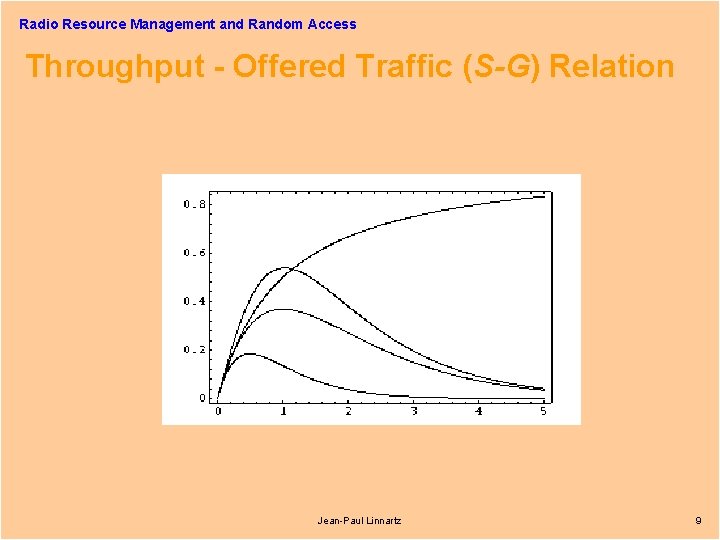
Radio Resource Management and Random Access Throughput - Offered Traffic (S-G) Relation Jean-Paul Linnartz 9
Radio Resource Management and Random Access Common Performance Analysis Assumptions • • • All packets are of uniform duration, unit of time = packet duration + guard time Acknowledgements are never lost Steady-state operation (stability) Poisson distributed attempts Steady-state operation: Random waiting times need to be long enough to ensure uncorrelated interference during the initial and successive transmission attempts. This is an approximation: dynamic retransmission control is needed in practice N. B. ALOHA without capture, with infinite population is always unstable Jean-Paul Linnartz 10
Radio Resource Management and Random Access WIRELESS RANDOM-ACCESS Probability of successful reception depends on • Receiver capture performance – Modulation method – Type of coding – Signal processing at the receiver (diversity, equalization, . . . ) • Propagation: – Distance from the central receiver, path loss, Shadowing – Channel fading and dispersion – Channel noise • Traffic: – Contending packet traffic (from same cell) – Interference from co-channel cells – Initial Access protocol: slotted ALOHA, Carrier Sense (CSMA) or Inhibit Sense Multiple Access (ISMA) – Retransmission policy Jean-Paul Linnartz 11
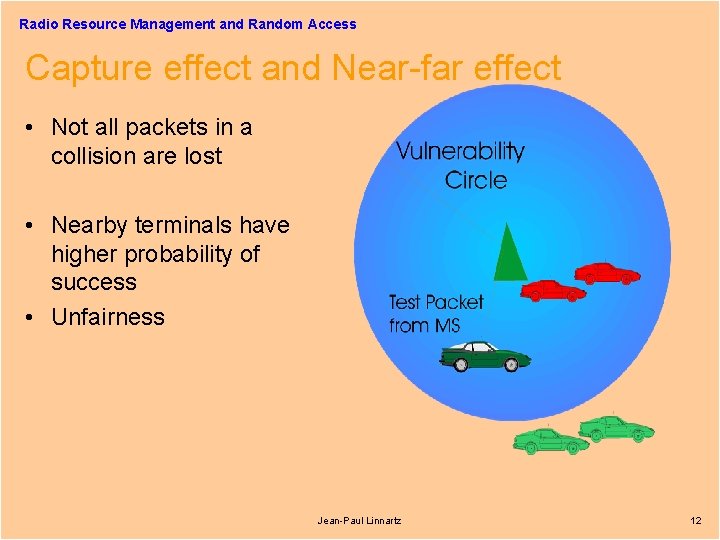
Radio Resource Management and Random Access Capture effect and Near-far effect • Not all packets in a collision are lost • Nearby terminals have higher probability of success • Unfairness Jean-Paul Linnartz 12
Radio Resource Management and Random Access Jean-Paul Linnartz 13
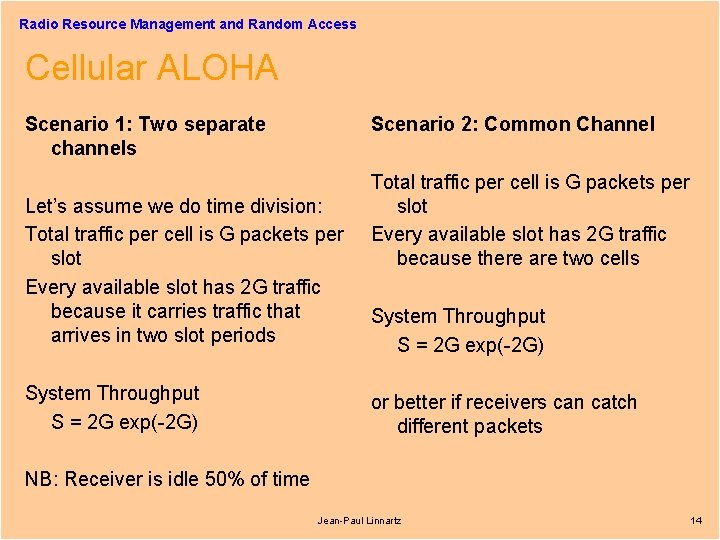
Radio Resource Management and Random Access Cellular ALOHA Scenario 1: Two separate channels Scenario 2: Common Channel Let’s assume we do time division: Total traffic per cell is G packets per slot Every available slot has 2 G traffic because it carries traffic that arrives in two slot periods System Throughput S = 2 G exp(-2 G) Total traffic per cell is G packets per slot Every available slot has 2 G traffic because there are two cells System Throughput S = 2 G exp(-2 G) or better if receivers can catch different packets NB: Receiver is idle 50% of time Jean-Paul Linnartz 14
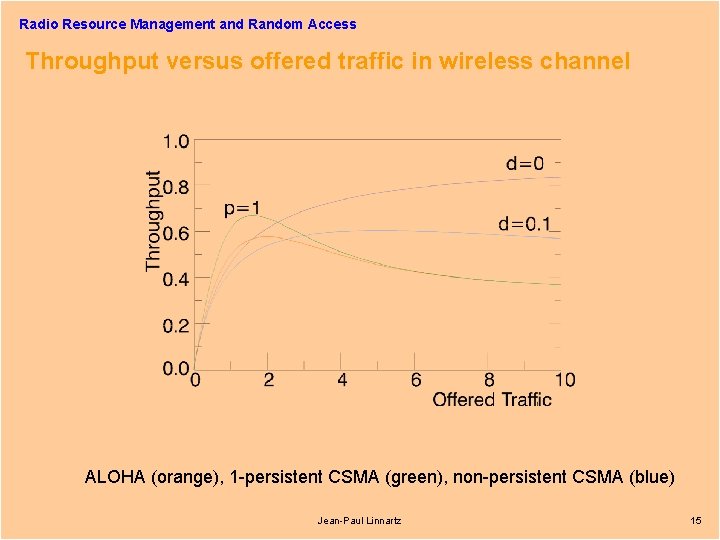
Radio Resource Management and Random Access Throughput versus offered traffic in wireless channel ALOHA (orange), 1 -persistent CSMA (green), non-persistent CSMA (blue) Jean-Paul Linnartz 15
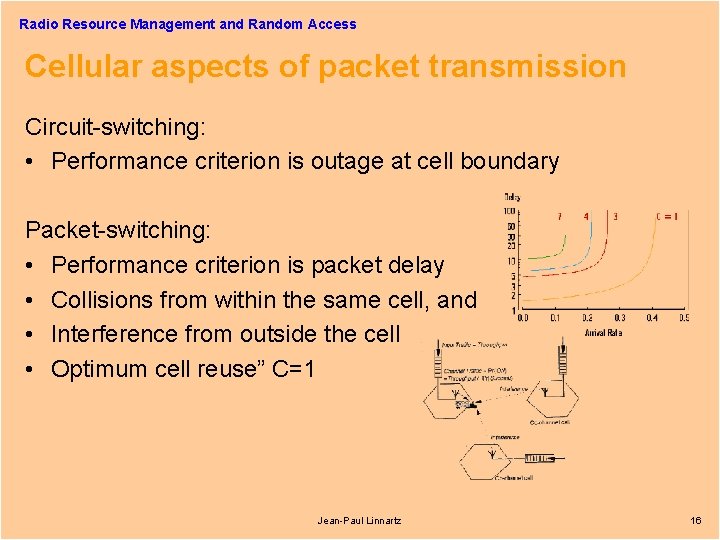
Radio Resource Management and Random Access Cellular aspects of packet transmission Circuit-switching: • Performance criterion is outage at cell boundary Packet-switching: • Performance criterion is packet delay • Collisions from within the same cell, and • Interference from outside the cell • Optimum cell reuse” C=1 Jean-Paul Linnartz 16
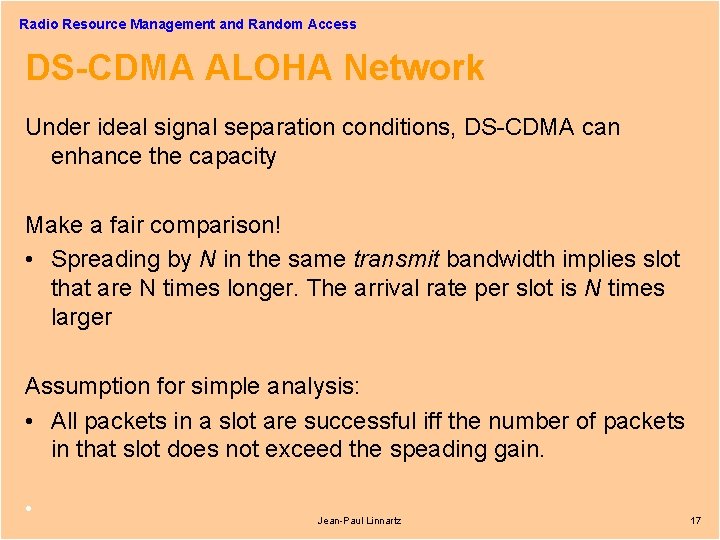
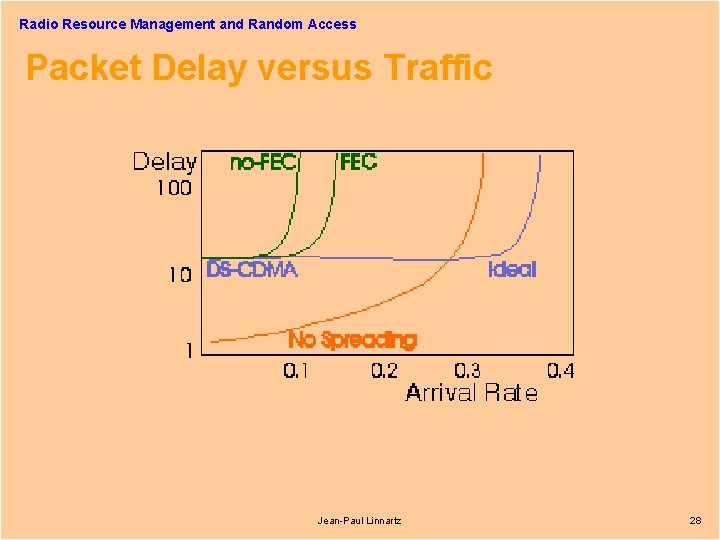
Radio Resource Management and Random Access DS-CDMA ALOHA Network Under ideal signal separation conditions, DS-CDMA can enhance the capacity Make a fair comparison! • Spreading by N in the same transmit bandwidth implies slot that are N times longer. The arrival rate per slot is N times larger Assumption for simple analysis: • All packets in a slot are successful iff the number of packets in that slot does not exceed the speading gain. • Jean-Paul Linnartz 17
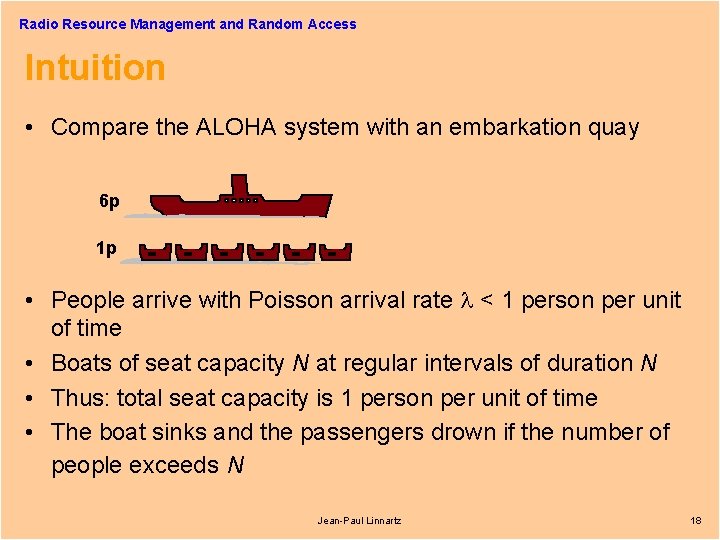
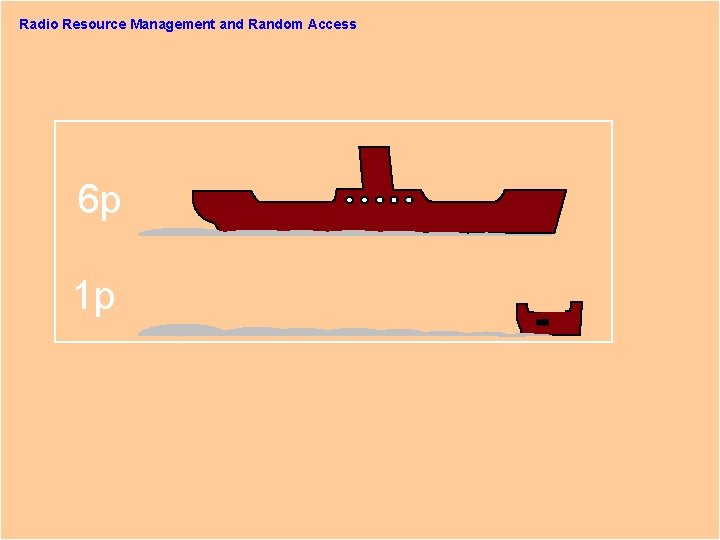
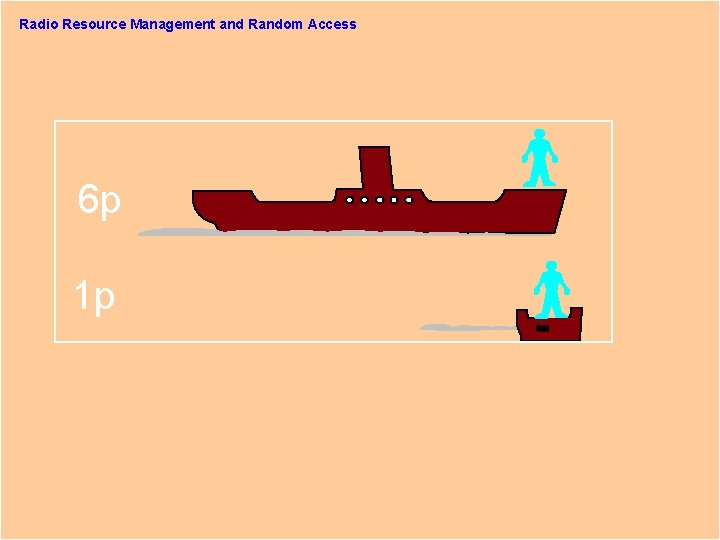
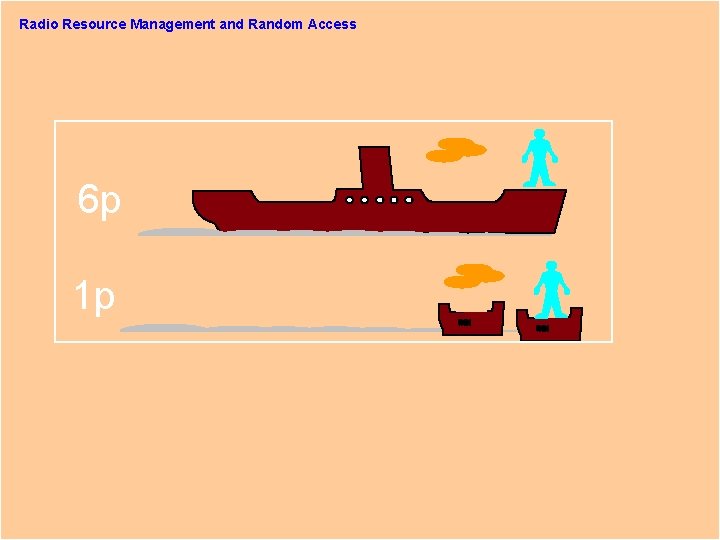
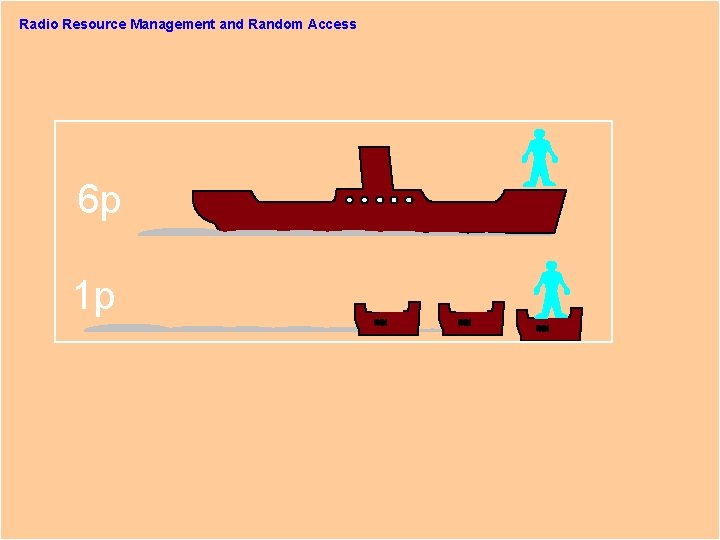
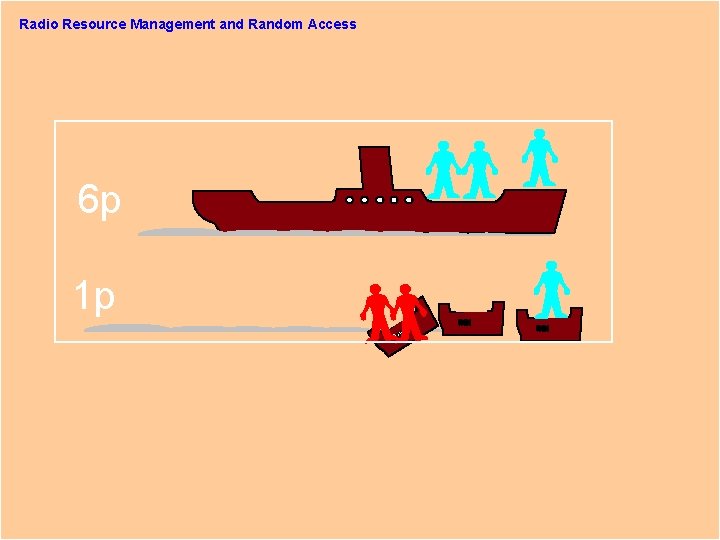
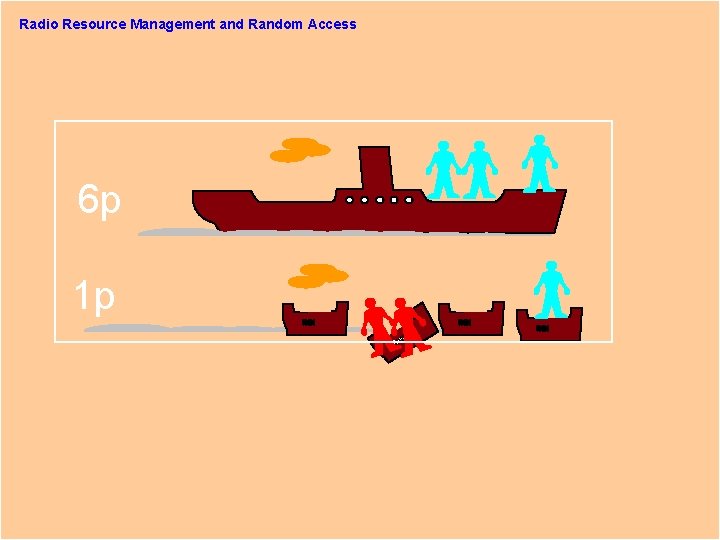
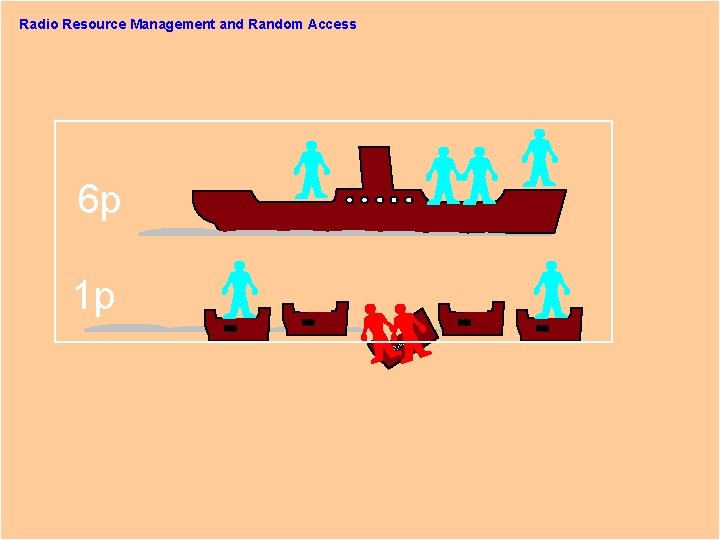
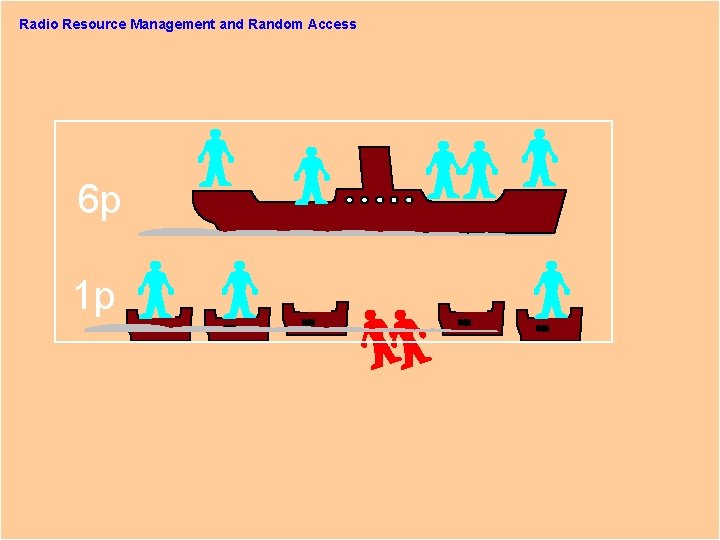
Radio Resource Management and Random Access Intuition • Compare the ALOHA system with an embarkation quay 6 p 1 p • People arrive with Poisson arrival rate l < 1 person per unit of time • Boats of seat capacity N at regular intervals of duration N • Thus: total seat capacity is 1 person per unit of time • The boat sinks and the passengers drown if the number of people exceeds N Jean-Paul Linnartz 18
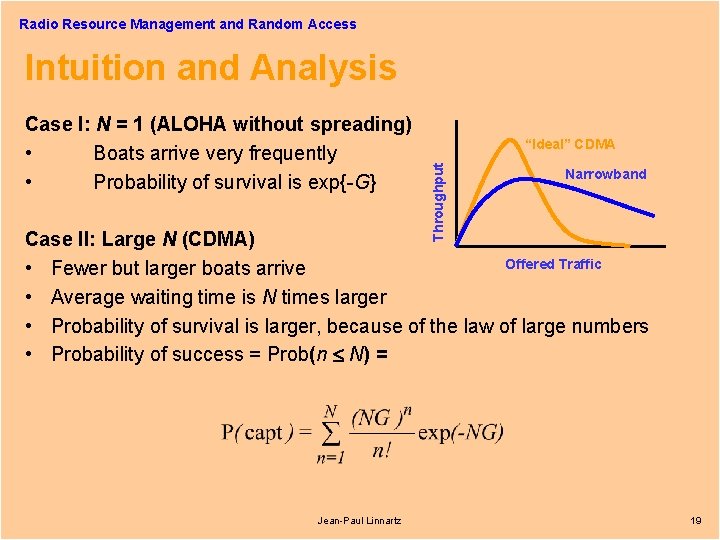
Radio Resource Management and Random Access Intuition and Analysis “Ideal” CDMA Throughput Case I: N = 1 (ALOHA without spreading) • Boats arrive very frequently • Probability of survival is exp{-G} Narrowband Case II: Large N (CDMA) Offered Traffic • Fewer but larger boats arrive • Average waiting time is N times larger • Probability of survival is larger, because of the law of large numbers • Probability of success = Prob(n £ N) = Jean-Paul Linnartz 19
Radio Resource Management and Random Access 6 p 1 p
Radio Resource Management and Random Access 6 p 1 p
Radio Resource Management and Random Access 6 p 1 p
Radio Resource Management and Random Access 6 p 1 p
Radio Resource Management and Random Access 6 p 1 p
Radio Resource Management and Random Access 6 p 1 p
Radio Resource Management and Random Access 6 p 1 p
Radio Resource Management and Random Access 6 p 1 p
Radio Resource Management and Random Access Packet Delay versus Traffic Jean-Paul Linnartz 28
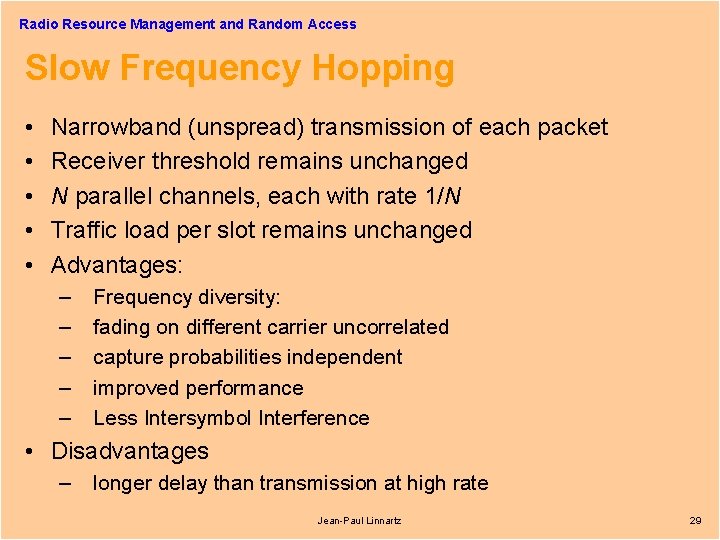
Radio Resource Management and Random Access Slow Frequency Hopping • • • Narrowband (unspread) transmission of each packet Receiver threshold remains unchanged N parallel channels, each with rate 1/N Traffic load per slot remains unchanged Advantages: – – – Frequency diversity: fading on different carrier uncorrelated capture probabilities independent improved performance Less Intersymbol Interference • Disadvantages – longer delay than transmission at high rate Jean-Paul Linnartz 29
Radio Resource Management and Random Access Conclusions • Wireless channel affects performance of random access scheme – Packets lost due to fading, inter and intracell interference – Signal capture enhances throughput and stability • Packet and circuit-switched data should be treated differently • DS-CDMA in ISM bands does not necessarily help Jean-Paul Linnartz 30
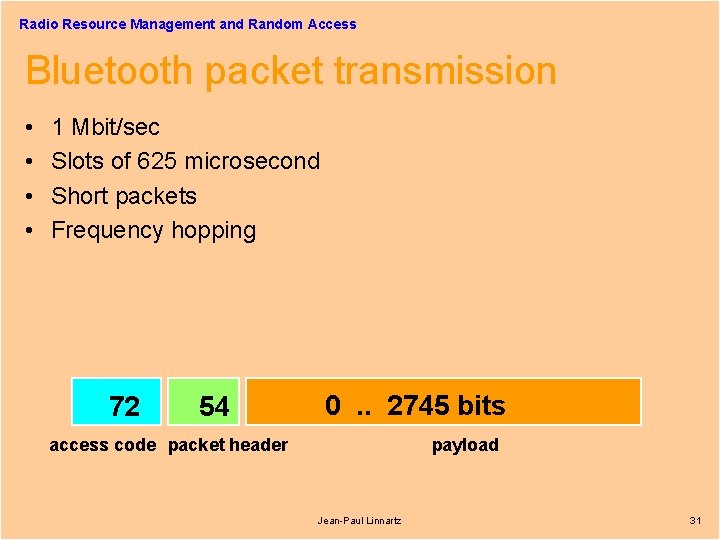
Radio Resource Management and Random Access Bluetooth packet transmission • • 1 Mbit/sec Slots of 625 microsecond Short packets Frequency hopping 72 54 0. . 2745 bits access code packet header payload Jean-Paul Linnartz 31
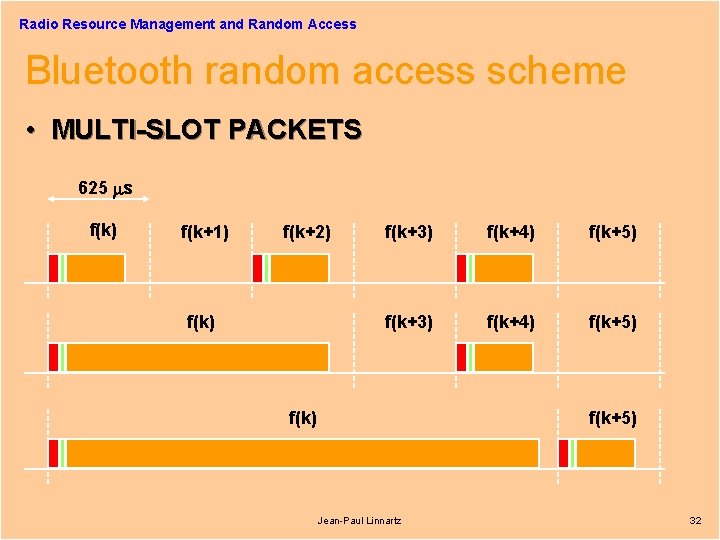
Radio Resource Management and Random Access Bluetooth random access scheme • MULTI-SLOT PACKETS 625 s f(k) f(k+1) f(k+2) f(k+3) f(k+4) f(k+5) f(k) f(k+5) Jean-Paul Linnartz 32
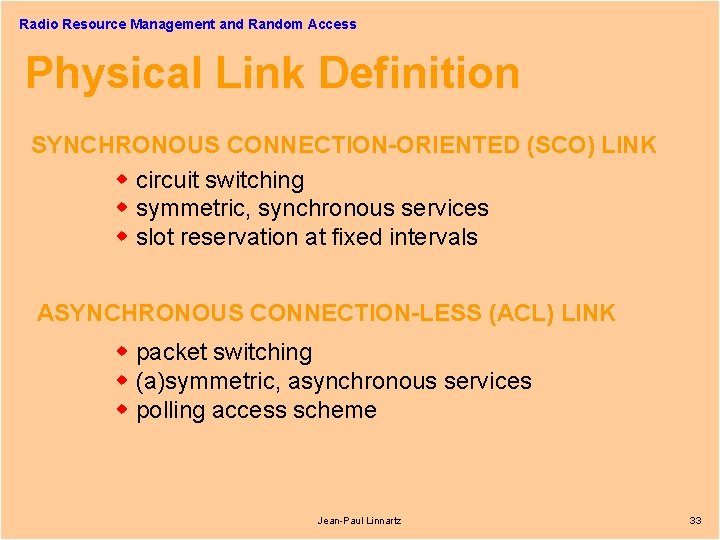
Radio Resource Management and Random Access Physical Link Definition SYNCHRONOUS CONNECTION-ORIENTED (SCO) LINK w circuit switching w symmetric, synchronous services w slot reservation at fixed intervals ASYNCHRONOUS CONNECTION-LESS (ACL) LINK w packet switching w (a)symmetric, asynchronous services w polling access scheme Jean-Paul Linnartz 33