R 98922004 YunNung Chen Nonprojective Dependency Parsing using



- Slides: 39
R 98922004 Yun-Nung Chen 資 碩一 陳縕儂 Non-projective Dependency Parsing using Spanning Tree Algorithm 1 /39
Reference �Non-projective Dependency Parsing using Spanning Tree Algorithms (HLT/EMNLP 2005) Ryan Mc. Donald, Fernando Pereira, Kiril Ribarov, Jan Hajic 2 /39
Introduction 3 /39
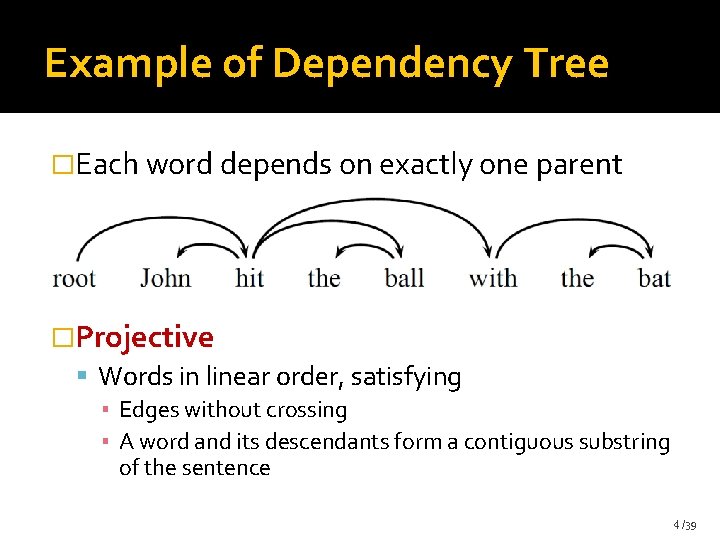
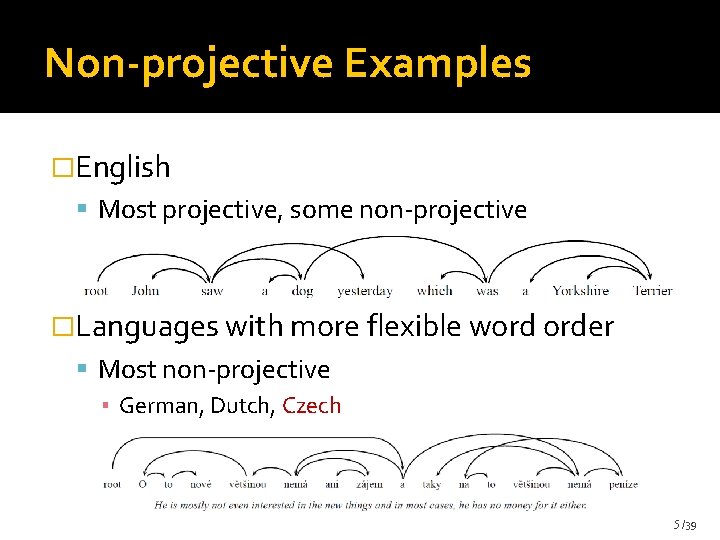
Example of Dependency Tree �Each word depends on exactly one parent �Projective Words in linear order, satisfying ▪ Edges without crossing ▪ A word and its descendants form a contiguous substring of the sentence 4 /39
Non-projective Examples �English Most projective, some non-projective �Languages with more flexible word order Most non-projective ▪ German, Dutch, Czech 5 /39
Advantage of Dependency Parsing �Related work relation extraction machine translation 6 /39
Main Idea of the Paper �Dependency parsing can be formalized as the search for a maximum spanning tree in a directed graph 7 /39
Dependency Parsing and Spanning Trees 8 /39
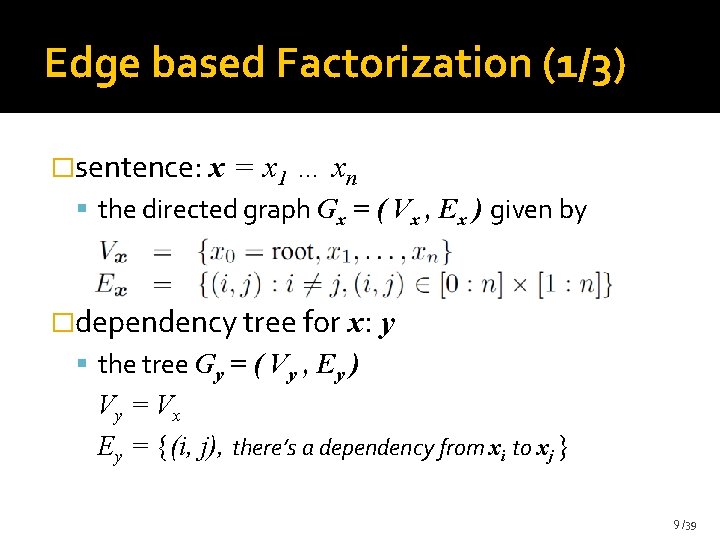
Edge based Factorization (1/3) �sentence: x = x 1 … xn the directed graph Gx = ( Vx , Ex ) given by �dependency tree for x: y the tree Gy = ( Vy , Ey ) Vy = V x Ey = {(i, j), there’s a dependency from xi to xj } 9 /39
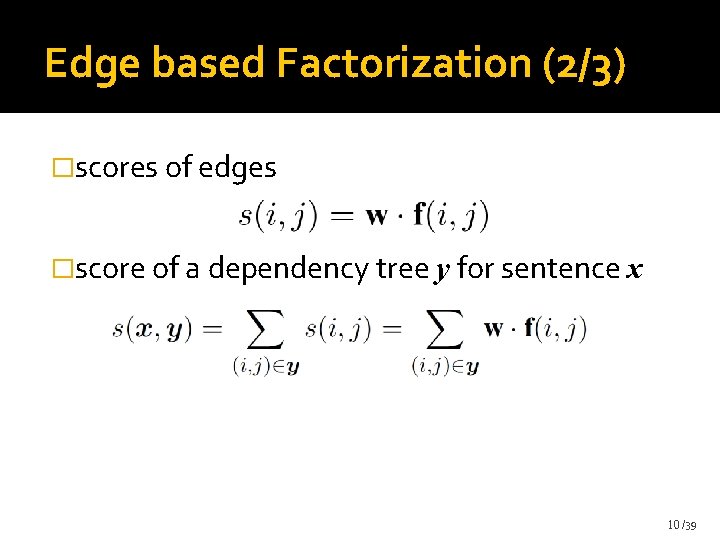
Edge based Factorization (2/3) �scores of edges �score of a dependency tree y for sentence x 10 /39
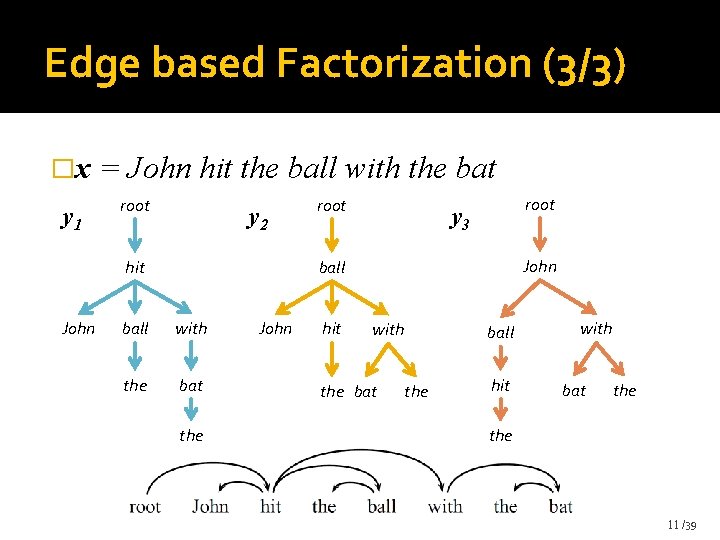
Edge based Factorization (3/3) �x y 1 = John hit the ball with the bat root y 2 hit John root y 3 John ball with the bat the John hit with the bat ball the hit with bat the 11 /39
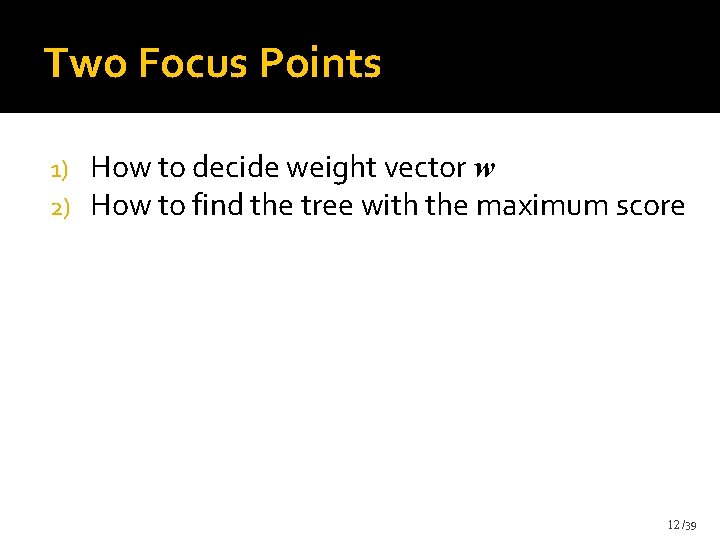
Two Focus Points 1) 2) How to decide weight vector w How to find the tree with the maximum score 12 /39
Maximum Spanning Trees �dependency trees for x = spanning trees for Gx �the dependency tree with maximum score for x = maximum spanning trees for Gx 13 /39
Maximum Spanning Tree Algorithm 14 /39
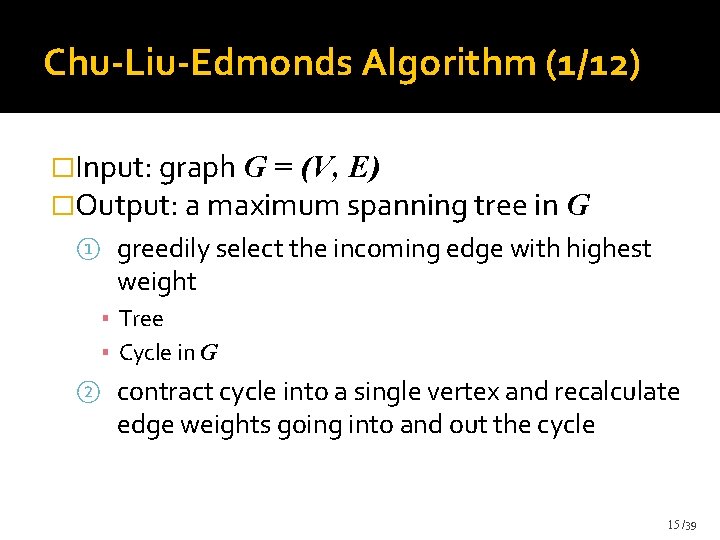
Chu-Liu-Edmonds Algorithm (1/12) �Input: graph G = (V, E) �Output: a maximum spanning tree in G ① greedily select the incoming edge with highest weight ▪ Tree ▪ Cycle in G ② contract cycle into a single vertex and recalculate edge weights going into and out the cycle 15 /39
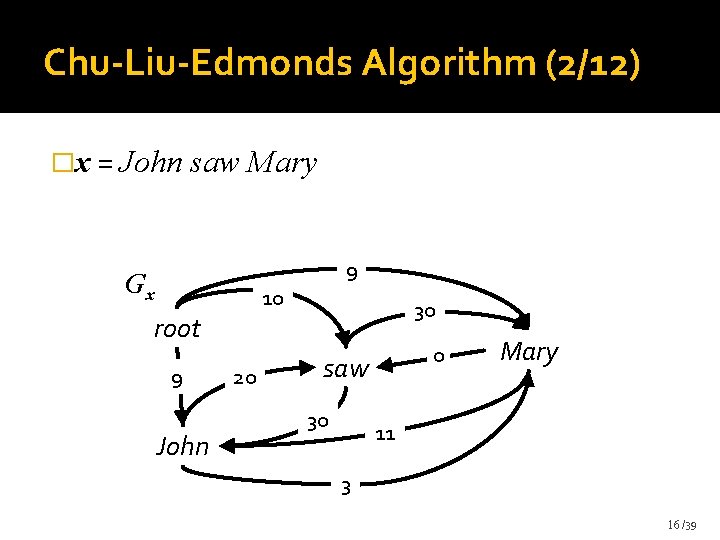
Chu-Liu-Edmonds Algorithm (2/12) �x = John saw Mary 9 Gx 10 root 9 John 20 30 0 saw 30 Mary 11 3 16 /39
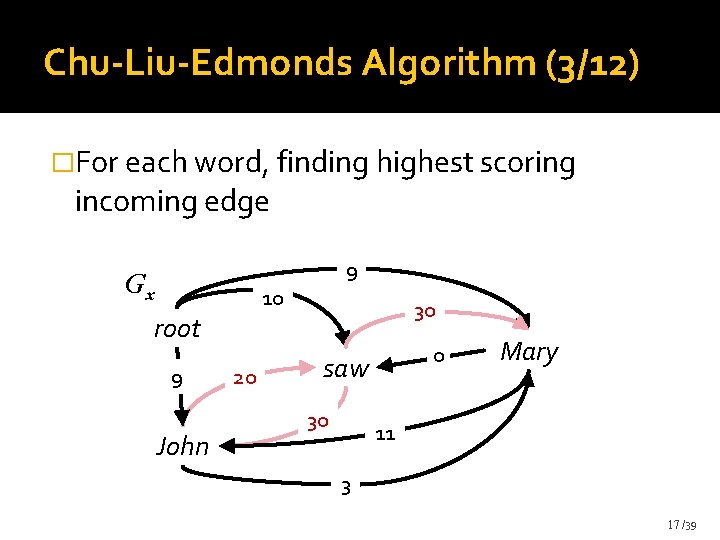
Chu-Liu-Edmonds Algorithm (3/12) �For each word, finding highest scoring incoming edge 9 Gx 10 root 9 John 20 30 0 saw 30 Mary 11 3 17 /39
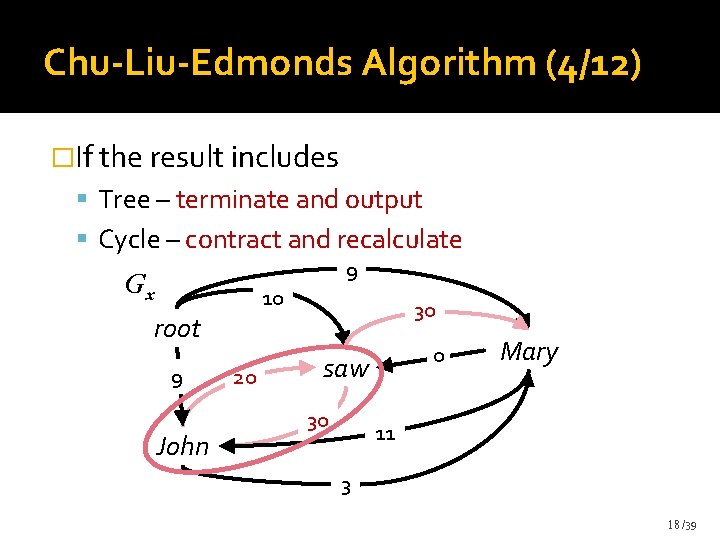
Chu-Liu-Edmonds Algorithm (4/12) �If the result includes Tree – terminate and output Cycle – contract and recalculate 9 Gx 10 root 9 John 20 30 0 saw 30 Mary 11 3 18 /39
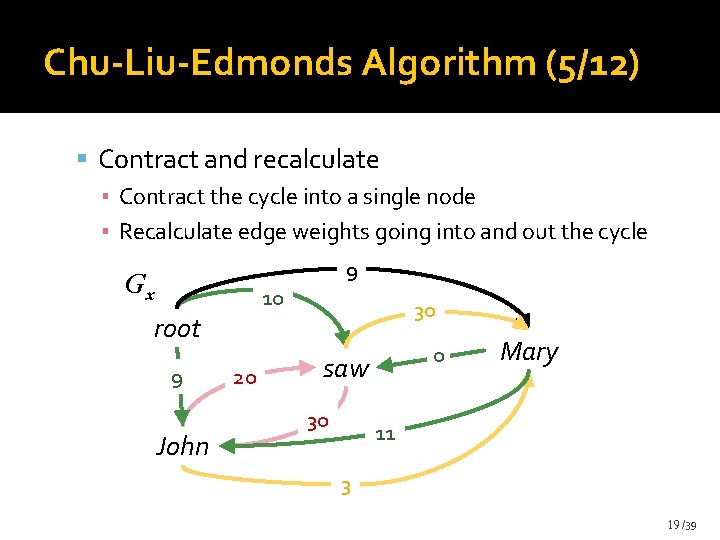
Chu-Liu-Edmonds Algorithm (5/12) Contract and recalculate ▪ Contract the cycle into a single node ▪ Recalculate edge weights going into and out the cycle 9 Gx 10 root 9 John 20 30 0 saw 30 Mary 11 3 19 /39
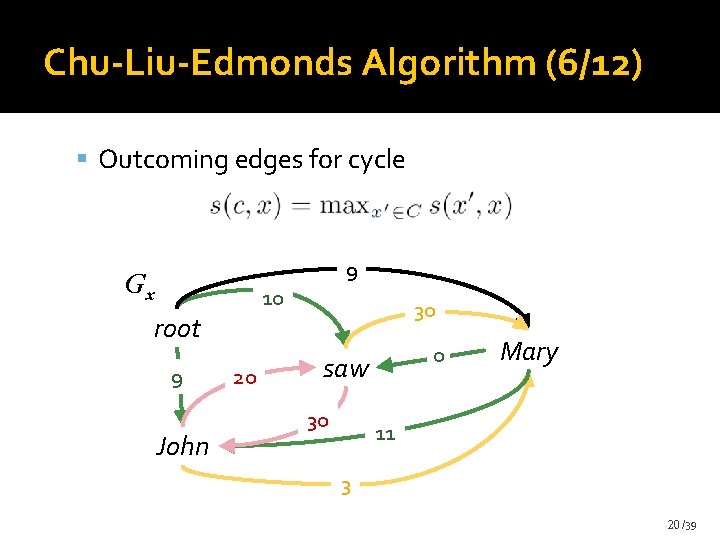
Chu-Liu-Edmonds Algorithm (6/12) Outcoming edges for cycle 9 Gx 10 root 9 John 20 30 0 saw 30 Mary 11 3 20 /39
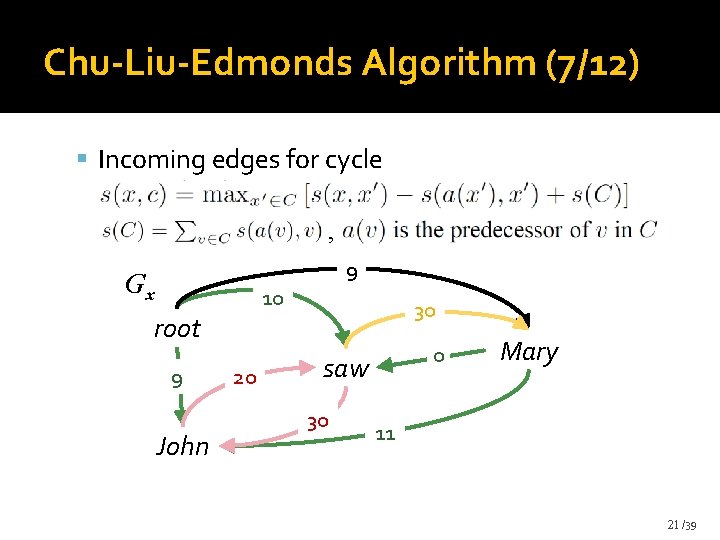
Chu-Liu-Edmonds Algorithm (7/12) Incoming edges for cycle , 9 Gx 10 root 9 John 20 30 0 saw 30 Mary 11 21 /39
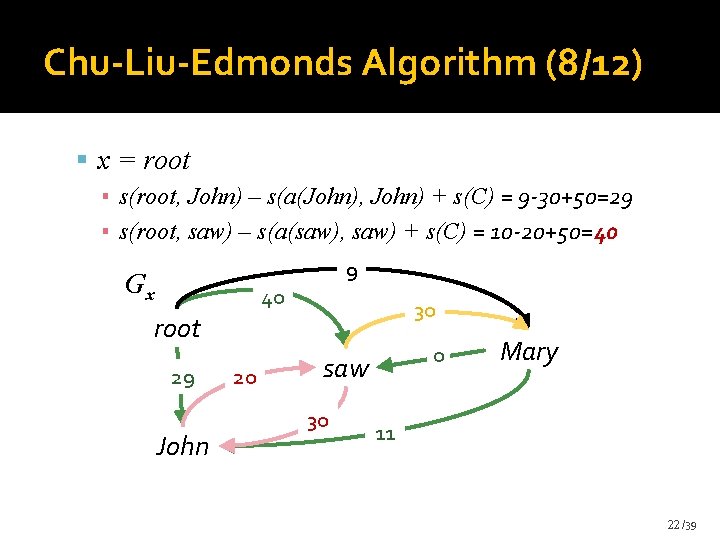
Chu-Liu-Edmonds Algorithm (8/12) x = root ▪ s(root, John) – s(a(John), John) + s(C) = 9 -30+50=29 ▪ s(root, saw) – s(a(saw), saw) + s(C) = 10 -20+50=40 9 Gx 40 10 root 9 29 John 20 30 0 saw 30 Mary 11 22 /39
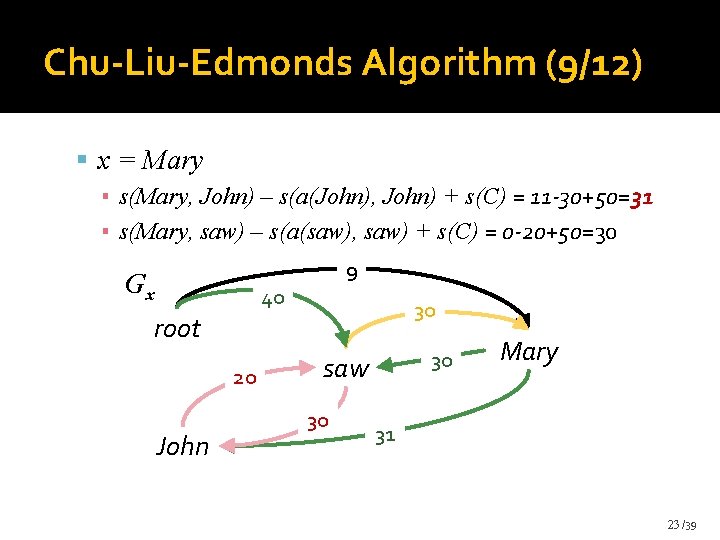
Chu-Liu-Edmonds Algorithm (9/12) x = Mary ▪ s(Mary, John) – s(a(John), John) + s(C) = 11 -30+50=31 ▪ s(Mary, saw) – s(a(saw), saw) + s(C) = 0 -20+50=30 9 Gx 40 30 root 20 John 0 30 saw 30 Mary 11 31 23 /39
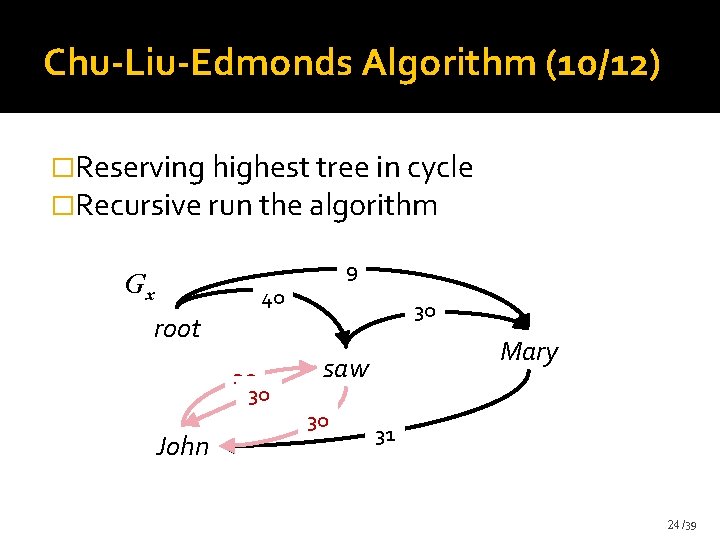
Chu-Liu-Edmonds Algorithm (10/12) �Reserving highest tree in cycle �Recursive run the algorithm 9 Gx 40 30 root 20 30 John Mary saw 30 31 24 /39
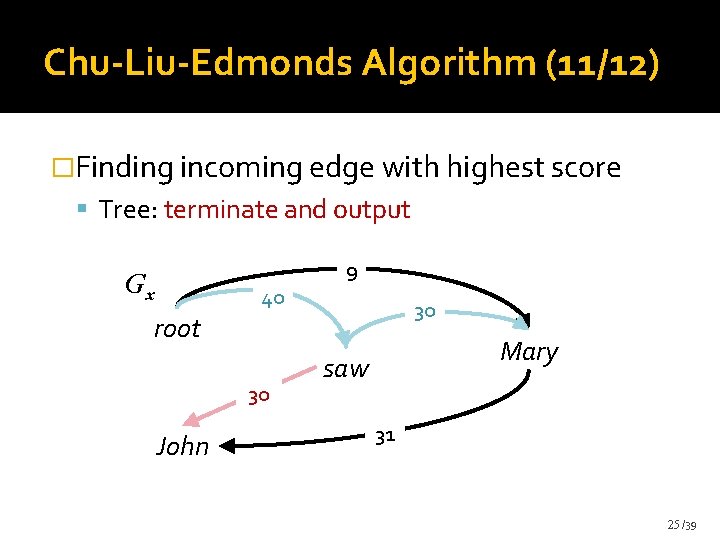
Chu-Liu-Edmonds Algorithm (11/12) �Finding incoming edge with highest score Tree: terminate and output Gx 40 9 30 root 30 John Mary saw 31 25 /39
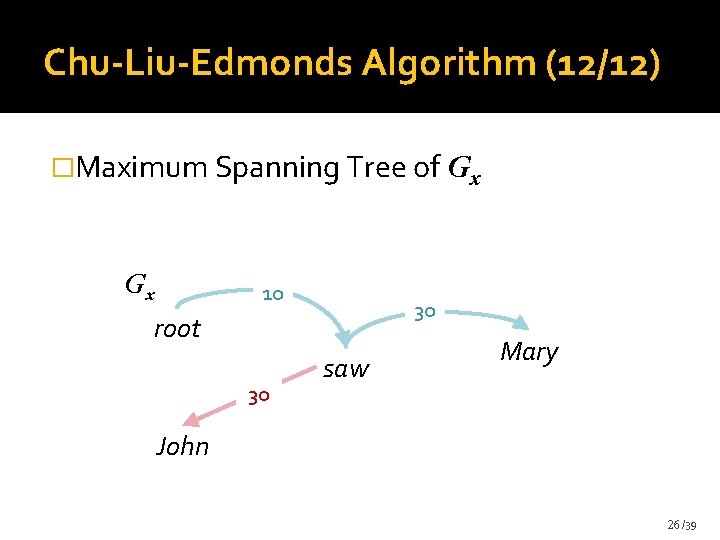
Chu-Liu-Edmonds Algorithm (12/12) �Maximum Spanning Tree of Gx Gx 10 40 30 root 30 saw Mary John 26 /39
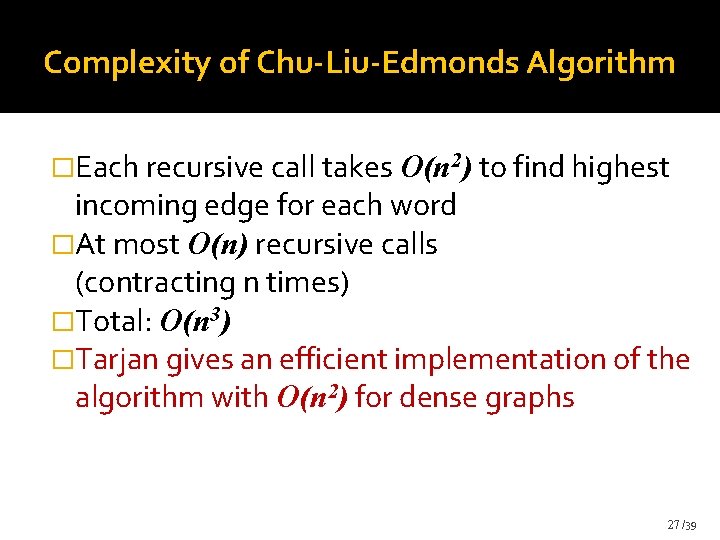
Complexity of Chu-Liu-Edmonds Algorithm �Each recursive call takes O(n 2) to find highest incoming edge for each word �At most O(n) recursive calls (contracting n times) �Total: O(n 3) �Tarjan gives an efficient implementation of the algorithm with O(n 2) for dense graphs 27 /39
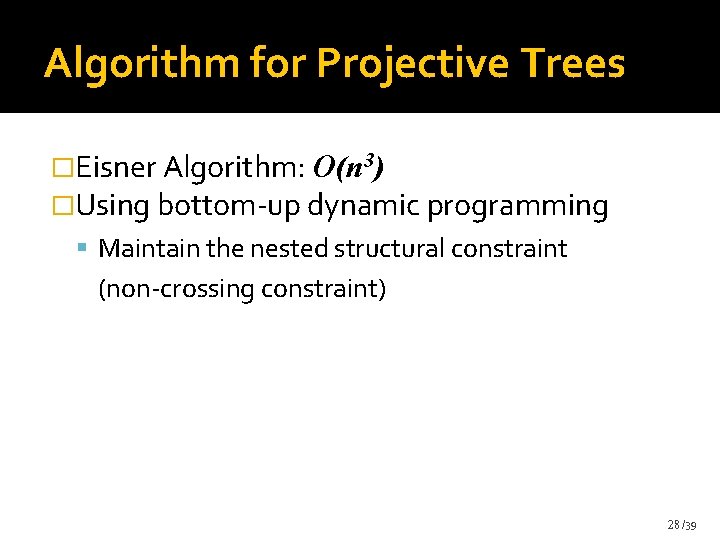
Algorithm for Projective Trees �Eisner Algorithm: O(n 3) �Using bottom-up dynamic programming Maintain the nested structural constraint (non-crossing constraint) 28 /39
Online Large Margin Learning 29 /39
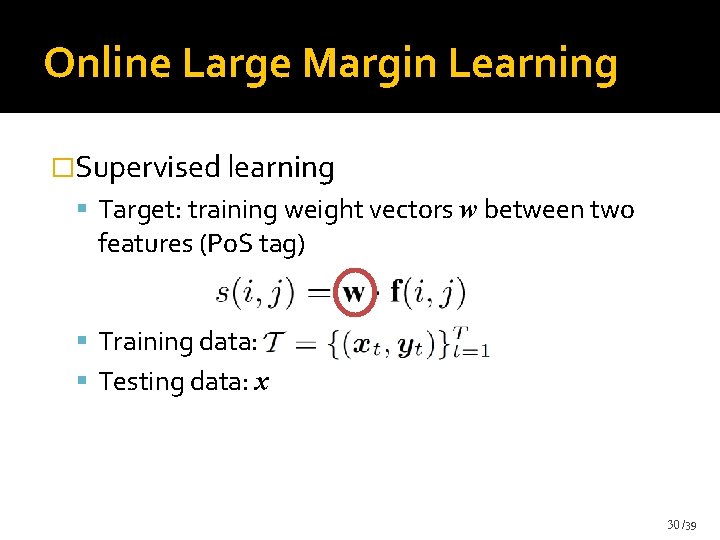
Online Large Margin Learning �Supervised learning Target: training weight vectors w between two features (Po. S tag) Training data: Testing data: x 30 /39
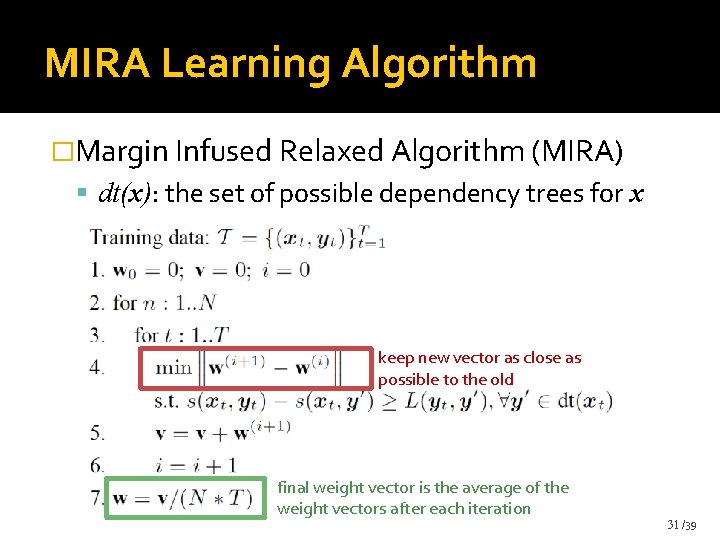
MIRA Learning Algorithm �Margin Infused Relaxed Algorithm (MIRA) dt(x): the set of possible dependency trees for x keep new vector as close as possible to the old final weight vector is the average of the weight vectors after each iteration 31 /39
Single-best MIRA �Using only the single margin constraint 32 /39
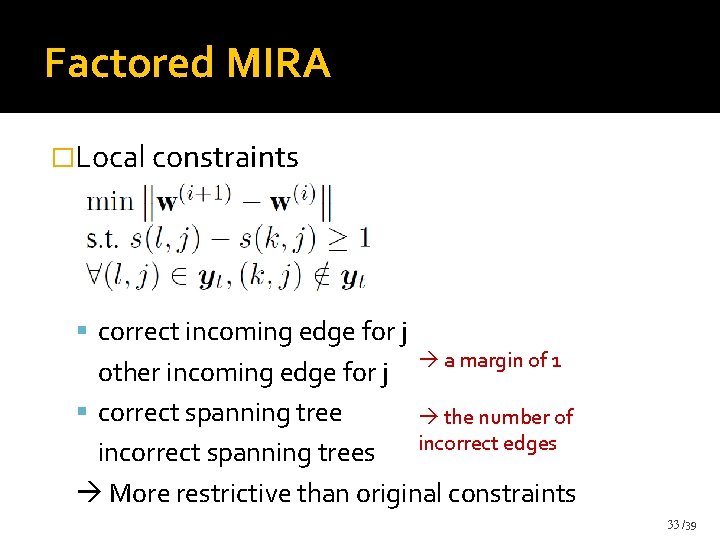
Factored MIRA �Local constraints correct incoming edge for j a margin of 1 other incoming edge for j correct spanning tree the number of incorrect edges incorrect spanning trees More restrictive than original constraints 33 /39
Experiments 34 /39
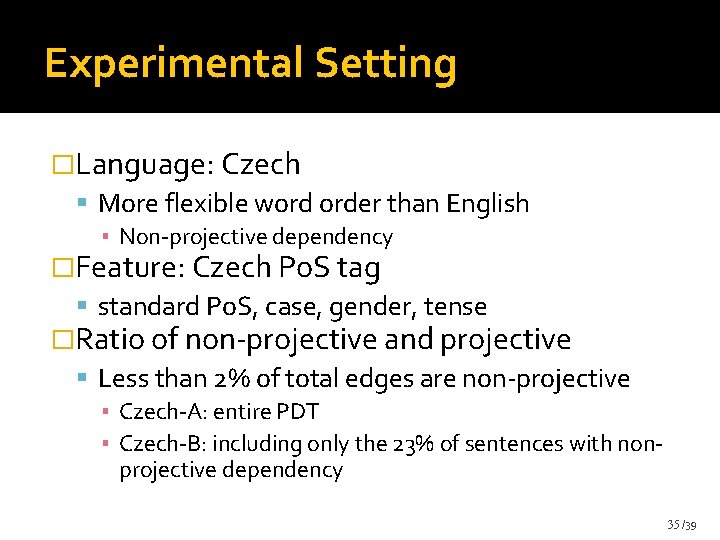
Experimental Setting �Language: Czech More flexible word order than English ▪ Non-projective dependency �Feature: Czech Po. S tag standard Po. S, case, gender, tense �Ratio of non-projective and projective Less than 2% of total edges are non-projective ▪ Czech-A: entire PDT ▪ Czech-B: including only the 23% of sentences with nonprojective dependency 35 /39
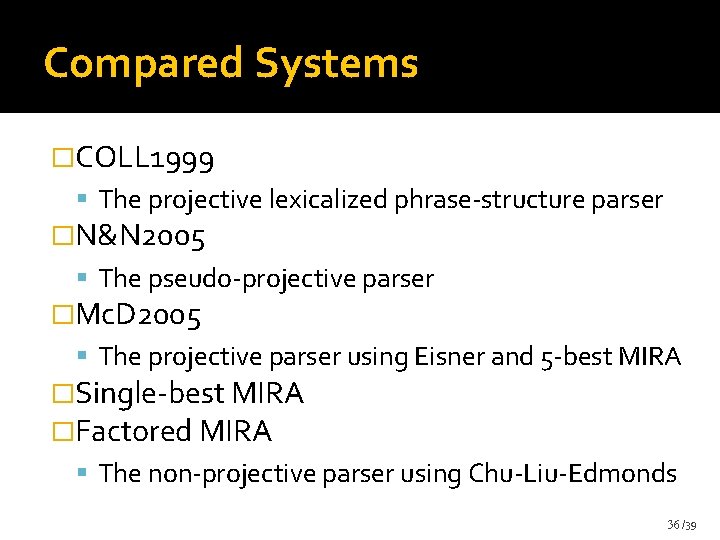
Compared Systems �COLL 1999 The projective lexicalized phrase-structure parser �N&N 2005 The pseudo-projective parser �Mc. D 2005 The projective parser using Eisner and 5 -best MIRA �Single-best MIRA �Factored MIRA The non-projective parser using Chu-Liu-Edmonds 36 /39
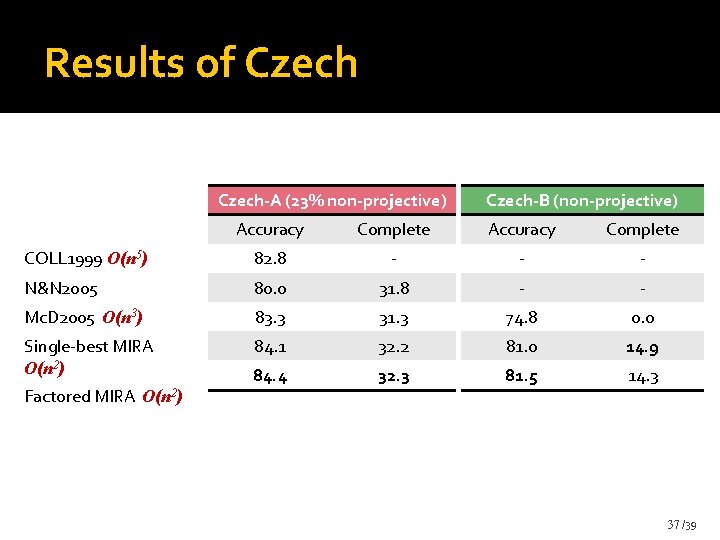
Results of Czech-A (23% non-projective) Czech-B (non-projective) Accuracy Complete COLL 1999 O(n 5) 82. 8 - - - N&N 2005 80. 0 31. 8 - - Mc. D 2005 O(n 3) 83. 3 31. 3 74. 8 0. 0 Single-best MIRA O(n 2) 84. 1 32. 2 81. 0 14. 9 84. 4 32. 3 81. 5 14. 3 Factored MIRA O(n 2) 37 /39
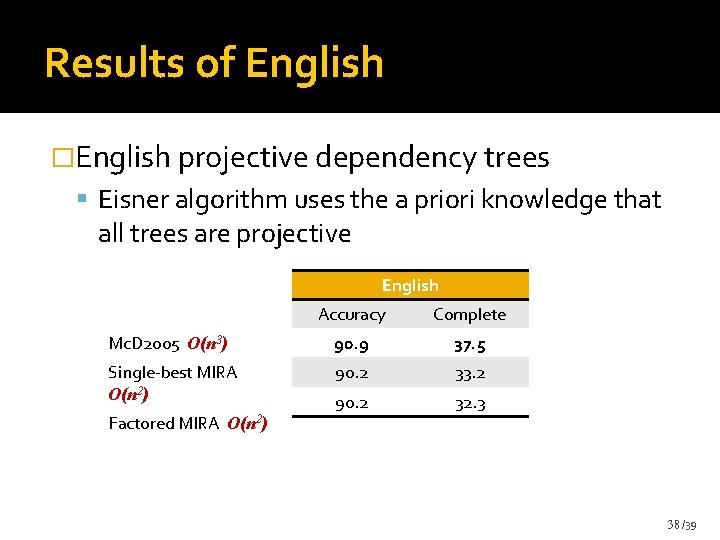
Results of English �English projective dependency trees Eisner algorithm uses the a priori knowledge that all trees are projective English Accuracy Complete Mc. D 2005 O(n 3) 90. 9 37. 5 Single-best MIRA O(n 2) 90. 2 33. 2 90. 2 32. 3 Factored MIRA O(n 2) 38 /39
Thanks for your attention! 39/39