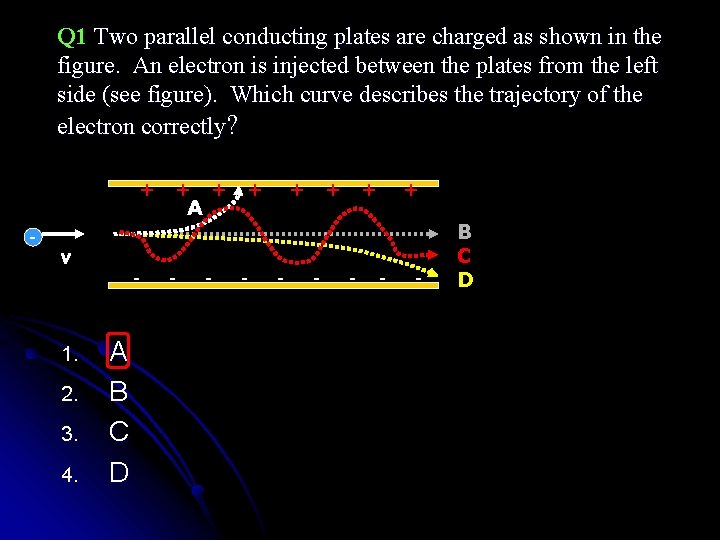
Q 1 Two parallel conducting plates are charged
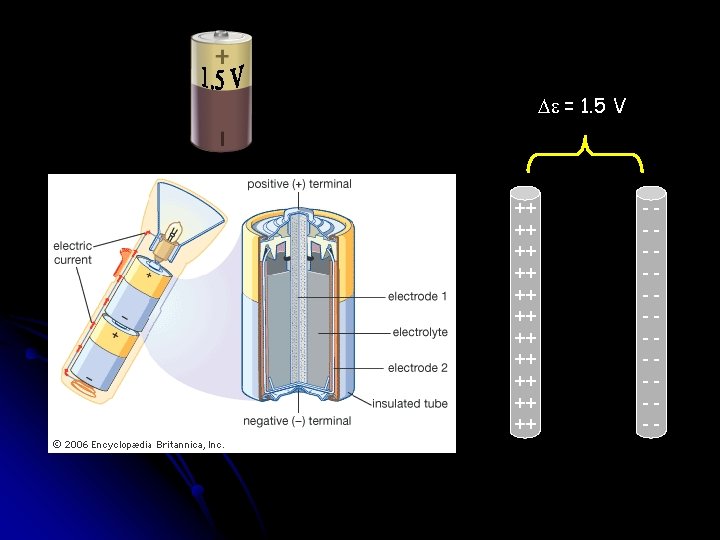
- Slides: 24
Q 1 Two parallel conducting plates are charged as shown in the figure. An electron is injected between the plates from the left side (see figure). Which curve describes the trajectory of the electron correctly? + - v 1. 2. 3. 4. - A B C D + A - + - + - + - - B C D
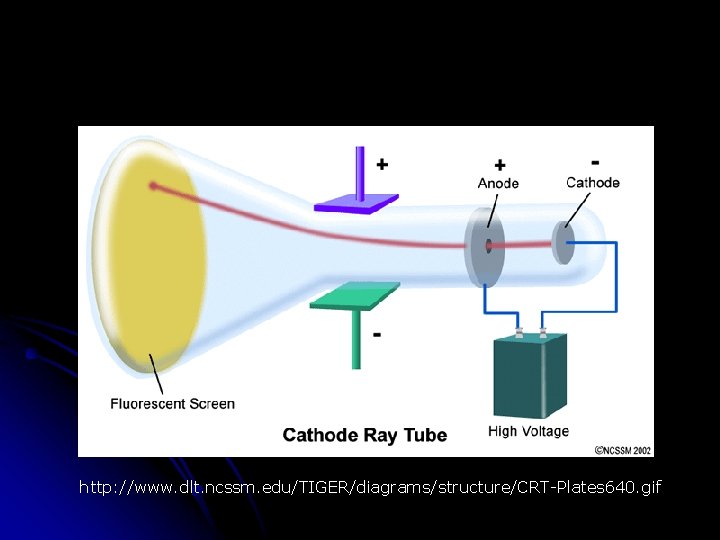
http: //www. dlt. ncssm. edu/TIGER/diagrams/structure/CRT-Plates 640. gif
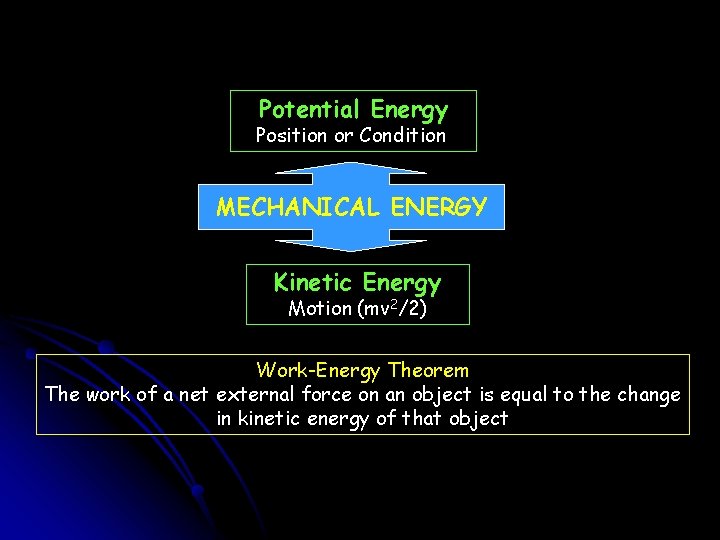
Potential Energy Position or Condition MECHANICAL ENERGY Kinetic Energy Motion (mv 2/2) Work-Energy Theorem The work of a net external force on an object is equal to the change in kinetic energy of that object
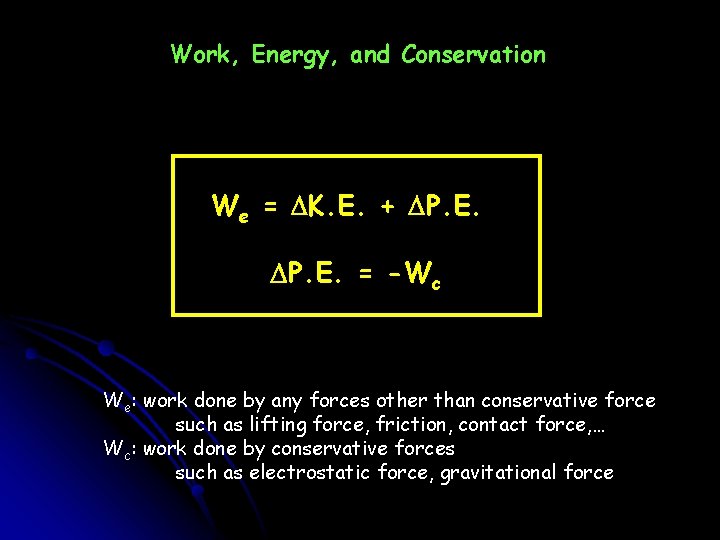
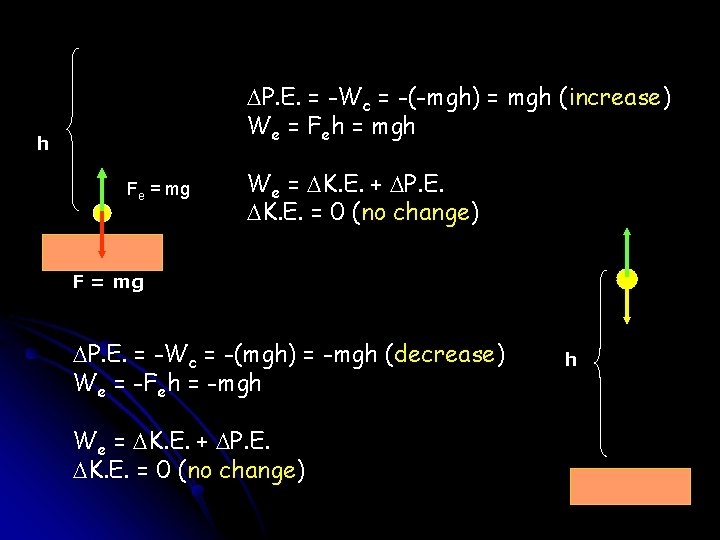
Work, Energy, and Conservation We = DK. E. + DP. E. = -Wc We: work done by any forces other than conservative force such as lifting force, friction, contact force, … Wc: work done by conservative forces such as electrostatic force, gravitational force
DP. E. = -Wc = -(-mgh) = mgh (increase) We = Feh = mgh h Fe = mg We = DK. E. + DP. E. DK. E. = 0 (no change) F = mg DP. E. = -Wc = -(mgh) = -mgh (decrease) We = -Feh = -mgh We = DK. E. + DP. E. DK. E. = 0 (no change) h
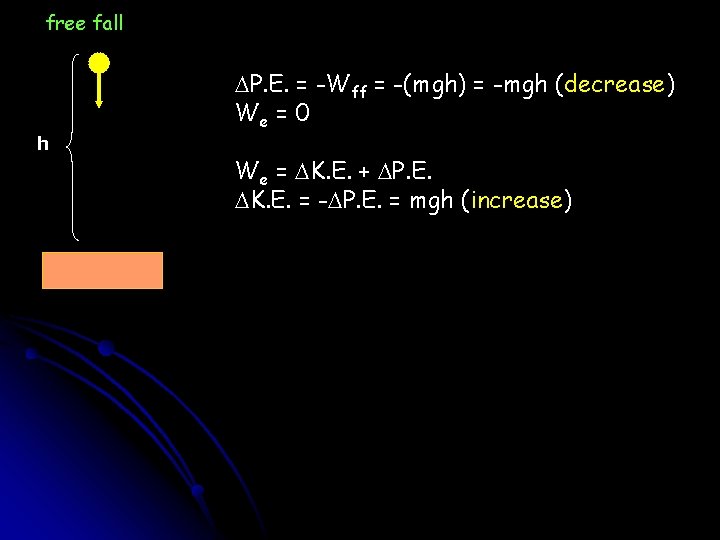
free fall DP. E. = -Wff = -(mgh) = -mgh (decrease) We = 0 h We = DK. E. + DP. E. DK. E. = -DP. E. = mgh (increase)
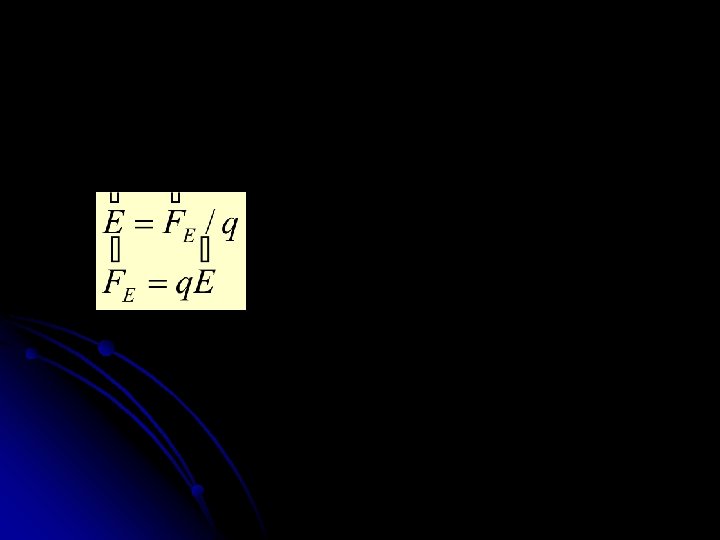
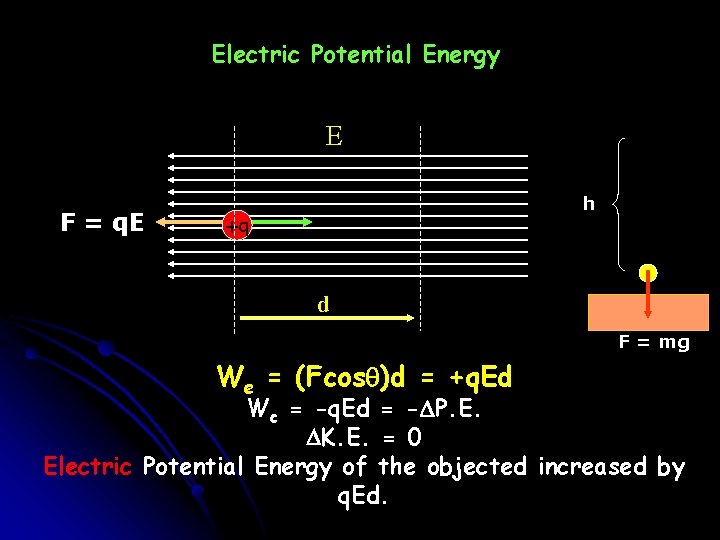
Electric Potential Energy E F = q. E h +q d F = mg We = (Fcosq)d = +q. Ed Wc = -q. Ed = -DP. E. DK. E. = 0 Electric Potential Energy of the objected increased by q. Ed.
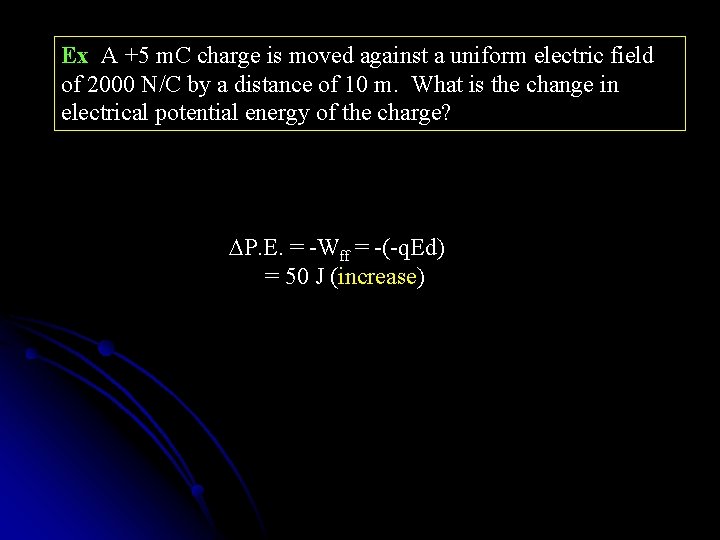
Ex A +5 m. C charge is moved against a uniform electric field of 2000 N/C by a distance of 10 m. What is the change in electrical potential energy of the charge? DP. E. = -Wff = -(-q. Ed) = 50 J (increase)
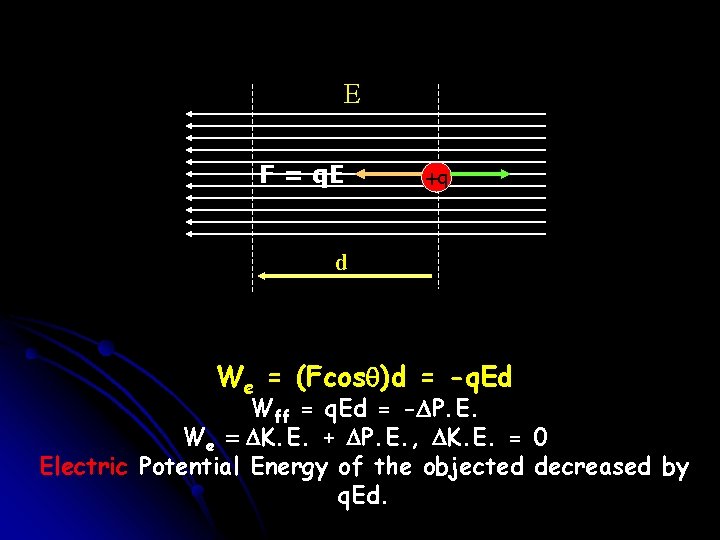
E F = q. E +q d We = (Fcosq)d = -q. Ed Wff = q. Ed = -DP. E. We = DK. E. + DP. E. , DK. E. = 0 Electric Potential Energy of the objected decreased by q. Ed.
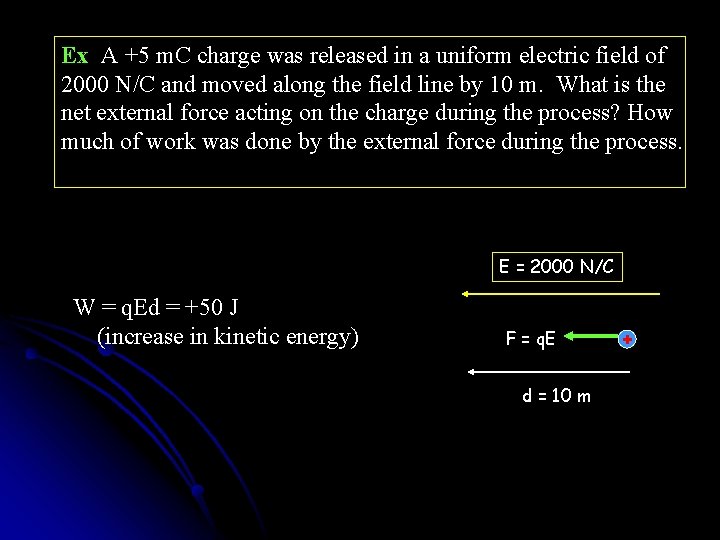
Ex A +5 m. C charge was released in a uniform electric field of 2000 N/C and moved along the field line by 10 m. What is the net external force acting on the charge during the process? How much of work was done by the external force during the process. E = 2000 N/C W = q. Ed = +50 J (increase in kinetic energy) F = q. E d = 10 m +
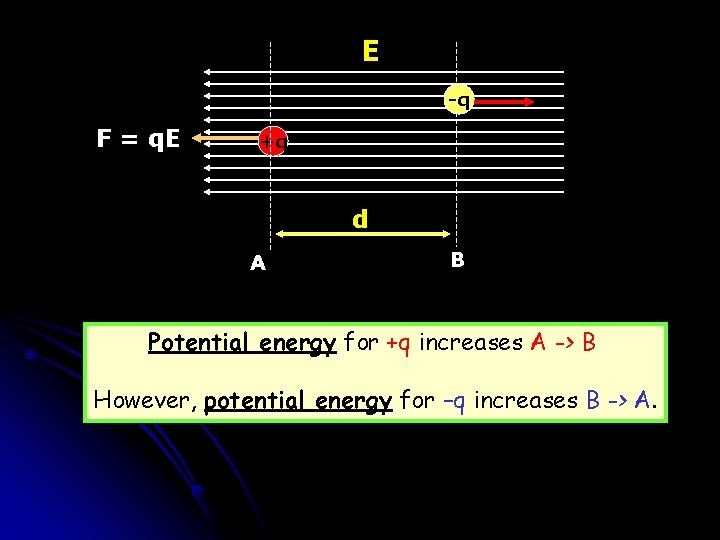
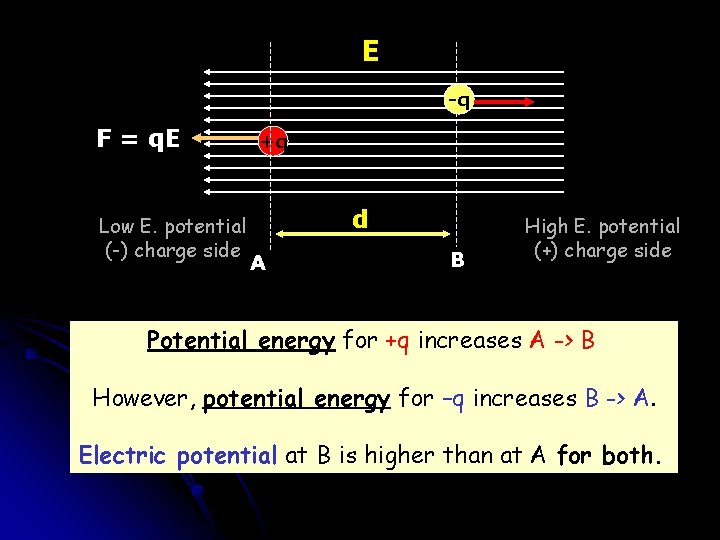
E -q F = q. E +q d A B Potential energy for +q increases A -> B. However, potential energy for –q increases B -> A.
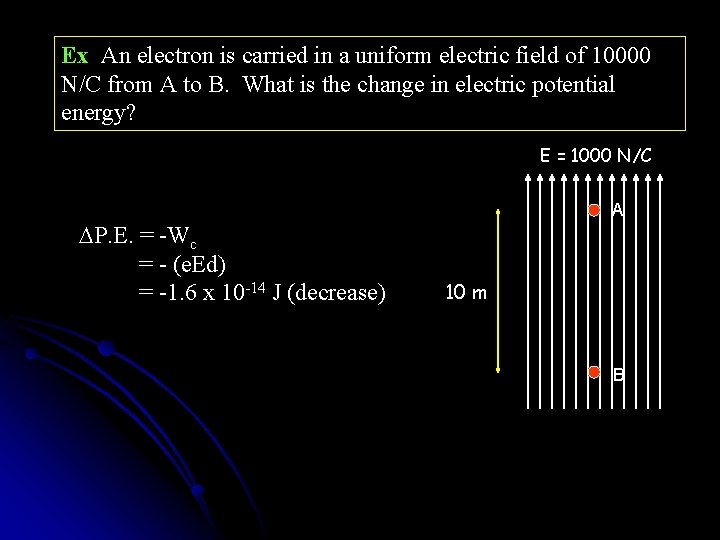
Ex An electron is carried in a uniform electric field of 10000 N/C from A to B. What is the change in electric potential energy? E = 1000 N/C DP. E. = -Wc = - (e. Ed) = -1. 6 x 10 -14 J (decrease) A 10 m B
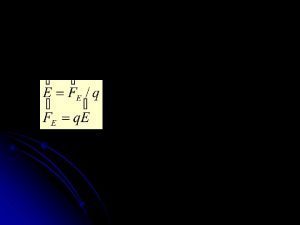
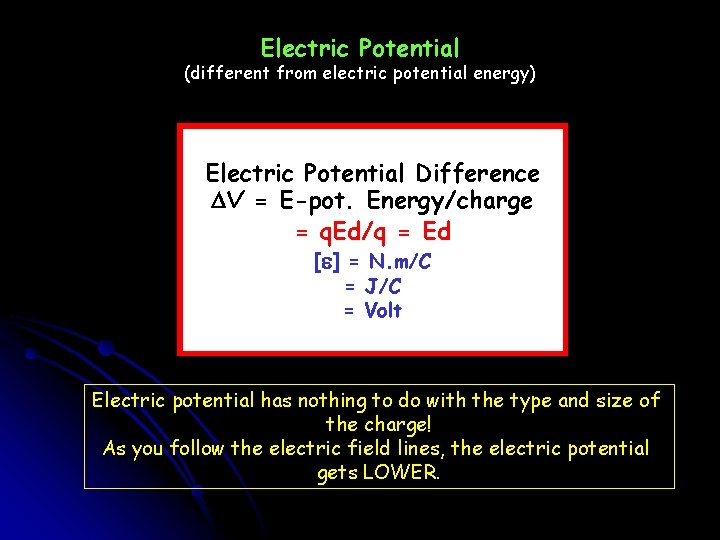
Electric Potential (different from electric potential energy) Electric Potential Difference DV = E-pot. Energy/charge = q. Ed/q = Ed [e] = N. m/C = J/C = Volt Electric potential has nothing to do with the type and size of the charge! As you follow the electric field lines, the electric potential gets LOWER.
E -q F = q. E Low E. potential (-) charge side +q d A B High E. potential (+) charge side Potential energy for +q increases A -> B. However, potential energy for –q increases B -> A. Electric potential at B is higher than at A for both. .
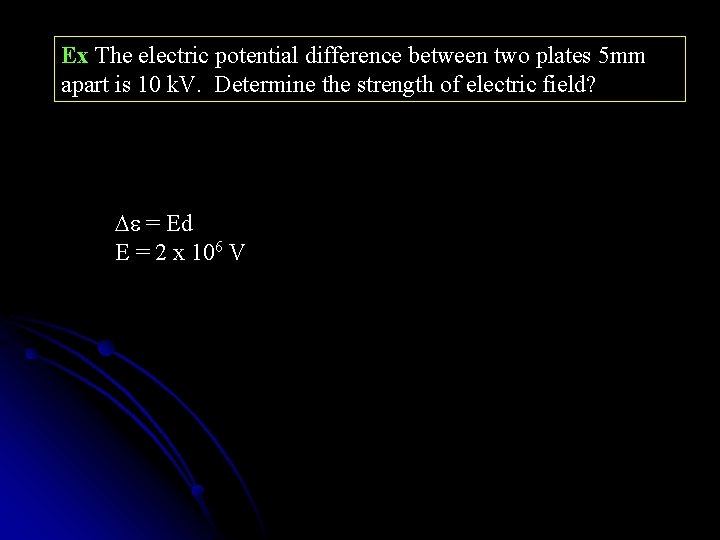
Ex The electric potential difference between two plates 5 mm apart is 10 k. V. Determine the strength of electric field? De = Ed E = 2 x 10⁶ V
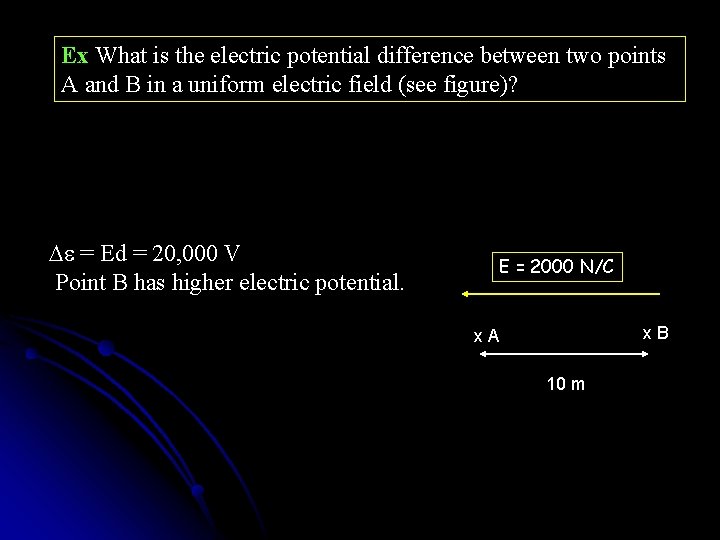
Ex What is the electric potential difference between two points A and B in a uniform electric field (see figure)? De = Ed = 20, 000 V Point B has higher electric potential. E = 2000 N/C x. B x. A 10 m
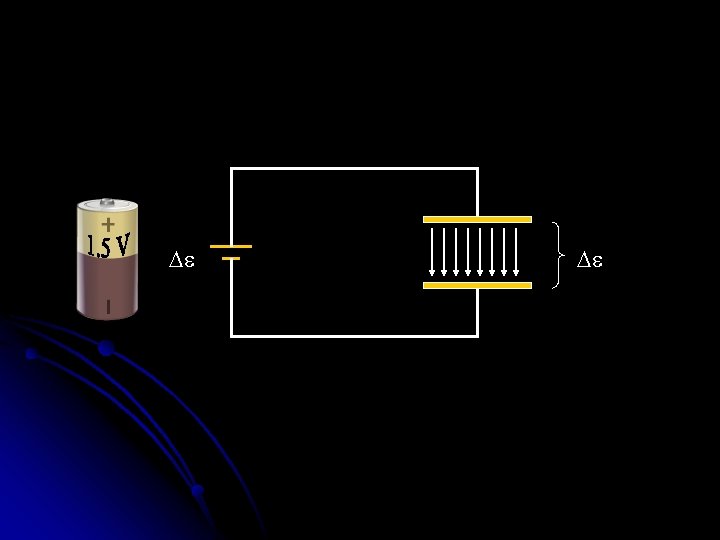
De De
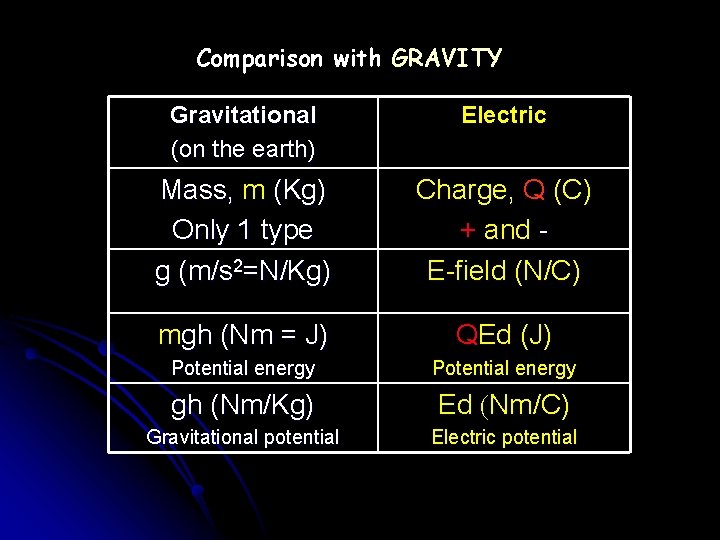
Comparison with GRAVITY Gravitational (on the earth) Electric Mass, m (Kg) Only 1 type g (m/s 2=N/Kg) Charge, Q (C) + and E-field (N/C) mgh (Nm = J) QEd (J) Potential energy gh (Nm/Kg) Ed (Nm/C) Gravitational potential Electric potential
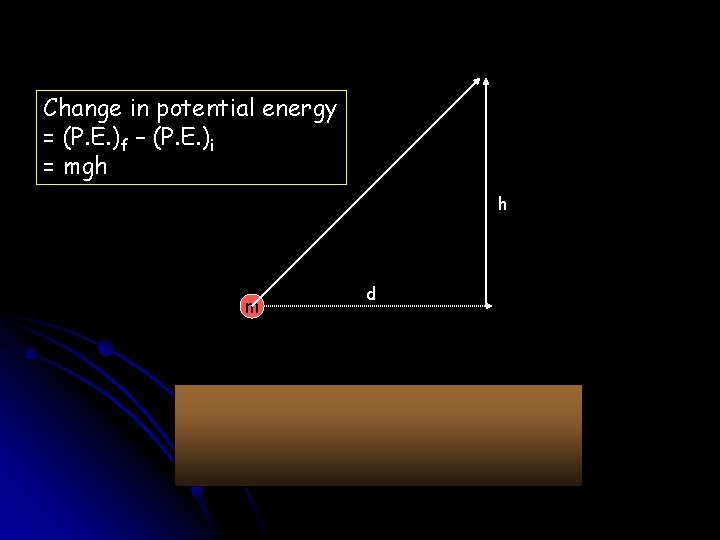
Change in potential energy = (P. E. )f – (P. E. )i = mgh h m d
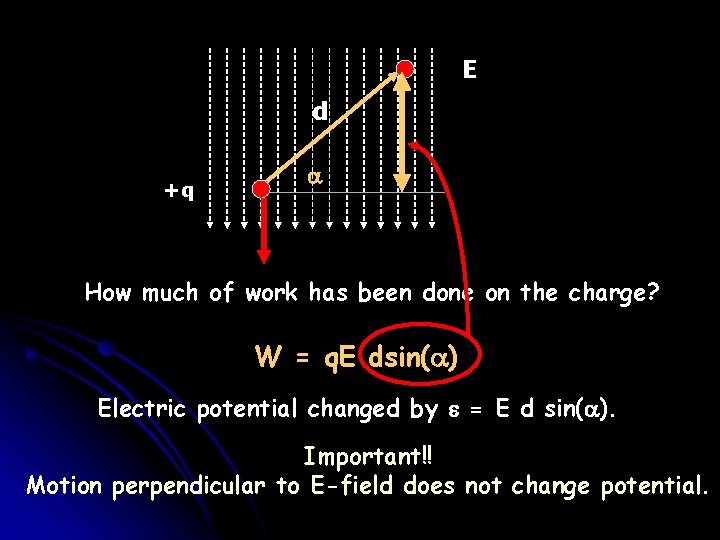
E d +q a How much of work has been done on the charge? W = q. E dsin(a) Electric potential changed by e = E d sin(a). Important!! Motion perpendicular to E-field does not change potential.
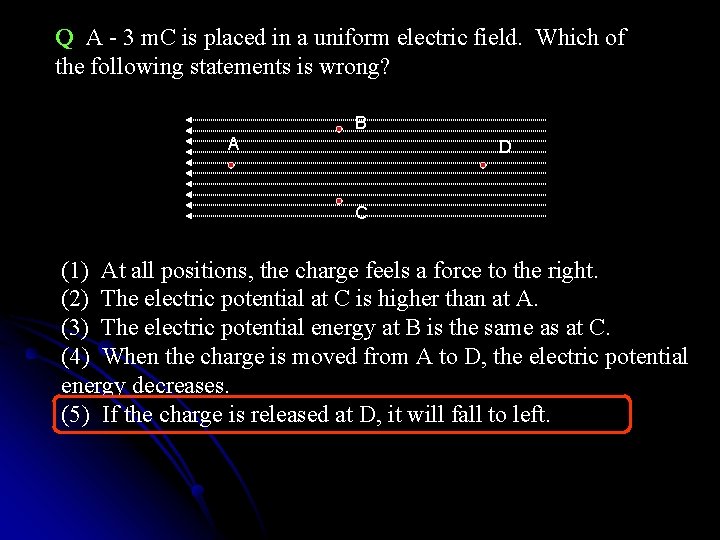
Q A - 3 m. C is placed in a uniform electric field. Which of the following statements is wrong? B A D C (1) At all positions, the charge feels a force to the right. (2) The electric potential at C is higher than at A. (3) The electric potential energy at B is the same as at C. (4) When the charge is moved from A to D, the electric potential energy decreases. (5) If the charge is released at D, it will fall to left.
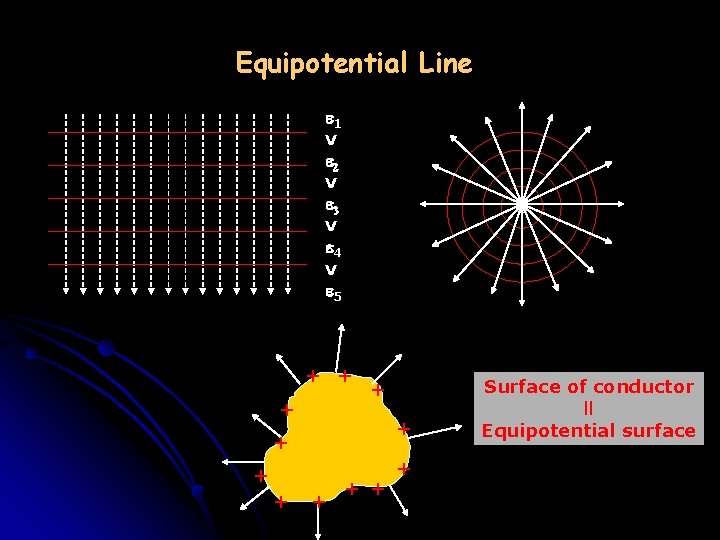
Equipotential Line e 1 v e 2 v e 3 v e 4 v e 5 + + + Surface of conductor ll Equipotential surface