Project Organization Contractual and Organizational Approaches The main

- Slides: 24
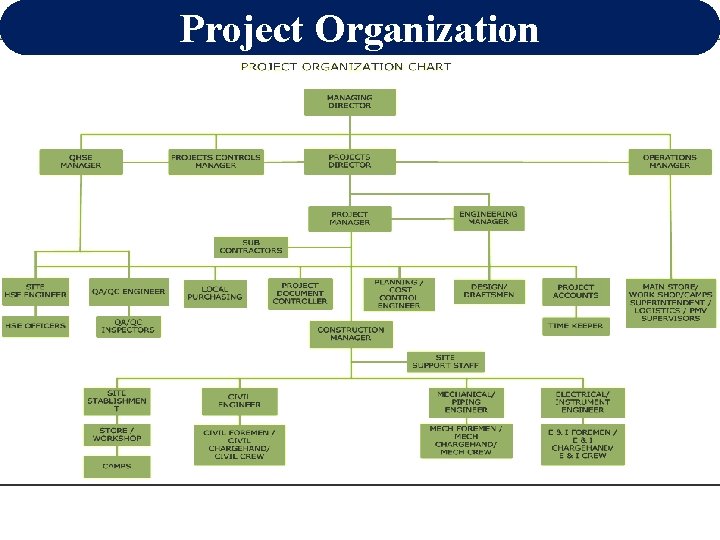
Project Organization
Contractual and Organizational Approaches The main objective of Project organization is to establish the relationship among: Ø the work to be done Ø the people doing the work Ø the work place(s)
Defining The Organization 1. within the firm Ø involves internal organization of personnel. 2. With other firms Ø number of organizations involved Ø relationship between the organizations Ø when each organization be involved in the project.
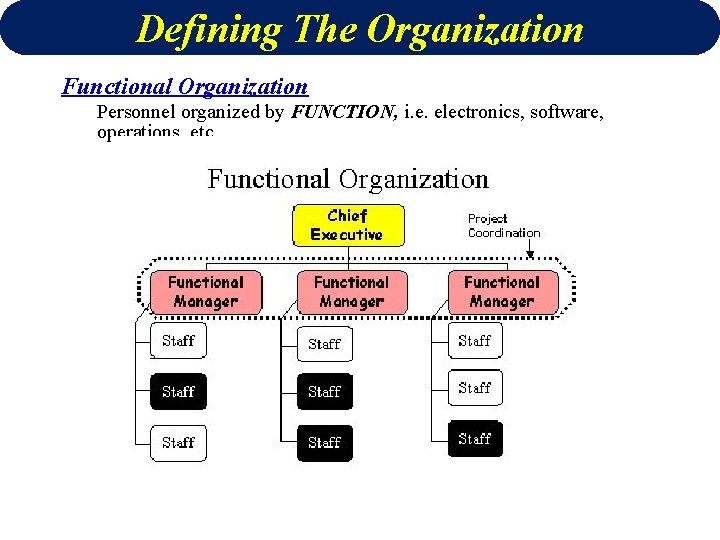
Defining The Organization Functional Organization Personnel organized by FUNCTION, i. e. electronics, software, operations, etc.
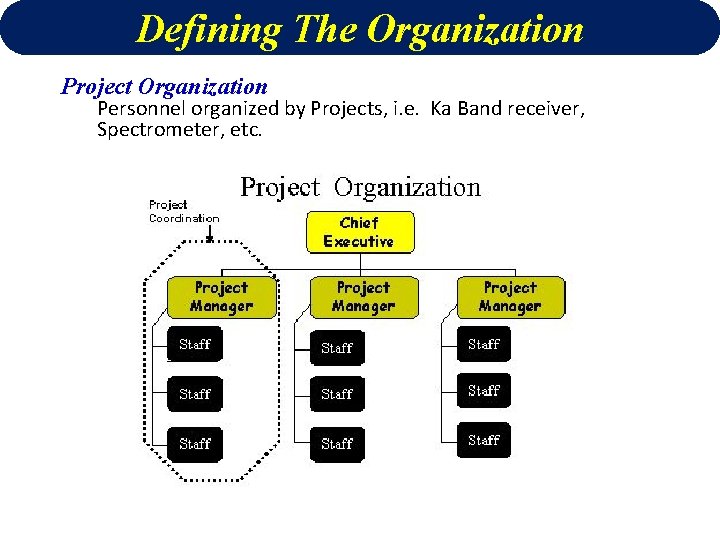
Defining The Organization Project Organization Personnel organized by Projects, i. e. Ka Band receiver, Spectrometer, etc.
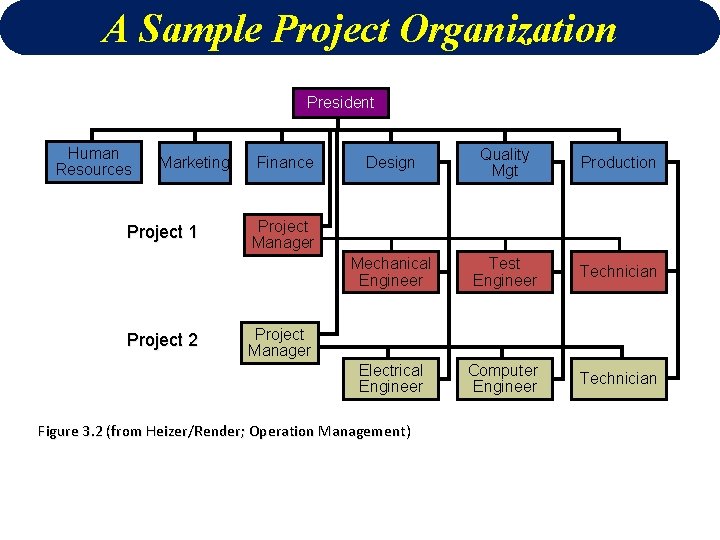
A Sample Project Organization President Human Resources Marketing Project 1 Project 2 Finance Design Quality Mgt Production Mechanical Engineer Test Engineer Technician Electrical Engineer Computer Engineer Technician Project Manager Figure 3. 2 (from Heizer/Render; Operation Management)
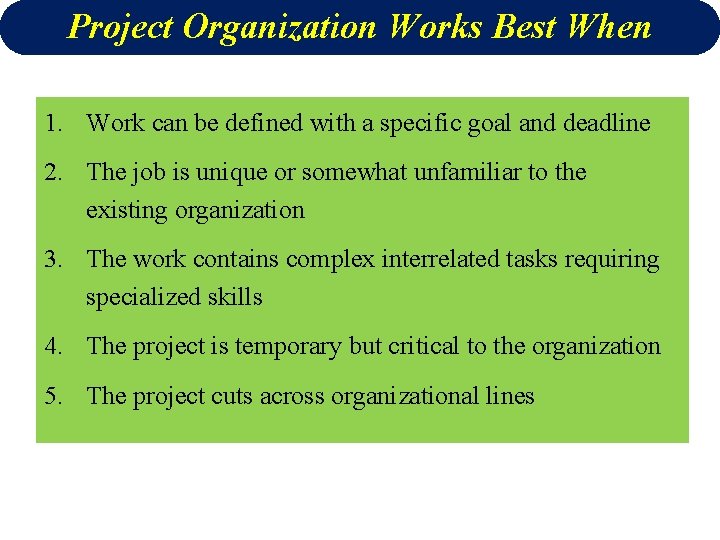
Project Organization Works Best When 1. Work can be defined with a specific goal and deadline 2. The job is unique or somewhat unfamiliar to the existing organization 3. The work contains complex interrelated tasks requiring specialized skills 4. The project is temporary but critical to the organization 5. The project cuts across organizational lines
Project Organization Characteristics þ Often temporary structure þ Uses specialists from entire company þ Headed by project manager þ Coordinates activities þ Monitors schedule and costs þ Permanent structure called ‘matrix organization’
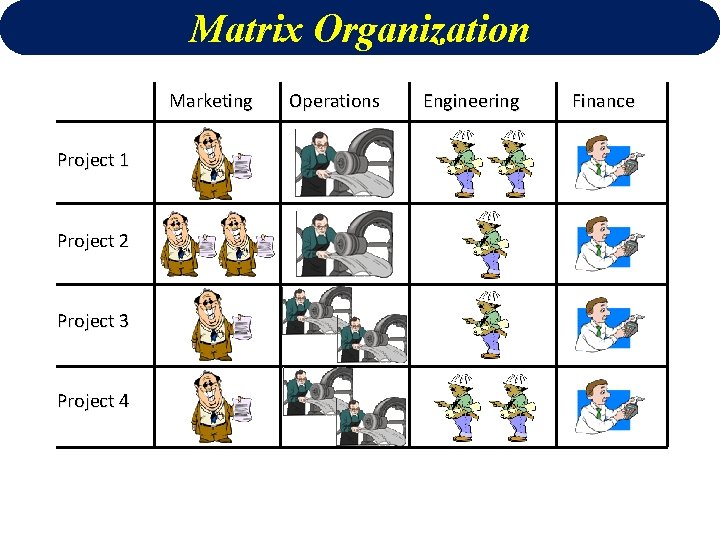
Matrix Organization Marketing Project 1 Project 2 Project 3 Project 4 Operations Engineering Finance
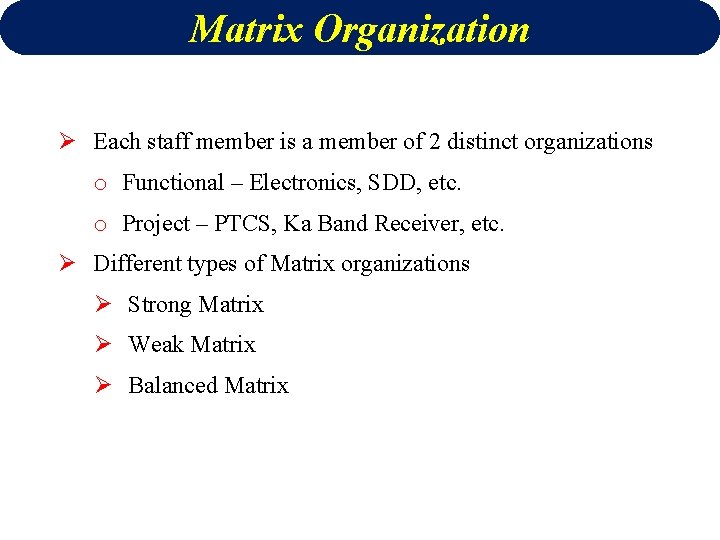
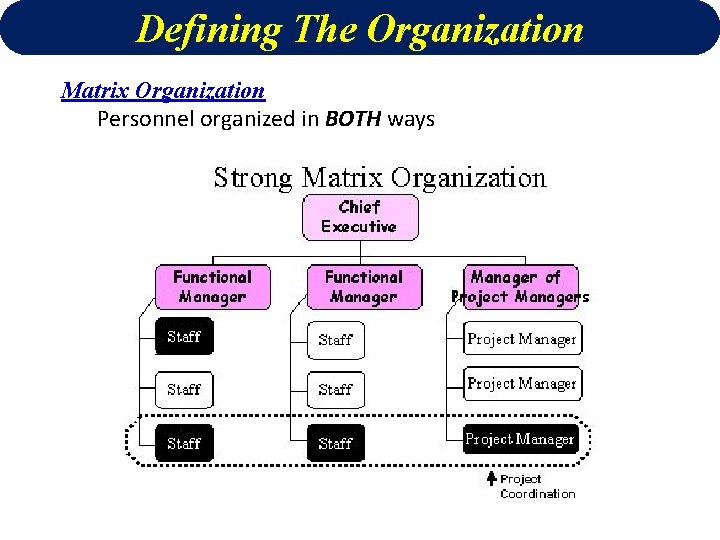
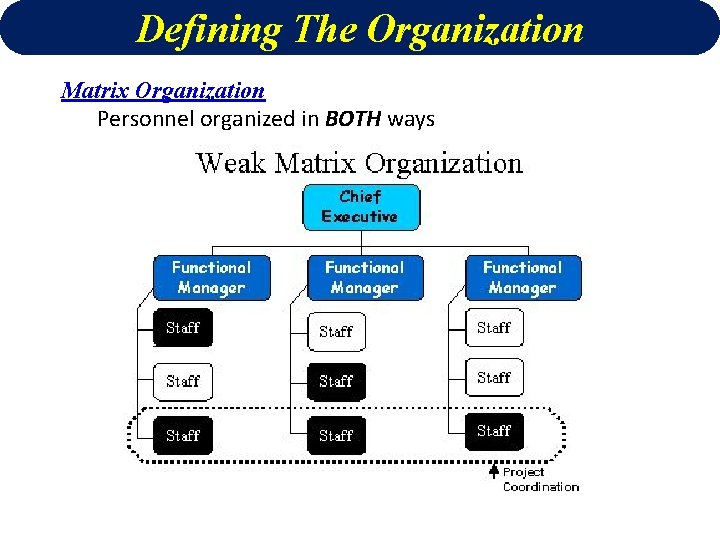
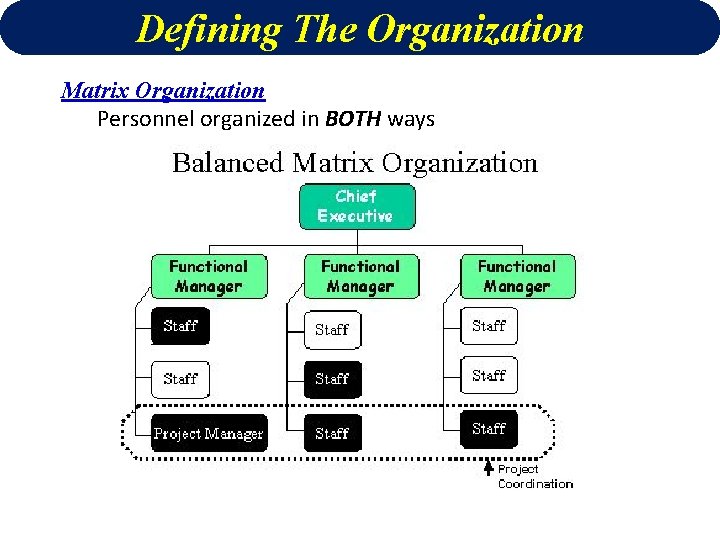
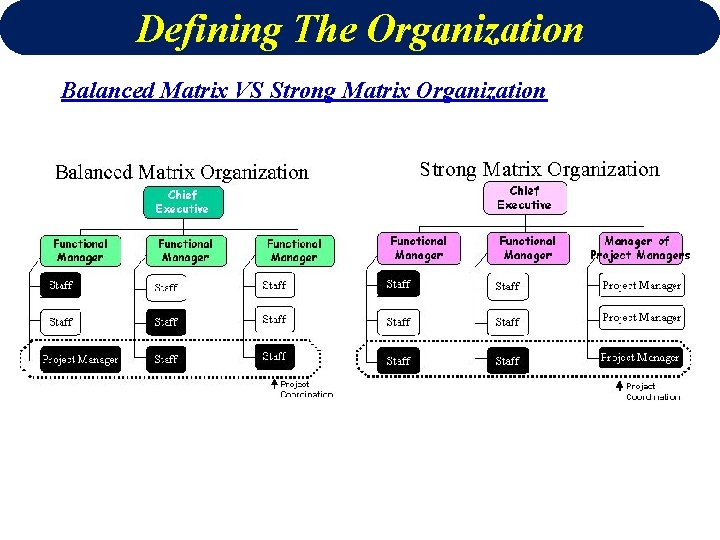
Matrix Organization Ø Each staff member is a member of 2 distinct organizations o Functional – Electronics, SDD, etc. o Project – PTCS, Ka Band Receiver, etc. Ø Different types of Matrix organizations Ø Strong Matrix Ø Weak Matrix Ø Balanced Matrix
Defining The Organization Matrix Organization Personnel organized in BOTH ways
Defining The Organization Matrix Organization Personnel organized in BOTH ways
Defining The Organization Matrix Organization Personnel organized in BOTH ways
Defining The Organization Balanced Matrix VS Strong Matrix Organization
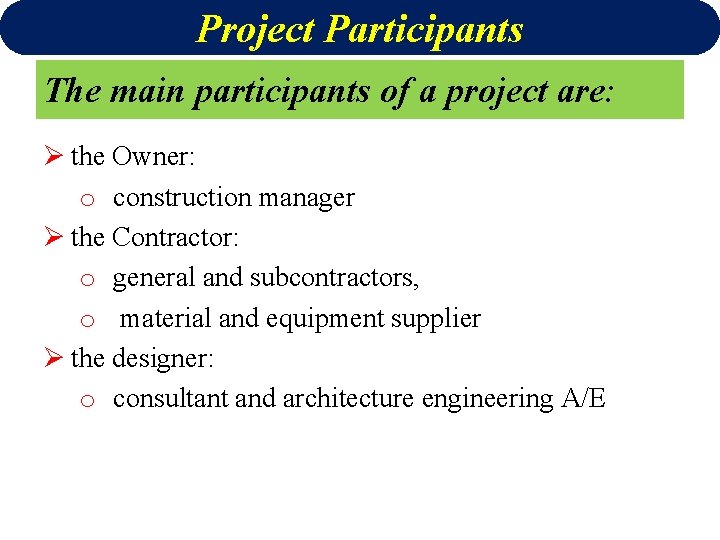
Project Participants The main participants of a project are: Ø the Owner: o construction manager Ø the Contractor: o general and subcontractors, o material and equipment supplier Ø the designer: o consultant and architecture engineering A/E
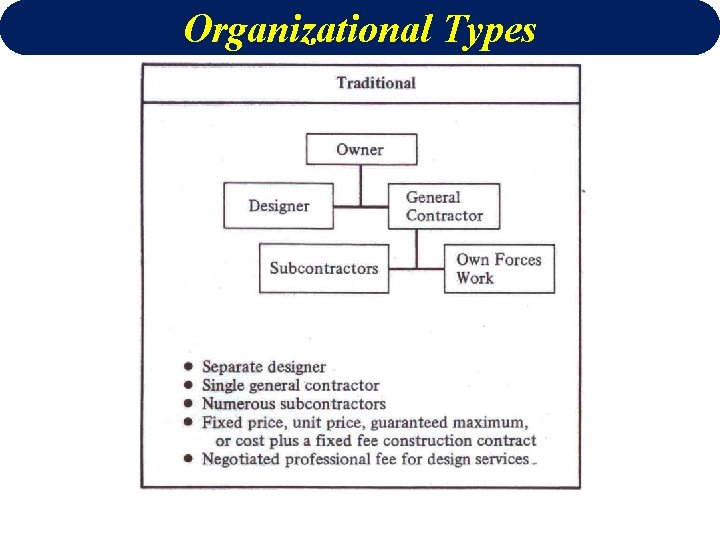
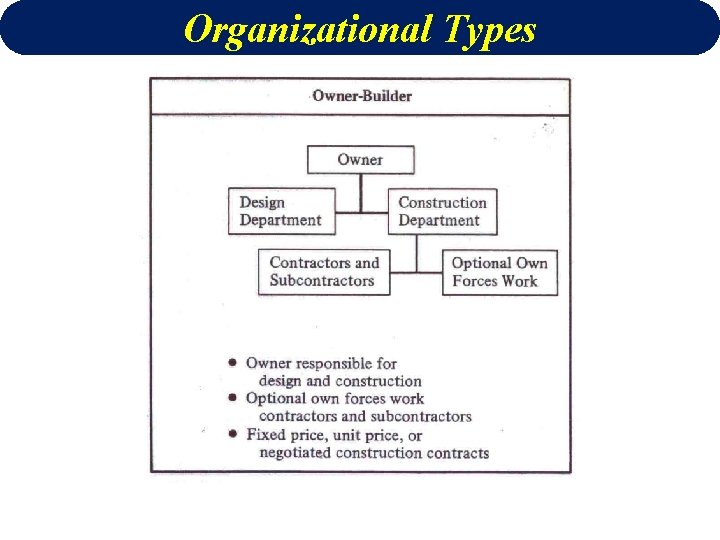
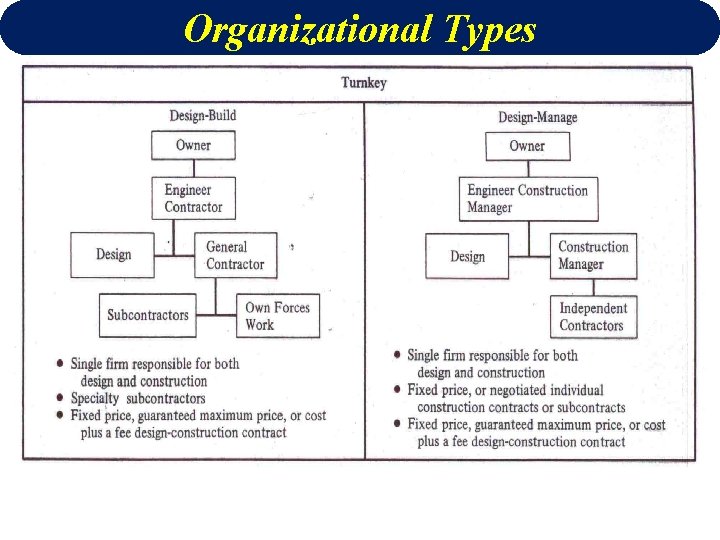
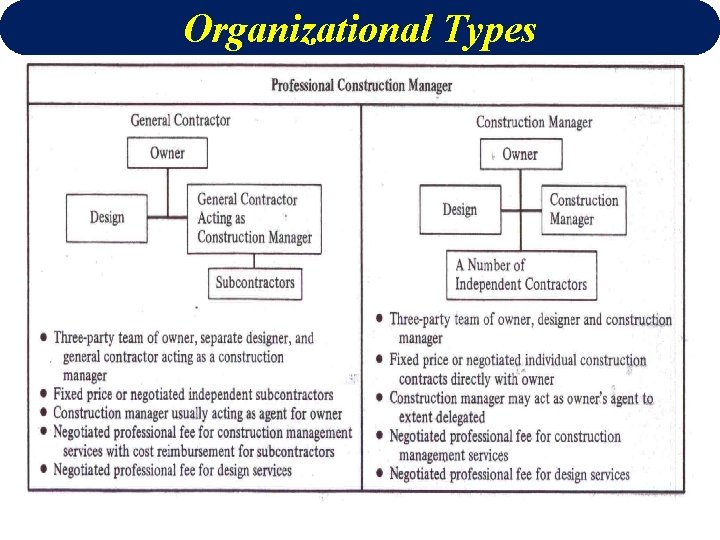
Organizational Types Four principal structures of contractual relationship between the project participants: 1. Traditional 2. Owner-Builder 3. Turnkey 4. Professional Construction Manager
Organizational Types
Organizational Types 1. Traditional Advantages: 1. Widely accepted and historically supported. 2. Using lump-sum the overall cost can be determined before awarding the contract. 3. Minimal involvement of the owner during construction. 4. Design-construct time can be reduced using phased construction. Disadvantages: 1. 2. 3. 4. Design may not benefit from construction expertise. Overall design-construct time is usually the longest. The owner and the designer are usually in an adversary position with general contractor (maximum vs. minimum quality). Change orders will often end in disputes and may drive-up costs.
Organizational Types
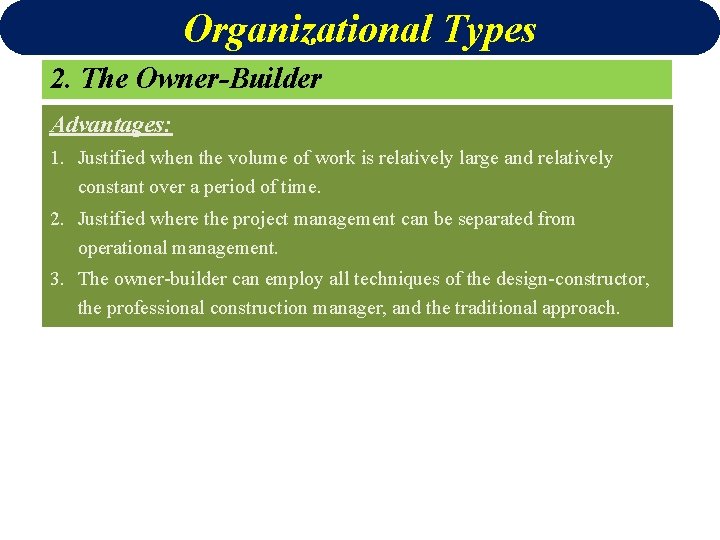
Organizational Types 2. The Owner-Builder Advantages: 1. Justified when the volume of work is relatively large and relatively constant over a period of time. 2. Justified where the project management can be separated from operational management. 3. The owner-builder can employ all techniques of the design-constructor, the professional construction manager, and the traditional approach.
Organizational Types
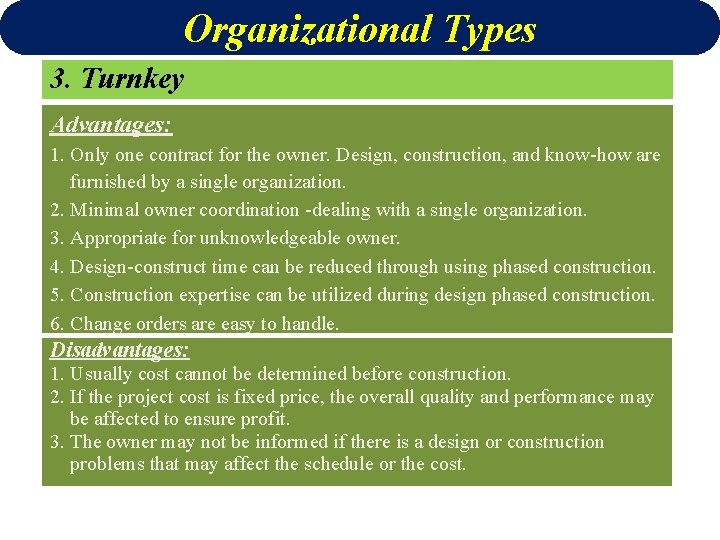
Organizational Types 3. Turnkey Advantages: 1. Only one contract for the owner. Design, construction, and know-how are furnished by a single organization. 2. Minimal owner coordination -dealing with a single organization. 3. Appropriate for unknowledgeable owner. 4. Design-construct time can be reduced through using phased construction. 5. Construction expertise can be utilized during design phased construction. 6. Change orders are easy to handle. Disadvantages: 1. Usually cost cannot be determined before construction. 2. If the project cost is fixed price, the overall quality and performance may be affected to ensure profit. 3. The owner may not be informed if there is a design or construction problems that may affect the schedule or the cost.
Organizational Types
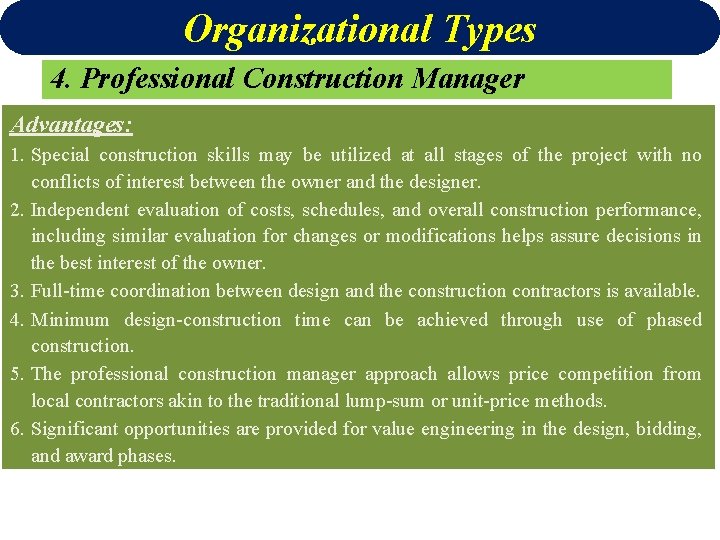
Organizational Types 4. Professional Construction Manager Advantages: 1. Special construction skills may be utilized at all stages of the project with no conflicts of interest between the owner and the designer. 2. Independent evaluation of costs, schedules, and overall construction performance, including similar evaluation for changes or modifications helps assure decisions in the best interest of the owner. 3. Full-time coordination between design and the construction contractors is available. 4. Minimum design-construction time can be achieved through use of phased construction. 5. The professional construction manager approach allows price competition from local contractors akin to the traditional lump-sum or unit-price methods. 6. Significant opportunities are provided for value engineering in the design, bidding, and award phases.