
Community Pharmacy Contractual Framework 201920 to 202324 Sue

- Slides: 26
Community Pharmacy Contractual Framework 2019/20 to 2023/24 Sue Taylor Devon LPC December 2019
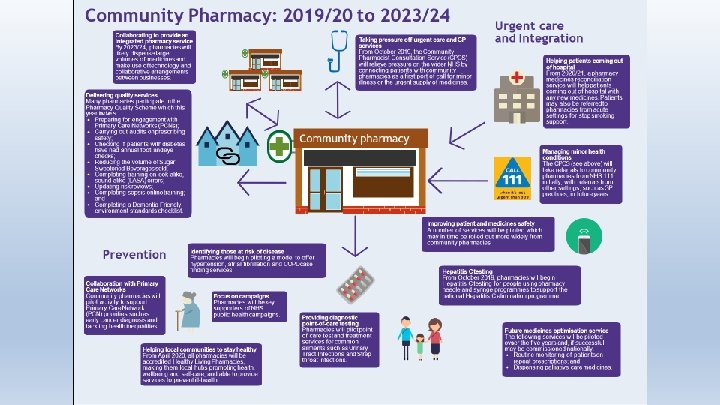
Community Pharmacy Contractual Framework 2019/20 to 2023/24 New five-year Community Pharmacy Contractual Framework (CPCF) published to support the delivery of the NHS Long-Term Plan
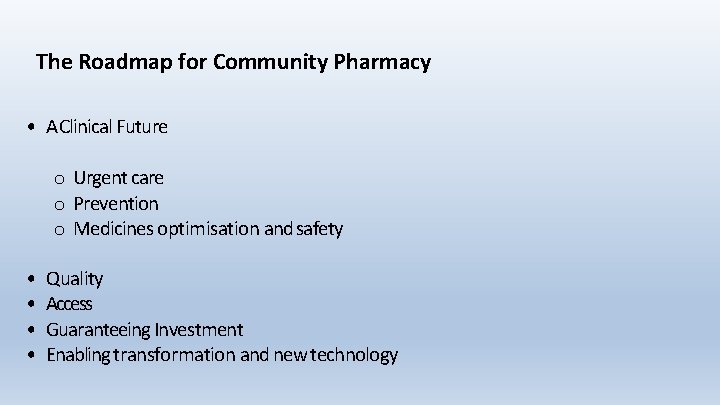
The Roadmap for Community Pharmacy • A Clinical Future o Urgent care o Prevention o Medicines optimisation and safety • • Quality Access Guaranteeing Investment Enabling transformation and new technology
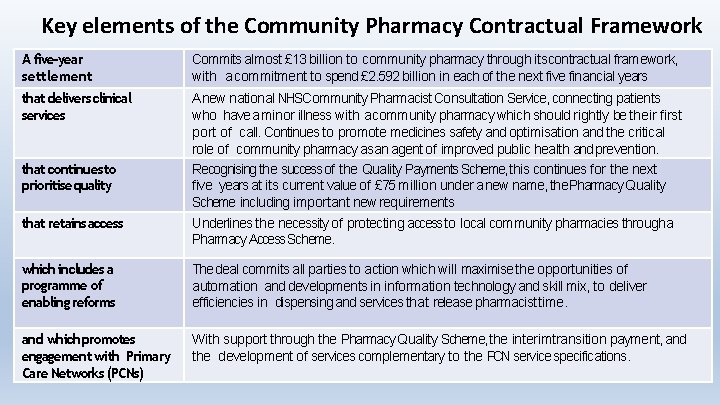
Key elements of the Community Pharmacy Contractual Framework A five-year settlement Commits almost £ 13 billion to community pharmacy through itscontractual framework, with a commitment to spend £ 2. 592 billion in each of the next five financial years that delivers clinical services A new national NHSCommunity Pharmacist Consultation Service, connecting patients who have a minor illness with a community pharmacy which should rightly be their first port of call. Continues to promote medicines safety and optimisation and the critical role of community pharmacy as an agent of improved public health and prevention. Recognising the success of the Quality Payments Scheme, this continues for the next five years at its current value of £ 75 million under a new name, the. Pharmacy Quality Scheme including important new requirements Underlines the necessity of protecting access to local community pharmacies througha Pharmacy Access Scheme. that continues to prioritise quality that retains access which includes a programme of enabling reforms The deal commits all parties to action which will maximise the opportunities of automation and developments in information technology and skill mix, to deliver efficiencies in dispensing and services that release pharmacist time. and which promotes engagement with Primary Care Networks (PCNs) With support through the Pharmacy Quality Scheme, the interimtransition payment, and the development of services complementary to the PCN service specifications.
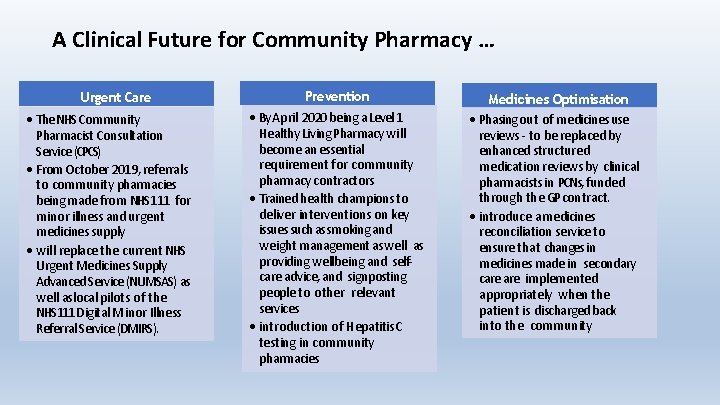
A Clinical Future for Community Pharmacy … Urgent Care • The NHS Community Pharmacist Consultation Service (CPCS) • From October 2019, referrals to community pharmacies being made from NHS 111 for minor illness and urgent medicines supply • will replace the current NHS Urgent Medicines Supply Advanced Service (NUMSAS) as well as local pilots of the NHS 111 Digital Minor Illness Referral Service (DMIRS). Prevention • By April 2020 being a Level 1 Healthy Living Pharmacy will become an essential requirement for community pharmacy contractors • Trained health champions to deliver interventions on key issues such as smoking and weight management as well as providing wellbeing and selfcare advice, and signposting people to other relevant services • introduction of Hepatitis C testing in community pharmacies Medicines Optimisation • Phasing out of medicines use reviews - to be replaced by enhanced structured medication reviews by clinical pharmacists in PCNs, funded through the GP contract. • introduce a medicines reconciliation service to ensure that changes in medicines made in secondary care implemented appropriately when the patient is discharged back into the community
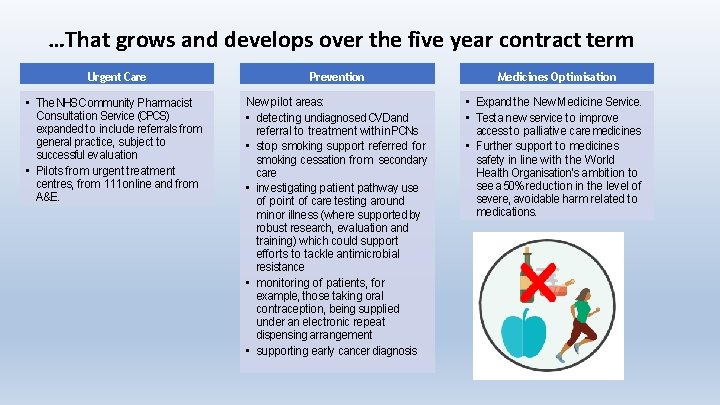
…That grows and develops over the five year contract term Urgent Care • The NHSCommunity Pharmacist Consultation Service (CPCS) expanded to include referrals from general practice, subject to successful evaluation • Pilots from urgent treatment centres, from 111 online and from A&E. Prevention Medicines Optimisation New pilot areas: • detecting undiagnosed CVDand referral to treatment within PCNs • stop smoking support referred for smoking cessation from secondary care • investigating patient pathway use of point of care testing around minor illness (where supported by robust research, evaluation and training) which could support efforts to tackle antimicrobial resistance • monitoring of patients, for example, those taking oral contraception, being supplied under an electronic repeat dispensing arrangement • supporting early cancer diagnosis • Expand the New Medicine Service. • Test a new service to improve access to palliative care medicines • Further support to medicines safety in line with the World Health Organisation’s ambition to see a 50% reduction in the level of severe, avoidable harm related to medications.
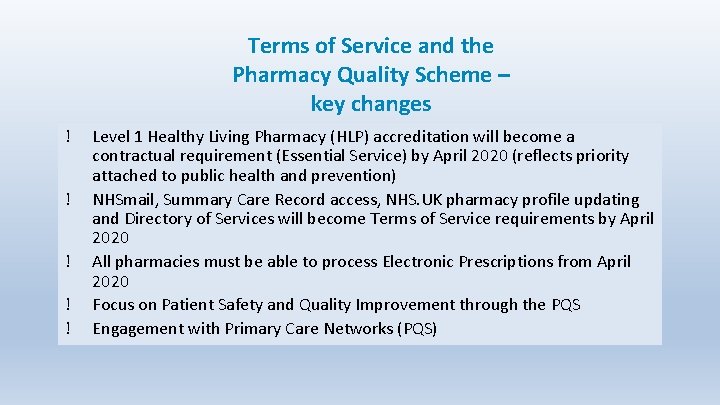
Terms of Service and the Pharmacy Quality Scheme – key changes ! ! ! Level 1 Healthy Living Pharmacy (HLP) accreditation will become a contractual requirement (Essential Service) by April 2020 (reflects priority attached to public health and prevention) NHSmail, Summary Care Record access, NHS. UK pharmacy profile updating and Directory of Services will become Terms of Service requirements by April 2020 All pharmacies must be able to process Electronic Prescriptions from April 2020 Focus on Patient Safety and Quality Improvement through the PQS Engagement with Primary Care Networks (PQS)
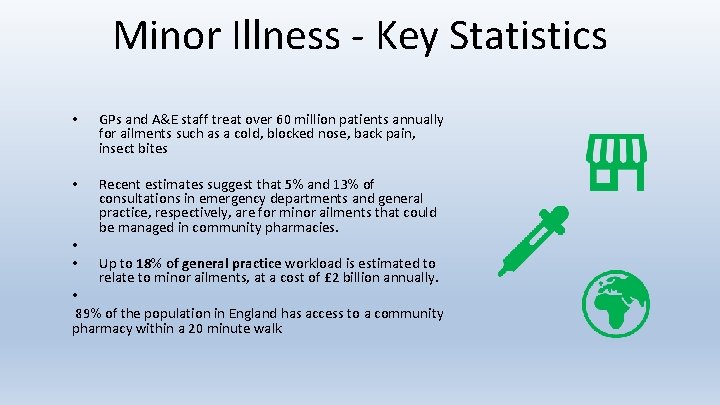
Minor Illness - Key Statistics • GPs and A&E staff treat over 60 million patients annually for ailments such as a cold, blocked nose, back pain, insect bites Recent estimates suggest that 5% and 13% of consultations in emergency departments and general practice, respectively, are for minor ailments that could be managed in community pharmacies. • • Up to 18% of general practice workload is estimated to relate to minor ailments, at a cost of £ 2 billion annually. • 89% of the population in England has access to a community pharmacy within a 20 minute walk •
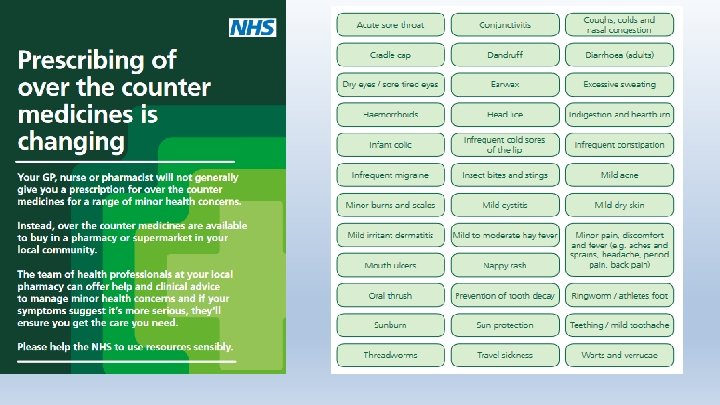
Self Care Pharmacies already provide a range of over the counter advice and treatment without patients having to go to their GP • • • Coughs and Colds Constipation Diarrhoea Dry Skin and Rashes Earwax Hay fever and Allergies Headaches Emergency Contraception Indigestion and Reflux Sore Throats Thrush And Much More….
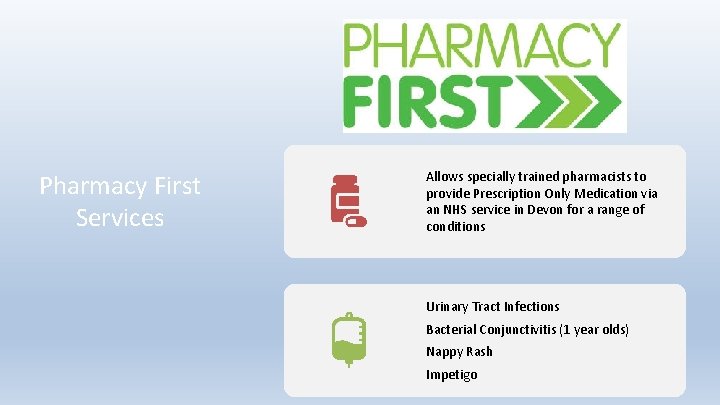
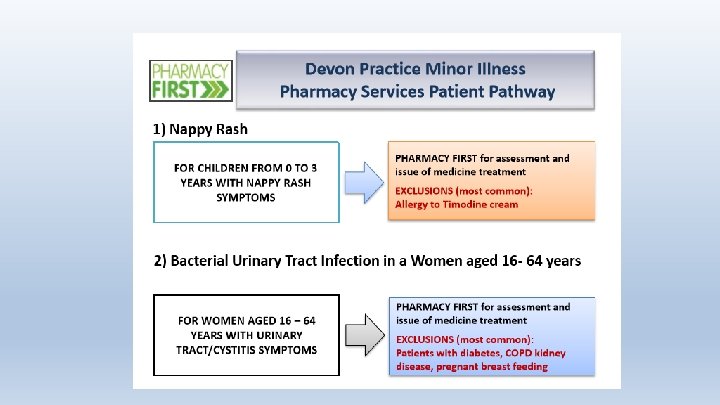
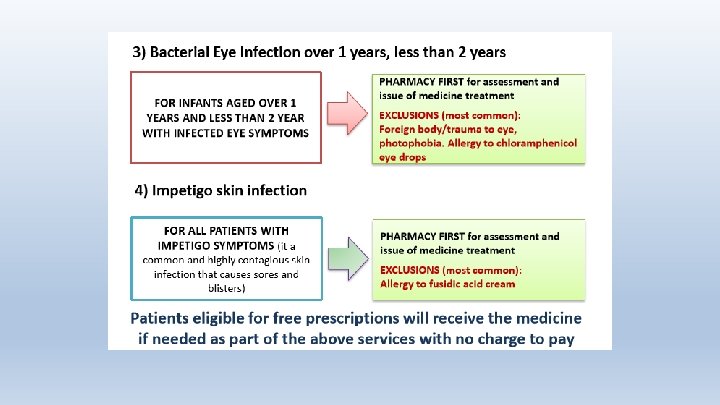
Pharmacy First Services Allows specially trained pharmacists to provide Prescription Only Medication via an NHS service in Devon for a range of conditions Urinary Tract Infections Bacterial Conjunctivitis (1 year olds) Nappy Rash Impetigo
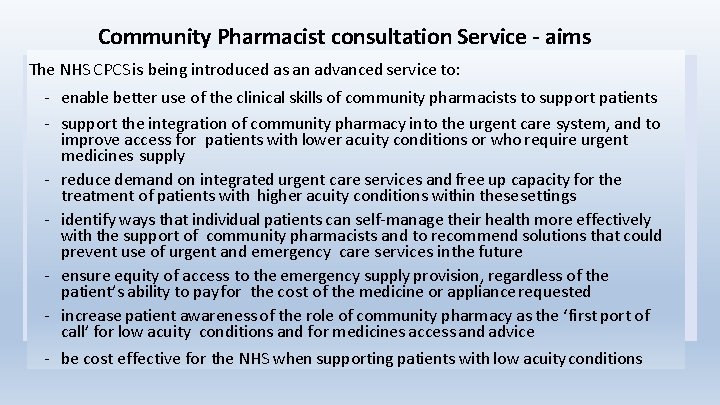
Community Pharmacist consultation Service - aims The NHS CPCS is being introduced as an advanced service to: - enable better use of the clinical skills of community pharmacists to support patients - support the integration of community pharmacy into the urgent care system, and to improve access for patients with lower acuity conditions or who require urgent medicines supply - reduce demand on integrated urgent care services and free up capacity for the treatment of patients with higher acuity conditions within these settings - identify ways that individual patients can self-manage their health more effectively with the support of community pharmacists and to recommend solutions that could prevent use of urgent and emergency care services in the future - ensure equity of access to the emergency supply provision, regardless of the patient’s ability to pay for the cost of the medicine or appliance requested - increase patient awareness of the role of community pharmacy as the ‘first port of call’ for low acuity conditions and for medicines access and advice - be cost effective for the NHS when supporting patients with low acuity conditions
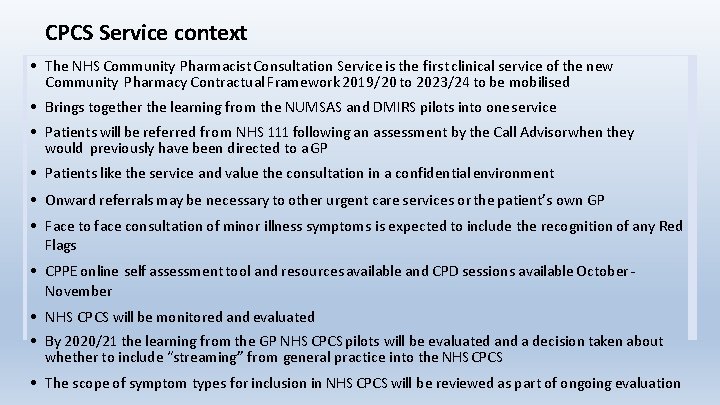
CPCS Service context • The NHS Community Pharmacist Consultation Service is the first clinical service of the new Community Pharmacy Contractual Framework 2019/20 to 2023/24 to be mobilised • Brings together the learning from the NUMSAS and DMIRS pilots into one service • Patients will be referred from NHS 111 following an assessment by the Call Advisor when they would previously have been directed to a GP • Patients like the service and value the consultation in a confidential environment • Onward referrals may be necessary to other urgent care services or the patient’s own GP • Face to face consultation of minor illness symptoms is expected to include the recognition of any Red Flags • CPPE online self assessment tool and resources available and CPD sessions available October November • NHS CPCS will be monitored and evaluated • By 2020/21 the learning from the GP NHS CPCS pilots will be evaluated and a decision taken about whether to include “streaming” from general practice into the NHS CPCS • The scope of symptom types for inclusion in NHS CPCS will be reviewed as part of ongoing evaluation
Introduction to CPCS • The service commenced on 29 th October 2019 • In the original DMIRS pilots, patients liked the service and valued the consultation in a confidential environment • The service will support: – the integration of community pharmacy into the urgent care system – increasing patient awareness of the role of community pharmacy as the ‘first port of call’ for low acuity conditions and for medicines access and advice – patients to self-manage their health more effectively
Development of CPCS • Over the course of the 5 -year Community Pharmacy Contractual Framework, the service will be monitored and evaluated • The range of symptom types included in the service will be reviewed to consider expansion, if safe, effective and it will improve patient experience • By 2020/21, the learning from the GP CPCS pilots will be evaluated and a decision taken about whether to include “streaming” from general practice into the CPCS
CPCS prerequisites • Consultation room • From 1 st April 2020, the pharmacy must have IT equipment accessible within the consultation room • NHS Summary Care Record (SCR) access • Shared NHSmail account: nhspharmacy. location. pharmacyname. ODScode@nhs. net • Up to date Directory of Services (Do. S) details • Access to the CPCS IT system provided by NHSE&I • SOP including key contact details • Update to your business continuity plan
The Directory of Services and the CPCS • The assessment by the call adviser uses NHS Pathways to gather information that identifies the specific clinical skills and defined timescale needed by the patient • At the end of the assessment (if an emergency ambulance is not required), an automatic search is carried out on the Do. S to locate an appropriate service in the patient’s local area that offers the clinical skills needed within the timeframe required
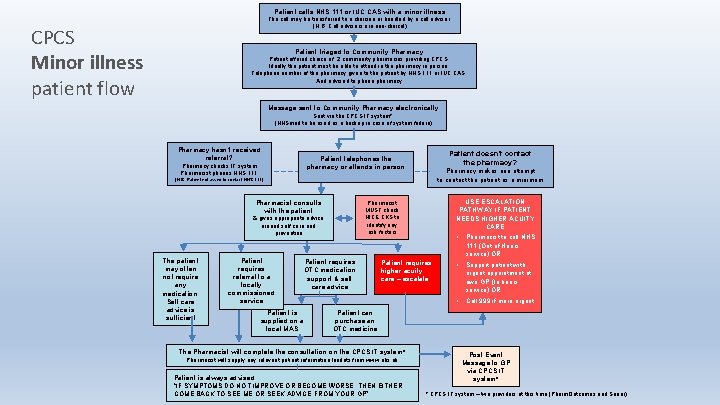
Patient calls NHS 111 or IUC CAS with a minor illness The call may be transferred to a clinician or handled by a call advisor. (N. B. Call advisors are non-clinical) CPCS Minor illness patient flow Patient triaged to Community Pharmacy Patient offered choice of 2 community pharmacies providing CPCS. Ideally the patient must be able to attend in the pharmacy in person. Telephone number of the pharmacy given to the patient by NHS 111 or IUC CAS And advised to phone pharmacy Message sent to Community Pharmacy electronically Sent via the CPCS IT system* (NHSmail to be used as a backup in case of system failure) Pharmacy hasn’t received referral? Pharmacy checks IT system Pharmacist phones NHS 111 Patient doesn’t contact the pharmacy? Patient telephones the pharmacy or attends in person Pharmacy makes one attempt to contact the patient as a minimum. (N. B. Patient not asked to contact NHS 111) Pharmacist consults with the patient & gives appropriate advice around self care and prevention The patient may often not require any medication. Self care advice is sufficient Patient requires referral to a locally commissioned service Patient is supplied on a local MAS USE ESCALATION PATHWAY IF PATIENT NEEDS HIGHER ACUITY CARE Pharmacist MUST check NICE CKS to identify any risk factors Patient requires OTC medication support & self care advice Patient requires higher acuity care – escalate • Pharmacist to call NHS 111 (Out of Hours service) OR • Support patient with urgent appointment at own GP (In hours service) OR • Call 999 if more urgent Patient can purchase an OTC medicine The Pharmacist will complete the consultation on the CPCS IT system* Pharmacist will supply any relevant patient information leaflets from www. nhs. uk Patient is always advised: “IF SYMPTOMS DO NOT IMPROVE OR BECOME WORSE, THEN EITHER COME BACK TO SEE ME OR SEEK ADVICE FROM YOUR GP” Post Event Message to GP via CPCS IT system* * CPCS IT system – two providers at this time (Pharm. Outcomes and Sonar)
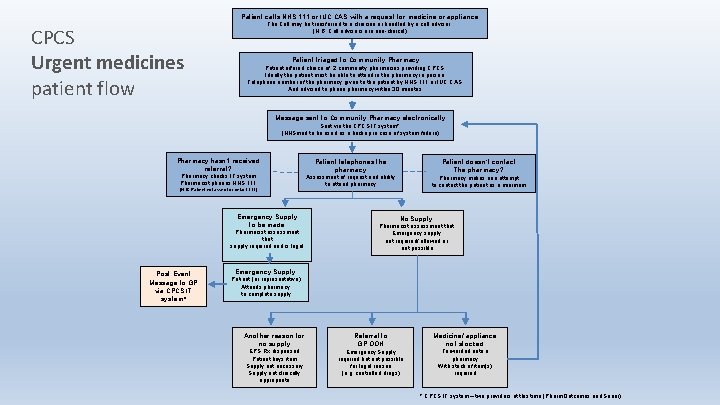
Patient calls NHS 111 or IUC CAS with a request for medicine or appliance CPCS Urgent medicines patient flow The Call may be transferred to a clinician or handled by a call advisor. (N. B. Call advisors are non-clinical) Patient triaged to Community Pharmacy Patient offered choice of 2 community pharmacies providing CPCS. Ideally the patient must be able to attend in the pharmacy in person. Telephone number of the pharmacy given to the patient by NHS 111 or IUC CAS And advised to phone pharmacy within 30 minutes Message sent to Community Pharmacy electronically Sent via the CPCS IT system* (NHSmail to be used as a backup in case of system failure) Pharmacy hasn’t received referral? Pharmacy checks IT system Pharmacist phones NHS 111 (N. B. Patient not asked to contact 111) Emergency Supply to be made Pharmacist assessment that supply required and is legal Post Event Message to GP via CPCS IT system* Patient telephones the pharmacy Patient doesn’t contact The pharmacy? Assessment of request and ability to attend pharmacy Pharmacy makes one attempt to contact the patient as a minimum. No Supply Pharmacist assessment that Emergency supply not required/ allowed or not possible Emergency Supply Patient (or representative) Attends pharmacy to complete supply Another reason for no supply Referral to GP OOH Medicine/ appliance not stocked EPS Rx dispensed Patient buys item Supply not necessary Supply not clinically appropriate Emergency Supply required but not possible for legal reason (e. g. controlled drugs) Forwarded onto a pharmacy With stock of item(s) required * CPCS IT system – two providers at this time (Pharm. Outcomes and Sonar)
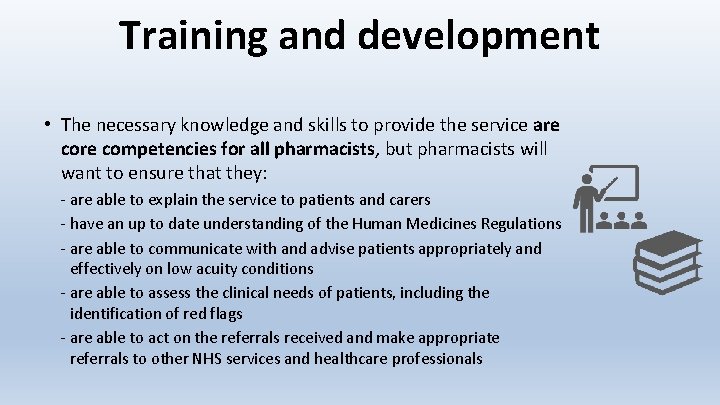
Training and development • The necessary knowledge and skills to provide the service are competencies for all pharmacists, but pharmacists will want to ensure that they: - are able to explain the service to patients and carers - have an up to date understanding of the Human Medicines Regulations - are able to communicate with and advise patients appropriately and effectively on low acuity conditions - are able to assess the clinical needs of patients, including the identification of red flags - are able to act on the referrals received and make appropriate referrals to other NHS services and healthcare professionals
Completed referrals • For urgent medicines supply, a referral is completed when the pharmacist has a consultation with the patient (by telephone or face-to-face) and – – – confirms no supply is required the patient is given advice the patient purchases the required product OTC the patient is referred on to another healthcare provider an EPS prescription is downloaded and dispensed an item is not available, and the patient is referred to a second pharmacy (both pharmacies can claim a consultation fee in this last scenario) • For minor illness consultations, a referral is completed when the pharmacist has a consultation with the patient (telephone or face-to-face) and has provided advice to the patient
Other CPCS pilots - National • • GP CPCS being pilot in a number of CCGs including Devon Online access for urgent medicines supply via CPCS is currently being tested across the north west via 111 Online A future pilot of a minor illness online pathway via 111 Online is under consideration These will be evaluated before consideration of national roll out Other pilots – Improving Access (Local)
Q&A