
Chapter 8 Factors Affecting the Contractual Relationship Copyright

- Slides: 23
Chapter 8: Factors Affecting the Contractual Relationship Copyright © 2008 Pearson Education Canada 8 -1
Factors Affecting Contractual Relationships Ø Ø Ø Mistake Misrepresentation Duress and undue influence Unconscionable Transaction Privity of Contract Assignment Copyright © 2008 Pearson Education Canada 2
Mistake Error that destroys consensus Ø Shared Mistake—fundamental mistake about subject matter of contract— common to both parties—courts must correct obvious error Ø Misunderstanding - questions existence of consensus - differing interpretations Ø Copyright © 2008 Pearson Education Canada 3
Mistake/2 One-sided Mistake-fundamental mistake Ø l l Non Est Factum (It is not my act) Ø l l Ø usually when one party misleads the other mistaken identification mistake goes to the nature of the document usually involves misrepresentation Rules of Interpretation apply with simple misunderstanding Copyright © 2008 Pearson Education Canada 4
Rules of Interpretation Reasonable person test Literal or liberal meanings imposed on written terms Courts or statutes may imply terms Parol Evidence Rule Ø Ø l Outside evidence will not change clear wording Copyright © 2008 Pearson Education Canada 5
Case Summary Cooper v. Phibbs Ø Because of a shared mistake a vendor sold some property, on which he had done considerable work, to a neighbour who it turned out already owned the property. Ø Copyright © 2008 Pearson Education Canada 6
Case Summary/2 Ø There was no way to compensate the vendor for his improvements to the property without the court applying an equitable principle. Copyright © 2008 Pearson Education Canada 7
Case Summary/2 Ø There was no way to compensate the vendor for his improvements to the property without the court applying an equitable principle. Copyright © 2008 Pearson Education Canada 8
Misrepresentation Ø Ø False statement of fact that persuades someone to enter into a contract. The statement must be an allegation of fact Silence is not misrepresentation when there is no duty to disclose The statement must be incorrect and untrue and must have been the inducement that led to the contract Copyright © 2008 Pearson Education Canada 9
Innocent Misrepresentation The person making it honestly believes it to be true. Ø Remedies are limited to rescission Ø Rescission puts both parties back into original positions Ø Copyright © 2008 Pearson Education Canada 10
Innocent Misrepresentation/2 Ø Ø Rescission is not available when contract is: affirmed impossible to restore where a third party is involved Copyright © 2008 Pearson Education Canada 11
Fraudulent Misrepresentation Victim of intentional misrepresentation can sue for damages in addition to rescission An innocent misrepresentation becomes fraudulent if not corrected when discovered Remedies: Ø Ø Ø l l l rescission damages contract may be considered void Copyright © 2008 Pearson Education Canada 12
Case Summary Negligent Misrepresentation Ø In Haig v. Bamford the courts found that even though the accountants honestly believed what they had stated on the audit was true, because they had not measured up to the standard expected of a reasonable accountant they were liable for the damages they caused to the group of investors they knew about. Ø Copyright © 2008 Pearson Education Canada 13
Duress and Undue Influence Duress Ø l threat of violence makes contract voidable Undue Influence Ø l l which reduces free will to bargain - voidable contract presumed in certain relationships Copyright © 2008 Pearson Education Canada 14
Duress and Undue Influence/2 Ø Unconscionable Transactions l Where a person takes advantage of another’s vulnerability - voidable Copyright © 2008 Pearson Education Canada 15
Question for Discussion The courts will presume undue influence in certain circumstances which may include a spouse assuming the indebtedness of their partner. Ø What evidence do you think would convincingly demonstrate to a court that there has been undue influence? Ø Copyright © 2008 Pearson Education Canada 16
Case Summary Stevenson v. Hilty - the court determined that a contract could be set aside if: Ø One party is ignorant, in need or in distress Ø One party uses position of power to achieve an advantage Ø The agreement is substantially unfair to weaker party Ø Copyright © 2008 Pearson Education Canada 17
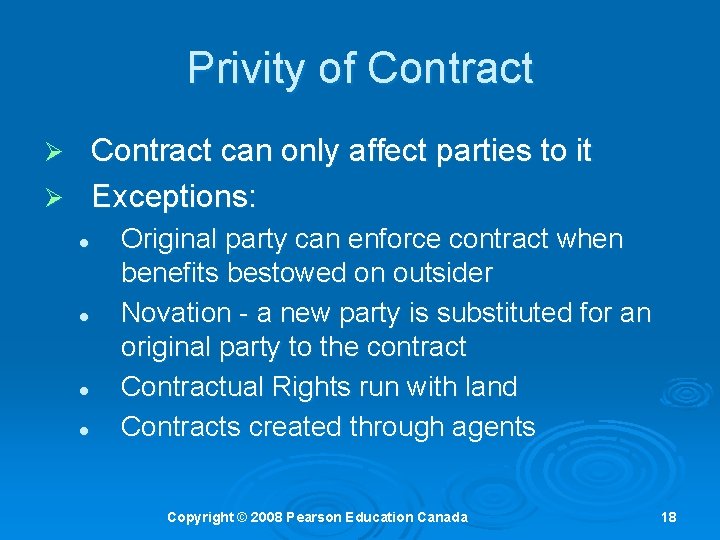
Privity of Contract can only affect parties to it Ø Exceptions: Ø l l Original party can enforce contract when benefits bestowed on outsider Novation - a new party is substituted for an original party to the contract Contractual Rights run with land Contracts created through agents Copyright © 2008 Pearson Education Canada 18
Question for Discussion The number of exceptions to the privity rule suggest that there is no justification for its existence. Ø Consider the validity of this statement and the advantages and disadvantages of the principle of privity of contract, particularly with reference to trusts which are designed to bestow benefits on third parties. Ø Copyright © 2008 Pearson Education Canada 19
Assignment The benefits (chose in action) received under a contract can be assigned or transferred to another Ø Qualifications for statutory assignment Ø l l l absolute and unconditional must be in writing and complete must give proper notice Copyright © 2008 Pearson Education Canada 20
Assignment/2 Ø Some things cannot be assigned: l l the right to sue (champerty) when contract involves the personal performance of a particular skill Copyright © 2008 Pearson Education Canada 21
Assignment/3 Assignee is in the same position as original contractor Ø Subsequent claims do not affect assignee Ø Contractual rights assigned automatically in case of death or bankruptcy Ø Copyright © 2008 Pearson Education Canada 22
Question for Discussion The rules relative to assignment of contractual benefits seem to favour the original contractor because the agreement is subject to the rights between the parties to the original contract. Ø Is this appropriate, or should the advantages be given to the assignee? Ø Copyright © 2008 Pearson Education Canada 23