Preserving Privacy in Participatory Sensing Systems Authors Kuan

- Slides: 31
Preserving Privacy in Participatory Sensing Systems Authors: Kuan Lun Huang, Salil S. Kanhere (School of CS & Engg. , The University of New South Wales, Sydney, Australia), Wen Hu (Autonomous Systems Lab, CSIRO ICT Centre, Australia) Journal: Computer Communications (Vol 33 Issue 11, July ‘ 10) Publisher: Butterworth-Heinemann Newton, MA, USA (Partly published at Per. Se. Ns ’ 09) Presented by: Sara Gaffar
Contents n n n Introduction A review of Anony. Sense Related Work System Model & Motivating example Implementation & Evaluation Important References
Two Major Attributes This paper focuses on the spatial and temporal privacy of users, the two universal attributes expected to be included in user reports for all participatory sensing applications.
Assumptions n n The adversary does not know true values of time and location of user reports. However, the adversary has means to find out the temporal and spatial properties of his victims. The adversary is able to observe submitted reports (eavesdropping).
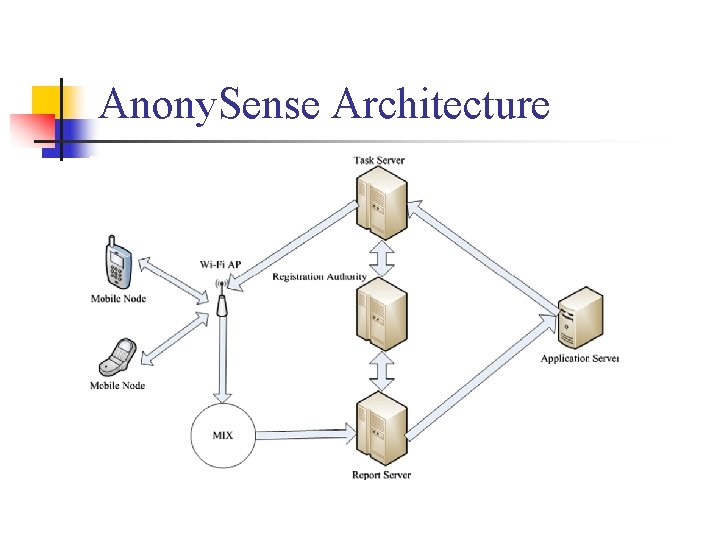
Anony. Sense Architecture
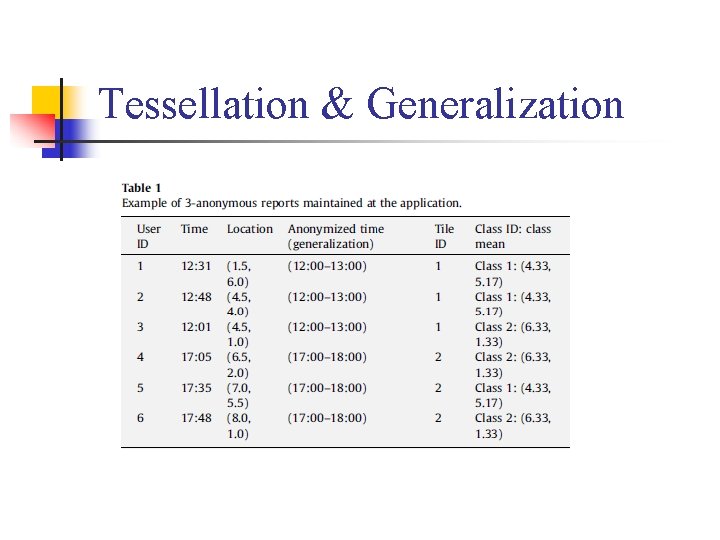
Tessellation & Generalization
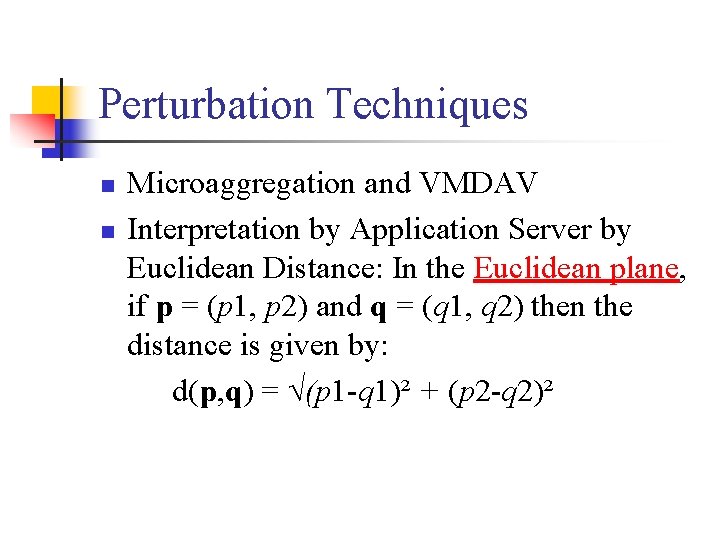
Perturbation Techniques n n Microaggregation and VMDAV Interpretation by Application Server by Euclidean Distance: In the Euclidean plane, if p = (p 1, p 2) and q = (q 1, q 2) then the distance is given by: d(p, q) = √(p 1 -q 1)² + (p 2 -q 2)²
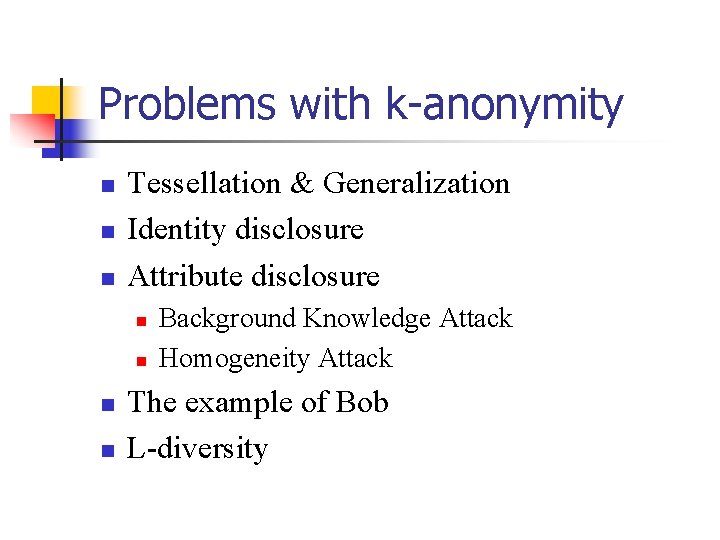
Problems with k-anonymity n n n Tessellation & Generalization Identity disclosure Attribute disclosure n n Background Knowledge Attack Homogeneity Attack The example of Bob L-diversity
System Model
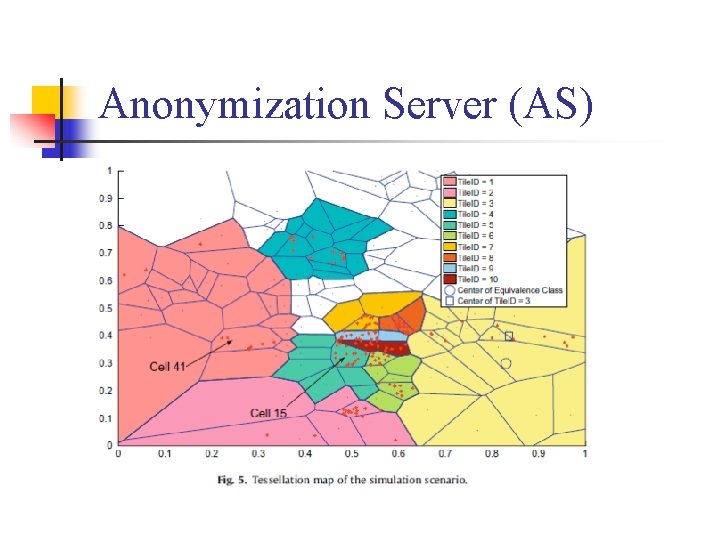
Anonymization Server (AS)
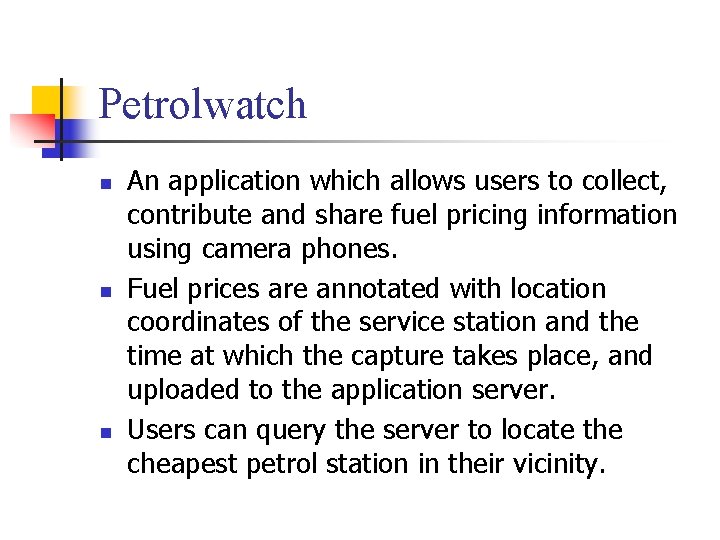
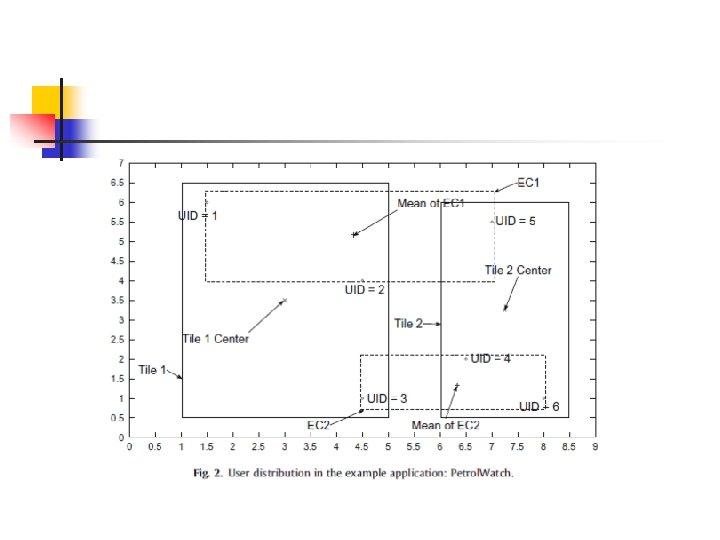
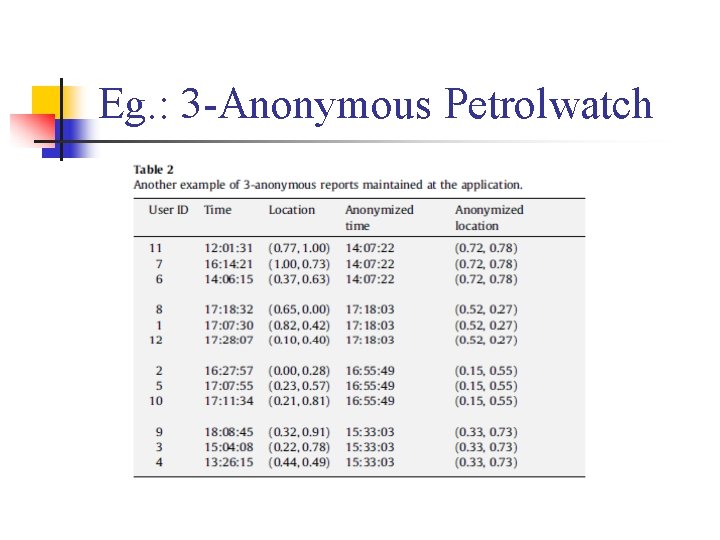
Petrolwatch n n n An application which allows users to collect, contribute and share fuel pricing information using camera phones. Fuel prices are annotated with location coordinates of the service station and the time at which the capture takes place, and uploaded to the application server. Users can query the server to locate the cheapest petrol station in their vicinity.
K-anonymous Privacy-Preserving Schemes n n Tessellation with tile center reporting (Tw. TCR) Location anonymization with microaggregation - VMDAV Location anonymization with Hybrid microaggregation
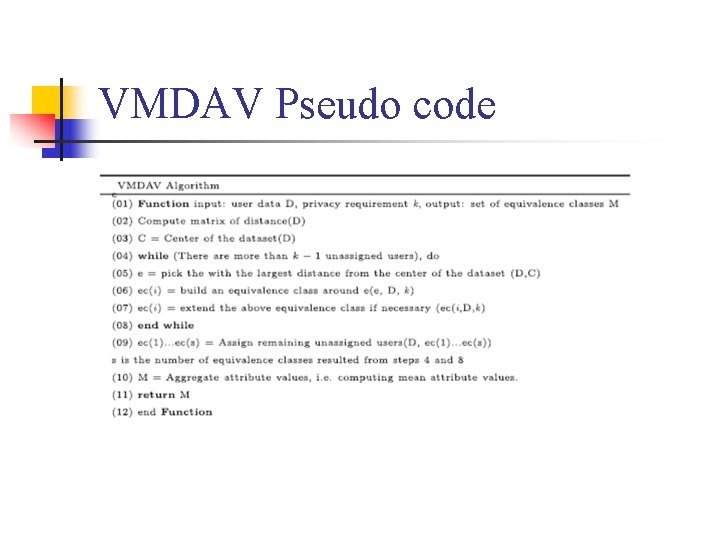
VMDAV Pseudo code
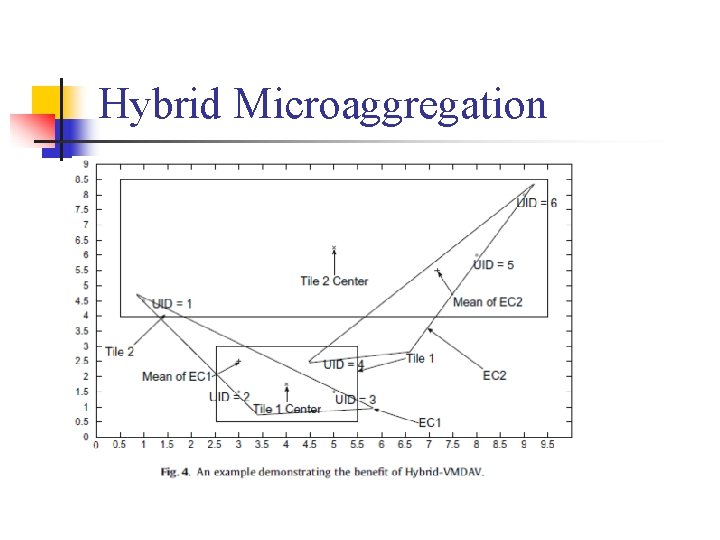
Hybrid Microaggregation
n n VMDAV enables an application to make better decisions when user distributions across different areas are relatively consistent On the contrary, in areas with dense distribution of users, Tw. TCR performs better
Gaussian Input Perturbation n n Why trust the AS? Perturbation Scheme – Artificially distort a user’s location prior to updating the AS.
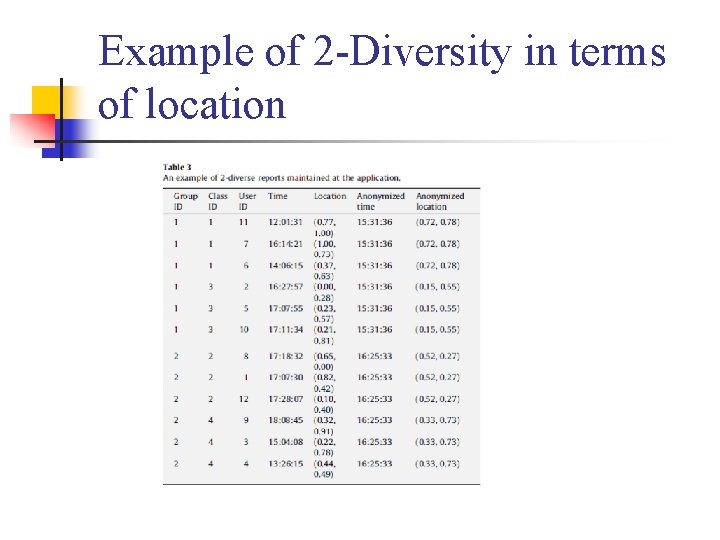
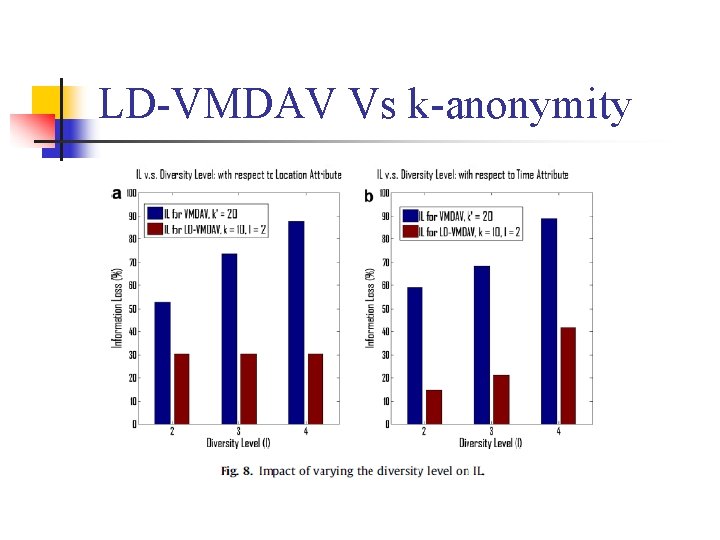
L-Diversity n n Spatial AND temporal privacy Homogeneity and background knowledge attack
Eg. : 3 -Anonymous Petrolwatch
Example of 2 -Diversity in terms of location
Two Issues n n Semantic relationship between locations Timing accuracy
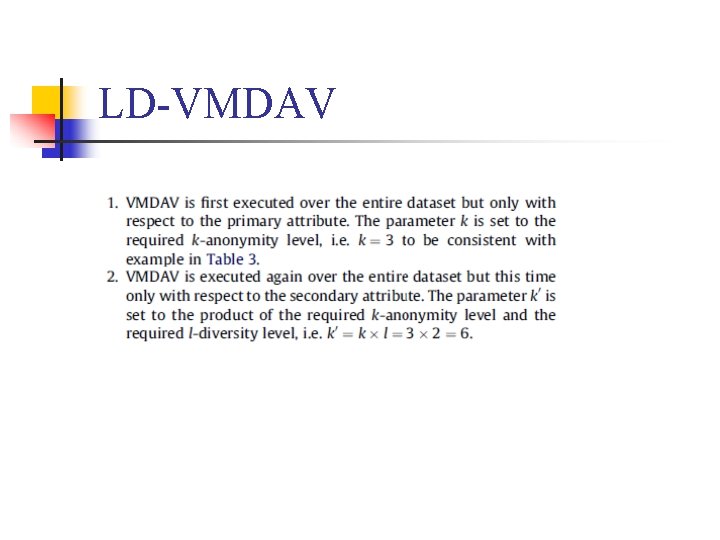
LD-VMDAV
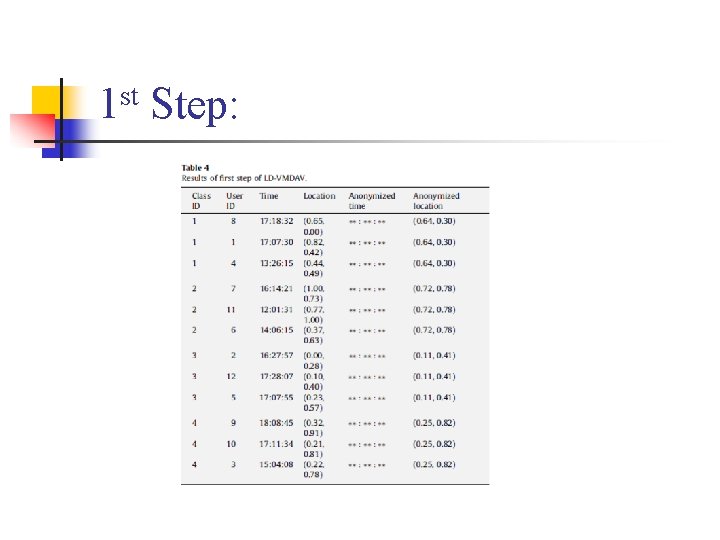
1 st Step:
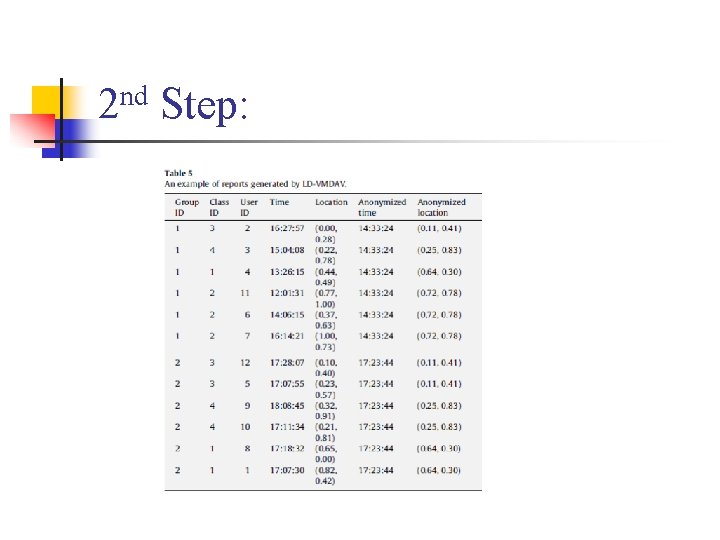
2 nd Step:
Evaluation
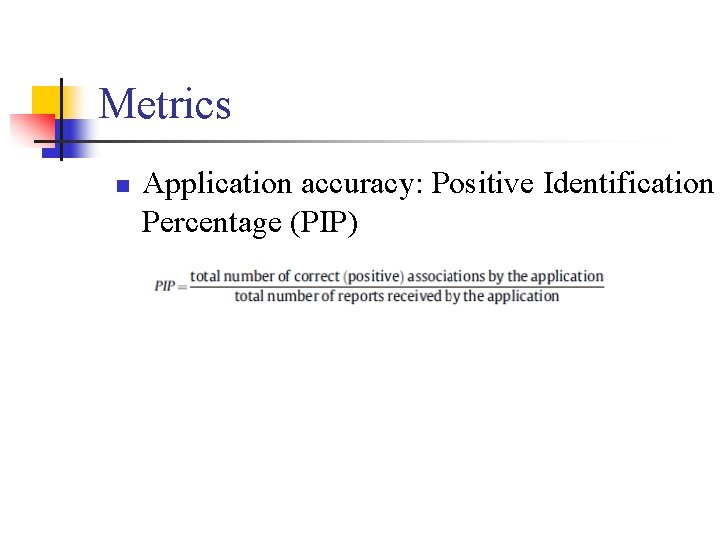
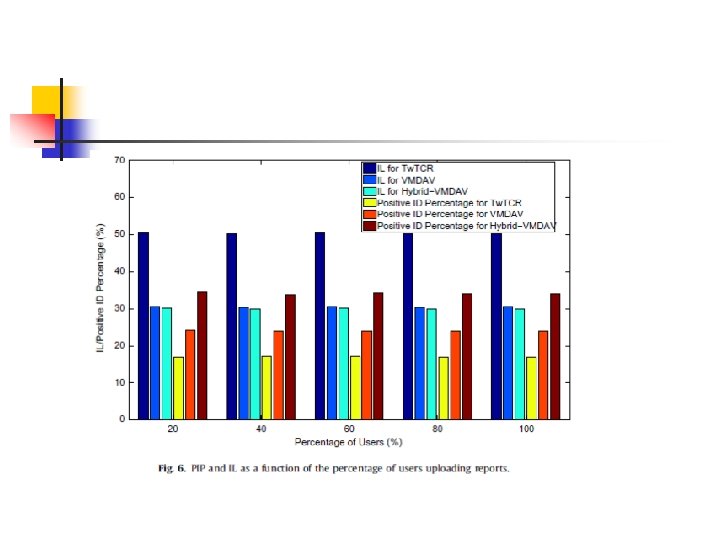
Metrics n Application accuracy: Positive Identification Percentage (PIP)
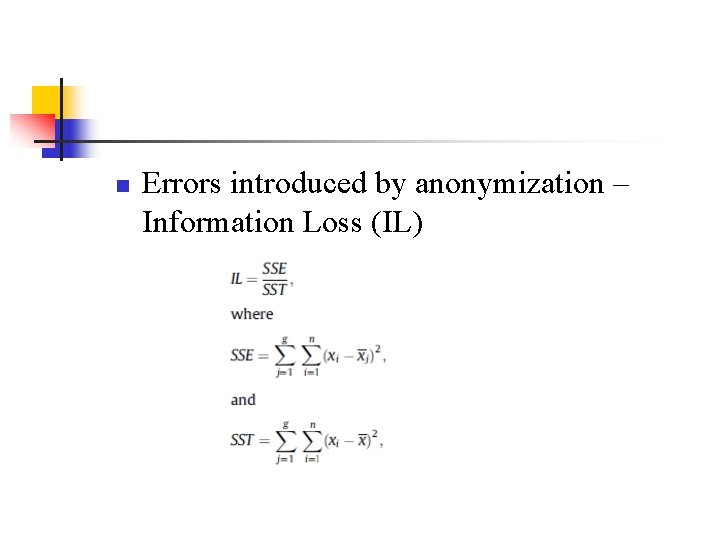
n Errors introduced by anonymization – Information Loss (IL)
Hybrid-VMDAV n Improves percentage of positive identifications made by an application server by up to 100% and decreases amount of information loss by about 40%
LD-VMDAV Vs k-anonymity
References n n Cory Cornelius , Apu Kapadia , David Kotz , Dan Peebles , Minho Shin , Nikos Triandopoulos, Anonysense: privacy-aware people-centric sensing, Proceeding of the 6 th international conference on Mobile systems, applications, and services, June 17 -20, 2008, Breckenridge, CO, USA A. Solanas, A Martinez-Baellest. V-MDAV: a multivariate microaggregation with variable group size, in: 17 th COMPSTAT Symposium of the IASC, Rome, 2006.