PLANKTON PATCHINESS Physical processes implicated in patchiness Diffusionrelated












- Slides: 43
PLANKTON PATCHINESS
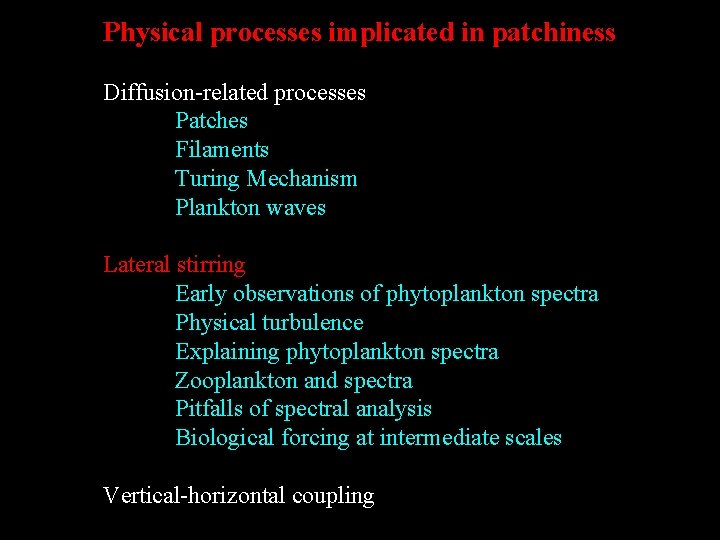
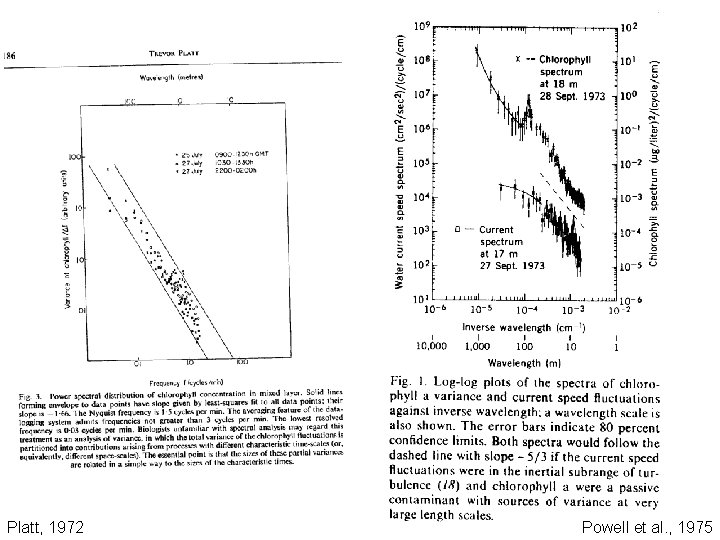
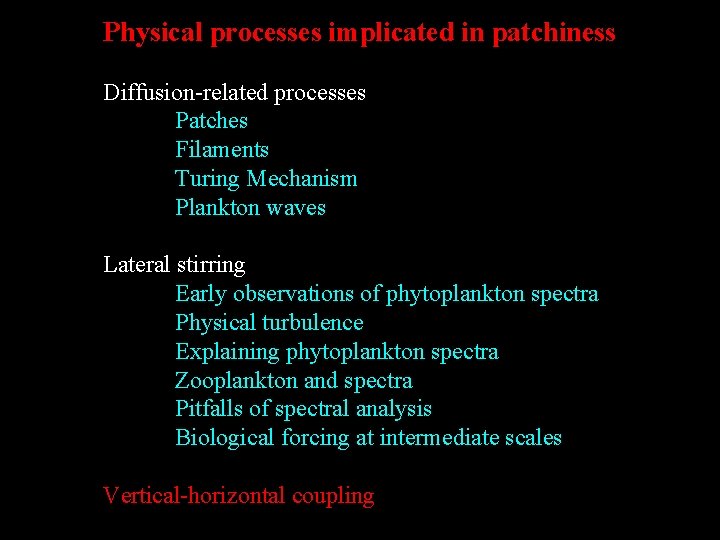
Physical processes implicated in patchiness Diffusion-related processes Patches Filaments Turing Mechanism Plankton waves Lateral stirring Early observations of phytoplankton spectra Physical turbulence Explaining phytoplankton spectra Zooplankton and spectra Pitfalls of spectral analysis Biological forcing at intermediate scales Vertical-horizontal coupling
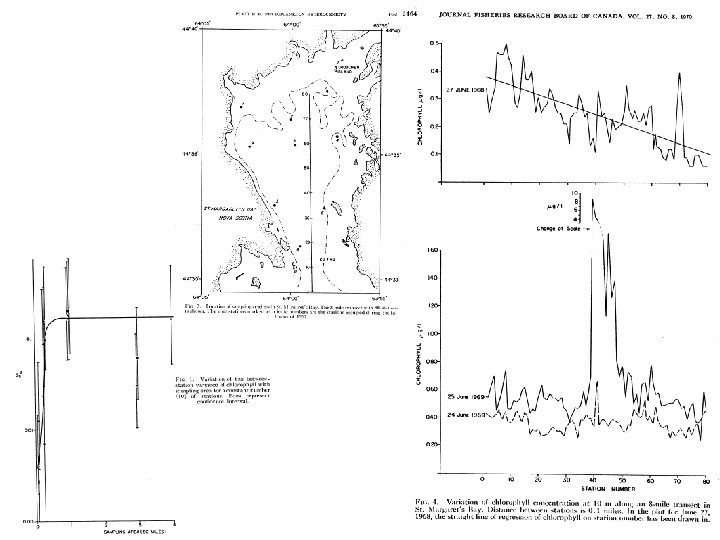
Platt, 1972 Powell et al. , 1975
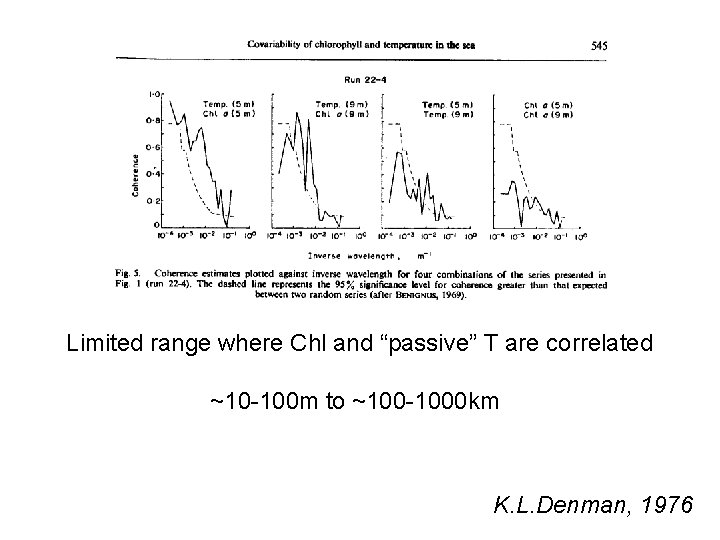
Limited range where Chl and “passive” T are correlated ~10 -100 m to ~100 -1000 km K. L. Denman, 1976
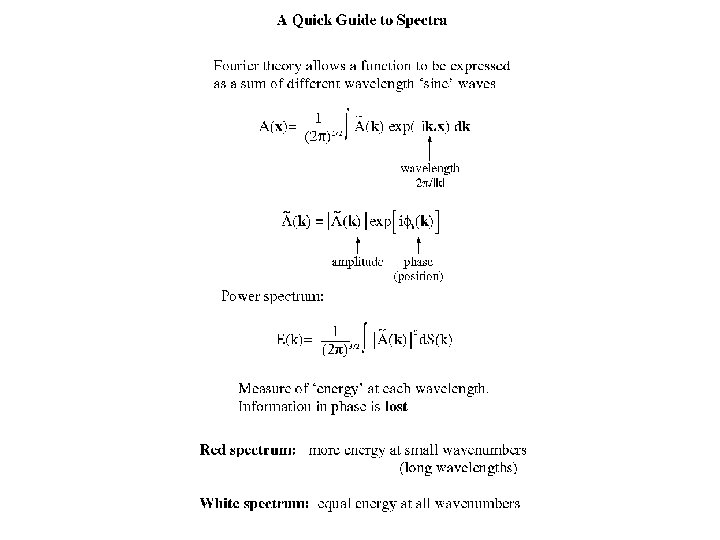
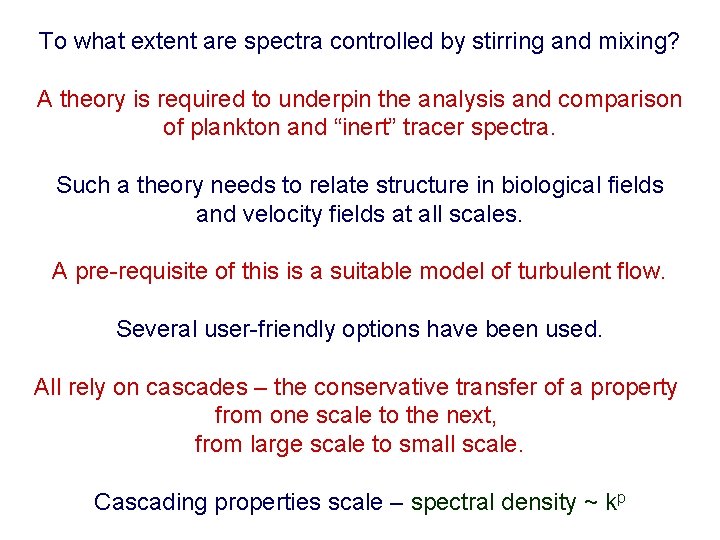
To what extent are spectra controlled by stirring and mixing? A theory is required to underpin the analysis and comparison of plankton and “inert” tracer spectra. Such a theory needs to relate structure in biological fields and velocity fields at all scales. A pre-requisite of this is a suitable model of turbulent flow. Several user-friendly options have been used. All rely on cascades – the conservative transfer of a property from one scale to the next, from large scale to small scale. Cascading properties scale – spectral density ~ kp
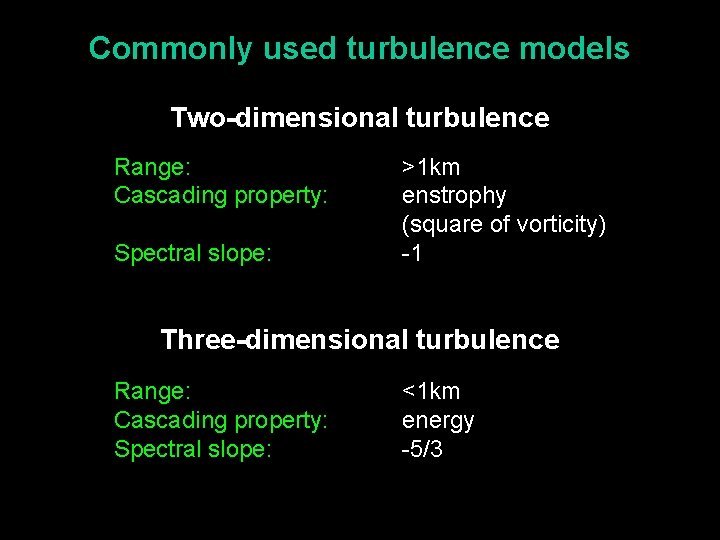
Commonly used turbulence models Two-dimensional turbulence Range: Cascading property: Spectral slope: >1 km enstrophy (square of vorticity) -1 Three-dimensional turbulence Range: Cascading property: Spectral slope: <1 km energy -5/3
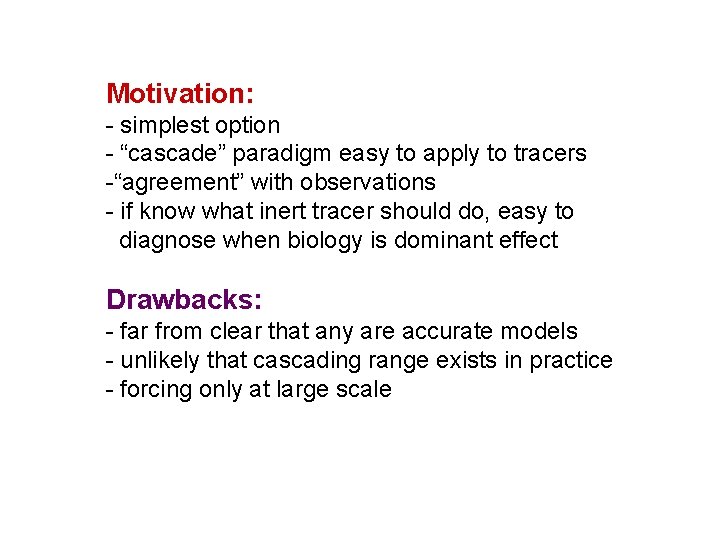
Motivation: - simplest option - “cascade” paradigm easy to apply to tracers -“agreement” with observations - if know what inert tracer should do, easy to diagnose when biology is dominant effect Drawbacks: - far from clear that any are accurate models - unlikely that cascading range exists in practice - forcing only at large scale
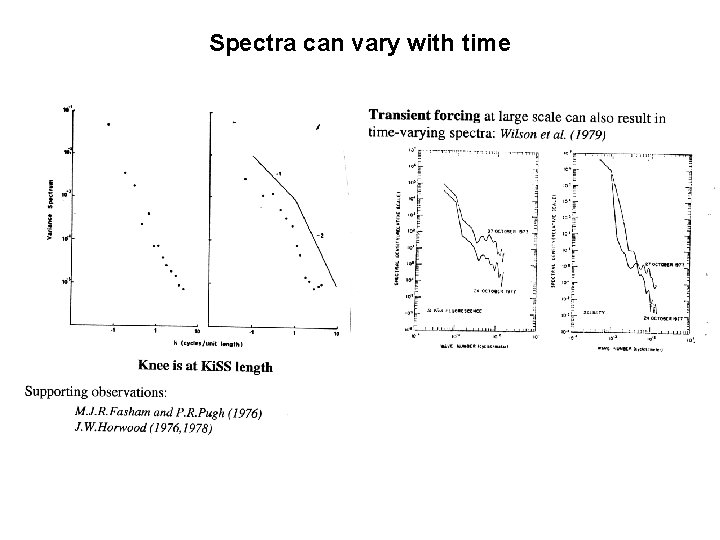
Critical scale kc~0. 2 -20 km Physically controlled at smaller scales Biologically controlled at larger scales Numerous independent derivations Corrsin, 1961 Denman and Platt, 1976 Denman et al. , 1977 Powell and Okubo, 1994 Different formulation for critical scale Fasham, 1978 kc= (m/k) Ki. SS scale
Spectra can vary with time
“…the fact that the spectra of these two variables [chlorophyll and temperature] have the same slope cannot be used to infer that the chlorophyll distribution is controlled physically rather than biologically. ” M. J. R. Fasham (1978)
“Passing just lately over this lake…I took up a little of it in a glass phial; and examining this water next day, I found… very many little animalcules. These animalcules had divers colours…and the motion of most of these animalcules was so swift, and so various upwards, downwards and round about that ‘twas wonderful to see. ” 7 September 1674 Antony von Leeuwenhoek, 1632 -1723
Hardy, 1955 “I once heard an eminent planktologist say that it did not do to arrange your stations too close together because it made it almost impossible to use contour methods when charting the results; I don’t think he realized the significance of what he was saying. ” “A marked patchiness was demonstrated for all animals occurring in sufficient numbers. ”
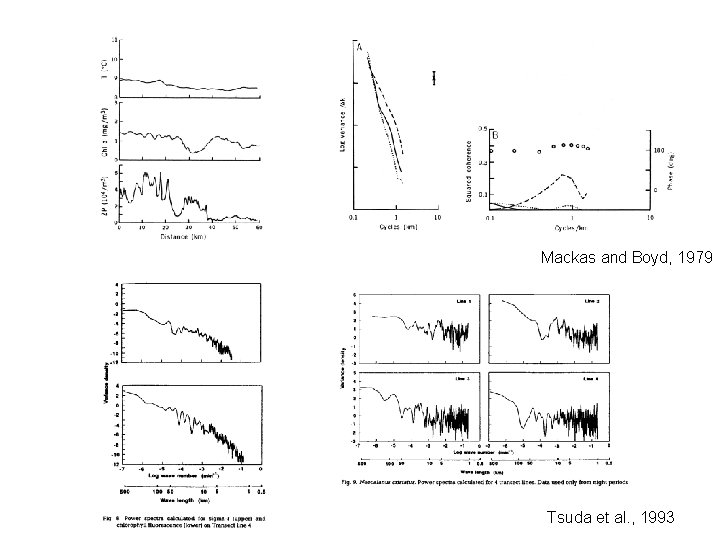
Mackas and Boyd, 1979 Tsuda et al. , 1993
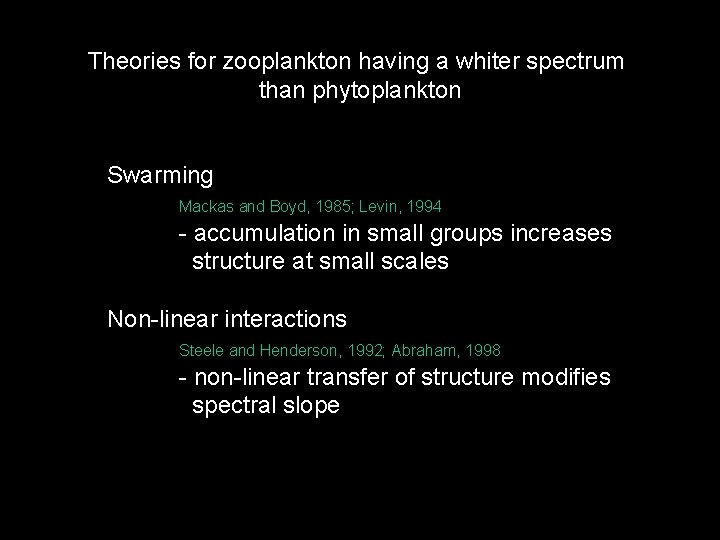
Theories for zooplankton having a whiter spectrum than phytoplankton Swarming Mackas and Boyd, 1985; Levin, 1994 - accumulation in small groups increases structure at small scales Non-linear interactions Steele and Henderson, 1992; Abraham, 1998 - non-linear transfer of structure modifies spectral slope
Powell and Okubo, 1994 Zooplankton and phytoplankton spectra the same. Slope relative to passive tracer is dependent on the turbulence model.
“Do any generalities emerge from our studies of the modifications that biological processes make to the patchiness imposed by solely physical processes? We answer no. ” “…one might also expect that several biological mechanisms might lead to the same (or very similar) spatial patterns in the plankton. ” Powell and Okubo, 1994
Denman and Platt, 1975
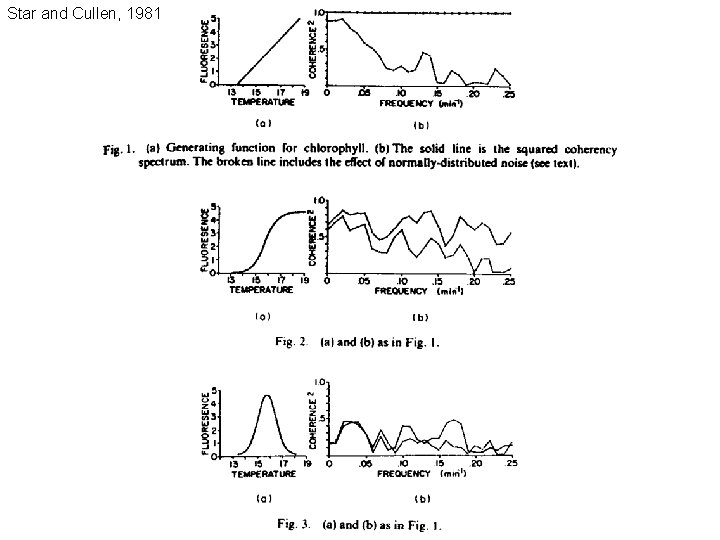
Star and Cullen, 1981
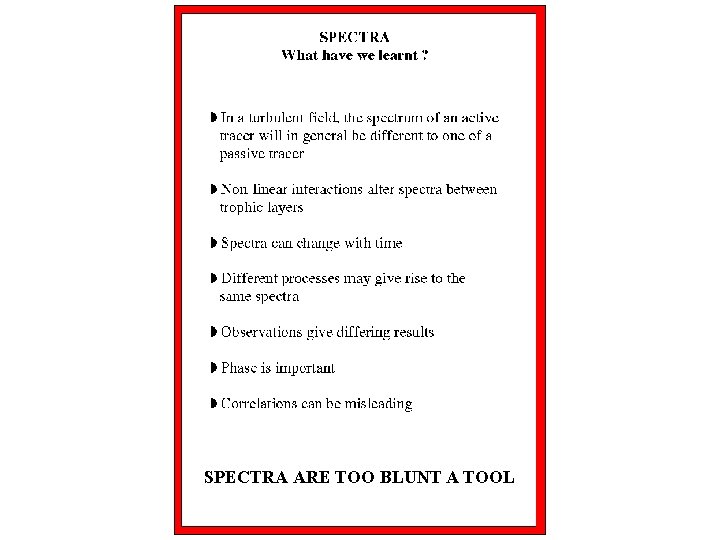
SPECTRA ARE TOO BLUNT A TOOL
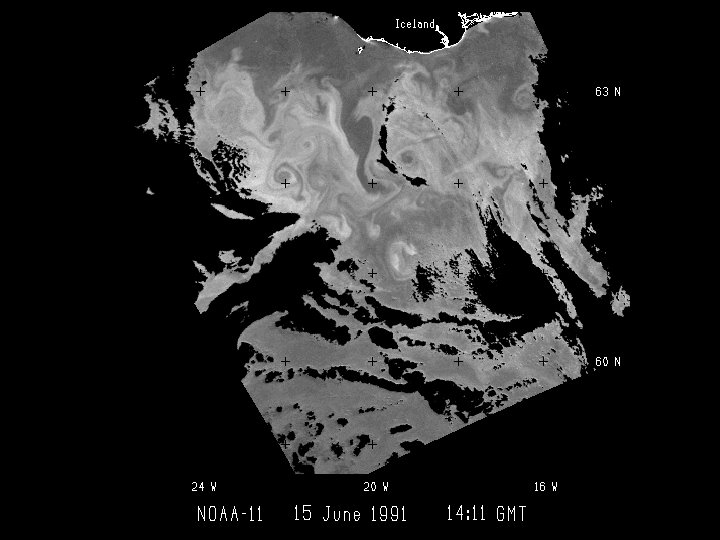
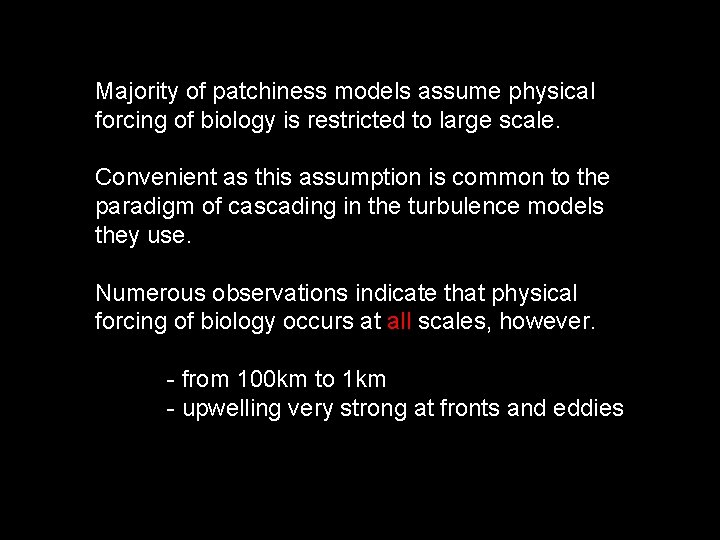
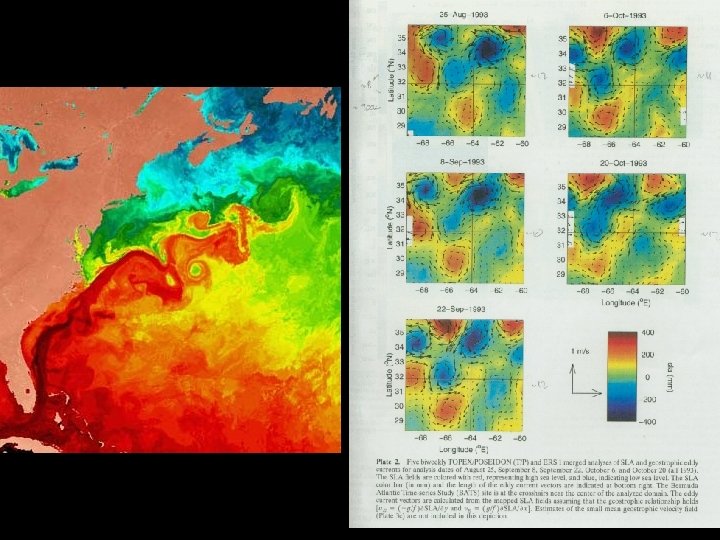
Majority of patchiness models assume physical forcing of biology is restricted to large scale. Convenient as this assumption is common to the paradigm of cascading in the turbulence models they use. Numerous observations indicate that physical forcing of biology occurs at all scales, however. - from 100 km to 1 km - upwelling very strong at fronts and eddies
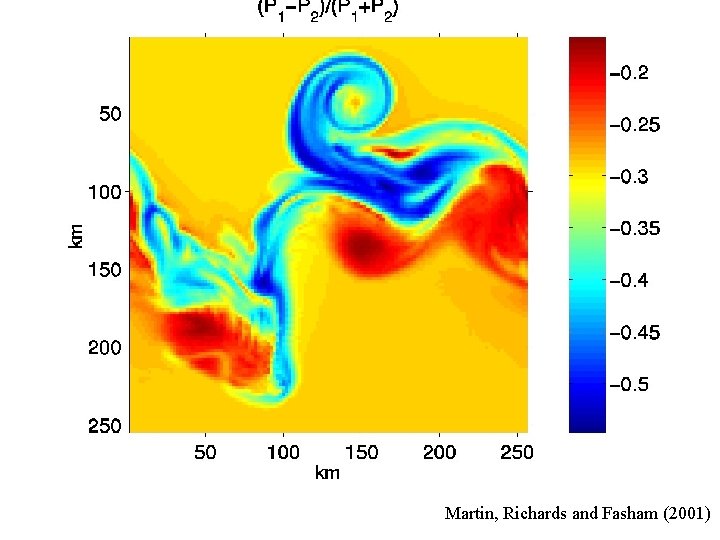
Martin, Richards and Fasham (2001)
“…clear evidence of a variance input at wavelengths between 15 and 35 km…”
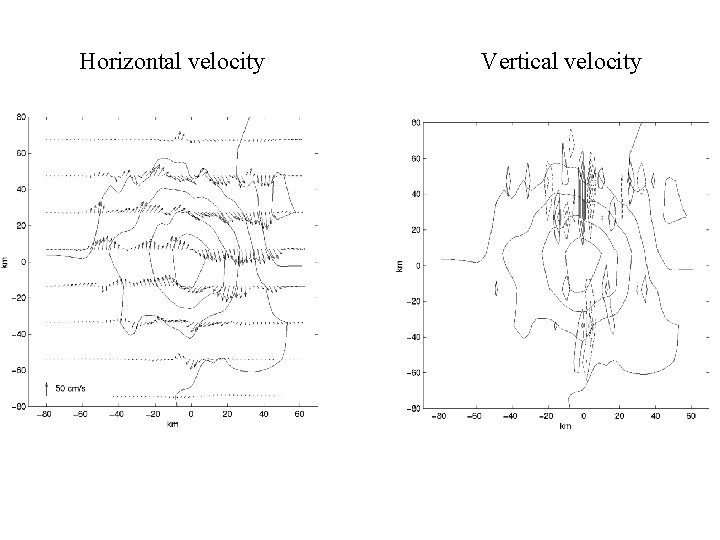
Horizontal velocity Vertical velocity Martin and Richards (2001)
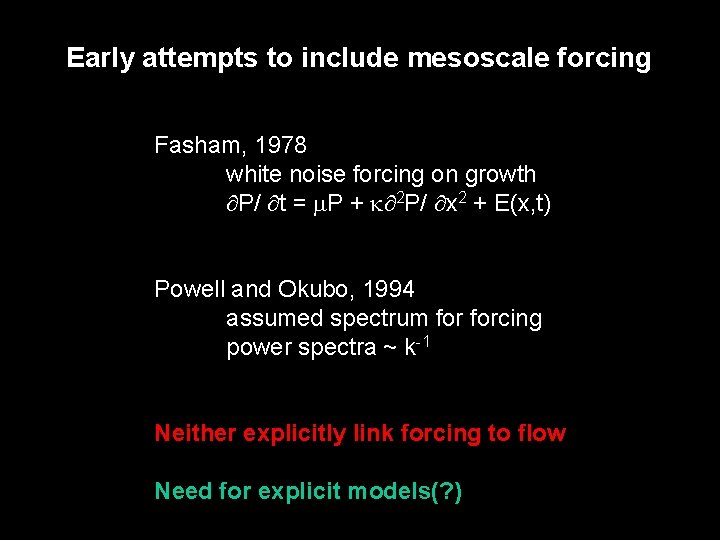
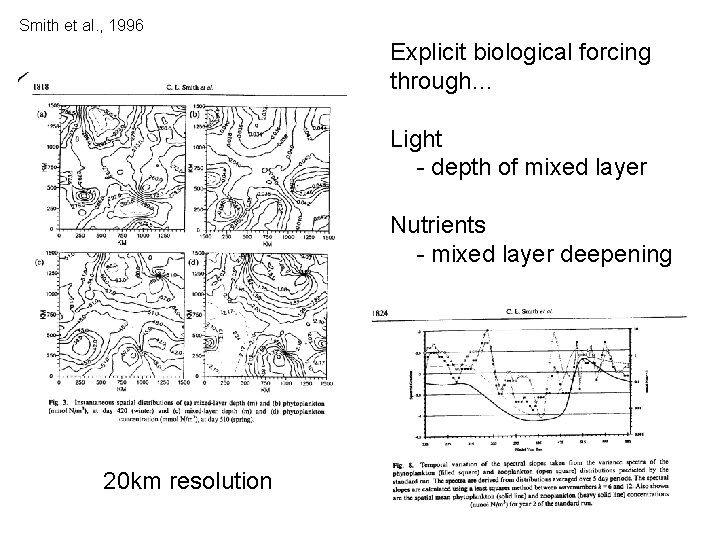
Early attempts to include mesoscale forcing Fasham, 1978 white noise forcing on growth P/ t = m. P + k 2 P/ x 2 + E(x, t) Powell and Okubo, 1994 assumed spectrum forcing power spectra ~ k-1 Neither explicitly link forcing to flow Need for explicit models(? )
Smith et al. , 1996 Explicit biological forcing through… Light - depth of mixed layer Nutrients - mixed layer deepening 20 km resolution
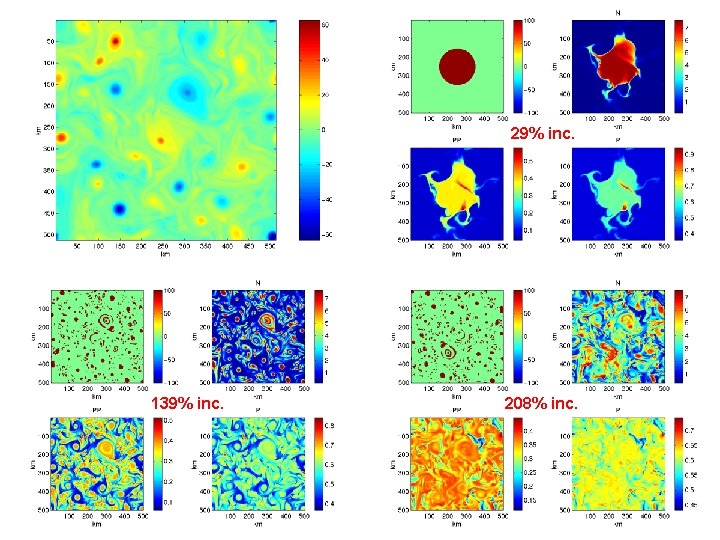
29% inc. 139% inc. 208% inc.
Physical processes implicated in patchiness Diffusion-related processes Patches Filaments Turing Mechanism Plankton waves Lateral stirring Early observations of phytoplankton spectra Physical turbulence Explaining phytoplankton spectra Zooplankton and spectra Pitfalls of spectral analysis Biological forcing at intermediate scales Vertical-horizontal coupling
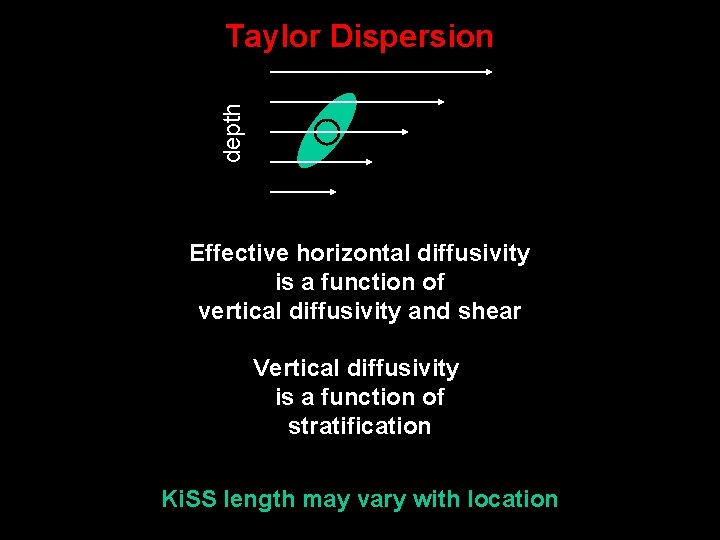
depth Taylor Dispersion Effective horizontal diffusivity is a function of vertical diffusivity and shear Vertical diffusivity is a function of stratification Ki. SS length may vary with location
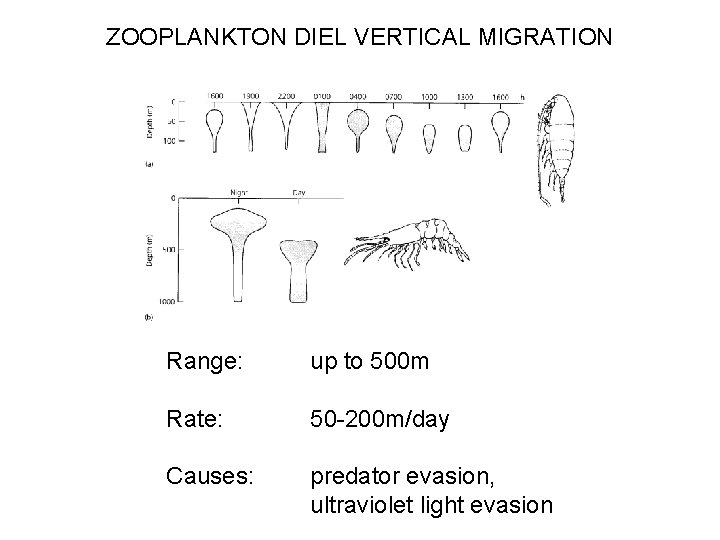
ZOOPLANKTON DIEL VERTICAL MIGRATION Range: up to 500 m Rate: 50 -200 m/day Causes: predator evasion, ultraviolet light evasion
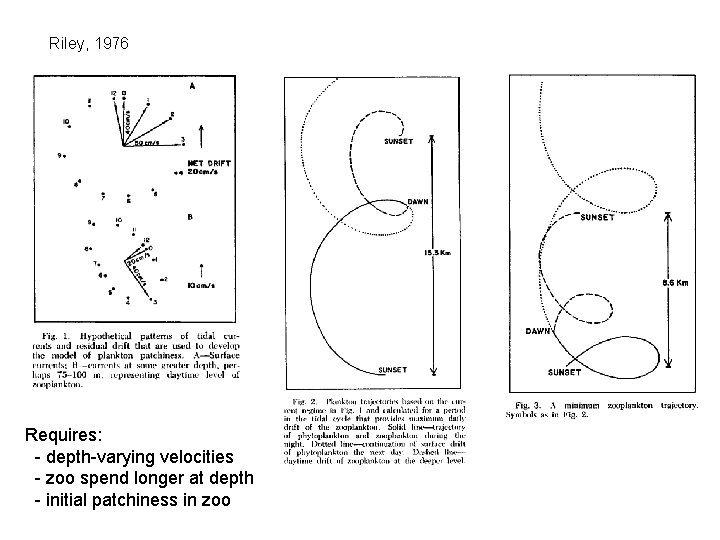
Riley, 1976 Requires: - depth-varying velocities - zoo spend longer at depth - initial patchiness in zoo
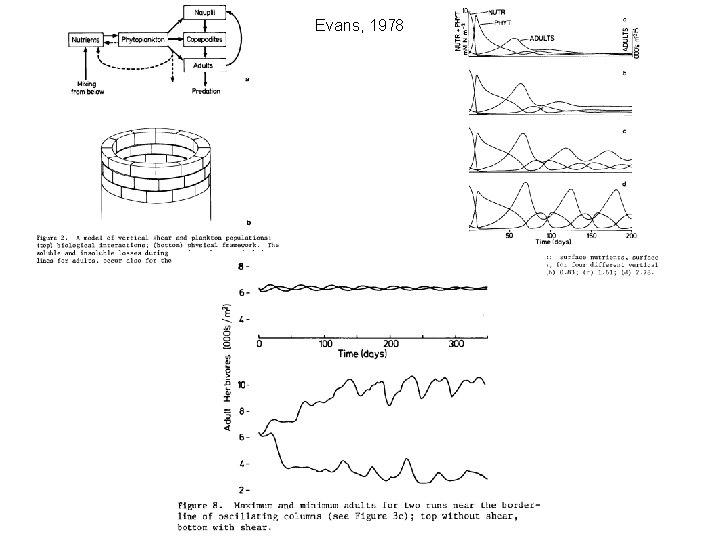
Evans, 1978
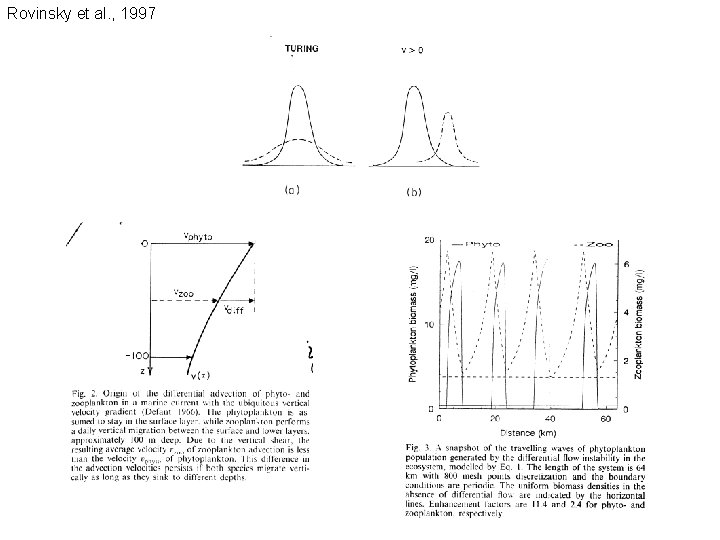
Rovinsky et al. , 1997
SUMMARY Huge range of ways stirring and mixing can interact with biological processes to produce plankton patchiness. Still no general, multiscale theory of patchiness, or concensus on whether one exists. Need for better observations to constrain models. Need for better techniques to analyse observations.