
Allophonic processes Kuiper and Allan Chapter 5 4

- Slides: 16
Allophonic processes Kuiper and Allan Chapter 5. 4
Some allophonic processes • aspiration – increasing your puff • assimilation – becoming like the neighbours • elision – getting lost • insertion – adding bits
IPA diacritics chart
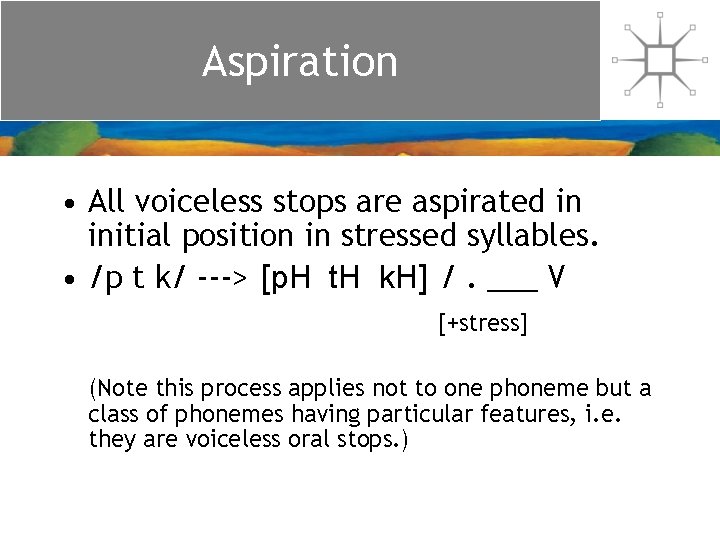
Aspiration • All voiceless stops are aspirated in initial position in stressed syllables. • /p t k/ ---> [p. H t. H k. H] /. ___ V [+stress] (Note this process applies not to one phoneme but a class of phonemes having particular features, i. e. they are voiceless oral stops. )
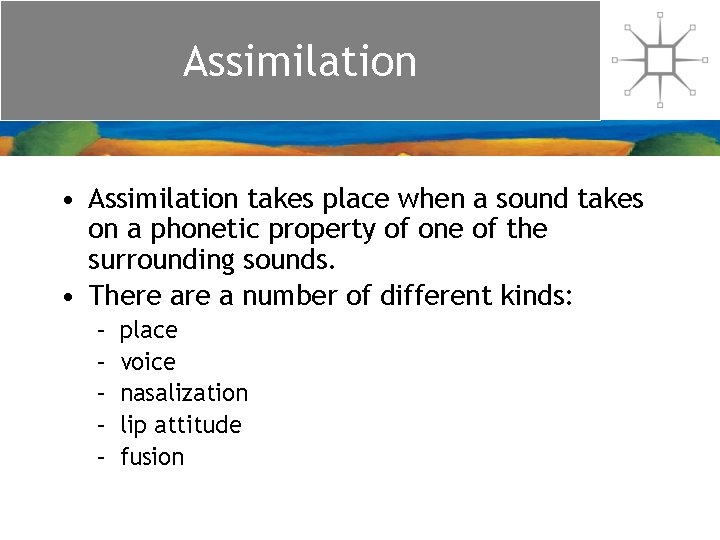
Assimilation • Assimilation takes place when a sound takes on a phonetic property of one of the surrounding sounds. • There a number of different kinds: – – – place voice nasalization lip attitude fusion
Direction of assimilation • progressive (or perseverative) – A sound segment takes on a phonetic property of a sound segment coming before it. • regressive (or anticipatory) – A sound segment takes on a phonetic property of a sound segment coming after it.
Place assimilation • How do you normally pronounce uncomfortable? – – Note that the /n/ is pronounced [N]. Its place of articulation is velar. Why? Because the following consonant is velar. The nasal consonant has assimilated its place of articulation.
Exercise How is the final consonant pronounced in the following words? hurts heads looks lags Is it voiced or voiceless? Why?
Voicing assimilation • Sound segments can take on the voicing characteristics of their neighbours. – voicing • cads – devoicing • crush
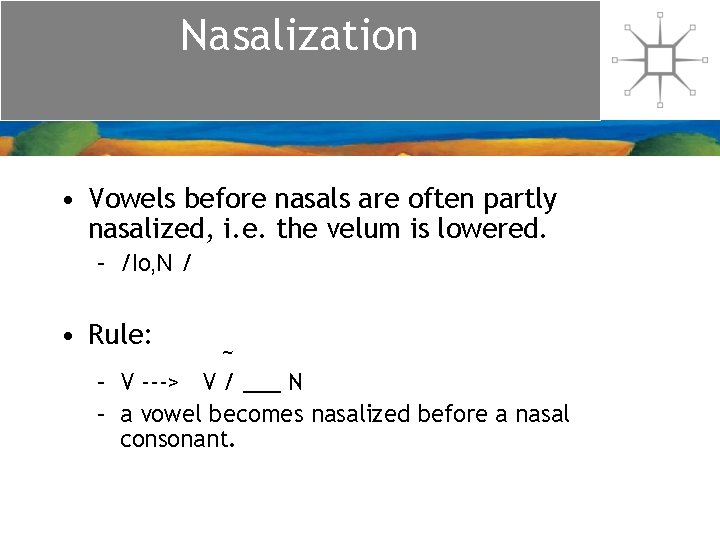
Nasalization • Vowels before nasals are often partly nasalized, i. e. the velum is lowered. – /lo‚N / • Rule: ~ – V ---> V / ___ N – a vowel becomes nasalized before a nasal consonant.
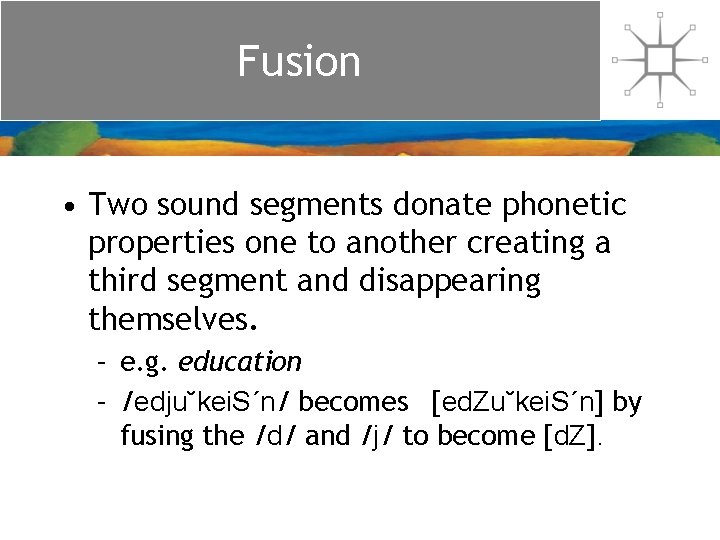
Fusion • Two sound segments donate phonetic properties one to another creating a third segment and disappearing themselves. – e. g. education – /edju˘kei. S´n/ becomes [ed. Zu˘kei. S´n] by fusing the /d/ and /j/ to become [d. Z].
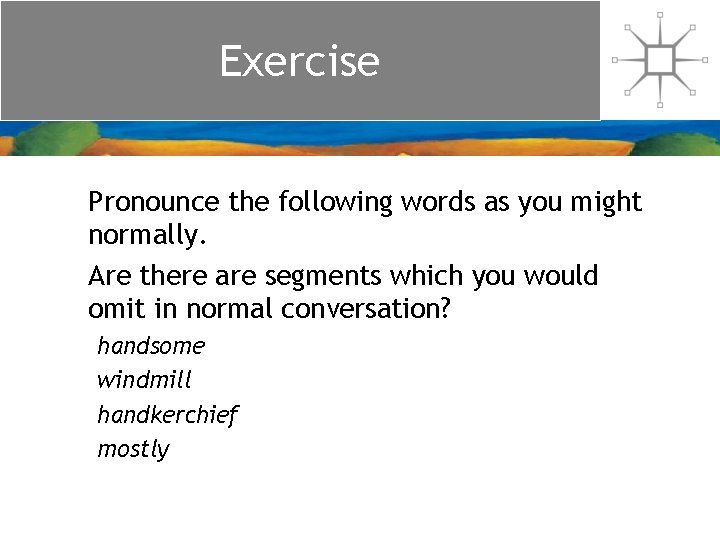
Exercise Pronounce the following words as you might normally. Are there are segments which you would omit in normal conversation? handsome windmill handkerchief mostly
Elision • In connected speech whole sound segments (both consonants and vowels) may be elided.
Exercise How might children pronounce the following words? athlete film
Insertion (epenthesis) • Into some sound sequences speakers may insert a vowel or consonant.
Summary • There can be a considerable distance between the underlying phonological representation of a word and how it is realized in speech. • Many processes may be involved.