Physics 319 Classical Mechanics G A Krafft Old
- Slides: 16
Physics 319 Classical Mechanics G. A. Krafft Old Dominion University Jefferson Lab Lecture 10 Undergraduate Classical Mechanics Spring 2017
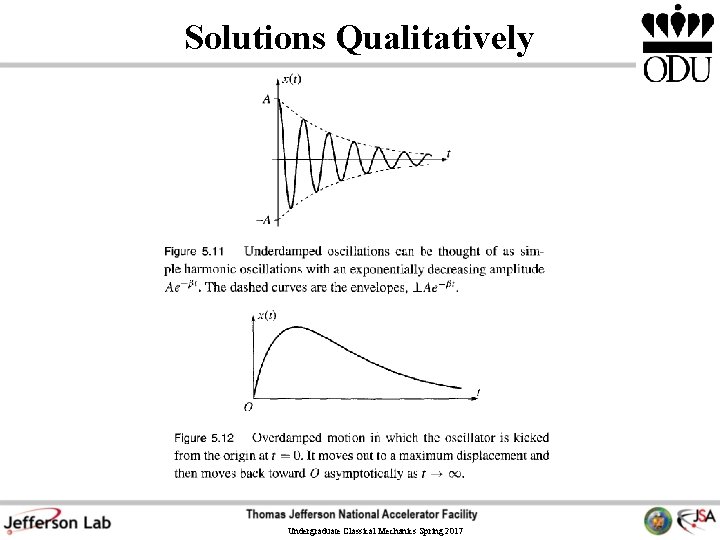
Solutions Qualitatively Undergraduate Classical Mechanics Spring 2017
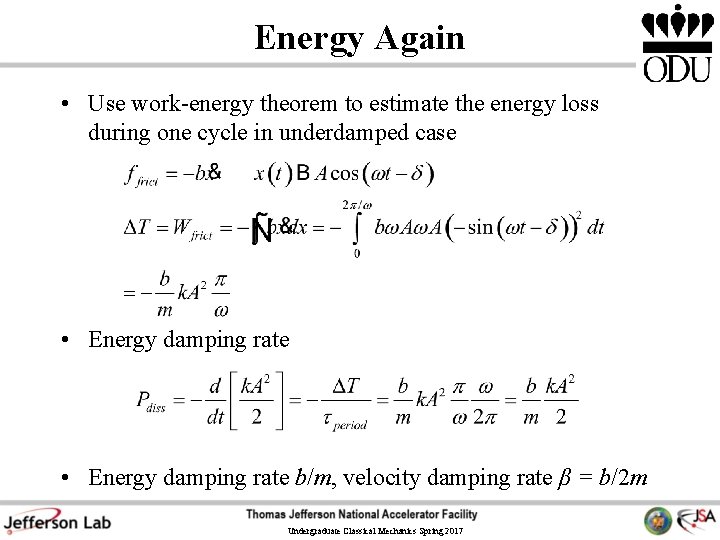
Energy Again • Use work-energy theorem to estimate the energy loss during one cycle in underdamped case • Energy damping rate b/m, velocity damping rate β = b/2 m Undergraduate Classical Mechanics Spring 2017
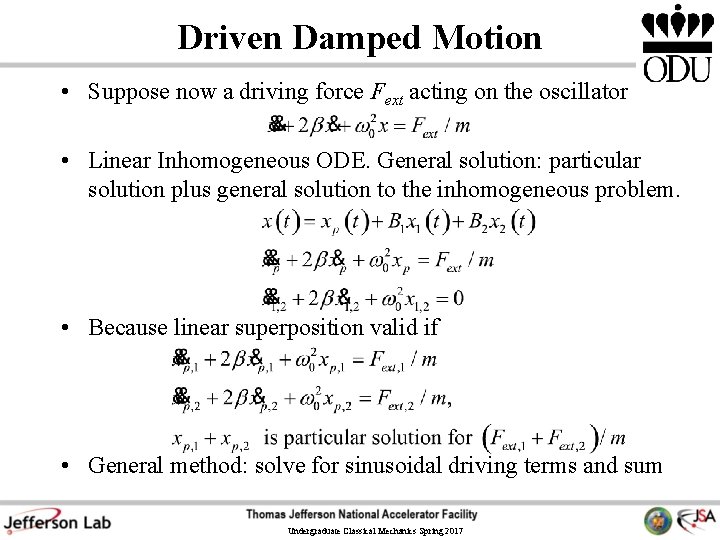
Driven Damped Motion • Suppose now a driving force Fext acting on the oscillator • Linear Inhomogeneous ODE. General solution: particular solution plus general solution to the inhomogeneous problem. • Because linear superposition valid if • General method: solve for sinusoidal driving terms and sum Undergraduate Classical Mechanics Spring 2017
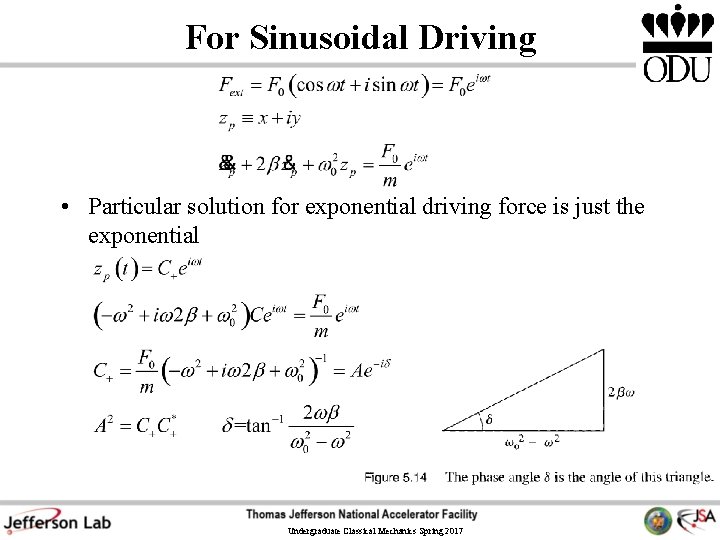
For Sinusoidal Driving • Particular solution for exponential driving force is just the exponential Undergraduate Classical Mechanics Spring 2017
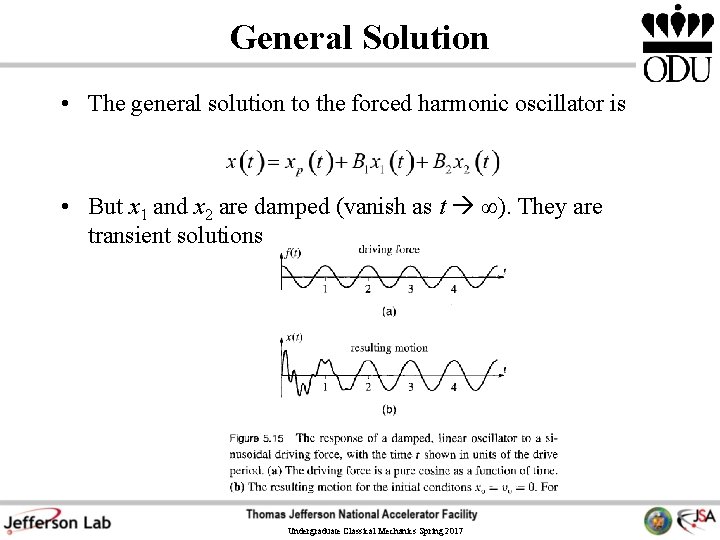
General Solution • The general solution to the forced harmonic oscillator is • But x 1 and x 2 are damped (vanish as t ∞). They are transient solutions Undergraduate Classical Mechanics Spring 2017
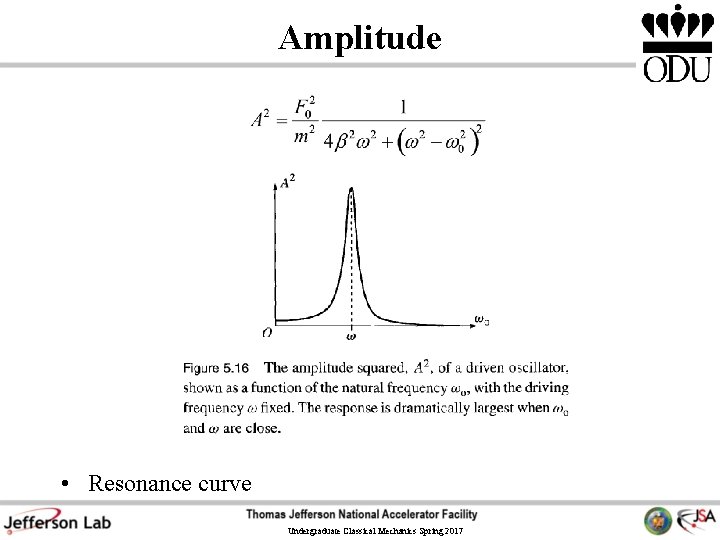
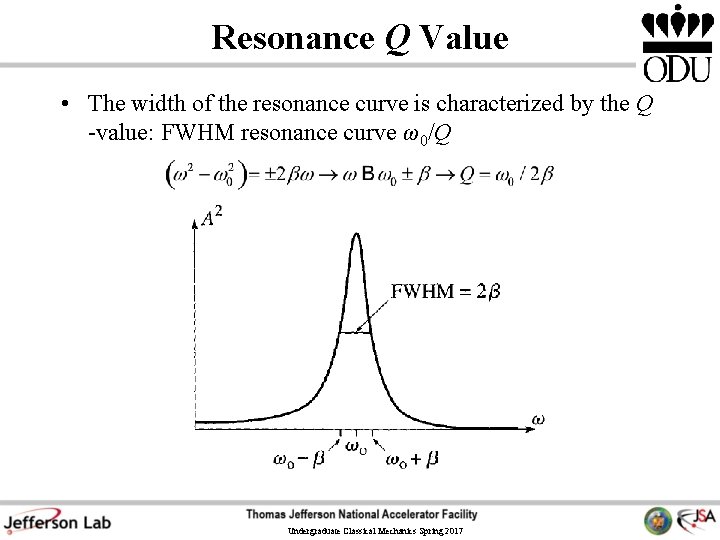
Amplitude • Resonance curve Undergraduate Classical Mechanics Spring 2017
Resonance Q Value • The width of the resonance curve is characterized by the Q -value: FWHM resonance curve ω0/Q Undergraduate Classical Mechanics Spring 2017
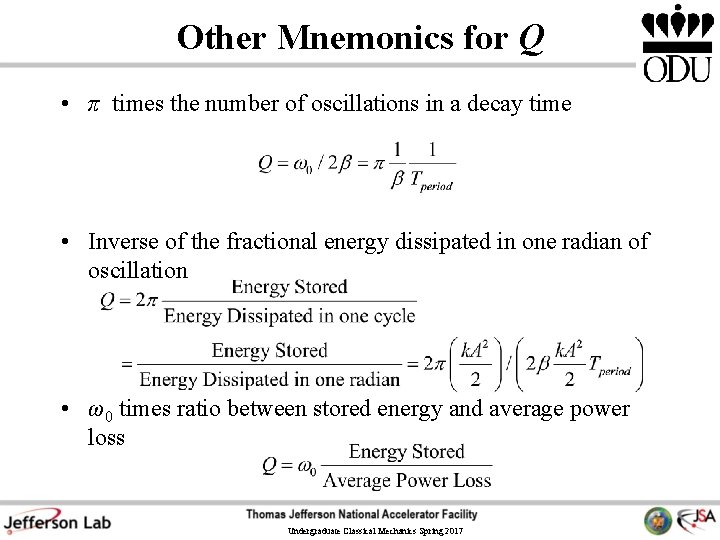
Other Mnemonics for Q • π times the number of oscillations in a decay time • Inverse of the fractional energy dissipated in one radian of oscillation • ω0 times ratio between stored energy and average power loss Undergraduate Classical Mechanics Spring 2017
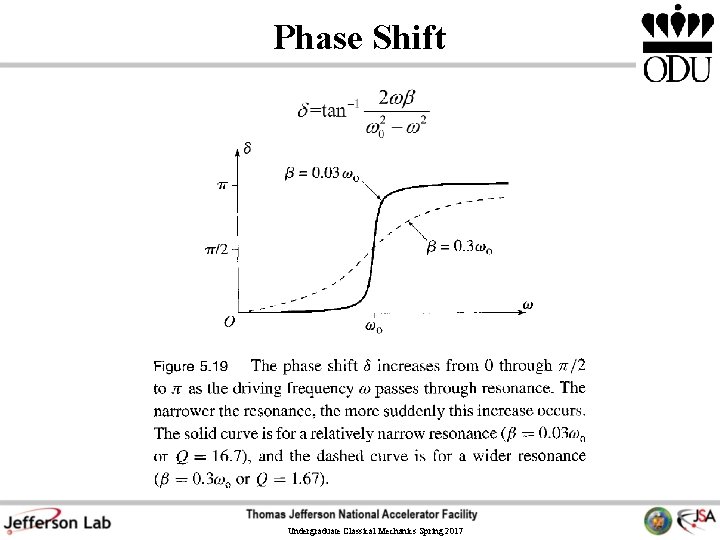
Phase Shift Undergraduate Classical Mechanics Spring 2017
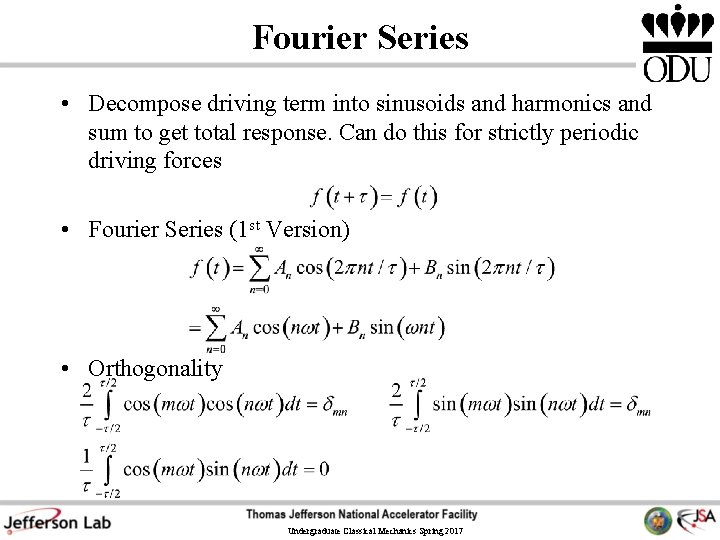
Fourier Series • Decompose driving term into sinusoids and harmonics and sum to get total response. Can do this for strictly periodic driving forces • Fourier Series (1 st Version) • Orthogonality Undergraduate Classical Mechanics Spring 2017
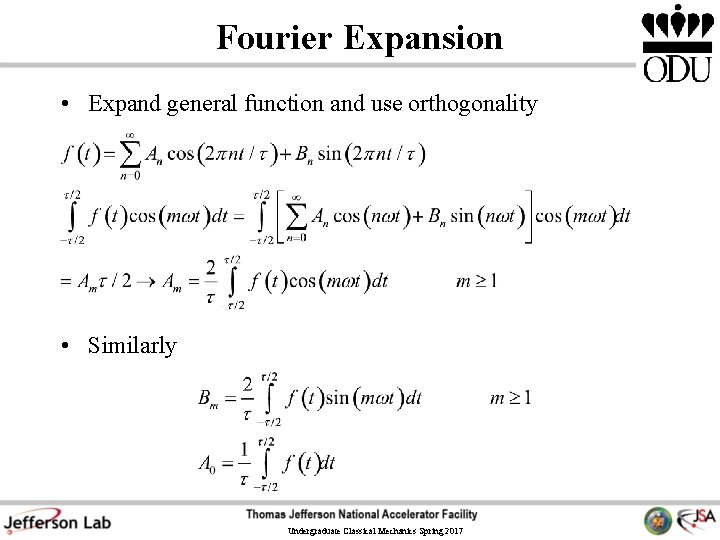
Fourier Expansion • Expand general function and use orthogonality • Similarly Undergraduate Classical Mechanics Spring 2017
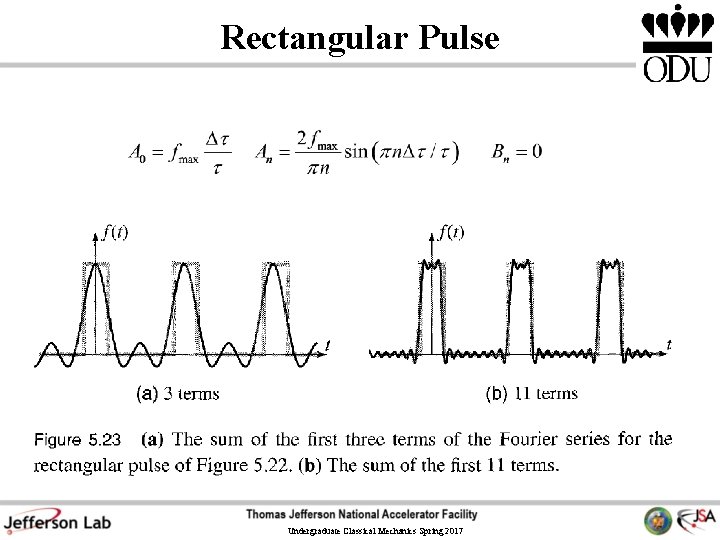
Rectangular Pulse Undergraduate Classical Mechanics Spring 2017
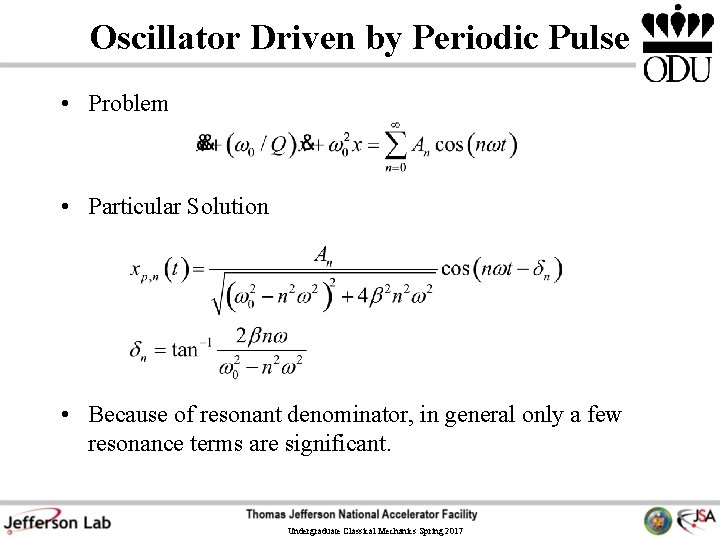
Oscillator Driven by Periodic Pulse • Problem • Particular Solution • Because of resonant denominator, in general only a few resonance terms are significant. Undergraduate Classical Mechanics Spring 2017
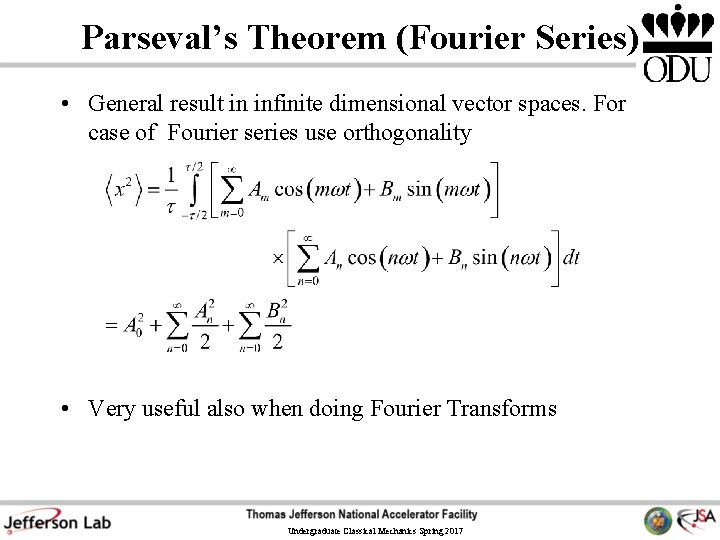
Parseval’s Theorem (Fourier Series) • General result in infinite dimensional vector spaces. For case of Fourier series use orthogonality • Very useful also when doing Fourier Transforms Undergraduate Classical Mechanics Spring 2017
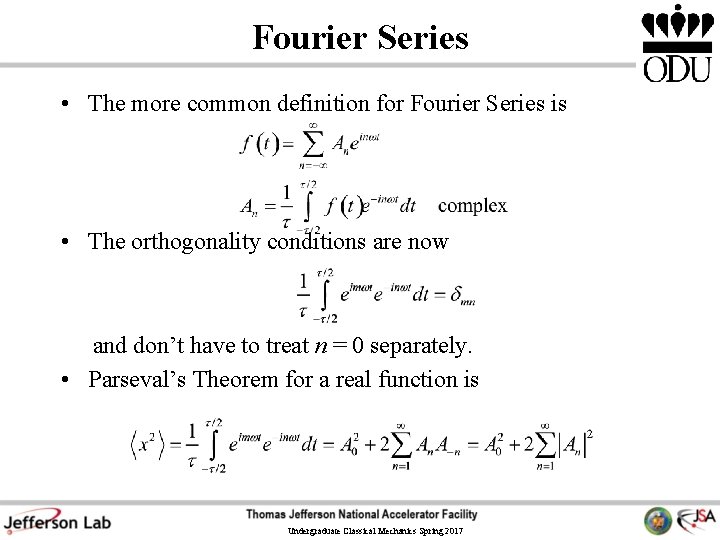
Fourier Series • The more common definition for Fourier Series is • The orthogonality conditions are now and don’t have to treat n = 0 separately. • Parseval’s Theorem for a real function is Undergraduate Classical Mechanics Spring 2017