
Physics 604 Electromagnetic Theory I G A Krafft
- Slides: 11
Physics 604 Electromagnetic Theory I G. A. Krafft Jefferson Lab Professor of Physics Old Dominion University 09 -02 -10 Physics 604 Electromagnetic Theory I
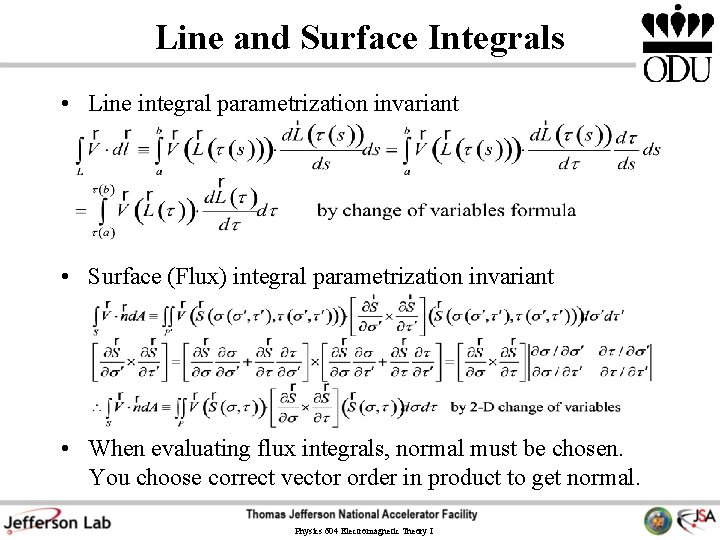
Line and Surface Integrals • Line integral parametrization invariant • Surface (Flux) integral parametrization invariant • When evaluating flux integrals, normal must be chosen. You choose correct vector order in product to get normal. Physics 604 Electromagnetic Theory I
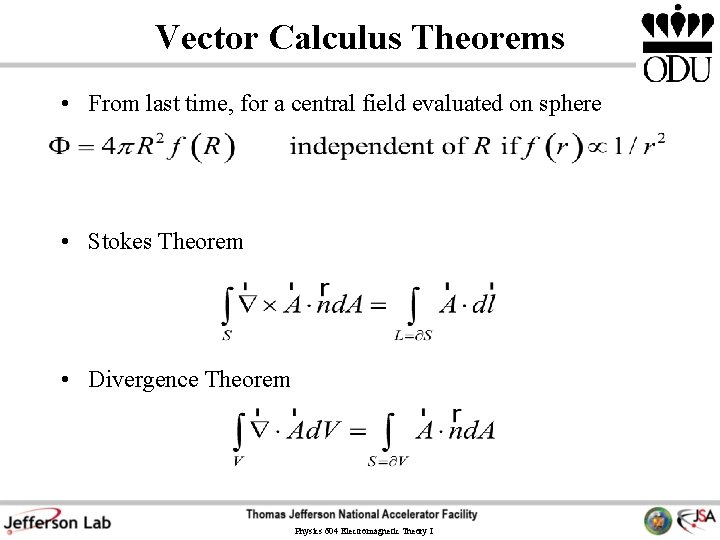
Vector Calculus Theorems • From last time, for a central field evaluated on sphere • Stokes Theorem • Divergence Theorem Physics 604 Electromagnetic Theory I
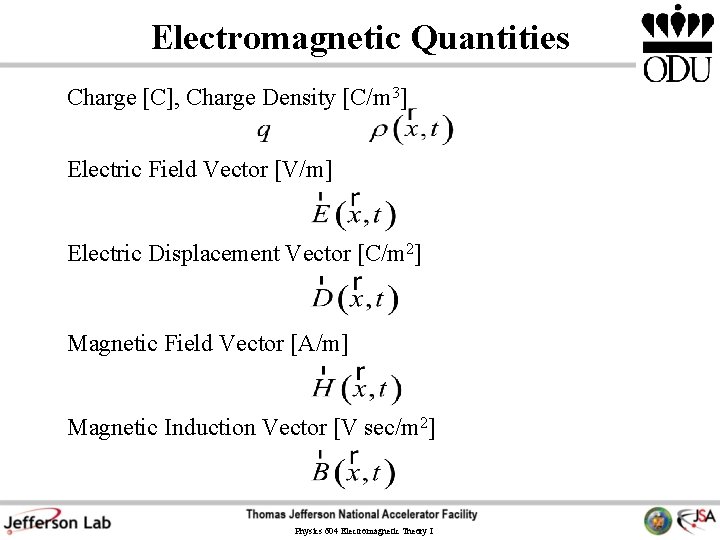
Electromagnetic Quantities Charge [C], Charge Density [C/m 3] Electric Field Vector [V/m] Electric Displacement Vector [C/m 2] Magnetic Field Vector [A/m] Magnetic Induction Vector [V sec/m 2] Physics 604 Electromagnetic Theory I
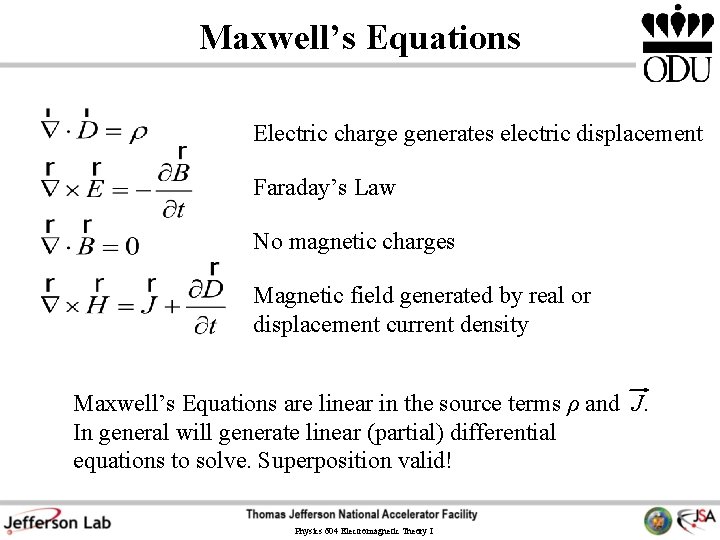
Maxwell’s Equations Electric charge generates electric displacement Faraday’s Law No magnetic charges Magnetic field generated by real or displacement current density Maxwell’s Equations are linear in the source terms ρ and J. In general will generate linear (partial) differential equations to solve. Superposition valid! Physics 604 Electromagnetic Theory I
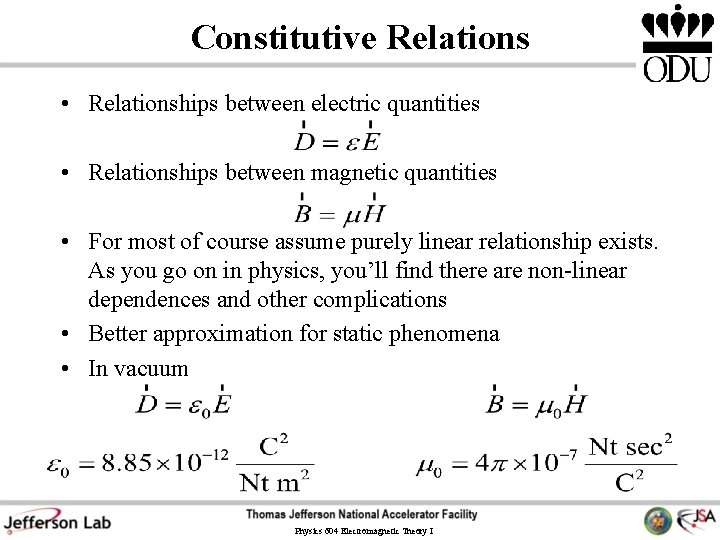
Constitutive Relations • Relationships between electric quantities • Relationships between magnetic quantities • For most of course assume purely linear relationship exists. As you go on in physics, you’ll find there are non-linear dependences and other complications • Better approximation for static phenomena • In vacuum Physics 604 Electromagnetic Theory I
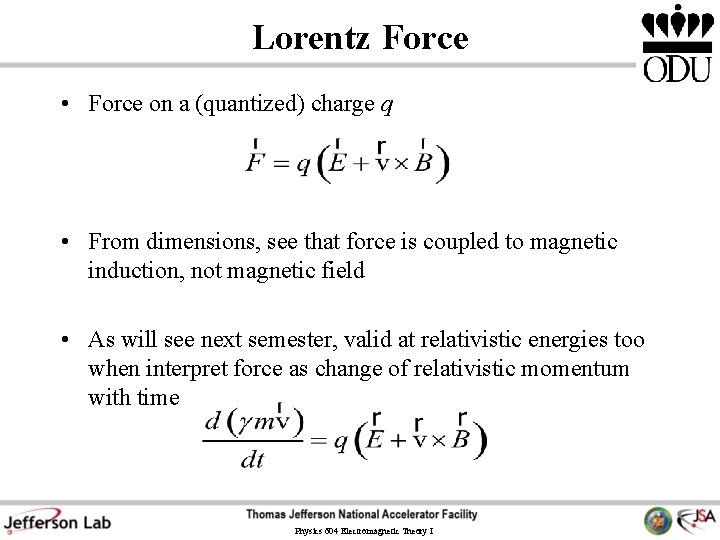
Lorentz Force • Force on a (quantized) charge q • From dimensions, see that force is coupled to magnetic induction, not magnetic field • As will see next semester, valid at relativistic energies too when interpret force as change of relativistic momentum with time Physics 604 Electromagnetic Theory I
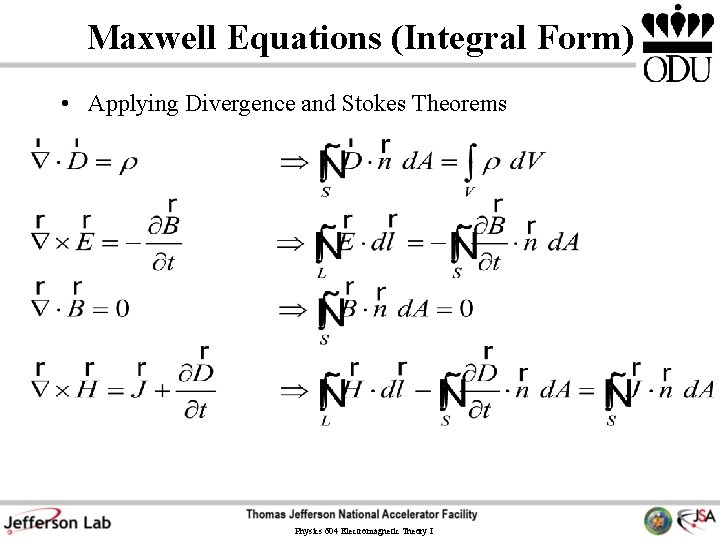
Maxwell Equations (Integral Form) • Applying Divergence and Stokes Theorems Physics 604 Electromagnetic Theory I
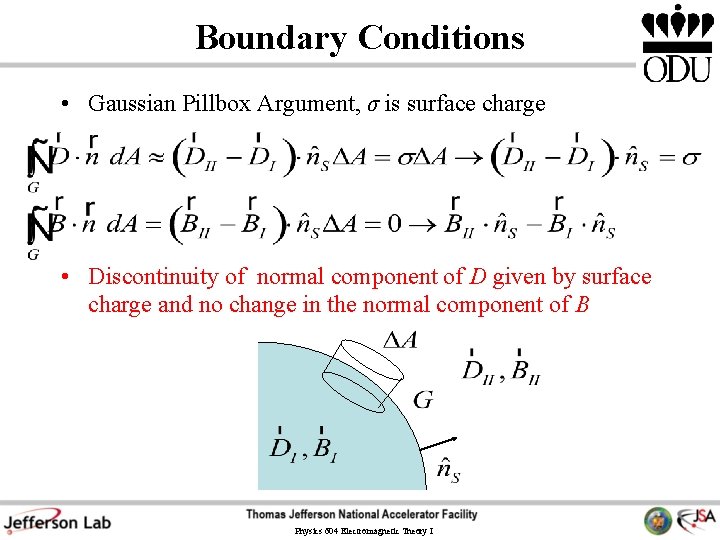
Boundary Conditions • Gaussian Pillbox Argument, σ is surface charge • Discontinuity of normal component of D given by surface charge and no change in the normal component of B Physics 604 Electromagnetic Theory I
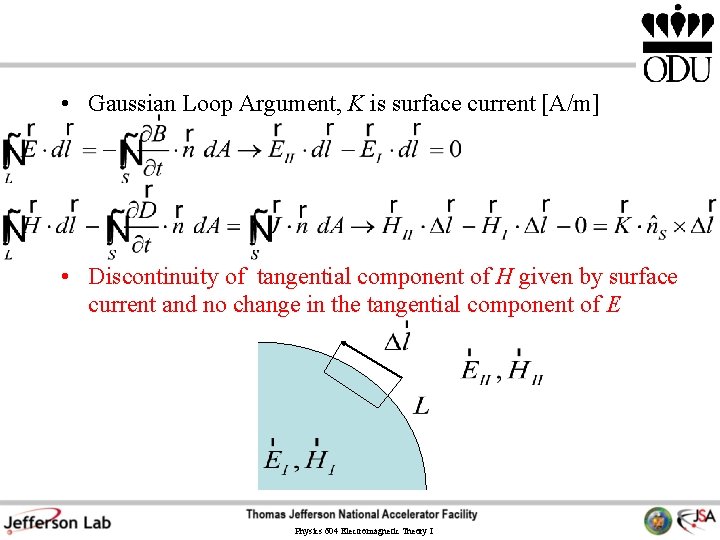
• Gaussian Loop Argument, K is surface current [A/m] • Discontinuity of tangential component of H given by surface current and no change in the tangential component of E Physics 604 Electromagnetic Theory I
• Maxwell Equations plus the boundary conditions provide a complete description of all classical electromagnetic phenomena • Given source functions and constitutive relations these equations have unique solutions • The rest of the course consists of learning methods found useful in finding solutions analytically • A wide variety of numerical solutions exist; we want you to be able to understand the solutions that you derive from codes in your future working life! Physics 604 Electromagnetic Theory I