
Physics 604 Electromagnetic Theory I G A Krafft
- Slides: 6
Physics 604 Electromagnetic Theory I G. A. Krafft Jefferson Lab Professor of Physics Old Dominion University 08 -31 -10 Physics 604 Electromagnetic Theory I
Classical Electrodynamics • A main physics discovery of the last half of the 20 th century is that electrodynamics is a part of an overarching quantum theory of nature called the standard model • In the standard model, electromagnetism is closely linked with the weak interaction force, through the so-called electroweak unification, in a non-Abelian gauge theory that relies on and utilizes the usual phase invariance of quantum mechanics • As part of the standard model, electromagnetic forces are distinguished in that they couple to electric charge, and they are long (∞ ? ) range because to the best of present knowledge, the photon (EM force carrier) is (nearly? ) massless • This fact “explains” their prevalence in our day-to-day life Physics 604 Electromagnetic Theory I
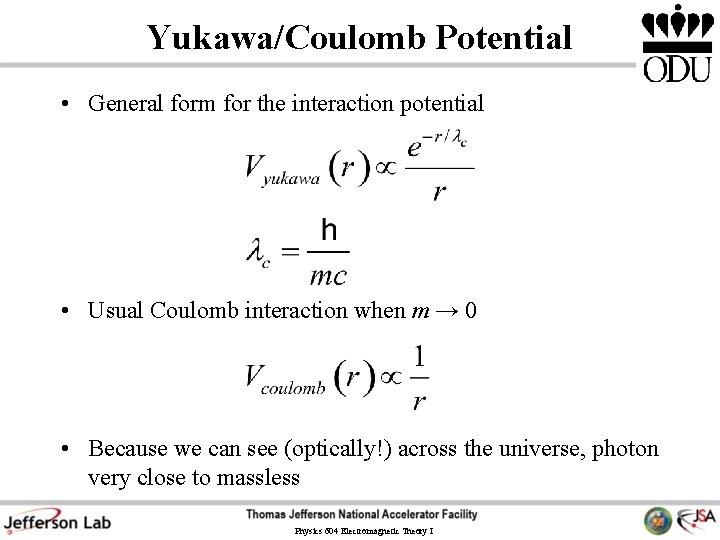
Yukawa/Coulomb Potential • General form for the interaction potential • Usual Coulomb interaction when m → 0 • Because we can see (optically!) across the universe, photon very close to massless Physics 604 Electromagnetic Theory I
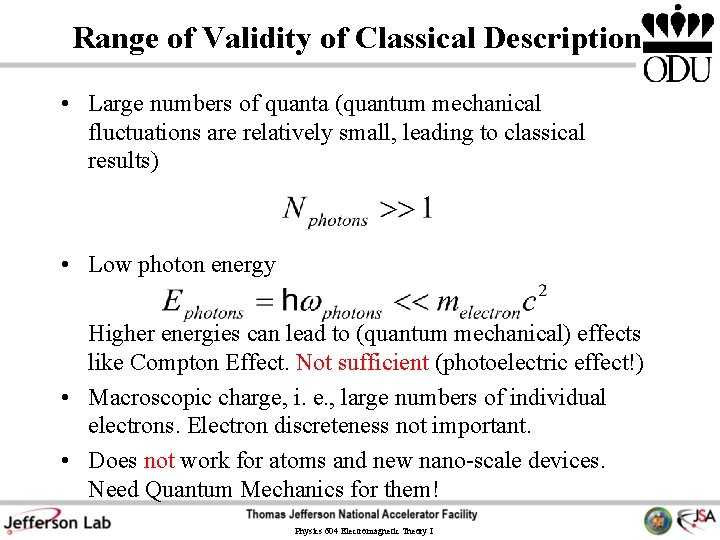
Range of Validity of Classical Description • Large numbers of quanta (quantum mechanical fluctuations are relatively small, leading to classical results) • Low photon energy Higher energies can lead to (quantum mechanical) effects like Compton Effect. Not sufficient (photoelectric effect!) • Macroscopic charge, i. e. , large numbers of individual electrons. Electron discreteness not important. • Does not work for atoms and new nano-scale devices. Need Quantum Mechanics for them! Physics 604 Electromagnetic Theory I
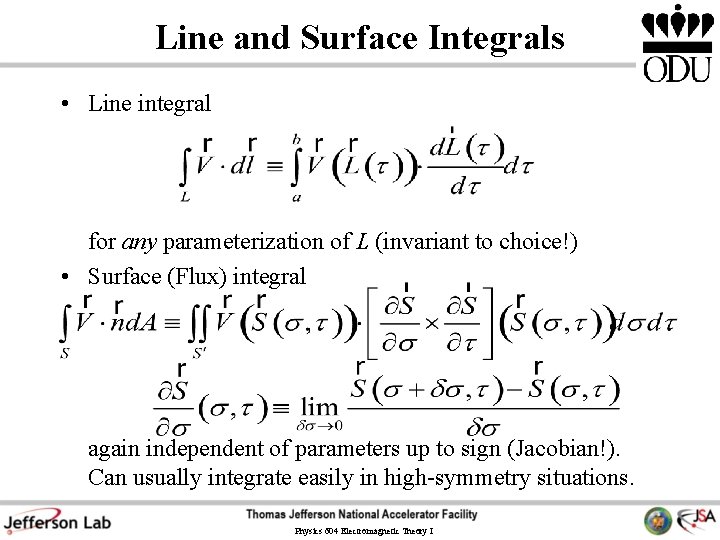
Line and Surface Integrals • Line integral for any parameterization of L (invariant to choice!) • Surface (Flux) integral again independent of parameters up to sign (Jacobian!). Can usually integrate easily in high-symmetry situations. Physics 604 Electromagnetic Theory I
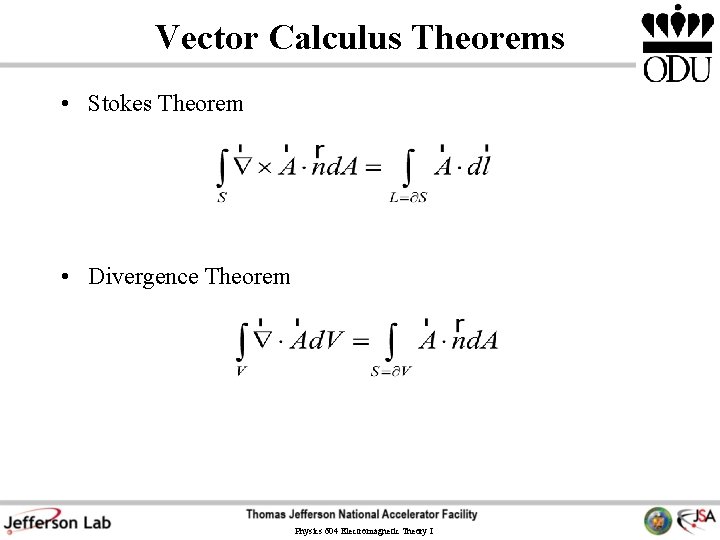
Vector Calculus Theorems • Stokes Theorem • Divergence Theorem Physics 604 Electromagnetic Theory I