PHENIX Perspectives for the RHIC Energy Scan Ralf

- Slides: 23
PHENIX Perspectives for the RHIC Energy Scan Ralf Averbeck, GSI Helmholtzzentrum für Schwerionenforschung Gmb. H for the Collaboration Symposium on "The Physics of Dense Baryonic Matter" GSI, Darmstadt, March 9 -10, 2009 l Introduction l Search for the QCD Critical Point l Search for the Onset of s. QGP Production l Summary and Outlook
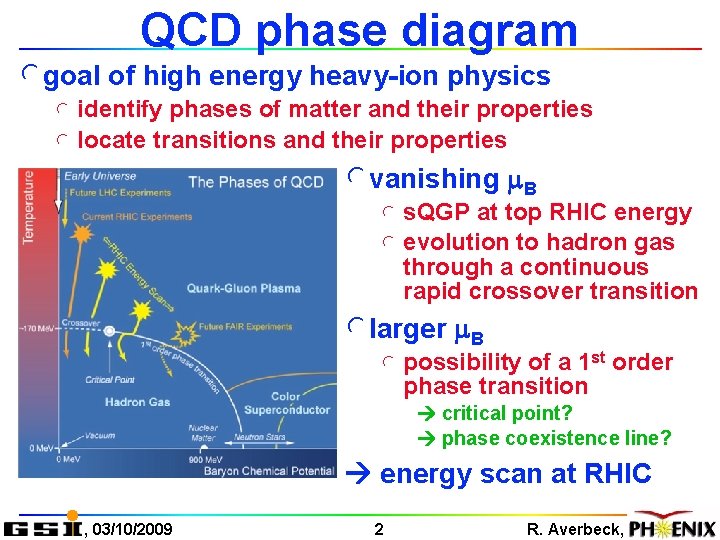
QCD phase diagram lgoal of high energy heavy-ion physics l identify phases of matter and their properties l locate transitions and their properties lvanishing m. B l s. QGP at top RHIC energy l evolution to hadron gas through a continuous rapid crossover transition llarger m. B l possibility of a 1 st order phase transition critical point? phase coexistence line? energy scan at RHIC , 03/10/2009 2 R. Averbeck,
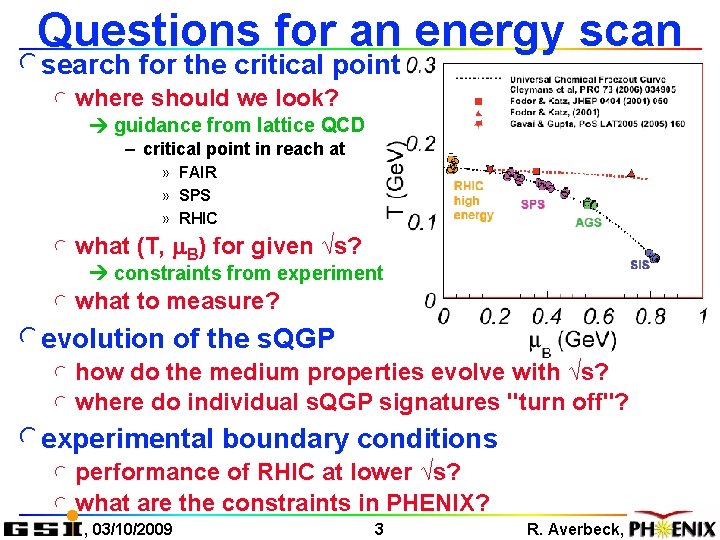
Questions for an energy scan lsearch for the critical point l where should we look? guidance from lattice QCD – critical point in reach at » FAIR » SPS » RHIC l what (T, m. B) for given √s? constraints from experiment l what to measure? levolution of the s. QGP l how do the medium properties evolve with √s? l where do individual s. QGP signatures "turn off"? lexperimental boundary conditions l performance of RHIC at lower √s? l what are the constraints in PHENIX? , 03/10/2009 3 R. Averbeck,
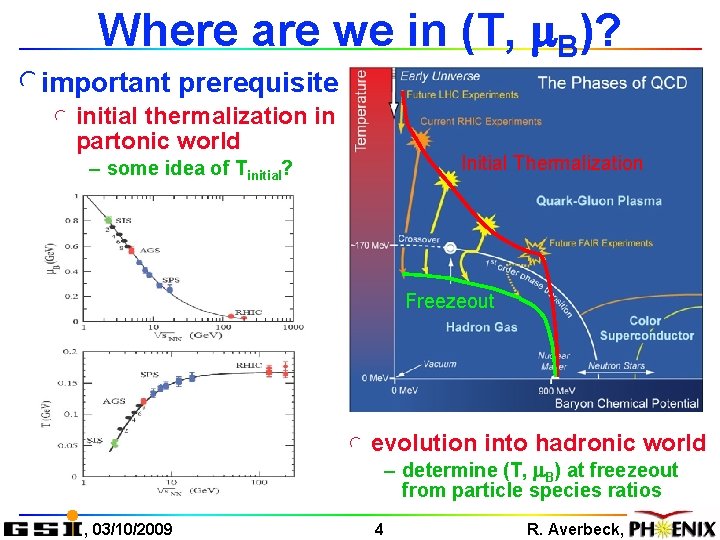
Where are we in (T, m. B)? limportant prerequisite l initial thermalization in partonic world Initial Thermalization – some idea of Tinitial? Freezeout l evolution into hadronic world – determine (T, m. B) at freezeout from particle species ratios , 03/10/2009 4 R. Averbeck,
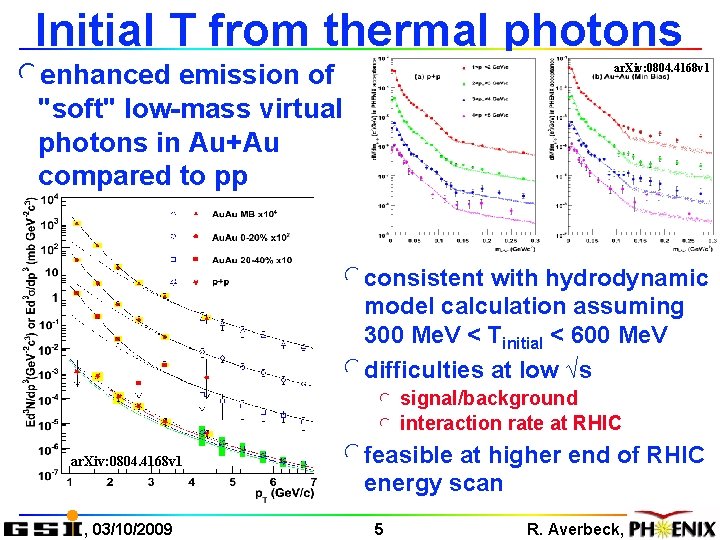
Initial T from thermal photons lenhanced emission of ar. Xiv: 0804. 4168 v 1 "soft" low-mass virtual photons in Au+Au compared to pp l consistent with hydrodynamic model calculation assuming 300 Me. V < Tinitial < 600 Me. V l difficulties at low √s l l ar. Xiv: 0804. 4168 v 1 signal/background interaction rate at RHIC l feasible at higher end of RHIC energy scan , 03/10/2009 5 R. Averbeck,
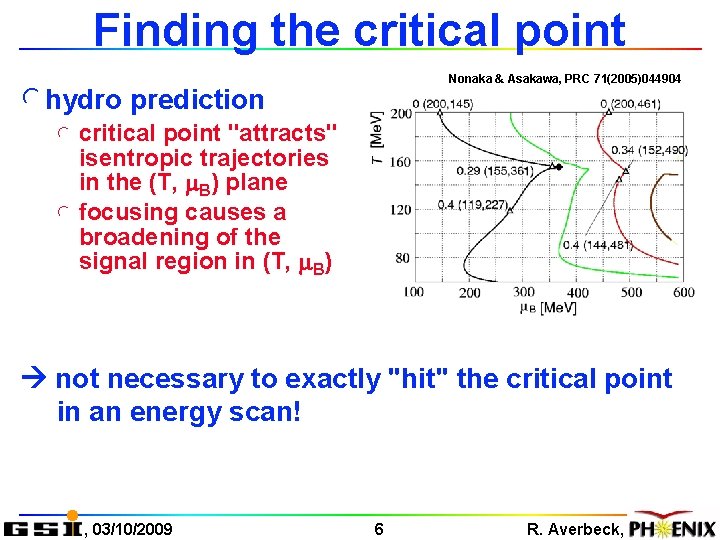
Finding the critical point Nonaka & Asakawa, PRC 71(2005)044904 lhydro prediction l critical point "attracts" isentropic trajectories in the (T, m. B) plane l focusing causes a broadening of the signal region in (T, m. B) not necessary to exactly "hit" the critical point in an energy scan! , 03/10/2009 6 R. Averbeck,
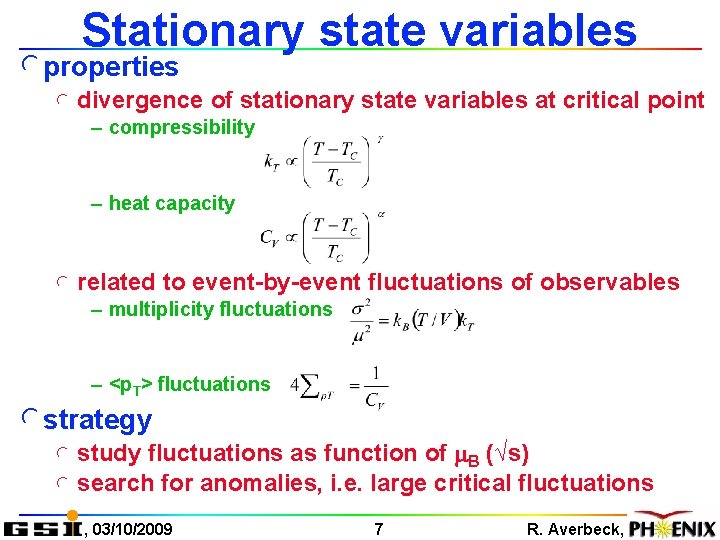
Stationary state variables lproperties l divergence of stationary state variables at critical point – compressibility – heat capacity l related to event-by-event fluctuations of observables – multiplicity fluctuations – <p. T> fluctuations lstrategy l study fluctuations as function of m. B (√s) l search for anomalies, i. e. large critical fluctuations , 03/10/2009 7 R. Averbeck,
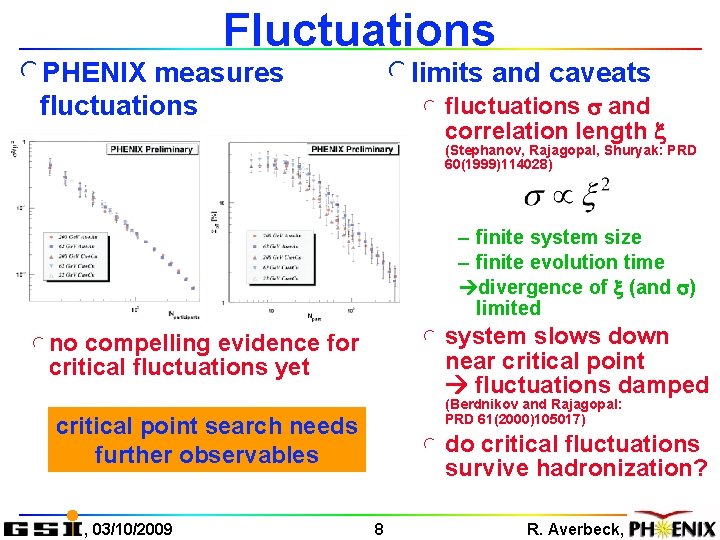
Fluctuations l. PHENIX measures llimits and caveats l fluctuations s and correlation length x fluctuations (Stephanov, Rajagopal, Shuryak: PRD 60(1999)114028) – finite system size – finite evolution time divergence of x (and s) limited l l no compelling evidence for critical fluctuations yet (Berdnikov and Rajagopal: PRD 61(2000)105017) critical point search needs further observables , 03/10/2009 system slows down near critical point fluctuations damped l 8 do critical fluctuations survive hadronization? R. Averbeck,
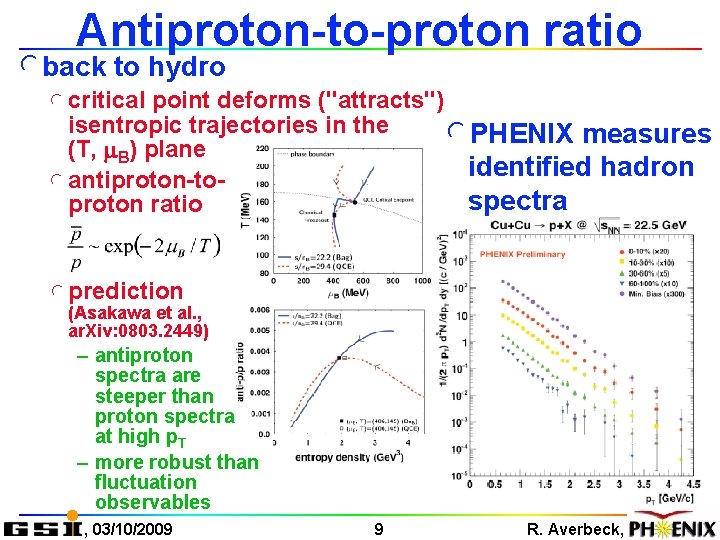
Antiproton-to-proton ratio lback to hydro l critical point deforms ("attracts") isentropic trajectories in the l. PHENIX measures (T, m. B) plane identified hadron l antiproton-tospectra proton ratio l prediction (Asakawa et al. , ar. Xiv: 0803. 2449) – antiproton spectra are steeper than proton spectra at high p. T – more robust than fluctuation observables , 03/10/2009 9 R. Averbeck,
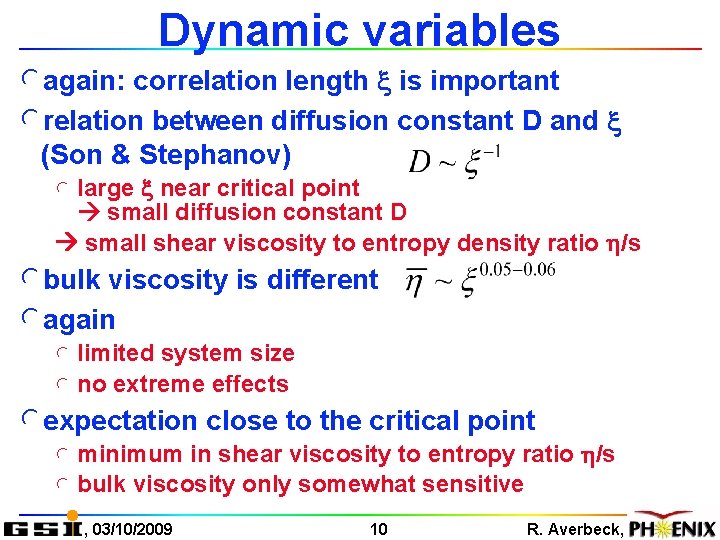
Dynamic variables lagain: correlation length x is important lrelation between diffusion constant D and x (Son & Stephanov) large x near critical point small diffusion constant D small shear viscosity to entropy density ratio h/s l lbulk viscosity is different lagain l limited system size l no extreme effects lexpectation close to the critical point l minimum in shear viscosity to entropy ratio h/s l bulk viscosity only somewhat sensitive , 03/10/2009 10 R. Averbeck,
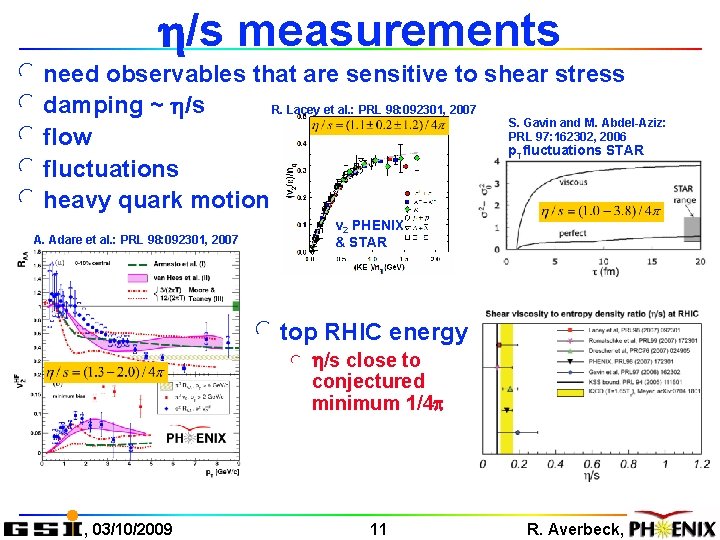
h/s measurements l need observables that are sensitive to shear stress l damping ~ h/s R. Lacey et al. : PRL 98: 092301, 2007 l flow S. Gavin and M. Abdel-Aziz: PRL 97: 162302, 2006 p. Tfluctuations STAR l fluctuations l heavy quark motion A. Adare et al. : PRL 98: 092301, 2007 v 2 PHENIX & STAR l top RHIC energy l h/s close to conjectured minimum 1/4 p , 03/10/2009 11 R. Averbeck,
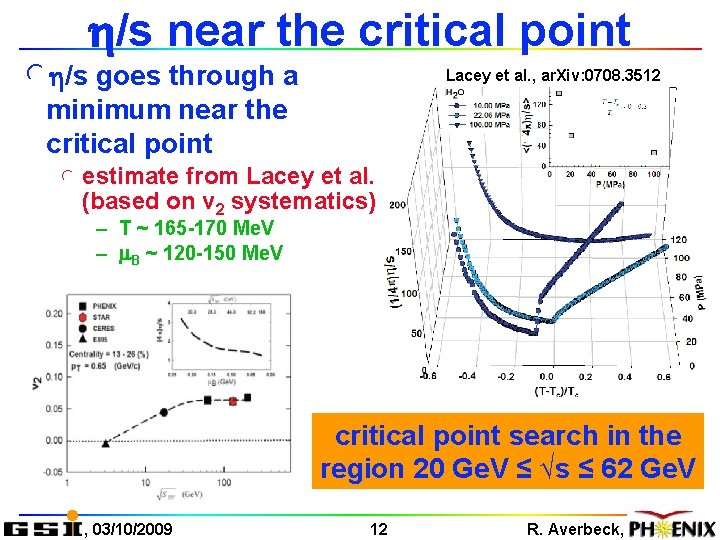
h/s near the critical point lh/s goes through a Lacey et al. , ar. Xiv: 0708. 3512 minimum near the critical point l estimate from Lacey et al. (based on v 2 systematics) – T ~ 165 -170 Me. V – m. B ~ 120 -150 Me. V critical point search in the region 20 Ge. V ≤ √s ≤ 62 Ge. V , 03/10/2009 12 R. Averbeck,
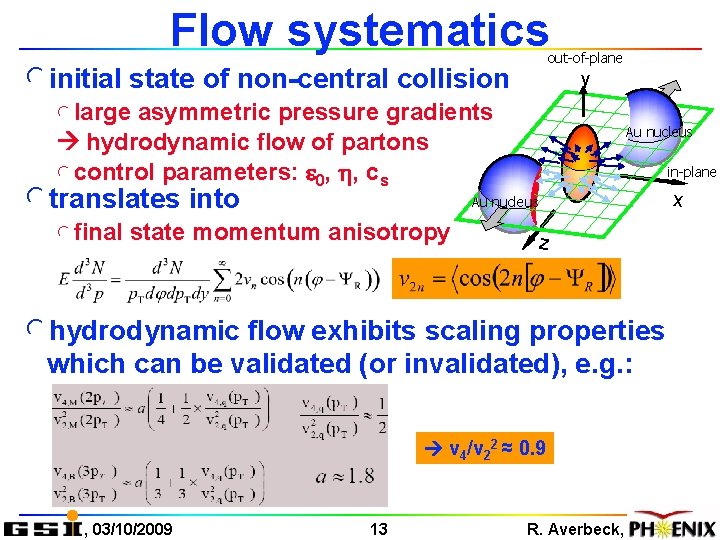
Flow systematics out-of-plane linitial state of non-central collision l large asymmetric pressure gradients hydrodynamic flow of partons l control parameters: e 0, h, cs Au nucleus ltranslates into l final state momentum anisotropy z y Au nucleus lhydrodynamic flow exhibits scaling properties which can be validated (or invalidated), e. g. : v 4/v 22 ≈ 0. 9 , 03/10/2009 13 R. Averbeck, in-plane x
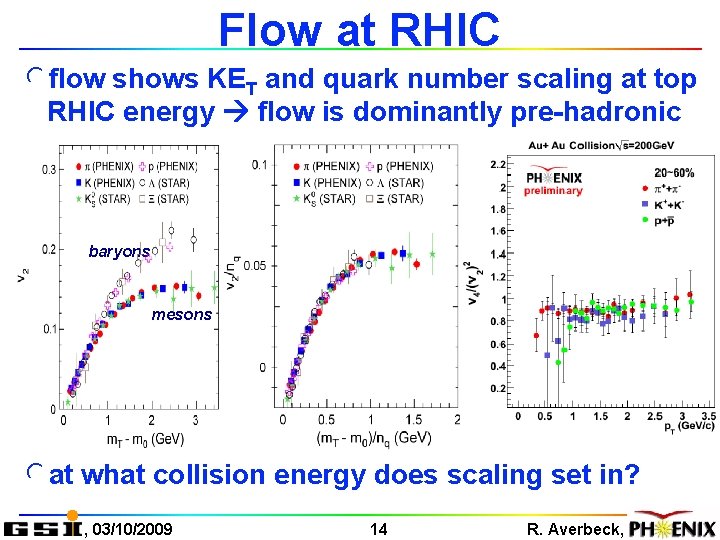
Flow at RHIC lflow shows KET and quark number scaling at top RHIC energy flow is dominantly pre-hadronic baryons mesons lat what collision energy does scaling set in? , 03/10/2009 14 R. Averbeck,
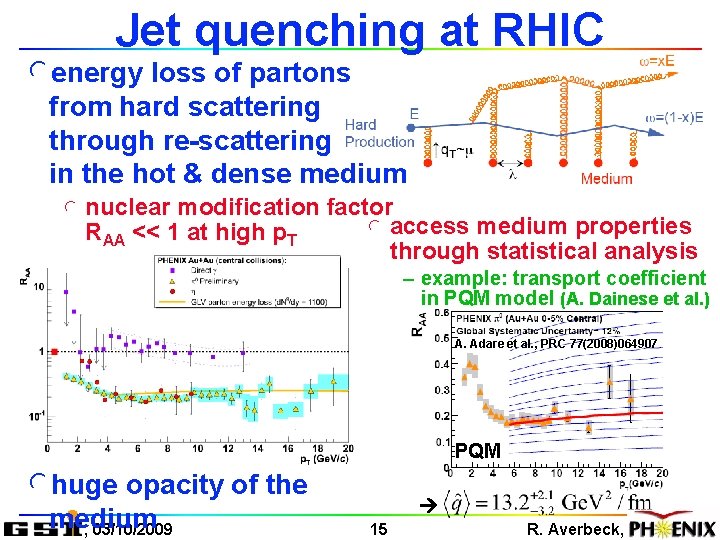
Jet quenching at RHIC lenergy loss of partons from hard scattering through re-scattering in the hot & dense medium l nuclear modification factor l access medium properties RAA << 1 at high p. T through statistical analysis – example: transport coefficient in PQM model (A. Dainese et al. ) A. Adare et al. , PRC 77(2008)064907 PQM lhuge opacity of the medium , 03/10/2009 15 R. Averbeck,
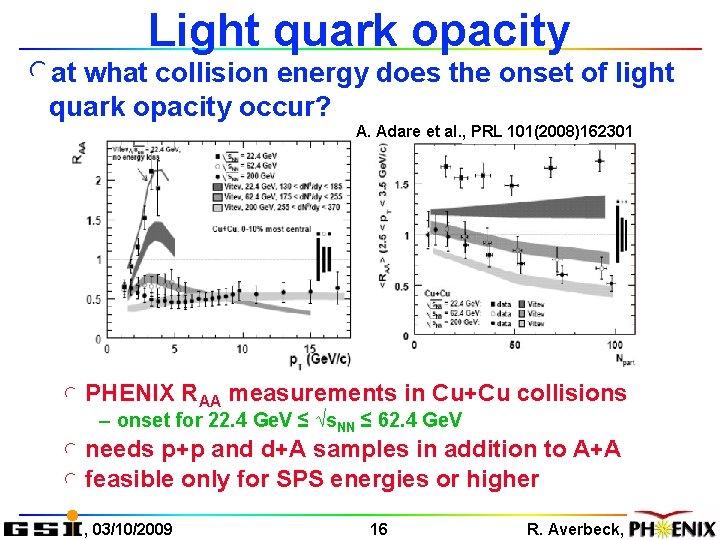
Light quark opacity lat what collision energy does the onset of light quark opacity occur? A. Adare et al. , PRL 101(2008)162301 l PHENIX RAA measurements in Cu+Cu collisions – onset for 22. 4 Ge. V ≤ √s. NN ≤ 62. 4 Ge. V needs p+p and d+A samples in addition to A+A l feasible only for SPS energies or higher l , 03/10/2009 16 R. Averbeck,
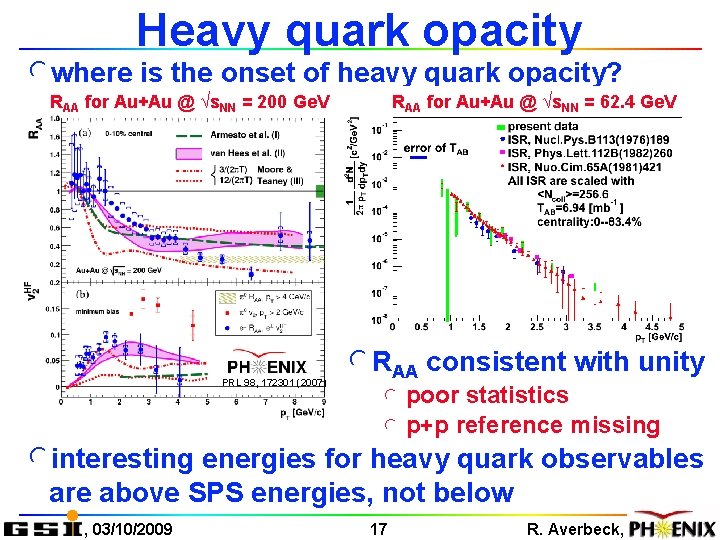
Heavy quark opacity lwhere is the onset of heavy quark opacity? RAA for Au+Au @ √s. NN = 200 Ge. V PRL 98, 172301 (2007) RAA for Au+Au @ √s. NN = 62. 4 Ge. V l. RAA consistent with unity l poor statistics l p+p reference missing linteresting energies for heavy quark observables are above SPS energies, not below , 03/10/2009 17 R. Averbeck,
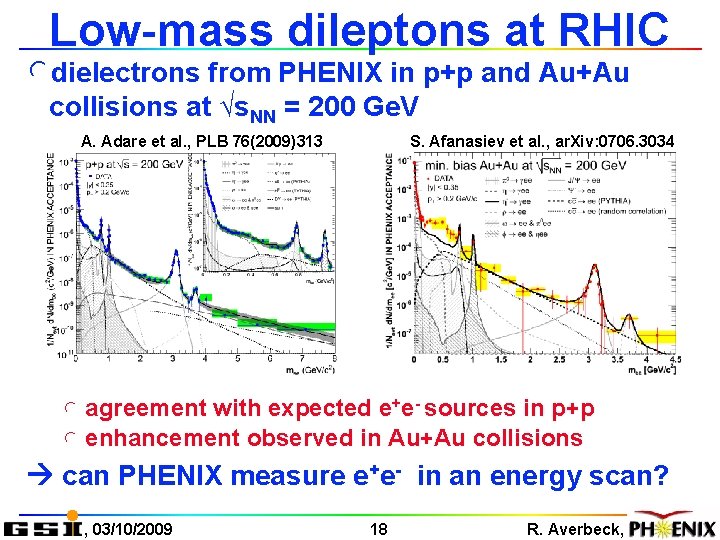
Low-mass dileptons at RHIC ldielectrons from PHENIX in p+p and Au+Au collisions at √s. NN = 200 Ge. V A. Adare et al. , PLB 76(2009)313 S. Afanasiev et al. , ar. Xiv: 0706. 3034 agreement with expected e+e- sources in p+p l enhancement observed in Au+Au collisions l can PHENIX measure e+e- in an energy scan? , 03/10/2009 18 R. Averbeck,
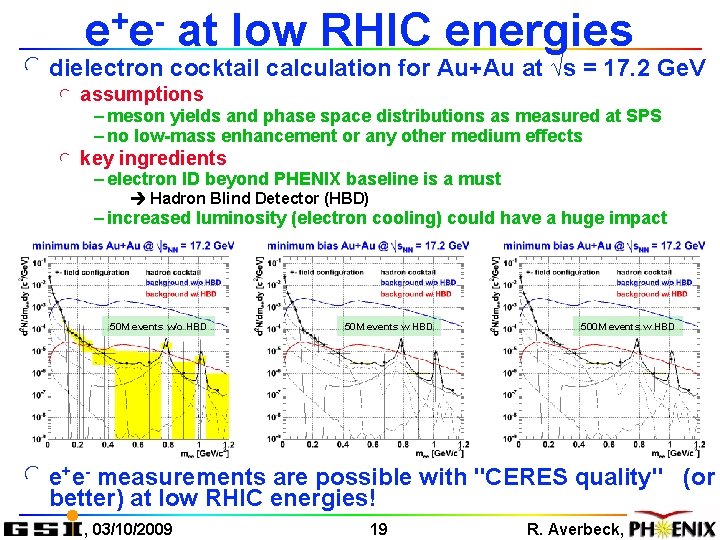
+ ee at low RHIC energies l dielectron cocktail calculation for Au+Au at √s = 17. 2 Ge. V l assumptions – meson yields and phase space distributions as measured at SPS – no low-mass enhancement or any other medium effects l key ingredients – electron ID beyond PHENIX baseline is a must Hadron Blind Detector (HBD) – increased luminosity (electron cooling) could have a huge impact 50 M events w/o HBD 50 M events w HBD 500 M events w HBD l e+e- measurements are possible with "CERES quality" (or better) at low RHIC energies! , 03/10/2009 19 R. Averbeck,
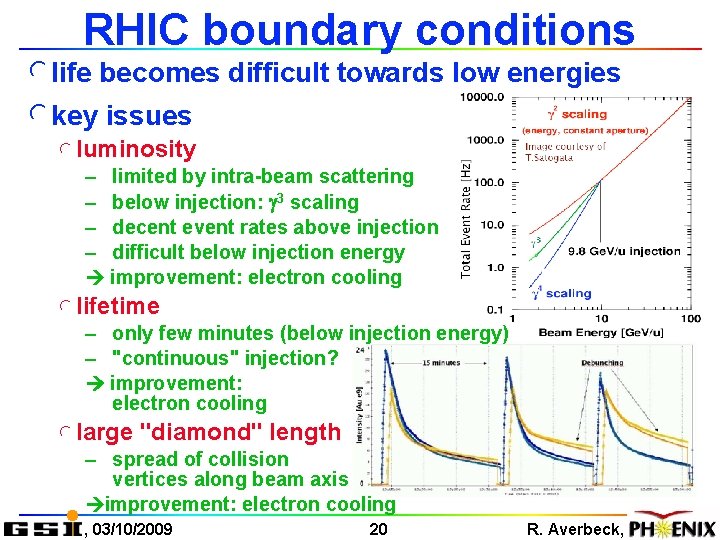
RHIC boundary conditions llife becomes difficult towards low energies lkey issues l luminosity – limited by intra-beam scattering – below injection: g 3 scaling – decent event rates above injection – difficult below injection energy improvement: electron cooling l lifetime – only few minutes (below injection energy) – "continuous" injection? improvement: electron cooling l large "diamond" length – spread of collision vertices along beam axis improvement: electron cooling , 03/10/2009 20 R. Averbeck,
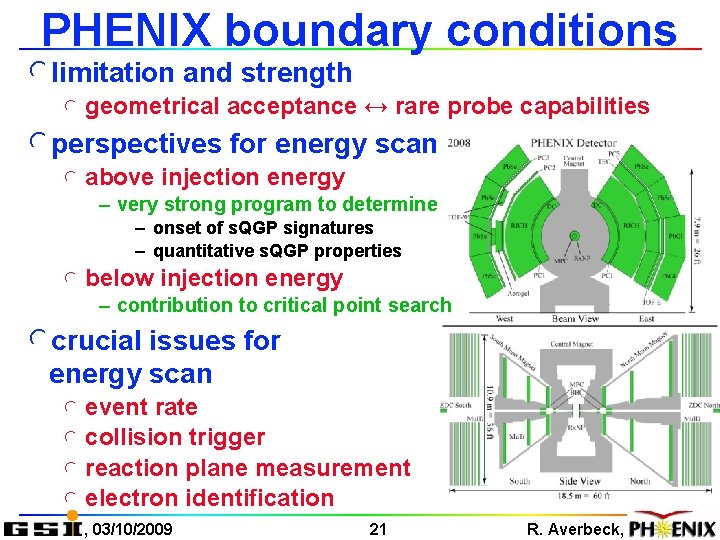
PHENIX boundary conditions llimitation and strength l geometrical acceptance ↔ rare probe capabilities lperspectives for energy scan l above injection energy – very strong program to determine – onset of s. QGP signatures – quantitative s. QGP properties l below injection energy – contribution to critical point search lcrucial issues for energy scan event rate l collision trigger l reaction plane measurement l electron identification l , 03/10/2009 21 R. Averbeck,
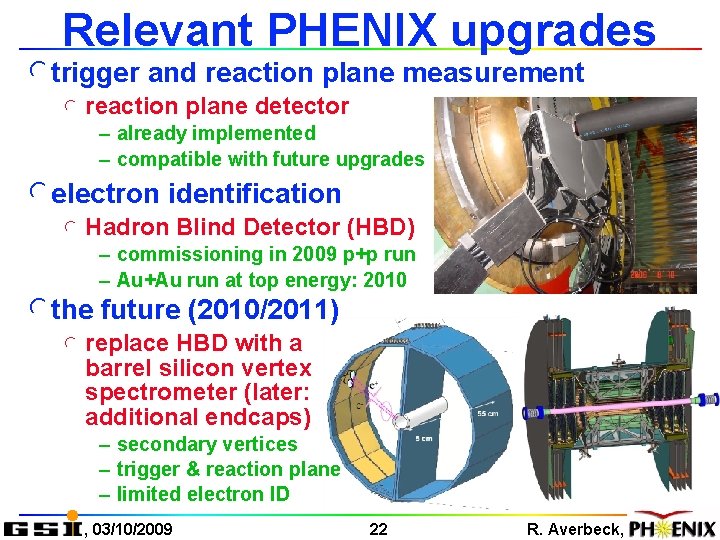
Relevant PHENIX upgrades ltrigger and reaction plane measurement l reaction plane detector – already implemented – compatible with future upgrades lelectron identification l Hadron Blind Detector (HBD) – commissioning in 2009 p+p run – Au+Au run at top energy: 2010 lthe future (2010/2011) l replace HBD with a barrel silicon vertex spectrometer (later: additional endcaps) – secondary vertices – trigger & reaction plane – limited electron ID , 03/10/2009 22 R. Averbeck,
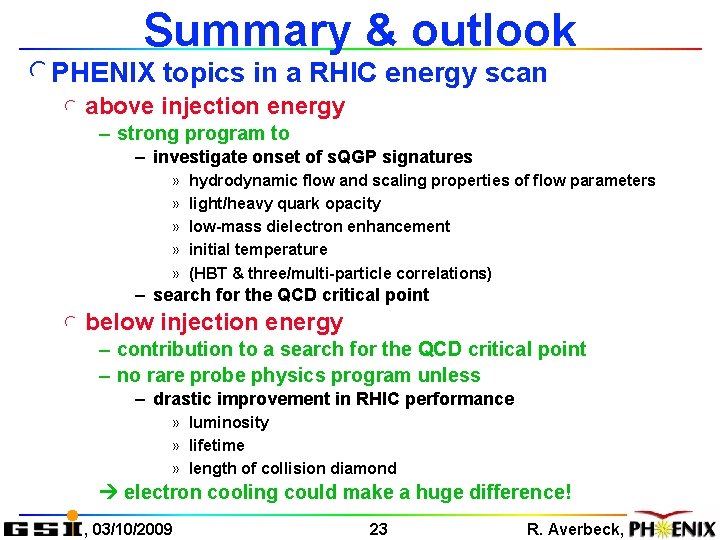
Summary & outlook l. PHENIX topics in a RHIC energy scan l above injection energy – strong program to – investigate onset of s. QGP signatures » » » hydrodynamic flow and scaling properties of flow parameters light/heavy quark opacity low-mass dielectron enhancement initial temperature (HBT & three/multi-particle correlations) – search for the QCD critical point l below injection energy – contribution to a search for the QCD critical point – no rare probe physics program unless – drastic improvement in RHIC performance » luminosity » lifetime » length of collision diamond electron cooling could make a huge difference! , 03/10/2009 23 R. Averbeck,