
Leptons Photons and Heavy Quarks Ralf Averbeck State
Leptons, Photons, and Heavy Quarks Ralf Averbeck State University of New York at Stony Brook Quark Matter 2004, Oakland January 11 - 17, 2004
Outline l Low and Intermediate-Mass Dileptons l open questions l pending answers l Direct Photons l controlling jets l Heavy Flavor l charmonia – news from SPS – preparing the case for RHIC l open charm at RHIC – reference and probe l Summary R. Averbeck, SUNY Stony Brook 2
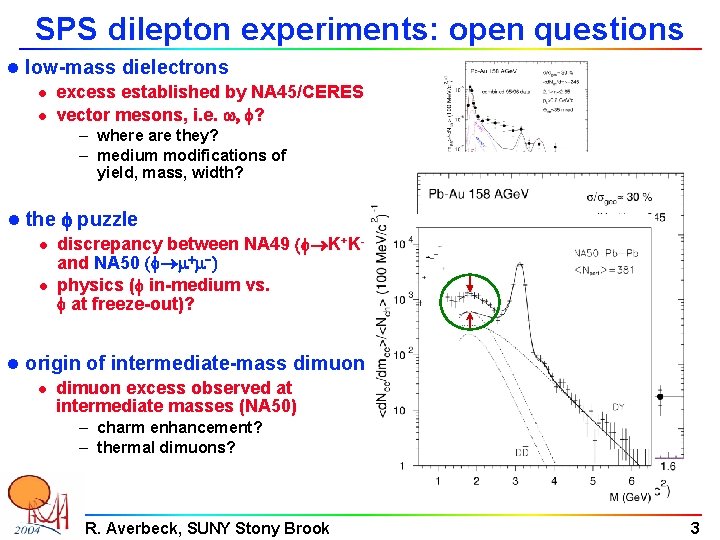
SPS dilepton experiments: open questions l low-mass dielectrons l excess established by NA 45/CERES l vector mesons, i. e. w, f? – where are they? – medium modifications of yield, mass, width? l the f puzzle l discrepancy between NA 49 (f K+K-) and NA 50 (f m+m-) l physics (f in-medium vs. f at freeze-out)? l origin of intermediate-mass dimuons l dimuon excess observed at intermediate masses (NA 50) – charm enhancement? – thermal dimuons? R. Averbeck, SUNY Stony Brook 3
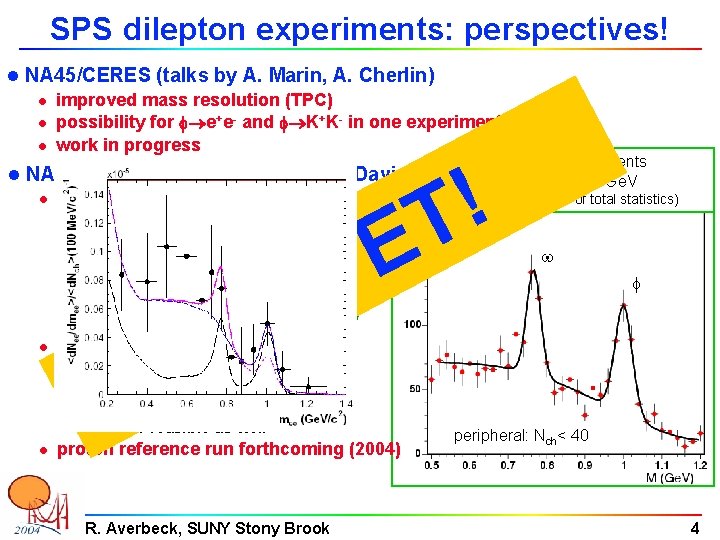
SPS dilepton experiments: perspectives! SPS dilepton experiments: answers? l NA 45/CERES (talks by A. Marin, A. Cherlin) l improved mass resolution (TPC) l possibility for f e+e- and f K+K- in one experiment l work in progress l NA 60 (talks by P. Sonderegger, A. David) l DESIGNED to answer open questions! l (less than 1 % of total statistics) w f Indium+Indium at 158 AGe. V (2003) – – – - l N T O ! T E Y – high statistics due to selective trigger – good mass resolution (~20 Me. V for w, f) – good phase-space coverage (down to zero p. T) – 50 mm secondary vertex resolution (prompt m vs. m from charm decays) 5000 signal events for M < 1. 2 Ge. V >106 low-mass dimuons! S/B: ½ - 1 (depending on centrality) >105 f m+mf K+K- feasible as well proton reference run forthcoming (2004) R. Averbeck, SUNY Stony Brook peripheral: Nch< 40 4
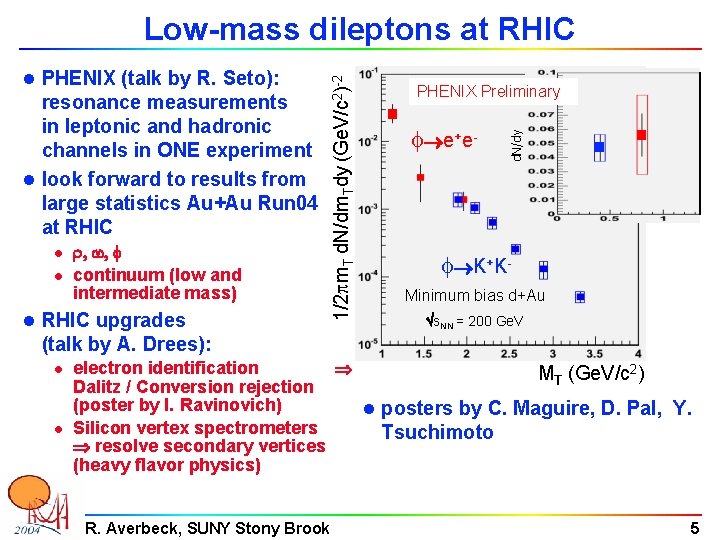
resonance measurements in leptonic and hadronic channels in ONE experiment l look forward to results from large statistics Au+Au Run 04 at RHIC l l r, w, f continuum (low and intermediate mass) l RHIC upgrades PHENIX Preliminary f e+e- d. N/dy l PHENIX (talk by R. Seto): 1/2 m. T d. N/dm. Tdy (Ge. V/c 2)-2 Low-mass dileptons at RHIC f K+KMinimum bias d+Au s. NN = 200 Ge. V (talk by A. Drees): l l electron identification MT (Ge. V/c 2) Dalitz / Conversion rejection (poster by I. Ravinovich) l posters by C. Maguire, D. Pal, Y. Silicon vertex spectrometers Tsuchimoto resolve secondary vertices (heavy flavor physics) R. Averbeck, SUNY Stony Brook 5
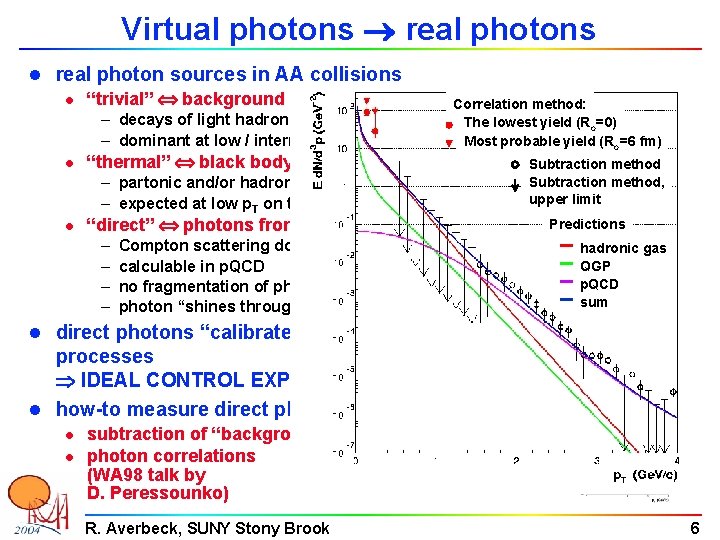
Virtual photons real photons l real photon sources in AA collisions l “trivial” background Correlation method: – decays of light hadrons The lowest yield (Ro=0) – dominant at low / intermediate p. T (few Ge. V/c) Most probable yield (Ro=6 fm) (p 0 gg) l “thermal” black body radiation from hot medium Subtraction method – partonic and/or hadronic medium – expected at low p. T on top of huge background l Subtraction method, upper limit “direct” photons from initial state hard scattering – – Predictions Compton scattering dominates, i. e. probe for gluon distribution hadronic gas QGP calculable in p. QCD no fragmentation of photon! sum photon “shines through” hot and dense medium! l direct photons “calibrate” hard scattering processes IDEAL CONTROL EXPERIMENT FOR JET SUPPRESSION! l how-to measure direct photons l l subtraction of “background” photons (WA 98 / PHENIX) photon correlations (WA 98 talk by D. Peressounko) R. Averbeck, SUNY Stony Brook 6
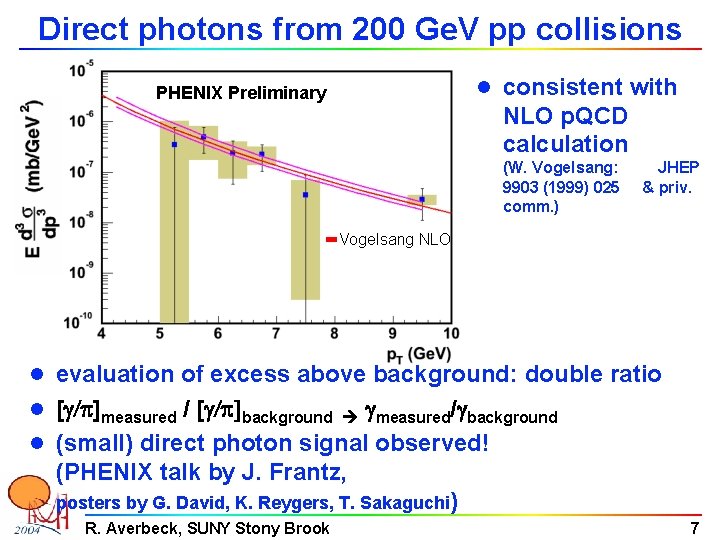
Direct photons from 200 Ge. V pp collisions l consistent with PHENIX Preliminary NLO p. QCD Ratio g/p 0 measured g/p 0 expected bkg calculation (W. Vogelsang: 9903 (1999) 025 comm. ) PHENIX Preliminary JHEP & priv. Vogelsang PHENIX NLO Preliminary l evaluation of excess above background: double ratio gmeasured/gbackground l (small) direct photon signal observed! (PHENIX talk by J. Frantz, posters by G. David, K. Reygers, T. Sakaguchi) l [g/p]measured / [g/p]background R. Averbeck, SUNY Stony Brook 7
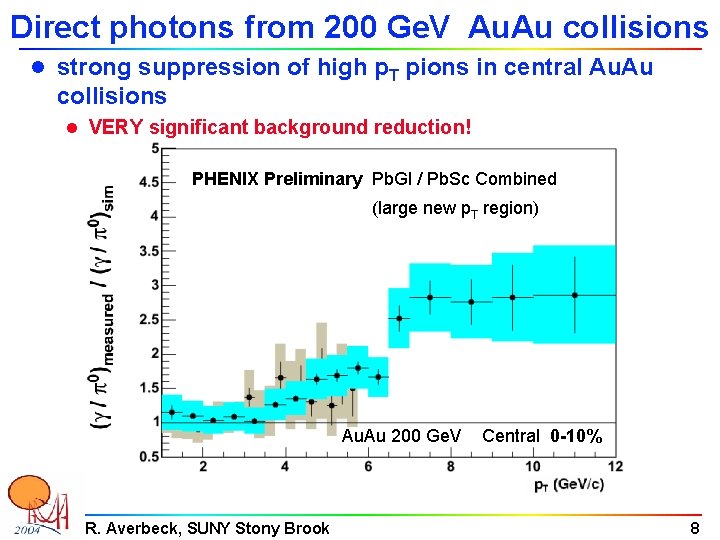
Direct photons from 200 Ge. V Au. Au collisions l strong suppression of high p. T pions in central Au. Au collisions l VERY significant background reduction! PHENIX Preliminary Pb. Gl / Pb. Sc Combined (large new p. T region) Au. Au 200 Ge. V R. Averbeck, SUNY Stony Brook Central 0 -10% 8

Comparison with NLO p. QCD calculation PHENIX Preliminary Pb. Gl / Pb. Sc Combined 1 + (g p. QCD direct x Ncoll) / g phenix backgrd Vogelsang NLO 1 + (g p. QCD direct x Ncoll) / g phenix backgrd Vogelsang, mscale = 0. 5, 2. 0 1 + (g p. QCD direct x Ncoll) / (g phenix pp backgrd x Ncoll) Au. Au 200 Ge. V Central 0 -10% l nice agreement with unsuppressed, binary scaled pp NLO p. QCD calculation! R. Averbeck, SUNY Stony Brook 9
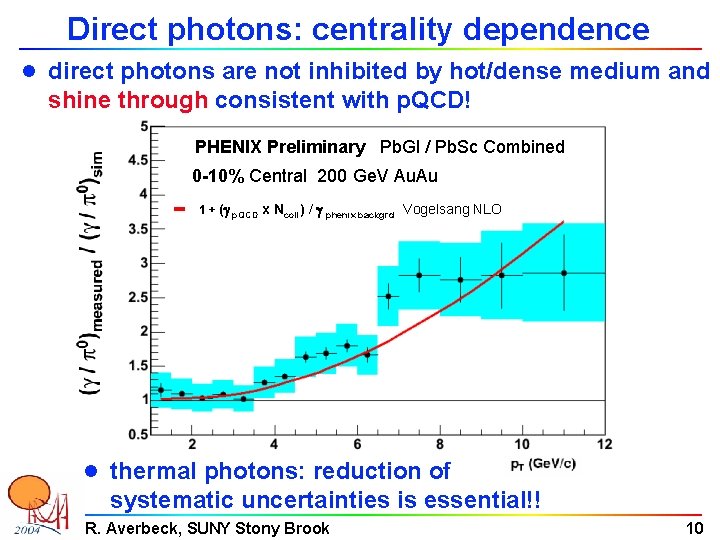
Direct photons: centrality dependence l direct photons are not inhibited by hot/dense medium and shine through consistent with p. QCD! PHENIX Preliminary Pb. Gl // Pb. Sc Combined PHENIX 50 -60% 40 -50% 30 -40% Central 200 Ge. V 60 -70% Central Au. Au 200 Ge. V 0 -10% Central 200 Ge. V Au. Au 80 -92% Central Au. Au 200 Ge. V 10 -20% Central. Au 200 Ge. V Au. Au 70 -80% 20 -30% Central Au. Au 200 Ge. V 1 + (g p. QCD x Ncoll) / g phenix backgrd Vogelsang NLO ++ (g (g p. QCD x Ncoll ) / g phenix Vogelsang NLO 111 + p. QCD backgrd p. QCD x Ncoll) / g phenix backgrd Vogelsang p. QCD coll phenix backgrd Vogelsang l thermal photons: reduction of systematic uncertainties is essential!! R. Averbeck, SUNY Stony Brook 10
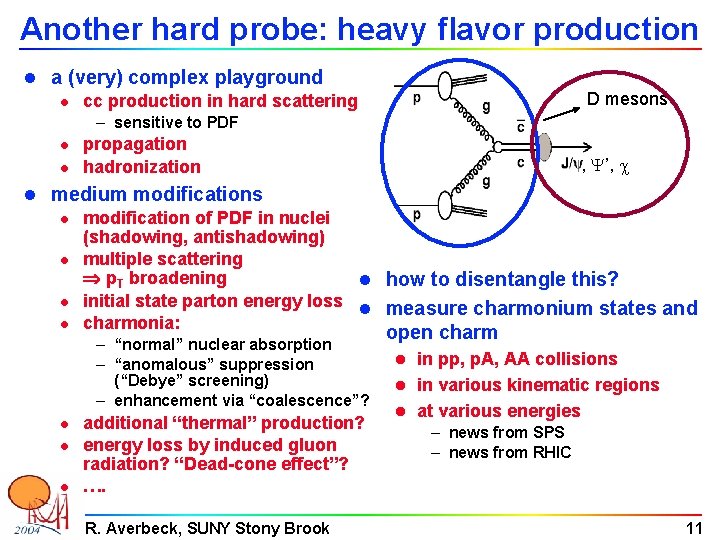
Another hard probe: heavy flavor production l a (very) complex playground l cc production in hard scattering D mesons – sensitive to PDF l l propagation hadronization , Y’, c l medium modifications l modification of PDF in nuclei (shadowing, antishadowing) l multiple scattering p. T broadening l how to disentangle this? l initial state parton energy loss l measure charmonium states and l charmonia: – “normal” nuclear absorption – “anomalous” suppression (“Debye” screening) – enhancement via “coalescence”? l l l additional “thermal” production? energy loss by induced gluon radiation? “Dead-cone effect”? …. R. Averbeck, SUNY Stony Brook open charm l in pp, p. A, AA collisions l in various kinematic regions l at various energies – news from SPS – news from RHIC 11
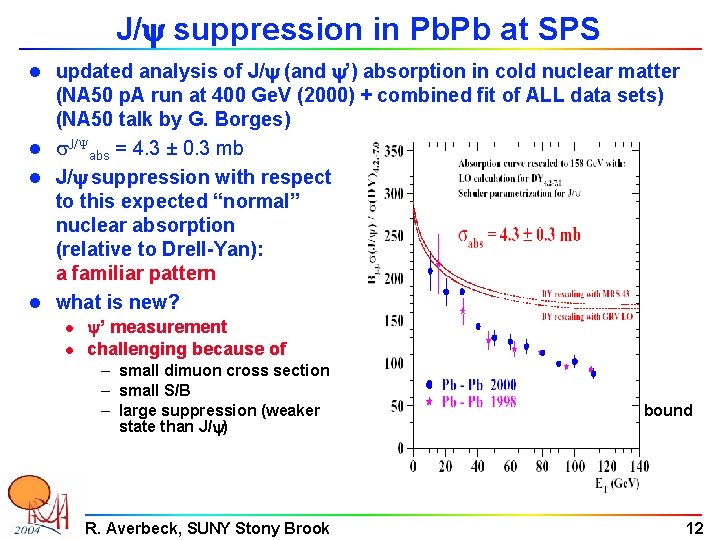
J/ suppression in Pb. Pb at SPS l updated analysis of J/ (and ’) absorption in cold nuclear matter (NA 50 p. A run at 400 Ge. V (2000) + combined fit of ALL data sets) (NA 50 talk by G. Borges) l s. J/Yabs = 4. 3 ± 0. 3 mb l J/ suppression with respect to this expected “normal” nuclear absorption (relative to Drell-Yan): a familiar pattern l what is new? l l ’ measurement challenging because of – small dimuon cross section – small S/B – large suppression (weaker state than J/ ) R. Averbeck, SUNY Stony Brook bound 12
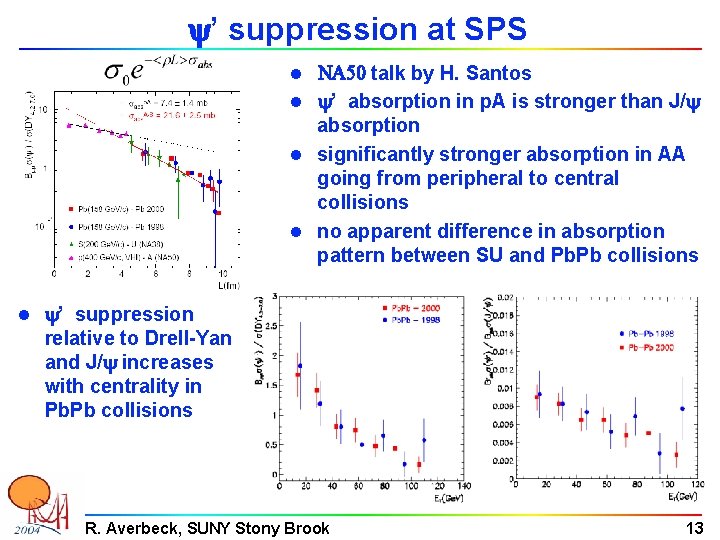
’ suppression at SPS l NA 50 talk by H. Santos l ’ absorption in p. A is stronger than J/ absorption l significantly stronger absorption in AA going from peripheral to central collisions l no apparent difference in absorption pattern between SU and Pb. Pb collisions l ’ suppression relative to Drell-Yan and J/ increases with centrality in Pb. Pb collisions R. Averbeck, SUNY Stony Brook 13
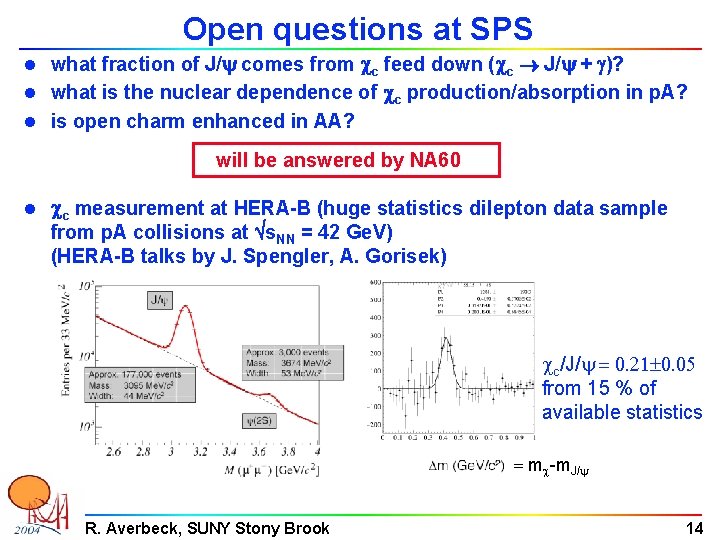
Open questions at SPS l what fraction of J/ comes from cc feed down (cc J/ + g)? l what is the nuclear dependence of cc production/absorption in p. A? l is open charm enhanced in AA? lwill be answered by NA 60 l cc measurement at HERA-B (huge statistics dilepton data sample from p. A collisions at s. NN = 42 Ge. V) (HERA-B talks by J. Spengler, A. Gorisek) cc/J/y = 0. 21 0. 05 from 15 % of available statistics = mc-m. J/y R. Averbeck, SUNY Stony Brook 14
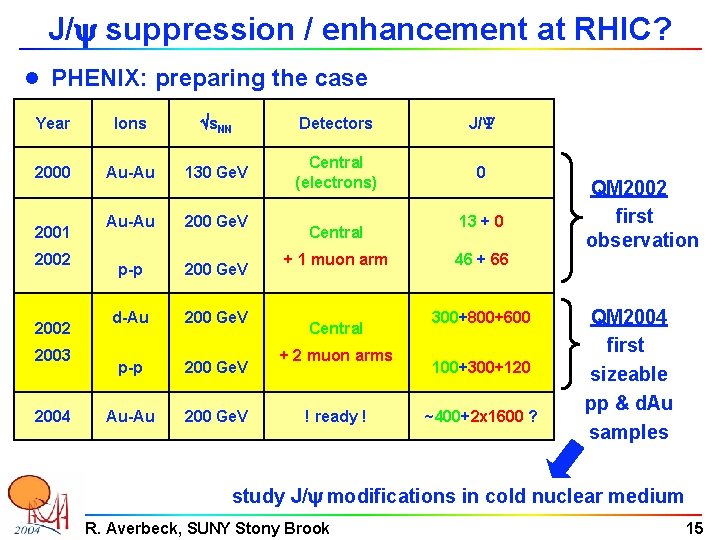
J/ suppression / enhancement at RHIC? l PHENIX: preparing the case Year Ions s. NN Detectors J/ 2000 Au-Au 130 Ge. V Central (electrons) 0 Au-Au 200 Ge. V p-p 200 Ge. V d-Au 200 Ge. V p-p 200 Ge. V Au-Au 200 Ge. V 2001 2002 2003 2004 Central + 1 muon arm Central + 2 muon arms ! ready ! 13 + 0 46 + 66 300+800+600 100+300+120 ~400+2 x 1600 ? QM 2002 first observation QM 2004 first sizeable pp & d. Au samples study J/ modifications in cold nuclear medium R. Averbeck, SUNY Stony Brook 15
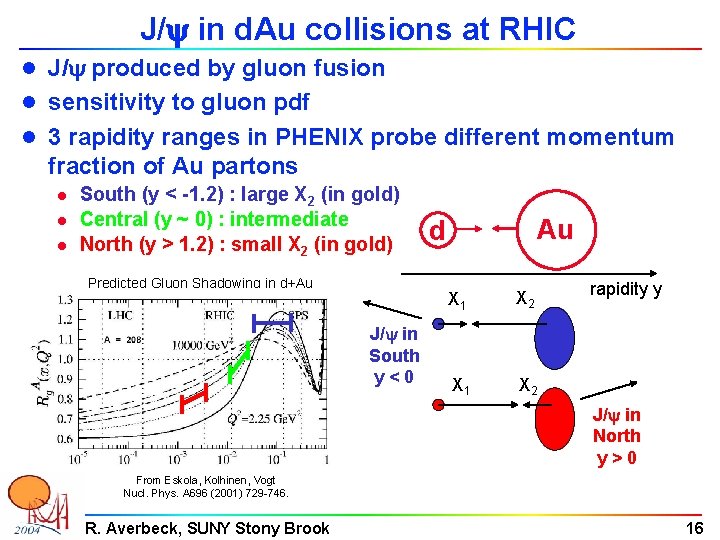
J/ in d. Au collisions at RHIC l J/ produced by gluon fusion l sensitivity to gluon pdf l 3 rapidity ranges in PHENIX probe different momentum fraction of Au partons l l l South (y < -1. 2) : large X 2 (in gold) Central (y ~ 0) : intermediate North (y > 1. 2) : small X 2 (in gold) Predicted Gluon Shadowing in d+Au J/ in South y<0 Au d X 1 X 2 rapidity y J/ in North y>0 From Eskola, Kolhinen, Vogt Nucl. Phys. A 696 (2001) 729 -746. R. Averbeck, SUNY Stony Brook 16
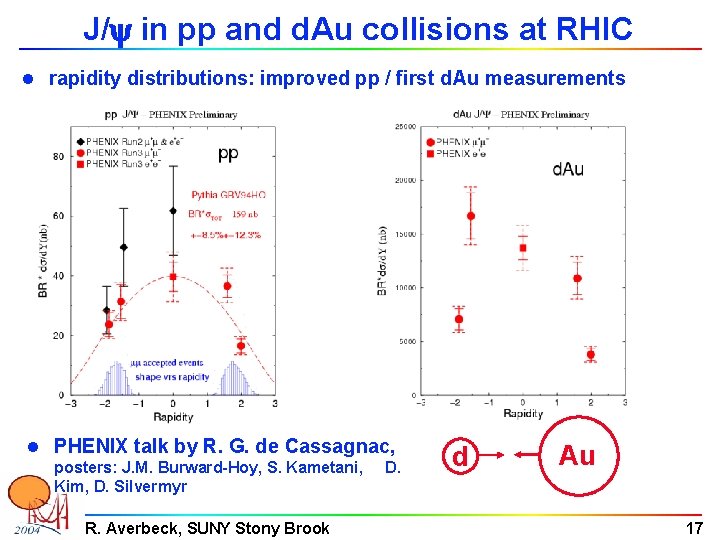
J/ in pp and d. Au collisions at RHIC l rapidity distributions: improved pp / first d. Au measurements l PHENIX talk by R. G. de Cassagnac, posters: J. M. Burward-Hoy, S. Kametani, Kim, D. Silvermyr R. Averbeck, SUNY Stony Brook D. d Au 17
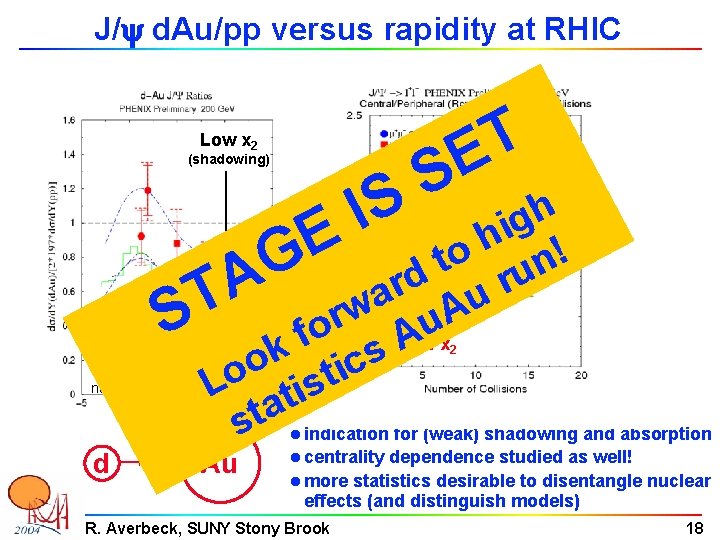
J/ d. Au/pp versus rapidity at RHIC Low x 2 T E S S (shadowing) I E h g i h ! o t n G u d r r A a Au T w S k for Low ux A s o c i o t L tis a t s indication for (weak) shadowing and absorption High x 2 2 S. B. Klein and R. Vogt, nucl-th/0305046 l d Au l centrality dependence studied as well! l more statistics desirable to disentangle nuclear effects (and distinguish models) R. Averbeck, SUNY Stony Brook 18
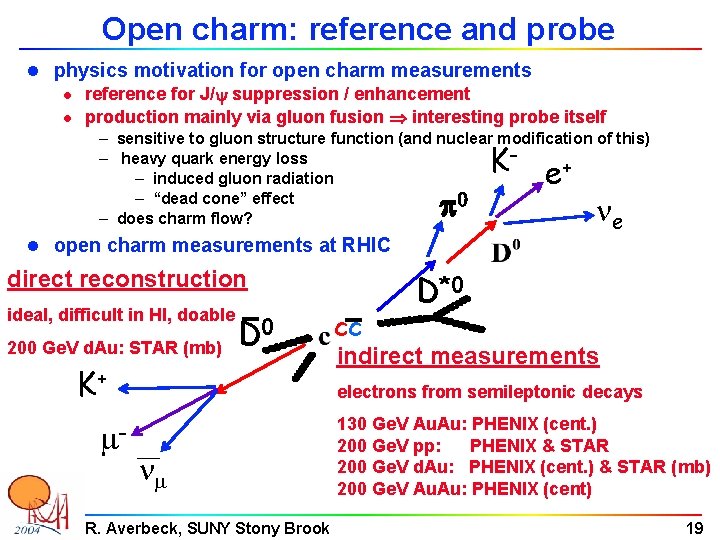
Open charm: reference and probe l physics motivation for open charm measurements l reference for J/ suppression / enhancement l production mainly via gluon fusion interesting probe itself – sensitive to gluon structure function (and nuclear modification of this) – heavy quark energy loss + – induced gluon radiation – “dead cone” effect 0 – does charm flow? e K p e n l open charm measurements at RHIC direct reconstruction ideal, difficult in HI, doable 200 Ge. V d. Au: STAR (mb) D 0 K+ m- cc D*0 indirect measurements electrons from semileptonic decays nm R. Averbeck, SUNY Stony Brook 130 Ge. V Au. Au: PHENIX (cent. ) 200 Ge. V pp: PHENIX & STAR 200 Ge. V d. Au: PHENIX (cent. ) & STAR (mb) 200 Ge. V Au. Au: PHENIX (cent) 19
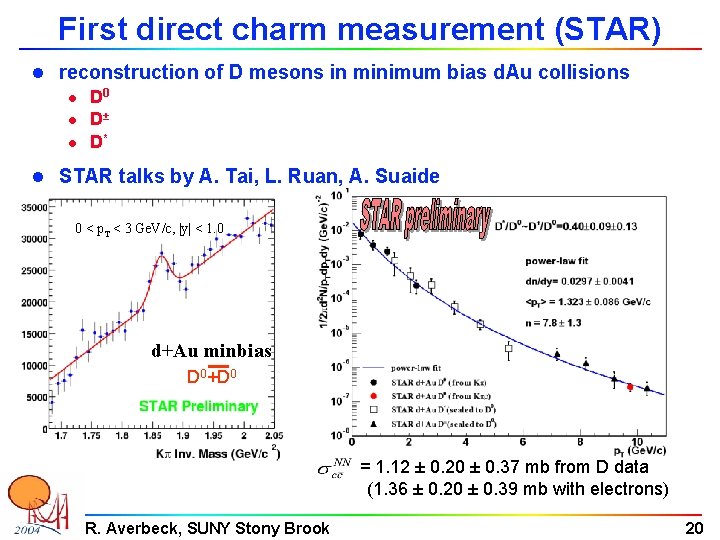
First direct charm measurement (STAR) l reconstruction of D mesons in minimum bias d. Au collisions l D 0 l D± l D* l STAR talks by A. Tai, L. Ruan, A. Suaide 0 < p. T < 3 Ge. V/c, |y| < 1. 0 d+Au minbias D 0+D 0 = 1. 12 ± 0. 20 ± 0. 37 mb from D data (1. 36 ± 0. 20 ± 0. 39 mb with electrons) R. Averbeck, SUNY Stony Brook 20
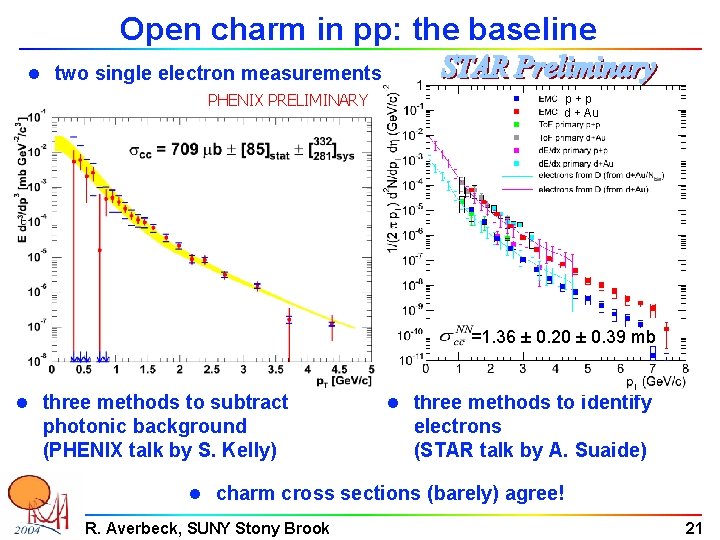
Open charm in pp: the baseline l two single electron measurements PHENIX PRELIMINARY p+p d + Au =1. 36 ± 0. 20 ± 0. 39 mb l three methods to subtract photonic background (PHENIX talk by S. Kelly) l three methods to identify electrons (STAR talk by A. Suaide) l charm cross sections (barely) agree! R. Averbeck, SUNY Stony Brook 21
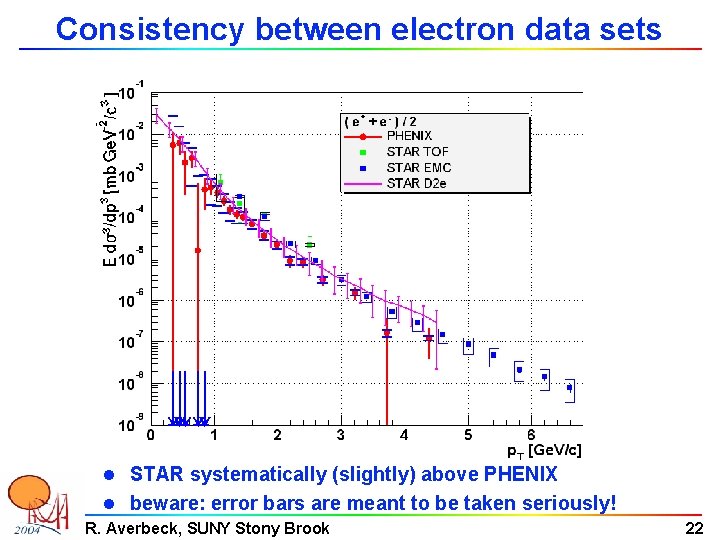
Consistency between electron data sets l STAR systematically (slightly) above PHENIX l beware: error bars are meant to be taken seriously! R. Averbeck, SUNY Stony Brook 22
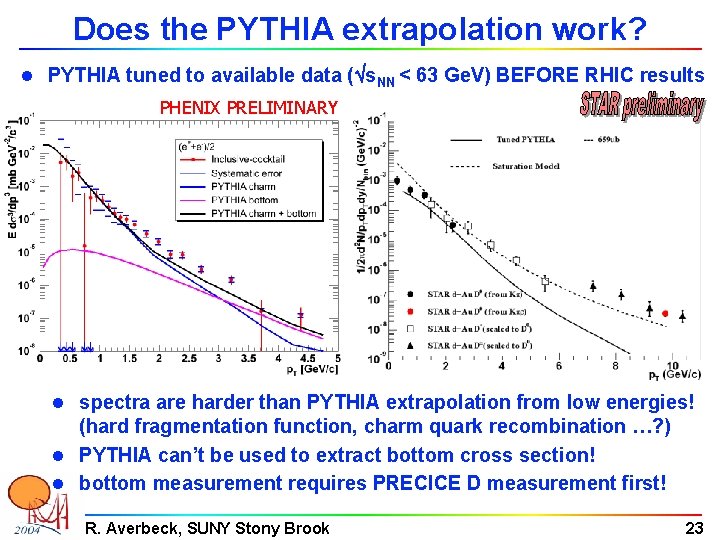
Does the PYTHIA extrapolation work? l PYTHIA tuned to available data ( s. NN < 63 Ge. V) BEFORE RHIC results PHENIX PRELIMINARY l spectra are harder than PYTHIA extrapolation from low energies! (hard fragmentation function, charm quark recombination …? ) l PYTHIA can’t be used to extract bottom cross section! l bottom measurement requires PRECICE D measurement first! R. Averbeck, SUNY Stony Brook 23
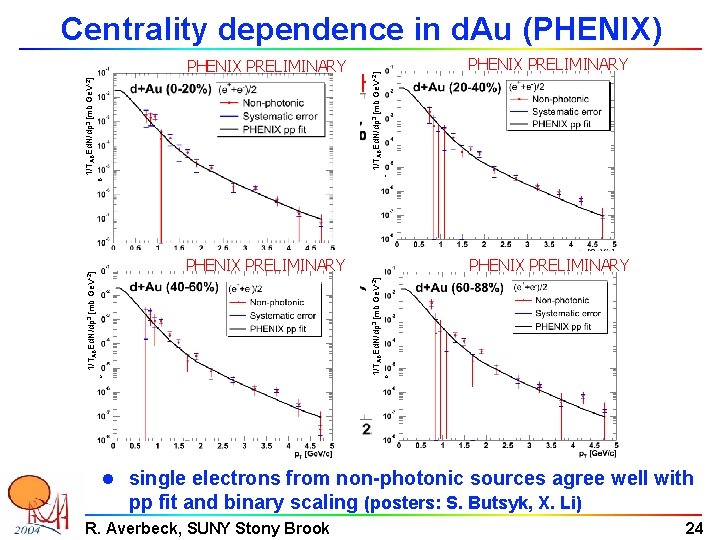
Centrality dependence in d. Au (PHENIX) B 1/T 3 -2 A 1/T ABEd. N/dp [mb Ge. V ] PHENIX PRELIMINARY B PHENIX PRELIMINARY 1/TAABEd. N/dp 3 [mb Ge. V-2] 1/TABEd. N/dp 3 [mb Ge. V-2] B PHENIX PRELIMINARY B 3 -2 1/T 1/T A ABEd. N/dp [mb Ge. V ] PHENIX PRELIMINARY l single electrons from non-photonic sources agree well with pp fit and binary scaling (posters: S. Butsyk, X. Li) R. Averbeck, SUNY Stony Brook 24
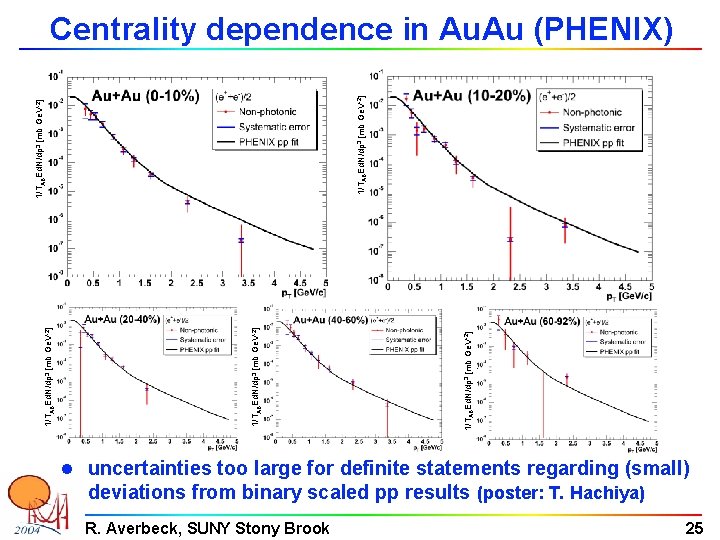
1/TAA 1/TABEd. N/dp 3 [mb Ge. V-2] AA 3 -2 1/TABEd. N/dp 1/T [mb Ge. V ] AA 3 3 Ge. V -2] Ge. V 1/T ABEd. N/dp 1/T [mb[mb 3 -2 1/TAA 1/T ABEd. N/dp [mb Ge. V ] 1/TABEd. N/dp 3 [mb Ge. V-2] 1/T AA Centrality dependence in Au. Au (PHENIX) l uncertainties too large for definite statements regarding (small) deviations from binary scaled pp results (poster: T. Hachiya) R. Averbeck, SUNY Stony Brook 25
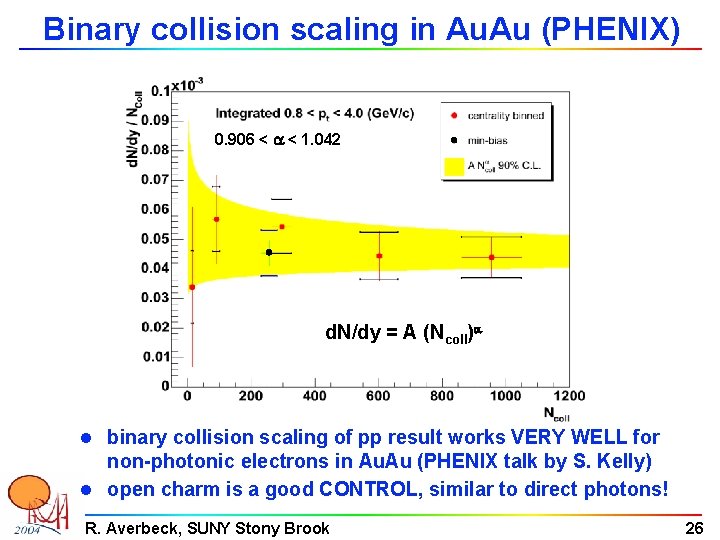
Binary collision scaling in Au. Au (PHENIX) 0. 906 < < 1. 042 d. N/dy = A (Ncoll) l binary collision scaling of pp result works VERY WELL for non-photonic electrons in Au. Au (PHENIX talk by S. Kelly) l open charm is a good CONTROL, similar to direct photons! R. Averbeck, SUNY Stony Brook 26
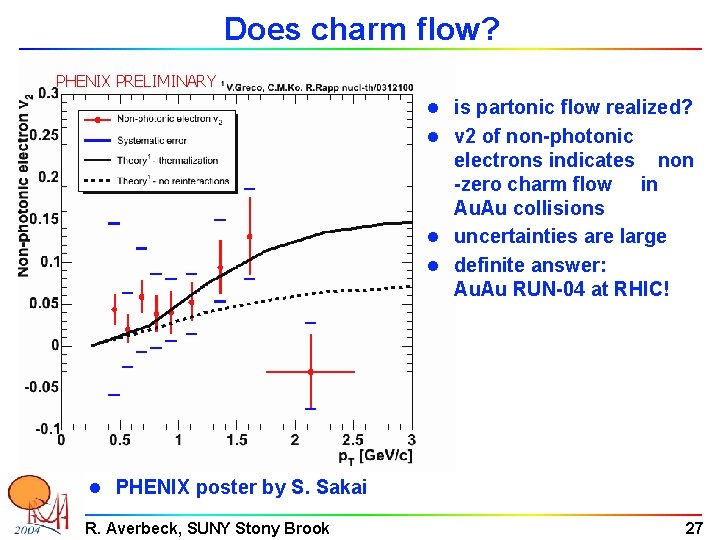
Does charm flow? PHENIX PRELIMINARY l is partonic flow realized? l v 2 of non-photonic electrons indicates non -zero charm flow in Au. Au collisions l uncertainties are large l definite answer: Au. Au RUN-04 at RHIC! l PHENIX poster by S. Sakai R. Averbeck, SUNY Stony Brook 27
Summary l low and intermediate-mass dileptons l looking forward to – solutions of SPS puzzles – data from RHIC l direct photons as jet control measurement l p. QCD at work l charmonia l improvements at SPS l preparing the reference for RHIC l open charm l a second player joined the game l what next? l LUMINOSITY!! l back to work R. Averbeck, SUNY Stony Brook 28
- Slides: 28