Ph USE CDASH 2 RFD TC May 31
- Slides: 22
Ph. USE CDASH 2 RFD TC May 31, 2013 Gary Walker, Quintiles Rhonda Facile, CDISC
Slide Number One Agenda • • • The need for CRF Standards Background Approach Current Deliverables Q&A © CDISC 2013 2
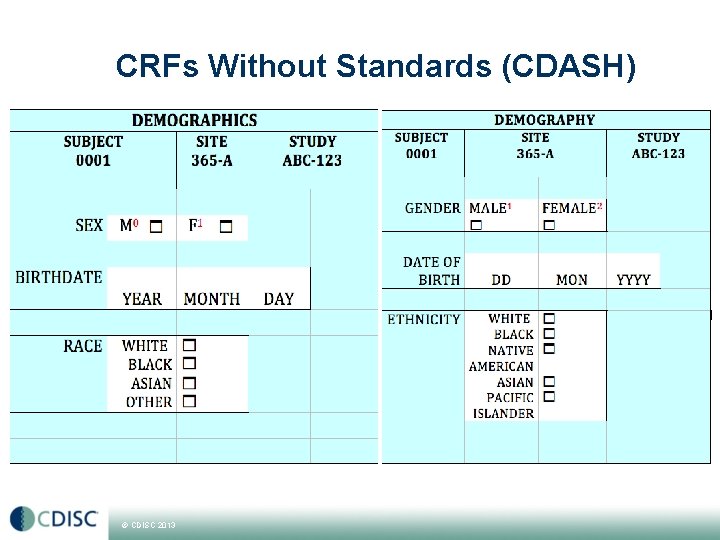
CRFs Without Standards (CDASH) © CDISC 2013
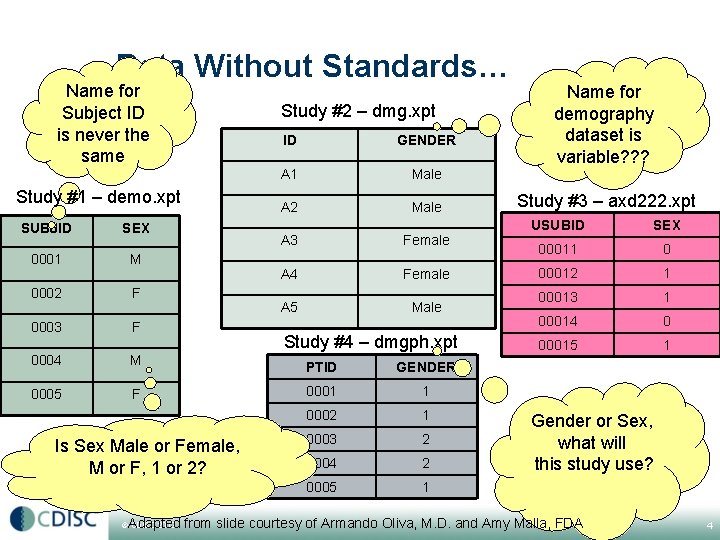
Data Without Standards… Name for Subject ID is never the same Study #1 – demo. xpt SUBJID SEX 0001 M 0002 F 0003 F Study #2 – dmg. xpt ID GENDER A 1 Male A 2 Male A 3 Female A 4 Female A 5 Male Study #4 – dmgph. xpt 0004 M PTID GENDER 0005 F 0001 1 0002 1 0003 2 0004 2 0005 1 Is Sex Male or Female, M or F, 1 or 2? Name for demography dataset is variable? ? ? Study #3 – axd 222. xpt USUBID SEX 00011 0 00012 1 00013 1 00014 0 00015 1 Gender or Sex, what will this study use? Adapted from slide courtesy of Armando Oliva, M. D. and Amy Malla, FDA © CDISC 2013 4
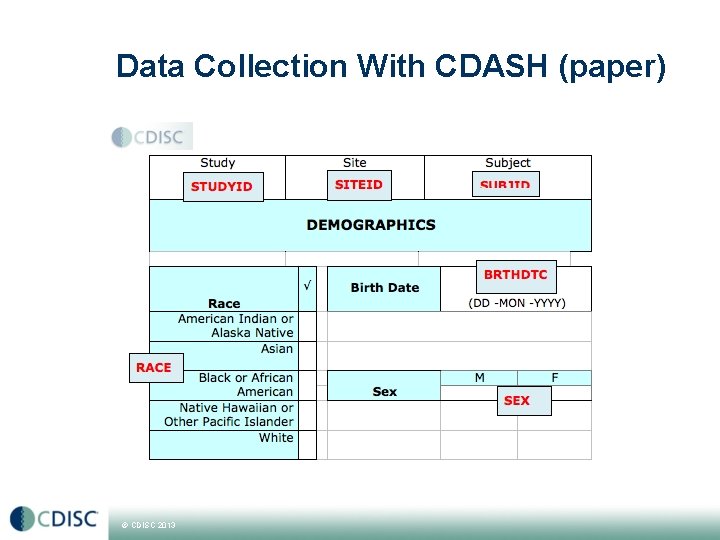
Data Collection With CDASH (paper) © CDISC 2013
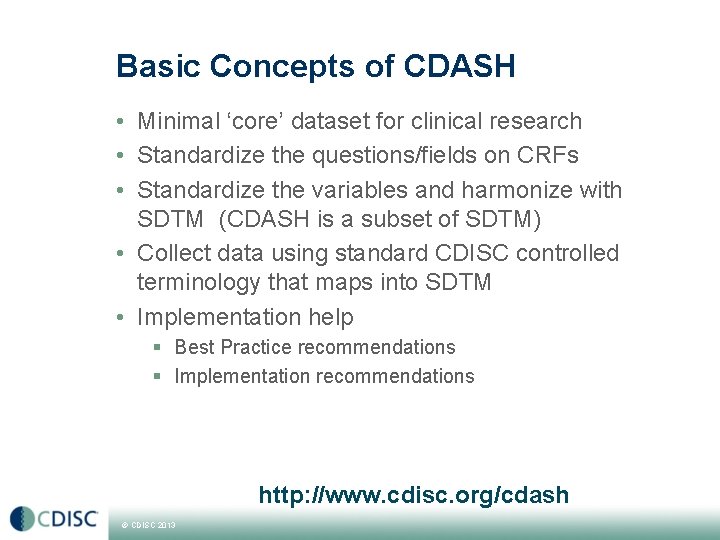
Basic Concepts of CDASH • Minimal ‘core’ dataset for clinical research • Standardize the questions/fields on CRFs • Standardize the variables and harmonize with SDTM (CDASH is a subset of SDTM) • Collect data using standard CDISC controlled terminology that maps into SDTM • Implementation help § Best Practice recommendations § Implementation recommendations http: //www. cdisc. org/cdash © CDISC 2013
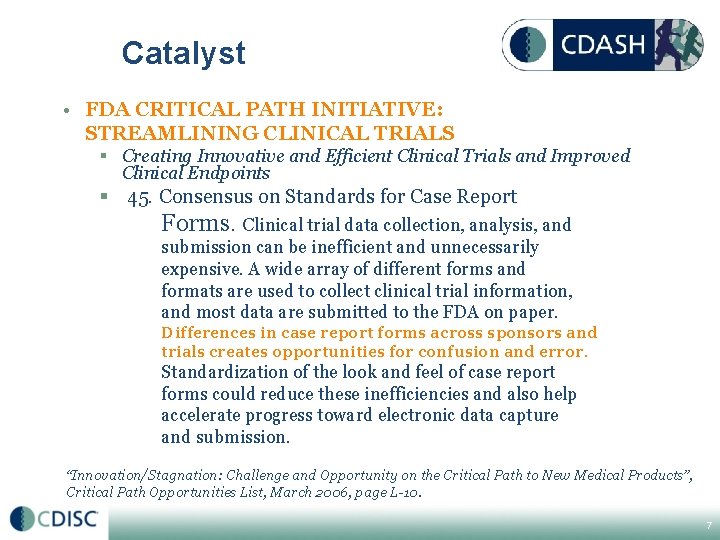
Catalyst • FDA CRITICAL PATH INITIATIVE: STREAMLINING CLINICAL TRIALS § Creating Innovative and Efficient Clinical Trials and Improved Clinical Endpoints § 45. Consensus on Standards for Case Report Forms. Clinical trial data collection, analysis, and submission can be inefficient and unnecessarily expensive. A wide array of different forms and formats are used to collect clinical trial information, and most data are submitted to the FDA on paper. Differences in case report forms across sponsors and trials creates opportunities for confusion and error. Standardization of the look and feel of case report forms could reduce these inefficiencies and also help accelerate progress toward electronic data capture and submission. “Innovation/Stagnation: Challenge and Opportunity on the Critical Path to New Medical Products”, Critical Path Opportunities List, March 2006, page L-10. 7
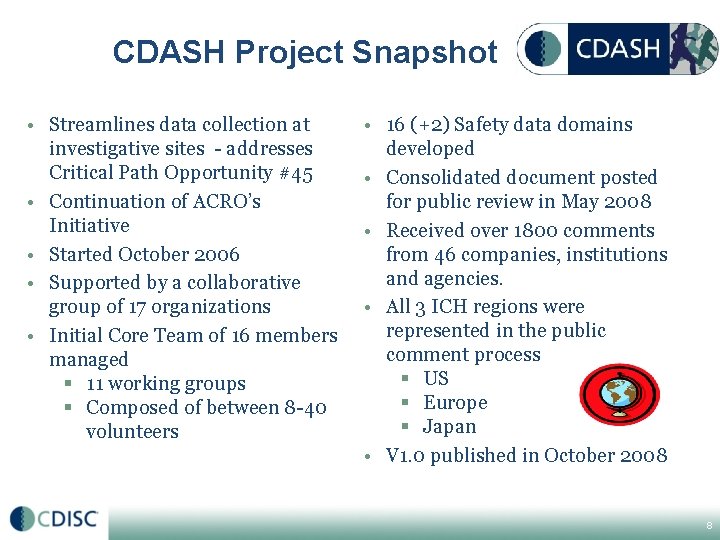
CDASH Project Snapshot • Streamlines data collection at investigative sites - addresses Critical Path Opportunity #45 • Continuation of ACRO’s Initiative • Started October 2006 • Supported by a collaborative group of 17 organizations • Initial Core Team of 16 members managed § 11 working groups § Composed of between 8 -40 volunteers • 16 (+2) Safety data domains developed • Consolidated document posted for public review in May 2008 • Received over 1800 comments from 46 companies, institutions and agencies. • All 3 ICH regions were represented in the public comment process § US § Europe § Japan • V 1. 0 published in October 2008 8
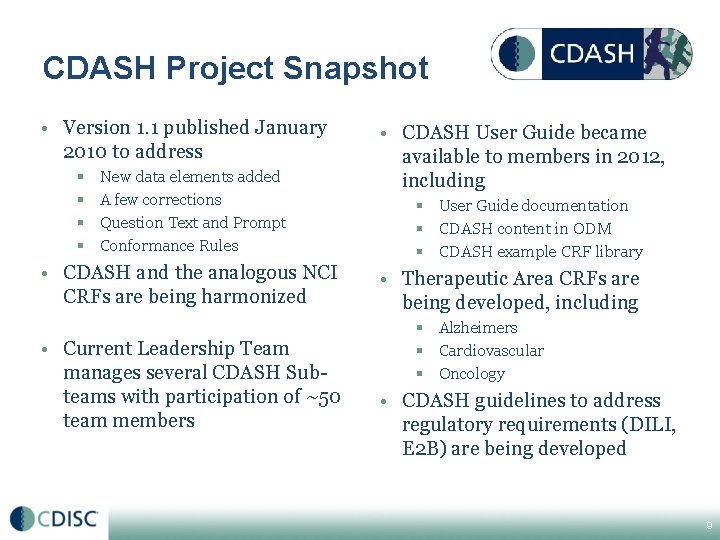
CDASH Project Snapshot • Version 1. 1 published January 2010 to address § § New data elements added A few corrections Question Text and Prompt Conformance Rules • CDASH and the analogous NCI CRFs are being harmonized • Current Leadership Team manages several CDASH Subteams with participation of ~50 team members • CDASH User Guide became available to members in 2012, including § User Guide documentation § CDASH content in ODM § CDASH example CRF library • Therapeutic Area CRFs are being developed, including § Alzheimers § Cardiovascular § Oncology • CDASH guidelines to address regulatory requirements (DILI, E 2 B) are being developed 9
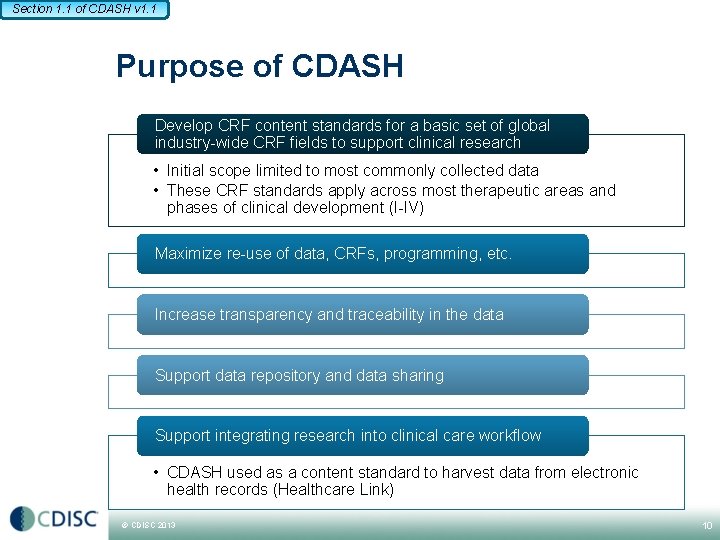
Section 1. 1 of CDASH v 1. 1 Purpose of CDASH Develop CRF content standards for a basic set of global industry-wide CRF fields to support clinical research • Initial scope limited to most commonly collected data • These CRF standards apply across most therapeutic areas and phases of clinical development (I-IV) Maximize re-use of data, CRFs, programming, etc. Increase transparency and traceability in the data Support data repository and data sharing Support integrating research into clinical care workflow • CDASH used as a content standard to harvest data from electronic health records (Healthcare Link) © CDISC 2013 10
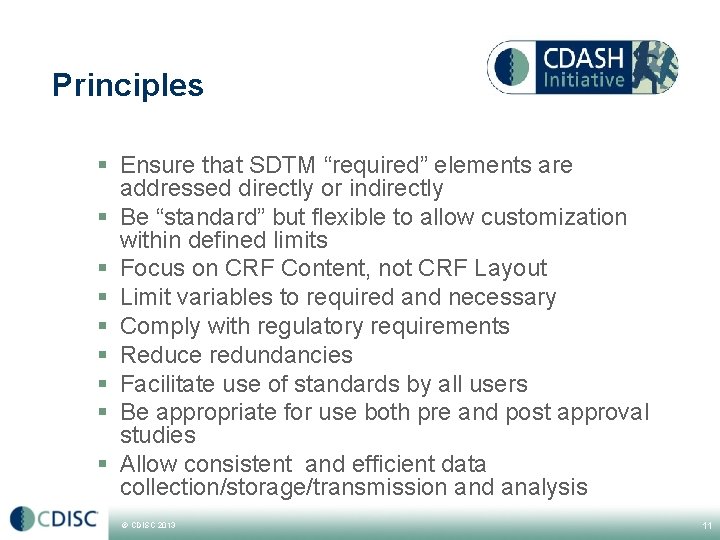
Principles § Ensure that SDTM “required” elements are addressed directly or indirectly § Be “standard” but flexible to allow customization within defined limits § Focus on CRF Content, not CRF Layout § Limit variables to required and necessary § Comply with regulatory requirements § Reduce redundancies § Facilitate use of standards by all users § Be appropriate for use both pre and post approval studies § Allow consistent and efficient data collection/storage/transmission and analysis © CDISC 2013 11
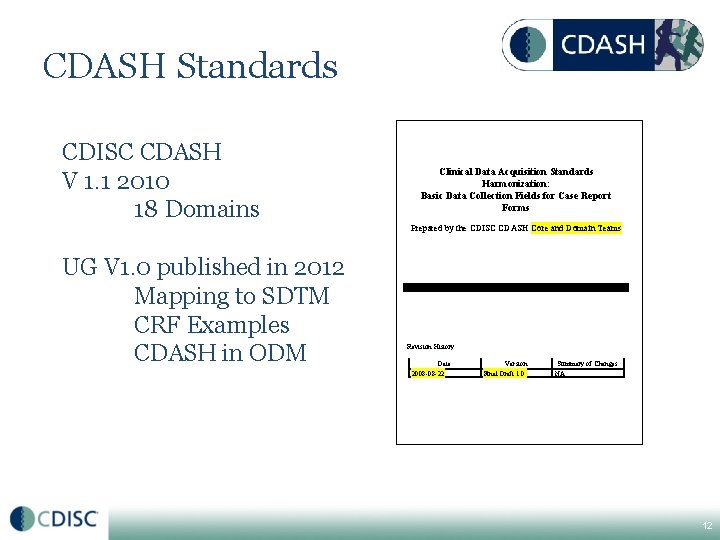
CDASH Standards CDISC CDASH V 1. 1 2010 18 Domains UG V 1. 0 published in 2012 Mapping to SDTM CRF Examples CDASH in ODM Clinical Data Acquisition Standards Harmonization: Basic Data Collection Fields for Case Report Forms Prepared by the CDISC CDASH Core and Domain Teams Revision History Date 2008 -08 -22 Version Final Draft 1. 0 Summary of Changes NA 12
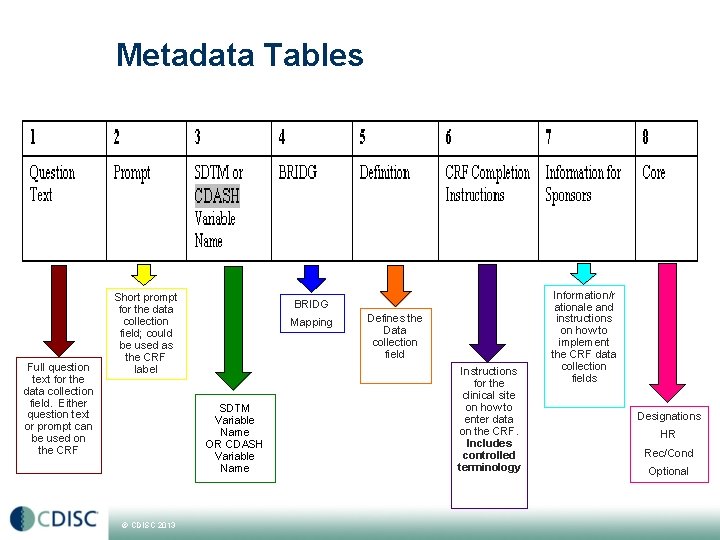
Metadata Tables Full question text for the data collection field. Either question text or prompt can be used on the CRF Short prompt for the data collection field; could be used as the CRF label BRIDG Mapping SDTM Variable Name OR CDASH Variable Name © CDISC 2013 Defines the Data collection field Instructions for the clinical site on how to enter data on the CRF. Includes controlled terminology Information/r ationale and instructions on how to implement the CRF data collection fields Designations HR Rec/Cond Optional
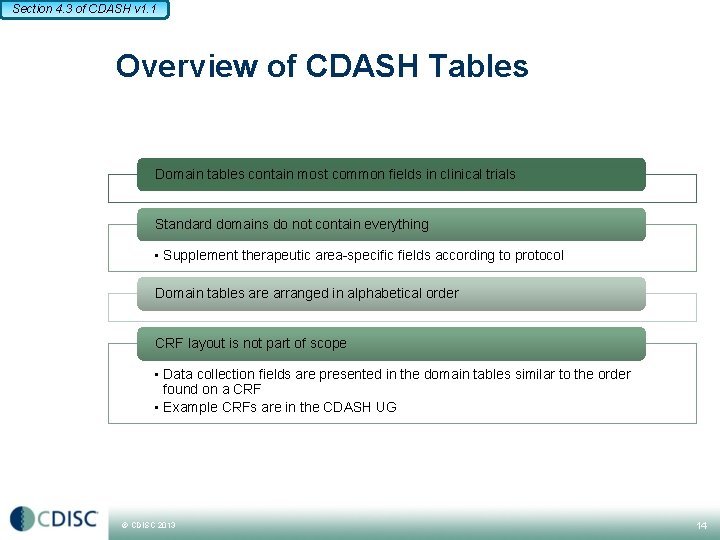
Section 4. 3 of CDASH v 1. 1 Overview of CDASH Tables Domain tables contain most common fields in clinical trials Standard domains do not contain everything • Supplement therapeutic area-specific fields according to protocol Domain tables are arranged in alphabetical order CRF layout is not part of scope • Data collection fields are presented in the domain tables similar to the order found on a CRF • Example CRFs are in the CDASH UG © CDISC 2013 14
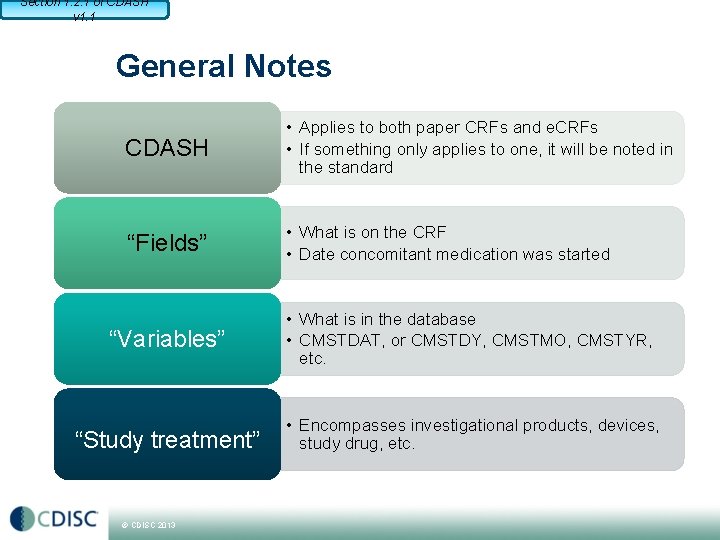
Section 1. 2. 1 of CDASH v 1. 1 General Notes CDASH • Applies to both paper CRFs and e. CRFs • If something only applies to one, it will be noted in the standard “Fields” • What is on the CRF • Date concomitant medication was started “Variables” • What is in the database • CMSTDAT, or CMSTDY, CMSTMO, CMSTYR, etc. “Study treatment” • Encompasses investigational products, devices, study drug, etc. © CDISC 2013
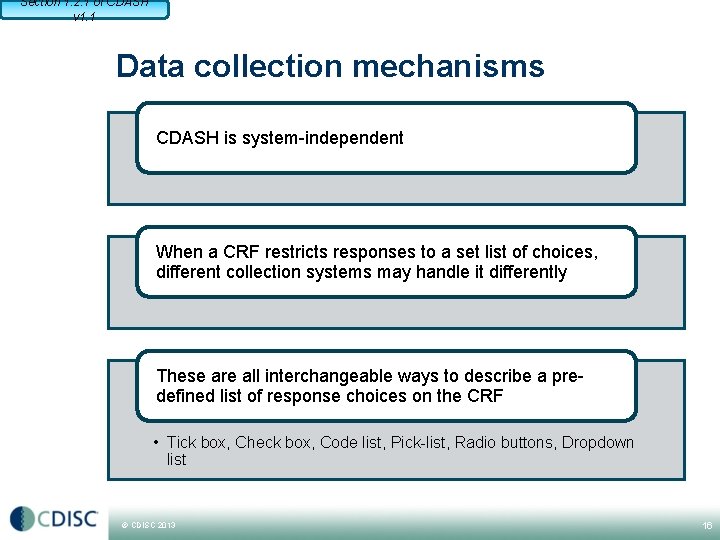
Section 1. 2. 1 of CDASH v 1. 1 Data collection mechanisms CDASH is system-independent When a CRF restricts responses to a set list of choices, different collection systems may handle it differently These are all interchangeable ways to describe a predefined list of response choices on the CRF • Tick box, Check box, Code list, Pick-list, Radio buttons, Dropdown list © CDISC 2013 16
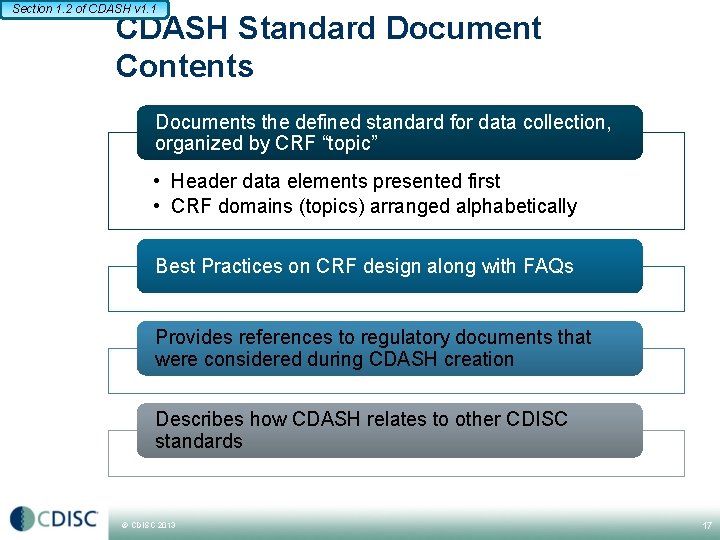
Section 1. 2 of CDASH v 1. 1 CDASH Standard Document Contents Documents the defined standard for data collection, organized by CRF “topic” • Header data elements presented first • CRF domains (topics) arranged alphabetically Best Practices on CRF design along with FAQs Provides references to regulatory documents that were considered during CDASH creation Describes how CDASH relates to other CDISC standards © CDISC 2013 17
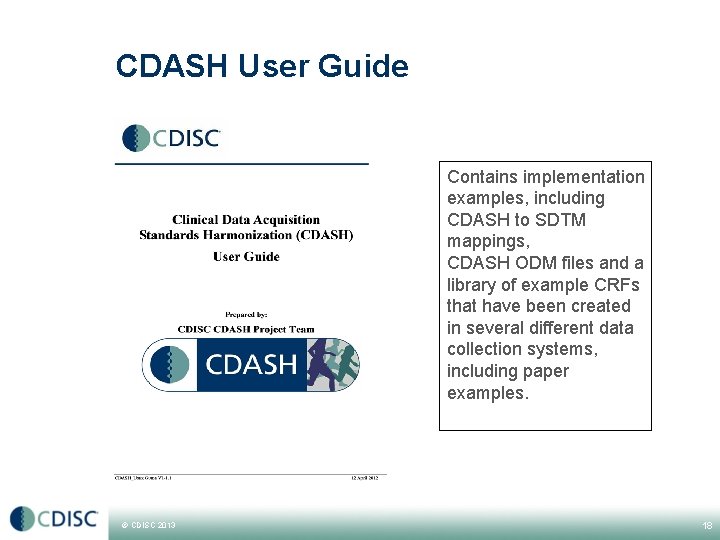
CDASH User Guide Contains implementation examples, including CDASH to SDTM mappings, CDASH ODM files and a library of example CRFs that have been created in several different data collection systems, including paper examples. © CDISC 2013 18
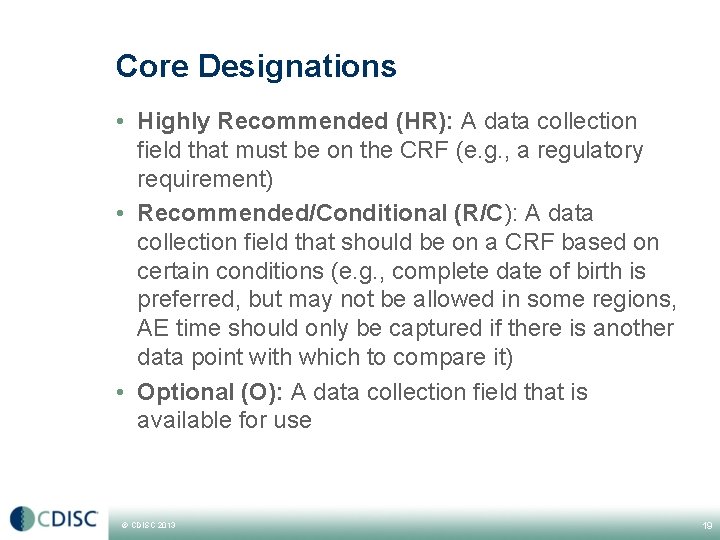
Core Designations • Highly Recommended (HR): A data collection field that must be on the CRF (e. g. , a regulatory requirement) • Recommended/Conditional (R/C): A data collection field that should be on a CRF based on certain conditions (e. g. , complete date of birth is preferred, but may not be allowed in some regions, AE time should only be captured if there is another data point with which to compare it) • Optional (O): A data collection field that is available for use © CDISC 2013 19
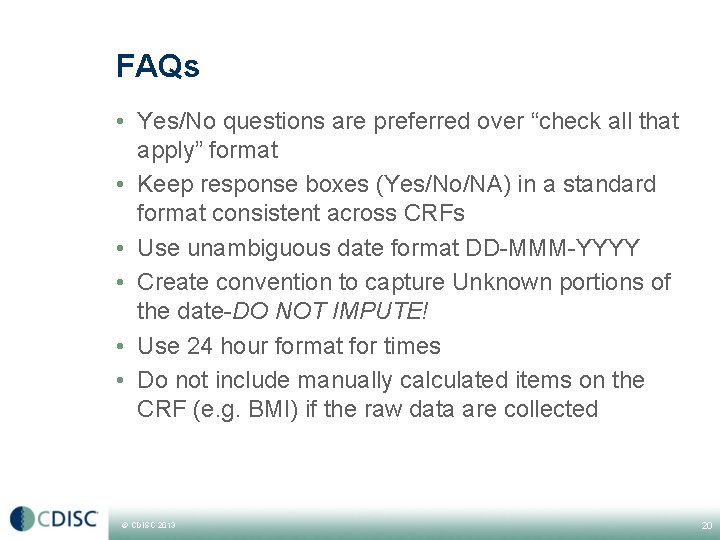
FAQs • Yes/No questions are preferred over “check all that apply” format • Keep response boxes (Yes/No/NA) in a standard format consistent across CRFs • Use unambiguous date format DD-MMM-YYYY • Create convention to capture Unknown portions of the date-DO NOT IMPUTE! • Use 24 hour format for times • Do not include manually calculated items on the CRF (e. g. BMI) if the raw data are collected © CDISC 2013 20
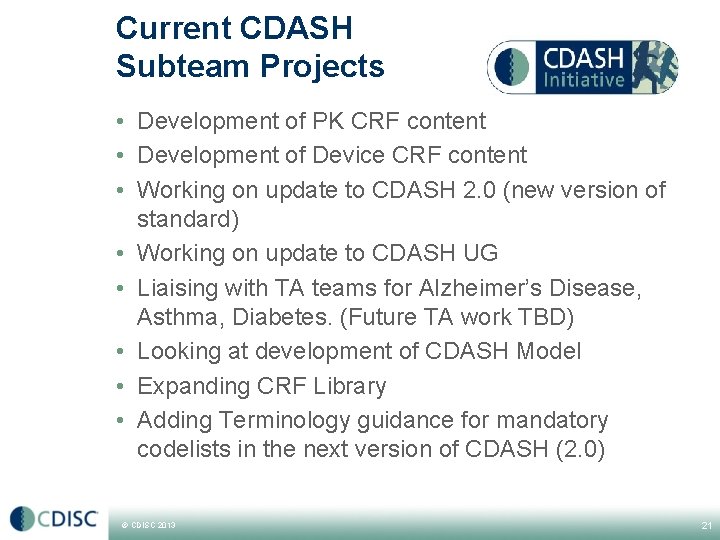
Current CDASH Subteam Projects • Development of PK CRF content • Development of Device CRF content • Working on update to CDASH 2. 0 (new version of standard) • Working on update to CDASH UG • Liaising with TA teams for Alzheimer’s Disease, Asthma, Diabetes. (Future TA work TBD) • Looking at development of CDASH Model • Expanding CRF Library • Adding Terminology guidance for mandatory codelists in the next version of CDASH (2. 0) © CDISC 2013 21
CDASH Overview Q&A © CDISC 2013 22