Pathways Out of Poverty True Integration Through Coalition

- Slides: 47
Pathways Out of Poverty: True Integration Through Coalition Building and Public Solidarity john a. powell Executive Director, Kirwan Institute for the Study of Race and Ethnicity Williams Chair in Civil Rights and Civil Liberties, Moritz College of Law The Ohio State University October 25, 2007
American Narrative on Poverty l l Self sufficiency and anti-government (ownership society) Responsibility tied only to the individual Deserving (children/innocence) and undeserving poor (mostly people of color) Resulting in durable, persistent and racialized poverty 2
Attitudes Toward the Poor l Perceived causes of poverty l l l Internal controllable causality (e. g. , lack of effort) > personal responsibility Internal uncontrollable causality (e. g. , illness) > no one is responsible External controllable causality (e. g. , government policy) > others are responsible External uncontrollable causality (e. g. , bad luck) > no one is responsible Perceptions regarding the poor (worthy or unworthy, deserving or not deserving, and moral or immoral) guide disparate emotional reactions and pro- versus anti-social behavioral responses. 3 Source: Weiner, Bernard. “When Poverty is a Moral Failure. ”
Attitudes Toward the Poor l “Why Americans hate welfare” (Gilens) l l Racial attitudes toward welfare recipients as undeserving The “undeserving poor” are assumed to be black, lazy, and lacking in commitment to the work ethic. Media overrepresentation of the level of black welfare dependence Ethnic and racial fractualization (Alesina & Glaeser) l l Racial fractualization correlated with income differences “All poor are lazy” – racial differences between rich and poor facilitated the propagation of this view Sources: Alesina, Alberto and Glaeser, Edward L. “Fighting poverty in the US and Europe: A world of difference” Gilens, Martin. “Why Americans Hate Welfare: Race, Media, and the Politics of Antipoverty Policy” 4
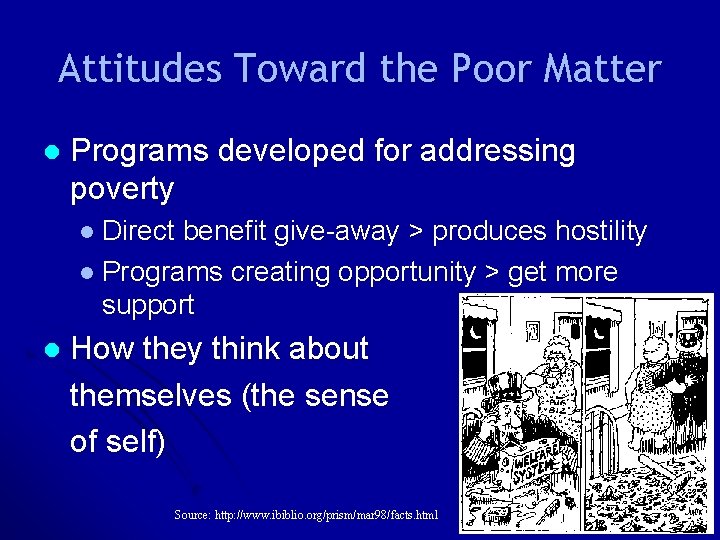
Attitudes Toward the Poor Matter l Programs developed for addressing poverty l Direct benefit give-away > produces hostility l Programs creating opportunity > get more support l How they think about themselves (the sense of self) Source: http: //www. ibiblio. org/prism/mar 98/facts. html 5
Individual vs. Collective Responsibility l l Poverty viewed as personal/cultural failure Emphasizing poverty as a result of personal or family failure to take advantage of opportunities or lack of motivation l l System Justification The poor deserve to be poor A highly racialized perspective Linked to the narrative of the “American Dream” 6
Individual vs. Collective Responsibility l l Poverty viewed as structural failure Recognizes poverty as the result of inequitable access to opportunities l l “A Failure of Opportunity” The dominant frame of the left l l Current debates of the left are lacking, focusing more on class not race Ignores the fact that most structural arrangements producing poverty are racialized 7
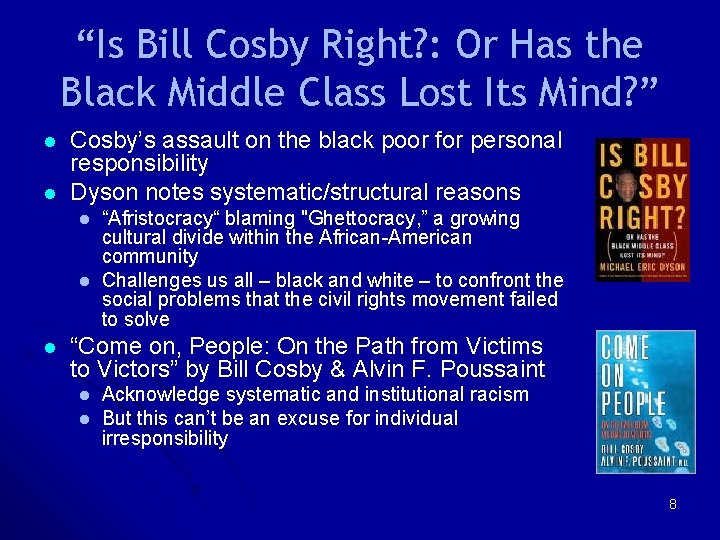
“Is Bill Cosby Right? : Or Has the Black Middle Class Lost Its Mind? ” l l Cosby’s assault on the black poor for personal responsibility Dyson notes systematic/structural reasons l l l “Afristocracy“ blaming "Ghettocracy, ” a growing cultural divide within the African-American community Challenges us all – black and white – to confront the social problems that the civil rights movement failed to solve “Come on, People: On the Path from Victims to Victors” by Bill Cosby & Alvin F. Poussaint l l Acknowledge systematic and institutional racism But this can’t be an excuse for individual irresponsibility 8
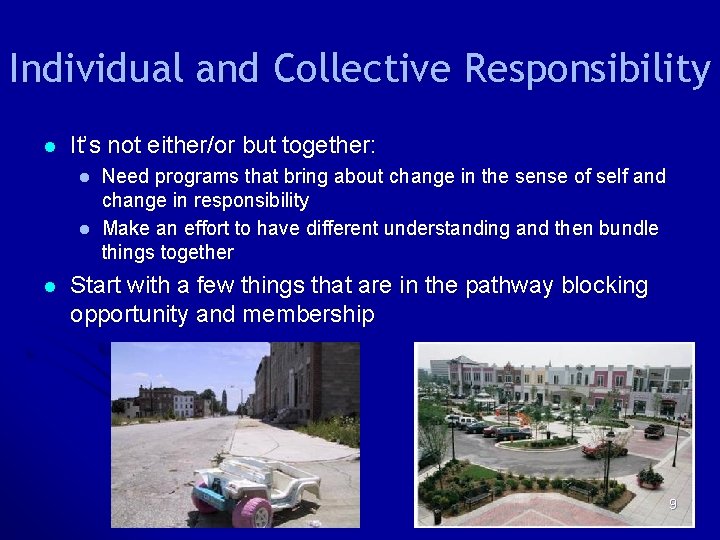
Individual and Collective Responsibility l It’s not either/or but together: l l l Need programs that bring about change in the sense of self and change in responsibility Make an effort to have different understanding and then bundle things together Start with a few things that are in the pathway blocking opportunity and membership 9
What do we mean by “Addressing Poverty”? l What are human needs? l Needs of persons l Needs to maintain order and stability (Hobbes, Nozick) l Need for Legitimacy > Membership (powell) l What is poverty? l Income or wealth l Freedom (Sen) l Membership (powell) Sources: Sen, Amartya. “Development as Freedom” powell, john a. “The Needs of Members in a Legitimate Democratic State” Source: Klein, David G. 10
Expanding our Understanding of Poverty l l l Poverty (and wealth) is measured by more than income, but by the capability to live the life one can value and contribute to society, a stable and sustainable existence Poverty is the deprivation of basic capabilities, including health and education People in poverty cannot fully exercise their freedoms l Amartya Sen, Development as Freedom (1999) 11
What is Freedom? l l Freedoms are many and varied, and they complement and strengthen one another Sen’s “Five Freedoms” l l l Political freedoms Economic facilities Social opportunities Transparency guarantees Protective security Economic development and social development are complementary, not competing, freedoms l Amartya Sen, Development as Freedom (1999) 12 Image: Rendering of the Freedom Tower released June 27, 2006.
Membership in a Legitimate Democratic State l Membership, the most important good that we distribute to one another in human community (Michael Walzer) l l Prior in importance even to freedom Citizenship, a precondition to freedom Membership, a precondition to citizenship Distribution of membership 13
Capability Inequalities and Needs of Members l l l Individual responsibilities and capabilities are affected by health, gender, income, geographic location What people need to become full members of the society is, everything! We need to look not just at income inequality, but at inequalities in: education, health care, housing, geographical (regional) inequalities 14
Who are Members? l And who are not real members? l l Race, class, gender, sexual orientation, etc. l l Theory of citizenship What about poor women of color? Separating people and isolating the poor l l l Affects everybody. Everybody is on their own! Problems with social welfare in the US. Privatizing public issues (eg. healthcare, global warming, poverty, education, prison, etc. ) 15
Racialization of Poverty Many feel that this racialization of concentrated poverty has improved in recent years. l In 1960, African-American families in poverty were 3. 8 times more likely to be concentrated in high-poverty neighborhoods than poor whites. l In 2000, they were 7. 3 times more likely. l Fact Sheet from the Opportunity Agenda, Housing Neighborhoods and Opportunity. http: //www. opportunityagenda. org/site/c. mw. L 5 Kk. N 0 Lv. H/b. 1433711/k. B 7 BA/Housing_Fact_Sheet. htm 16
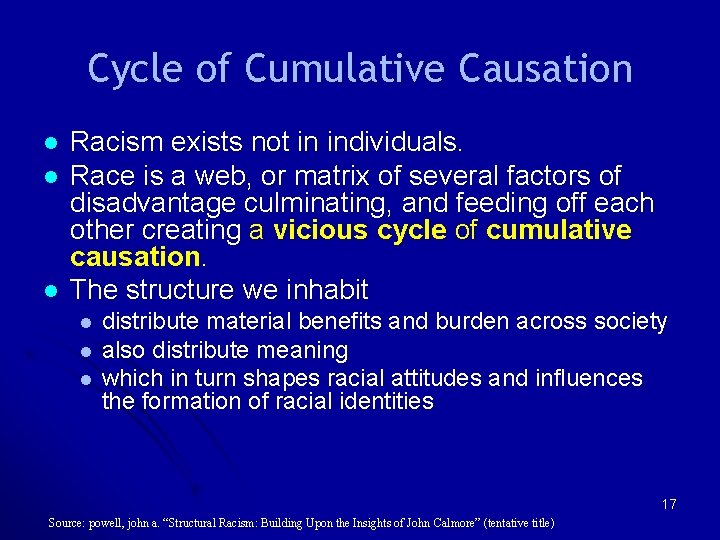
Cycle of Cumulative Causation l l l Racism exists not in individuals. Race is a web, or matrix of several factors of disadvantage culminating, and feeding off each other creating a vicious cycle of cumulative causation. The structure we inhabit l l l distribute material benefits and burden across society also distribute meaning which in turn shapes racial attitudes and influences the formation of racial identities 17 Source: powell, john a. “Structural Racism: Building Upon the Insights of John Calmore” (tentative title)
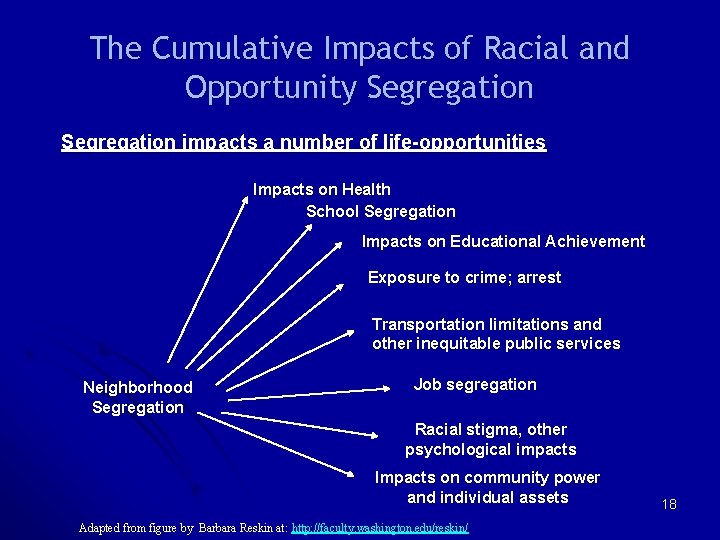
The Cumulative Impacts of Racial and Opportunity Segregation impacts a number of life-opportunities Impacts on Health School Segregation Impacts on Educational Achievement Exposure to crime; arrest Transportation limitations and other inequitable public services Neighborhood Segregation Job segregation Racial stigma, other psychological impacts Impacts on community power and individual assets Adapted from figure by Barbara Reskin at: http: //faculty. washington. edu/reskin/ 18
Programs Addressing Poverty l Strategic mistakes of separating the poor from everybody else l l l Programs that enjoy the most support are the ones targeting the non-poor (eg. social security) Programs targeting a particular racial group separate them from the other … Not much attention paid to why whites should care about integration “What about us? ” - poor white middle class reacting to social justice work Need programs that link the poor and the non-poor 19
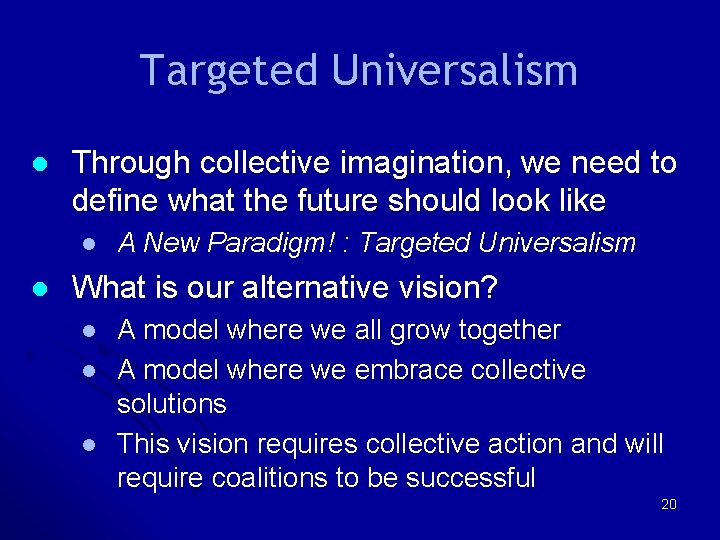
Targeted Universalism l Through collective imagination, we need to define what the future should look like l l A New Paradigm! : Targeted Universalism What is our alternative vision? l l l A model where we all grow together A model where we embrace collective solutions This vision requires collective action and will require coalitions to be successful 20
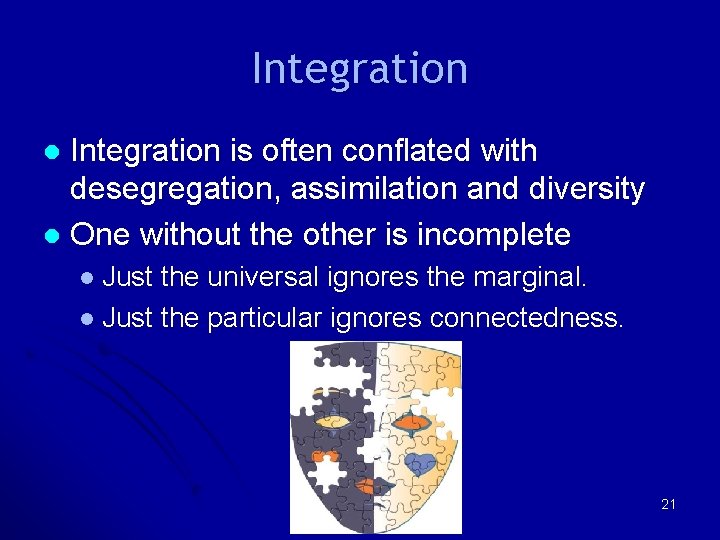
Integration is often conflated with desegregation, assimilation and diversity l One without the other is incomplete l l Just the universal ignores the marginal. l Just the particular ignores connectedness. 21
Integration into Opportunity Segregation is more than just the physical isolation of people l Segregation is isolation from opportunity or opportunity structures l Integration is not just about bringing in more people. l Integration into opportunity l 22
Integration l l l We are constantly making our commonality. It is there and not there. Because we are both the same and different, dialogue is necessary and possible. l l If we were all just the same, dialogue would not be necessary. If we were just different, dialogue would not be possible. This project is not just one of distributing benefit but also identity. It is a deeply political, practical and spiritual issue. 23
True Integration l l l Creative and respective of inter-group relations based on mutuality, equality and fairness Transformative rather than assimilative Transforms and enriches the mainstream (cf. desegregation, at best, attempts to assimilate “minorities” into the mainstream) 24
Coalition building Move from transactional level to a deeper level l Coalition across groups, space, ideology l Ethics of connectedness and linked fate l l We are seeing us as disconnected. l Structure in our society is disconnecting us (eg. public utility, public transportation) 25
Transformative View of Race Strategic and transformative use of race requires that we show all groups, including whites, are helped and harmed by our current institutional arrangements. l Structural analysis enables us to understand race as a transformative instrument for change. l Source: powell, john a. “Race and Transformative Agenda” 26
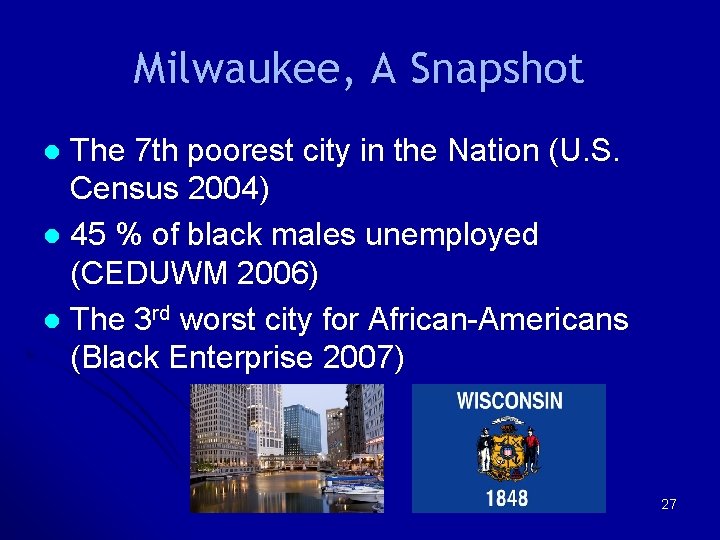
Milwaukee, A Snapshot The 7 th poorest city in the Nation (U. S. Census 2004) l 45 % of black males unemployed (CEDUWM 2006) l The 3 rd worst city for African-Americans (Black Enterprise 2007) l 27
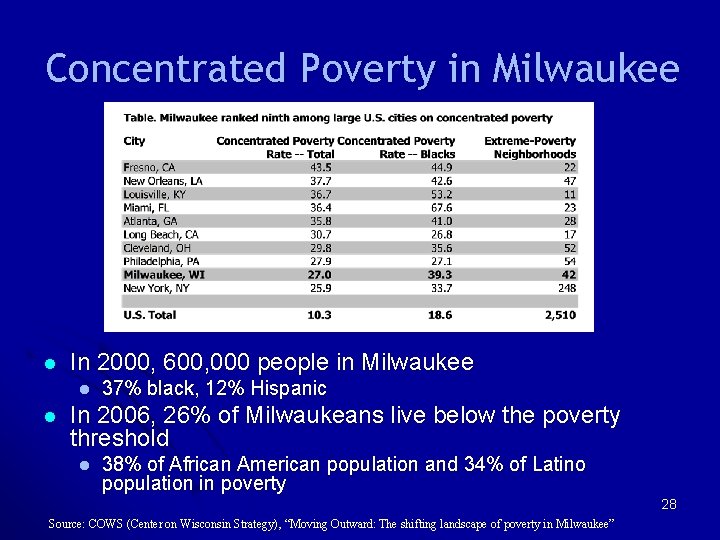
Concentrated Poverty in Milwaukee l In 2000, 600, 000 people in Milwaukee l l 37% black, 12% Hispanic In 2006, 26% of Milwaukeans live below the poverty threshold l 38% of African American population and 34% of Latino population in poverty 28 Source: COWS (Center on Wisconsin Strategy), Strategy) “Moving Outward: The shifting landscape of poverty in Milwaukee”
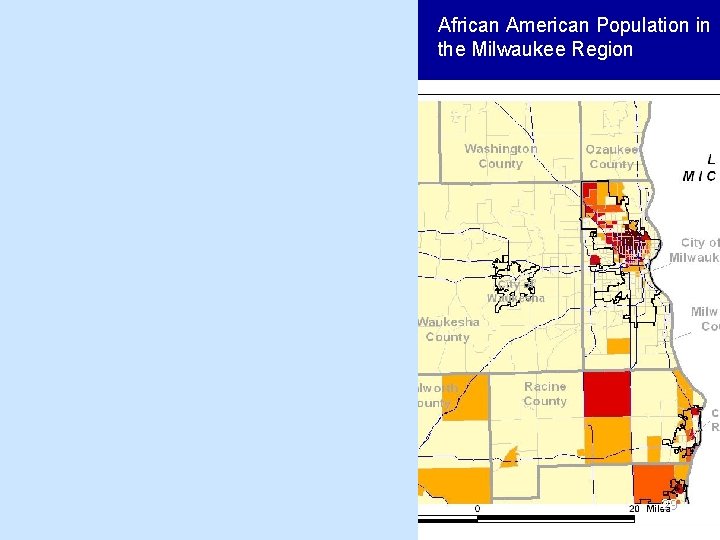
African American Population in the Milwaukee Region 29
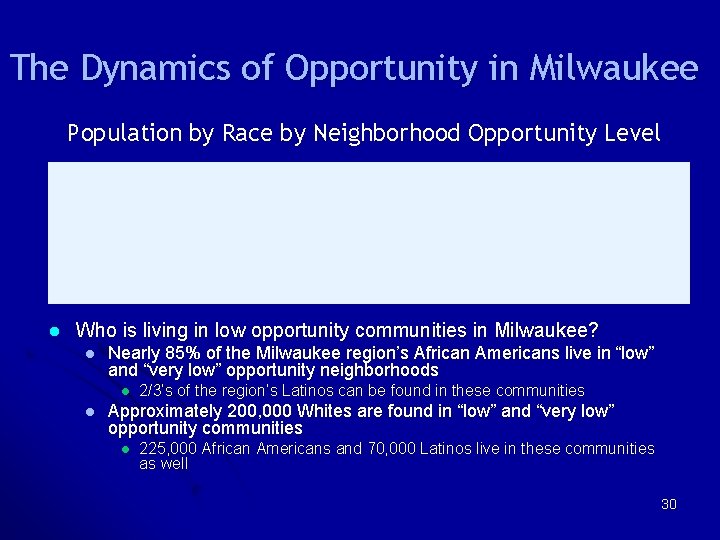
The Dynamics of Opportunity in Milwaukee Population by Race by Neighborhood Opportunity Level l Who is living in low opportunity communities in Milwaukee? l Nearly 85% of the Milwaukee region’s African Americans live in “low” and “very low” opportunity neighborhoods l l 2/3’s of the region’s Latinos can be found in these communities Approximately 200, 000 Whites are found in “low” and “very low” opportunity communities l 225, 000 African Americans and 70, 000 Latinos live in these communities as well 30
l Subsidized Housing and Poverty in the Milwaukee Region 1998 is concentrated in higher poverty areas. l Milwaukee needs approximately 28, 000 units of housing for extremely low income families. (Comprehensive Housing Affordability Survey, HUD, 2004) 31
Milwaukee Initiatives l A Review of the Milwaukee Workforce Development System l l l Low level of business involvement Separation of Workforce Development funding streams Lack of employment and training service coordination Inadequate transitional support of new workers and Meager career development opportunities 32 Source: “A Review of the Milwaukee Workforce Development System and Recommendations for Improvements”
Milwaukee Initiatives l Residents Preference Program (1991 ~ ) l l New Hope Project (1994 ~ ) l l Income supplement, subsidized health and child care, job search assistance Housing Trust Fund (2006 ~ ) l l Requires 25% of all hours worked on city public works contracts be performed by residents in poor areas of the city Assist in the construction and rehabilitation of affordable housing for both for-profit and non-profit developers Need for collaborative initiatives 33
Examples of Successful Programs l Chicago, IL - Center for Working Families l A new approach to help low-income families l l Portland, OR l l l increase their earnings and income ("Earn It"), reduce their financial transaction costs ("Keep It"), and build wealth for themselves and their communities ("Grow It") Assign recipients to adult education, vocational training, or life skills classes depending on their skills and needs. An employment focus, the use of both job search and short-term education or training, and an emphasis on holding out for a good job Suggests a need to bundle things together Sources: “A Review of the Milwaukee Workforce Development System and Recommendations for Improvements, ” 2007 “Moving People from Welfare to Work: Lessons from the National Evaluation of Welfare-to-Work Strategies, ” 2002 34
Pathways Out of Poverty l l Think about how to serve the poor without isolating the poor Identify, test and help sustain pathways out of poverty See people move along a road to selfsufficiency Ensure access to meaningful opportunity is shared fairly, giving all children, adults, and families and communities a chance to live free of poverty 35
Public Face of Love is Solidarity l “We are all caught up in an inescapable network of mutuality, tied in a single garment of destiny. Whatever effects one directly effects all indirectly. ” - The Rev. Dr. Martin Luther King, Jr. l What Are Community Values? (Video clip) 36
www. Kirwan. Institute. org 37
Addendum Our current paradigm and its effects on social justice work l Race and Class l Integration vs. Desegregation (Dr. Martin Luther King, Jr. ) l 38
Our Current Paradigm l Hobbesian, isolated, radically individualistic l Perceives individuals as autonomousindependent selves l Egoistic, possessive, separate, isolated, rational l Role of state: protect individualism and individual property 39 Addendum
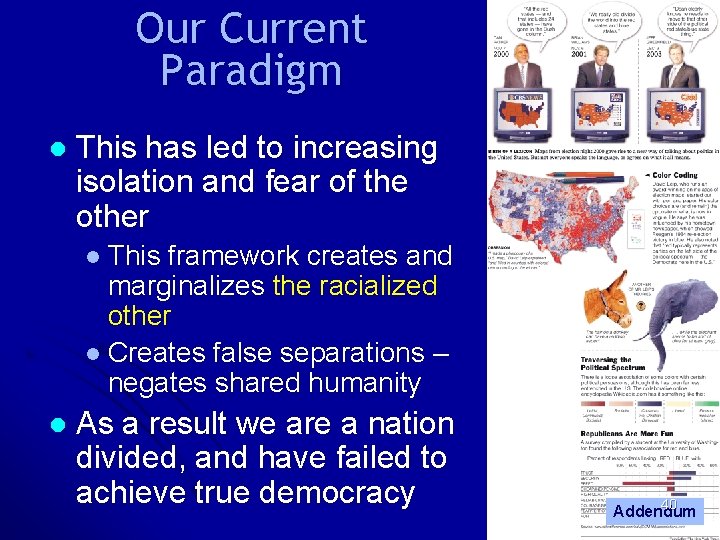
Our Current Paradigm l This has led to increasing isolation and fear of the other l This framework creates and marginalizes the racialized other l Creates false separations – negates shared humanity l As a result we are a nation divided, and have failed to achieve true democracy 40 Addendum
Effects of Current Paradigm on Social Justice Work l Within this framework, social justice work: l Overlooks opportunities for coalition building l Is more fragmented and isolated l May be competitive and divisive l Can lead to guilt or disempowerment l Is not connected to an overarching set of shared values l Lacks a cohesive and unified vision! 41 Addendum
Race and Class l l l From this nation’s inception, the race line was used to demarcate and patrol the divide between those who constituted the “We” in “We The People. ” Race is a critical part of the construction of classas-merit. It is this individualistic ideology that helps to defeat class solidarity. According to economists Alberto Alesina and Edwans Glaeser, much of the difference between America and European welfare systems can be explained by racial heterogeneity. 42 Addendum
Race and Class Many today argue that class, not race, is the greatest cleavage in American society l There is a fear that talking about race will take away from class and economic concerns l Race and class, however, cannot be so easily separated l 43 Addendum
Race and Class As related sociological phenomena, race and class analyses are strongest when employed together l Race and class are mutually constitutive l l Differential treatment of indentured servants and black slaves—led to barriers in collective organization l Led to racial distinction—middle class individualism and the black underclass as “unworthy” 44 Addendum
Race and Class l Race left a heavy footprint on class l Entrenched racial divide continues today l White face on the suburban middle class, allowed for stereotyping of the “black welfare queen”—which prevented the development of a welfare state similar to Europe or Canada l Racial associations made with certain occupations—example of class and race interacting 45 Addendum
Connecting Race and Class l l l Class may be understood even less than race, but it is important to recognize it as equally a cultural and economic formation Transformative potential lies in realizing the link between race and class—apply the knowledge of the limitations of middle-class merit thinking with the best scholarship on race A progressive agenda must account for race and not use class as a proxy. The most successful multi-racial, multi-class progressive movements in the United States tackled race directly 46 Addendum
Integration vs. Desegregation l l l “The word segregation represents a system that is prohibitive; it denies the Negro equal access to schools, parks, restaurants, libraries and the like. Desegregation is eliminative and negative, for it simply removes these legal and social prohibitions. ” “Integration is creative, and is therefore more profound and far-reaching than desegregation. Integration is the positive acceptance of desegregation and the welcomed participation of Negroes into the total range of human activities. ” “Integration is genuine intergroup, interpersonal doing. Desegregation then, rightly, is only a short-range goal. Integration is the ultimate goal of our national community. ” 47 Source: Dr. Martin Luther King, Jr. “The Ethical Demands of Integration. ” December 27, 1962. Addendum