Participation of children with Down syndrome in therapyintervention





- Slides: 18
Participation of children with Down syndrome in therapy/intervention Dr. Clare Carroll Discipline of Speech and Language Therapy School of Health Sciences NUIG Down Syndrome Research Forum Ireland 29 th March 2019 UCC Cork
Participating. . World Health Organisation (2002) states that participating is a process by which people are enabled to become actively involved in defining the issues of concern to them, in making decisions about factors that affect their lives. . Down Syndrome Research Forum Ireland 29 th March 2019 UCC Cork
Imms, Granlund, Wilson, Steenburger, Rosenbaum and Gordon (2017, p 16) ‘Participation can be both a process and an outcome of health and education services’. ‘Participation in meaningful life activities should be an essential intervention goal’. Down Syndrome Research Forum Ireland 29 th March 2019 UCC Cork
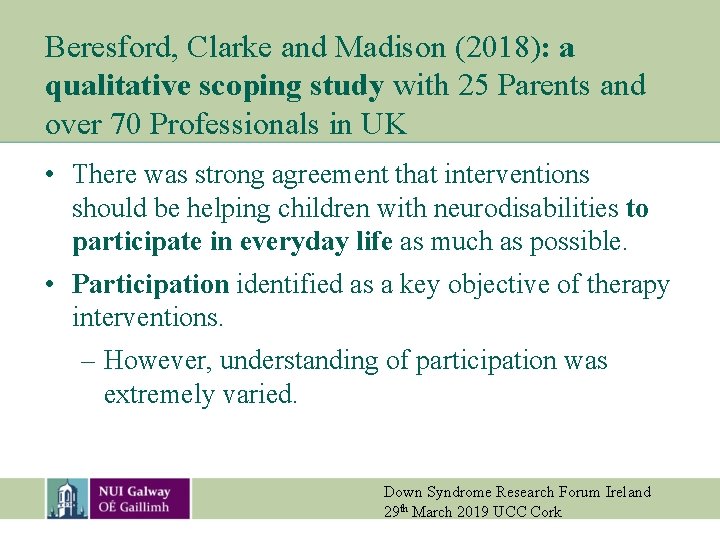
Beresford, Clarke and Madison (2018): a qualitative scoping study with 25 Parents and over 70 Professionals in UK • There was strong agreement that interventions should be helping children with neurodisabilities to participate in everyday life as much as possible. • Participation identified as a key objective of therapy interventions. – However, understanding of participation was extremely varied. Down Syndrome Research Forum Ireland 29 th March 2019 UCC Cork
Participation… Essential Element 1 Participation is involvement in a life situation (WHO, 2001) Attendance: ‘being there’ (frequency of attending, child’s range of activities) Essential Element 2 Involvement: ‘experience of participation while attending’ (engagement, persistence, motivation) Imms, Granlund, Wilson, Steenburger, Rosenbaum and Gordon (2017). Family of Participation Constructs.
Can professionals support the participation of a child and family in intervention without knowing their contexts, interests and needs? #childvoice #parentvoice Down Syndrome Research Forum Ireland 29 th March 2019 UCC Cork
Carroll, C. , Hannon, E. , Keane, N. & O’Connell, A. (2018) 3 qualitative case studies: Chloe (2 yrs 6 mths) Paul (3 yrs) Emily (3 yrs) Structured observations of the children in their intervention group and in their homes using an observation tool adapted from (Imms et al. 2016) Interviews with their parents Irish context Theme 1: Being there Individuality Abilities/skills Temperament Theme 3: Opportunities for Growth Professional Support Progressing Theme 2: Engagement Belonging Familiarity and routine People
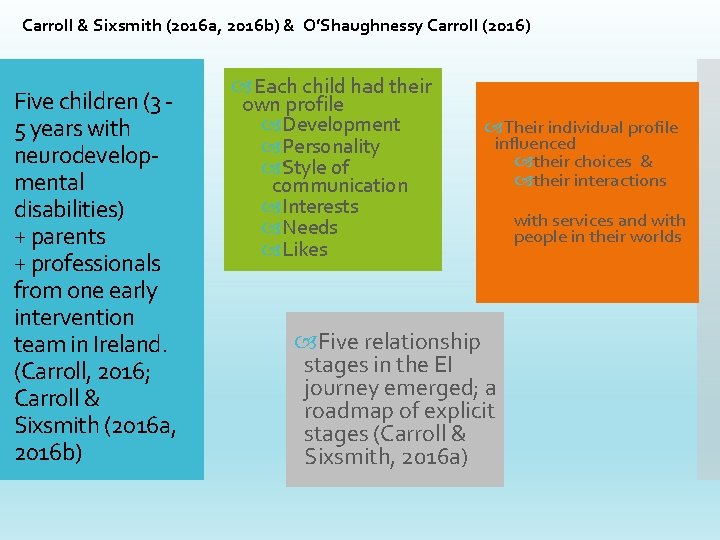
Carroll & Sixsmith (2016 a, 2016 b) & O’Shaughnessy Carroll (2016) Five children (3 5 years with neurodevelopmental disabilities) + parents + professionals from one early intervention team in Ireland. (Carroll, 2016; Carroll & Sixsmith (2016 a, 2016 b) Each child had their own profile Development Personality Style of communication Interests Needs Likes Their individual profile influenced their choices & their interactions Five relationship stages in the EI journey emerged; a roadmap of explicit stages (Carroll & Sixsmith, 2016 a) with services and with people in their worlds
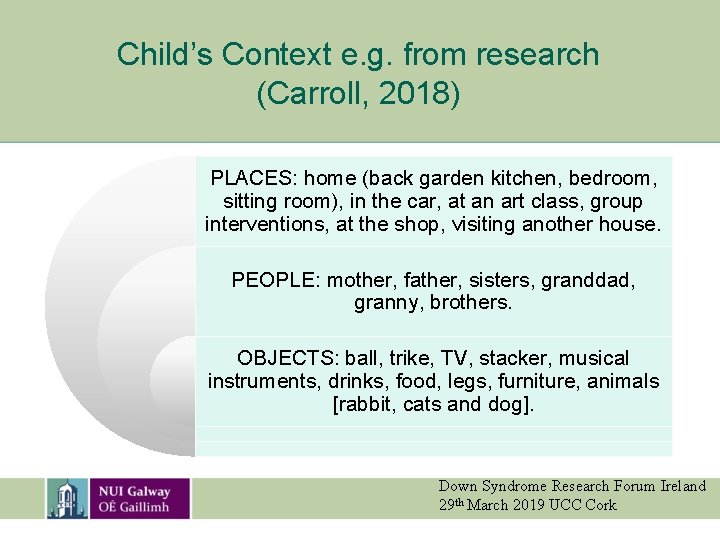
Child’s Context e. g. from research (Carroll, 2018) PLACES: home (back garden kitchen, bedroom, sitting room), in the car, at an art class, group interventions, at the shop, visiting another house. PEOPLE: mother, father, sisters, granddad, granny, brothers. OBJECTS: ball, trike, TV, stacker, musical instruments, drinks, food, legs, furniture, animals [rabbit, cats and dog]. Down Syndrome Research Forum Ireland 29 th March 2019 UCC Cork
Brennan, Lyons & Carroll (2016) 7 parents of children aged between 6 -12 years with DS from Ireland in interviews Theme 1: value of participation Skill development Enhanced wellbeing and sense of belonging Theme 2: barriers and facilitators to participation Child factors Attitudes and views of others Modifications to the environment Logistical issues
17 parents in 3 focus groups and 103 parents answered a questionnaire Parents of school-aged children with disabilities in Ireland Focus groups Need for consistency Intensive therapy Ongoing therapy into adulthood Therapist knowing child's needs Contact and awareness of therapy programme (teacher and therapist) Questionnaire: Significant associations Location of therapy and awareness of what happens Location of therapy and importance of relationships Location of therapy and need for therapy Location of therapy and perception that therapist and teacher were working closely Location of therapy and speech outcome and effect on child’s confidence Carroll (2010) Exploration of parents' perceptions and expectations of speech-language pathology services for children with intellectual disability.
Complexity and change • Beresford et al. (2018) • There is a wide variation in – Therapy interventions are complex. how services for young – All therapies (SLT, OT, Physio) are children with developmental undergoing many changes: disabilities are provided • way they work and how their (Carroll et al. , 2013). services are structured and organised. • reduced resources, but changes in beliefs and thinking about therapy interventions also have a large part to play. • Reconfiguration of services, interagency team working and adoption of Progressing Disability Services (PDS) Programme Down Syndrome Research Forum Ireland 29 th March 2019 UCC Cork
In Ireland interventions are aiming… • To understand a child’s social relationships, independence, participation in everyday life/natural environment (PDS, 2013) • To focus on outcomes of intervention (e. g. develop skills and create/source opportunities to reach goals/dreams/aspirations) • Progressing Disability Services (2013) – Outcome 4: Child has friends and gets on well with other people in their lives – Outcome 5: Child learns skills to help them to be independent – Outcome 6: Child takes part in home life, school life and community life Down Syndrome Research Forum Ireland 29 th March 2019 UCC Cork
Professionals need to know the child and family contexts, interests, and needs… • Contexts – include place, people, objects, activity, time (Batorowicz, King, Mishra, & Missiuna, 2016) – influence participation and participation is influenced by context (Imms et al. 2017) • Preferences/interests influence participation and participation is influenced by preferences (Imms et al. 2017) • Activity competence/needs influence participation and participation is influenced by activity competence (Imms et al. 2017) • PLUS expectations and goals (Carroll, 2010) Down Syndrome Research Forum Ireland 29 th March 2019 UCC Cork
Professionals need to know the child and family contexts, interests, and needs… • Clear need to: – include children and their families during intervention – be aware of the need to tailor intervention for each child – consider preferences, personality and routines for each child • ALSO – ‘If you don’t have a relationship, and a trust and belief that what you are embarking upon is going to be effective, then you’re not going to get anywhere…’(T 2; Beresford et al. 2018) – ‘If you are aware of roles and what somebody’s job is then you won’t be confused, you can engage. . ’ (Parent 2; Carroll & Sixsmith, 2016 a). – A roadmap of explicit stages can support all involved in the relationship to work together (Carroll & Sixsmith, 2016 a). Down Syndrome Research Forum Ireland 29 th March 2019 UCC Cork
‘practitioners cannot support the child and family without knowing their contexts, interests and needs. Therefore, the child and family and professionals become a unit/team and each team member needs a space to be heard and included’ (Carroll, 2018, p. 192) #Speak. Up 4 Comm. Rights c. carroll@nuigalway. ie or @clare_carroll 1 Down Syndrome Research Forum Ireland 29 th March 2019 UCC Cork
Batorowicz, B. , King, G. , Mishra, L. , & Missiuna, C. (2016). An integrated model of social environment and social context for pediatric rehabilitation. Disability Rehabilitation, 38(12), 1204 -1215. Beresford, B. , Clarke, S. , & Maddison, J. (2018). Therapy interventions for children with neurodisabilities: a qualitative scoping study. Southampton (UK): NIHR Journals Library; 2018 Jan. (Health Technology Assessment, No. 22. 3. ) https: //www. ncbi. nlm. nih. gov/books/NBK 476020/? report=reader Carroll, C. (2010) ‘It's not everyday that parents get a chance to talk like this’: Exploring parents' perceptions and expectations of speech-language pathology services for children with intellectual disability. International Journal of Speech-Language Pathology, 12: 352 -361. Carroll, C. , Murphy, G. , & Sixsmith, J. (2013). The Progression of Early Intervention Disability Services in Ireland. Infants and Young Children, 26(1), 1 -88. doi: 10. 1097/IYC. 0 b 013 e 3182736 ce 6 Carroll, C. , & Sixsmith, J. (2016 a) A trajectory of relationship development for early intervention practice for children with developmental disabilities. International Journal of Therapy and Rehabilitation, 23: 131 -140. Carroll, C. , & Sixsmith, J. (2016 b). Exploring the facilitation of young children with disabilities in research about their early intervention service. Child Language Teaching and Therapy, 32(3), 313 -325. Carroll, C. (2018). Let me tell you about my rabbit! Listening to the needs and preferences of the child in Early Intervention. In M. Twomey and C. Carroll (eds. ), Seen and heard: Exploring participation, engagement, and voice of children with disabilities, p. 191242. Oxford, UK: Peter Lang. Hannon, E. , Keane, N. , O’Connell, A. , Caulfield, M. & Carroll, C. (2018). An exploration of young children with Down syndrome’s engagement in a communication intervention group. World Down Syndrome Congress, Glasgow, 28 th July, Symposium Oral Presentation. Down Syndrome Research Forum Ireland 29 th March 2019 UCC Cork
O’Shaughnessy Carroll, C. (2016). Understanding early intervention services in Ireland: a conceptual evaluation. Doctoral dissertation. Health Promotion. National University of Ireland Galway, Ireland. Retrieved from https: //aran. library. nuigalway. ie/bitstream/handle/10379/6361/2016 oshaughnessycarrollphd. pdf? sequence=1&is. Allowed=y Progressing Disability Services for Children and Young People (2013). Outcomes for Children and their families: Report on an Outcomes-Focused Performance Management and Accountability Framework for Early Intervention and School Age Disability Network Teams. Standards and Performance Reporting Working Group. https: //www. hse. ie/eng/services/list/4/disability/progressing-disability/report-on-outcomes-for-childrenframework. pdf Imms, C. , Granlund, M. , Wilson, P. H. , Steenburger, B. , Rosenbaum, P. , & Gordon , A. (2017). Participation - both a means and an end. A conceptual analysis of processes and outcomes in childhood disability. Developmental Medicine & Child Neurology, 59(1), 16 -25. Imms, C. (2017). Enabling participation in childhood disability: Challenges & opportunities. Presentation on: http: //www. ahresearch. com. au/wp-content/uploads/2016/12/Imms-Paper-Vic-AH-2017 -version-for-PDF-upload. pdf Lyons, R. , Brennan, S. & Carroll, C. (2016) Exploring parental perspectives of participation in children with Down Syndrome. Child Language Teaching & Therapy, 32: 79 -93. World Health Organization. (2001). International Classification of Functioning, Disability and Health. Geneva: World Health Organization (2002). Community Participation in local health and sustainable development: approaches and techniques. WHO regional Office for Europe: Copenhagen, Denmark. http: //www. euro. who. int/__data/assets/pdf_file/0013/101065/E 78652. pdf Down Syndrome Research Forum Ireland 29 th March 2019 UCC Cork