Chester Childrens Chorus Astronomy 2005 Professors David Cohen
- Slides: 1
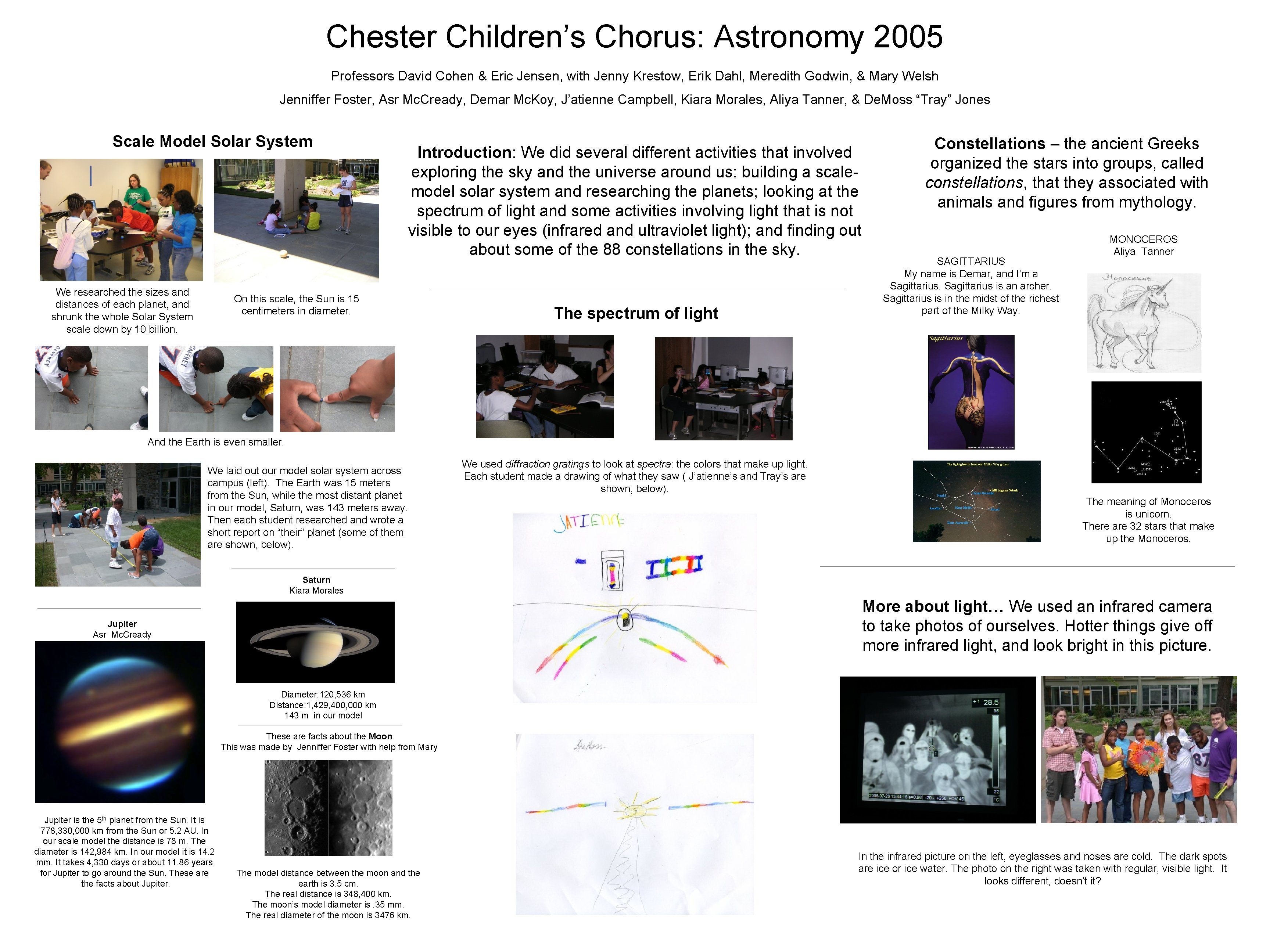
Chester Children’s Chorus: Astronomy 2005 Professors David Cohen & Eric Jensen, with Jenny Krestow, Erik Dahl, Meredith Godwin, & Mary Welsh Jenniffer Foster, Asr Mc. Cready, Demar Mc. Koy, J’atienne Campbell, Kiara Morales, Aliya Tanner, & De. Moss “Tray” Jones Scale Model Solar System We researched the sizes and distances of each planet, and shrunk the whole Solar System scale down by 10 billion. Introduction: We did several different activities that involved exploring the sky and the universe around us: building a scalemodel solar system and researching the planets; looking at the spectrum of light and some activities involving light that is not visible to our eyes (infrared and ultraviolet light); and finding out about some of the 88 constellations in the sky. On this scale, the Sun is 15 centimeters in diameter. The spectrum of light Constellations – the ancient Greeks organized the stars into groups, called constellations, that they associated with animals and figures from mythology. SAGITTARIUS My name is Demar, and I’m a Sagittarius is an archer. Sagittarius is in the midst of the richest part of the Milky Way. MONOCEROS Aliya Tanner And the Earth is even smaller. We laid out our model solar system across campus (left). The Earth was 15 meters from the Sun, while the most distant planet in our model, Saturn, was 143 meters away. Then each student researched and wrote a short report on “their” planet (some of them are shown, below). We used diffraction gratings to look at spectra: the colors that make up light. Each student made a drawing of what they saw ( J’atienne’s and Tray’s are shown, below). The meaning of Monoceros is unicorn. There are 32 stars that make up the Monoceros. Saturn Kiara Morales More about light… We used an infrared camera to take photos of ourselves. Hotter things give off more infrared light, and look bright in this picture. Jupiter Asr Mc. Cready Diameter: 120, 536 km Distance: 1, 429, 400, 000 km 143 m in our model These are facts about the Moon This was made by Jenniffer Foster with help from Mary Jupiter is the 5 th planet from the Sun. It is 778, 330, 000 km from the Sun or 5. 2 AU. In our scale model the distance is 78 m. The diameter is 142, 984 km. In our model it is 14. 2 mm. It takes 4, 330 days or about 11. 86 years for Jupiter to go around the Sun. These are the facts about Jupiter. The model distance between the moon and the earth is 3. 5 cm. The real distance is 348, 400 km. The moon’s model diameter is. 35 mm. The real diameter of the moon is 3476 km. In the infrared picture on the left, eyeglasses and noses are cold. The dark spots are ice or ice water. The photo on the right was taken with regular, visible light. It looks different, doesn’t it?