
Part 6 Synthesis of Heat Exchanger Networks 6

- Slides: 16
Part 6 Synthesis of Heat Exchanger Networks
6. 2 Simultaneous Synthesis MINLP Model
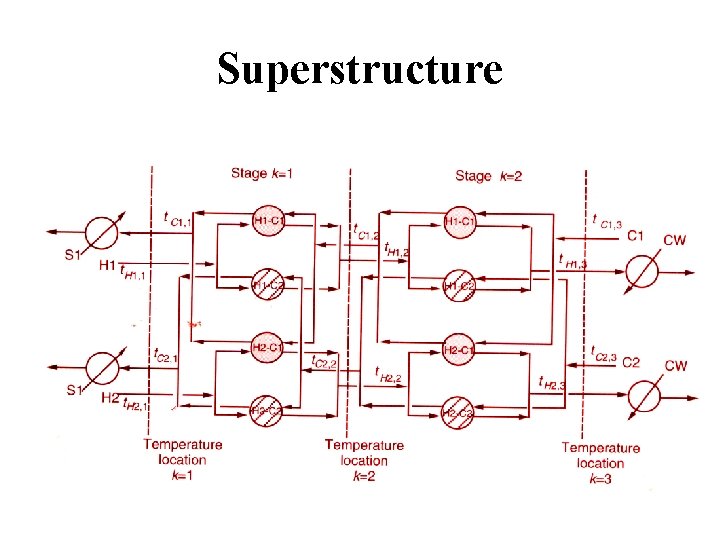
Superstructure
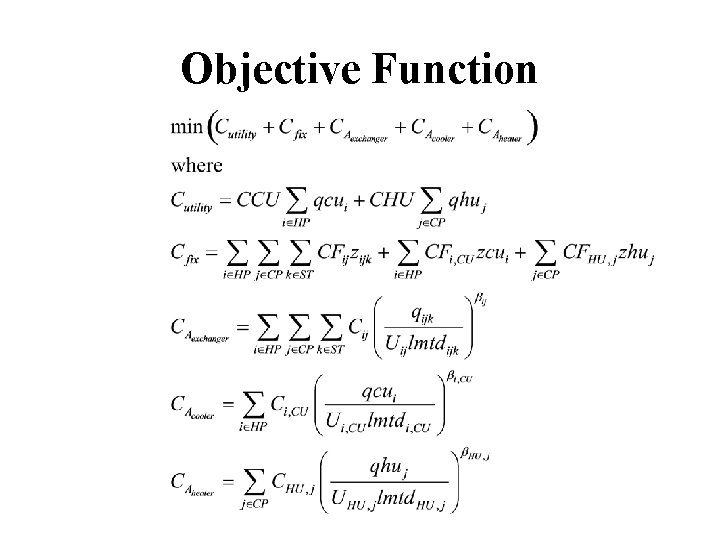
Special Features • Objective function = annualized area cost + annualized fixed unit cost + utility cost. • Objective function is nonlinear, but constraints are linear. • Within each stage of the superstructure, potential exchangers between every pair of hot and cold streams can occur. • It is assumed that the outlets of the exchangers are isothermally mixed, which simplifies the calculation of the stream temperature for the next stage, since no information of flows is needed in the model!!! • The outlet temperatures of each stage are treated as variables. • The isothermal-mixing assumption can be relaxed.
Special Features • In most cases, it is OK to select the number of stages as the maximum of hot and cold streams. • The use of by-passes and split streams with 2 or more matches in each branches is not included in superstructure. • A major advantage of this model is its capability of handling constraints forbidding stream splits.
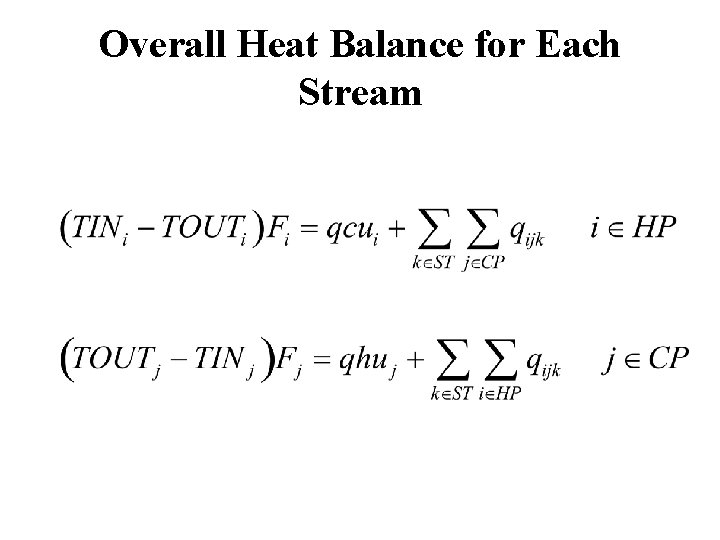
Overall Heat Balance for Each Stream
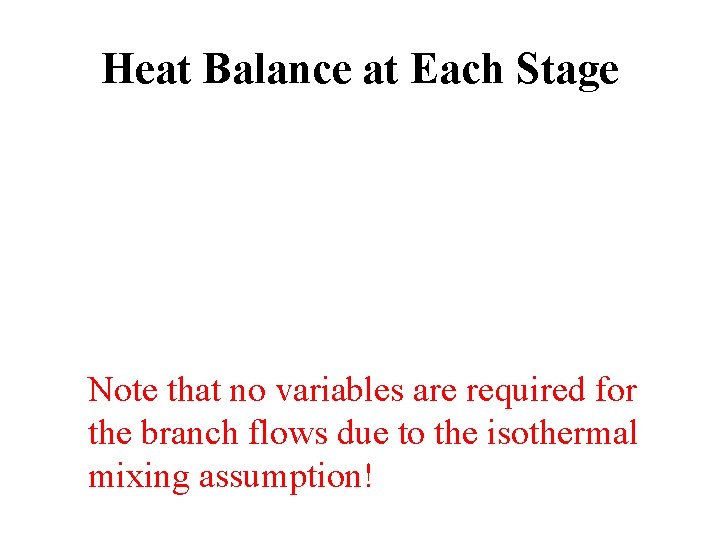
Heat Balance at Each Stage Note that no variables are required for the branch flows due to the isothermal mixing assumption!
Temperature Constraints
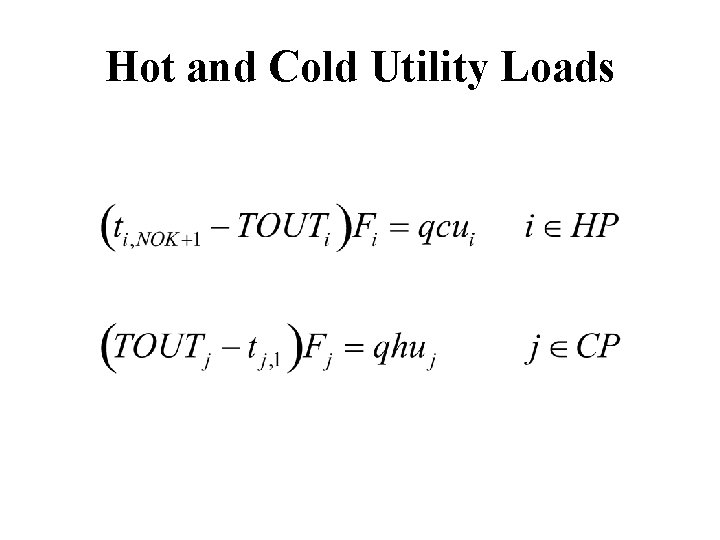
Hot and Cold Utility Loads
Logic Constraints
Temperature Approach
Objective Function
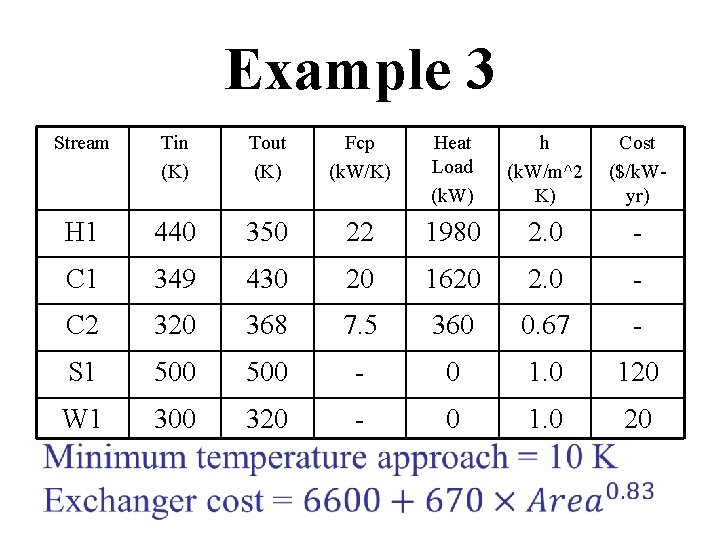
Example 3 Stream Tin (K) Tout (K) Fcp (k. W/K) Heat Load (k. W) h (k. W/m^2 K) Cost ($/k. Wyr) H 1 440 350 22 1980 2. 0 - C 1 349 430 20 1620 2. 0 - C 2 320 368 7. 5 360 0. 67 - S 1 500 - 0 120 W 1 300 320 - 0 1. 0 20
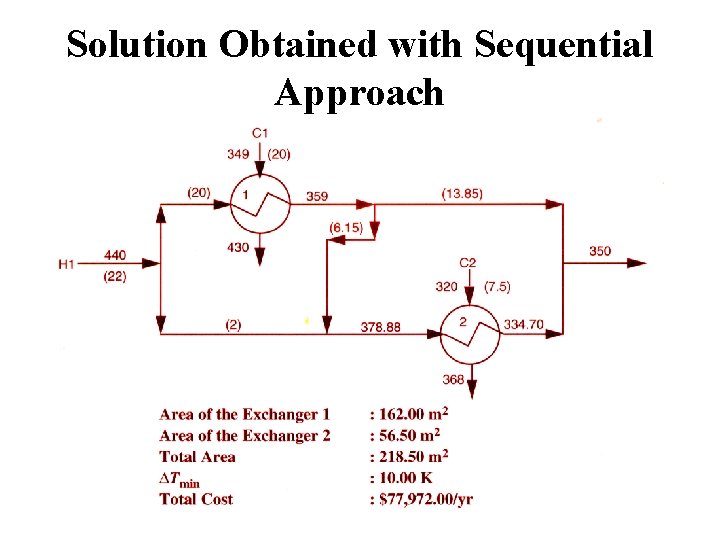
Solution Obtained with Sequential Approach
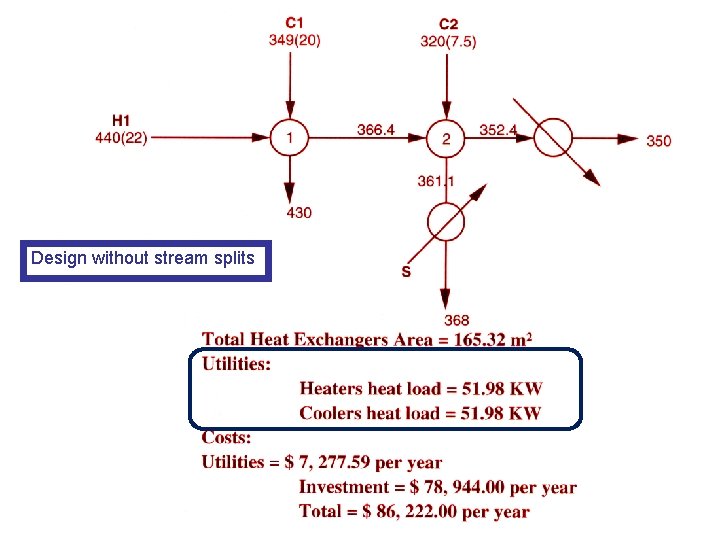
Design without stream splits