Parallel primitives Task SAXPY Scaled Vector Addition yaxy

- Slides: 29
Parallel primitives
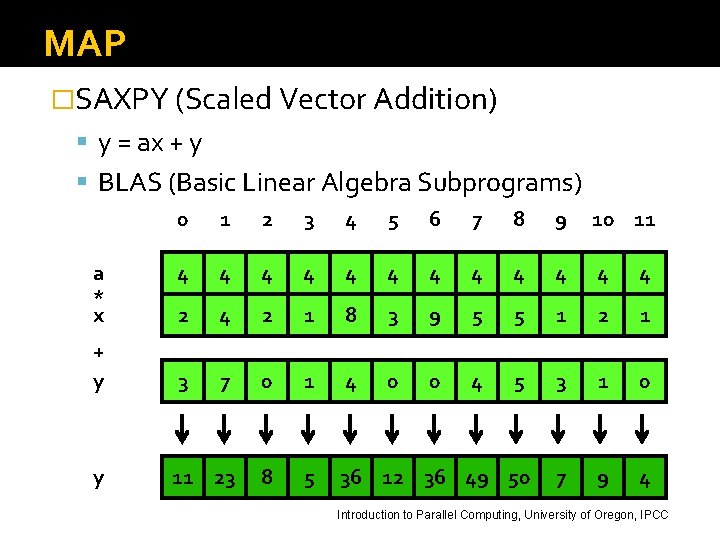
Task �SAXPY (Scaled Vector Addition) y=a*x+y BLAS (Basic Linear Algebra Subprograms) ?
MAP �SAXPY (Scaled Vector Addition) y = ax + y BLAS (Basic Linear Algebra Subprograms) 0 1 2 3 4 5 6 7 8 9 10 11 4 4 4 2 4 2 1 8 3 9 5 5 1 2 1 + y 3 7 0 1 4 0 0 4 5 3 1 0 y 11 23 8 5 36 12 36 49 50 7 9 4 a * x Introduction to Parallel Computing, University of Oregon, IPCC
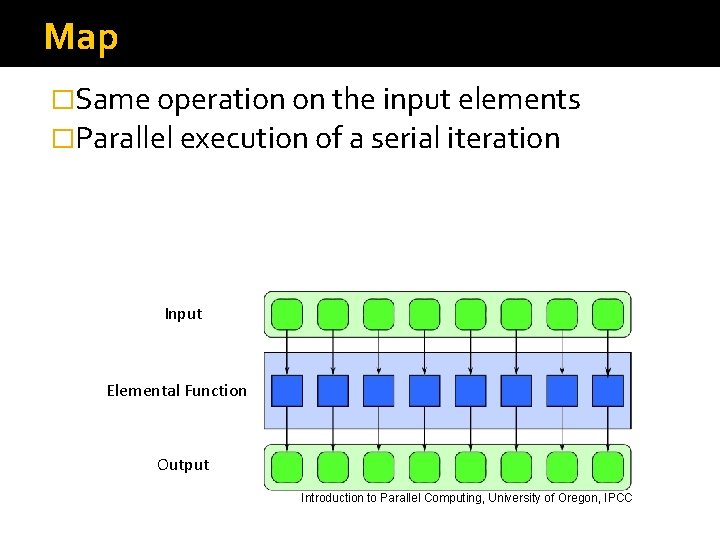
Map �Same operation on the input elements �Parallel execution of a serial iteration Input Elemental Function Output Introduction to Parallel Computing, University of Oregon, IPCC
Task �Find the largest or smallest element in an array ?
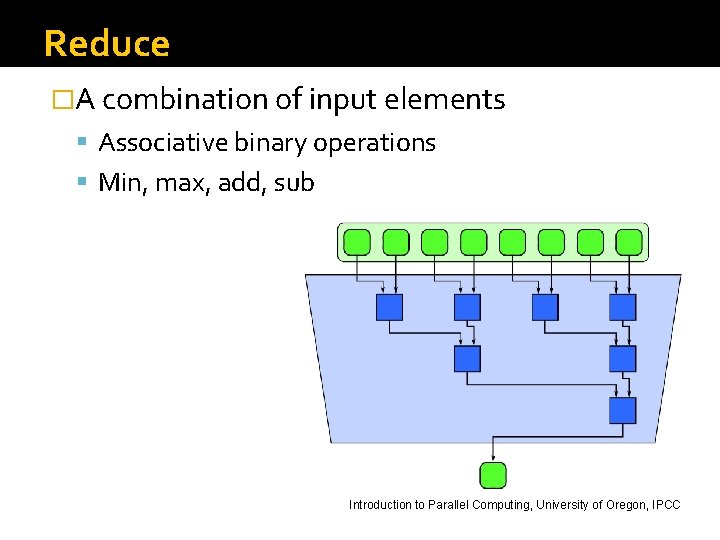
Reduce �A combination of input elements Associative binary operations Min, max, add, sub Introduction to Parallel Computing, University of Oregon, IPCC
Task �What to do if we cannot start all the required threads at once? ?
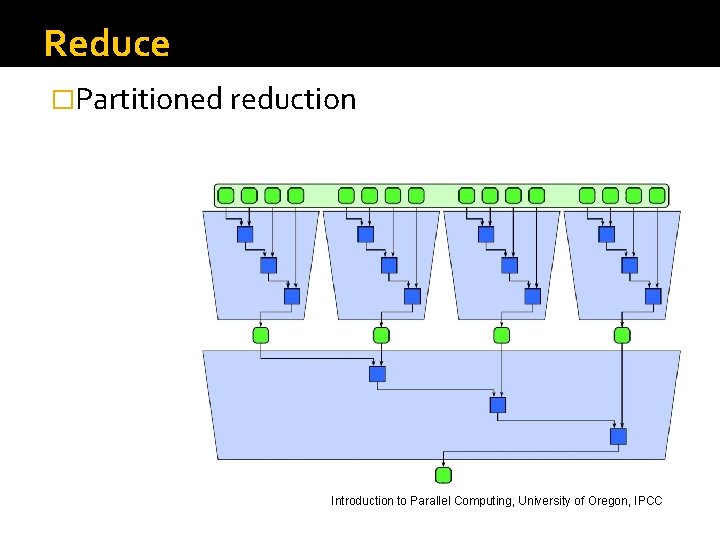
Reduce �Partitioned reduction Introduction to Parallel Computing, University of Oregon, IPCC
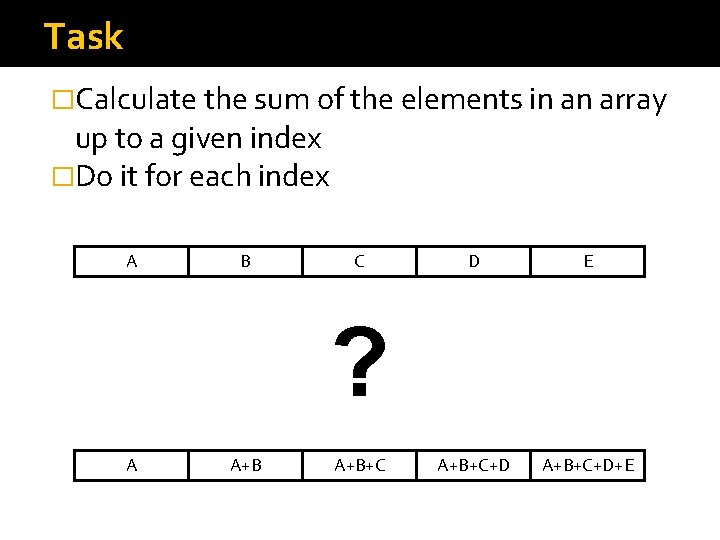
Task �Calculate the sum of the elements in an array up to a given index �Do it for each index A B C D E A+B+C+D+E ? A A+B+C
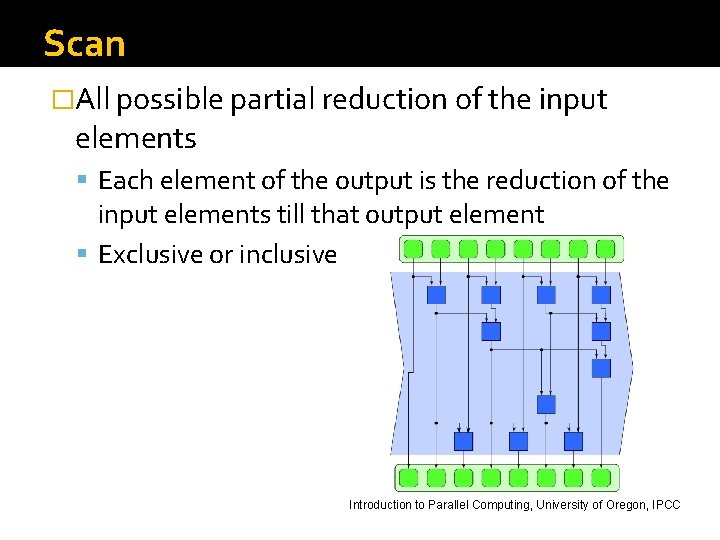
Scan �All possible partial reduction of the input elements Each element of the output is the reduction of the input elements till that output element Exclusive or inclusive Introduction to Parallel Computing, University of Oregon, IPCC
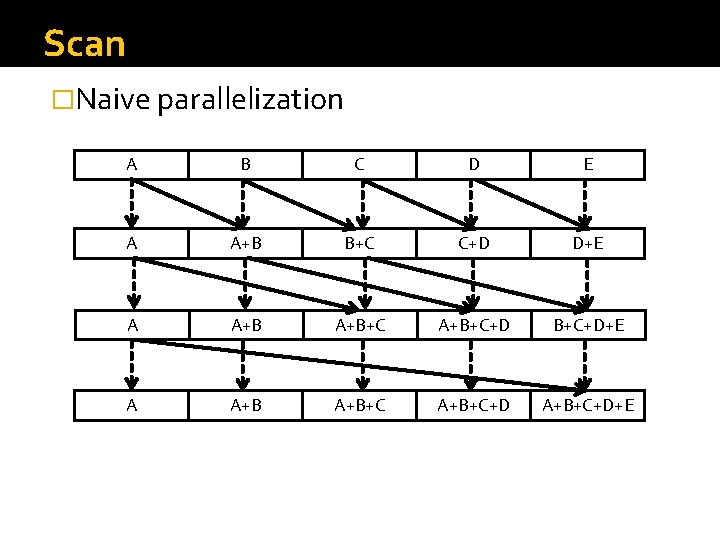
Scan �Naive parallelization A B C D E A A+B B+C C+D D+E A A+B+C+D B+C+D+E A A+B+C+D+E
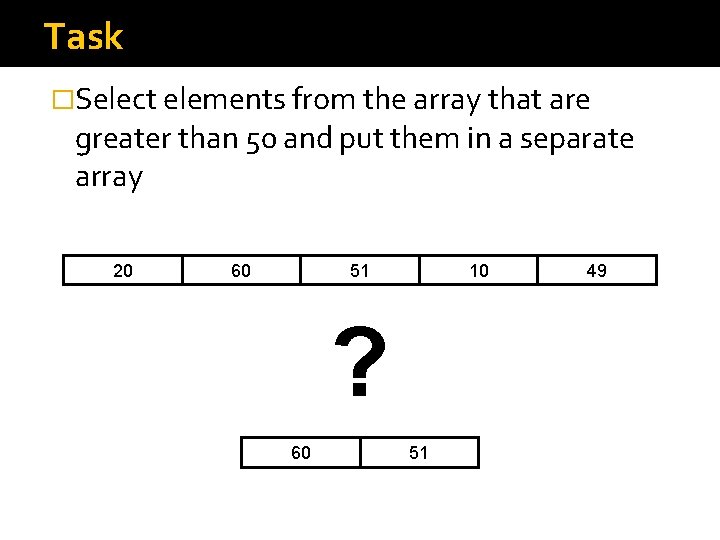
Task �Select elements from the array that are greater than 50 and put them in a separate array 20 60 51 10 ? 60 51 49
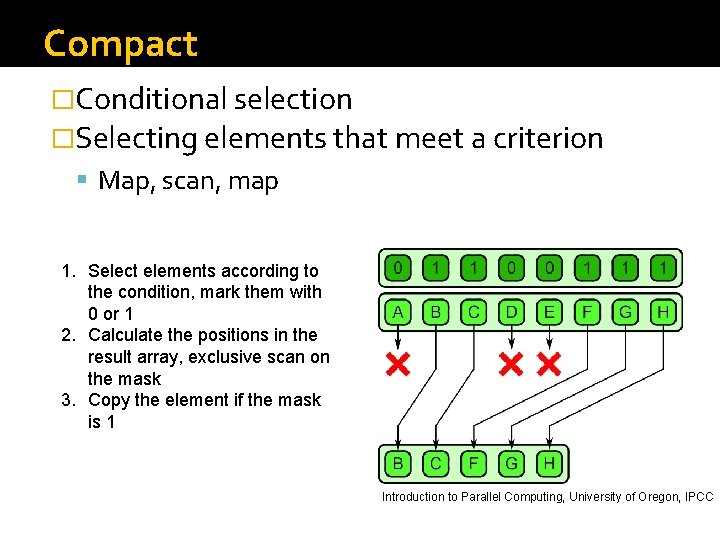
Compact �Conditional selection �Selecting elements that meet a criterion Map, scan, map 1. Select elements according to the condition, mark them with 0 or 1 2. Calculate the positions in the result array, exclusive scan on the mask 3. Copy the element if the mask is 1 Introduction to Parallel Computing, University of Oregon, IPCC
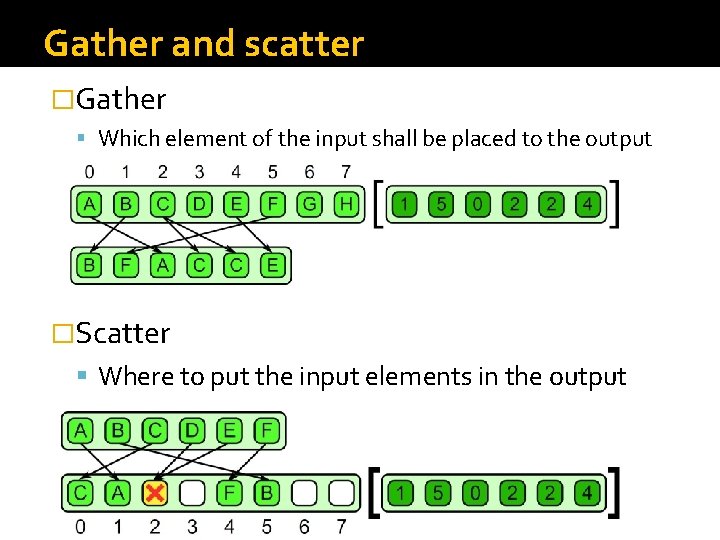
Gather and scatter �Gather Which element of the input shall be placed to the output �Scatter Where to put the input elements in the output
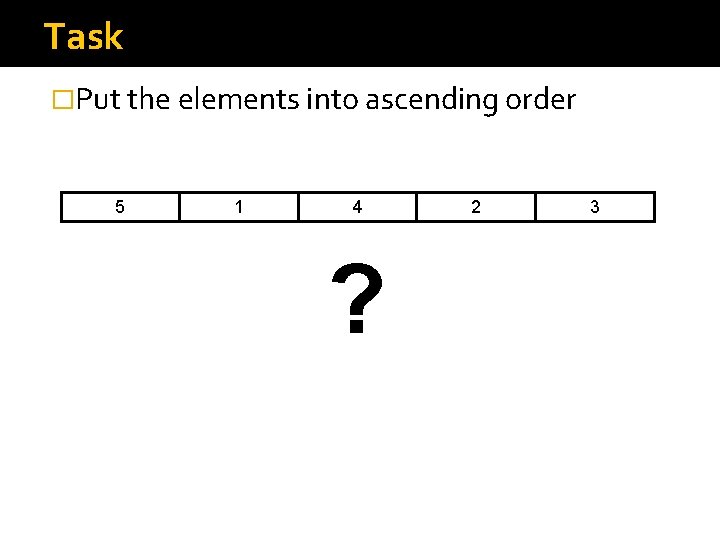
Task �Put the elements into ascending order 5 1 4 ? 2 3
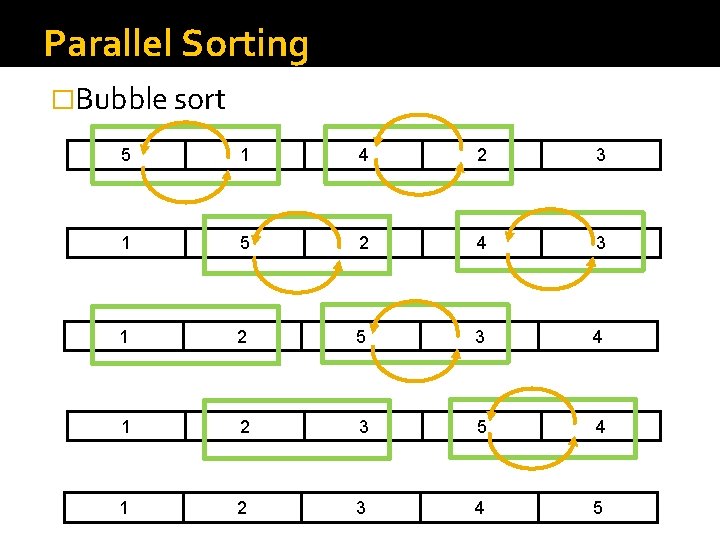
Parallel Sorting �Bubble sort 5 1 4 2 3 1 5 2 4 3 1 2 5 3 4 1 2 3 5 4 1 2 3 4 5
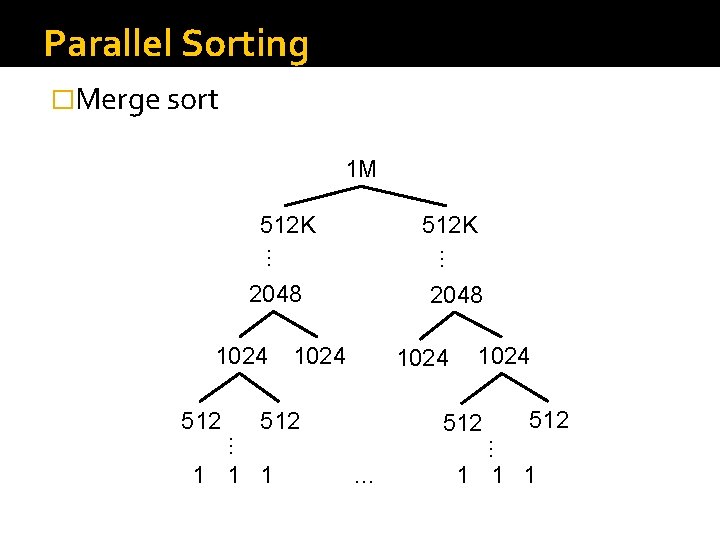
Parallel Sorting �Merge sort 1 M 512 K … … 2048 1024 512 512 … … … 1 1024 1 1 1
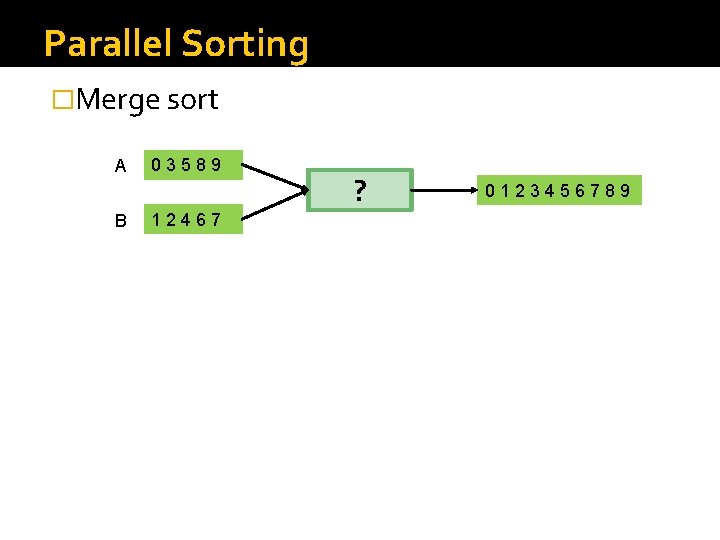
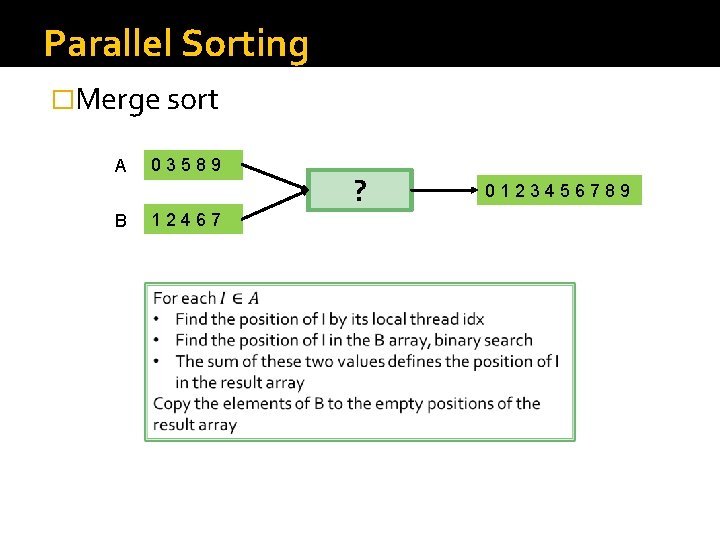
Parallel Sorting �Merge sort A B 0 3 5 8 9 1 2 4 6 7 ? 0 1 2 3 4 5 6 7 8 9
Parallel Sorting �Merge sort A B 0 3 5 8 9 1 2 4 6 7 ? 0 1 2 3 4 5 6 7 8 9
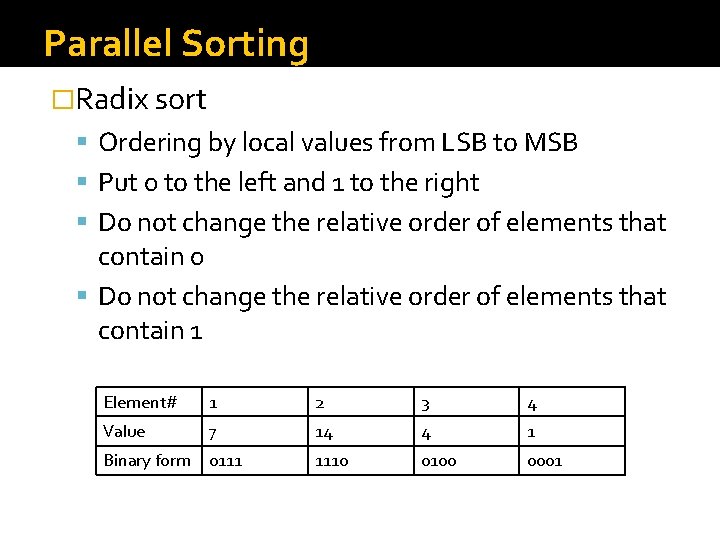
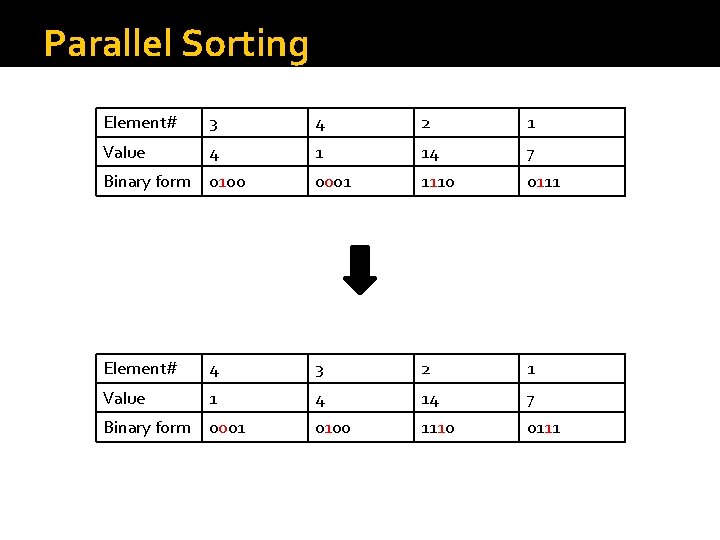
Parallel Sorting �Radix sort Ordering by local values from LSB to MSB Put 0 to the left and 1 to the right Do not change the relative order of elements that contain 0 Do not change the relative order of elements that contain 1 Element# 1 2 3 4 Value 7 14 4 1 Binary form 0111 1110 0100 0001
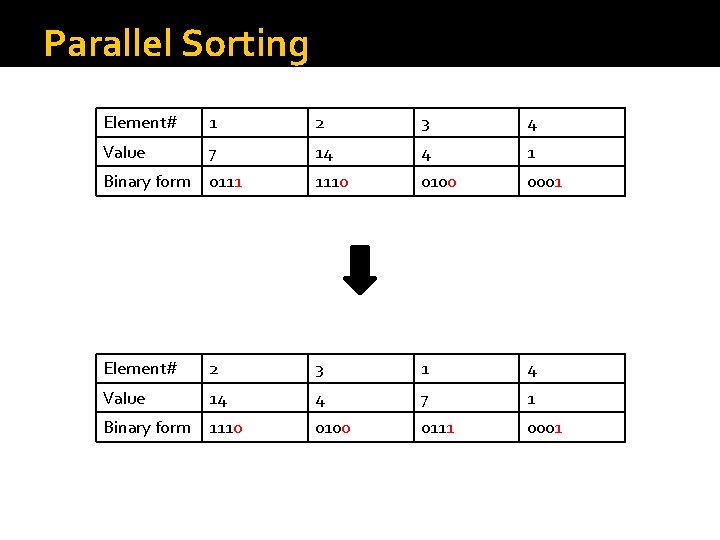
Parallel Sorting Element# 1 2 3 4 Value 7 14 4 1 Binary form 0111 1110 0100 0001 Element# 2 3 1 4 Value 14 4 7 1 Binary form 1110 0100 0111 0001
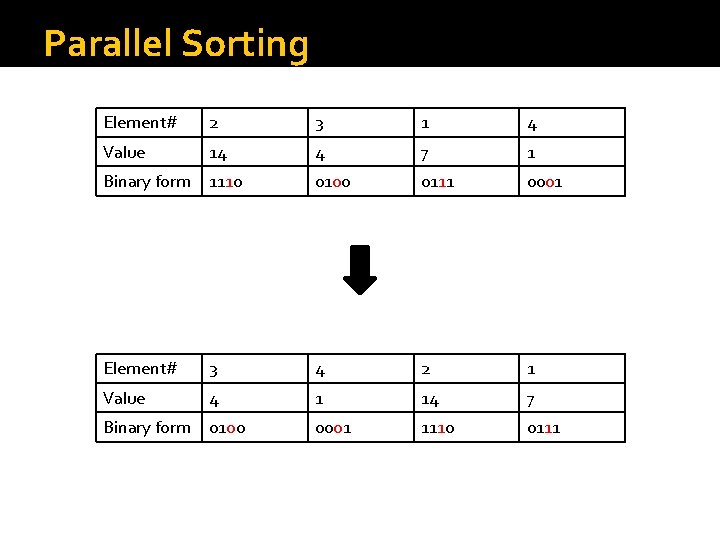
Parallel Sorting Element# 2 3 1 4 Value 14 4 7 1 Binary form 1110 0100 0111 0001 Element# 3 4 2 1 Value 4 1 14 7 Binary form 0100 0001 1110 0111
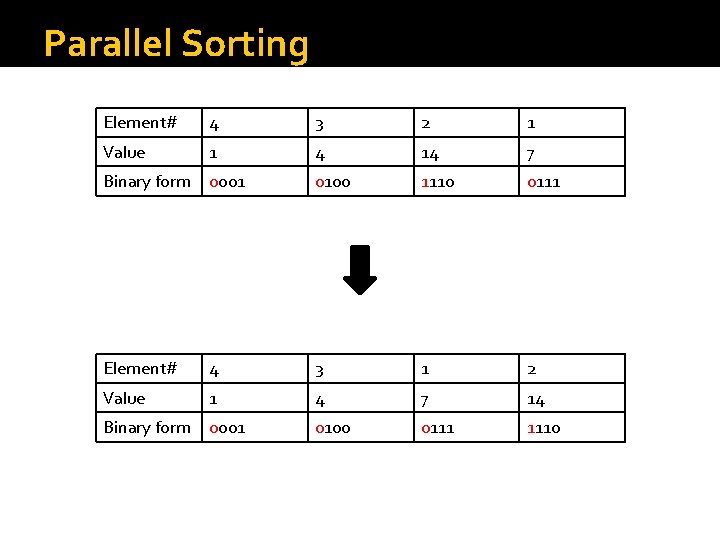
Parallel Sorting Element# 3 4 2 1 Value 4 1 14 7 Binary form 0100 0001 1110 0111 Element# 4 3 2 1 Value 1 4 14 7 Binary form 0001 0100 1110 0111
Parallel Sorting Element# 4 3 2 1 Value 1 4 14 7 Binary form 0001 0100 1110 0111 Element# 4 3 1 2 Value 1 4 7 14 Binary form 0001 0100 0111 1110
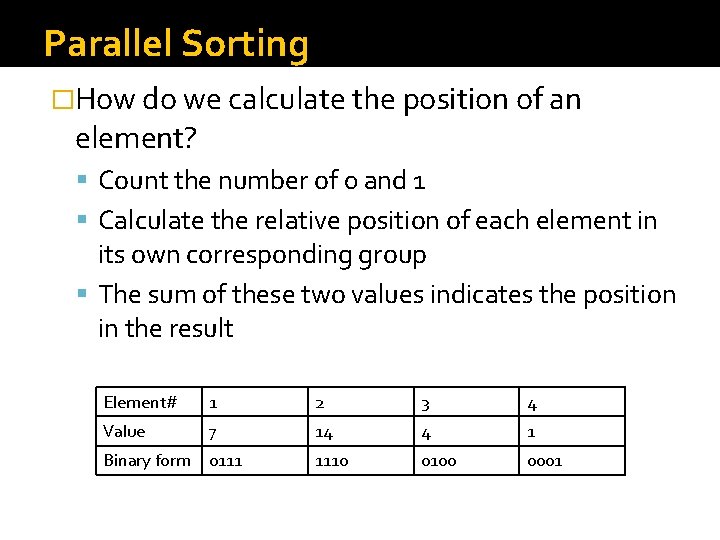
Parallel Sorting �How do we calculate the position of an element? Count the number of 0 and 1 Calculate the relative position of each element in its own corresponding group The sum of these two values indicates the position in the result Element# 1 2 3 4 Value 7 14 4 1 Binary form 0111 1110 0100 0001
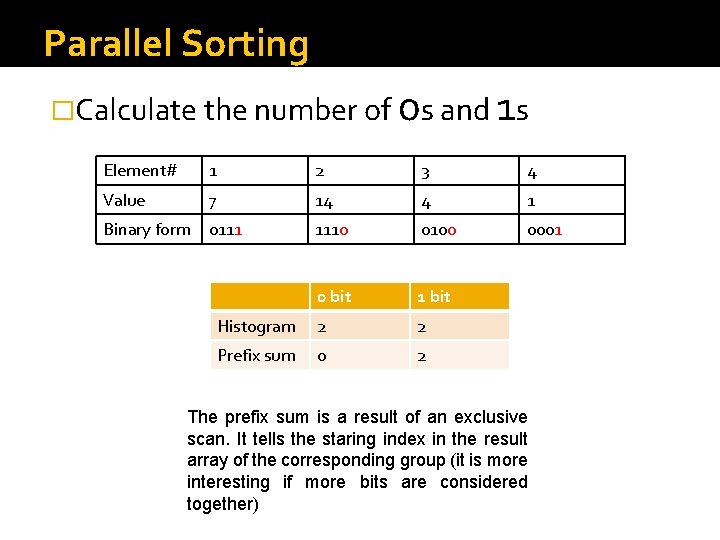
Parallel Sorting �Calculate the number of 0 s and 1 s Element# 1 2 3 4 Value 7 14 4 1 Binary form 0111 1110 0100 0001 0 bit 1 bit Histogram 2 2 Prefix sum 0 2 The prefix sum is a result of an exclusive scan. It tells the staring index in the result array of the corresponding group (it is more interesting if more bits are considered together)
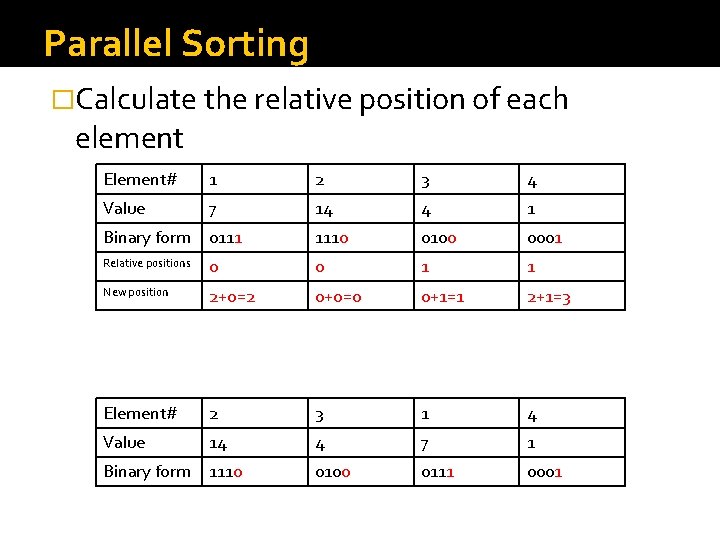
Parallel Sorting �Calculate the relative position of each element Element# 1 2 3 4 Value 7 14 4 1 Binary form 0111 1110 0100 0001 Relative positions 0 0 1 1 New position 2+0=2 0+0=0 0+1=1 2+1=3 Element# 2 3 1 4 Value 14 4 7 1 Binary form 1110 0100 0111 0001
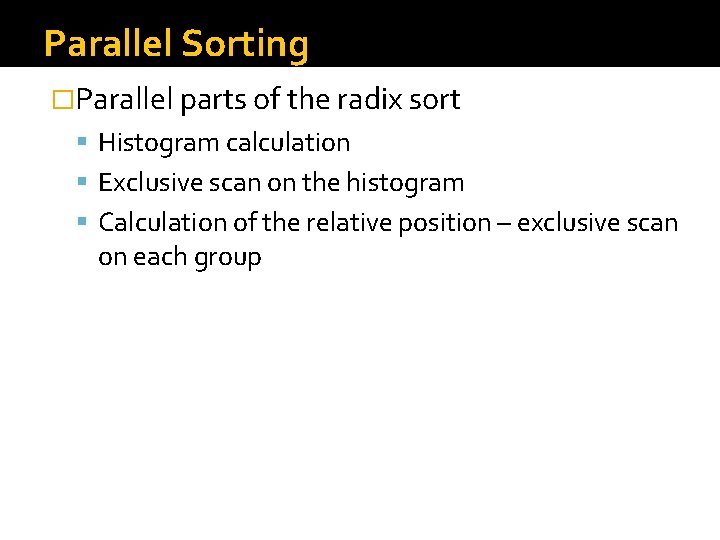
Parallel Sorting �Parallel parts of the radix sort Histogram calculation Exclusive scan on the histogram Calculation of the relative position – exclusive scan on each group
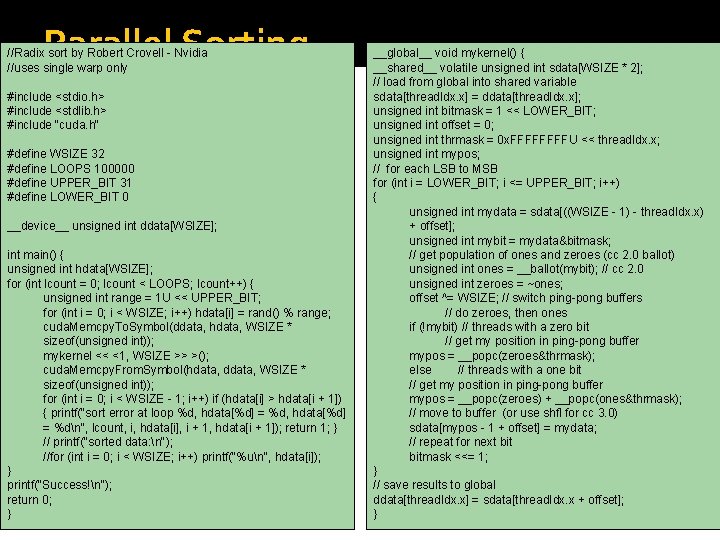
Parallel Sorting //Radix sort by Robert Crovell - Nvidia //uses single warp only #include <stdio. h> #include <stdlib. h> #include "cuda. h" #define WSIZE 32 #define LOOPS 100000 #define UPPER_BIT 31 #define LOWER_BIT 0 __device__ unsigned int ddata[WSIZE]; int main() { unsigned int hdata[WSIZE]; for (int lcount = 0; lcount < LOOPS; lcount++) { unsigned int range = 1 U << UPPER_BIT; for (int i = 0; i < WSIZE; i++) hdata[i] = rand() % range; cuda. Memcpy. To. Symbol(ddata, hdata, WSIZE * sizeof(unsigned int)); mykernel << <1, WSIZE >> >(); cuda. Memcpy. From. Symbol(hdata, ddata, WSIZE * sizeof(unsigned int)); for (int i = 0; i < WSIZE - 1; i++) if (hdata[i] > hdata[i + 1]) { printf("sort error at loop %d, hdata[%d] = %dn", lcount, i, hdata[i], i + 1, hdata[i + 1]); return 1; } // printf("sorted data: n"); //for (int i = 0; i < WSIZE; i++) printf("%un", hdata[i]); } printf("Success!n"); return 0; } __global__ void mykernel() { __shared__ volatile unsigned int sdata[WSIZE * 2]; // load from global into shared variable sdata[thread. Idx. x] = ddata[thread. Idx. x]; unsigned int bitmask = 1 << LOWER_BIT; unsigned int offset = 0; unsigned int thrmask = 0 x. FFFFU << thread. Idx. x; unsigned int mypos; // for each LSB to MSB for (int i = LOWER_BIT; i <= UPPER_BIT; i++) { unsigned int mydata = sdata[((WSIZE - 1) - thread. Idx. x) + offset]; unsigned int mybit = mydata&bitmask; // get population of ones and zeroes (cc 2. 0 ballot) unsigned int ones = __ballot(mybit); // cc 2. 0 unsigned int zeroes = ~ones; offset ^= WSIZE; // switch ping-pong buffers // do zeroes, then ones if (!mybit) // threads with a zero bit // get my position in ping-pong buffer mypos = __popc(zeroes&thrmask); else // threads with a one bit // get my position in ping-pong buffer mypos = __popc(zeroes) + __popc(ones&thrmask); // move to buffer (or use shfl for cc 3. 0) sdata[mypos - 1 + offset] = mydata; // repeat for next bitmask <<= 1; } // save results to global ddata[thread. Idx. x] = sdata[thread. Idx. x + offset]; }