
This power point is the summer assignment for
- Slides: 100
This power point is the summer assignment for PAP Physics. Please show all work on practice “Do and Turn In” problems and be prepared to both submit the completed work and take a quiz after returning to school in the fall. You CANNOT be in PAP Physics unless you are concurrently enrolled in Alg 2. PAP Physics Mr. Robert Powell RPOWELL@huffmanisd. net
Physics and Math Physics is the study of motion, forces, matter, energy and their interactions. Physics and math are interconnected. Theories in physics are almost always explained using math models or equations. Since math is used to solve most physics problems, math is sometimes called the language of physics. Because math is such an integral part of physics, some basic math skills are important to learn and completely understand.
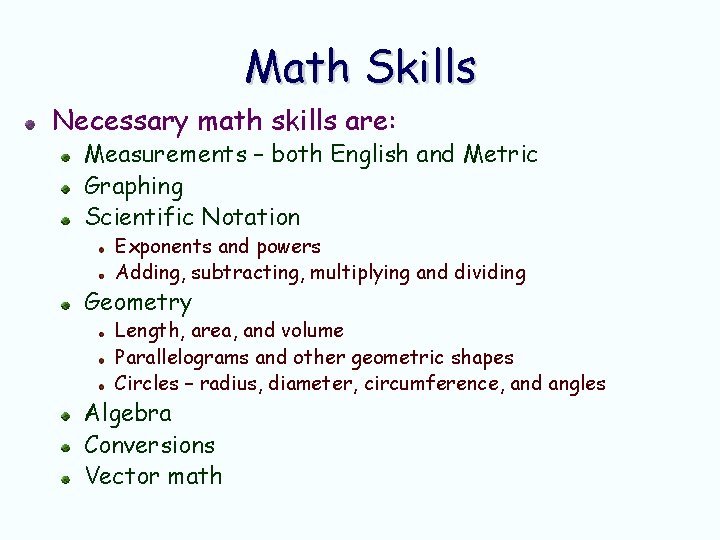
Math Skills Necessary math skills are: Measurements – both English and Metric Graphing Scientific Notation Exponents and powers Adding, subtracting, multiplying and dividing Geometry Length, area, and volume Parallelograms and other geometric shapes Circles – radius, diameter, circumference, and angles Algebra Conversions Vector math
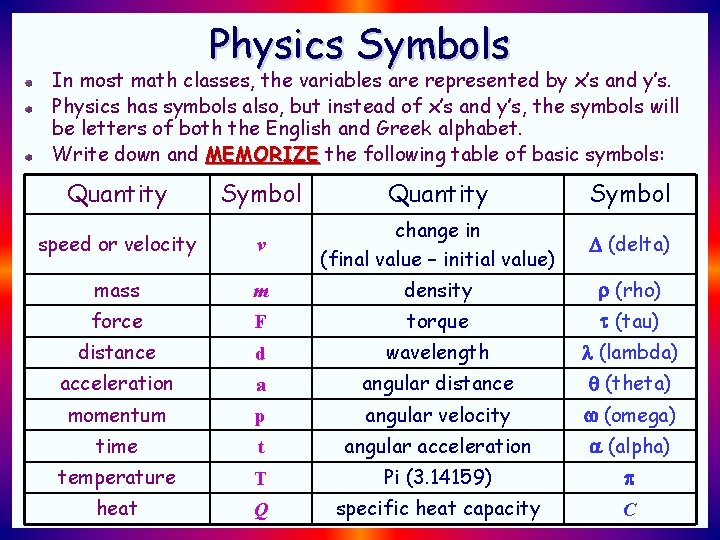
Physics Symbols In most math classes, the variables are represented by x’s and y’s. Physics has symbols also, but instead of x’s and y’s, the symbols will be letters of both the English and Greek alphabet. Write down and MEMORIZE the following table of basic symbols: Quantity Symbol speed or velocity v change in (final value – initial value) (delta) mass m density (rho) force F torque (tau) distance d wavelength (lambda) acceleration a angular distance (theta) momentum p angular velocity (omega) time t angular acceleration (alpha) temperature T Pi (3. 14159) heat Q specific heat capacity C
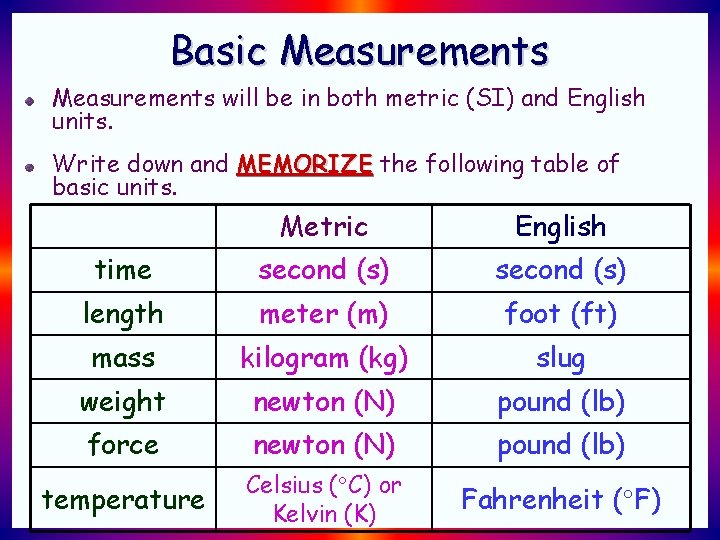
Basic Measurements will be in both metric (SI) and English units. Write down and MEMORIZE the following table of basic units. Metric English time second (s) length meter (m) foot (ft) mass kilogram (kg) slug weight newton (N) pound (lb) force newton (N) pound (lb) temperature Celsius ( C) or Kelvin (K) Fahrenheit ( F)
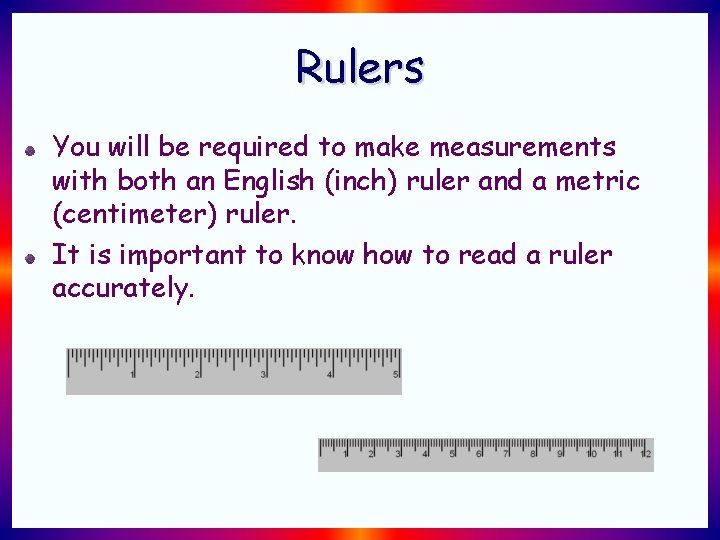
Rulers You will be required to make measurements with both an English (inch) ruler and a metric (centimeter) ruler. It is important to know how to read a ruler accurately.
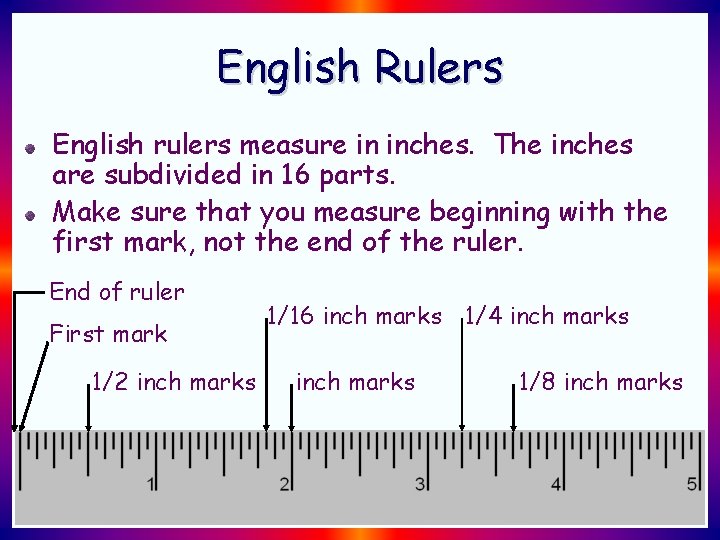
English Rulers English rulers measure in inches. The inches are subdivided in 16 parts. Make sure that you measure beginning with the first mark, not the end of the ruler. End of ruler First mark 1/2 inch marks 1/16 inch marks 1/4 inch marks 1/8 inch marks
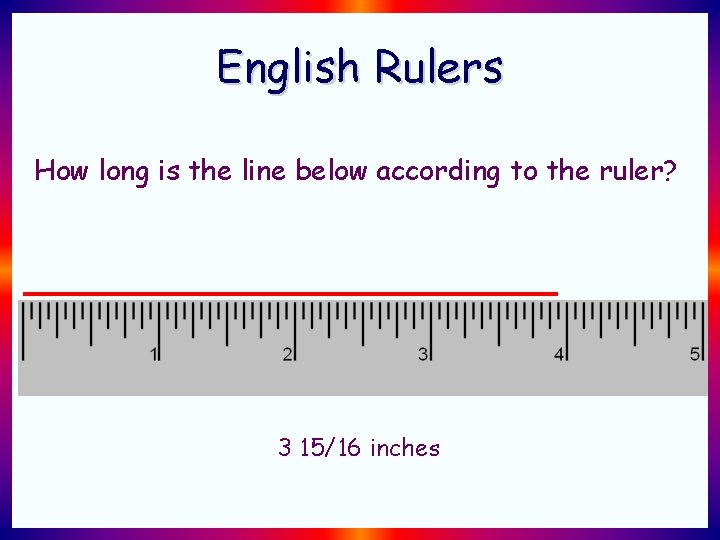
English Rulers How long is the line below according to the ruler? 3 15/16 inches
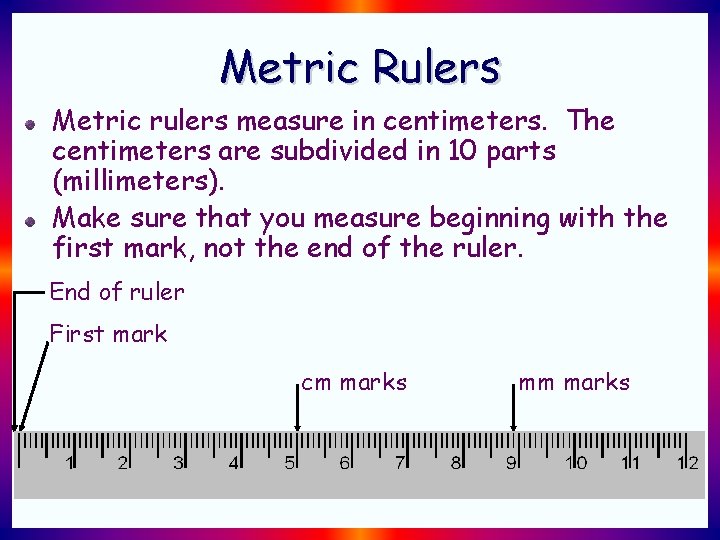
Metric Rulers Metric rulers measure in centimeters. The centimeters are subdivided in 10 parts (millimeters). Make sure that you measure beginning with the first mark, not the end of the ruler. End of ruler First mark cm marks mm marks
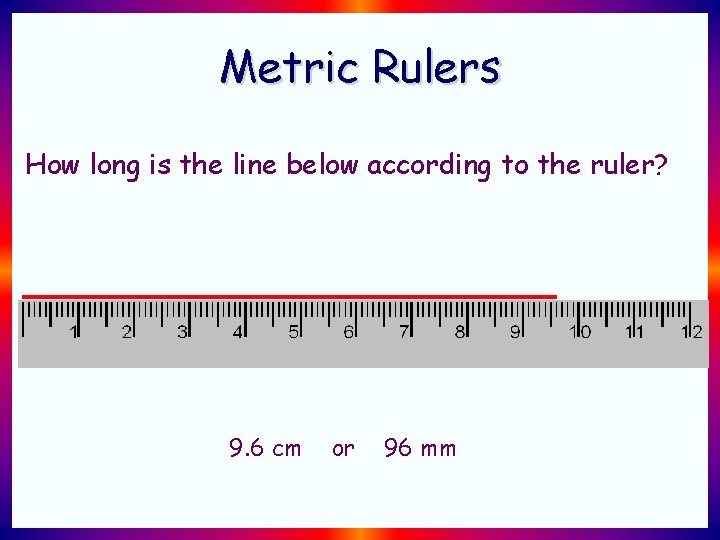
Metric Rulers How long is the line below according to the ruler? 9. 6 cm or 96 mm
Graphing Graphs are useful for showing trends and predicting outcomes. Graphs are a visual representation of the data. There are many types of graphs, but the most common are: Bar graphs Circle or Pie graphs Line graphs
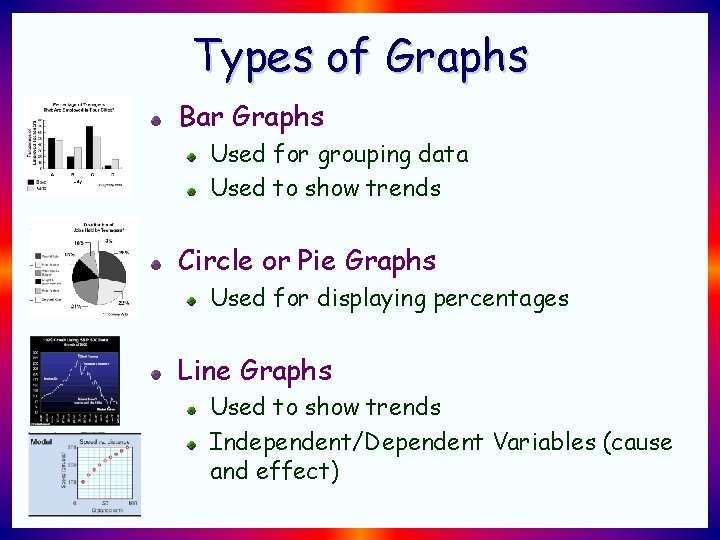
Types of Graphs Bar Graphs Used for grouping data Used to show trends Circle or Pie Graphs Used for displaying percentages Line Graphs Used to show trends Independent/Dependent Variables (cause and effect)
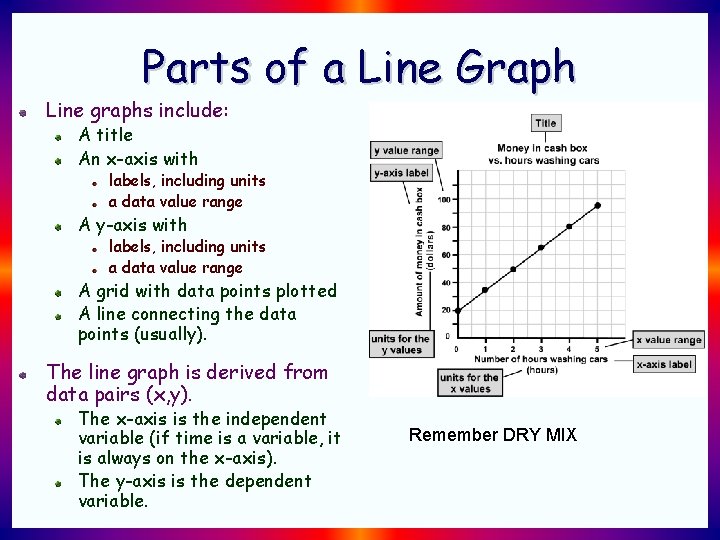
Parts of a Line Graph Line graphs include: A title An x-axis with labels, including units a data value range A y-axis with labels, including units a data value range A grid with data points plotted A line connecting the data points (usually). The line graph is derived from data pairs (x, y). The x-axis is the independent variable (if time is a variable, it is always on the x-axis). The y-axis is the dependent variable. Remember DRY MIX
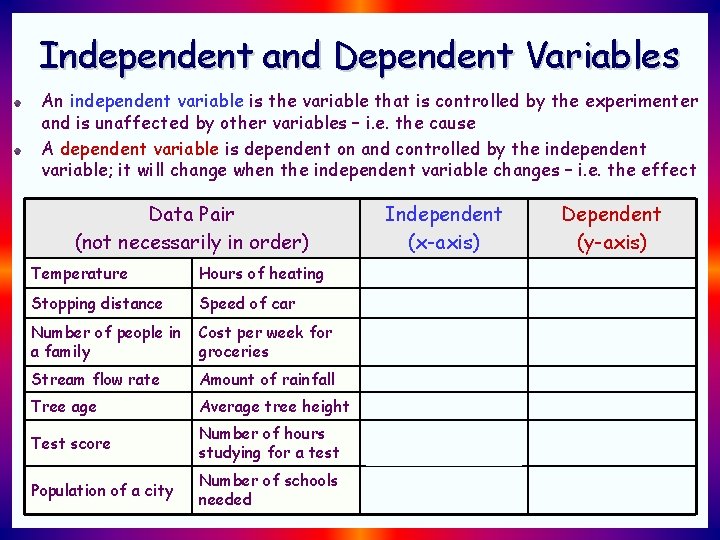
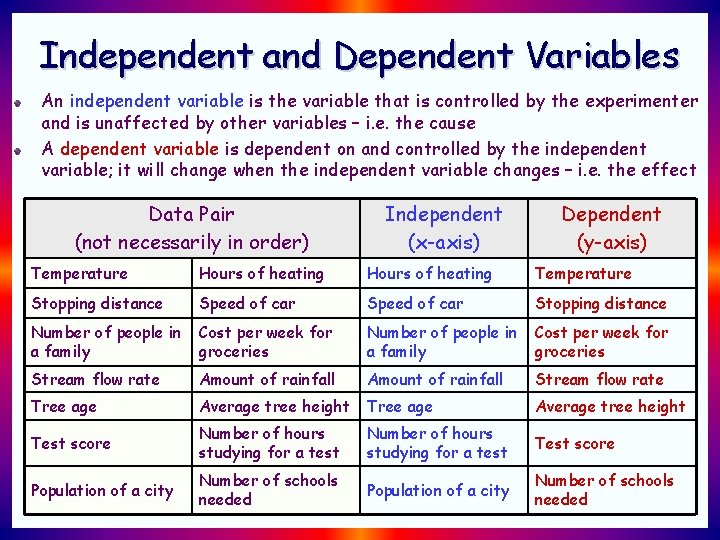
Independent and Dependent Variables An independent variable is the variable that is controlled by the experimenter and is unaffected by other variables – i. e. the cause A dependent variable is dependent on and controlled by the independent variable; it will change when the independent variable changes – i. e. the effect Data Pair (not necessarily in order) Independent (x-axis) Dependent (y-axis) Temperature Hours of heating Temperature Stopping distance Speed of car Stopping distance Number of people in a family Cost per week for groceries Stream flow rate Amount of rainfall Stream flow rate Tree age Average tree height Test score Number of hours studying for a test Test score Population of a city Number of schools needed
Independent and Dependent Variables An independent variable is the variable that is controlled by the experimenter and is unaffected by other variables – i. e. the cause A dependent variable is dependent on and controlled by the independent variable; it will change when the independent variable changes – i. e. the effect Data Pair (not necessarily in order) Independent (x-axis) Dependent (y-axis) Temperature Hours of heating Temperature Stopping distance Speed of car Stopping distance Number of people in a family Cost per week for groceries Stream flow rate Amount of rainfall Stream flow rate Tree age Average tree height Test score Number of hours studying for a test Test score Population of a city Number of schools needed
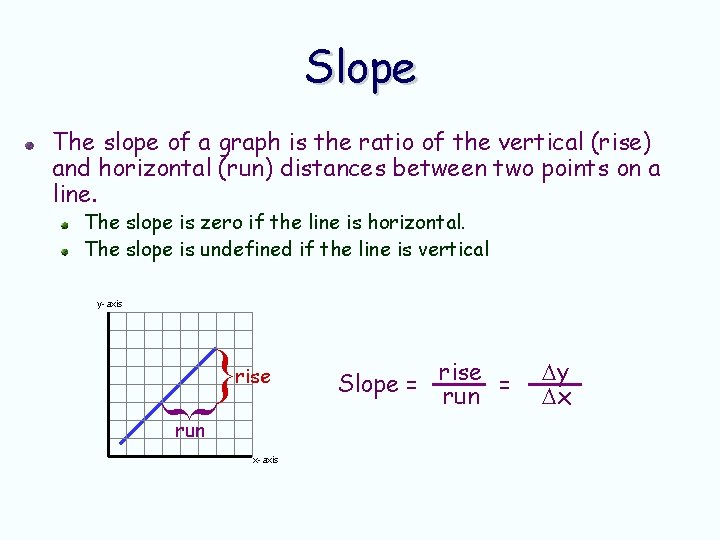
Slope The slope of a graph is the ratio of the vertical (rise) and horizontal (run) distances between two points on a line. The slope is zero if the line is horizontal. The slope is undefined if the line is vertical y-axis } rise } run x-axis Slope = rise run = y x
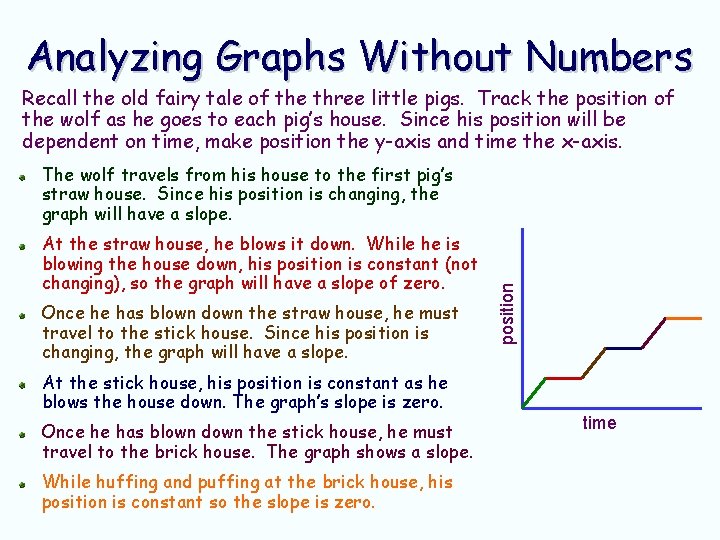
Analyzing Graphs Without Numbers Recall the old fairy tale of the three little pigs. Track the position of the wolf as he goes to each pig’s house. Since his position will be dependent on time, make position the y-axis and time the x-axis. At the straw house, he blows it down. While he is blowing the house down, his position is constant (not changing), so the graph will have a slope of zero. Once he has blown down the straw house, he must travel to the stick house. Since his position is changing, the graph will have a slope. At the stick house, his position is constant as he blows the house down. The graph’s slope is zero. Once he has blown down the stick house, he must travel to the brick house. The graph shows a slope. While huffing and puffing at the brick house, his position is constant so the slope is zero. position The wolf travels from his house to the first pig’s straw house. Since his position is changing, the graph will have a slope. time
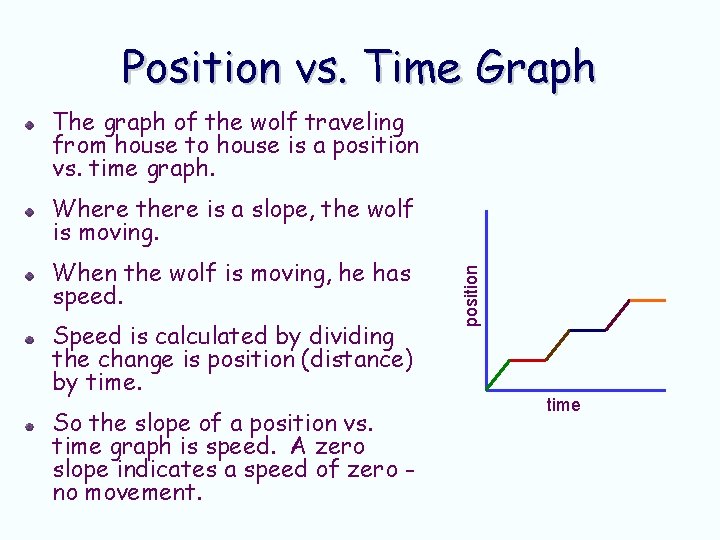
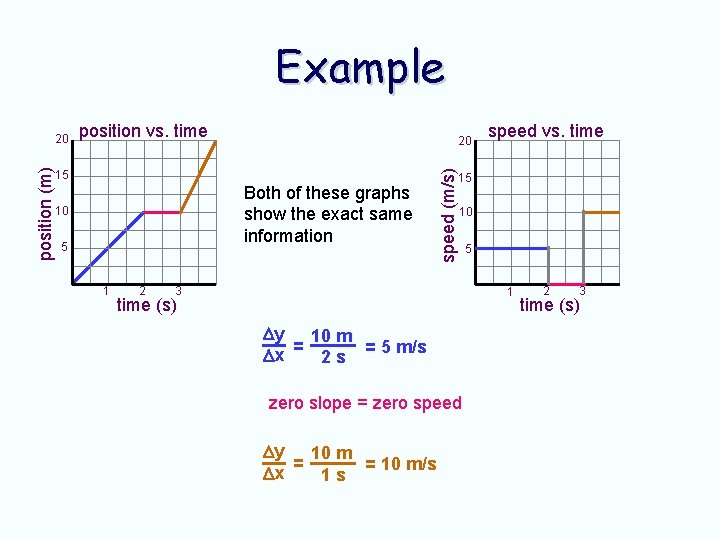
Position vs. Time Graph The graph of the wolf traveling from house to house is a position vs. time graph. When the wolf is moving, he has speed. Speed is calculated by dividing the change is position (distance) by time. So the slope of a position vs. time graph is speed. A zero slope indicates a speed of zero no movement. position Where there is a slope, the wolf is moving. time
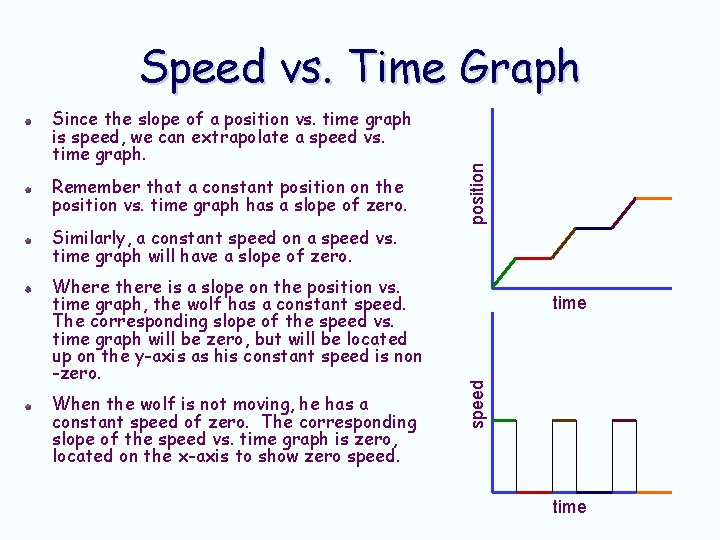
Remember that a constant position on the position vs. time graph has a slope of zero. Similarly, a constant speed on a speed vs. time graph will have a slope of zero. Where there is a slope on the position vs. time graph, the wolf has a constant speed. The corresponding slope of the speed vs. time graph will be zero, but will be located up on the y-axis as his constant speed is non -zero. When the wolf is not moving, he has a constant speed of zero. The corresponding slope of the speed vs. time graph is zero, located on the x-axis to show zero speed. time speed Since the slope of a position vs. time graph is speed, we can extrapolate a speed vs. time graph. position Speed vs. Time Graph time
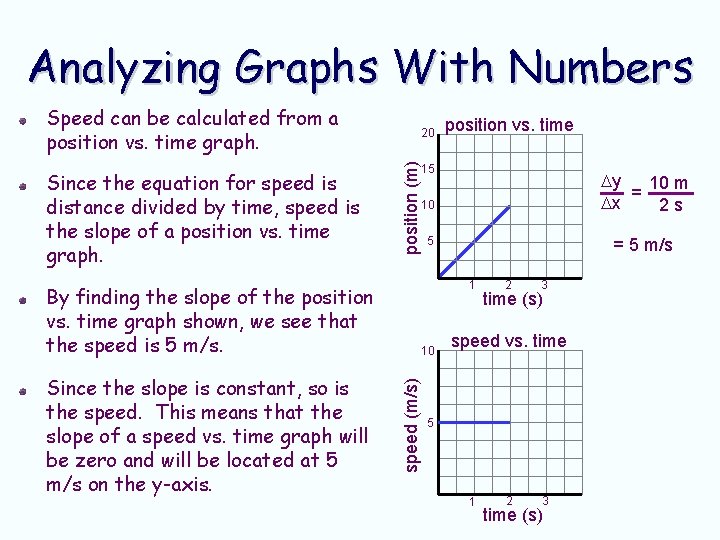
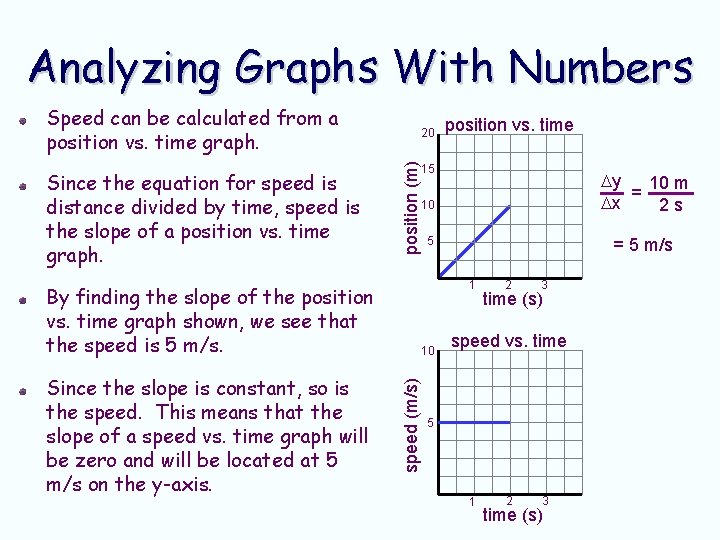
Analyzing Graphs With Numbers Speed can be calculated from a position vs. time graph. position (m) Since the equation for speed is distance divided by time, speed is the slope of a position vs. time graph. 20 15 y 10 m = x 2 s 10 5 = 5 m/s 1 By finding the slope of the position vs. time graph shown, we see that the speed is 5 m/s. 10 speed (m/s) Since the slope is constant, so is the speed. This means that the slope of a speed vs. time graph will be zero and will be located at 5 m/s on the y-axis. position vs. time 2 3 time (s) speed vs. time 5 1 2 3 time (s)
Example position vs. time 20 15 Both of these graphs show the exact same information 10 5 1 2 speed (m/s) position (m) 20 speed vs. time 15 10 3 5 1 time (s) y 10 m = = 5 m/s x 2 s zero slope = zero speed y 10 m = = 10 m/s x 1 s 2 3 time (s)
Analyzing Graphs With Numbers Speed can be calculated from a position vs. time graph. position (m) Since the equation for speed is distance divided by time, speed is the slope of a position vs. time graph. 20 15 y 10 m = x 2 s 10 5 = 5 m/s 1 By finding the slope of the position vs. time graph shown, we see that the speed is 5 m/s. 10 speed (m/s) Since the slope is constant, so is the speed. This means that the slope of a speed vs. time graph will be zero and will be located at 5 m/s on the y-axis. position vs. time 2 3 time (s) speed vs. time 5 1 2 3 time (s)
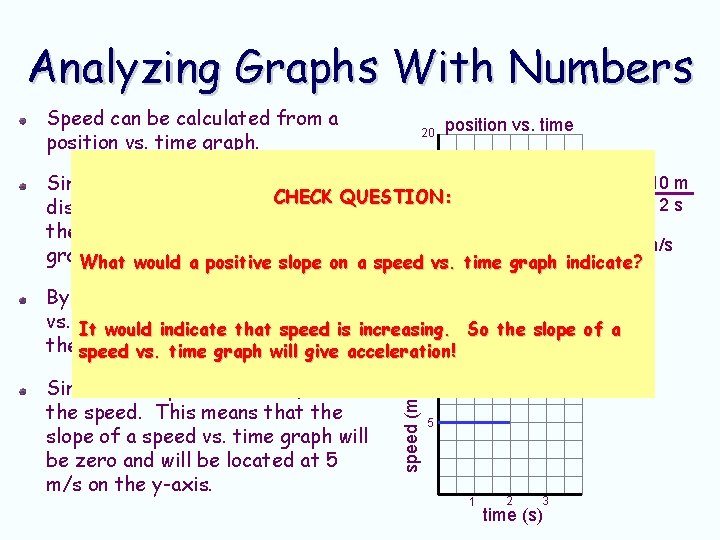
Analyzing Graphs With Numbers Speed can be calculated from a position vs. time graph. position (m) 20 position vs. time 15 y 10 m Since the equation for speed is = CHECK QUESTION: x 10 2 s distance divided by time, speed is the slope of a position vs. time 5 = 5 m/s graph. What would a positive slope on a speed vs. time graph indicate? 1 2 3 Since the slope is constant, so is the speed. This means that the slope of a speed vs. time graph will be zero and will be located at 5 m/s on the y-axis. speed (m/s) By finding the slope of the position time (s) vs. time graph shown, that we speed see that It would indicate is increasing. So the slope of a speed vs. time the speedvs. is 5 time m/s. graph will give acceleration! 10 5 time (s)
Additional Hints: Velocity (speed) = change in position (distance) ÷ time Acceleration = change in velocity (speed) ÷ time Remember that a zero slope indicates a constant value. A positive slope will give a positive value. A negative slope will give a negative value.
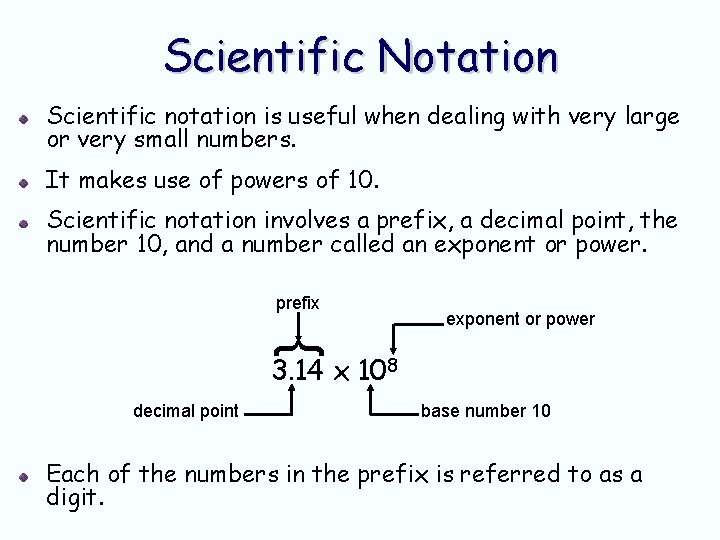
Scientific Notation Scientific notation is useful when dealing with very large or very small numbers. It makes use of powers of 10. Scientific notation involves a prefix, a decimal point, the number 10, and a number called an exponent or power } prefix 3. 14 x 108 decimal point base number 10 Each of the numbers in the prefix is referred to as a digit.
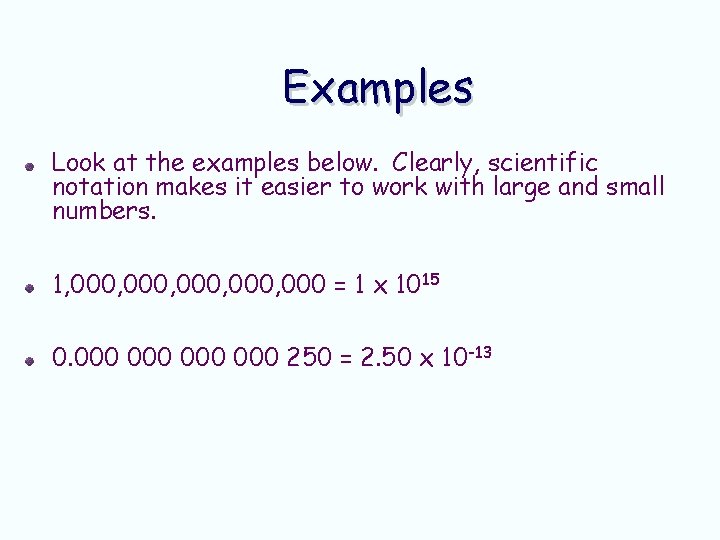
Examples Look at the examples below. Clearly, scientific notation makes it easier to work with large and small numbers. 1, 000, 000 = 1 x 10¹⁵ 0. 000 000 250 = 2. 50 x 10 -13
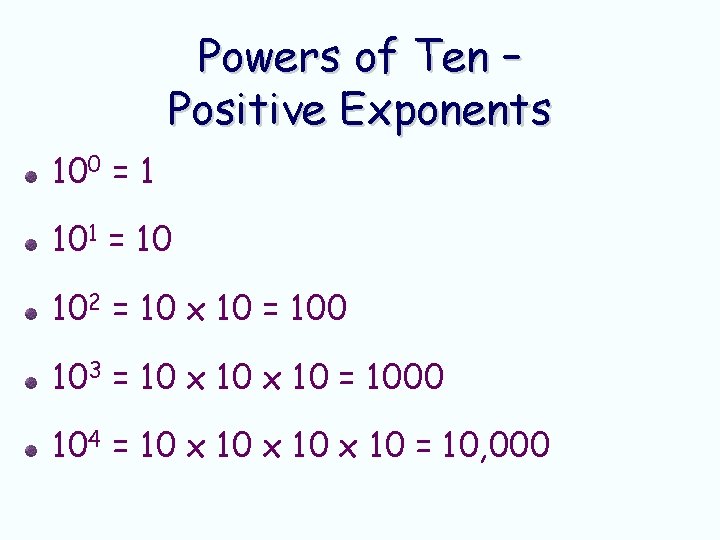
Powers of Ten – Positive Exponents 100 = 1 101 = 10 102 = 10 x 10 = 100 103 = 10 x 10 = 1000 104 = 10 x 10 = 10, 000
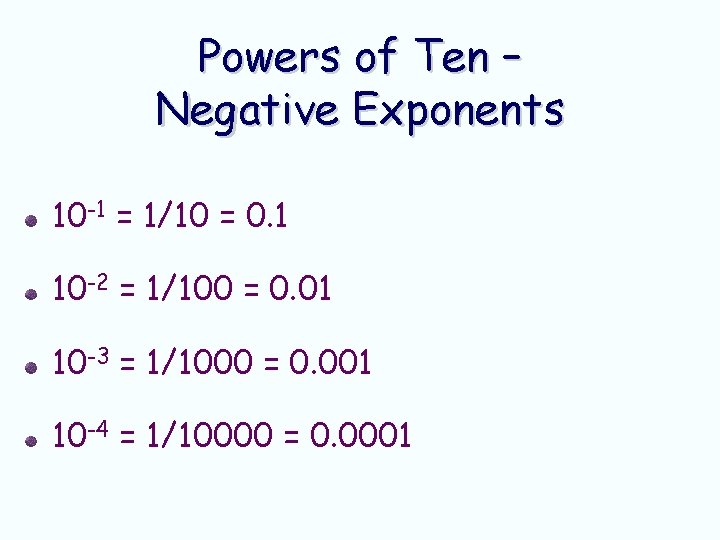
Powers of Ten – Negative Exponents 10 -1 = 1/10 = 0. 1 10 -2 = 1/100 = 0. 01 10 -3 = 1/1000 = 0. 001 10 -4 = 1/10000 = 0. 0001
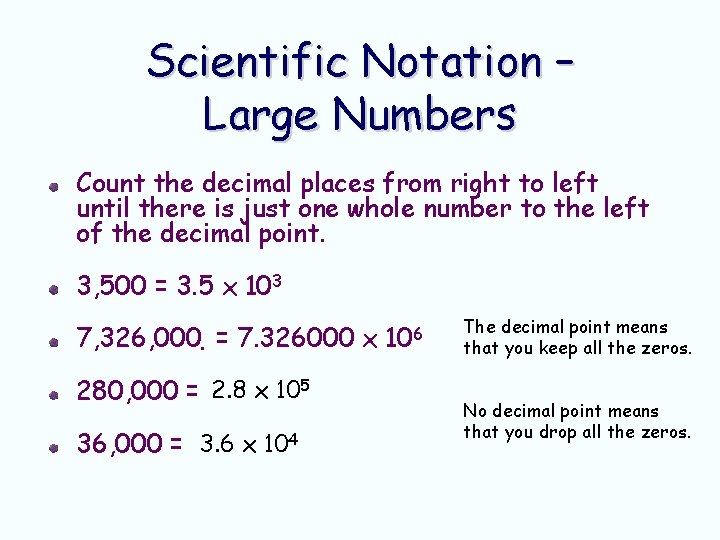
Scientific Notation – Large Numbers Count the decimal places from right to left until there is just one whole number to the left of the decimal point. 3, 500 = 3. 5 x 10³ 7, 326, 000. . = 7. 326000 x 106 280, 000 = ? 2. 8 x 10⁵ 36, 000 = ? 3. 6 x 10⁴ The decimal point means that you keep all the zeros. No decimal point means that you drop all the zeros.
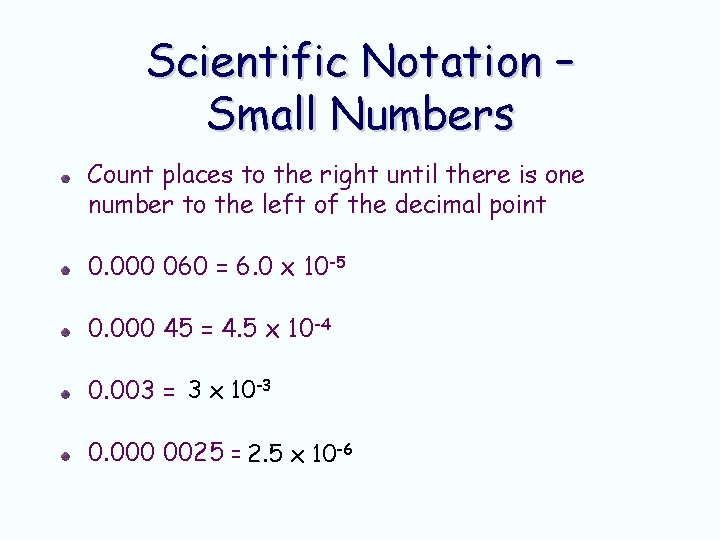
Scientific Notation – Small Numbers Count places to the right until there is one number to the left of the decimal point 0. 000 060 = 6. 0 x 10 -5 0. 000 45 = 4. 5 x 10 -4 0. 003 = ? 3 x 10 -3 0. 000 0025 = 2. 5 ? x 10 -6
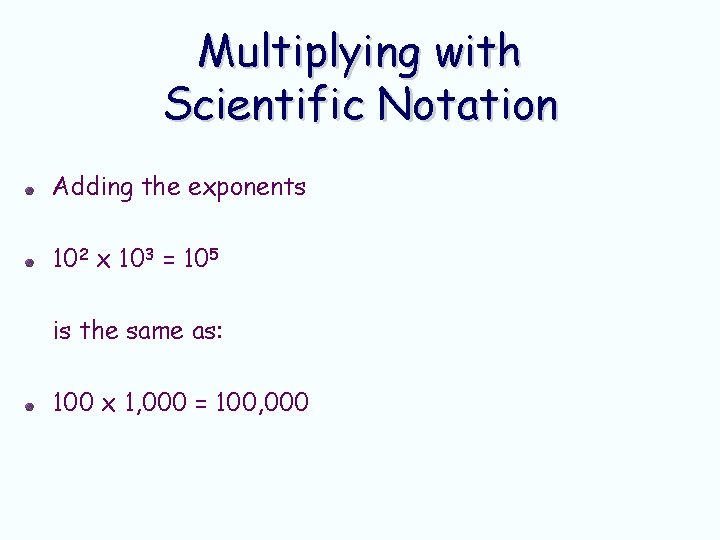
Multiplying with Scientific Notation Adding the exponents 102 x 103 = 105 is the same as: 100 x 1, 000 = 100, 000
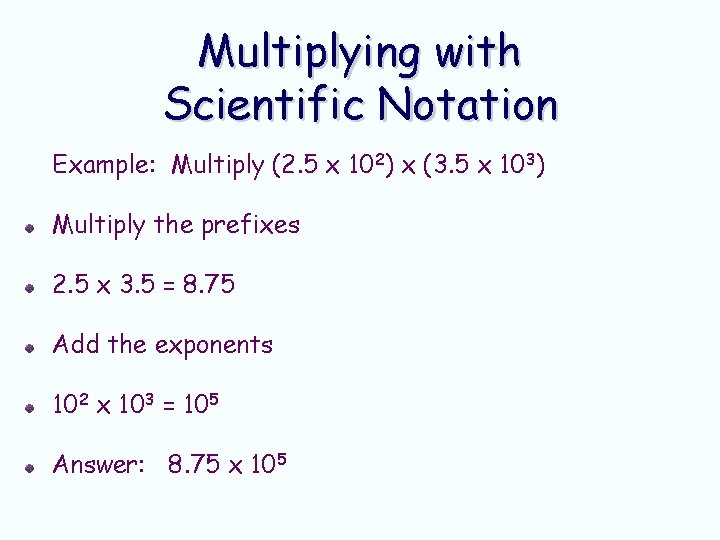
Multiplying with Scientific Notation Example: Multiply (2. 5 x 102) x (3. 5 x 10³) Multiply the prefixes 2. 5 x 3. 5 = 8. 75 Add the exponents 102 x 103 = 105 Answer: 8. 75 x 105
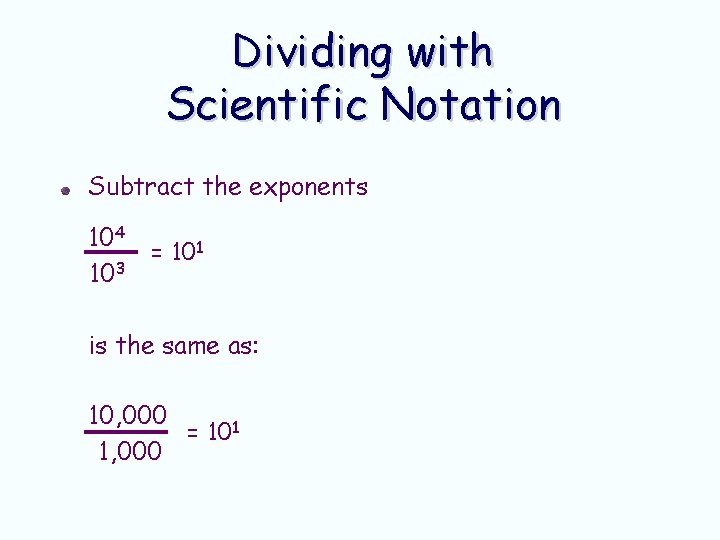
Dividing with Scientific Notation Subtract the exponents 104 103 = 101 is the same as: 10, 000 = 101 1, 000
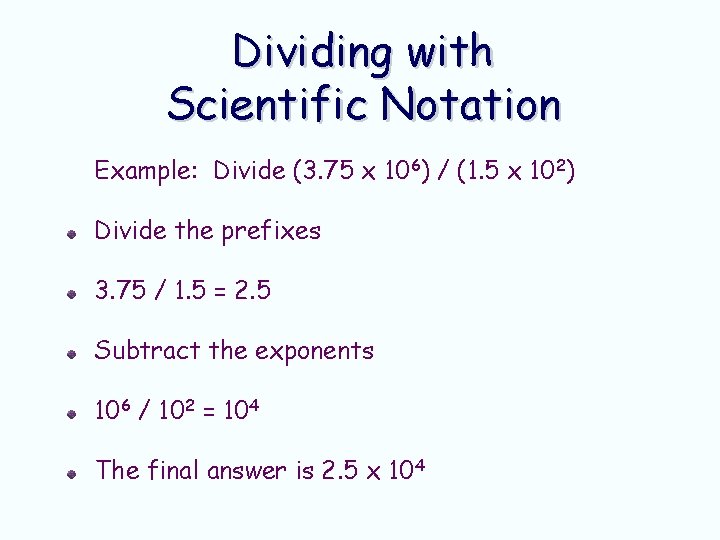
Dividing with Scientific Notation Example: Divide (3. 75 x 106) / (1. 5 x 10²) Divide the prefixes 3. 75 / 1. 5 = 2. 5 Subtract the exponents 106 / 102 = 104 The final answer is 2. 5 x 10⁴
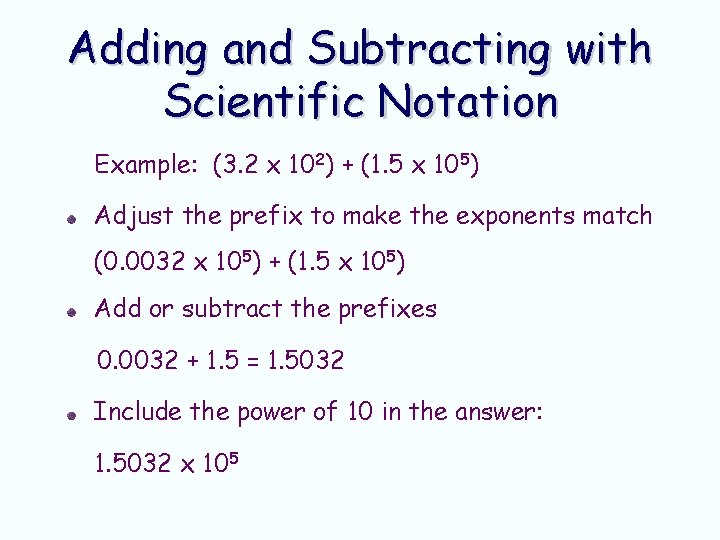
Adding and Subtracting with Scientific Notation Example: (3. 2 x 10²) + (1. 5 x 10⁵) Adjust the prefix to make the exponents match (0. 0032 x 105) + (1. 5 x 10⁵) Add or subtract the prefixes 0. 0032 + 1. 5 = 1. 5032 Include the power of 10 in the answer: 1. 5032 x 105
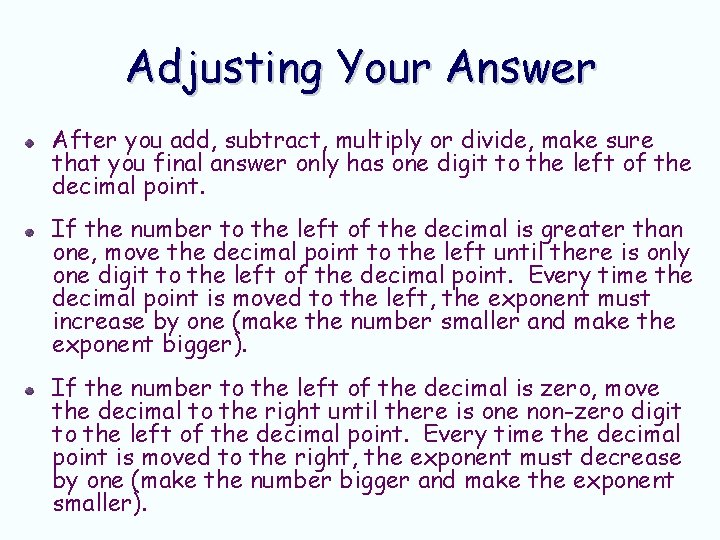
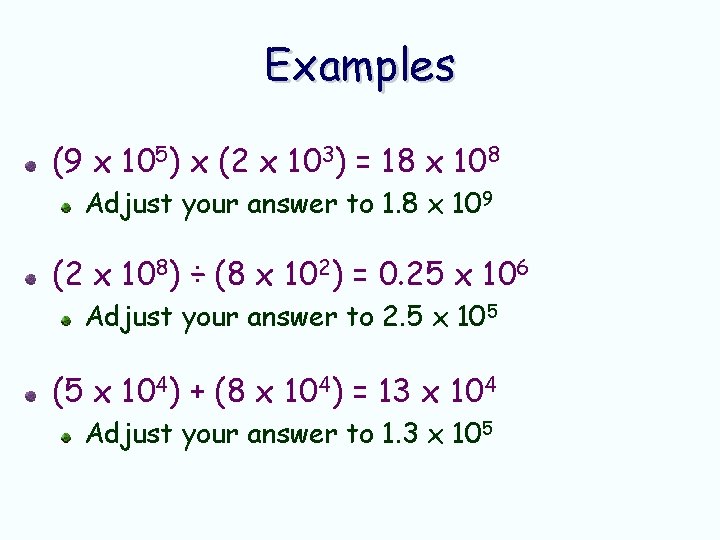
Adjusting Your Answer After you add, subtract, multiply or divide, make sure that you final answer only has one digit to the left of the decimal point. If the number to the left of the decimal is greater than one, move the decimal point to the left until there is only one digit to the left of the decimal point. Every time the decimal point is moved to the left, the exponent must increase by one (make the number smaller and make the exponent bigger). If the number to the left of the decimal is zero, move the decimal to the right until there is one non-zero digit to the left of the decimal point. Every time the decimal point is moved to the right, the exponent must decrease by one (make the number bigger and make the exponent smaller).
Examples (9 x 105) x (2 x 103) = 18 x 108 Adjust your answer to 1. 8 x 10⁹ (2 x 10⁸) ÷ (8 x 10²) = 0. 25 x 106 Adjust your answer to 2. 5 x 10⁵ (5 x 10⁴) + (8 x 10⁴) = 13 x 104 Adjust your answer to 1. 3 x 10⁵
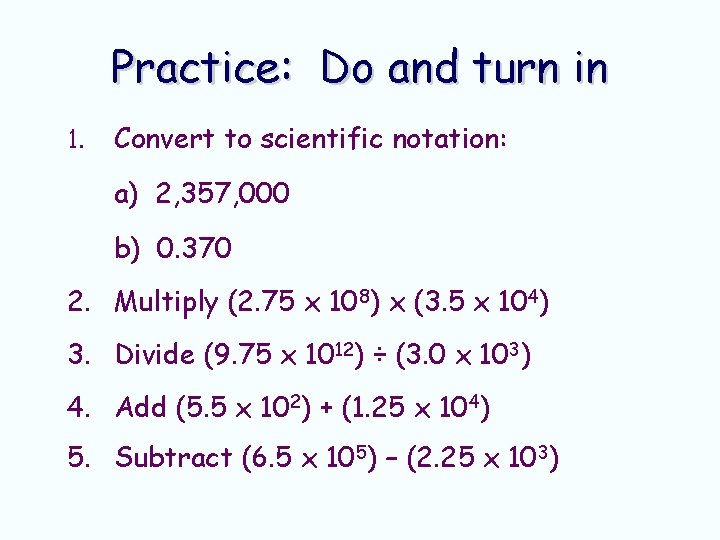
Practice: Do and turn in 1. Convert to scientific notation: a) 2, 357, 000 b) 0. 370 2. Multiply (2. 75 x 108) x (3. 5 x 10⁴) 3. Divide (9. 75 x 1012) ÷ (3. 0 x 103) 4. Add (5. 5 x 10²) + (1. 25 x 104) 5. Subtract (6. 5 x 10⁵) – (2. 25 x 103)
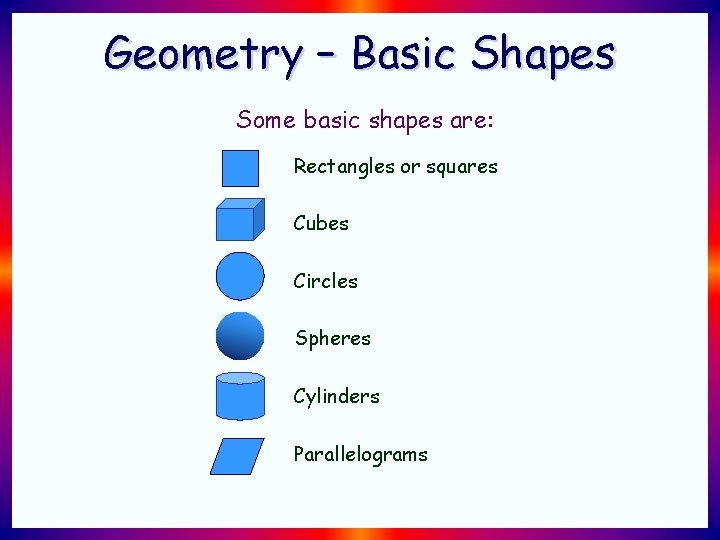
Geometry – Basic Shapes Some basic shapes are: Rectangles or squares Cubes Circles Spheres Cylinders Parallelograms
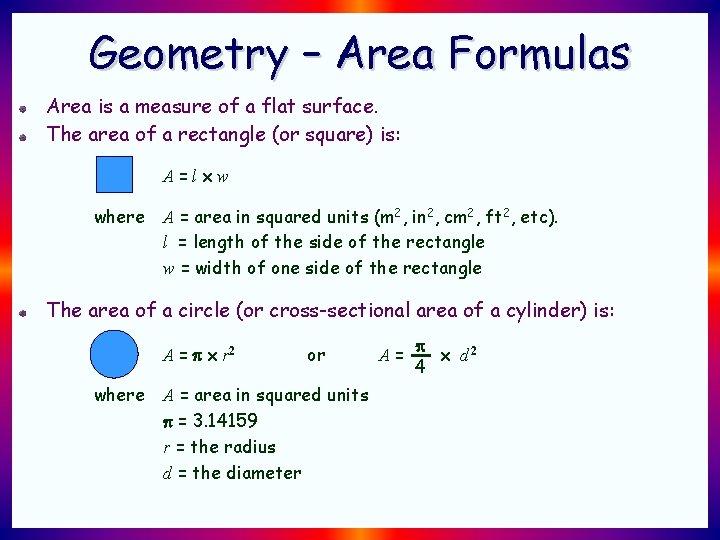
Geometry – Area Formulas Area is a measure of a flat surface. The area of a rectangle (or square) is: A=lxw where A = area in squared units (m 2, in 2, cm 2, ft 2, etc). l = length of the side of the rectangle w = width of one side of the rectangle The area of a circle (or cross-sectional area of a cylinder) is: A = x r 2 where or A = area in squared units = 3. 14159 r = the radius d = the diameter A= x d 2 4
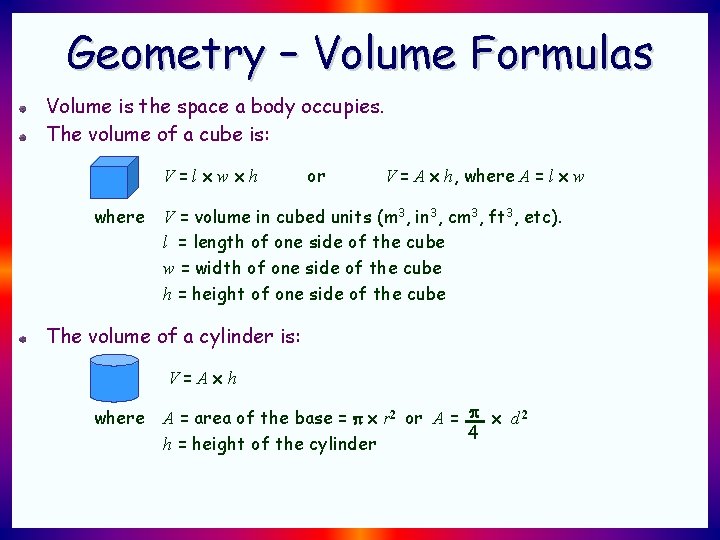
Geometry – Volume Formulas Volume is the space a body occupies. The volume of a cube is: V=lxwxh where or V = A x h, where A = l x w V = volume in cubed units (m 3, in 3, cm 3, ft 3, etc). l = length of one side of the cube w = width of one side of the cube h = height of one side of the cube The volume of a cylinder is: V=Axh where A = area of the base = x r 2 or A = x d 2 4 h = height of the cylinder
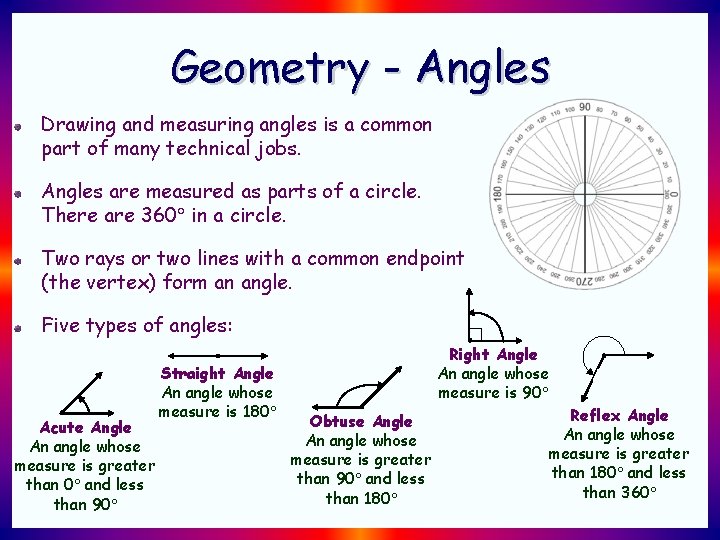
Geometry - Angles Drawing and measuring angles is a common part of many technical jobs. Angles are measured as parts of a circle. There are 360 in a circle. Two rays or two lines with a common endpoint (the vertex) form an angle. Five types of angles: Acute Angle An angle whose measure is greater than 0 and less than 90 Straight Angle An angle whose measure is 180 Right Angle An angle whose measure is 90 Obtuse Angle An angle whose measure is greater than 90 and less than 180 Reflex Angle An angle whose measure is greater than 180 and less than 360
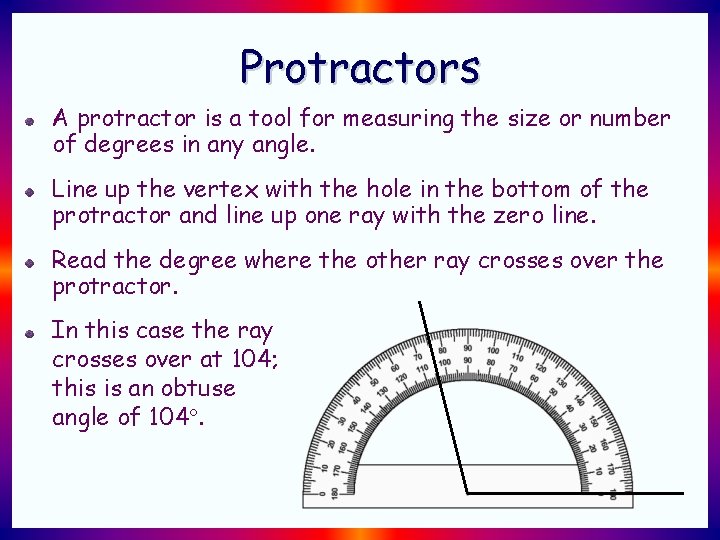
Protractors A protractor is a tool for measuring the size or number of degrees in any angle. Line up the vertex with the hole in the bottom of the protractor and line up one ray with the zero line. Read the degree where the other ray crosses over the protractor. In this case the ray crosses over at 104; this is an obtuse angle of 104.
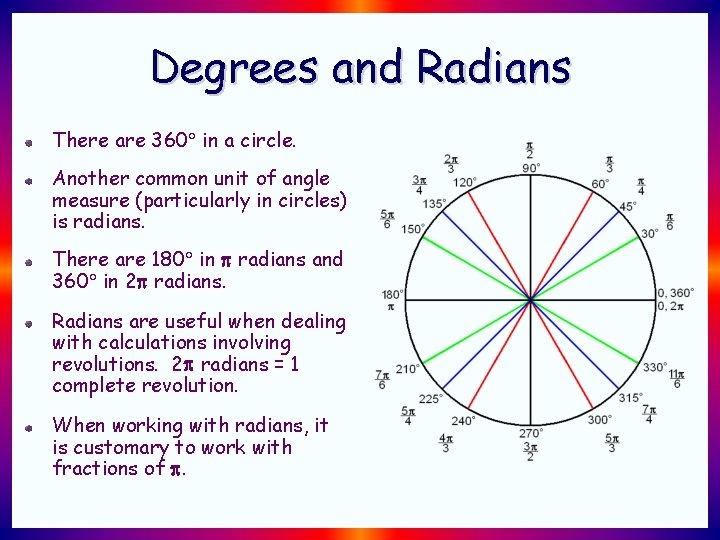
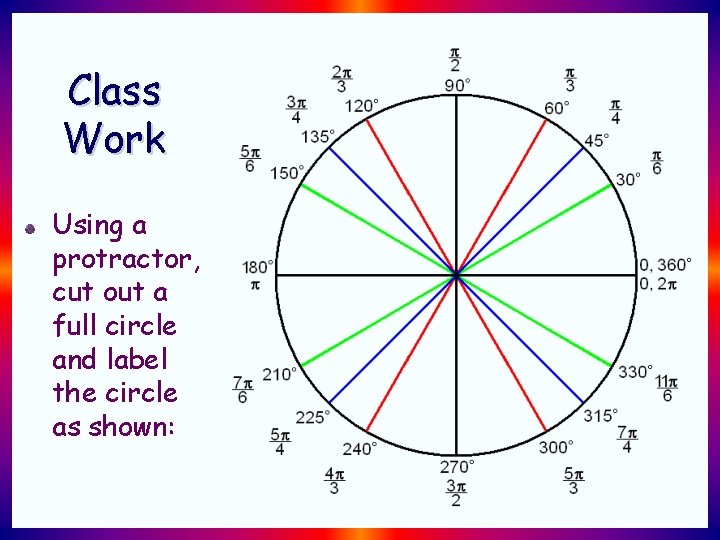
Degrees and Radians There are 360 in a circle. Another common unit of angle measure (particularly in circles) is radians. There are 180 in radians and 360 in 2 radians. Radians are useful when dealing with calculations involving revolutions. 2 radians = 1 complete revolution. When working with radians, it is customary to work with fractions of .
Class Work Using a protractor, cut out a full circle and label the circle as shown:
Algebra Review Objectives: Simplify an expression (order of operations). Rearrange formulas so that one variable is isolated. Substitute into formulas and solve for unknown quantities.
Formulas, sometimes called equations, show some quantities relate to each other. Always take care to substitute correct numbers and units for known symbols in an equation. Answers will be in English or metric units, not both!
Order of Operations Mathematical operations are: Addition Subtraction Multiplication Division A numerical expression is a combination of numbers and operations, such as 130 ÷ 10 + 3 x 2. An algebraic expression contains one or more variables, such as 2 x 2 – 5 x + 3. To evaluate an expression means to find its value. When evaluating an algebraic expression, the variable must be replaced with a value. When evaluating any expression, the mathematical operations must be done in the following order: Parentheses Exponents Multiplication and division – from left to right Addition and subtraction – from left to right
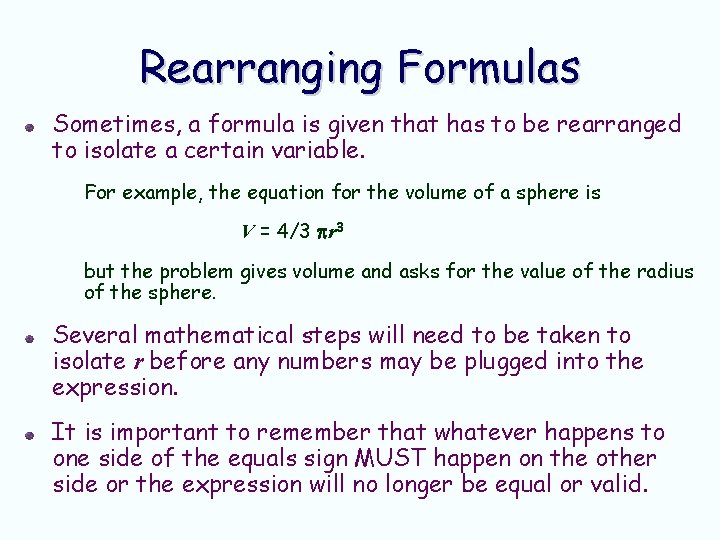
Rearranging Formulas Sometimes, a formula is given that has to be rearranged to isolate a certain variable. For example, the equation for the volume of a sphere is V = 4/3 r 3 but the problem gives volume and asks for the value of the radius of the sphere. Several mathematical steps will need to be taken to isolate r before any numbers may be plugged into the expression. It is important to remember that whatever happens to one side of the equals sign MUST happen on the other side or the expression will no longer be equal or valid.
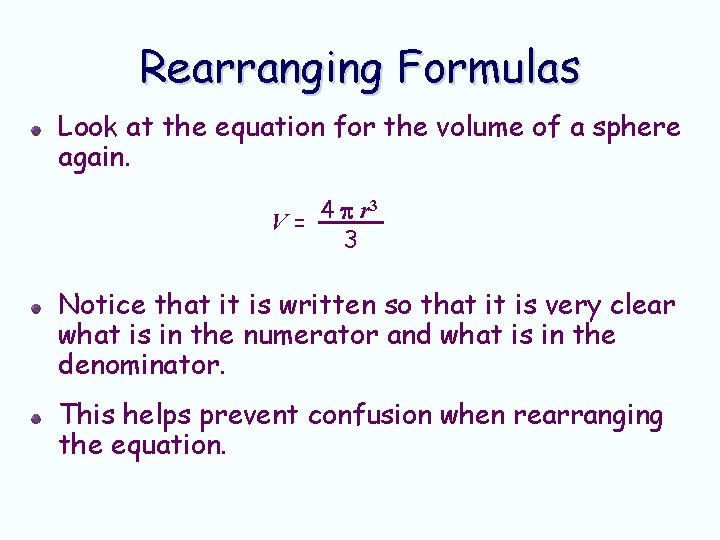
Rearranging Formulas Look at the equation for the volume of a sphere again. 3 4 r V= 3 Notice that it is written so that it is very clear what is in the numerator and what is in the denominator. This helps prevent confusion when rearranging the equation.
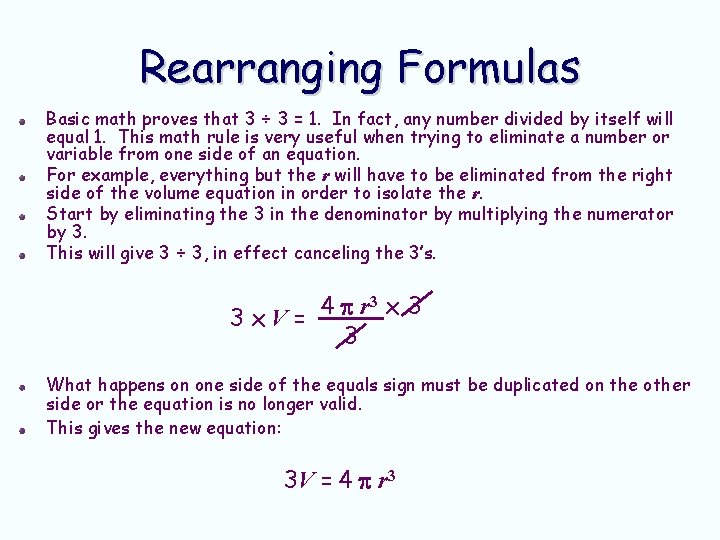
Rearranging Formulas Basic math proves that 3 ÷ 3 = 1. In fact, any number divided by itself will equal 1. This math rule is very useful when trying to eliminate a number or variable from one side of an equation. For example, everything but the r will have to be eliminated from the right side of the volume equation in order to isolate the r. Start by eliminating the 3 in the denominator by multiplying the numerator by 3. This will give 3 ÷ 3, in effect canceling the 3’s. 4 r 3 x 3 3 x. V= 3 What happens on one side of the equals sign must be duplicated on the other side or the equation is no longer valid. This gives the new equation: 3 V = 4 r 3
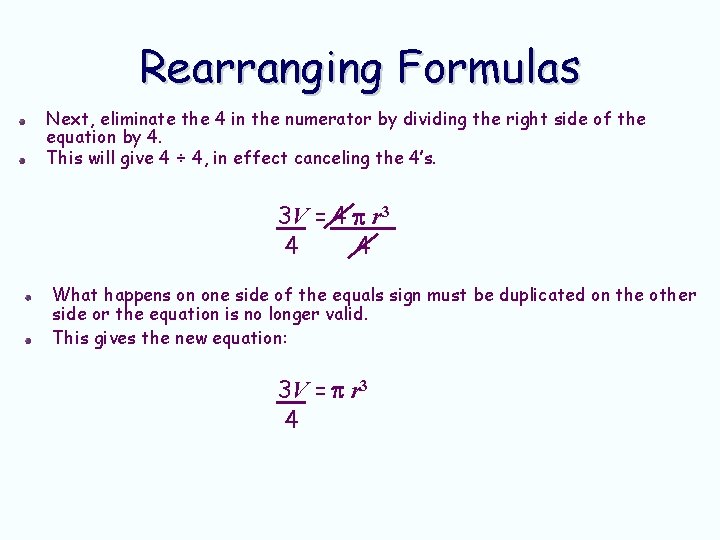
Rearranging Formulas Next, eliminate the 4 in the numerator by dividing the right side of the equation by 4. This will give 4 ÷ 4, in effect canceling the 4’s. 3 V = 4 r 3 4 4 What happens on one side of the equals sign must be duplicated on the other side or the equation is no longer valid. This gives the new equation: 3 V = r 3 4
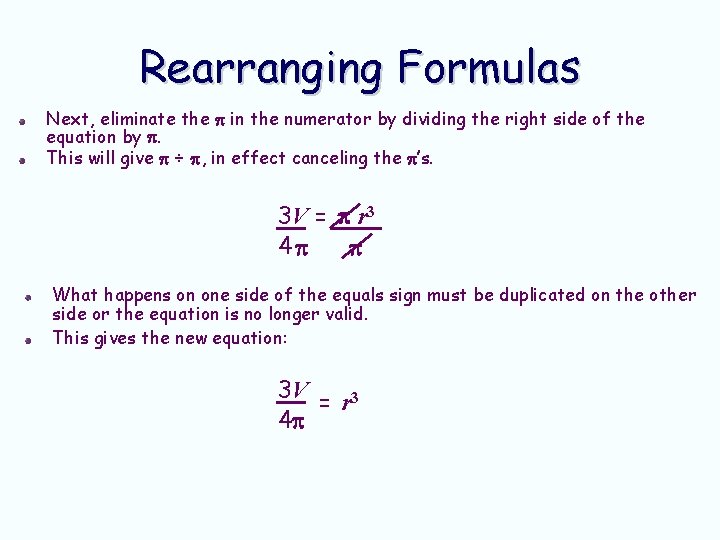
Rearranging Formulas Next, eliminate the in the numerator by dividing the right side of the equation by . This will give ÷ , in effect canceling the ’s. 3 V = r 3 4 What happens on one side of the equals sign must be duplicated on the other side or the equation is no longer valid. This gives the new equation: 3 V = r 3 4
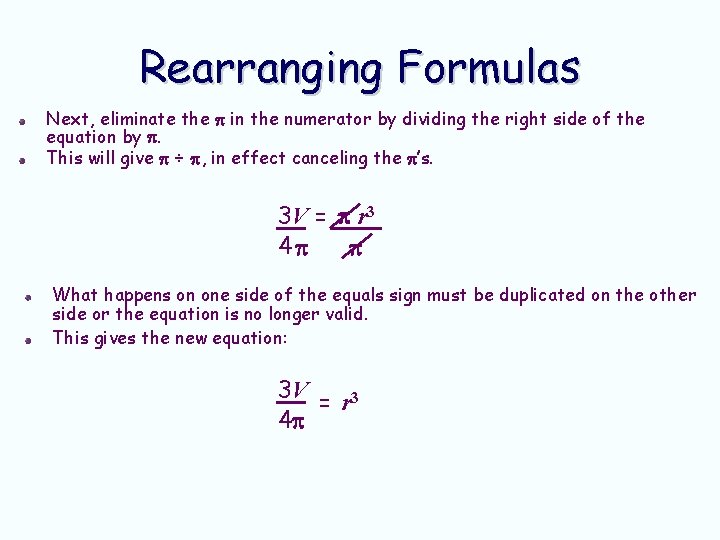
Rearranging Formulas Next, eliminate the in the numerator by dividing the right side of the equation by . This will give ÷ , in effect canceling the ’s. 3 V = r 3 4 What happens on one side of the equals sign must be duplicated on the other side or the equation is no longer valid. This gives the new equation: 3 V = r 3 4
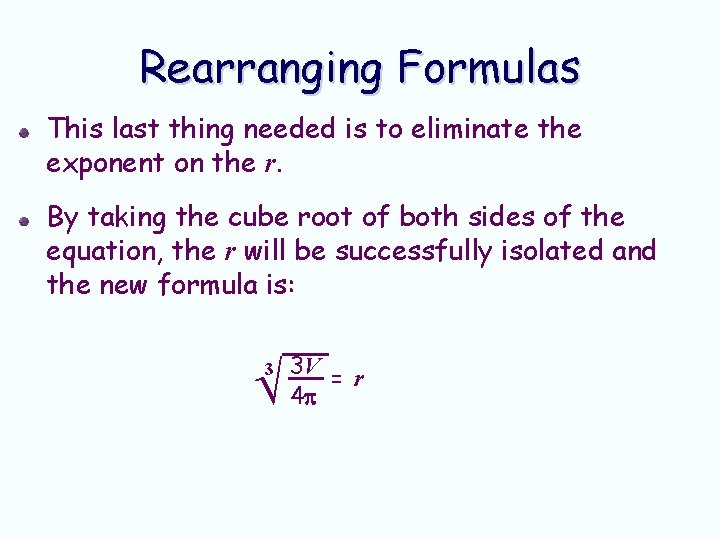
Rearranging Formulas This last thing needed is to eliminate the exponent on the r. By taking the cube root of both sides of the equation, the r will be successfully isolated and the new formula is: √ 3 3 V = r 4
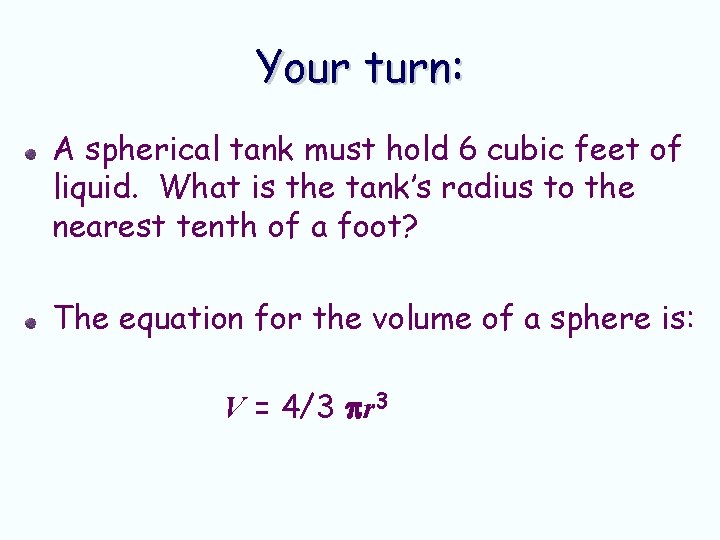
Your turn: A spherical tank must hold 6 cubic feet of liquid. What is the tank’s radius to the nearest tenth of a foot? The equation for the volume of a sphere is: V = 4/3 r 3
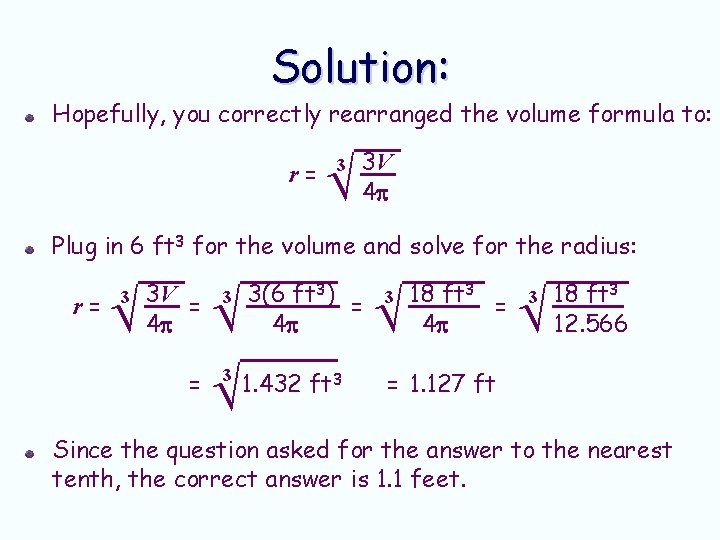
Solution: Hopefully, you correctly rearranged the volume formula to: r= √ 3 3 V 4 Plug in 6 ft 3 for the volume and solve for the radius: r= √ 3 3 V = 4 3(6 ft 3) = 4 18 ft 3 = 4 √ √ √ = 1. 127 ft = 1. 432 ft √ 3 3 18 ft 3 12. 566 3 Since the question asked for the answer to the nearest tenth, the correct answer is 1. 1 feet.
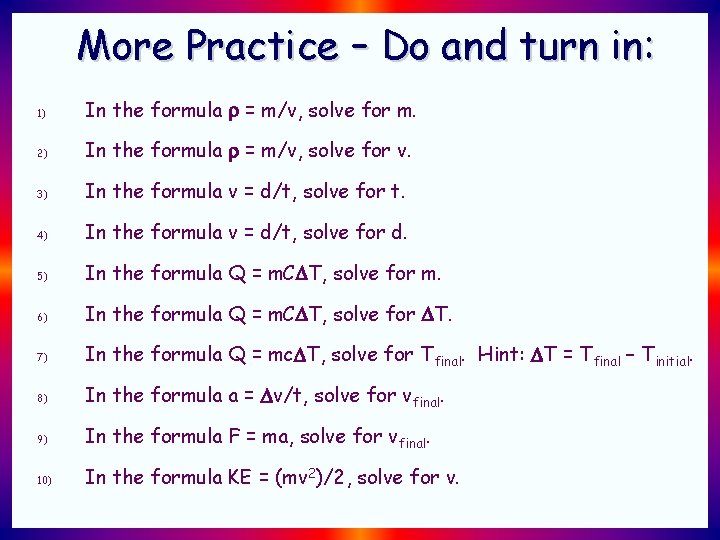
More Practice – Do and turn in: 1) In the formula = m/v, solve for m. 2) In the formula = m/v, solve for v. 3) In the formula v = d/t, solve for t. 4) In the formula v = d/t, solve for d. 5) In the formula Q = m. C T, solve for m. 6) In the formula Q = m. C T, solve for T. 7) In the formula Q = mc T, solve for Tfinal. Hint: T = Tfinal – Tinitial. 8) In the formula a = v/t, solve for vfinal. 9) In the formula F = ma, solve for vfinal. 10) In the formula KE = (mv 2)/2, solve for v.
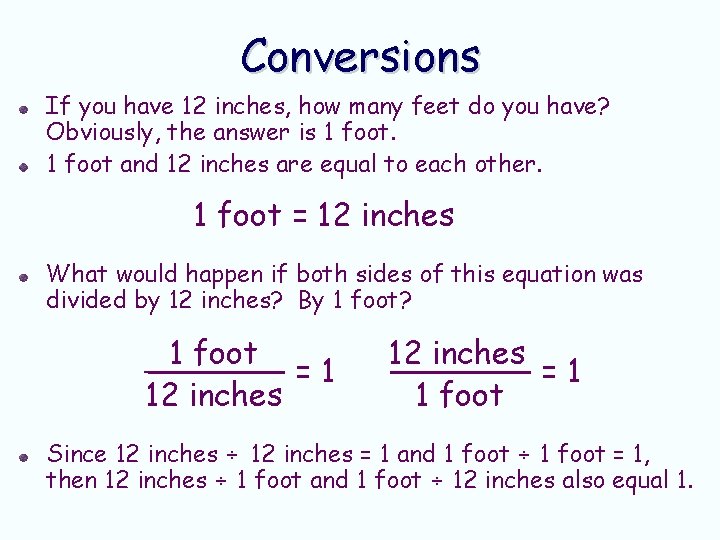
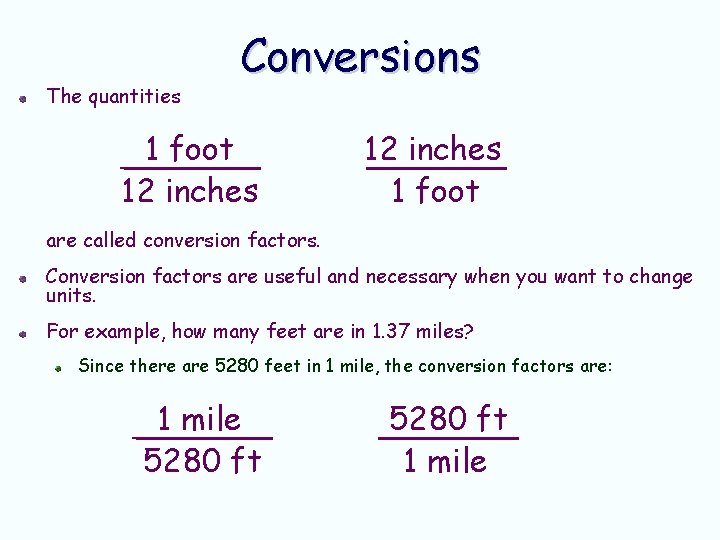
Conversions If you have 12 inches, how many feet do you have? Obviously, the answer is 1 foot and 12 inches are equal to each other. 1 foot = 12 inches What would happen if both sides of this equation was divided by 12 inches? By 1 foot? 1 foot =1 12 inches =1 1 foot Since 12 inches ÷ 12 inches = 1 and 1 foot ÷ 1 foot = 1, then 12 inches ÷ 1 foot and 1 foot ÷ 12 inches also equal 1.
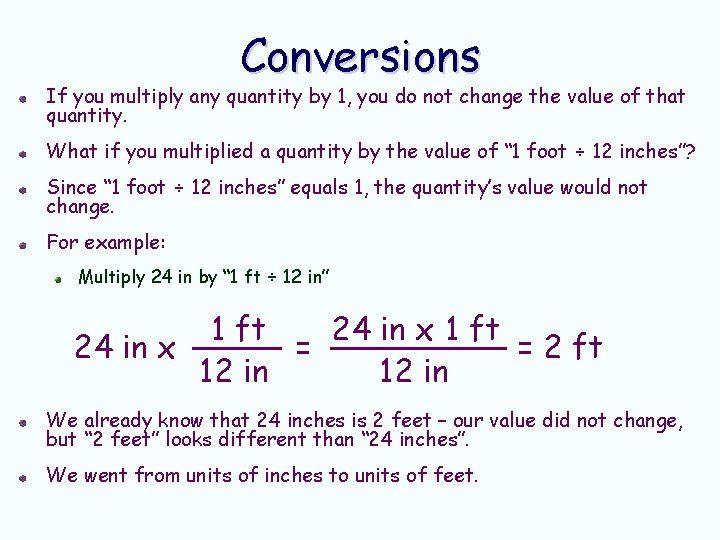
Conversions If you multiply any quantity by 1, you do not change the value of that quantity. What if you multiplied a quantity by the value of “ 1 foot ÷ 12 inches”? Since “ 1 foot ÷ 12 inches” equals 1, the quantity’s value would not change. For example: Multiply 24 in by “ 1 ft ÷ 12 in” 1 ft 24 in x = = 2 ft 12 in We already know that 24 inches is 2 feet – our value did not change, but “ 2 feet” looks different than “ 24 inches”. We went from units of inches to units of feet.
The quantities Conversions 1 foot 12 inches 1 foot are called conversion factors. Conversion factors are useful and necessary when you want to change units. For example, how many feet are in 1. 37 miles? Since there are 5280 feet in 1 mile, the conversion factors are: 1 mile 5280 ft 1 mile
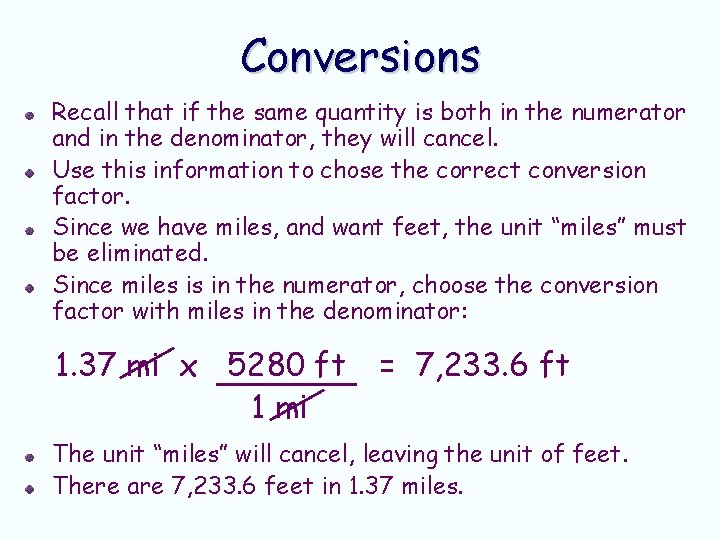
Conversions Recall that if the same quantity is both in the numerator and in the denominator, they will cancel. Use this information to chose the correct conversion factor. Since we have miles, and want feet, the unit “miles” must be eliminated. Since miles is in the numerator, choose the conversion factor with miles in the denominator: 1. 37 mi x 5280 ft 1 mi = 7, 233. 6 ft The unit “miles” will cancel, leaving the unit of feet. There are 7, 233. 6 feet in 1. 37 miles.
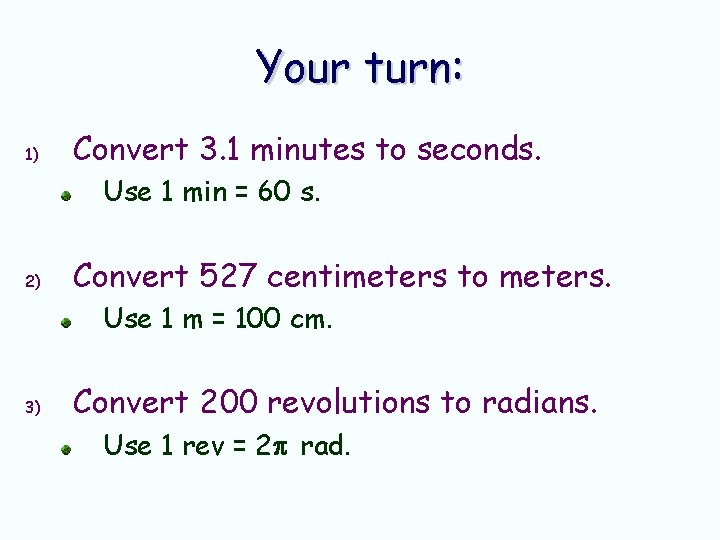
Your turn: 1) Convert 3. 1 minutes to seconds. Use 1 min = 60 s. 2) Convert 527 centimeters to meters. Use 1 m = 100 cm. 3) Convert 200 revolutions to radians. Use 1 rev = 2 rad.
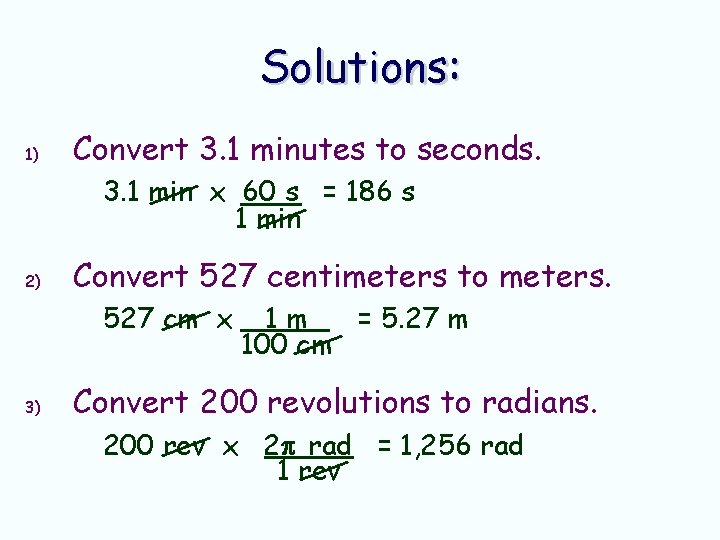
Solutions: 1) Convert 3. 1 minutes to seconds. 3. 1 min x 60 s = 186 s 1 min 2) Convert 527 centimeters to meters. 527 cm x 3) 1 m = 5. 27 m 100 cm Convert 200 revolutions to radians. 200 rev x 2 rad = 1, 256 rad 1 rev
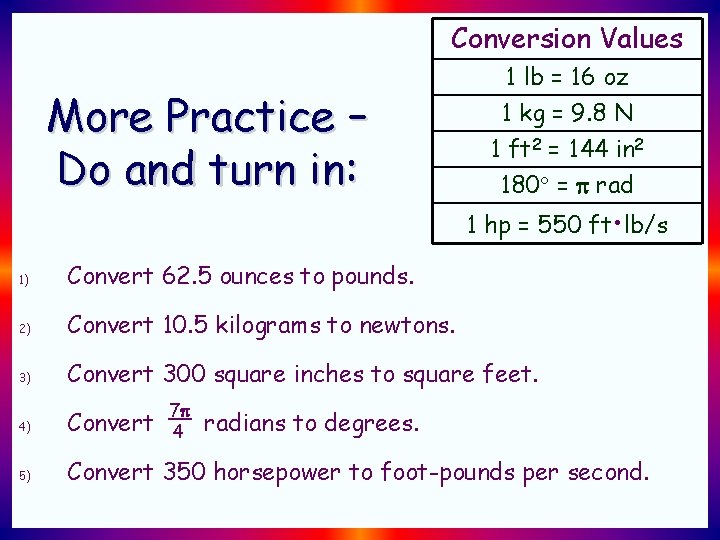
Conversion Values More Practice – Do and turn in: 1 lb = 16 oz 1 kg = 9. 8 N 1 ft 2 = 144 in 2 180 = rad 1 hp = 550 ft • lb/s 1) Convert 62. 5 ounces to pounds. 2) Convert 10. 5 kilograms to newtons. 3) Convert 300 square inches to square feet. 4) Convert 5) Convert 350 horsepower to foot-pounds per second. 7 4 radians to degrees.
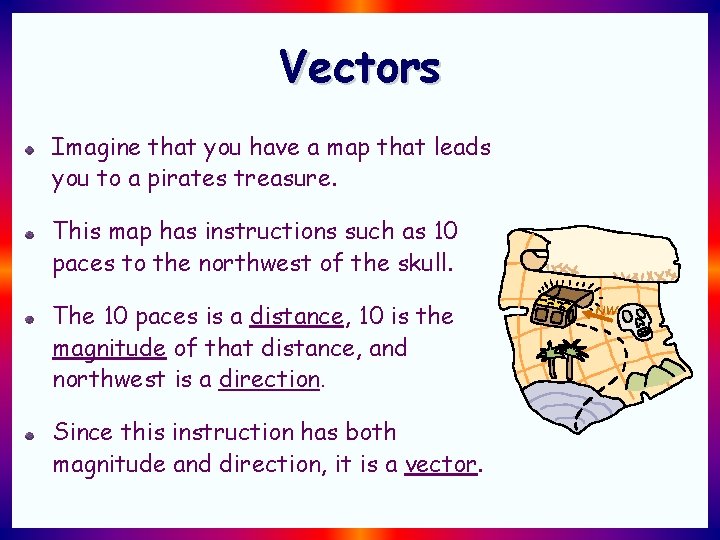
Vectors Imagine that you have a map that leads you to a pirates treasure. This map has instructions such as 10 paces to the northwest of the skull. The 10 paces is a distance, 10 is the magnitude of that distance, and northwest is a direction. Since this instruction has both magnitude and direction, it is a vector. NW
Vectors vs. Scalars Quantities that require a magnitude (how big or small) and direction for specification are called vectors. Those quantities that have magnitude but no direction are called scalars.
Vectors and Scalars Examples of scalars are: distance speed time mass Examples of vectors are: displacement velocity acceleration force All vectors have a scalar component: The displacement vector includes both distance and direction, The velocity vector includes both speed and direction.
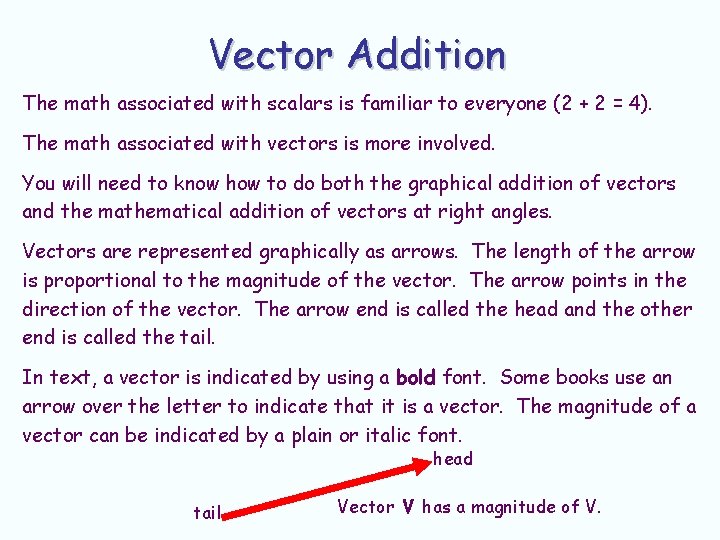
Vector Addition The math associated with scalars is familiar to everyone (2 + 2 = 4). The math associated with vectors is more involved. You will need to know how to do both the graphical addition of vectors and the mathematical addition of vectors at right angles. Vectors are represented graphically as arrows. The length of the arrow is proportional to the magnitude of the vector. The arrow points in the direction of the vector. The arrow end is called the head and the other end is called the tail. In text, a vector is indicated by using a bold font. Some books use an arrow over the letter to indicate that it is a vector. The magnitude of a vector can be indicated by a plain or italic font. head tail Vector V has a magnitude of V.
Two Methods of Vector Addition The head-to-tail method of vector addition is more useful when dealing with displacements. The parallelogram method of vector addition is more useful when dealing with forces on an object. When adding two vectors, you can move one of the vectors to either the head or the tail of the other vector so long as you do not change either the magnitude or direction of a vector you are moving. Since vectors can be moved around for addition purposes, either method will give the right answer to a problem.
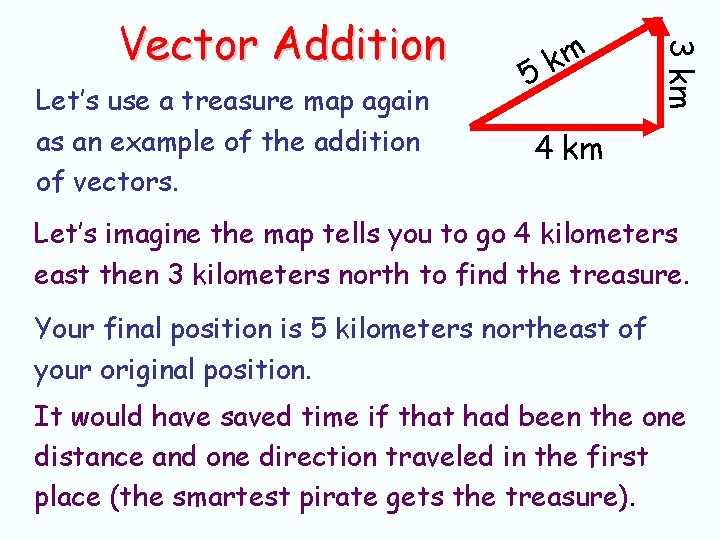
Let’s use a treasure map again as an example of the addition of vectors. m k 5 3 km Vector Addition 4 km Let’s imagine the map tells you to go 4 kilometers east then 3 kilometers north to find the treasure. Your final position is 5 kilometers northeast of your original position. It would have saved time if that had been the one distance and one direction traveled in the first place (the smartest pirate gets the treasure).
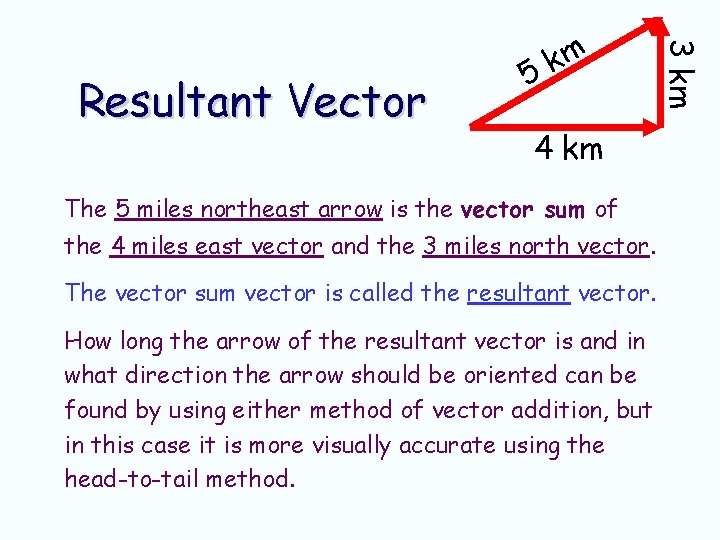
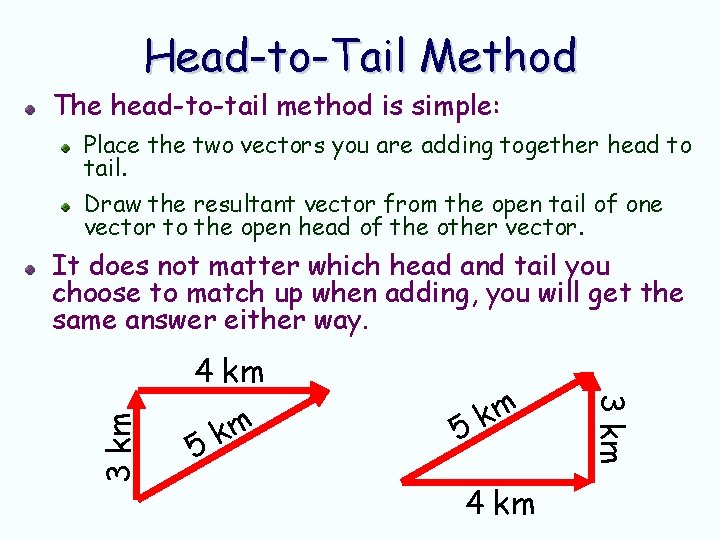
4 km The 5 miles northeast arrow is the vector sum of the 4 miles east vector and the 3 miles north vector. The vector sum vector is called the resultant vector. How long the arrow of the resultant vector is and in what direction the arrow should be oriented can be found by using either method of vector addition, but in this case it is more visually accurate using the head-to-tail method. 3 km Resultant Vector m k 5
Head-to-Tail Method The head-to-tail method is simple: Place the two vectors you are adding together head to tail. Draw the resultant vector from the open tail of one vector to the open head of the other vector. It does not matter which head and tail you choose to match up when adding, you will get the same answer either way. m k 5 4 km 3 km 4 km
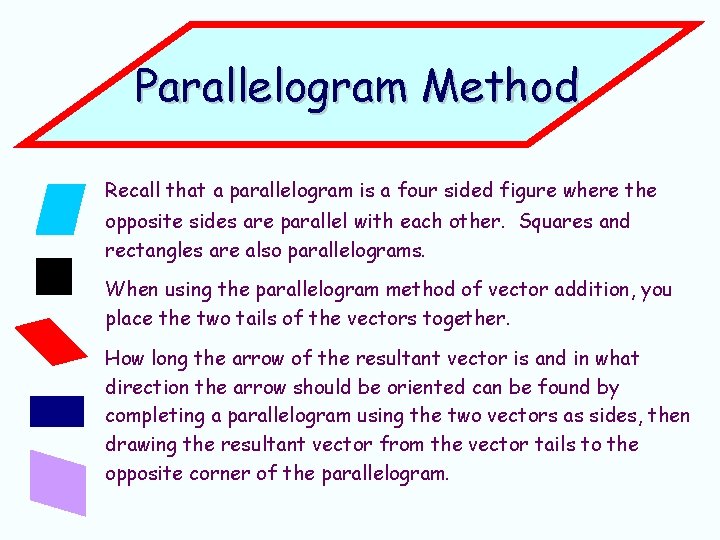
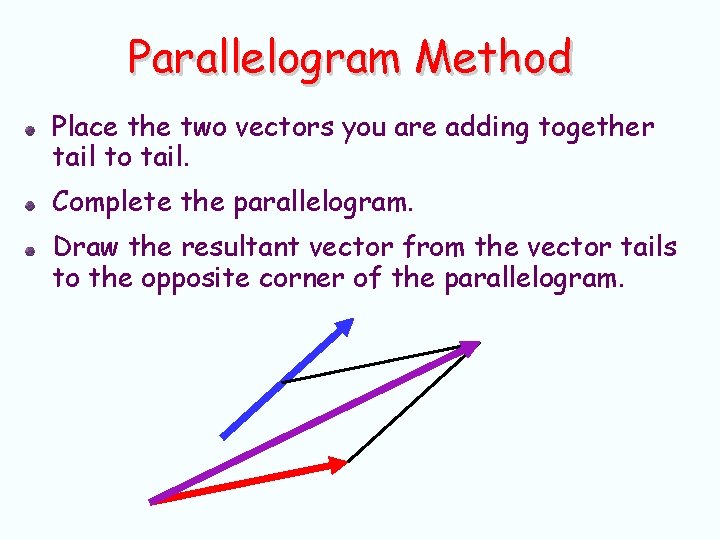
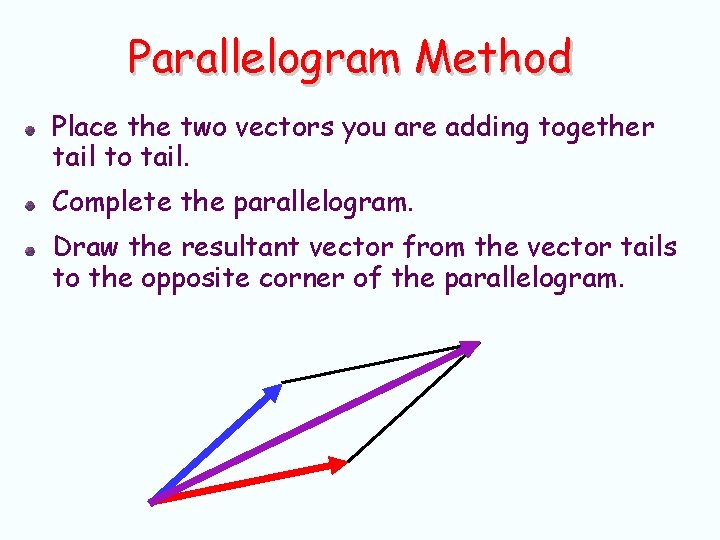
Parallelogram Method Recall that a parallelogram is a four sided figure where the opposite sides are parallel with each other. Squares and rectangles are also parallelograms. When using the parallelogram method of vector addition, you place the two tails of the vectors together. How long the arrow of the resultant vector is and in what direction the arrow should be oriented can be found by completing a parallelogram using the two vectors as sides, then drawing the resultant vector from the vector tails to the opposite corner of the parallelogram.
Parallelogram Method Place the two vectors you are adding together tail to tail. Complete the parallelogram. Draw the resultant vector from the vector tails to the opposite corner of the parallelogram.
Parallelogram Method Place the two vectors you are adding together tail to tail. Complete the parallelogram. Draw the resultant vector from the vector tails to the opposite corner of the parallelogram.
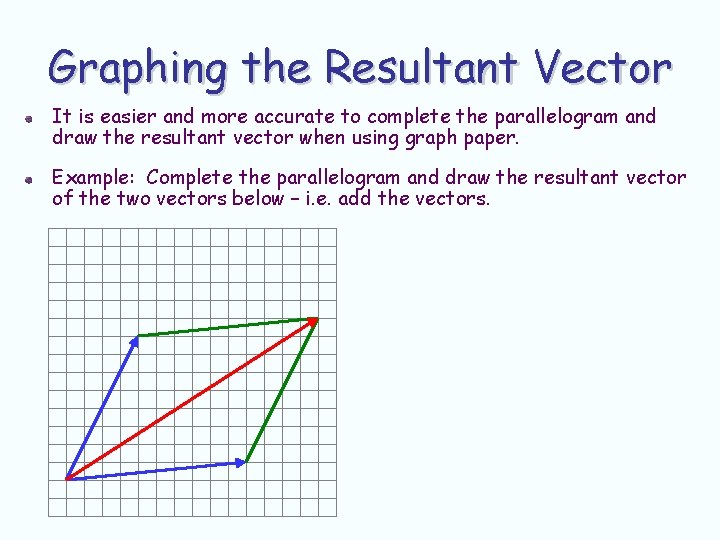
Graphing the Resultant Vector It is easier and more accurate to complete the parallelogram and draw the resultant vector when using graph paper. Example: Complete the parallelogram and draw the resultant vector of the two vectors below – i. e. add the vectors.
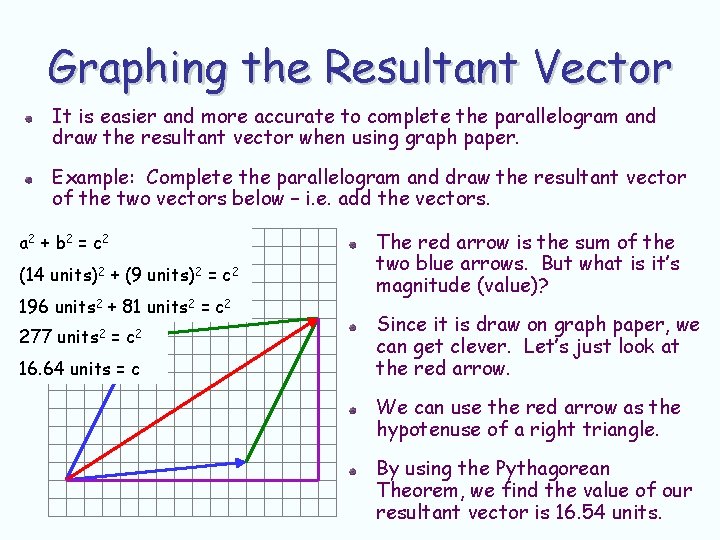
Graphing the Resultant Vector It is easier and more accurate to complete the parallelogram and draw the resultant vector when using graph paper. Example: Complete the parallelogram and draw the resultant vector of the two vectors below – i. e. add the vectors. a 2 + b 2 = c 2 (14 units)2 + (9 units)2 = c 2 196 units 2 + 81 units 2 = c 2 277 units 2 = c 2 16. 64 units = c The red arrow is the sum of the two blue arrows. But what is it’s magnitude (value)? Since it is draw on graph paper, we can get clever. Let’s just look at the red arrow. We can use the red arrow as the hypotenuse of a right triangle. By using the Pythagorean Theorem, we find the value of our resultant vector is 16. 54 units.
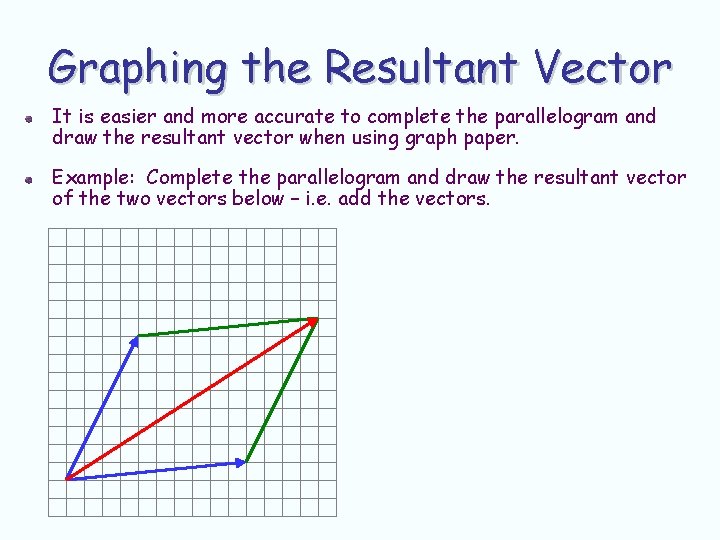
Graphing the Resultant Vector It is easier and more accurate to complete the parallelogram and draw the resultant vector when using graph paper. Example: Complete the parallelogram and draw the resultant vector of the two vectors below – i. e. add the vectors.
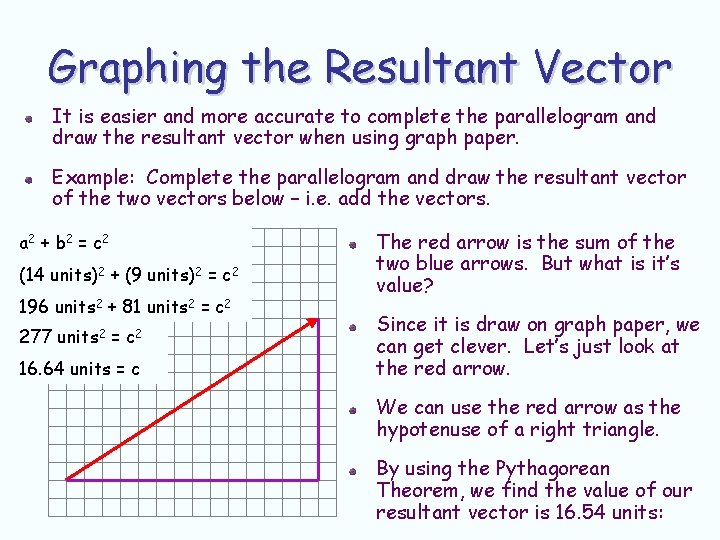
Graphing the Resultant Vector It is easier and more accurate to complete the parallelogram and draw the resultant vector when using graph paper. Example: Complete the parallelogram and draw the resultant vector of the two vectors below – i. e. add the vectors. a 2 + b 2 = c 2 (14 units)2 + (9 units)2 = c 2 196 units 2 + 81 units 2 = c 2 277 units 2 = c 2 16. 64 units = c The red arrow is the sum of the two blue arrows. But what is it’s value? Since it is draw on graph paper, we can get clever. Let’s just look at the red arrow. We can use the red arrow as the hypotenuse of a right triangle. By using the Pythagorean Theorem, we find the value of our resultant vector is 16. 54 units:
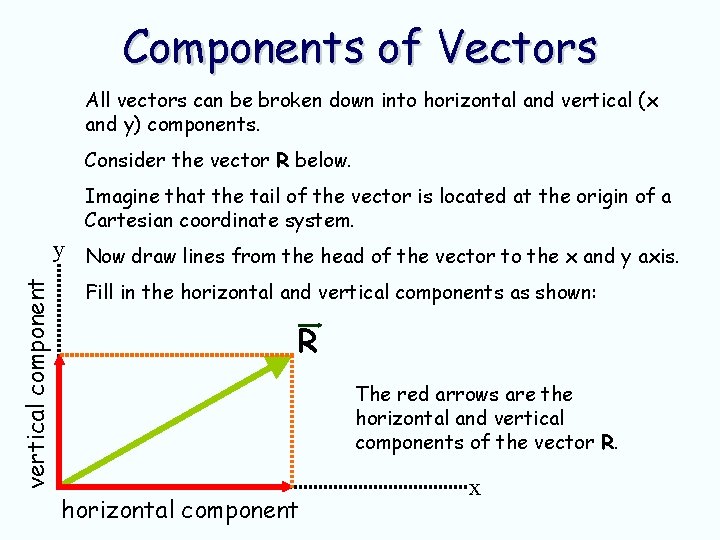
Components of Vectors All vectors can be broken down into horizontal and vertical (x and y) components. Consider the vector R below. Imagine that the tail of the vector is located at the origin of a Cartesian coordinate system. vertical component y Now draw lines from the head of the vector to the x and y axis. Fill in the horizontal and vertical components as shown: R The red arrows are the horizontal and vertical components of the vector R. horizontal component x
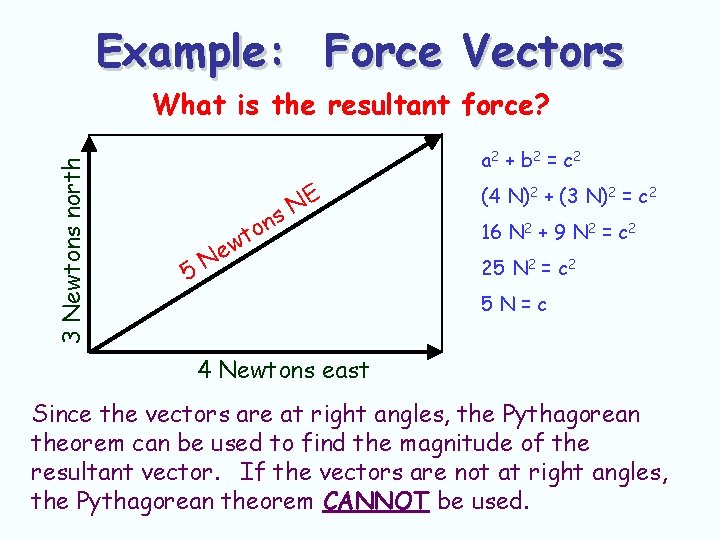
Example: Force Vectors 3 Newtons north What is the resultant force? a 2 + b 2 = c 2 s n o t ew NE 5 N (4 N)2 + (3 N)2 = c 2 16 N 2 + 9 N 2 = c 2 25 N 2 = c 2 5 N=c 4 Newtons east Since the vectors are at right angles, the Pythagorean theorem can be used to find the magnitude of the resultant vector. If the vectors are not at right angles, the Pythagorean theorem CANNOT be used.
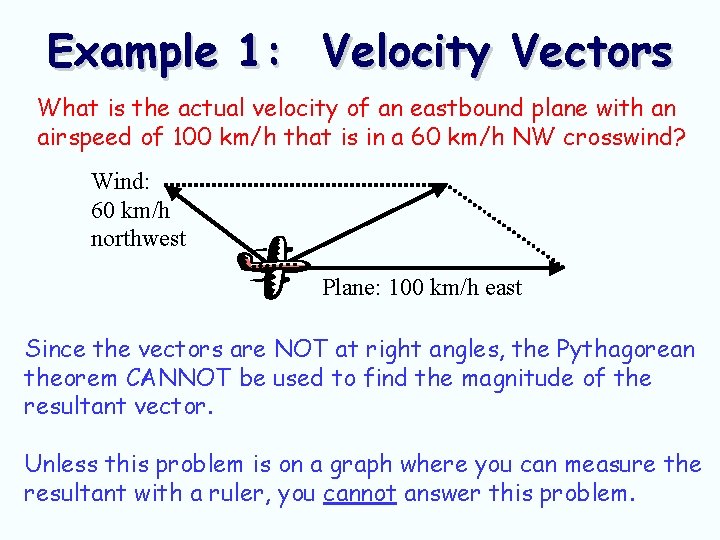
Example 1: Velocity Vectors What is the actual velocity of an eastbound plane with an airspeed of 100 km/h that is in a 60 km/h NW crosswind? Wind: 60 km/h northwest Plane: 100 km/h east Since the vectors are NOT at right angles, the Pythagorean theorem CANNOT be used to find the magnitude of the resultant vector. Unless this problem is on a graph where you can measure the resultant with a ruler, you cannot answer this problem.
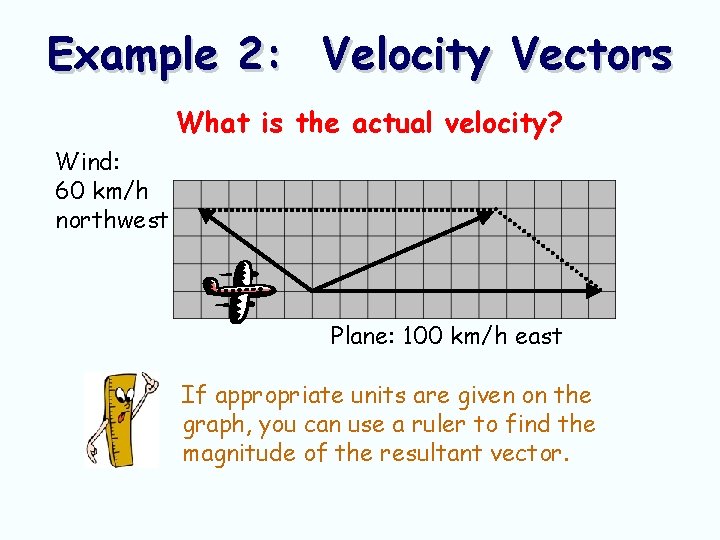
Example 2: Velocity Vectors What is the actual velocity? Wind: 60 km/h northwest Plane: 100 km/h east If appropriate units are given on the graph, you can use a ruler to find the magnitude of the resultant vector.
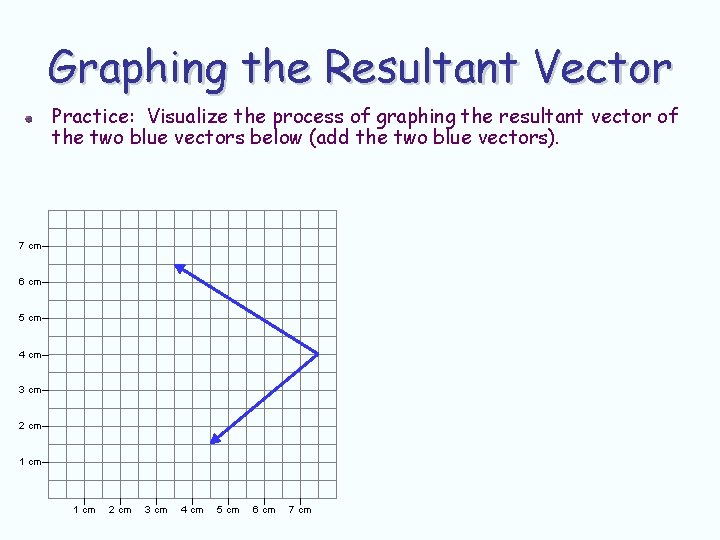
Graphing the Resultant Vector Practice: Visualize the process of graphing the resultant vector of the two blue vectors below (add the two blue vectors). 7 cm 6 cm 5 cm 4 cm 3 cm 2 cm 1 cm 2 cm 3 cm 4 cm 5 cm 6 cm 7 cm
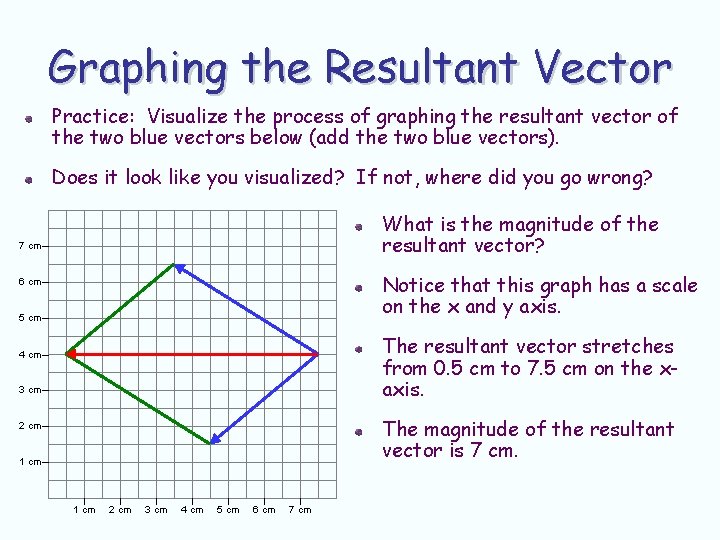
Graphing the Resultant Vector Practice: Visualize the process of graphing the resultant vector of the two blue vectors below (add the two blue vectors). Does it look like you visualized? If not, where did you go wrong? What is the magnitude of the resultant vector? 7 cm Notice that this graph has a scale on the x and y axis. 6 cm 5 cm The resultant vector stretches from 0. 5 cm to 7. 5 cm on the xaxis. 4 cm 3 cm The magnitude of the resultant vector is 7 cm. 2 cm 1 cm 2 cm 3 cm 4 cm 5 cm 6 cm 7 cm
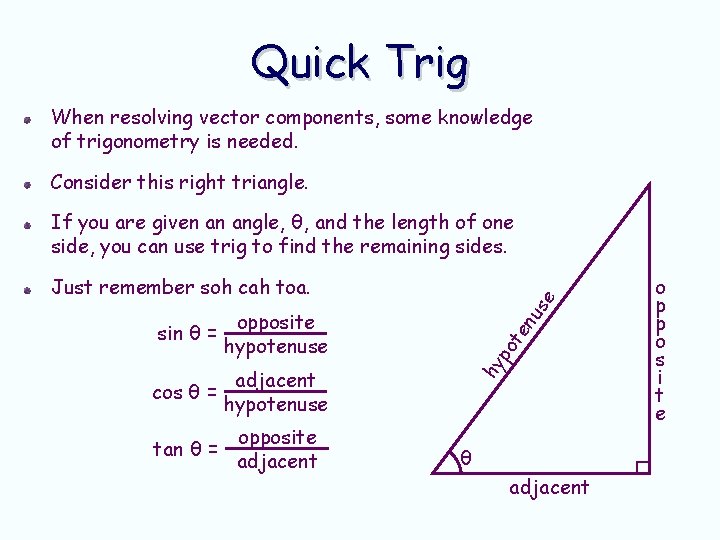
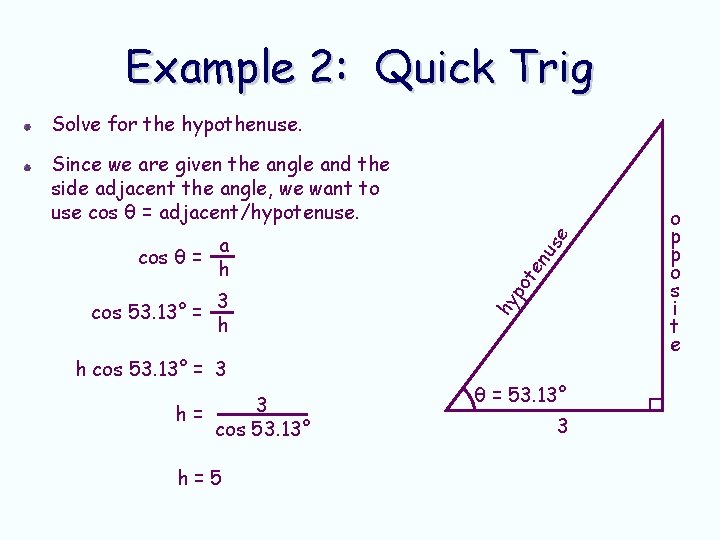
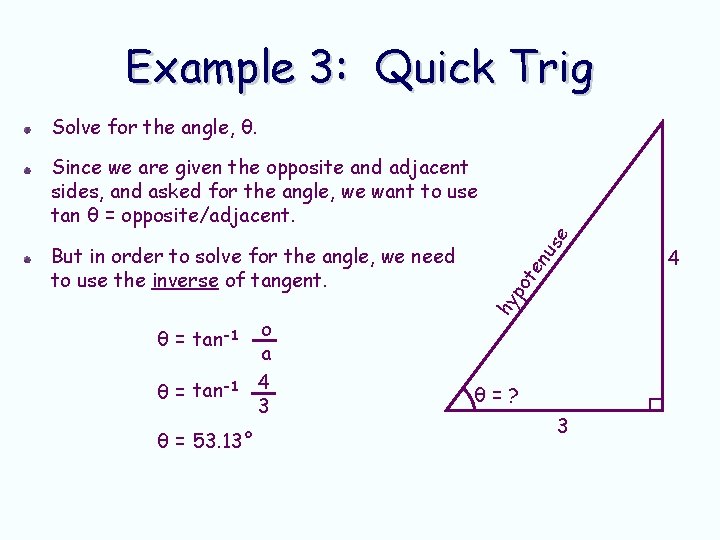
Quick Trig When resolving vector components, some knowledge of trigonometry is needed. Consider this right triangle. If you are given an angle, θ, and the length of one side, you can use trig to find the remaining sides. tan θ = opposite adjacent nu adjacent hypotenuse te cos θ = po opposite hypotenuse hy sin θ = se Just remember soh cah toa. θ adjacent o p p o s i t e
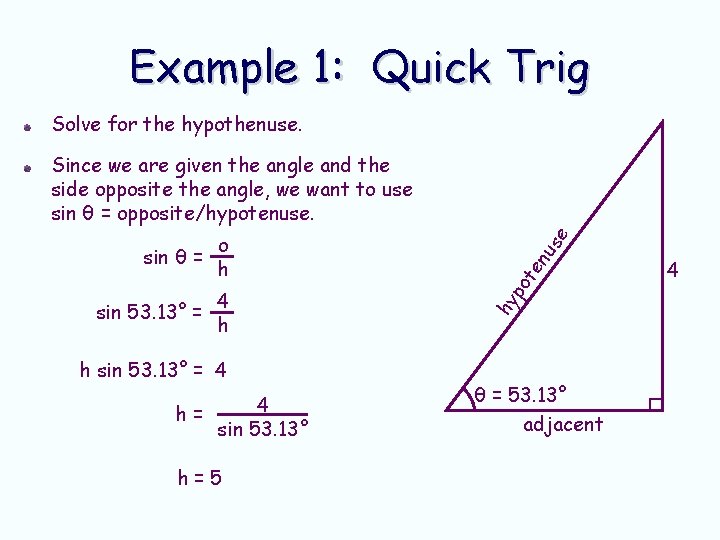
Example 1: Quick Trig Solve for the hypothenuse. h sin 53. 13° = 4 4 h= sin 53. 13° h=5 nu 4 h te sin 53. 13° = po o h hy sin θ = se Since we are given the angle and the side opposite the angle, we want to use sin θ = opposite/hypotenuse. θ = 53. 13° adjacent 4
Example 2: Quick Trig Solve for the hypothenuse. h cos 53. 13° = 3 3 h= cos 53. 13° h=5 nu 3 h te cos 53. 13° = po a h hy cos θ = se Since we are given the angle and the side adjacent the angle, we want to use cos θ = adjacent/hypotenuse. θ = 53. 13° 3 o p p o s i t e
Example 3: Quick Trig Solve for the angle, θ. θ = tan-1 θ = 53. 13° o a 4 3 nu te po hy But in order to solve for the angle, we need to use the inverse of tangent. se Since we are given the opposite and adjacent sides, and asked for the angle, we want to use tan θ = opposite/adjacent. θ=? 3 4
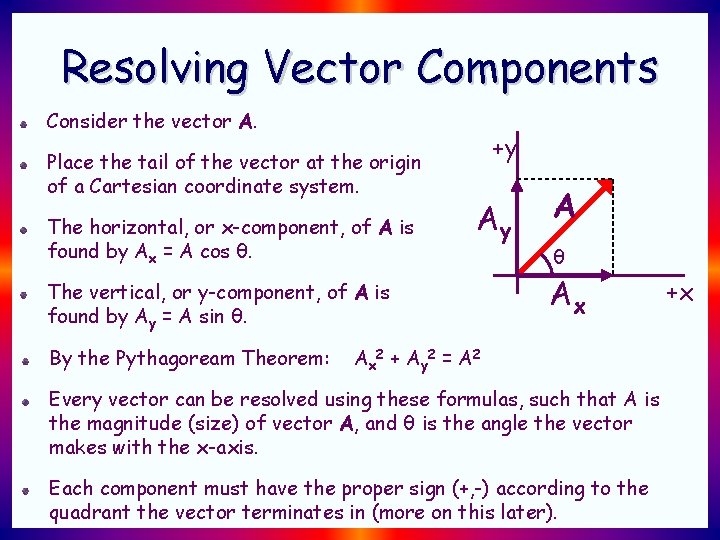
Resolving Vector Components Consider the vector A. Place the tail of the vector at the origin of a Cartesian coordinate system. The horizontal, or x-component, of A is found by Ax = A cos θ. +y Ay The vertical, or y-component, of A is found by Ay = A sin θ. By the Pythagoream Theorem: A θ Ax Ax 2 + Ay 2 = A 2 Every vector can be resolved using these formulas, such that A is the magnitude (size) of vector A, and θ is the angle the vector makes with the x-axis. Each component must have the proper sign (+, -) according to the quadrant the vector terminates in (more on this later). +x
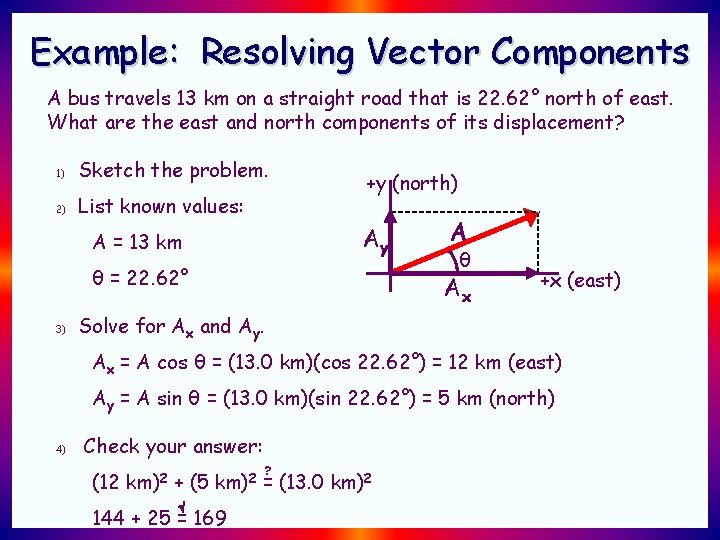
Example: Resolving Vector Components A bus travels 13 km on a straight road that is 22. 62° north of east. What are the east and north components of its displacement? 1) Sketch the problem. 2) List known values: +y (north) Ay A = 13 km θ = 22. 62° 3) A θ Ax +x (east) Solve for Ax and Ay. Ax = A cos θ = (13. 0 km)(cos 22. 62°) = 12 km (east) Ay = A sin θ = (13. 0 km)(sin 22. 62°) = 5 km (north) 4) Check your answer: (12 km)2 + (5 km)2 144 + 25 = 169 ? = (13. 0 km)2
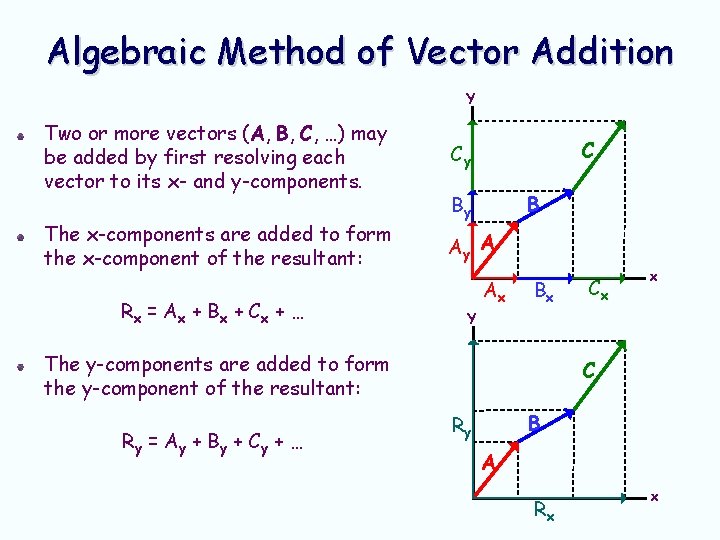
Algebraic Method of Vector Addition Y Two or more vectors (A, B, C, …) may be added by first resolving each vector to its x- and y-components. The x-components are added to form the x-component of the resultant: Rx = A x + B x + C x + … C Cy B By Ay A Ax Bx x Y The y-components are added to form the y-component of the resultant: Ry = A y + B y + C y + … Cx C B Ry A Rx x
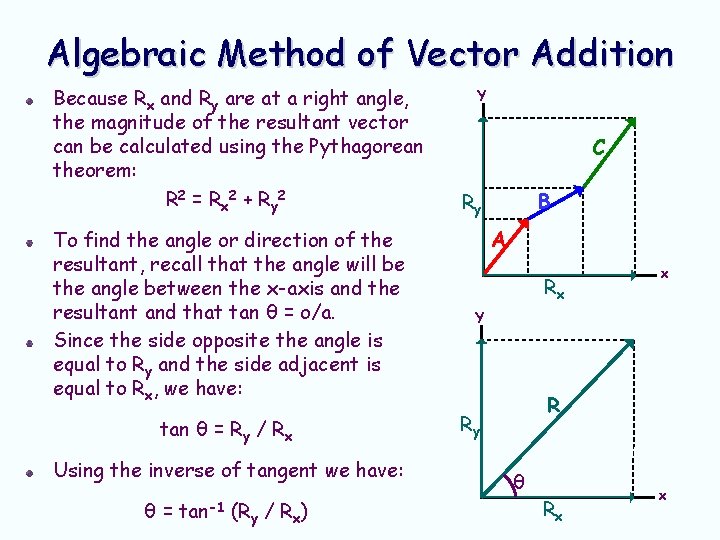
Algebraic Method of Vector Addition Because Rx and Ry are at a right angle, the magnitude of the resultant vector can be calculated using the Pythagorean theorem: R 2 = Rx 2 + Ry 2 To find the angle or direction of the resultant, recall that the angle will be the angle between the x-axis and the resultant and that tan θ = o/a. Since the side opposite the angle is equal to Ry and the side adjacent is equal to Rx, we have: tan θ = Ry / Rx Using the inverse of tangent we have: θ= tan-1 (Ry / Rx) Y C B Ry A Rx x Y R Ry θ Rx x
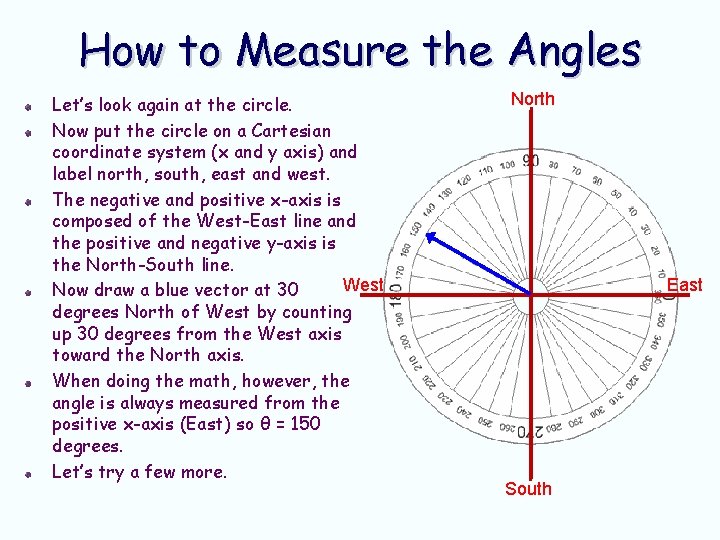
How to Measure the Angles Let’s look again at the circle. Now put the circle on a Cartesian coordinate system (x and y axis) and label north, south, east and west. The negative and positive x-axis is composed of the West-East line and the positive and negative y-axis is the North-South line. West Now draw a blue vector at 30 degrees North of West by counting up 30 degrees from the West axis toward the North axis. When doing the math, however, the angle is always measured from the positive x-axis (East) so θ = 150 degrees. Let’s try a few more. North East South
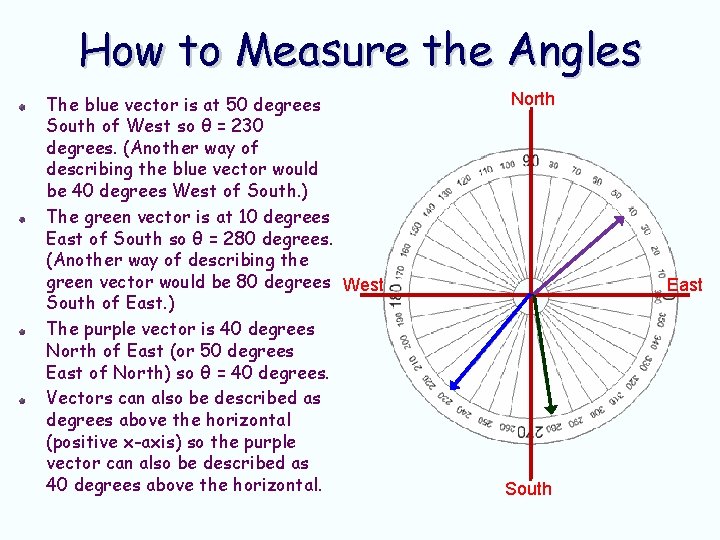
How to Measure the Angles The blue vector is at 50 degrees South of West so θ = 230 degrees. (Another way of describing the blue vector would be 40 degrees West of South. ) The green vector is at 10 degrees East of South so θ = 280 degrees. (Another way of describing the green vector would be 80 degrees West South of East. ) The purple vector is 40 degrees North of East (or 50 degrees East of North) so θ = 40 degrees. Vectors can also be described as degrees above the horizontal (positive x-axis) so the purple vector can also be described as 40 degrees above the horizontal. North East South
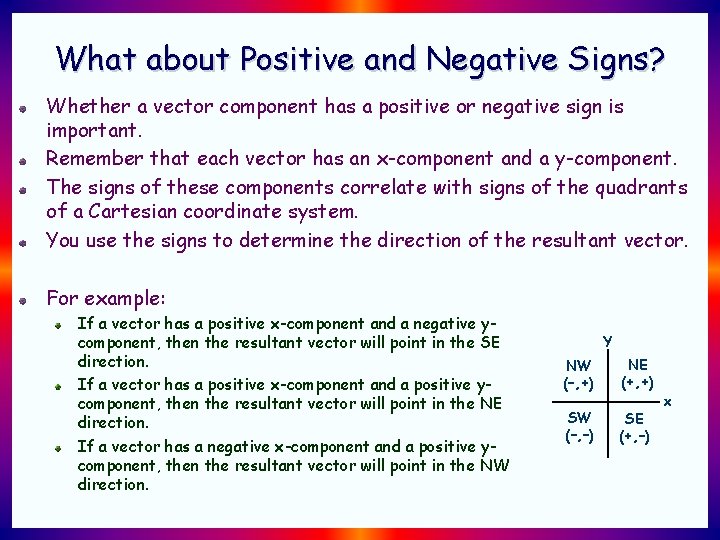
What about Positive and Negative Signs? Whether a vector component has a positive or negative sign is important. Remember that each vector has an x-component and a y-component. The signs of these components correlate with signs of the quadrants of a Cartesian coordinate system. You use the signs to determine the direction of the resultant vector. For example: If a vector has a positive x-component and a negative ycomponent, then the resultant vector will point in the SE direction. If a vector has a positive x-component and a positive ycomponent, then the resultant vector will point in the NE direction. If a vector has a negative x-component and a positive ycomponent, then the resultant vector will point in the NW direction. Y NW (–, +) NE (+, +) SW (–, –) SE (+, –) x
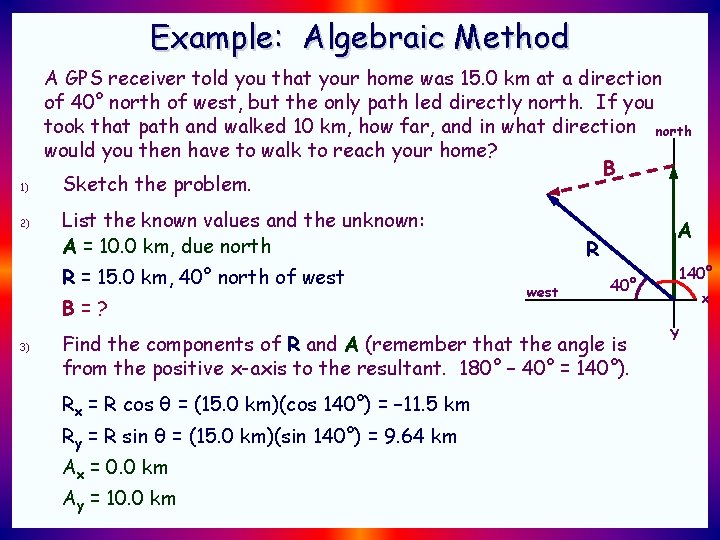
Example: Algebraic Method 1) 2) A GPS receiver told you that your home was 15. 0 km at a direction of 40° north of west, but the only path led directly north. If you took that path and walked 10 km, how far, and in what direction north would you then have to walk to reach your home? B Sketch the problem. List the known values and the unknown: A = 10. 0 km, due north R = 15. 0 km, 40° north of west B=? 3) A R west Find the components of R and A (remember that the angle is from the positive x-axis to the resultant. 180° – 40° = 140°). Rx = R cos θ = (15. 0 km)(cos 140°) = – 11. 5 km Ry = R sin θ = (15. 0 km)(sin 140°) = 9. 64 km Ax = 0. 0 km Ay = 10. 0 km 140° x Y
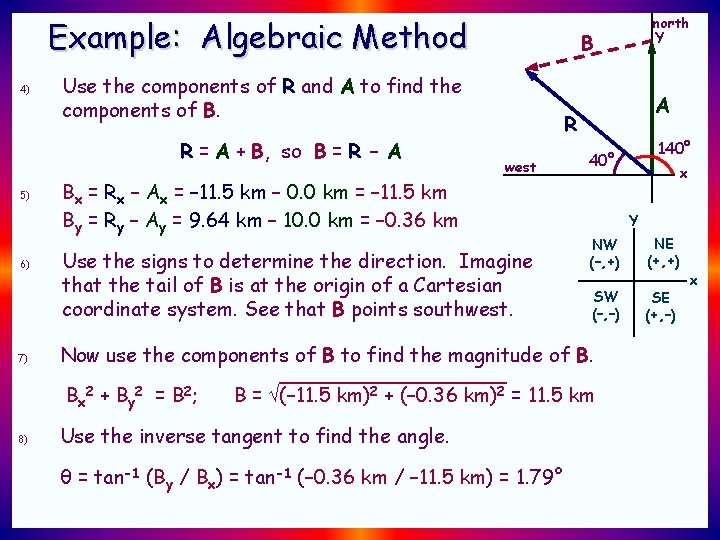
Example: Algebraic Method 4) 5) 6) 7) A R west Bx = Rx – Ax = – 11. 5 km – 0. 0 km = – 11. 5 km By = Ry – Ay = 9. 64 km – 10. 0 km = – 0. 36 km Use the signs to determine the direction. Imagine that the tail of B is at the origin of a Cartesian coordinate system. See that B points southwest. θ = tan-1 (By / Bx) = tan-1 (– 0. 36 km / – 11. 5 km) = 1. 79° x Y NW (–, +) NE (+, +) SW (–, –) SE (+, –) B = √(– 11. 5 km)2 + (– 0. 36 km)2 = 11. 5 km Use the inverse tangent to find the angle. 140° Now use the components of B to find the magnitude of B. Bx 2 + By 2 = B 2; 8) B Use the components of R and A to find the components of B. R = A + B, so B = R – A north Y x
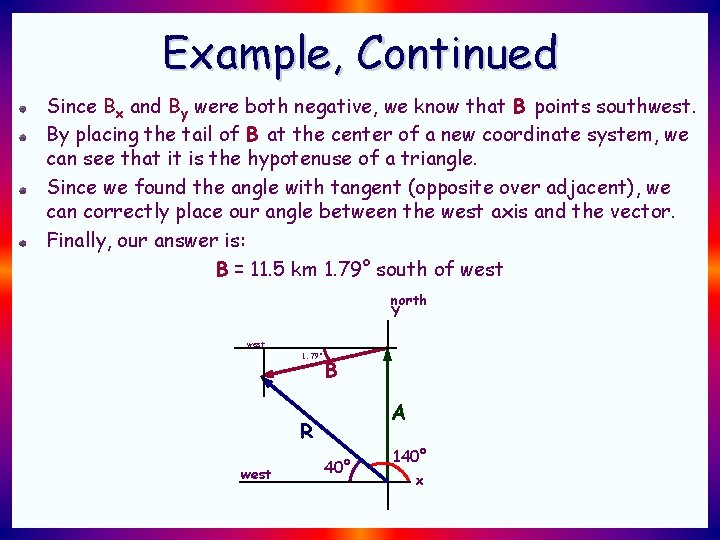
Example, Continued Since Bx and By were both negative, we know that B points southwest. By placing the tail of B at the center of a new coordinate system, we can see that it is the hypotenuse of a triangle. Since we found the angle with tangent (opposite over adjacent), we can correctly place our angle between the west axis and the vector. Finally, our answer is: B = 11. 5 km 1. 79° south of west north Y west 1. 79° B A R west 40° 140° x