Outline Stress definition 3 components of stress 1



- Slides: 33
Outline Stress – definition 3 components of stress 1. 2. l l l Frustration Conflict Pressure 4 important factors 3. l l Nature of the stress Perception of the stress Stress tolerance External resources
Outline 5. 6. Selye’s General Adaptation Syndrome Stress and Anxiety l l 7. Incidence Assessment Test Anxiety
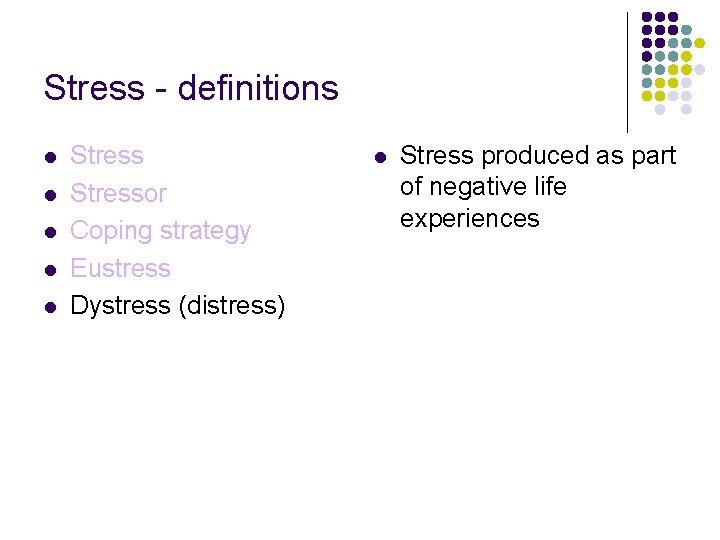
Stress - definitions l Stress l A response to situations that involve demands, constraints, or opportunities
Stress - definitions l l Stressor l Anything which requires a person to adapt to changing conditions
Stress - definitions l l l Stressor Coping strategy l The strategy adopted to manage the stress and the stressor
Stress - definitions l l Stressor Coping strategy Eustress l l Stress produced as part of positive life experiences Eu- same beginning as the words Eutopia and evangelist
Stress - definitions l l l Stressor Coping strategy Eustress Dystress (distress) l Stress produced as part of negative life experiences
3 Components of Stress l Frustration l l When attainment of goal is blocked Or when goal itself is missing
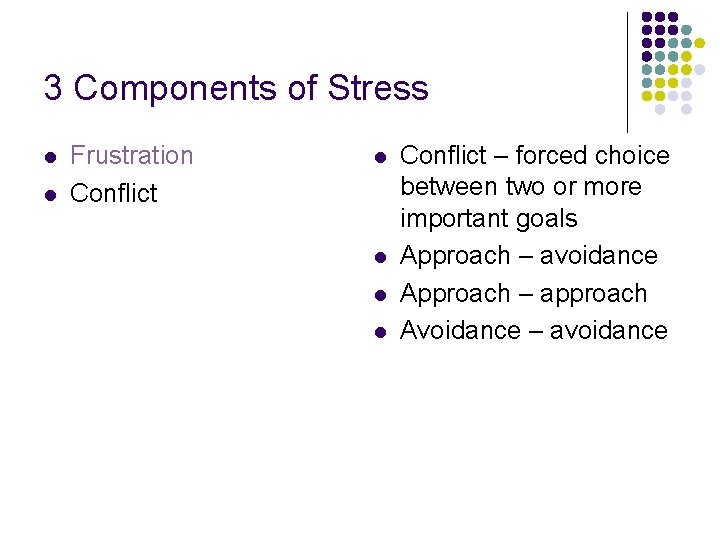
3 Components of Stress l l Frustration Conflict l l Conflict – forced choice between two or more important goals Approach – avoidance Approach – approach Avoidance – avoidance
3 Components of Stress l l l Frustration Conflict Pressure l l Pressure – a constraint that works to shape your behavior in a certain way Can be internallyimposed or externallyimposed
Stress – 4 important factors l Nature of the stress l l Severity Duration Imminence Other simultaneous stressors
Stress – 4 important factors l l Nature of the stress Perception of the stressor l l Is minor setback seen as serious challenge? Is serious challenge seen as minor setback?
Stress – 4 important factors l l l Nature of the stress Perception of the stressor Stress-tolerance l l Two people could have similar perceptions of a stressor, but respond very differently to it Biologically-based, but can be learned to some extent
Stress – 4 important factors l l Nature of the stress Perception of the stressor Stress-tolerance External resources l l E. g. , money, social support Chandrasena et al. (1991) – study of suicide cases: no immigrants in sample had acquired a social support network after arriving in Canada
Selye’s General Adaptation Syndrome l l Hans Selye – Canadian endocrinologist Born in Hungary, studied in Prague and at Johns Hopkins University, Baltimore Mc. Gill 1932 -1976 Founded Canadian Institute of Stress 1979
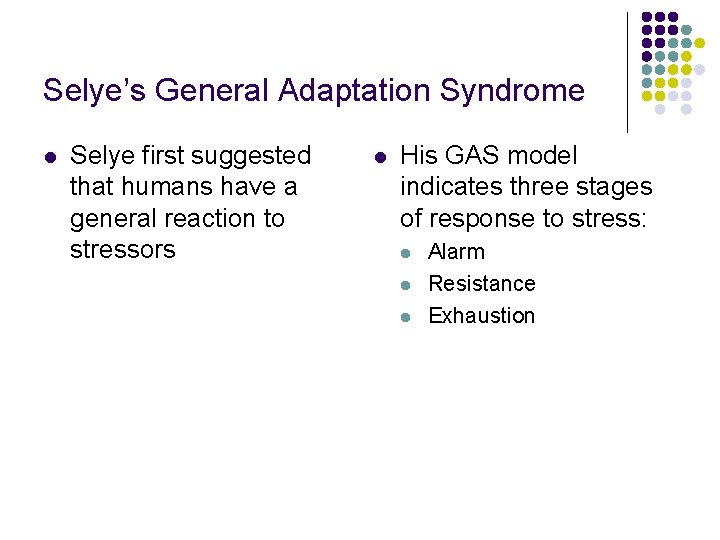
Selye’s General Adaptation Syndrome l Selye first suggested that humans have a general reaction to stressors l His GAS model indicates three stages of response to stress: l l l Alarm Resistance Exhaustion
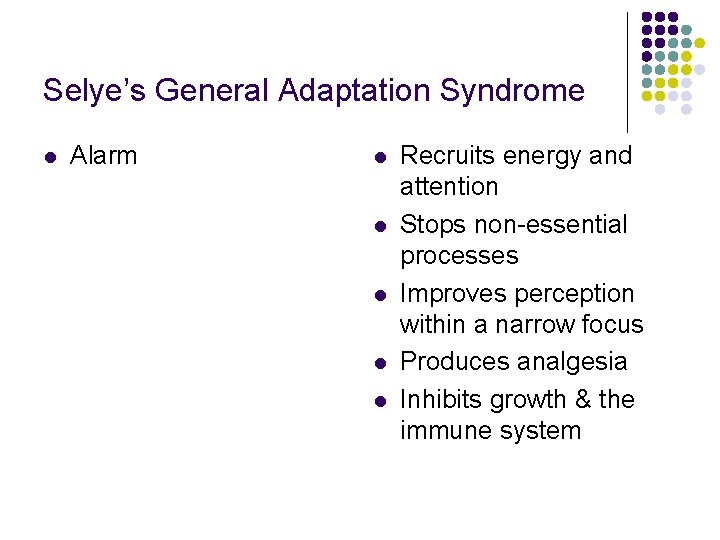
Selye’s General Adaptation Syndrome l Alarm l l l Recruits energy and attention Stops non-essential processes Improves perception within a narrow focus Produces analgesia Inhibits growth & the immune system
Selye’s General Adaptation Syndrome l l Alarm Resistance l The body attempts to return to normal
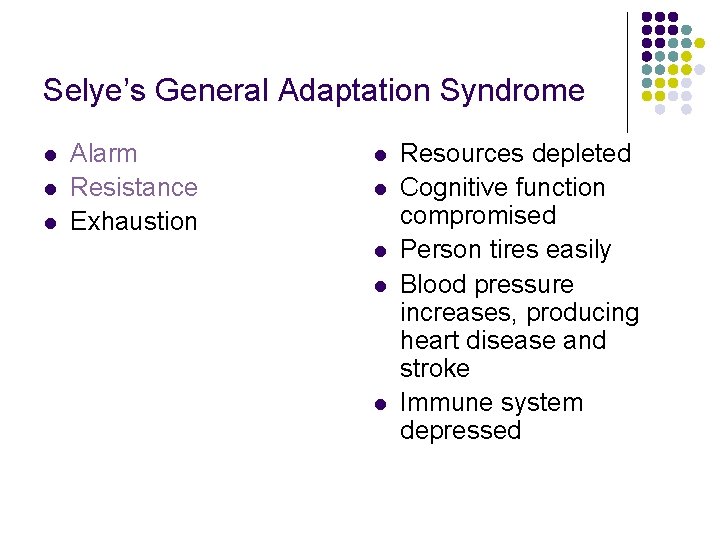
Selye’s General Adaptation Syndrome l l l Alarm Resistance Exhaustion l l l Resources depleted Cognitive function compromised Person tires easily Blood pressure increases, producing heart disease and stroke Immune system depressed
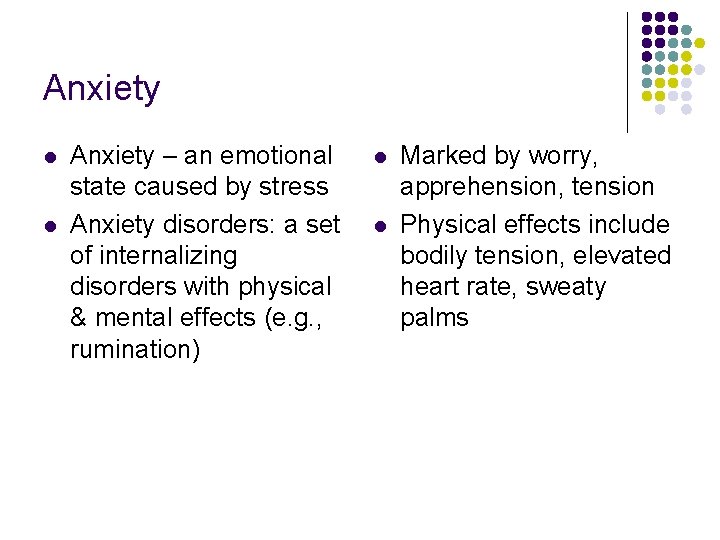
Anxiety l l Anxiety – an emotional state caused by stress Anxiety disorders: a set of internalizing disorders with physical & mental effects (e. g. , rumination) l l Marked by worry, apprehension, tension Physical effects include bodily tension, elevated heart rate, sweaty palms
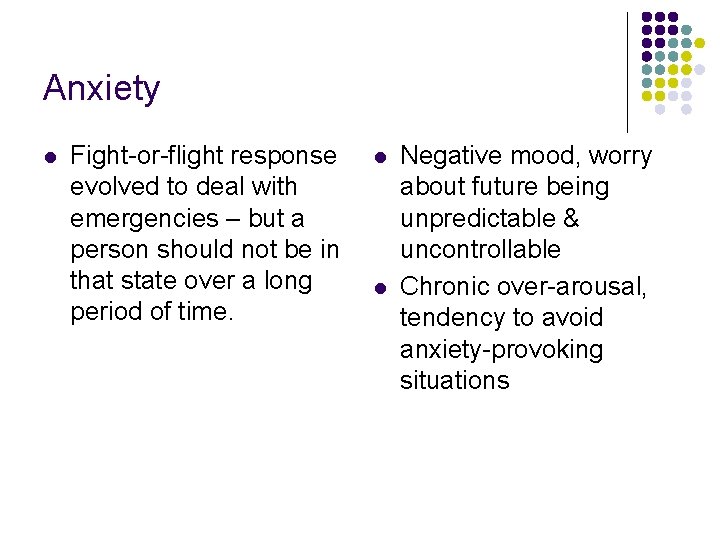
Anxiety l Fight-or-flight response evolved to deal with emergencies – but a person should not be in that state over a long period of time. l l Negative mood, worry about future being unpredictable & uncontrollable Chronic over-arousal, tendency to avoid anxiety-provoking situations
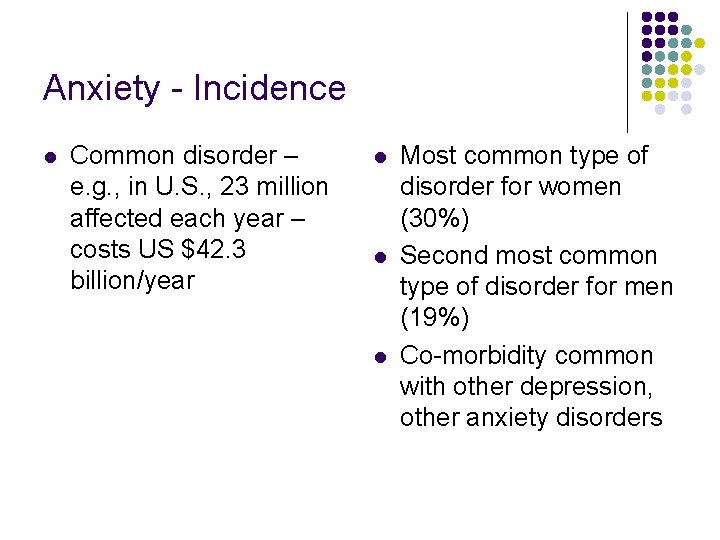
Anxiety - Incidence l Common disorder – e. g. , in U. S. , 23 million affected each year – costs US $42. 3 billion/year l l l Most common type of disorder for women (30%) Second most common type of disorder for men (19%) Co-morbidity common with other depression, other anxiety disorders
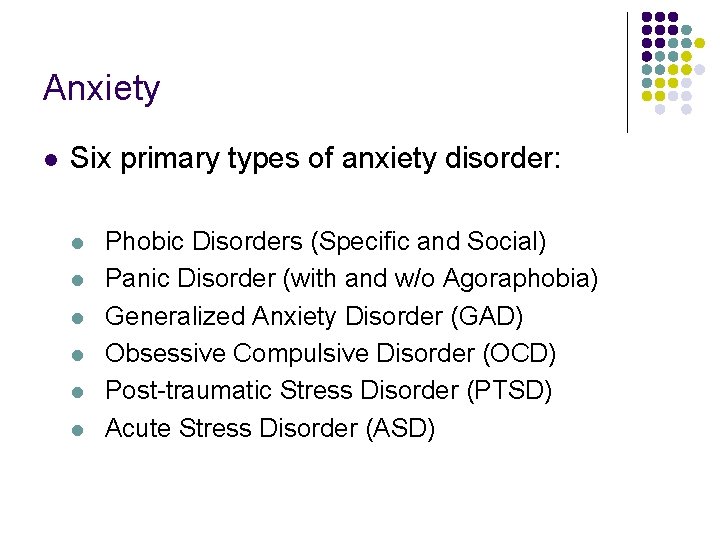
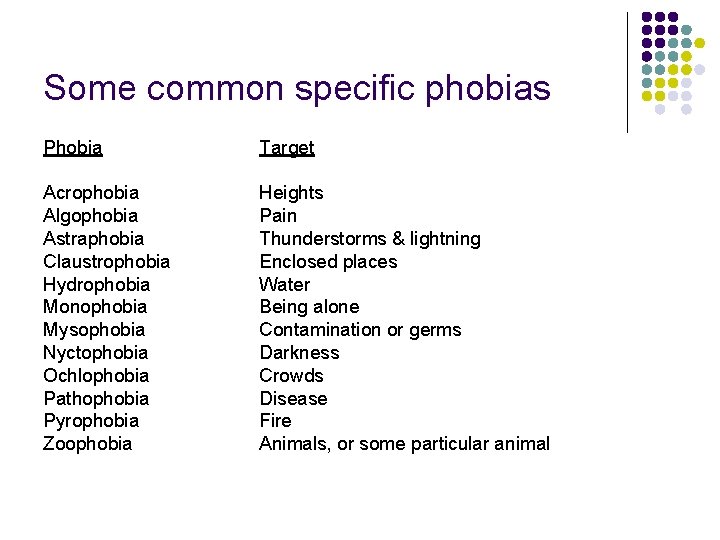
Anxiety l Six primary types of anxiety disorder: l l l Phobic Disorders (Specific and Social) Panic Disorder (with and w/o Agoraphobia) Generalized Anxiety Disorder (GAD) Obsessive Compulsive Disorder (OCD) Post-traumatic Stress Disorder (PTSD) Acute Stress Disorder (ASD)
Some common specific phobias Phobia Target Acrophobia Algophobia Astraphobia Claustrophobia Hydrophobia Monophobia Mysophobia Nyctophobia Ochlophobia Pathophobia Pyrophobia Zoophobia Heights Pain Thunderstorms & lightning Enclosed places Water Being alone Contamination or germs Darkness Crowds Disease Fire Animals, or some particular animal
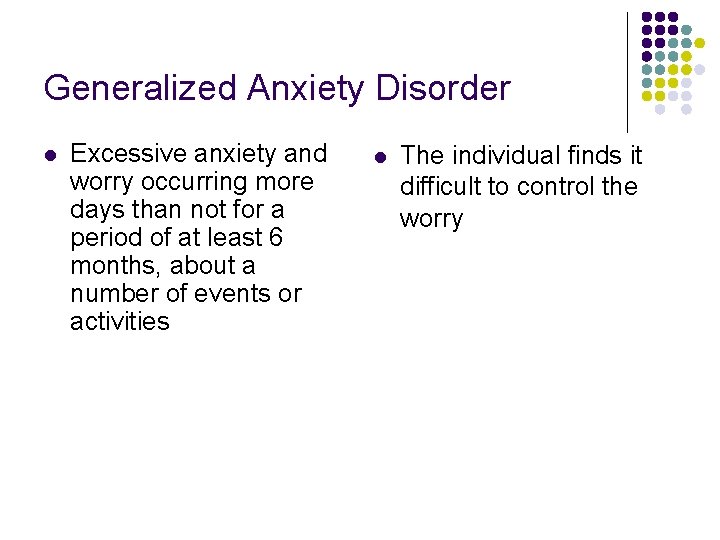
Generalized Anxiety Disorder l Excessive anxiety and worry occurring more days than not for a period of at least 6 months, about a number of events or activities l The individual finds it difficult to control the worry
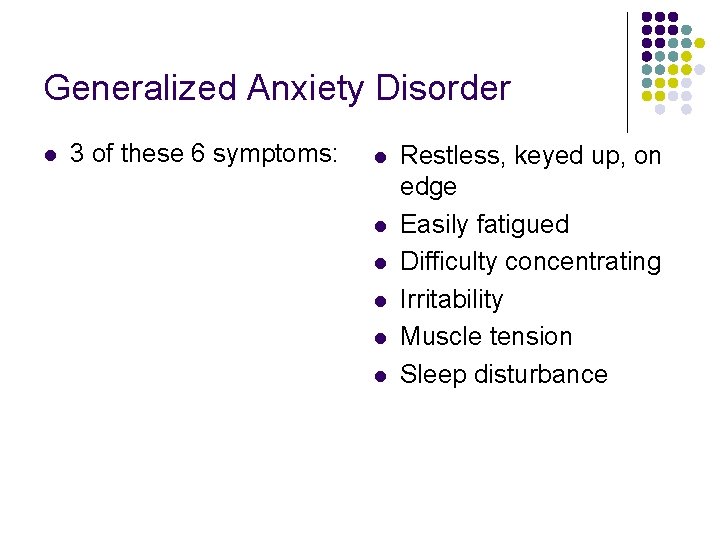
Generalized Anxiety Disorder l 3 of these 6 symptoms: l l l Restless, keyed up, on edge Easily fatigued Difficulty concentrating Irritability Muscle tension Sleep disturbance
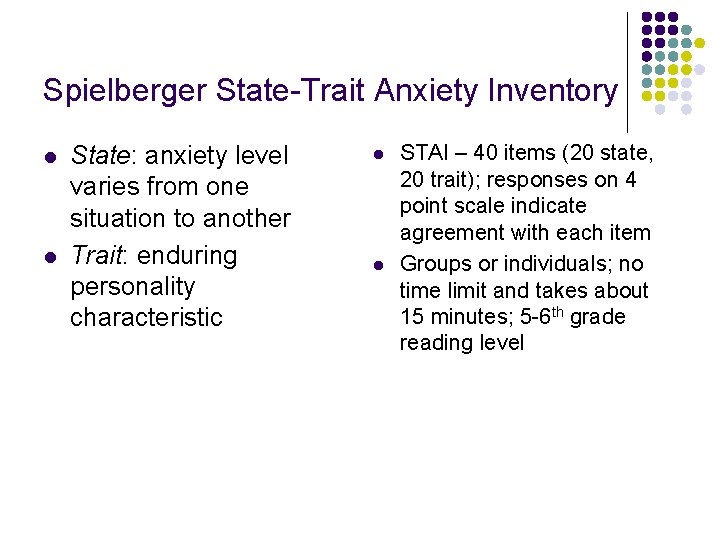
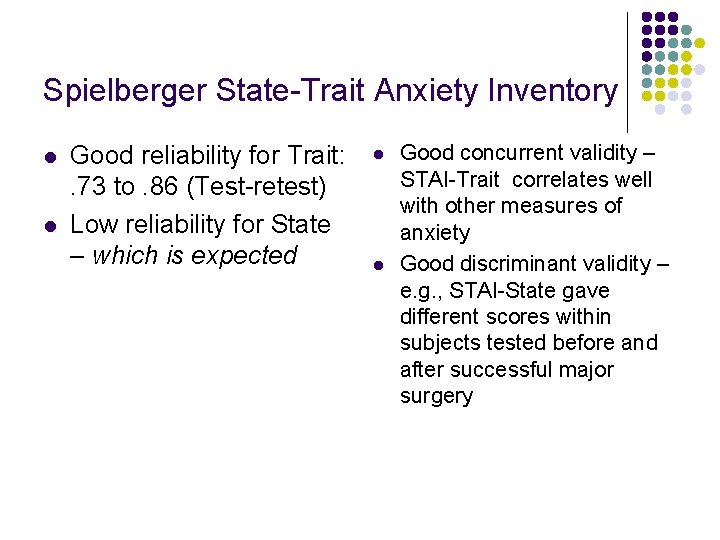
Spielberger State-Trait Anxiety Inventory l l State: anxiety level varies from one situation to another Trait: enduring personality characteristic l l STAI – 40 items (20 state, 20 trait); responses on 4 point scale indicate agreement with each item Groups or individuals; no time limit and takes about 15 minutes; 5 -6 th grade reading level
Spielberger State-Trait Anxiety Inventory l l Good reliability for Trait: . 73 to. 86 (Test-retest) Low reliability for State – which is expected l l Good concurrent validity – STAI-Trait correlates well with other measures of anxiety Good discriminant validity – e. g. , STAI-State gave different scores within subjects tested before and after successful major surgery
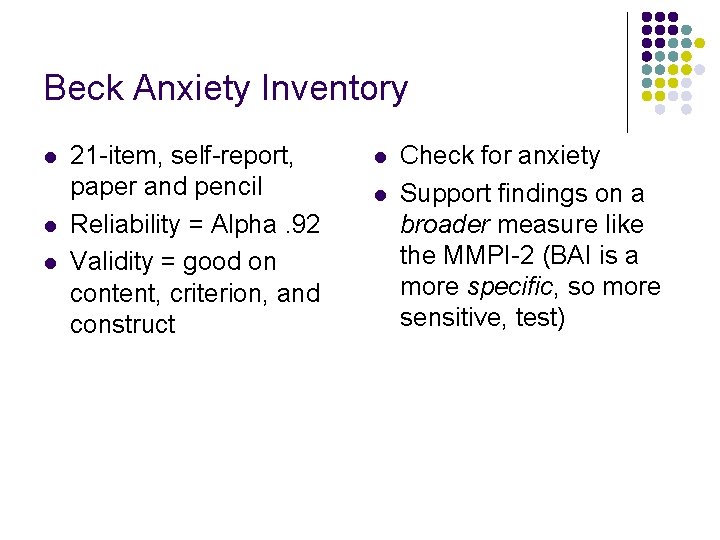
Beck Anxiety Inventory l l l 21 -item, self-report, paper and pencil Reliability = Alpha. 92 Validity = good on content, criterion, and construct l l Check for anxiety Support findings on a broader measure like the MMPI-2 (BAI is a more specific, so more sensitive, test)
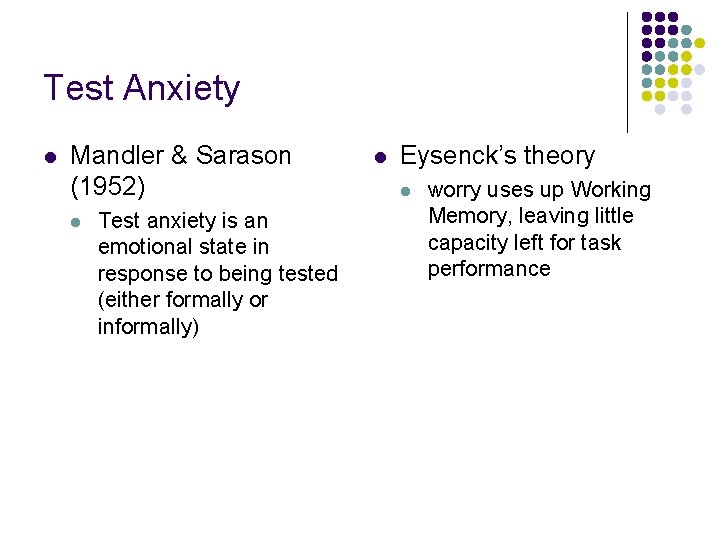
Test Anxiety l Mandler & Sarason (1952) l Test anxiety is an emotional state in response to being tested (either formally or informally) l Eysenck’s theory l worry uses up Working Memory, leaving little capacity left for task performance
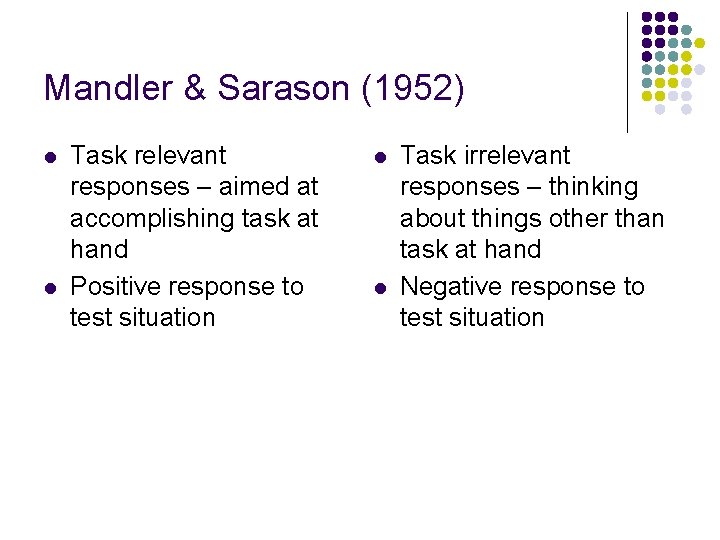
Mandler & Sarason (1952) l l Task relevant responses – aimed at accomplishing task at hand Positive response to test situation l l Task irrelevant responses – thinking about things other than task at hand Negative response to test situation
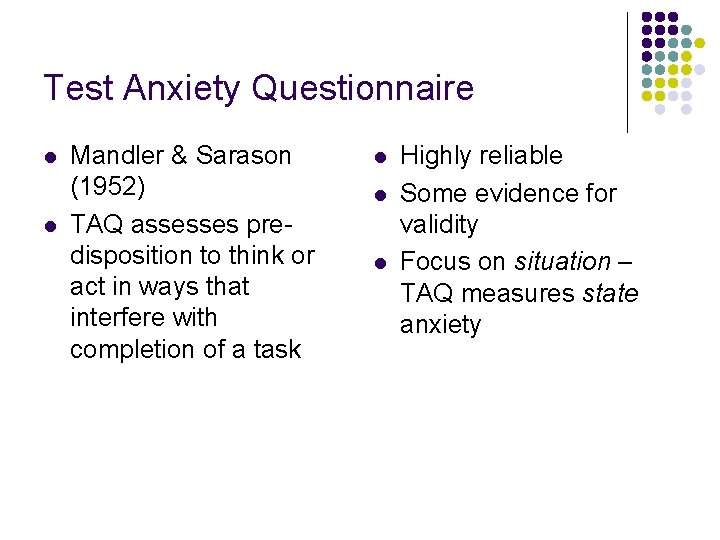
Test Anxiety Questionnaire l l Mandler & Sarason (1952) TAQ assesses predisposition to think or act in ways that interfere with completion of a task l l l Highly reliable Some evidence for validity Focus on situation – TAQ measures state anxiety
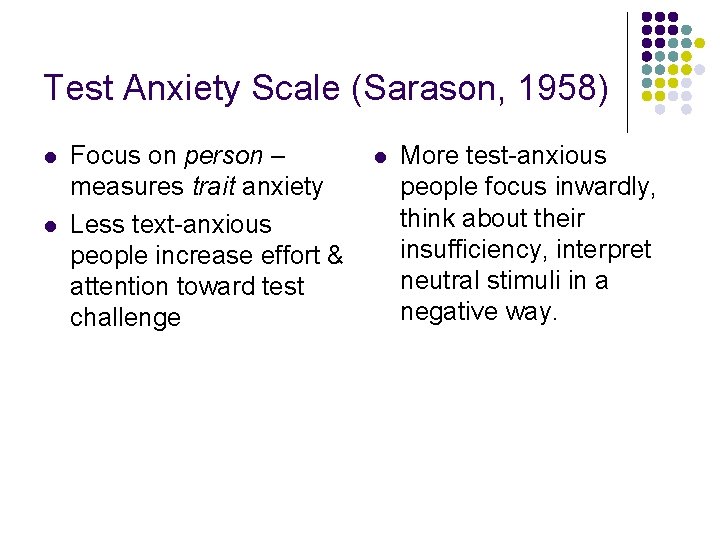
Test Anxiety Scale (Sarason, 1958) l l Focus on person – measures trait anxiety Less text-anxious people increase effort & attention toward test challenge l More test-anxious people focus inwardly, think about their insufficiency, interpret neutral stimuli in a negative way.