Outline Future Plans for the PICO superheated liquid



- Slides: 27
Outline Future Plans for the PICO superheated liquid technology Dark Matter Bubble Chamber Searching for dark matter with a series of ever more sophisticated detectors. Future Plans: PICO 40 → PICO 500 PICO Background Mitigation & Threshold Capability Physics Reach Tony Noble. Queen’s University & Mc. Donald Institute TAUP 2019. Toyama
O. Harris S. Chen, M. Laurin, J. -P. Martin, A. Plante, A. E. Robinson, N. Starinski, F. Tardif, D. Tiwari, V. Zacek, C. Wen Chao, R. Filgas, I. Stekl J. I. Collar, A. Ortega E. Behnke, I. Levine, T. Nania I. Lawson M. Ardid, M. Bou-Cabo, I. Felis M. Das, S. Sahoo, S. Seth M. Bressler, R. Neilson D. Maurya, S. Priya, Y. Yan P. S. Cooper, M. Crisler, W. H. Lippincott, A. Sonnenschein C. Coutu, S. Fallows, C. Krauss, M. -C. Piro B. Broerman, G. Cao, K. Clark, G. Giroux, C. Hardy, C. Moore, A. Noble I. Arnquist , C. Cowles, C. M. Jackson, B. Loer, K. Wierman D. Baxter, C. E. Dahl, M. Jin, J. Zhang E. Vázquez-Jáuregui J. Farine, A. Le Blanc, C. Licciardi, O. Scallon, U. Wichoski
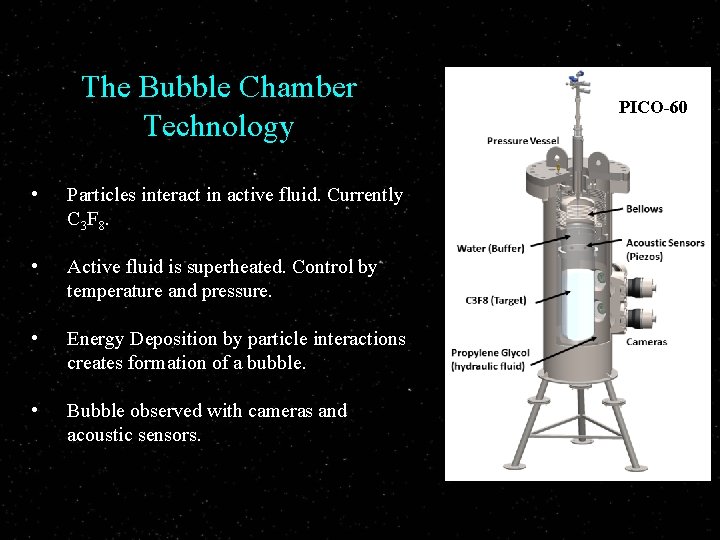
The Bubble Chamber Technology • Particles interact in active fluid. Currently C 3 F 8. • Active fluid is superheated. Control by temperature and pressure. • Energy Deposition by particle interactions creates formation of a bubble. • Bubble observed with cameras and acoustic sensors. PICO-60
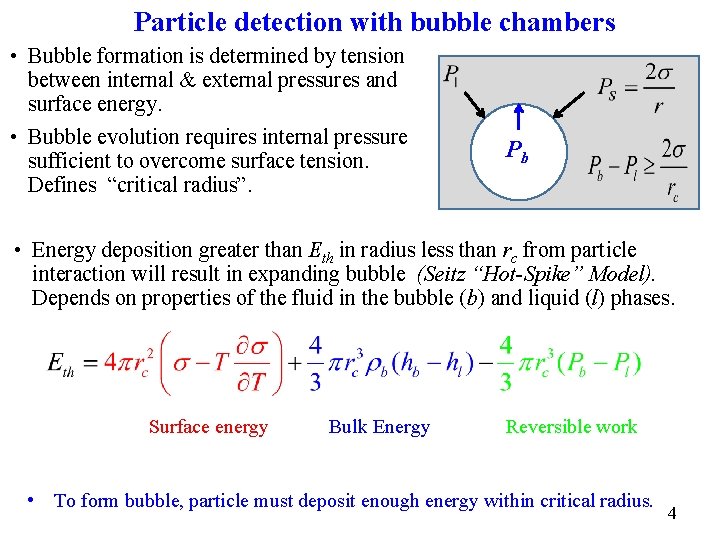
Particle detection with bubble chambers • Bubble formation is determined by tension between internal & external pressures and surface energy. • Bubble evolution requires internal pressure sufficient to overcome surface tension. Defines “critical radius”. Pb • Energy deposition greater than Eth in radius less than rc from particle interaction will result in expanding bubble (Seitz “Hot-Spike” Model). Depends on properties of the fluid in the bubble (b) and liquid (l) phases. Surface energy Bulk Energy Reversible work • To form bubble, particle must deposit enough energy within critical radius. 4
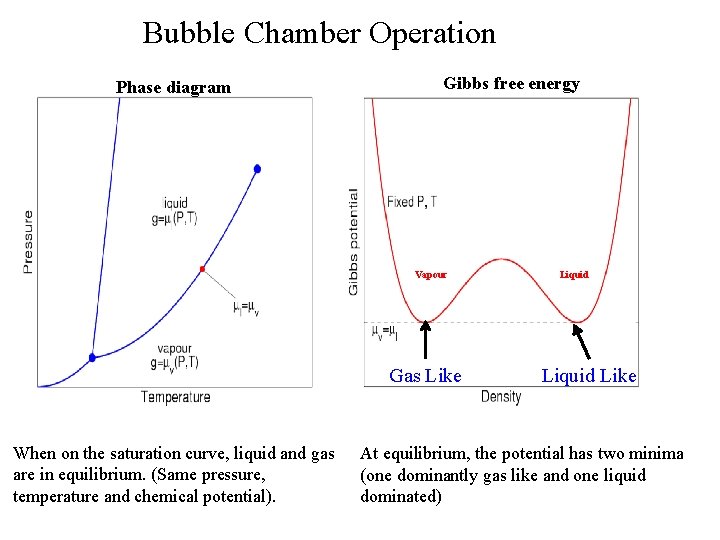
Bubble Chamber Operation Phase diagram Gibbs free energy Vapour Gas Like When on the saturation curve, liquid and gas are in equilibrium. (Same pressure, temperature and chemical potential). Liquid Like At equilibrium, the potential has two minima (one dominantly gas like and one liquid dominated)
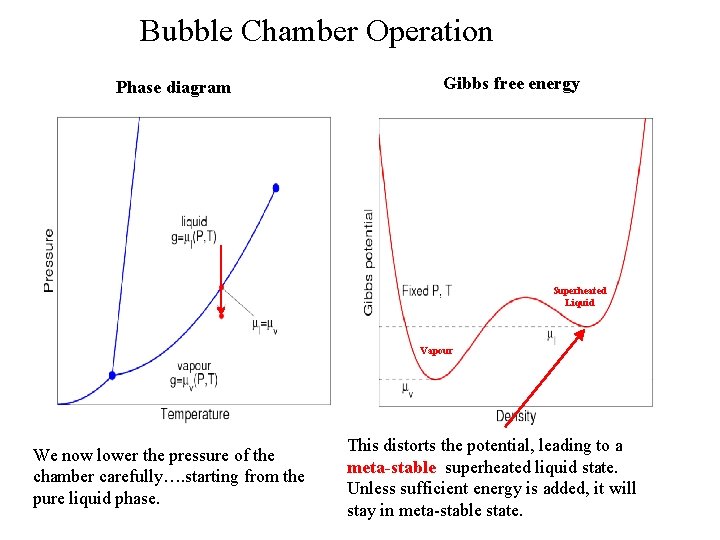
Bubble Chamber Operation Phase diagram Gibbs free energy Superheated Liquid Vapour We now lower the pressure of the chamber carefully…. starting from the pure liquid phase. This distorts the potential, leading to a meta-stable superheated liquid state. Unless sufficient energy is added, it will stay in meta-stable state.
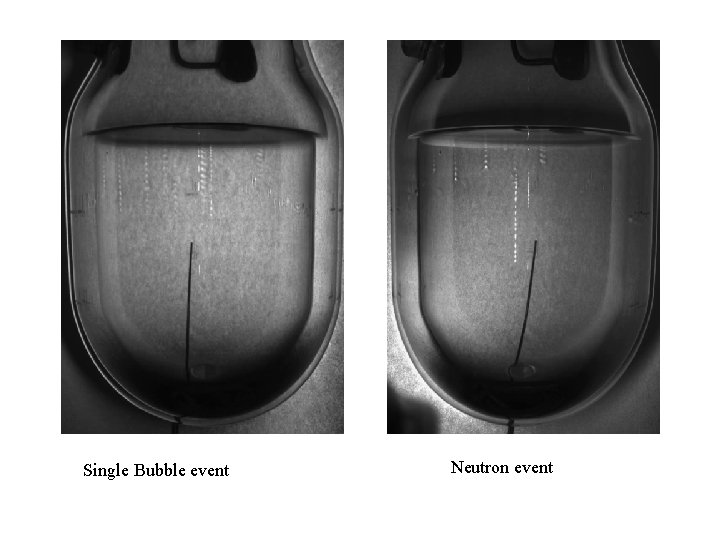
Two example events recorded Single Bubble event Neutron event
PICO Physics Program PICASSO & COUPP → PICO-2 L → Technology “enhancement” Talk by Carsten Krauss PICO 60 PICO-40 L Now Merger of two collaborations incorporating background capability of PICASSO into large volume COUPP style chambers World leading SD-p limits → PICO 500 L On the way
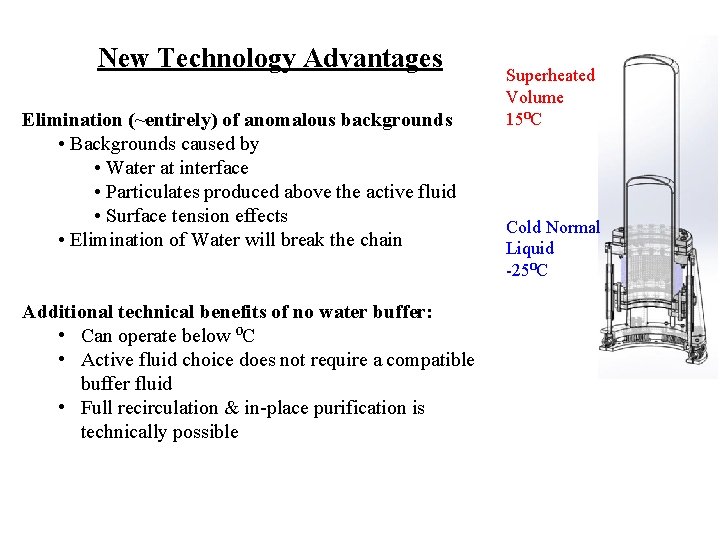
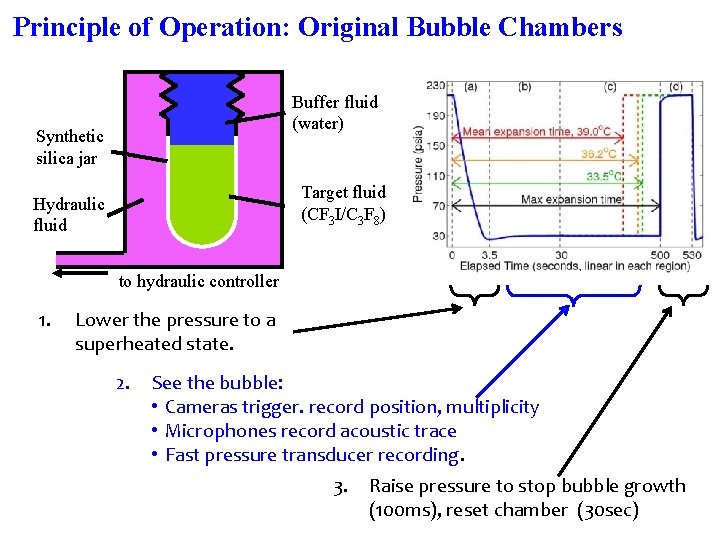
New Technology Advantages Elimination (~entirely) of anomalous backgrounds • Backgrounds caused by • Water at interface • Particulates produced above the active fluid • Surface tension effects • Elimination of Water will break the chain Additional technical benefits of no water buffer: • Can operate below ⁰C • Active fluid choice does not require a compatible buffer fluid • Full recirculation & in-place purification is technically possible Superheated Volume 15⁰C Cold Normal Liquid -25⁰C
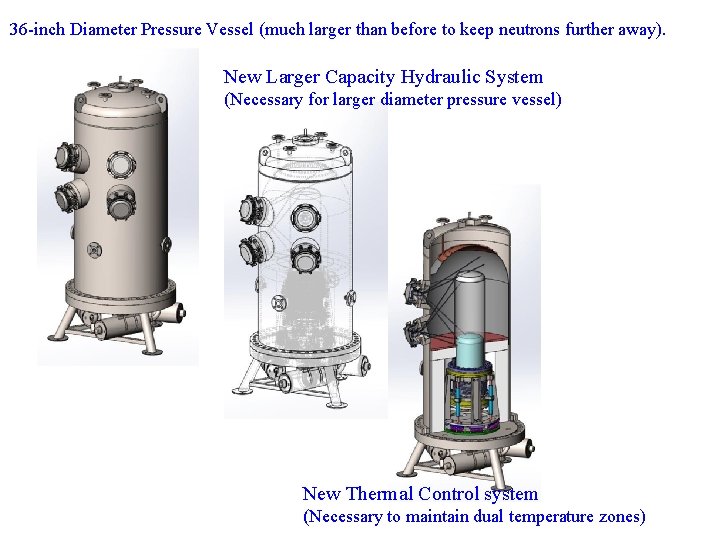
36 -inch Diameter Pressure Vessel (much larger than before to keep neutrons further away). New Larger Capacity Hydraulic System (Necessary for larger diameter pressure vessel) New Thermal Control system (Necessary to maintain dual temperature zones)
PICO 500
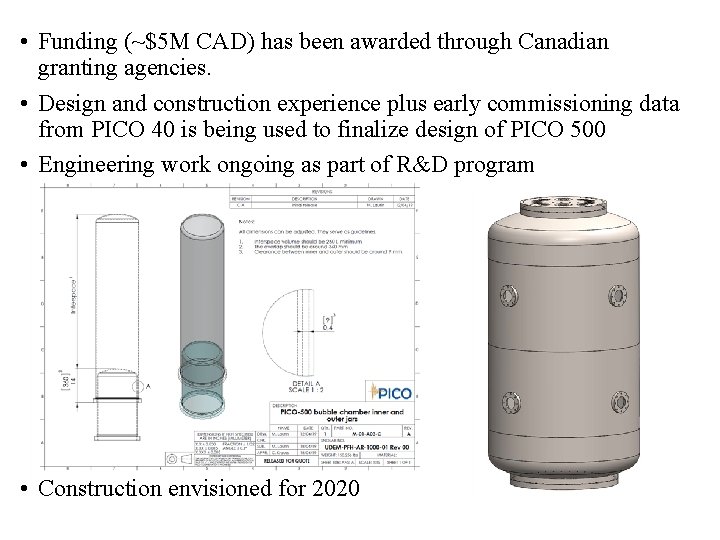
• Funding (~$5 M CAD) has been awarded through Canadian granting agencies. • Design and construction experience plus early commissioning data from PICO 40 is being used to finalize design of PICO 500 • Engineering work ongoing as part of R&D program • Construction envisioned for 2020
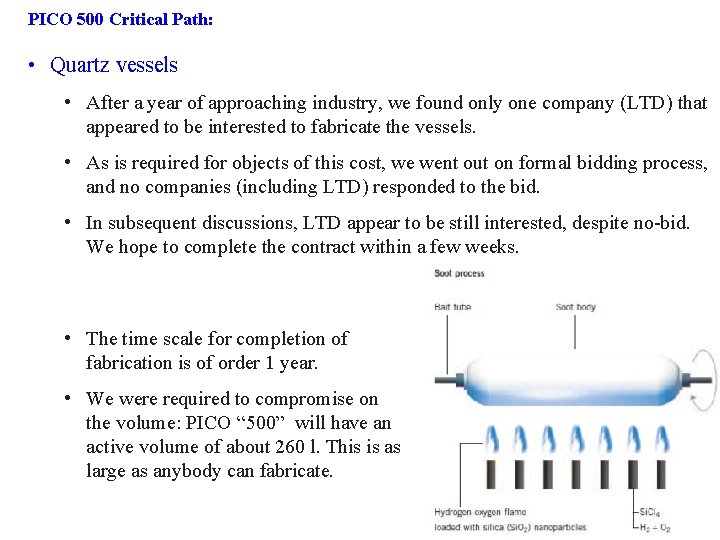
PICO 500 Critical Path: • Quartz vessels • After a year of approaching industry, we found only one company (LTD) that appeared to be interested to fabricate the vessels. • As is required for objects of this cost, we went out on formal bidding process, and no companies (including LTD) responded to the bid. • In subsequent discussions, LTD appear to be still interested, despite no-bid. We hope to complete the contract within a few weeks. • The time scale for completion of fabrication is of order 1 year. • We were required to compromise on the volume: PICO “ 500” will have an active volume of about 260 l. This is as large as anybody can fabricate.
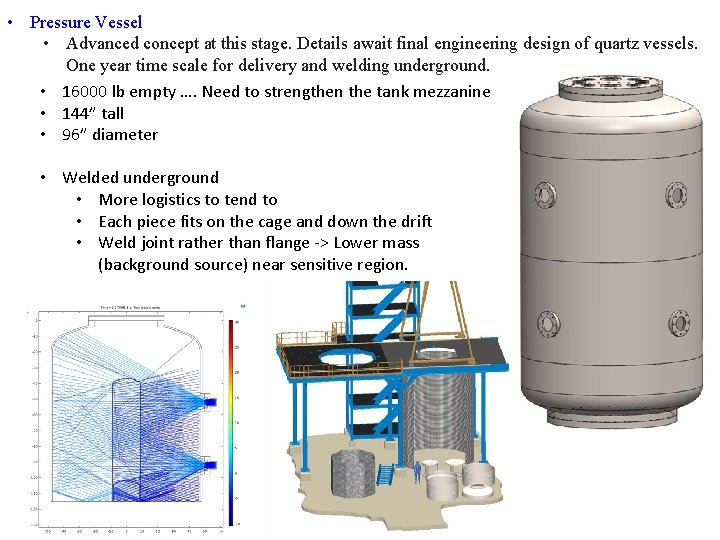
• Pressure Vessel • Advanced concept at this stage. Details await final engineering design of quartz vessels. One year time scale for delivery and welding underground. • 16000 lb empty …. Need to strengthen the tank mezzanine • 144” tall • 96” diameter • Welded underground • More logistics to tend to • Each piece fits on the cage and down the drift • Weld joint rather than flange -> Lower mass (background source) near sensitive region.
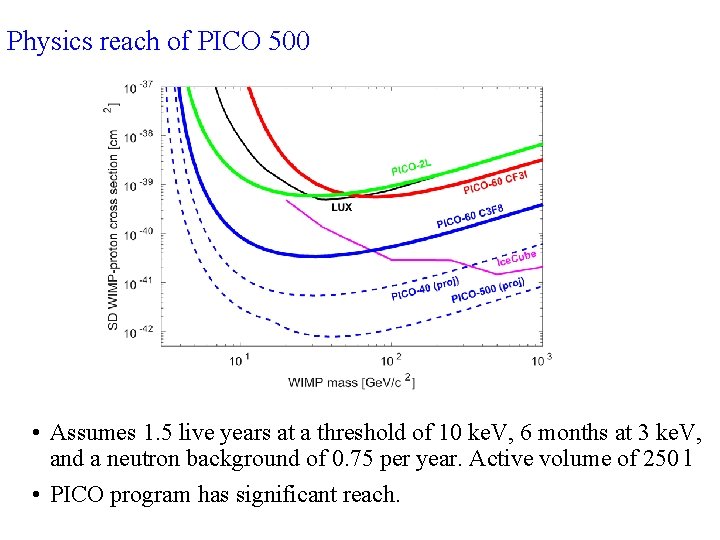
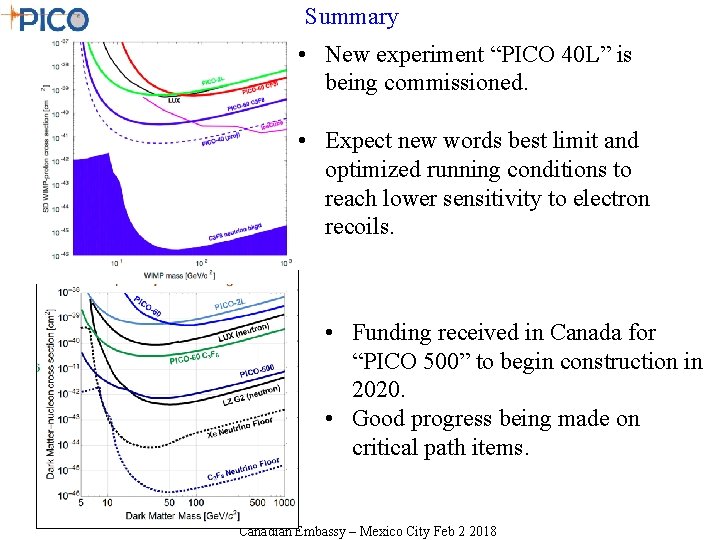
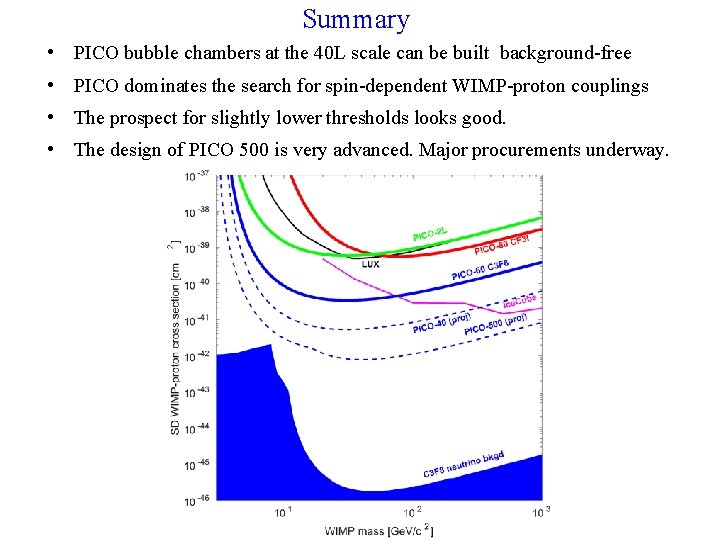
Physics reach of PICO 500 • Assumes 1. 5 live years at a threshold of 10 ke. V, 6 months at 3 ke. V, and a neutron background of 0. 75 per year. Active volume of 250 l • PICO program has significant reach.
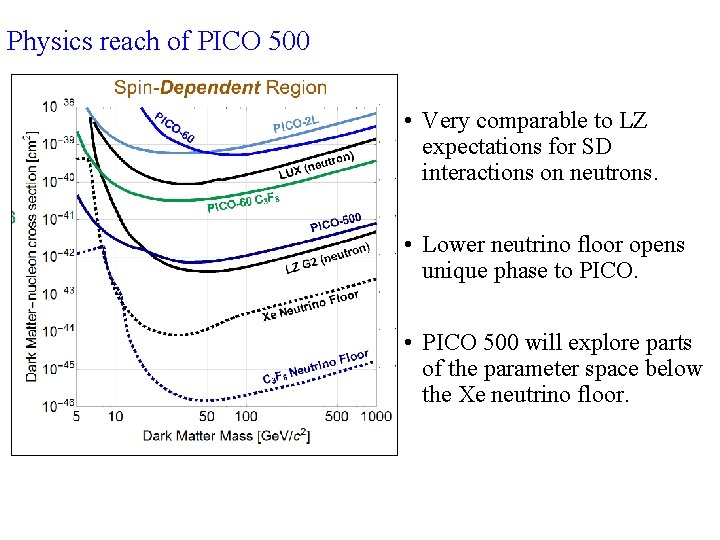
Physics reach of PICO 500 • Very comparable to LZ expectations for SD interactions on neutrons. • Lower neutrino floor opens unique phase to PICO. • PICO 500 will explore parts of the parameter space below the Xe neutrino floor.
Towards lower threshold sensitivity and Optimizing the running conditions
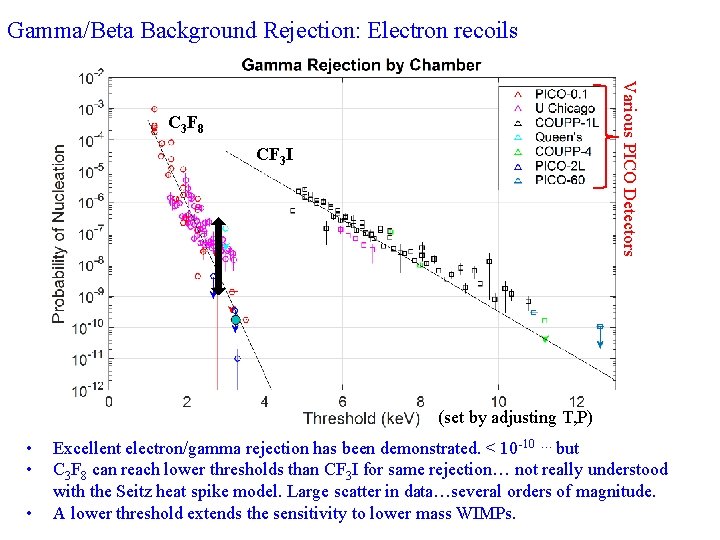
Gamma/Beta Background Rejection: Electron recoils Various PICO Detectors C 3 F 8 CF 3 I (set by adjusting T, P) • • • Excellent electron/gamma rejection has been demonstrated. < 10 -10 … but C 3 F 8 can reach lower thresholds than CF 3 I for same rejection… not really understood with the Seitz heat spike model. Large scatter in data…several orders of magnitude. A lower threshold extends the sensitivity to lower mass WIMPs.
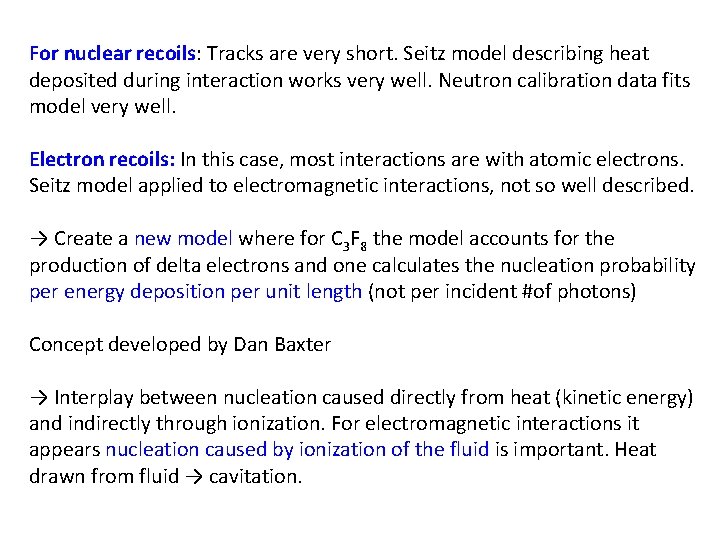
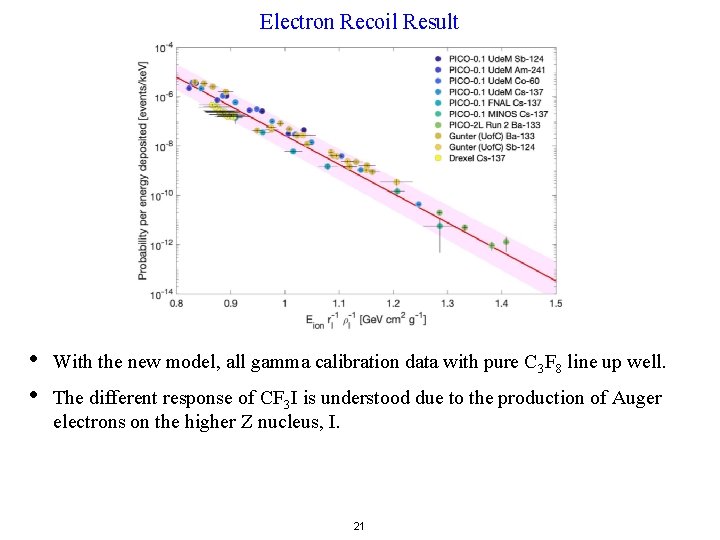
For nuclear recoils: Tracks are very short. Seitz model describing heat deposited during interaction works very well. Neutron calibration data fits model very well. Electron recoils: In this case, most interactions are with atomic electrons. Seitz model applied to electromagnetic interactions, not so well described. → Create a new model where for C 3 F 8 the model accounts for the production of delta electrons and one calculates the nucleation probability per energy deposition per unit length (not per incident #of photons) Concept developed by Dan Baxter → Interplay between nucleation caused directly from heat (kinetic energy) and indirectly through ionization. For electromagnetic interactions it appears nucleation caused by ionization of the fluid is important. Heat drawn from fluid → cavitation.
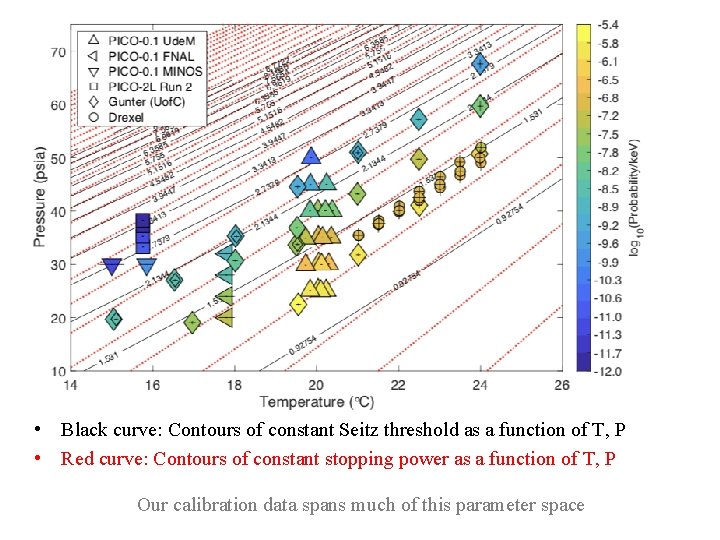
• Black curve: Contours of constant Seitz threshold as a function of T, P • Red curve: Contours of constant stopping power as a function of T, P Our calibration data spans much of this parameter space
Electron Recoil Result • • With the new model, all gamma calibration data with pure C 3 F 8 line up well. The different response of CF 3 I is understood due to the production of Auger electrons on the higher Z nucleus, I. 21
How is this helpful? • The Seitz nucleation model works well for nuclear recoils: neutrons, dark matter … • The ionization model works well for electromagnetic interactions. • This allows one to tune the detector to optimize rejection of EM backgrounds while retaining good acceptance of nuclear recoils. • Generally while the Seitz model suggests a range of possible pressure and temperature to achieve a given Seitz threshold: • Operating at lower pressures (and corresponding temperature) gives better electron rejection and hence lower thresholds. • Fortunately, lower pressure also give better acoustic signals and hence better alpha rejection. • The plan is to test this with PICO 40 with a Sietz threshold of 2. 8 ke. V and a low pressure.
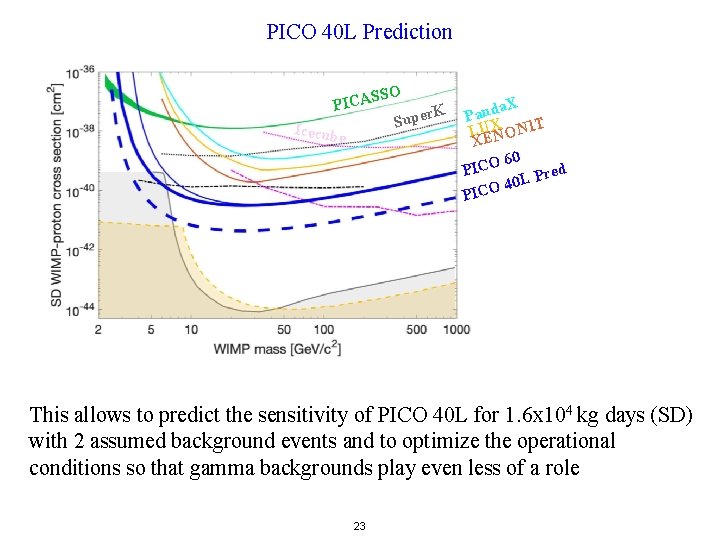
PICO 40 L Prediction SSO PICA Icecub e r. K Supe a. X Pand T LUEX ON 1 N X 60 O C I P Pred L 0 4 PICO This allows to predict the sensitivity of PICO 40 L for 1. 6 x 10⁴ kg days (SD) with 2 assumed background events and to optimize the operational conditions so that gamma backgrounds play even less of a role 23
Summary • New experiment “PICO 40 L” is being commissioned. • Expect new words best limit and optimized running conditions to reach lower sensitivity to electron recoils. • Funding received in Canada for “PICO 500” to begin construction in 2020. • Good progress being made on critical path items. Canadian Embassy – Mexico City Feb 2 2018
Summary • PICO bubble chambers at the 40 L scale can be built background-free • PICO dominates the search for spin-dependent WIMP-proton couplings • The prospect for slightly lower thresholds looks good. • The design of PICO 500 is very advanced. Major procurements underway.
Principle of Operation: Original Bubble Chambers Buffer fluid (water) Synthetic silica jar Target fluid (CF 3 I/C 3 F 8) Hydraulic fluid to hydraulic controller 1. Lower the pressure to a superheated state. 2. See the bubble: • Cameras trigger. record position, multiplicity • Microphones record acoustic trace • Fast pressure transducer recording. 3. Raise pressure to stop bubble growth (100 ms), reset chamber (30 sec)