Oral Maxillofacial Trauma lishouhong Oral and Maxillofacial Surgery


- Slides: 55
Oral & Maxillofacial Trauma 口腔颌面部损伤 lishouhong Oral and Maxillofacial Surgery School of Stomatology Hubei Medical University
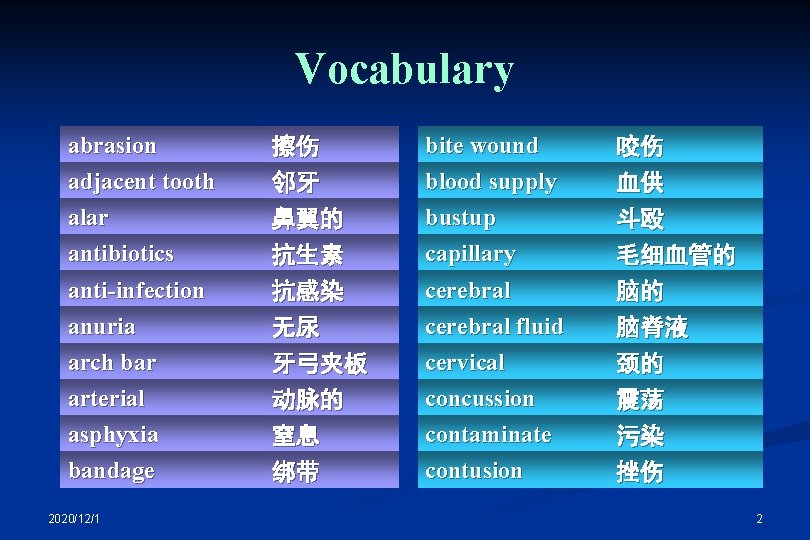
Vocabulary abrasion adjacent tooth 擦伤 邻牙 bite wound blood supply 咬伤 血供 alar antibiotics 鼻翼的 抗生素 bustup capillary 斗殴 毛细血管的 anti-infection anuria 抗感染 无尿 cerebral fluid 脑的 脑脊液 arch bar arterial 牙弓夹板 动脉的 cervical concussion 颈的 震荡 asphyxia bandage 窒息 绑带 contaminate contusion 污染 挫伤 2020/12/1 2
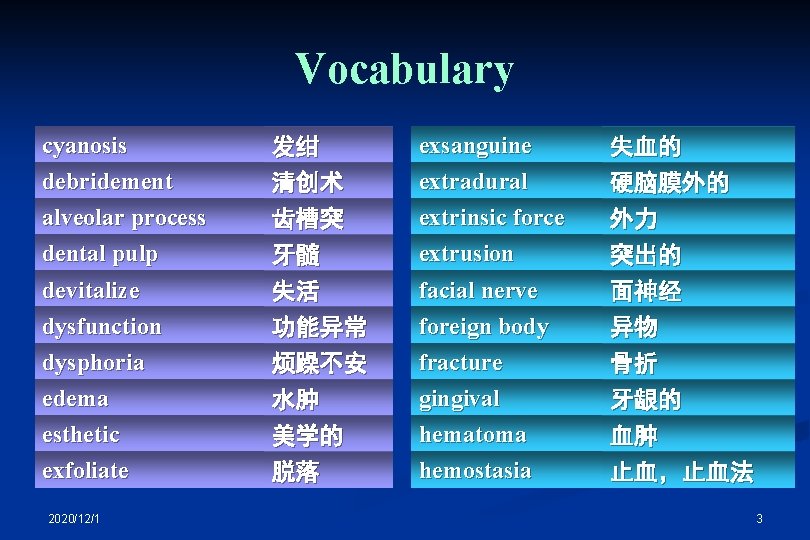
Vocabulary cyanosis debridement 发绀 清创术 exsanguine extradural 失血的 硬脑膜外的 alveolar process dental pulp 齿槽突 牙髓 extrinsic force extrusion 外力 突出的 devitalize dysfunction 失活 功能异常 facial nerve foreign body 面神经 异物 dysphoria edema 烦躁不安 水肿 fracture gingival 骨折 牙龈的 esthetic exfoliate 美学的 脱落 hematoma hemostasia 血肿 止血,止血法 2020/12/1 3
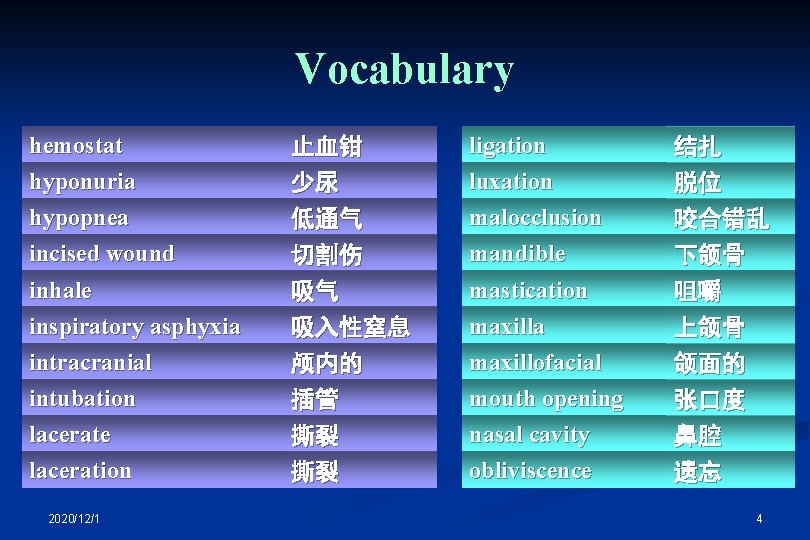
Vocabulary hemostat hyponuria 止血钳 少尿 ligation luxation 结扎 脱位 hypopnea incised wound 低通气 切割伤 malocclusion mandible 咬合错乱 下颌骨 inhale inspiratory asphyxia 吸气 吸入性窒息 mastication maxilla 咀嚼 上颌骨 intracranial intubation 颅内的 插管 maxillofacial mouth opening 颌面的 张口度 lacerate laceration 撕裂 撕裂 nasal cavity obliviscence 鼻腔 遗忘 2020/12/1 4
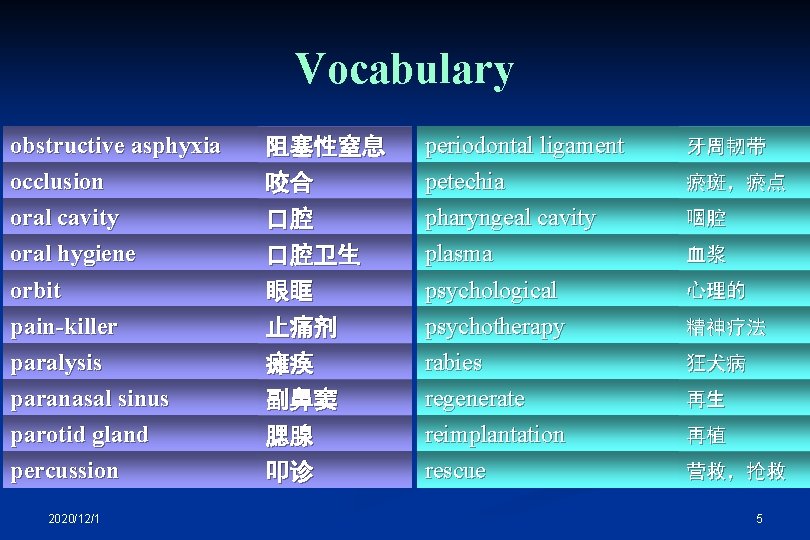
Vocabulary obstructive asphyxia occlusion 阻塞性窒息 咬合 periodontal ligament petechia 牙周韧带 oral cavity oral hygiene 口腔 口腔卫生 pharyngeal cavity plasma 咽腔 orbit pain-killer 眼眶 止痛剂 psychological psychotherapy 心理的 paralysis paranasal sinus 瘫痪 副鼻窦 rabies regenerate 狂犬病 parotid gland percussion 腮腺 叩诊 reimplantation rescue 再植 2020/12/1 瘀斑,瘀点 血浆 精神疗法 再生 营救,抢救 5
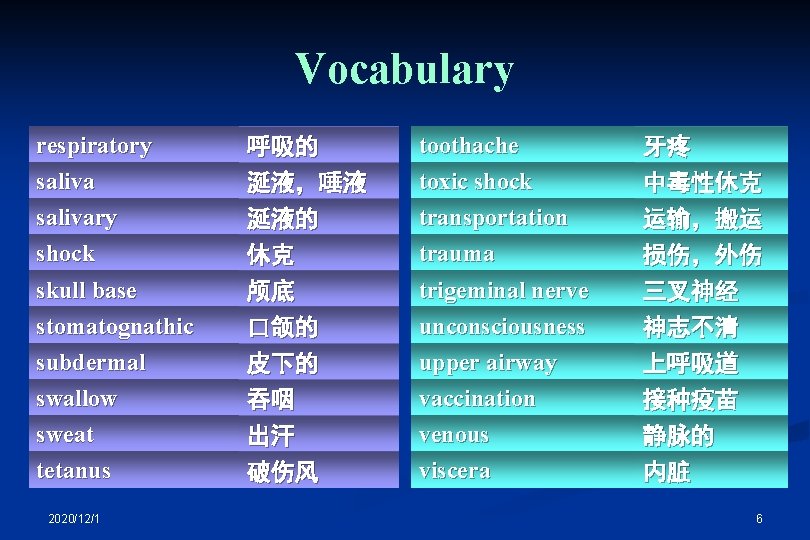
Vocabulary respiratory saliva 呼吸的 涎液,唾液 toothache toxic shock 牙疼 中毒性休克 salivary shock 涎液的 休克 transportation trauma 运输,搬运 损伤,外伤 skull base stomatognathic 颅底 口颌的 trigeminal nerve unconsciousness 三叉神经 神志不清 subdermal swallow 皮下的 吞咽 upper airway vaccination 上呼吸道 接种疫苗 sweat tetanus 出汗 破伤风 venous viscera 静脉的 内脏 2020/12/1 6
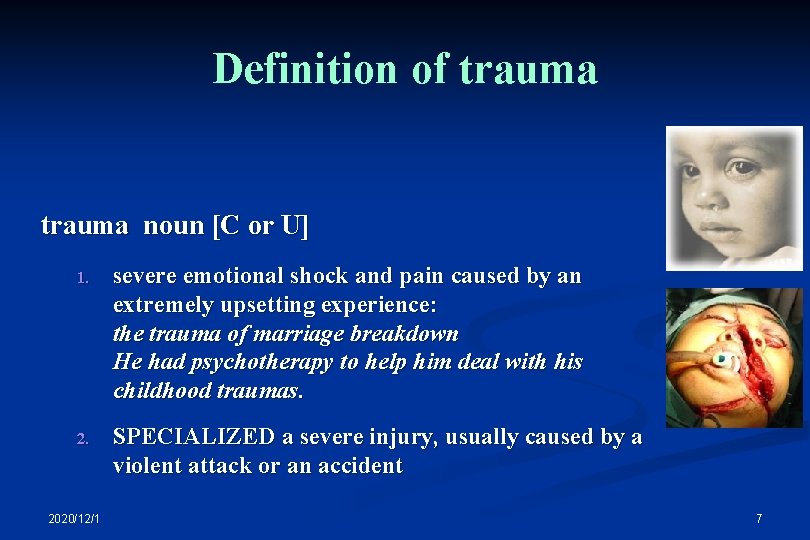
Definition of trauma noun [C or U] 1. severe emotional shock and pain caused by an extremely upsetting experience: the trauma of marriage breakdown He had psychotherapy to help him deal with his childhood traumas. 2. SPECIALIZED a severe injury, usually caused by a violent attack or an accident 2020/12/1 7
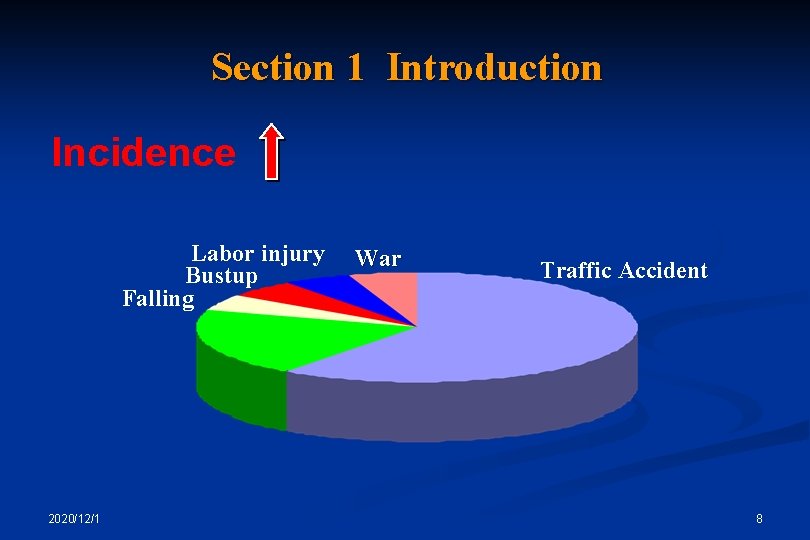
Section 1 Introduction Incidence Labor injury Bustup Falling War Traffic Accident Sports 2020/12/1 8
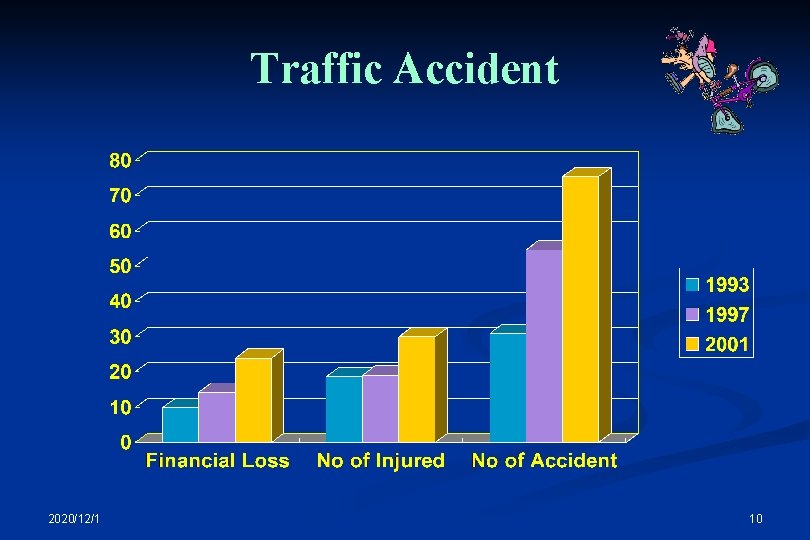
Traffic Accident 2020/12/1 10
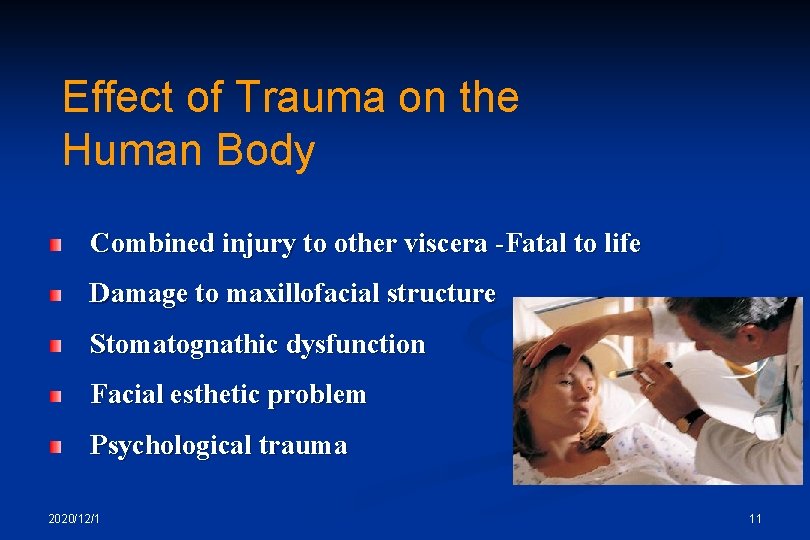
Effect of Trauma on the Human Body Combined injury to other viscera -Fatal to life Damage to maxillofacial structure Stomatognathic dysfunction Facial esthetic problem Psychological trauma 2020/12/1 11
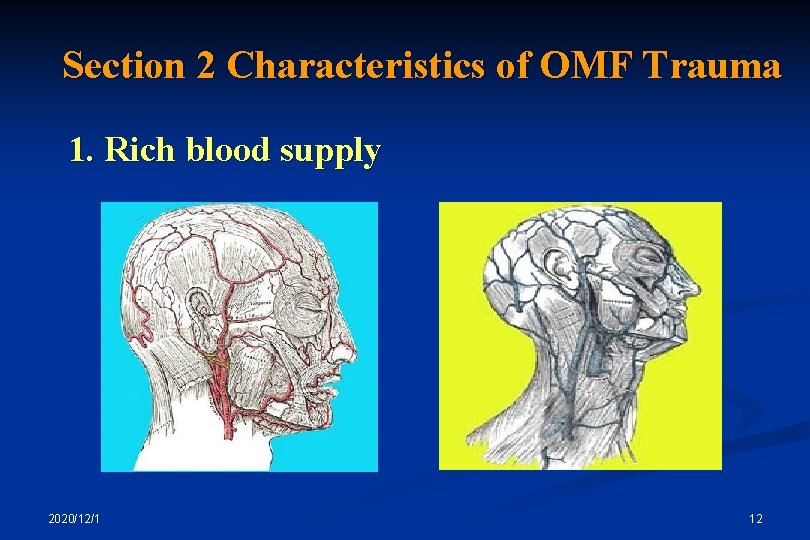
Section 2 Characteristics of OMF Trauma 1. Rich blood supply 2020/12/1 12
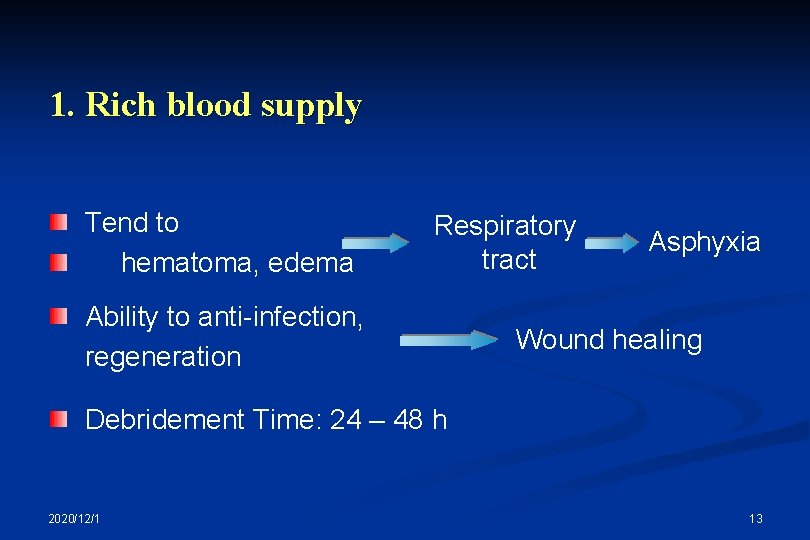
1. Rich blood supply Tend to hematoma, edema Respiratory tract Ability to anti-infection, regeneration Asphyxia Wound healing Debridement Time: 24 – 48 h 2020/12/1 13
2. Relationship btw tooth & OMF trauma Increase infectious incidence Malocclusion caused - Diagnosis Occlusion regained - Treatment 3. Cranio-cerebral trauma Cerebral concussion Cerebral contusion Intracranial hematoma Skull base fracture 2020/12/1 14
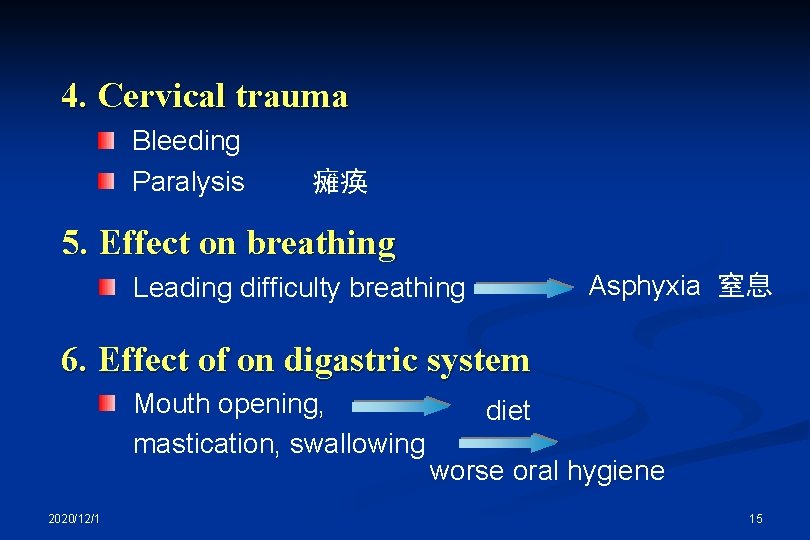
4. Cervical trauma Bleeding Paralysis 瘫痪 5. Effect on breathing Asphyxia 窒息 Leading difficulty breathing 6. Effect of on digastric system Mouth opening, mastication, swallowing 2020/12/1 diet worse oral hygiene 15
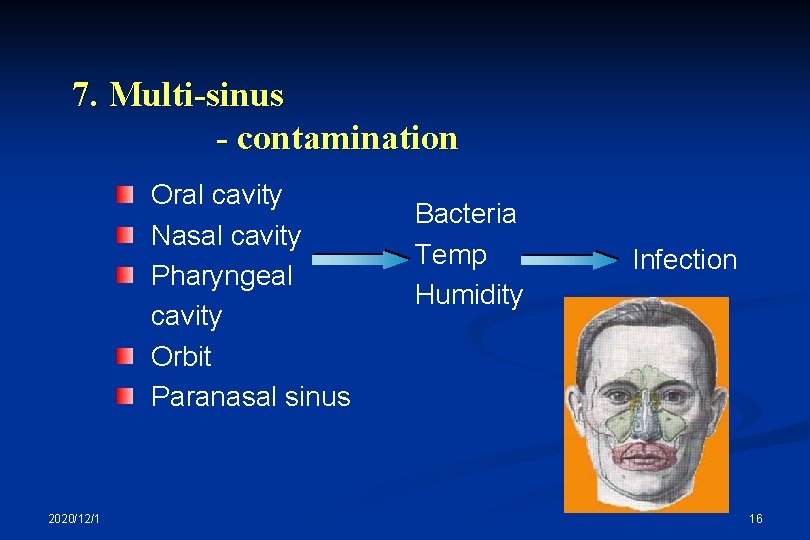
7. Multi-sinus - contamination Oral cavity Nasal cavity Pharyngeal cavity Orbit Paranasal sinus 2020/12/1 Bacteria Temp Humidity Infection 16
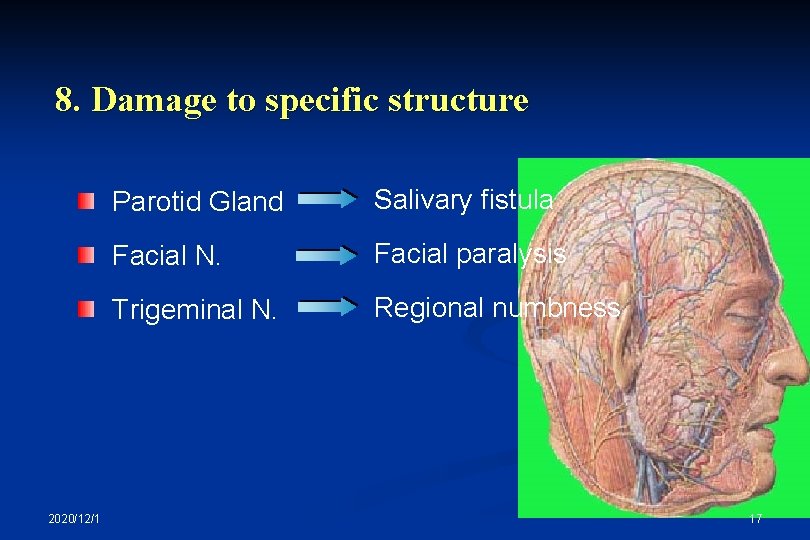
8. Damage to specific structure 2020/12/1 Parotid Gland Salivary fistula Facial N. Facial paralysis Trigeminal N. Regional numbness 17
9. Facial Defect Facial contour Psychological trauma 2020/12/1 18
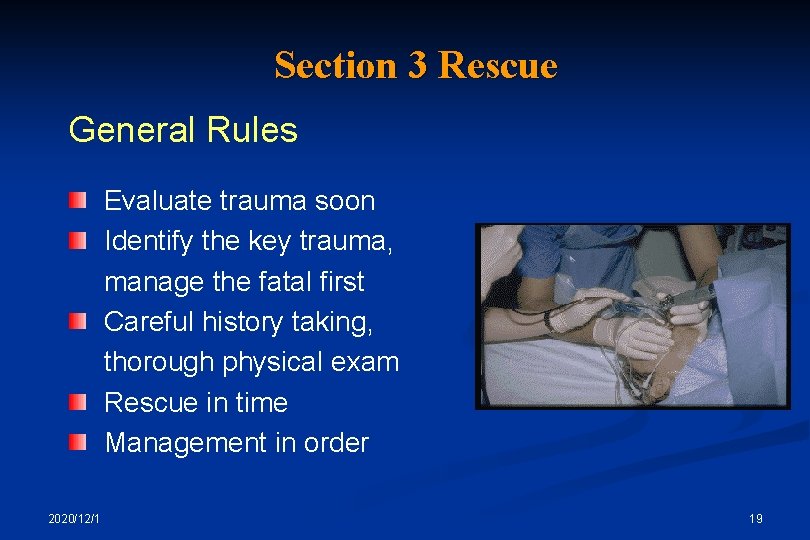
Section 3 Rescue General Rules Evaluate trauma soon Identify the key trauma, manage the fatal first Careful history taking, thorough physical exam Rescue in time Management in order 2020/12/1 19
Section 3 Rescue 1. Prevention of Asphyxia 2020/12/1 20
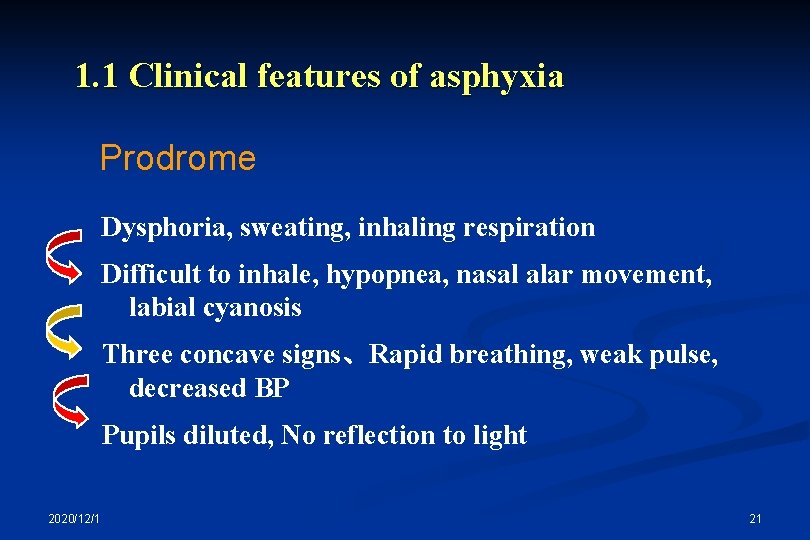
1. 1 Clinical features of asphyxia Prodrome Dysphoria, sweating, inhaling respiration Difficult to inhale, hypopnea, nasal alar movement, labial cyanosis Three concave signs、Rapid breathing, weak pulse, decreased BP Pupils diluted, No reflection to light 2020/12/1 21
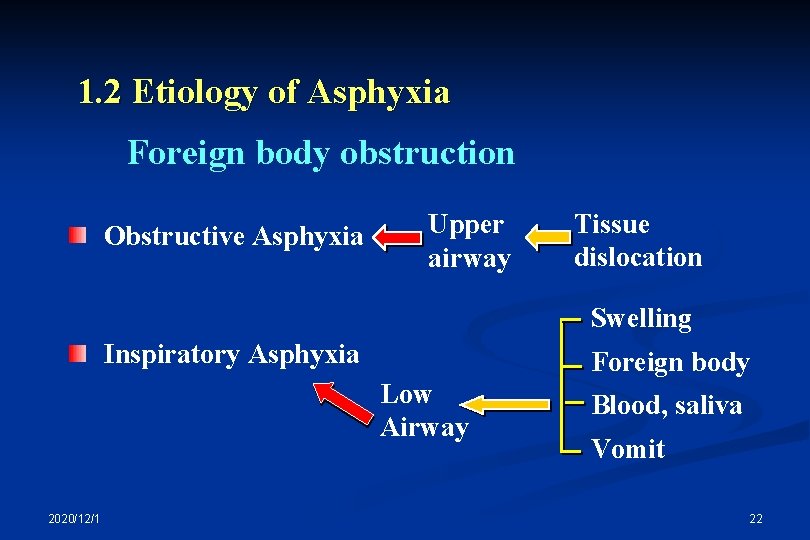
1. 2 Etiology of Asphyxia Foreign body obstruction Obstructive Asphyxia Upper airway Tissue dislocation Swelling Inspiratory Asphyxia Foreign body Low Airway 2020/12/1 Blood, saliva Vomit 22
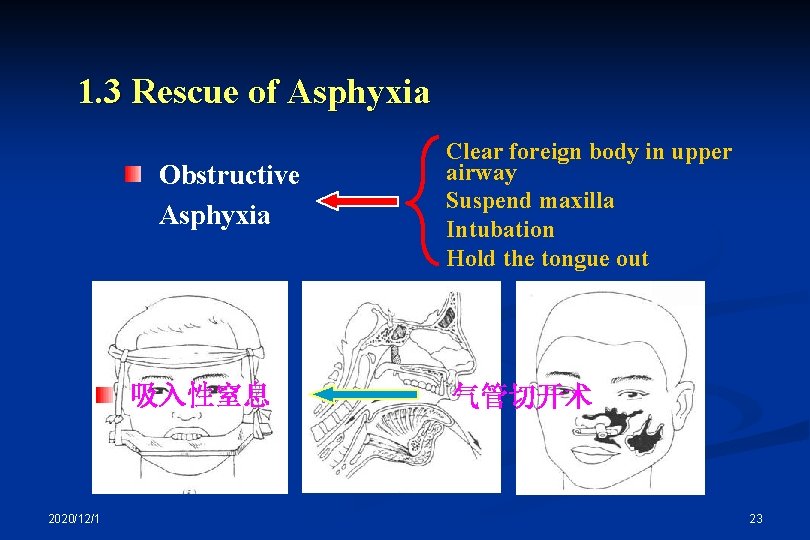
1. 3 Rescue of Asphyxia Obstructive Asphyxia 吸入性窒息 2020/12/1 Clear foreign body in upper airway Suspend maxilla Intubation Hold the tongue out 气管切开术 23
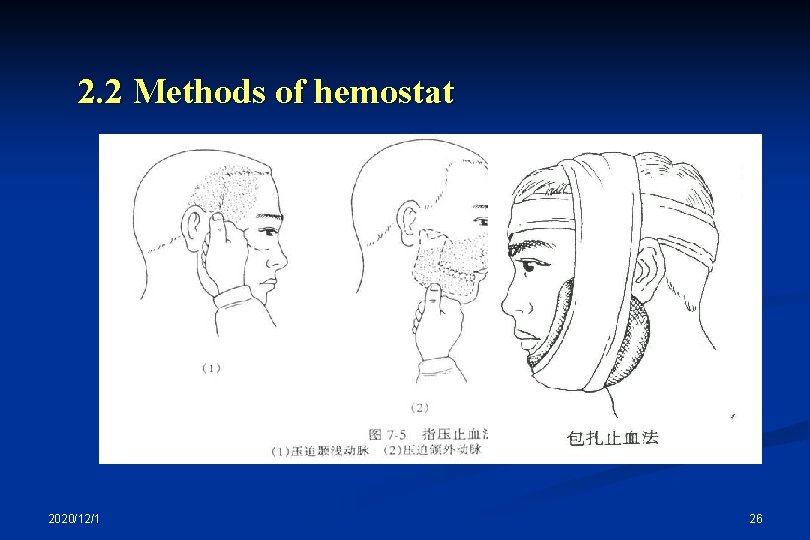
Section 3 Rescue 2. Hemostasia Two steps: Judge bleeding situation Choose the way to stop bleeding 2020/12/1 24
2. 1 Judge bleeding situation Based on origin Three categories Arterial Capillary Venous 2020/12/1 25
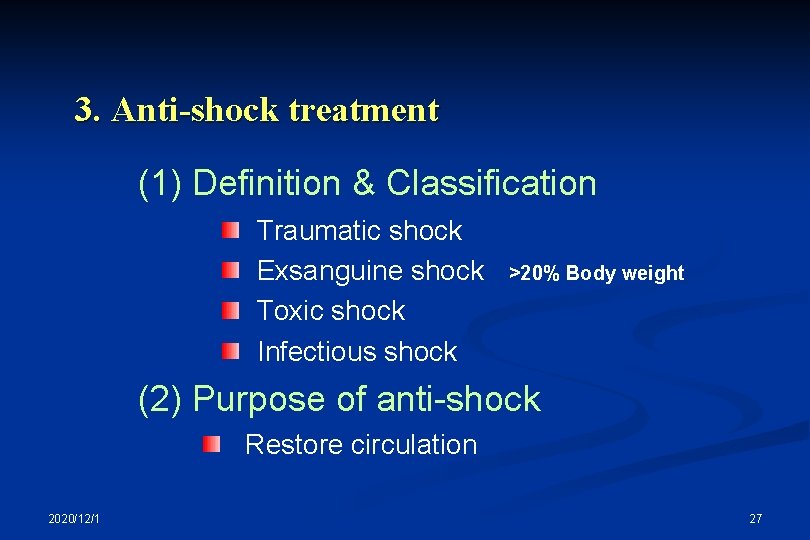
3. Anti-shock treatment (1) Definition & Classification Traumatic shock Exsanguine shock Toxic shock Infectious shock >20% Body weight (2) Purpose of anti-shock Restore circulation 2020/12/1 27
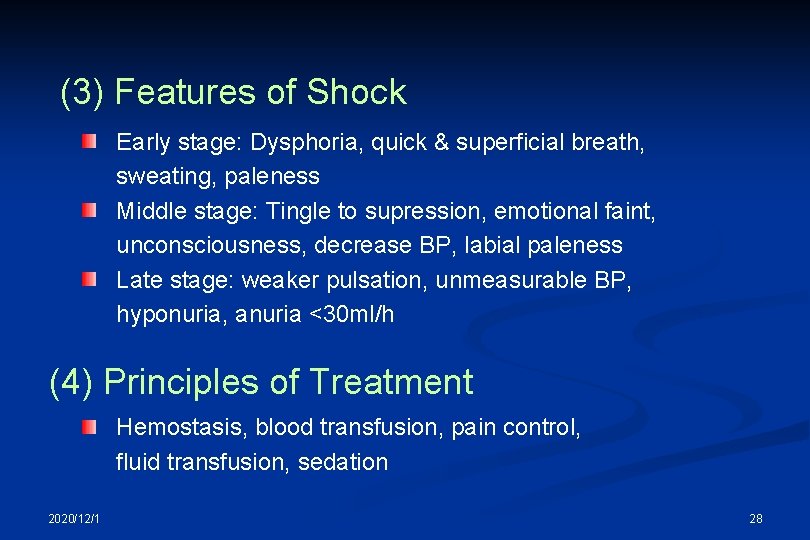
(3) Features of Shock Early stage: Dysphoria, quick & superficial breath, sweating, paleness Middle stage: Tingle to supression, emotional faint, unconsciousness, decrease BP, labial paleness Late stage: weaker pulsation, unmeasurable BP, hyponuria, anuria <30 ml/h (4) Principles of Treatment Hemostasis, blood transfusion, pain control, fluid transfusion, sedation 2020/12/1 28
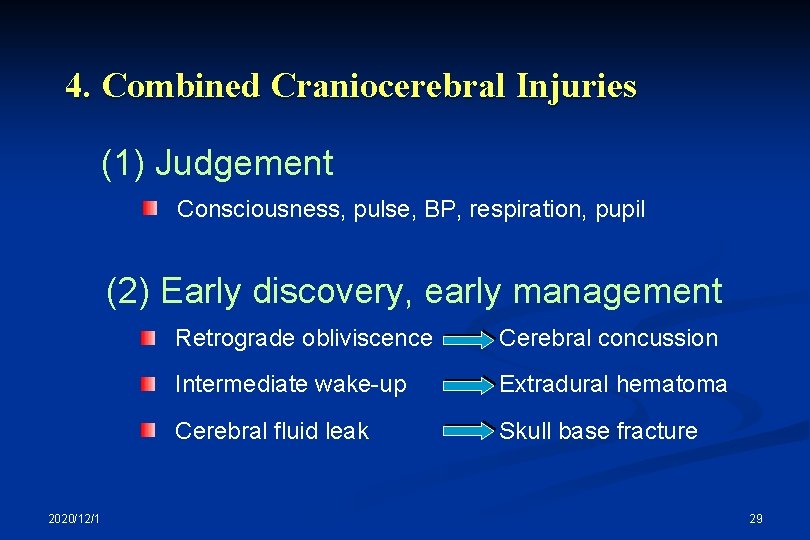
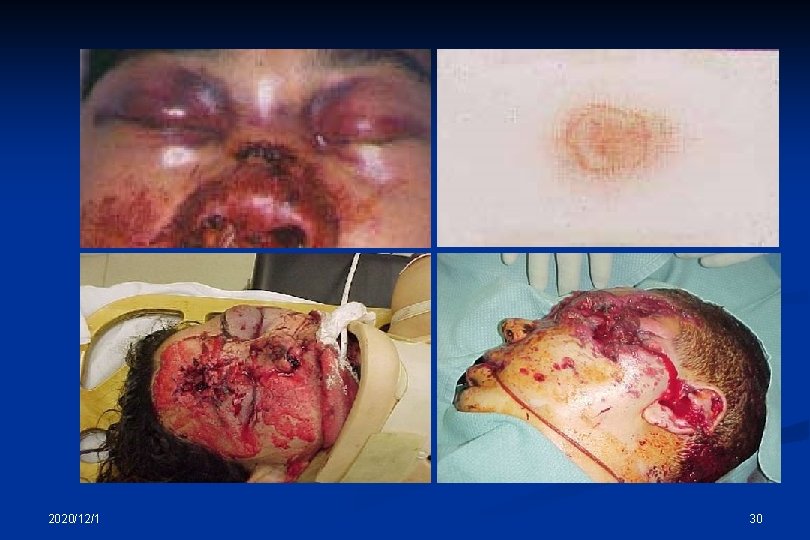
4. Combined Craniocerebral Injuries (1) Judgement Consciousness, pulse, BP, respiration, pupil (2) Early discovery, early management 2020/12/1 Retrograde obliviscence Cerebral concussion Intermediate wake-up Extradural hematoma Cerebral fluid leak Skull base fracture 29
2020/12/1 30
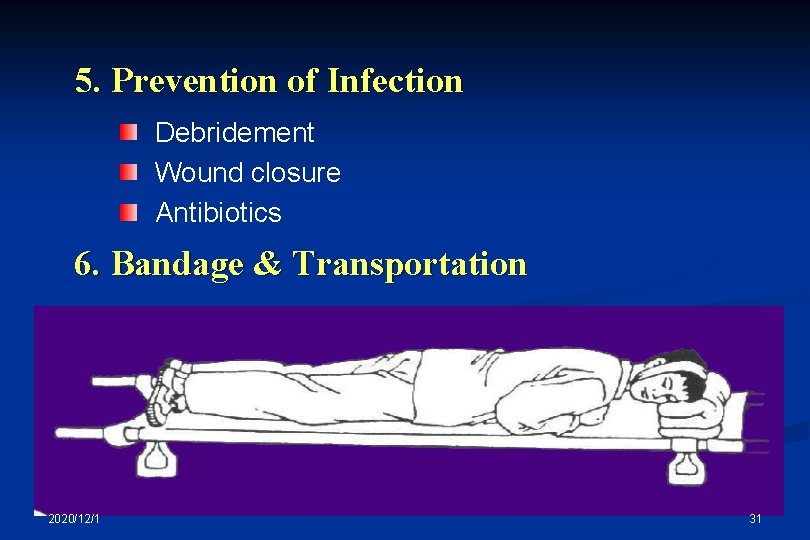
5. Prevention of Infection Debridement Wound closure Antibiotics 6. Bandage & Transportation 2020/12/1 31
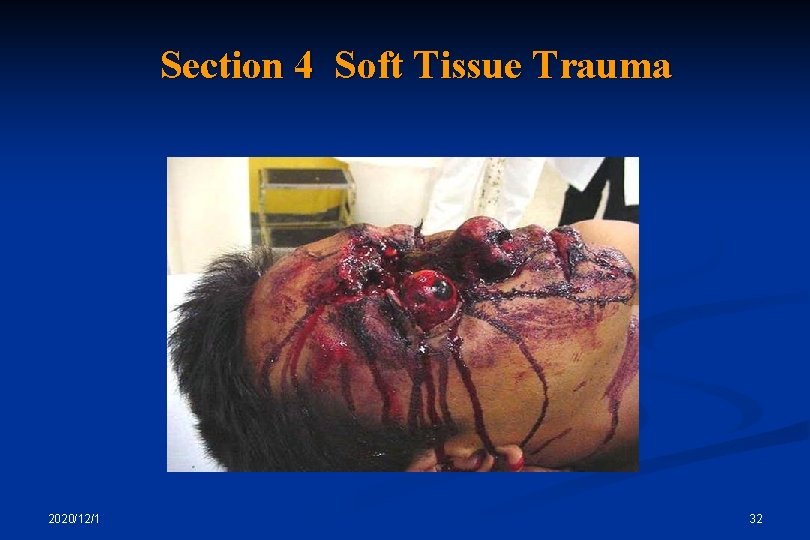
Section 4 Soft Tissue Trauma 2020/12/1 32
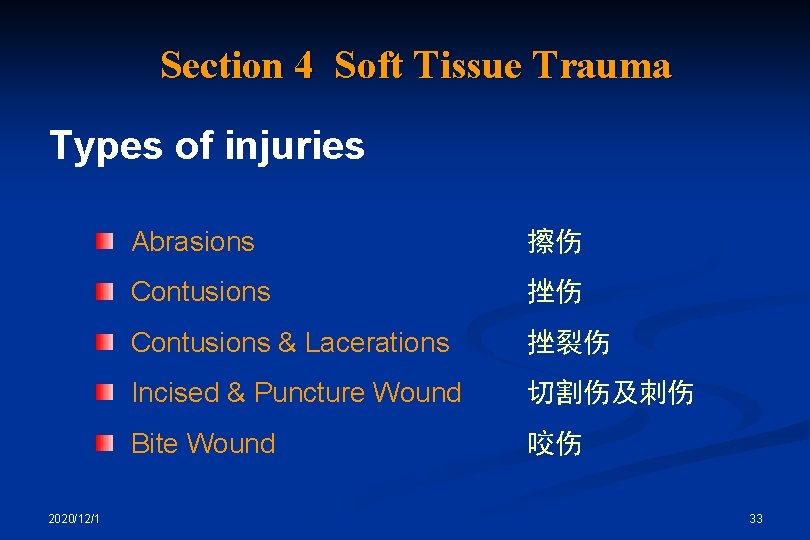
Section 4 Soft Tissue Trauma Types of injuries 2020/12/1 Abrasions 擦伤 Contusions 挫伤 Contusions & Lacerations 挫裂伤 Incised & Puncture Wound 切割伤及刺伤 Bite Wound 咬伤 33
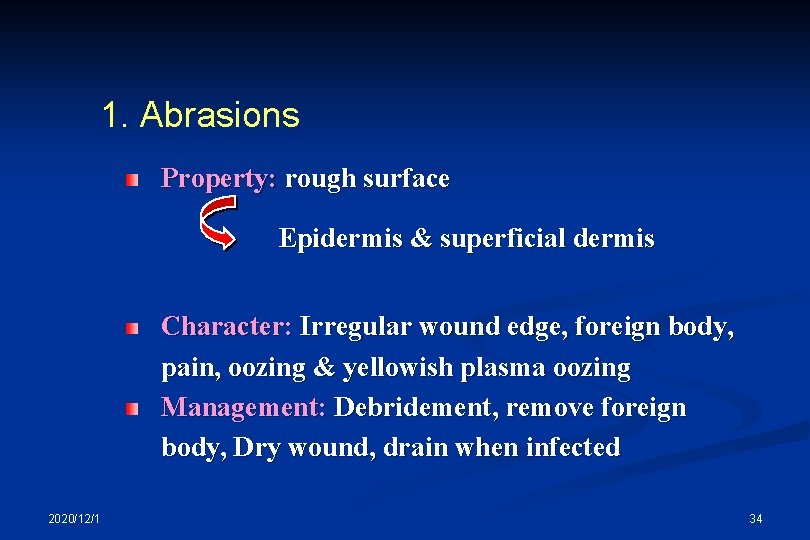
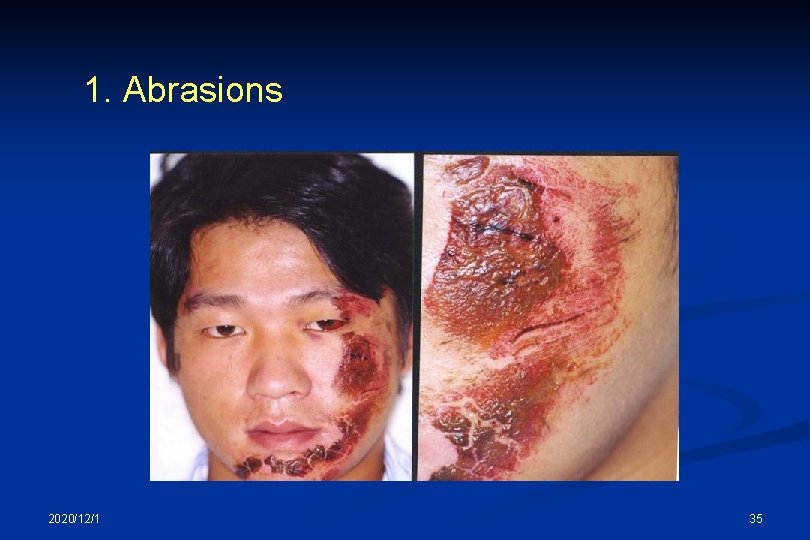
1. Abrasions Property: rough surface Epidermis & superficial dermis Character: Irregular wound edge, foreign body, pain, oozing & yellowish plasma oozing Management: Debridement, remove foreign body, Dry wound, drain when infected 2020/12/1 34
1. Abrasions 2020/12/1 35
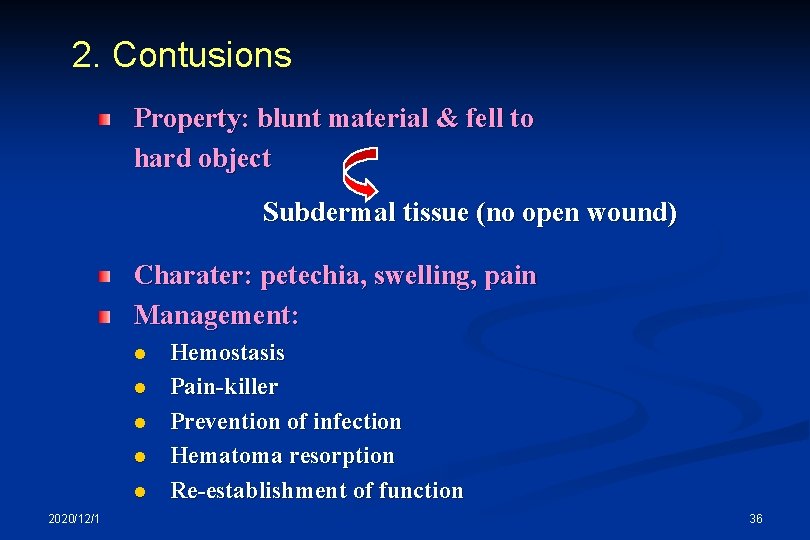
2. Contusions Property: blunt material & fell to hard object Subdermal tissue (no open wound) Charater: petechia, swelling, pain Management: l l l 2020/12/1 Hemostasis Pain-killer Prevention of infection Hematoma resorption Re-establishment of function 36
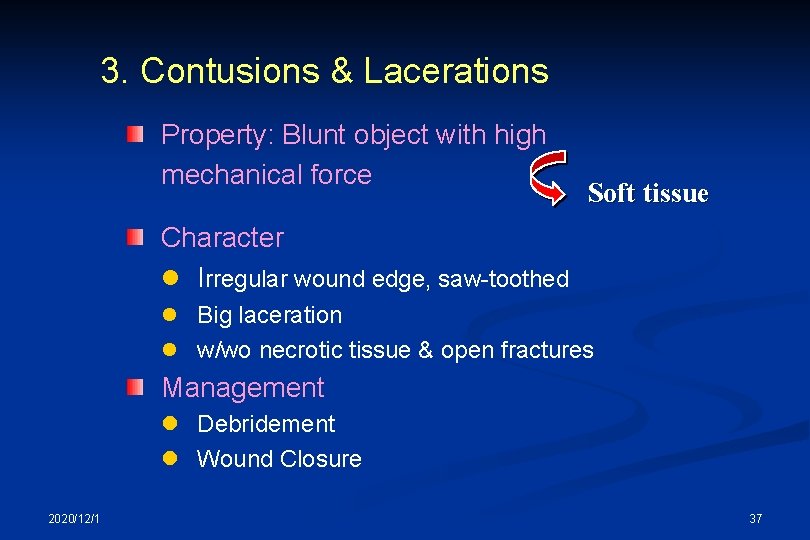
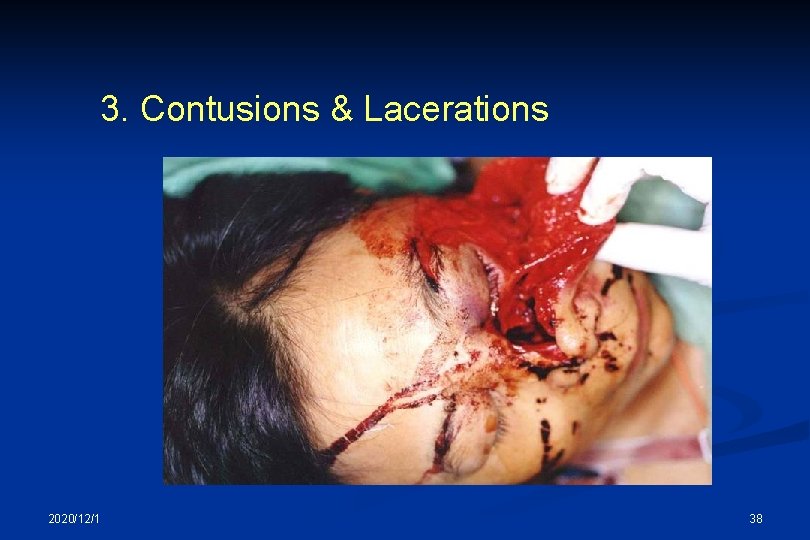
3. Contusions & Lacerations Property: Blunt object with high mechanical force Soft tissue Character l Irregular wound edge, saw-toothed l Big laceration l w/wo necrotic tissue & open fractures Management l Debridement l Wound Closure 2020/12/1 37
3. Contusions & Lacerations 2020/12/1 38
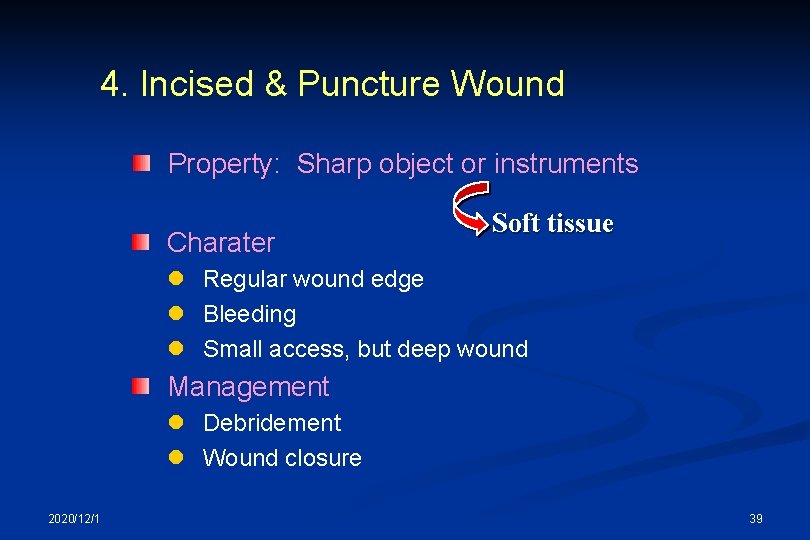
4. Incised & Puncture Wound Property: Sharp object or instruments Charater Soft tissue l Regular wound edge l Bleeding l Small access, but deep wound Management l Debridement l Wound closure 2020/12/1 39
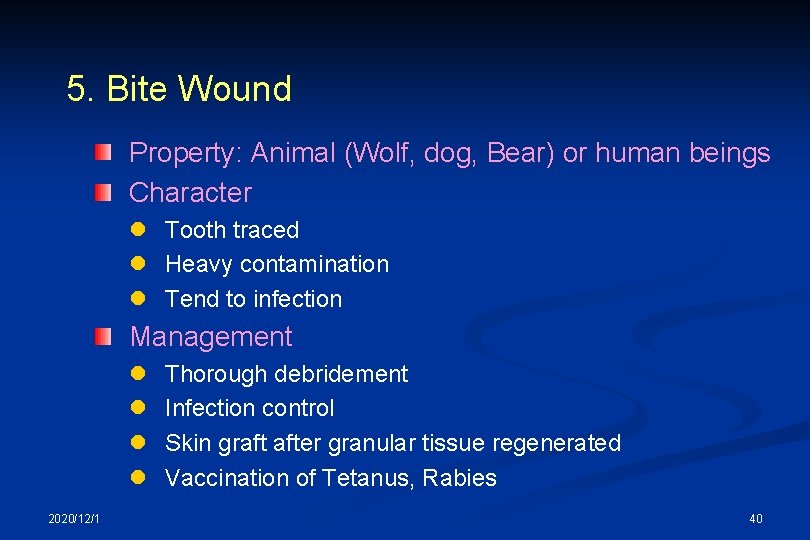
5. Bite Wound Property: Animal (Wolf, dog, Bear) or human beings Character l Tooth traced l Heavy contamination l Tend to infection Management l l 2020/12/1 Thorough debridement Infection control Skin graft after granular tissue regenerated Vaccination of Tetanus, Rabies 40
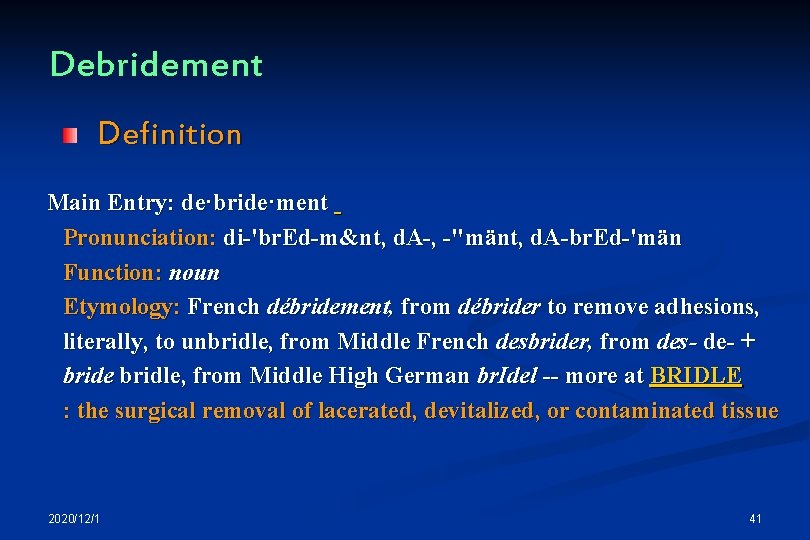
Debridement Definition Main Entry: de·bride·ment Pronunciation: di-'br. Ed-m&nt, d. A-, -"mänt, d. A-br. Ed-'män Function: noun Etymology: French débridement, from débrider to remove adhesions, literally, to unbridle, from Middle French desbrider, from des- de- + bride bridle, from Middle High German br. Idel -- more at BRIDLE : the surgical removal of lacerated, devitalized, or contaminated tissue 2020/12/1 41
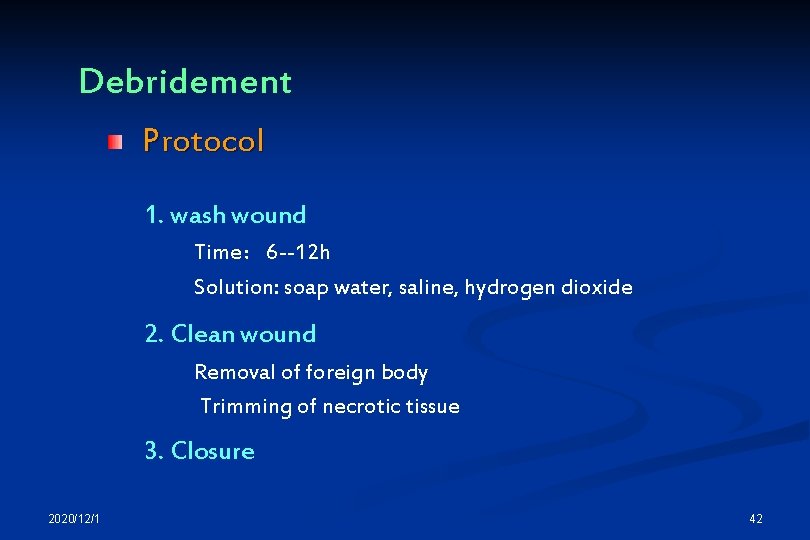
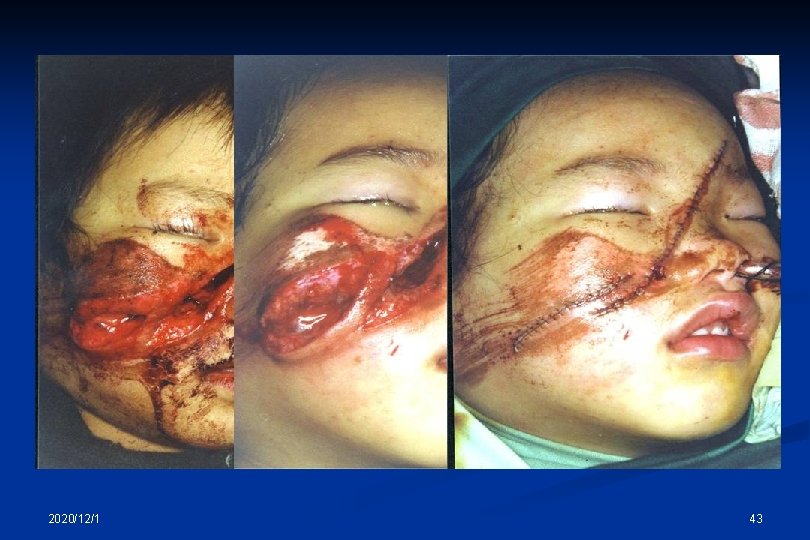
Debridement Protocol 1. wash wound Time: 6 --12 h Solution: soap water, saline, hydrogen dioxide 2. Clean wound Removal of foreign body Trimming of necrotic tissue 3. Closure 2020/12/1 42
2020/12/1 43
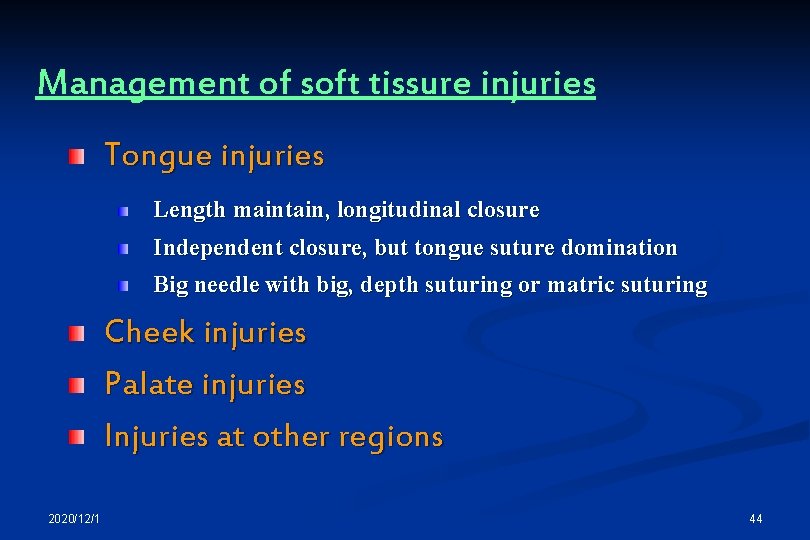
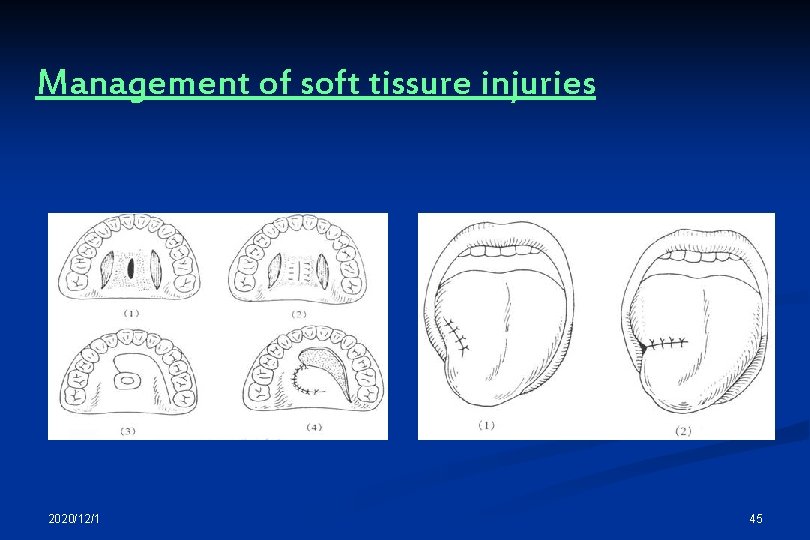
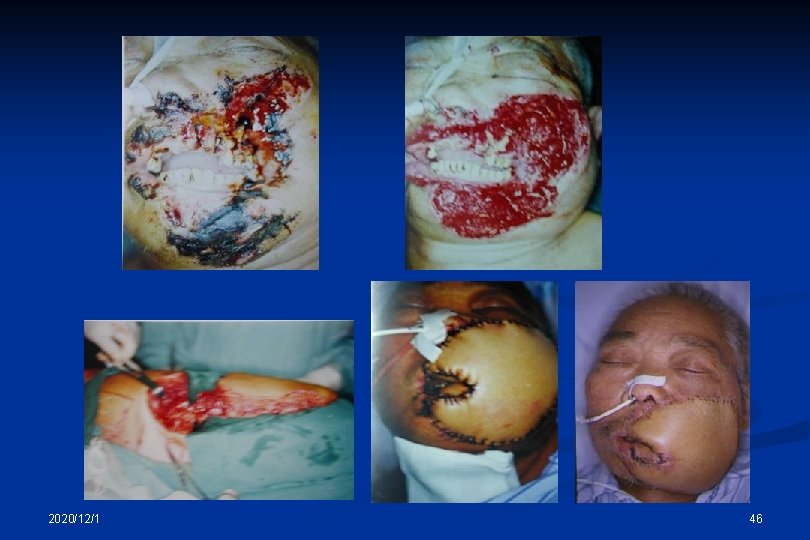
Management of soft tissure injuries Tongue injuries Length maintain, longitudinal closure Independent closure, but tongue suture domination Big needle with big, depth suturing or matric suturing Cheek injuries Palate injuries Injuries at other regions 2020/12/1 44
Management of soft tissure injuries 2020/12/1 45
2020/12/1 46
Section 5 Injury of Teeth and Dental Alveolar Process 2020/12/1 47
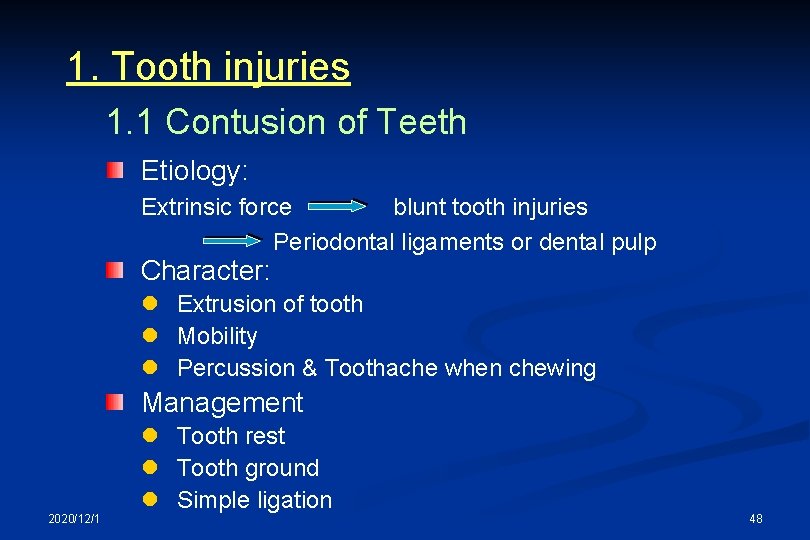
1. Tooth injuries 1. 1 Contusion of Teeth Etiology: Extrinsic force blunt tooth injuries Periodontal ligaments or dental pulp Character: l Extrusion of tooth l Mobility l Percussion & Toothache when chewing Management 2020/12/1 l Tooth rest l Tooth ground l Simple ligation 48
1. Tooth injuries 1. 2 Luxation of Teeth Classification Partial luxation Complete luxation - Tooth dislocation - Semi luxation - Intrusive movement Character l Tooth dislocated or exfoliated Management l l 2020/12/1 Tooth protection priority Reduction Fixation Reimplantation 49
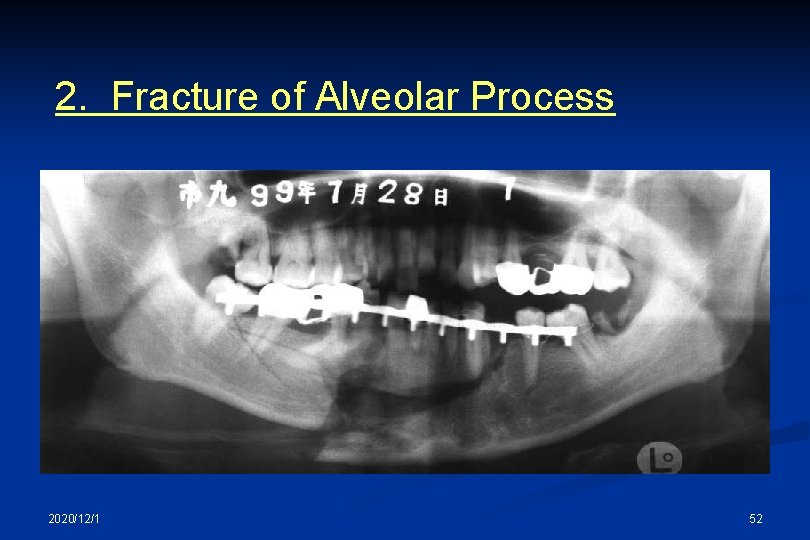
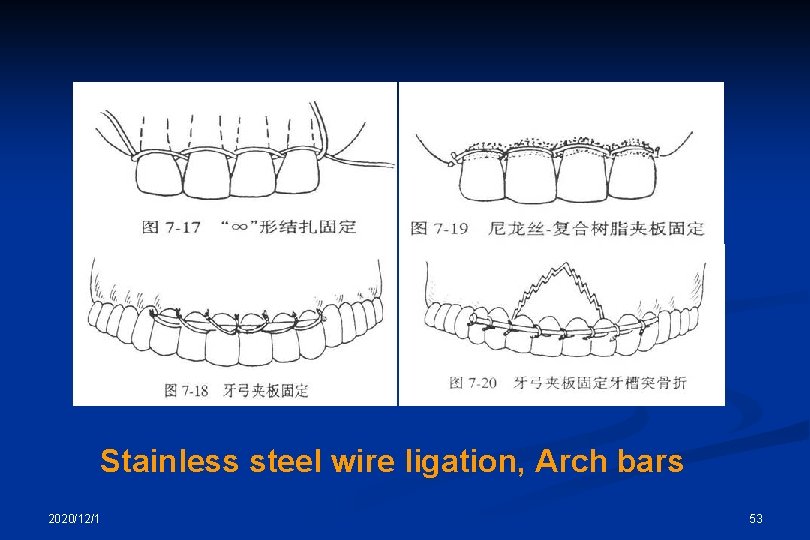
2. Fracture of Alveolar Process Characters Gingival or labial swelling, laceration Adjacent teeth or alveolar process movement when one affected tooth touched Fragment dislocation, Malocclusion In accordance with tooth luxation or fracture 2020/12/1 50
2. Fracture of Alveolar Process Etiology l Extrinsic force to dental alveolar process, mainly to upper jaw Management l Reduction under LA l Arch bar applied 2020/12/1 51
2. Fracture of Alveolar Process 2020/12/1 52
Stainless steel wire ligation, Arch bars 2020/12/1 53
Questions 1. Describe the characteristics of OMF Trauma? 2. Describe the etiology, clinical features and management of asphyxia. 3. Describe the ways of hemastasis. 4. What is debridement? 5. Describe the common site of dental alveolar process fracture, and their clinical manifestation. 2020/12/1 54
Reference 1. LJ Peterson, et al : Contemporary Oral & Maxillofacial Surgery. 4 th ed. Mosby. Missorri. 2003 2. W Booth, et al: Maxillofacial Surgery. Vol 1, 2. 1 st ed. Churchill Livingstone. London. 1999 3. 邱蔚六主编. 口腔颌面外科学. 第 6版. 人民卫生出版社. 2010 2020/12/1 55
THE END 2020/12/1 56