OneWay Analysis of Covariance OneWay ANCOVA ANCOVA n


- Slides: 15
One-Way Analysis of Covariance One-Way ANCOVA
ANCOVA n Allows you to compare mean differences in 1 or more groups with 2+ levels (just like a regular ANOVA), while removing variance from a 3 rd variable n What does this mean?
ANCOVA
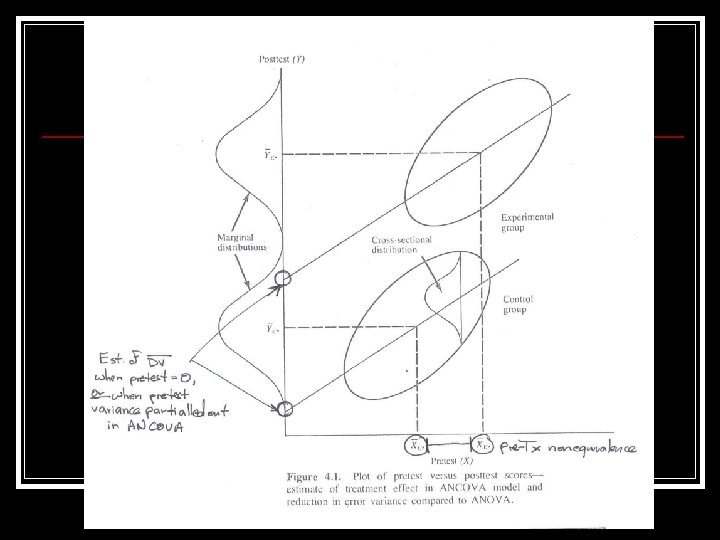
ANCOVA n Removing variance that is unrelated to the IV/intervention = removing error variance n n Makes ANCOVA potentially a very powerful test (i. e. easier to find significant results than with ANOVA alone) by potentially reducing MSerror Generally, the more strongly related are covariate and DV, and unrelated the covariate and IV, the more useful (statistically) the covariate will be in reducing MSerror
ANCOVA n Why would this be useful? n Any longitudinal research design needs to control for T 1 differences in the DV n n I. e. If assessing change in symptoms of social anxiety over time between 2 groups, we need to control for group differences in T 1 social anxiety Even if random assignment is used, use of a covariate is a good idea – Random assignment doesn’t guarantee group equality
ANCOVA n Why would this be useful? n Any DV’s with poor discriminant validity n I. e. SES and race are highly related – If we wanted to study the effects of SES, independent of race, on scholastic achievement we could use an ANCOVA using SES as the DV and race as a covariate
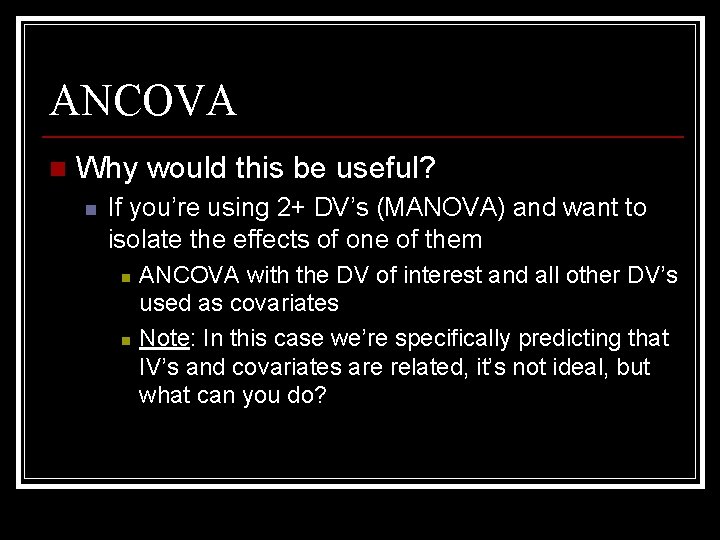
ANCOVA n Why would this be useful? n If you’re using 2+ DV’s (MANOVA) and want to isolate the effects of one of them n n ANCOVA with the DV of interest and all other DV’s used as covariates Note: In this case we’re specifically predicting that IV’s and covariates are related, it’s not ideal, but what can you do?
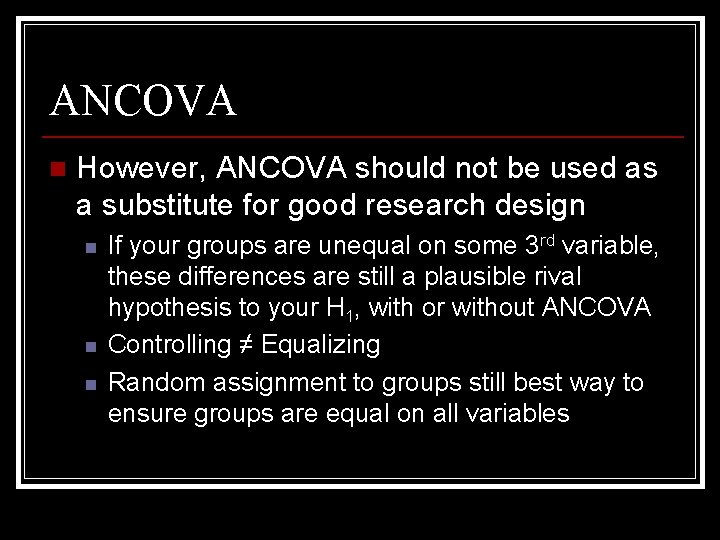
ANCOVA n However, ANCOVA should not be used as a substitute for good research design n If your groups are unequal on some 3 rd variable, these differences are still a plausible rival hypothesis to your H 1, with or without ANCOVA Controlling ≠ Equalizing Random assignment to groups still best way to ensure groups are equal on all variables
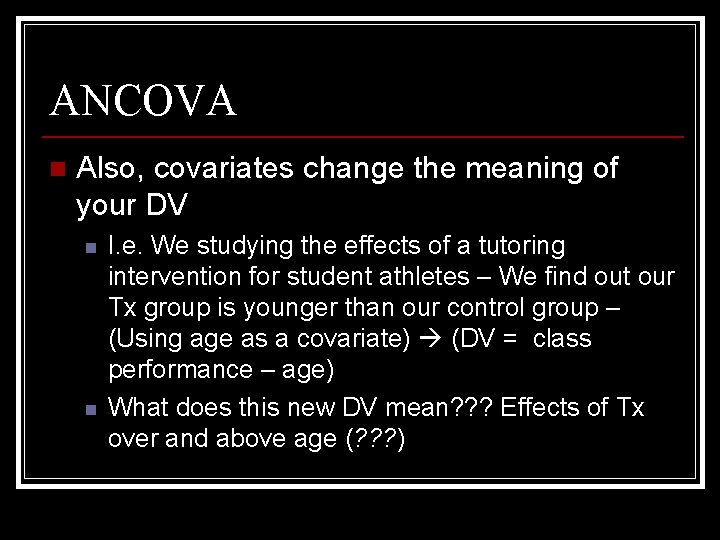
ANCOVA n Also, covariates change the meaning of your DV n n I. e. We studying the effects of a tutoring intervention for student athletes – We find out our Tx group is younger than our control group – (Using age as a covariate) (DV = class performance – age) What does this new DV mean? ? ? Effects of Tx over and above age (? ? ? )
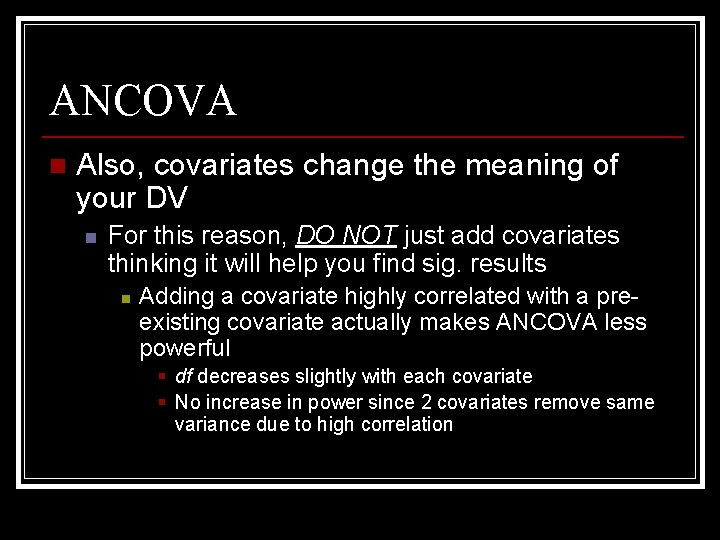
ANCOVA n Also, covariates change the meaning of your DV n For this reason, DO NOT just add covariates thinking it will help you find sig. results n Adding a covariate highly correlated with a preexisting covariate actually makes ANCOVA less powerful § df decreases slightly with each covariate § No increase in power since 2 covariates remove same variance due to high correlation
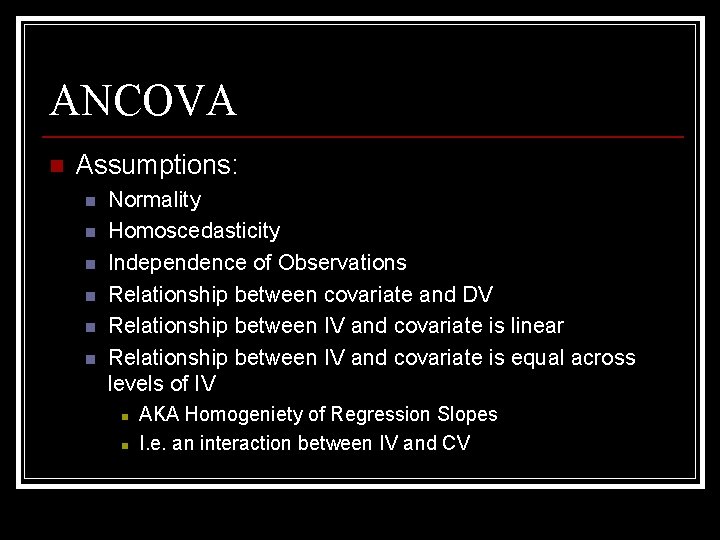
ANCOVA n Assumptions: n n n Normality Homoscedasticity Independence of Observations Relationship between covariate and DV Relationship between IV and covariate is linear Relationship between IV and covariate is equal across levels of IV n n AKA Homogeniety of Regression Slopes I. e. an interaction between IV and CV
ANCOVA n Calculations n n Don’t worry about them, in fact, you can skip pp. 577 -585 in the text Recall that in the one-way ANOVA we divided the total variance (SStotal) into variance attributable to our IV (SStreat) and not attributable to our IV (SSerror)
ANCOVA n In ANCOVA, we just divide the variance once more (for the covariate) § IV: Inferences are made re: its effects on the DV by systematically separating its variance from everything else § Covariate: Inferences are made by separating its variance from everything else, however this separated variance is not investigated in-and-of itself