Estimation of covariance matrix under informative sampling Julia

- Slides: 12
Estimation of covariance matrix under informative sampling Julia Aru University of Tartu and Statistics Estonia Tartu, June 26 -29, 2007 Tartu, June 25 -29, 2007
Outline • Informative sampling • Population and sample distribution • Multivariate normal distribution and exponential inclusion probabilities • Conclusions for normal case • Simulation study Tartu, June 26 -29, 2007 2
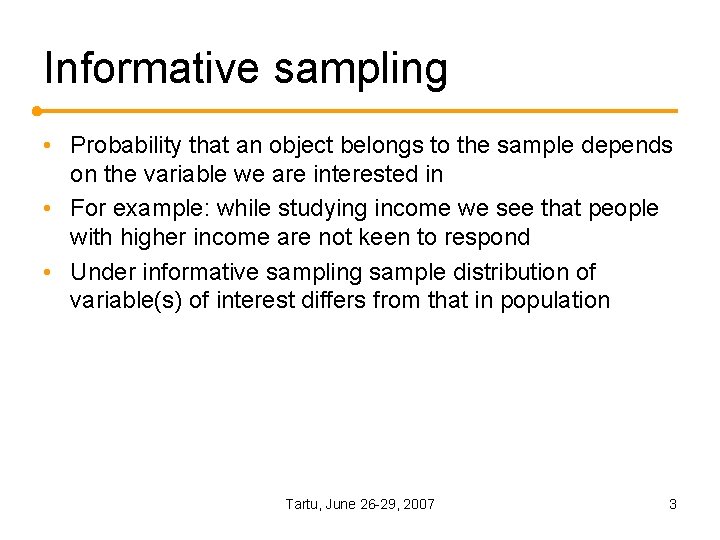
Informative sampling • Probability that an object belongs to the sample depends on the variable we are interested in • For example: while studying income we see that people with higher income are not keen to respond • Under informative sampling sample distribution of variable(s) of interest differs from that in population Tartu, June 26 -29, 2007 3
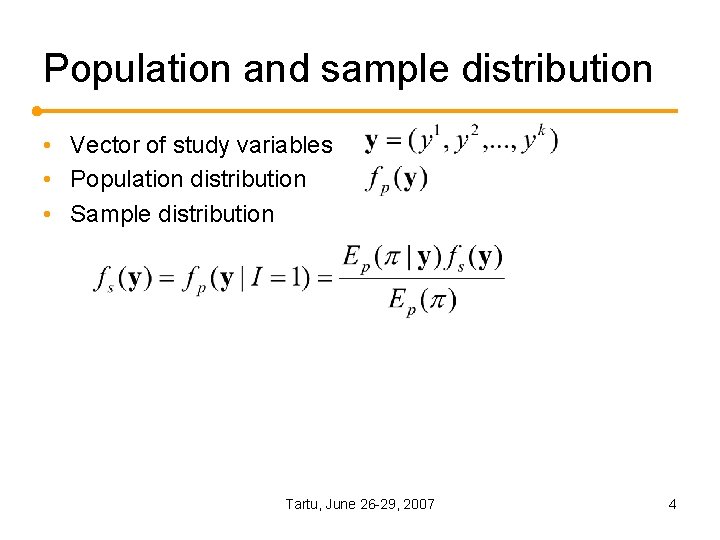
Population and sample distribution • Vector of study variables • Population distribution • Sample distribution Tartu, June 26 -29, 2007 4
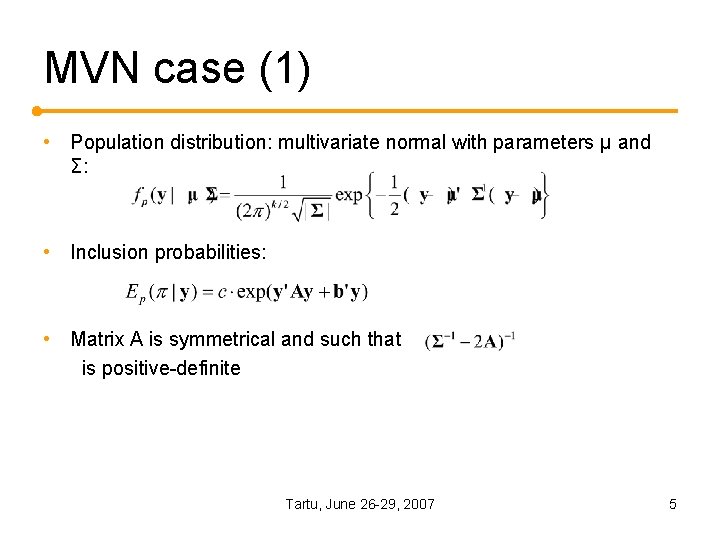
MVN case (1) • Population distribution: multivariate normal with parameters µ and Σ: • Inclusion probabilities: • Matrix A is symmetrical and such that is positive-definite Tartu, June 26 -29, 2007 5
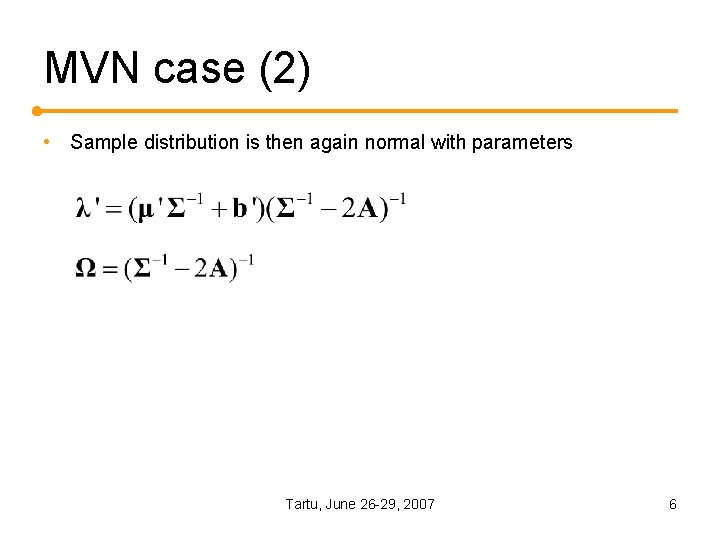
MVN case (2) • Sample distribution is then again normal with parameters Tartu, June 26 -29, 2007 6
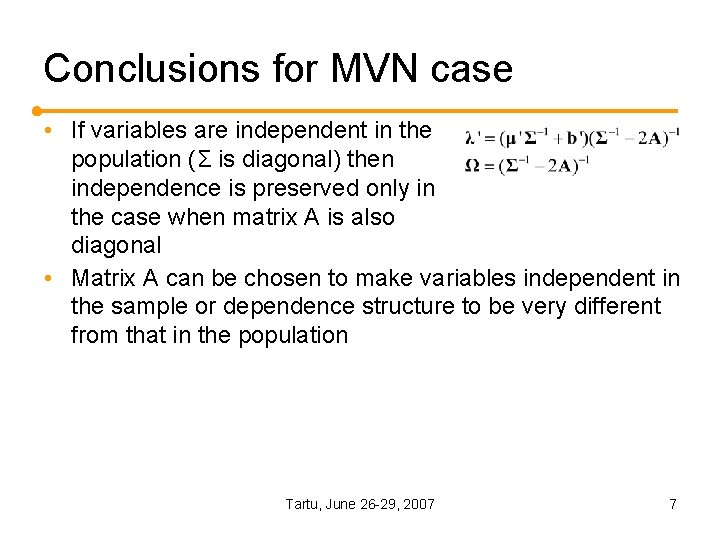
Conclusions for MVN case • If variables are independent in the population (Σ is diagonal) then independence is preserved only in the case when matrix A is also diagonal • Matrix A can be chosen to make variables independent in the sample or dependence structure to be very different from that in the population Tartu, June 26 -29, 2007 7
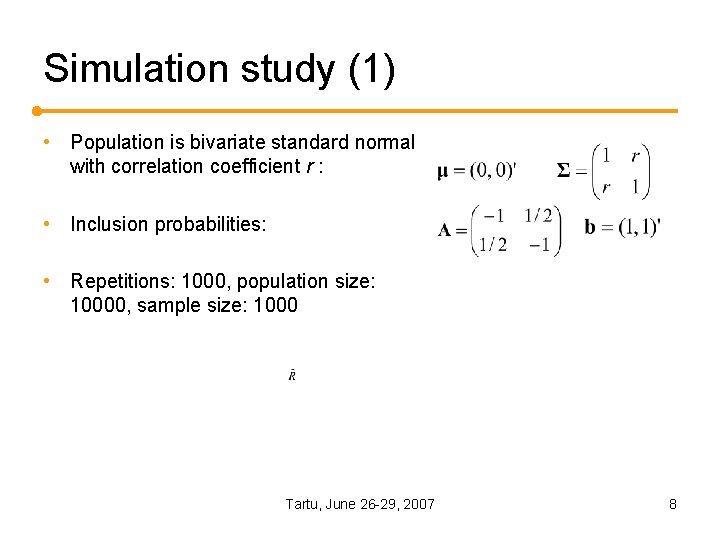
Simulation study (1) • Population is bivariate standard normal with correlation coefficient r : • Inclusion probabilities: • Repetitions: 1000, population size: 10000, sample size: 1000 Tartu, June 26 -29, 2007 8
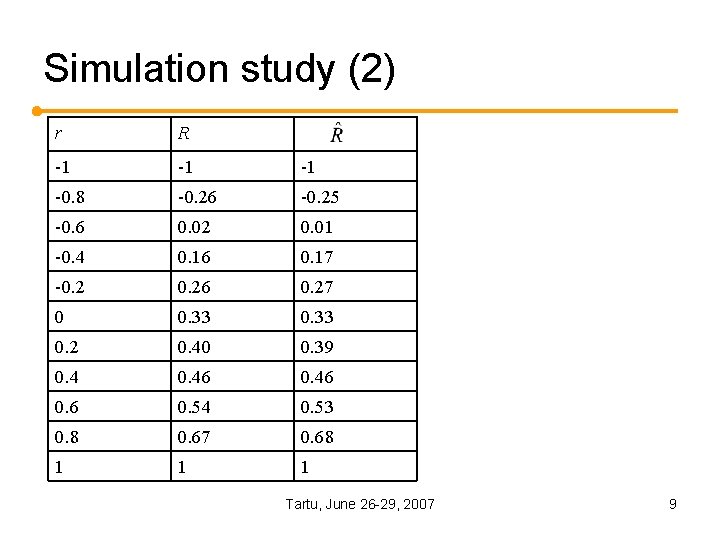
Simulation study (2) r R -1 -1 -1 -0. 8 -0. 26 -0. 25 -0. 6 0. 02 0. 01 -0. 4 0. 16 0. 17 -0. 26 0. 27 0 0. 33 0. 2 0. 40 0. 39 0. 46 0. 54 0. 53 0. 8 0. 67 0. 68 1 1 1 Tartu, June 26 -29, 2007 9
Thank you! Tartu, June 26 -29, 2007 10
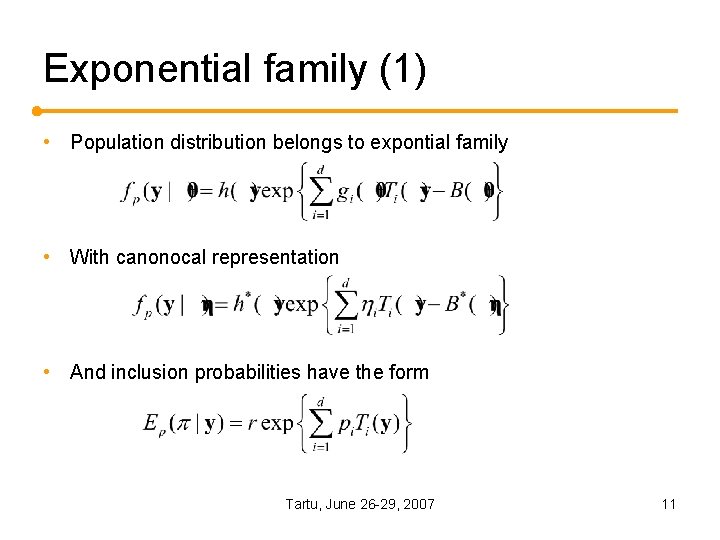
Exponential family (1) • Population distribution belongs to expontial family • With canonocal representation • And inclusion probabilities have the form Tartu, June 26 -29, 2007 11
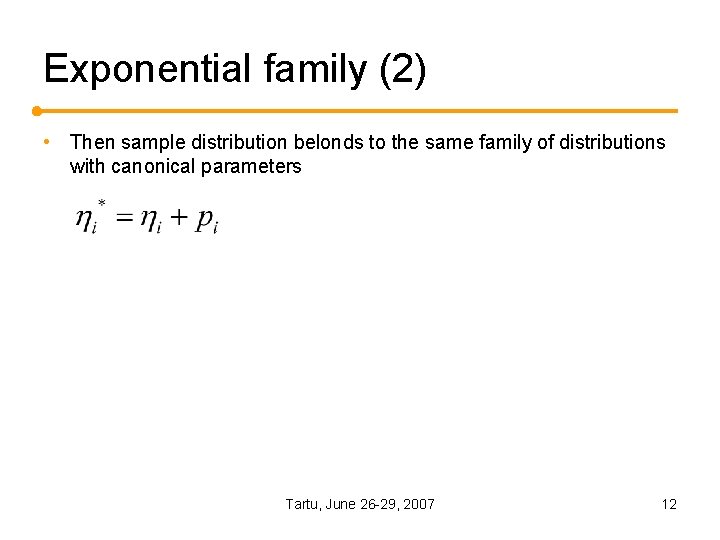
Exponential family (2) • Then sample distribution belonds to the same family of distributions with canonical parameters Tartu, June 26 -29, 2007 12