One out of Many V S Naipaul 1932


- Slides: 26
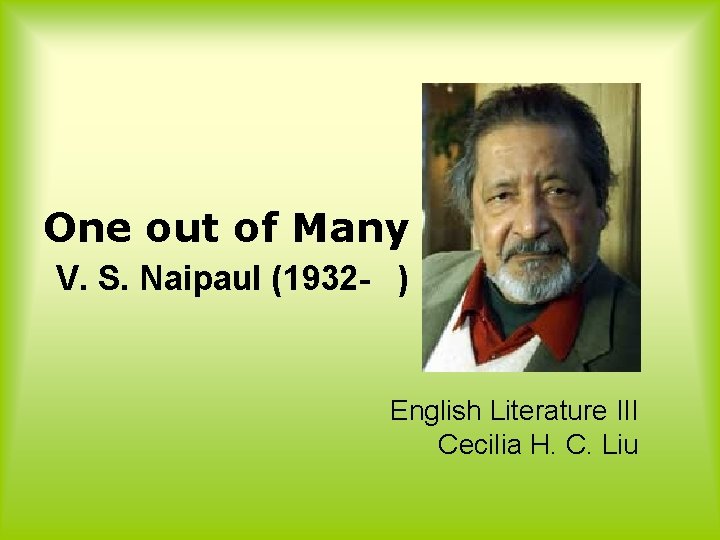
One out of Many V. S. Naipaul (1932 - ) English Literature III Cecilia H. C. Liu
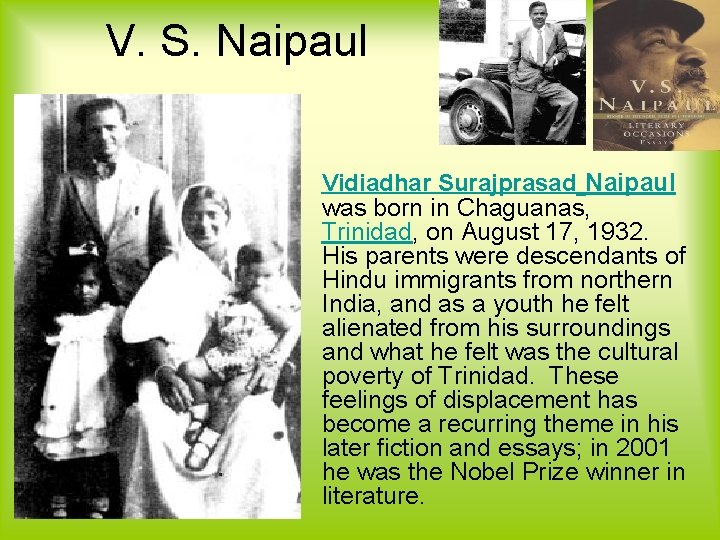
V. S. Naipaul Vidiadhar Surajprasad Naipaul was born in Chaguanas, Trinidad, on August 17, 1932. His parents were descendants of Hindu immigrants from northern India, and as a youth he felt alienated from his surroundings and what he felt was the cultural poverty of Trinidad. These feelings of displacement has become a recurring theme in his later fiction and essays; in 2001 he was the Nobel Prize winner in literature.
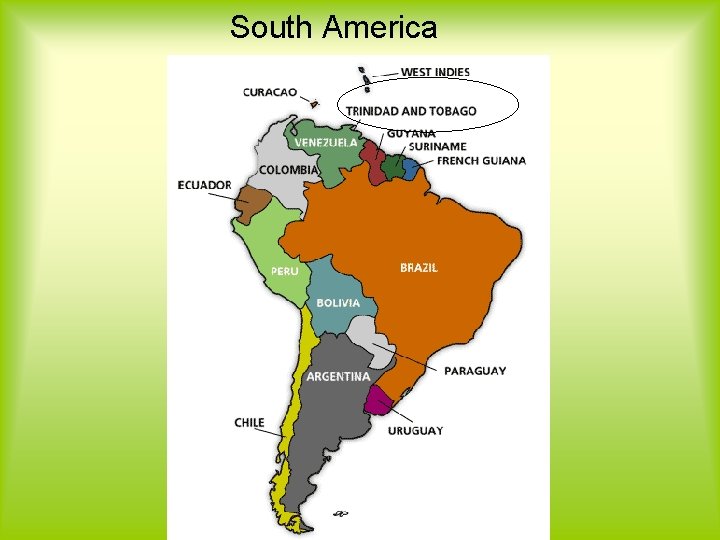
South America
Caribbean Countries and Trinidad
Characters Santosh: - A cook - He wants to find his selfidentity in U. S. A - He feels that he is isolated from this new environment. - He is anxious about new environment and lacks of security in Washington, D. C.
Characters Priya: • He is a restaurant owner • He is like Santosh’s mentor • He always speaks like a philosopher and is so sweet (p. 2736 )
Characters Hubshi maid: • She is a supermarket’s cashier • Santosh says that she is like “Kali” • She marries to Santosh in the end of story • “Hubshi” means Negro/Negress in English; it’s a disparaging word.
Characters Santosh’s employer: • He is a government officer and nominated to Washington, D. C • Santosh called him “Sahib”, which means Master
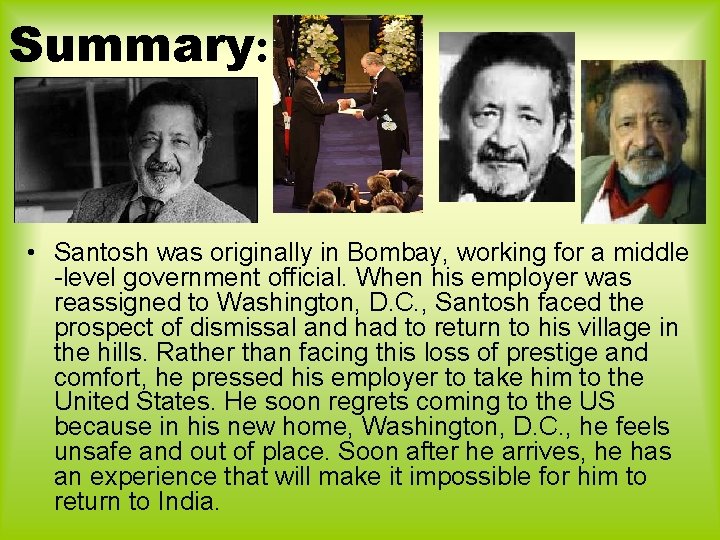
Summary: • Santosh was originally in Bombay, working for a middle -level government official. When his employer was reassigned to Washington, D. C. , Santosh faced the prospect of dismissal and had to return to his village in the hills. Rather than facing this loss of prestige and comfort, he pressed his employer to take him to the United States. He soon regrets coming to the US because in his new home, Washington, D. C. , he feels unsafe and out of place. Soon after he arrives, he has an experience that will make it impossible for him to return to India.
Summary: He becomes aware of his own identity. He loses the ability to confide in his employer. The only Americans who seem real to him are on television which is where he usually sees them; the $3. 75 he earns per week is not enough to allow for social activity. In order to get his freedom again, he decides to marry to the black woman (Hubshi maid), because in this way he gets the Green Card and becomes a legal citizen.
Symbols Imagery of prison: A. Cupboard B. Airplane: “It was bright and hot outside, cool inside. ” (p. 2724, par 2 from the bottom) “I felt I would choke in the tiny, hissing room at the back” (p. 2725, par 3 line 4) C. Apartment: “The corridor was long: doors, doors…Below that imitation sky I felt like a prisoner. ” (p. 2726, par 3 from the bottom) Santosh first intends to search from personal freedom, but he eventually imprisons himself.
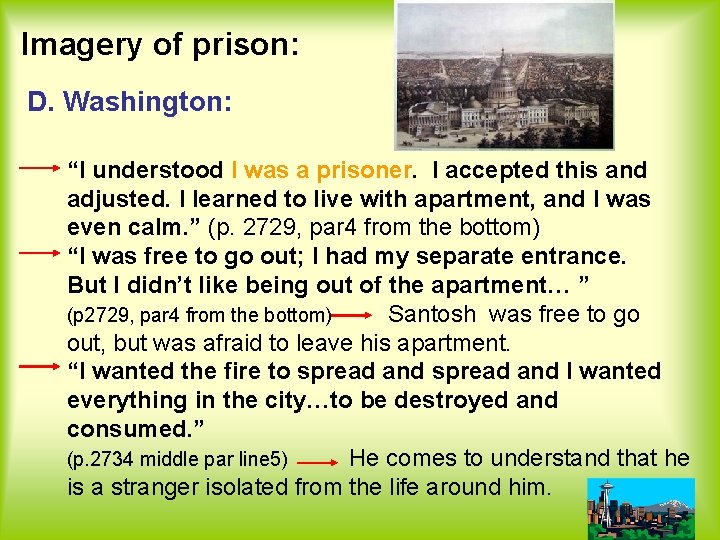
Imagery of prison: D. Washington: “I understood I was a prisoner. I accepted this and adjusted. I learned to live with apartment, and I was even calm. ” (p. 2729, par 4 from the bottom) “I was free to go out; I had my separate entrance. But I didn’t like being out of the apartment… ” (p 2729, par 4 from the bottom) Santosh was free to go out, but was afraid to leave his apartment. “I wanted the fire to spread and I wanted everything in the city…to be destroyed and consumed. ” (p. 2734 middle par line 5) He comes to understand that he is a stranger isolated from the life around him.
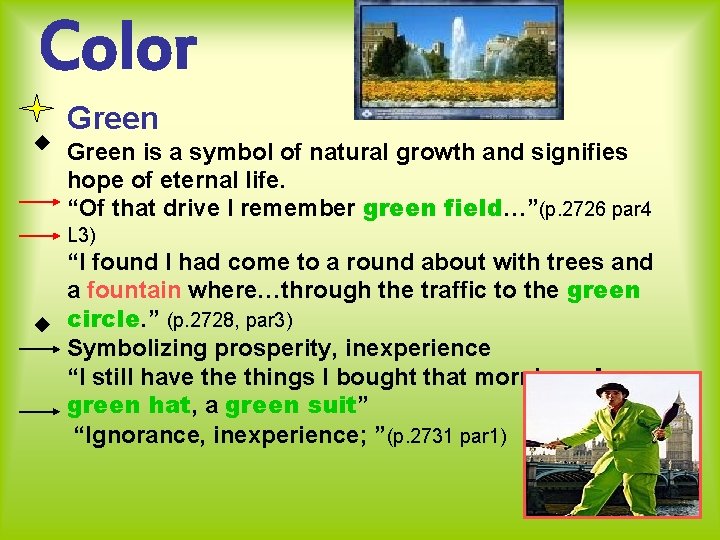
Color ◆ Green is a symbol of natural growth and signifies hope of eternal life. “Of that drive I remember green field…”(p. 2726 par 4 L 3) ◆ “I found I had come to a round about with trees and a fountain where…through the traffic to the green circle. ” (p. 2728, par 3) Symbolizing prosperity, inexperience “I still have things I bought that morning. A green hat, a green suit” “Ignorance, inexperience; ”(p. 2731 par 1)
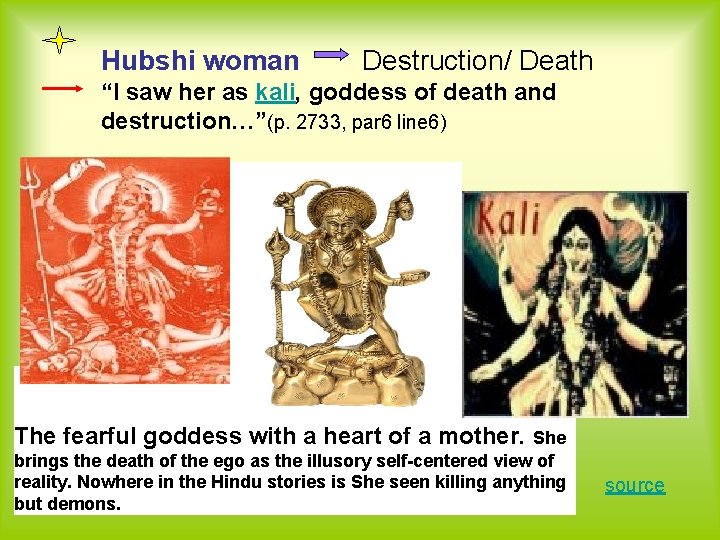
Hubshi woman Destruction/ Death “I saw her as kali, goddess of death and destruction…”(p. 2733, par 6 line 6) The fearful goddess with a heart of a mother. She brings the death of the ego as the illusory self-centered view of reality. Nowhere in the Hindu stories is She seen killing anything but demons. source
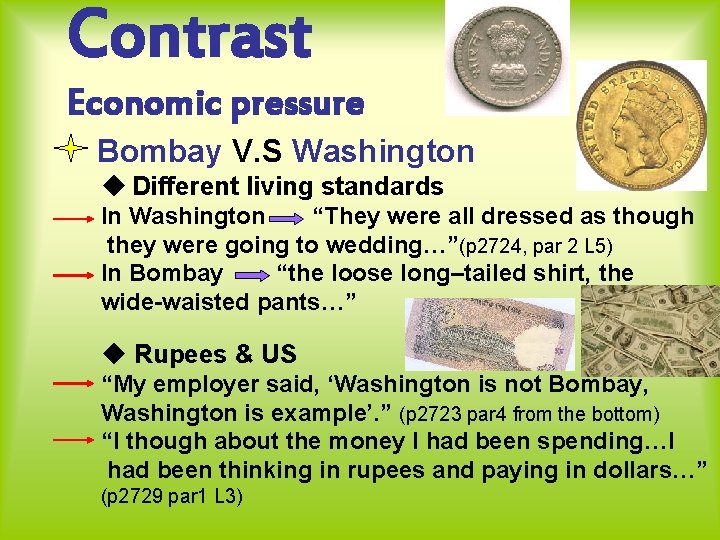
Contrast Economic pressure Bombay V. S Washington ◆ Different living standards In Washington “They were all dressed as though they were going to wedding…”(p 2724, par 2 L 5) In Bombay “the loose long–tailed shirt, the wide-waisted pants…” ◆ Rupees & US “My employer said, ‘Washington is not Bombay, Washington is example’. ” (p 2723 par 4 from the bottom) “I though about the money I had been spending…I had been thinking in rupees and paying in dollars…” (p 2729 par 1 L 3)
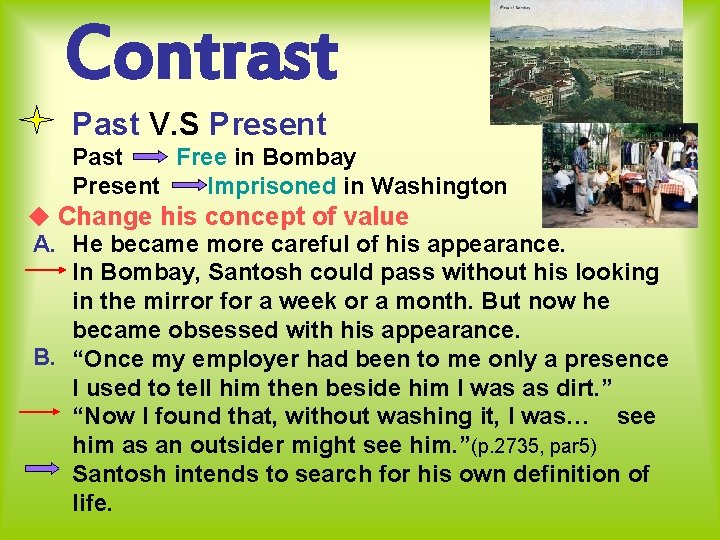
Contrast Past V. S Present Past Free in Bombay Present Imprisoned in Washington ◆ Change his concept of value A. He became more careful of his appearance. In Bombay, Santosh could pass without his looking in the mirror for a week or a month. But now he became obsessed with his appearance. B. “Once my employer had been to me only a presence I used to tell him then beside him I was as dirt. ” “Now I found that, without washing it, I was… see him as an outsider might see him. ”(p. 2735, par 5) Santosh intends to search for his own definition of life.
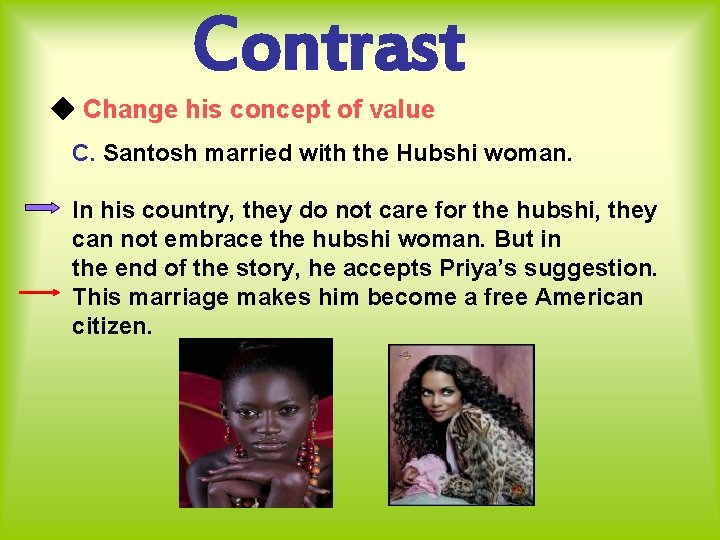
Contrast ◆ Change his concept of value C. Santosh married with the Hubshi woman. In his country, they do not care for the hubshi, they can not embrace the hubshi woman. But in the end of the story, he accepts Priya’s suggestion. This marriage makes him become a free American citizen.
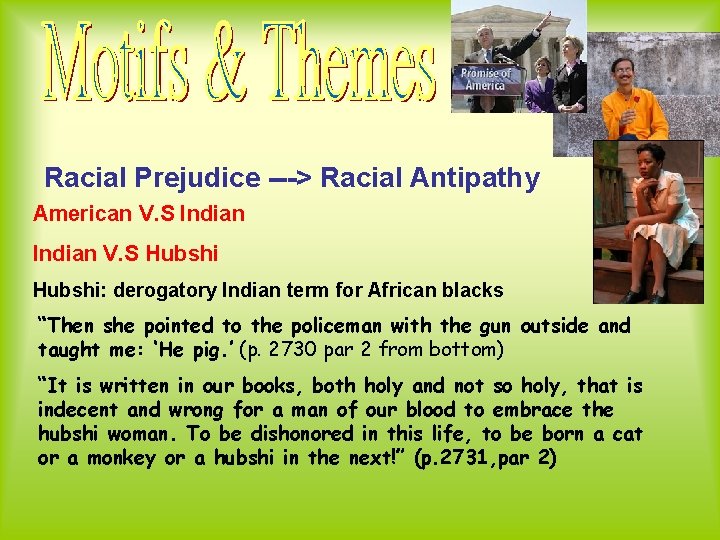
Racial Prejudice ---> Racial Antipathy American V. S Indian V. S Hubshi: derogatory Indian term for African blacks “Then she pointed to the policeman with the gun outside and taught me: ‘He pig. ’ (p. 2730 par 2 from bottom) “It is written in our books, both holy and not so holy, that is indecent and wrong for a man of our blood to embrace the hubshi woman. To be dishonored in this life, to be born a cat or a monkey or a hubshi in the next!” (p. 2731, par 2)
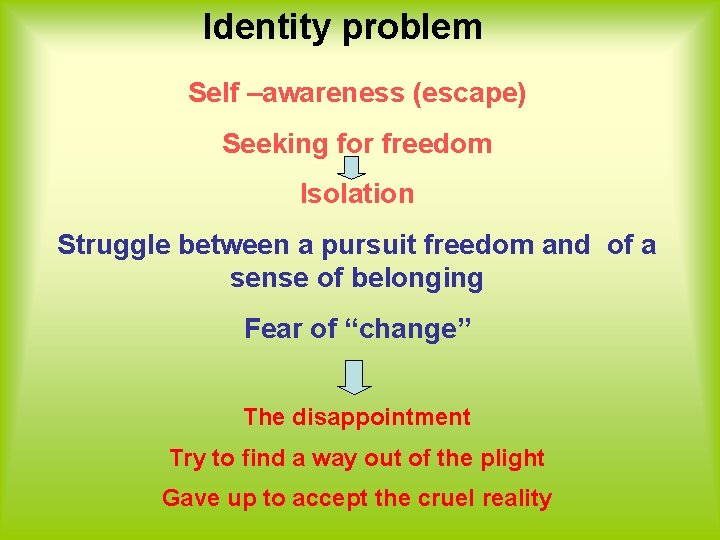
Identity problem Self –awareness (escape) Seeking for freedom Isolation Struggle between a pursuit freedom and of a sense of belonging Fear of “change” The disappointment Try to find a way out of the plight Gave up to accept the cruel reality
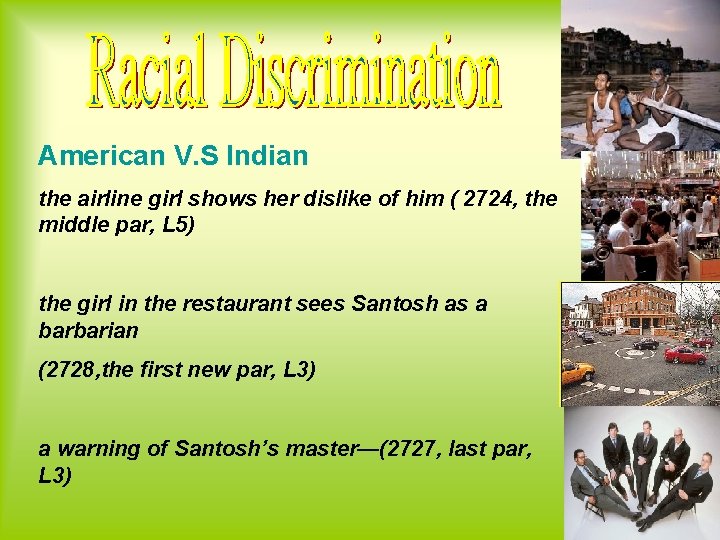
American V. S Indian the airline girl shows her dislike of him ( 2724, the middle par, L 5) the girl in the restaurant sees Santosh as a barbarian (2728, the first new par, L 3) a warning of Santosh’s master—(2727, last par, L 3)
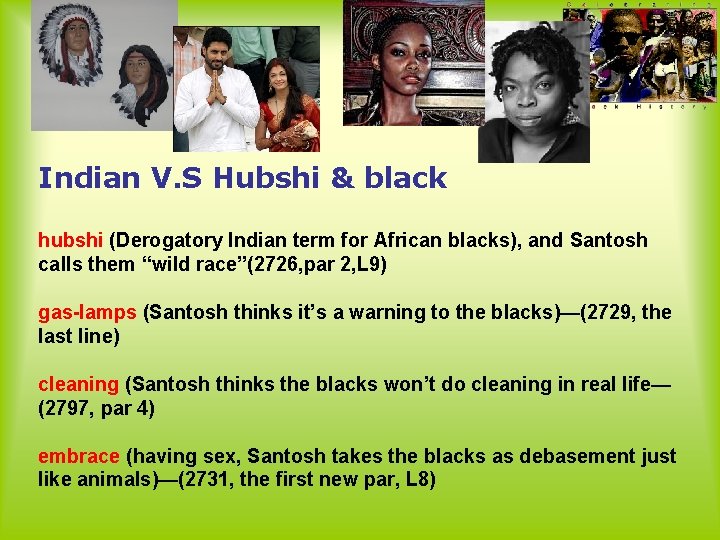
Indian V. S Hubshi & black hubshi (Derogatory Indian term for African blacks), and Santosh calls them “wild race”(2726, par 2, L 9) gas-lamps (Santosh thinks it’s a warning to the blacks)—(2729, the last line) cleaning (Santosh thinks the blacks won’t do cleaning in real life— (2797, par 4) embrace (having sex, Santosh takes the blacks as debasement just like animals)—(2731, the first new par, L 8)
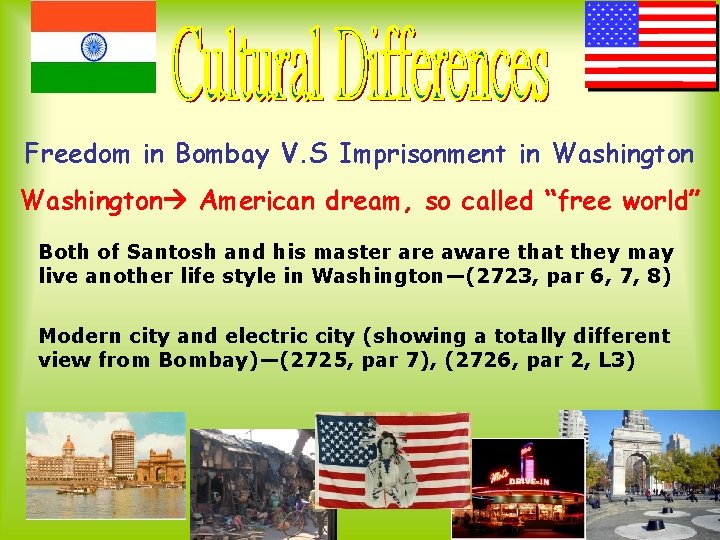
Freedom in Bombay V. S Imprisonment in Washington American dream, so called “free world” Both of Santosh and his master are aware that they may live another life style in Washington—(2723, par 6, 7, 8) Modern city and electric city (showing a totally different view from Bombay)—(2725, par 7), (2726, par 2, L 3)
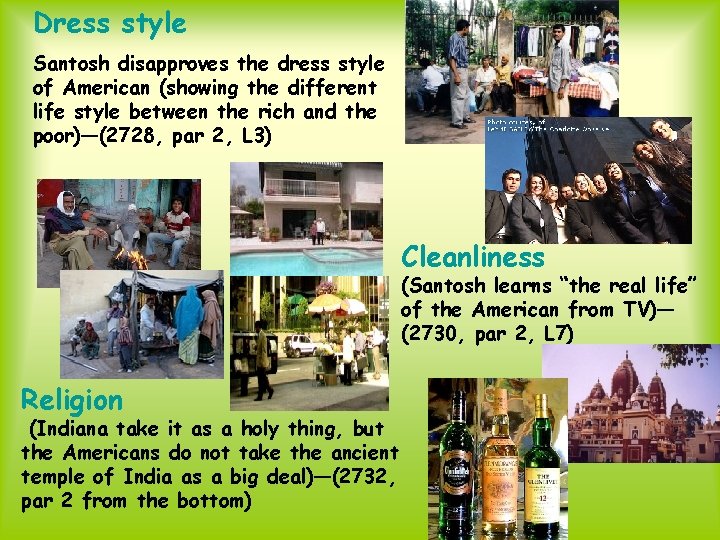
Dress style Santosh disapproves the dress style of American (showing the different life style between the rich and the poor)—(2728, par 2, L 3) Cleanliness (Santosh learns “the real life” of the American from TV)— (2730, par 2, L 7) Religion (Indiana take it as a holy thing, but the Americans do not take the ancient temple of India as a big deal)—(2732, par 2 from the bottom)
Fear → curiosity and disapproval →change→ fear → isolation Santosh starts to fit himself into American life style (language and dress)—(2731 -32) Santosh finds out that his old sickness and fears coming back after his so called “victory”—(2741, par 2 from the bottom, L 3) Santosh wants to get out of the struggle physically and mentally— 2744 (last par) Priya tries to join a different culture, but he still cannot be accepted — 2735 (last two lines)
Q&A 1. Do you think that Santosh is really free in the end of the story? We think Santosh is not really free in the end of the story. He finally loses in the western world and entrapped in a state of homelessness. Although he becomes a free and legal citizen, he loses his spiritual freedom in marrying a Hubshi woman. He has no “real home” to which he can really feel that he belongs.
Works Cited • Liu, Cecilia. Modern/Postmodern English Literature: One Out of Many. 7 May 2006 <http: //www. eng. fju. edu. tw/iacd_2003 S/c_pm_lit/oneoutmany. htm> • Naipaul, V. S. “One Out of Many. ” The Norton Anthology of English Literature. Ed. M. H. Abrams, et al. 7 th ed. Vol. 2. New York: Norton, 2000. 2722 -45. • The Nobel Prize in Literature 2001 (V. S. Naipaul). Nobelproze. org 1 May 2007 <http: //nobelprize. org/literature/laureates/2001/>. (You can view Naipaul’s biography, Nobel lecture and interview in this site. )