OMA Po C Overview and draftallensippingpocpheaders Andrew Allen

- Slides: 13
OMA Po. C Overview and draft-allen-sipping-poc-pheaders Andrew Allen: Research In Motion Tom Hiller: Lucent Technologies
Latest Public OMA Po. C Specs • http: //member. openmobilealliance. org/ftp/Public _documents/POC/Permanent_documents/OMAAD-Po. C-V 1_0 -20050308 -D. zip • http: //member. openmobilealliance. org/ftp/Public _documents/POC/Permanent_documents/OMATS-Po. C_Control. Plane-V 1_0 -20050308 -D. zip • http: //member. openmobilealliance. org/ftp/Public _documents/POC/Permanent_documents/OMATS-Po. C_User. Plane-V 1_0_16 -20050308 -D. zip
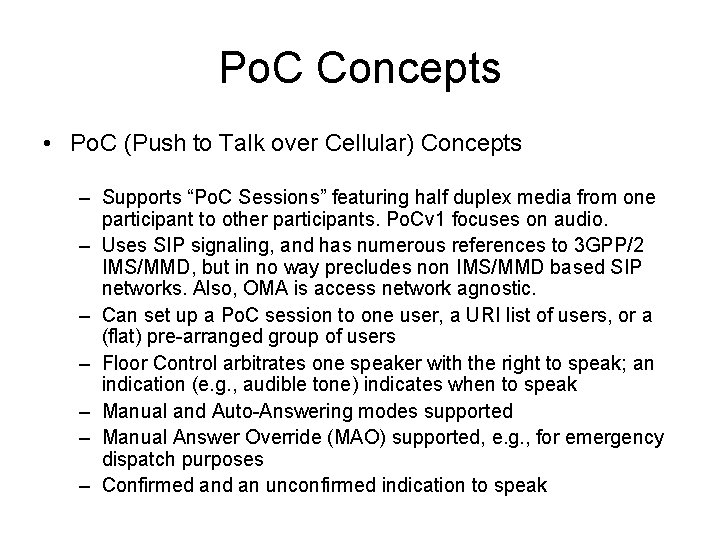
Po. C Concepts • Po. C (Push to Talk over Cellular) Concepts – Supports “Po. C Sessions” featuring half duplex media from one participant to other participants. Po. Cv 1 focuses on audio. – Uses SIP signaling, and has numerous references to 3 GPP/2 IMS/MMD, but in no way precludes non IMS/MMD based SIP networks. Also, OMA is access network agnostic. – Can set up a Po. C session to one user, a URI list of users, or a (flat) pre-arranged group of users – Floor Control arbitrates one speaker with the right to speak; an indication (e. g. , audible tone) indicates when to speak – Manual and Auto-Answering modes supported – Manual Answer Override (MAO) supported, e. g. , for emergency dispatch purposes – Confirmed an unconfirmed indication to speak
OMA Po. C Architecture
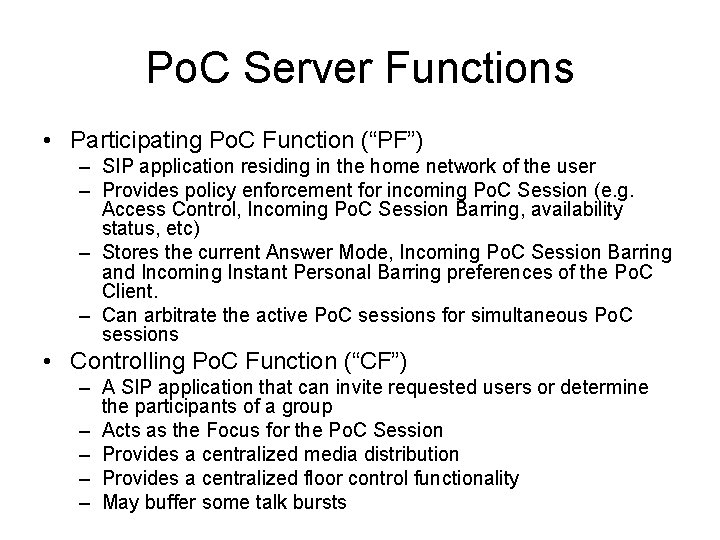
Po. C Server Functions • Participating Po. C Function (“PF”) – SIP application residing in the home network of the user – Provides policy enforcement for incoming Po. C Session (e. g. Access Control, Incoming Po. C Session Barring, availability status, etc) – Stores the current Answer Mode, Incoming Po. C Session Barring and Incoming Instant Personal Barring preferences of the Po. C Client. – Can arbitrate the active Po. C sessions for simultaneous Po. C sessions • Controlling Po. C Function (“CF”) – A SIP application that can invite requested users or determine the participants of a group – Acts as the Focus for the Po. C Session – Provides a centralized media distribution – Provides a centralized floor control functionality – May buffer some talk bursts
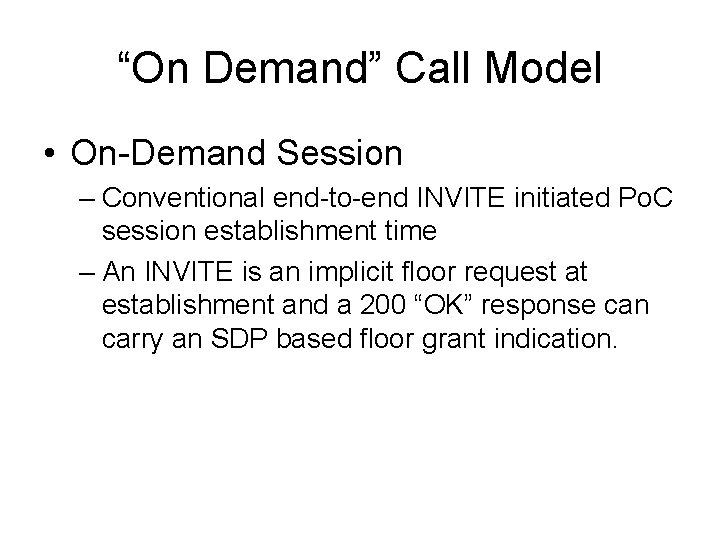
“On Demand” Call Model • On-Demand Session – Conventional end-to-end INVITE initiated Po. C session establishment time – An INVITE is an implicit floor request at establishment and a 200 “OK” response can carry an SDP based floor grant indication.
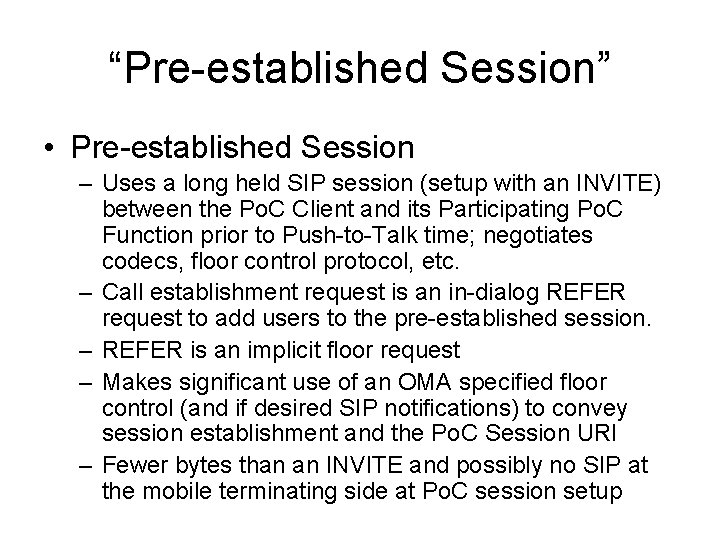
“Pre-established Session” • Pre-established Session – Uses a long held SIP session (setup with an INVITE) between the Po. C Client and its Participating Po. C Function prior to Push-to-Talk time; negotiates codecs, floor control protocol, etc. – Call establishment request is an in-dialog REFER request to add users to the pre-established session. – REFER is an implicit floor request – Makes significant use of an OMA specified floor control (and if desired SIP notifications) to convey session establishment and the Po. C Session URI – Fewer bytes than an INVITE and possibly no SIP at the mobile terminating side at Po. C session setup
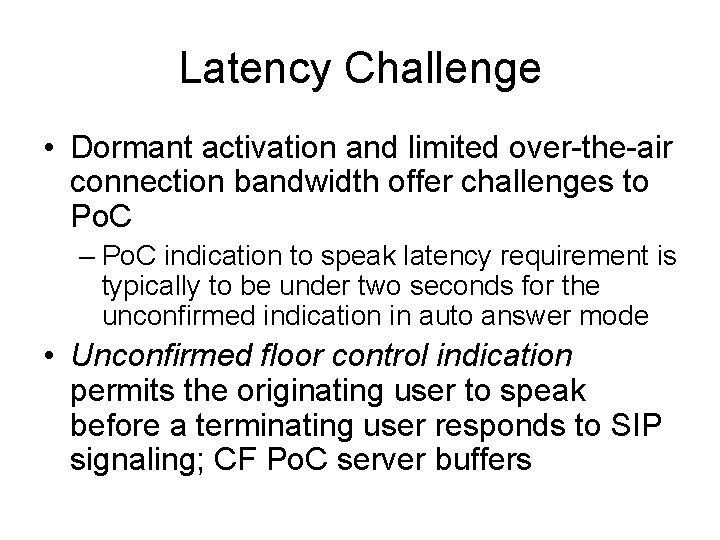
Latency Challenge • Dormant activation and limited over-the-air connection bandwidth offer challenges to Po. C – Po. C indication to speak latency requirement is typically to be under two seconds for the unconfirmed indication in auto answer mode • Unconfirmed floor control indication permits the originating user to speak before a terminating user responds to SIP signaling; CF Po. C server buffers
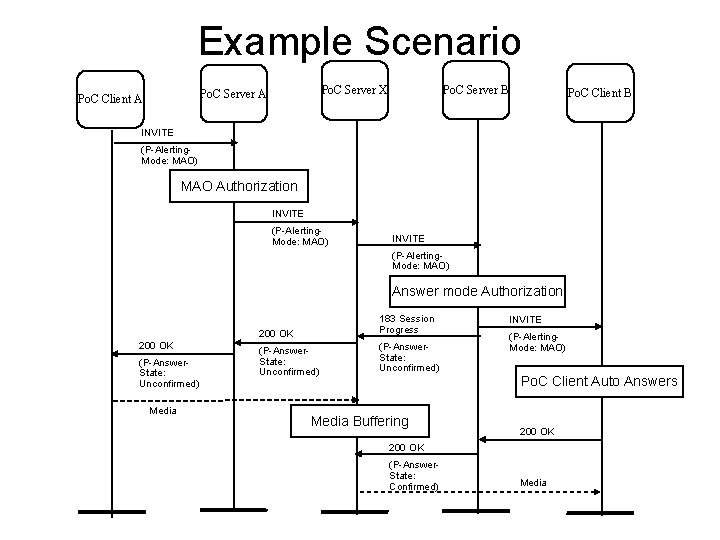
Example Scenario Po. C Server B Po. C Server X Po. C Server A Po. C Client B INVITE (P-Alerting. Mode: MAO) MAO Authorization INVITE (P-Alerting. Mode: MAO) Answer mode Authorization 200 OK (P-Answer. State: Unconfirmed) Media 200 OK 183 Session Progress (P-Answer. State: Unconfirmed) INVITE (P-Alerting. Mode: MAO) Po. C Client Auto Answers Media Buffering 200 OK (P-Answer. State: Confirmed) Media
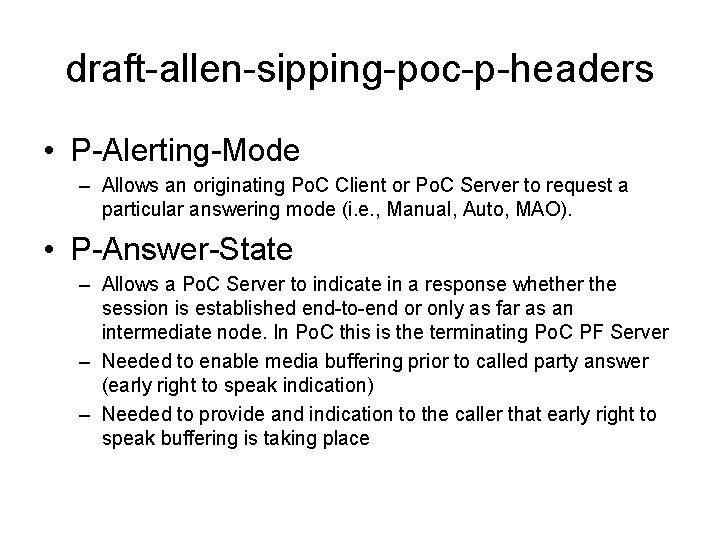
draft-allen-sipping-poc-p-headers • P-Alerting-Mode – Allows an originating Po. C Client or Po. C Server to request a particular answering mode (i. e. , Manual, Auto, MAO). • P-Answer-State – Allows a Po. C Server to indicate in a response whether the session is established end-to-end or only as far as an intermediate node. In Po. C this is the terminating Po. C PF Server – Needed to enable media buffering prior to called party answer (early right to speak indication) – Needed to provide and indication to the caller that early right to speak buffering is taking place
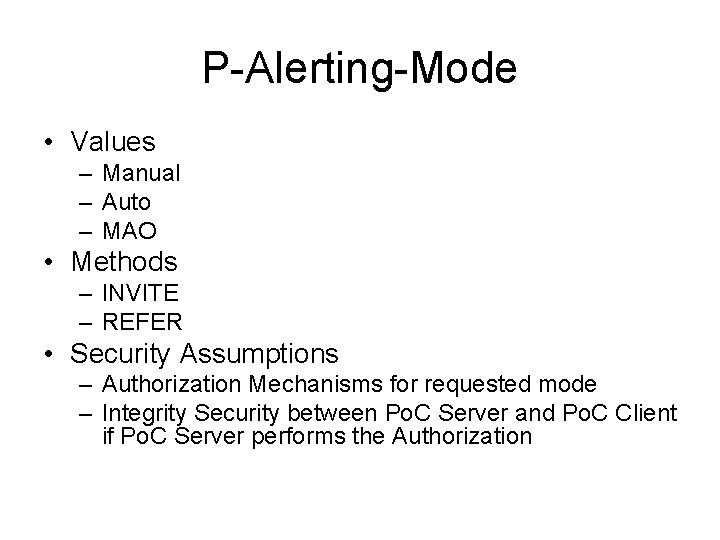
P-Alerting-Mode • Values – Manual – Auto – MAO • Methods – INVITE – REFER • Security Assumptions – Authorization Mechanisms for requested mode – Integrity Security between Po. C Server and Po. C Client if Po. C Server performs the Authorization
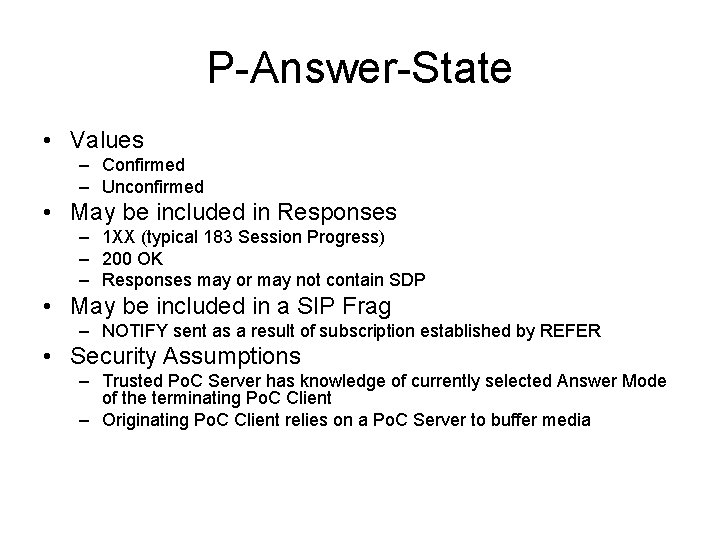
P-Answer-State • Values – Confirmed – Unconfirmed • May be included in Responses – 1 XX (typical 183 Session Progress) – 200 OK – Responses may or may not contain SDP • May be included in a SIP Frag – NOTIFY sent as a result of subscription established by REFER • Security Assumptions – Trusted Po. C Server has knowledge of currently selected Answer Mode of the terminating Po. C Client – Originating Po. C Client relies on a Po. C Server to buffer media
Thank you Questions?