NUTRITION AND OPTIMUM SPORT PERFORMANCE What you need




- Slides: 17
NUTRITION AND OPTIMUM SPORT PERFORMANCE What you need to know to: Increase energy levels, Perform better, & Recover faster. Presented by: Professor Steven P. Dion, Health and Wellness Coordinator Salem State College - Sport, Fitness and Leisure Studies Dept. Professor Dion - Nutrition and Sport Performance
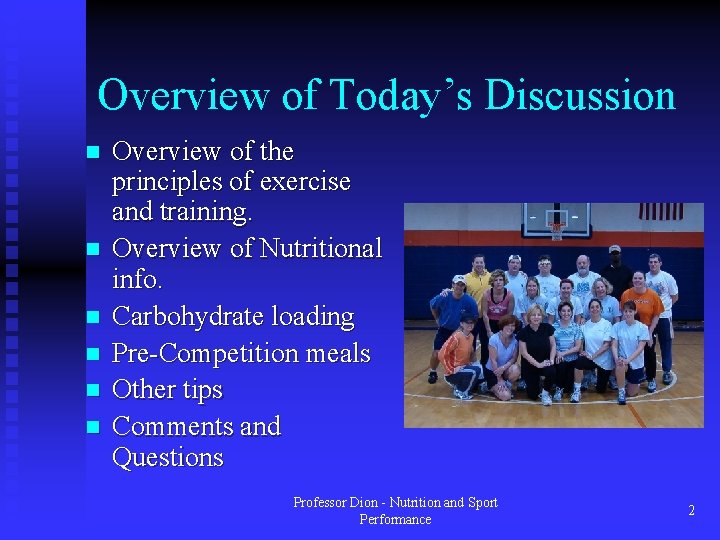
Overview of Today’s Discussion n n n Overview of the principles of exercise and training. Overview of Nutritional info. Carbohydrate loading Pre-Competition meals Other tips Comments and Questions Professor Dion - Nutrition and Sport Performance 2
Overview of the Principles of Exercise Training Overload principle: to improve, muscles must be stressed n Principle of progression: overload should be increased gradually n Specificity of exercise: training effect specific to muscles trained n Professor Dion - Nutrition and Sport Performance 3
Principles of Exercise Training n n Principle of recuperation: recovery period to adapt to stress u Overtraining u Sleep requirements – without sleep, it’s a gradual decline in performance. u Decrease psychological stress levels – high levels of Cortisol (a stress hormone) suppresses the bodies ability to grow, recover and repair Reversibility of training effects: loss of fitness due to inactivity (atrophy can begin within 6 Professor Dion - Nutrition and Sport Performance hours) 4
Nutritional Info n n Diet and Training / Overtraining How exercise intensity affects fuel use, and ultimately dietary choices. Intensity Fuel Used < 30% VO 2 max mainly fat 40 -60% VO 2 max fat and CHO equally 75% VO 2 max mainly CHO >80% VO 2 max ~100% CHO Failure to consume adequate fuel can promote fatigue and an overtraining effect. Professor Dion - Nutrition and Sport Performance 5
Nutritional Info n n Carbohydrates (60% of diet: 40+ women ? ) u critical fuel during exercise u increase % complex carbohydrates in the diet u maintain adequate calories so CHO can be stored as glycogen Protein (10 -15%) u eat a normal well-balanced diet u ~0. 8 – 1. 5 grams of protein/kg body weight u increase total food intake to provide Professor Dion - Nutrition and Sport more calories (don’t just increase protein Performance intake) 6
Nutritional Info n n n Fats/Lipids (20 -30%) u High quality, monounsaturated fats will promote better health, healthier joints and fuel for low too moderate intensity activities. Vitamins (multivitamin? ) u avoid mega-dosing – eat your fruits and veggies Antioxidants u chemicals that prevent oxygen from damaging cells u supplementing vitamins A, C, E, betacarotene, zinc, and selenium may be Professor Dion - Nutrition and Sport 7 beneficial Performance
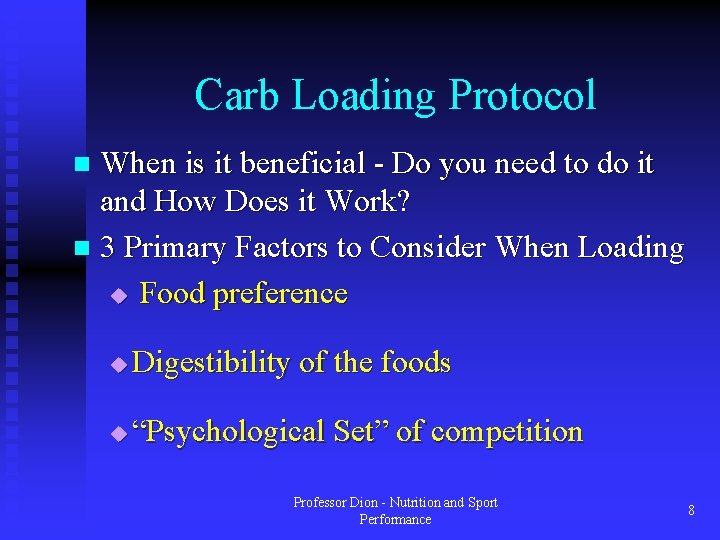
Carb Loading Protocol When is it beneficial - Do you need to do it and How Does it Work? n 3 Primary Factors to Consider When Loading u Food preference n u Digestibility of the foods u “Psychological Set” of competition Professor Dion - Nutrition and Sport Performance 8
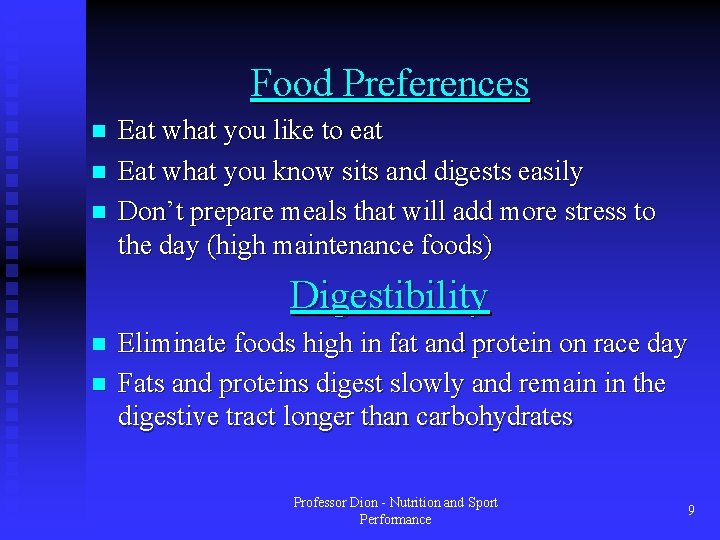
Food Preferences n n n Eat what you like to eat Eat what you know sits and digests easily Don’t prepare meals that will add more stress to the day (high maintenance foods) Digestibility n n Eliminate foods high in fat and protein on race day Fats and proteins digest slowly and remain in the digestive tract longer than carbohydrates Professor Dion - Nutrition and Sport Performance 9
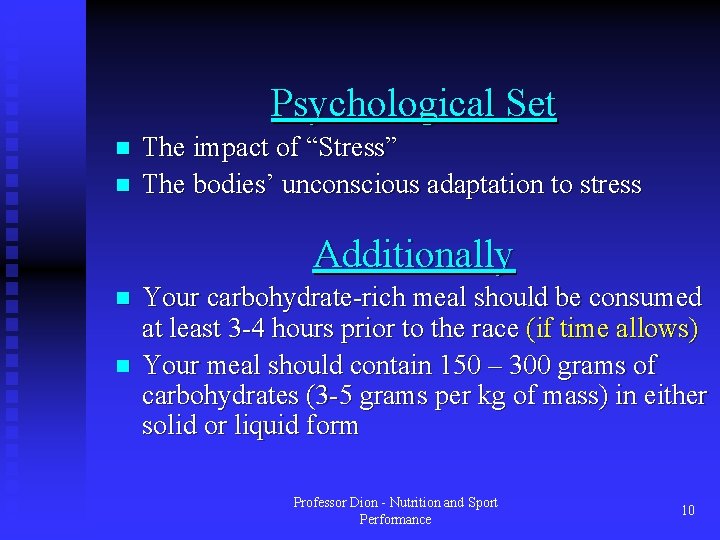
Psychological Set n n The impact of “Stress” The bodies’ unconscious adaptation to stress Additionally n n Your carbohydrate-rich meal should be consumed at least 3 -4 hours prior to the race (if time allows) Your meal should contain 150 – 300 grams of carbohydrates (3 -5 grams per kg of mass) in either solid or liquid form Professor Dion - Nutrition and Sport Performance 10
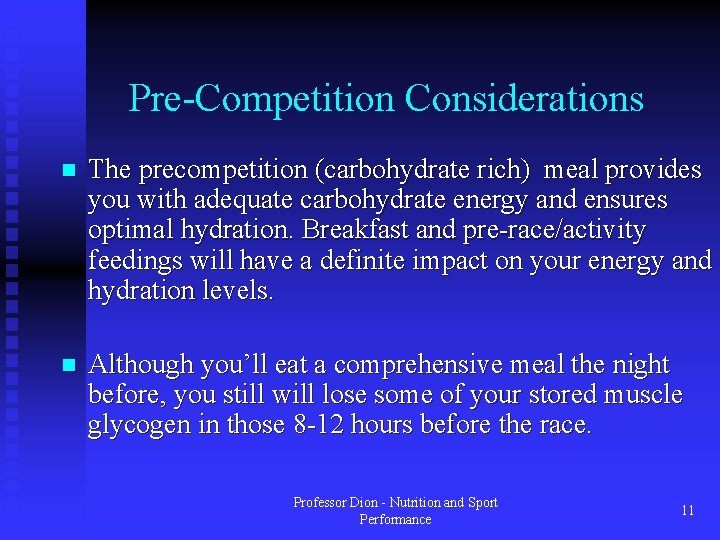
Pre-Competition Considerations n The precompetition (carbohydrate rich) meal provides you with adequate carbohydrate energy and ensures optimal hydration. Breakfast and pre-race/activity feedings will have a definite impact on your energy and hydration levels. n Although you’ll eat a comprehensive meal the night before, you still will lose some of your stored muscle glycogen in those 8 -12 hours before the race. Professor Dion - Nutrition and Sport Performance 11
Pre-Competition Considerations n n n Therefore – your breakfast and pre-race feedings will assist in the constant production of energy during the race. Without breakfast and pre-race feedings you mostly likely will be able to finish – but your level of intensity will not be as high. Possible draw backs however = Water Retention. Professor Dion - Nutrition and Sport Performance 12
Additional Info - Tips n Sport Drinks – what’s the deal and what’s the best? n Ergogenic Aids – are they worth the money? Side effects – safe or not? n Eating schedules – best times to eat. Professor Dion - Nutrition and Sport Performance 13
Sport Drinks To date, for post exercise glucose restoring, Coke Cola has not been surpassed. A quick handful of some candy can also be beneficial. u After 1 hour of aerobic activity 55% of your glycogen stores are empty and after 2 hours they are just about empty. n Most sport drinks will be beneficial during activities lasting 90 minutes or more. u Otherwise – just drink water during the activity. n Professor Dion - Nutrition and Sport Performance 14
Ergogenic Aids n n There has been no concrete scientific evidence on most Ergogenic aids, except caffeine and carbohydrates. Anecdotal evidence has led me to believe that Creatine has benefited people with muscle development, strength and decrease of lactic acid impact. Protein shakes and powders have drawbacks as well as some benefits – depends on your usage & dosage. Various metabolism boosters should not be used without consulting a knowledgeable physician or pharmacist – heart arrhythmias etc… Professor Dion - Nutrition and Sport Performance 15
Eating Schedule n n n When do you have your biggest meal? u If we could design our lives around our eating habits – it would be best to eat dinner in the morning and breakfast in the evening. (say what? ) Good idea to maintain an constant eating pattern all day long to assist in blood sugar regulation. Eating at night can/may disturb your sleeping habits, and ability to achieve REM. u However, foods with tryptophan, can assist in falling asleep faster (meats/animal products) Professor Dion - Nutrition and Sport Performance 16
Questions and Comments Thank You for coming & Thank Brandi and Deb for having me here Professor Dion - Nutrition and Sport Performance