NOVEL ENERGY CURED MERCAPTO FUNCTIONAL SILICON Q RESIN













- Slides: 40
NOVEL ENERGY CURED MERCAPTO FUNCTIONAL SILICON Q RESIN MATERIALS FOR 3 D PRINTING Bob, Ruckle; Tom-Seung, Cheung; John Grande; & Yanjun Luo Siltech Corporation Toronto, ON Canada Robert@siltech. com, Tom@siltech. com
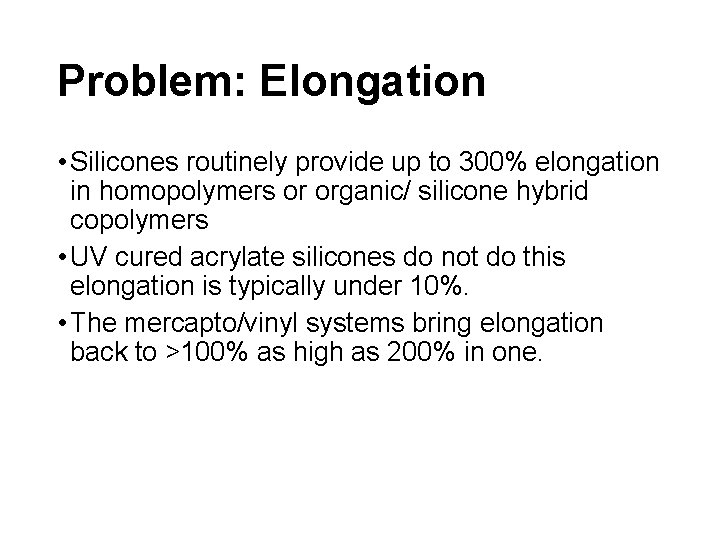
Problem: Elongation • Silicones routinely provide up to 300% elongation in homopolymers or organic/ silicone hybrid copolymers • UV cured acrylate silicones do not do this elongation is typically under 10%. • The mercapto/vinyl systems bring elongation back to >100% as high as 200% in one.
Epoxy Silicone System Linears X=400 (20 -34%) X=10 (10 -35%) 8 250 5 -11% MHHPA AMI-1 110°C, 4 hours 350 10%Di 10 15%Di 10 300 20%Di 10 250 30%Di 10 35%Di 10 200 X-linker (8%) 150 100 50 0 Tensile St. (k. Pa)*10 Elongation (%) Shore A*0. 1 G' (k. Pa)
Silicone/ Organic Epoxy Hybrid System 1 8 3 450 0% Silicone 25% 30% 35% 40% 45% 50% 400 8 350 0 -50% 300 32 -53% D. E. R. 671 -X 75 17 -23% MHHPA 1% AMI-1 0. 2% reactive defoamer 110°C, 4 hours 200 250 100 50 0 Tensile x 100 (k. Pa) Elongation (%) Total Energy x 10 (m. J) Shore D
Silicone/ Organic UV Cured Epoxy Hybrid System 1 32 0 -50% 50 -100 % UVACURE 1500 UV 9380 UV light, RT 500 450 5 400 350 300 18 250 200 6 150 100 50 0 0% Silicone 10% 20% 30% 40% 50% Tensile x 100 Elongation x Total Energy (k. Pa) 0. 1 (%) (m. J/mm) Shore D Hardness
Polymers from Condensation Reactions n R 2 = hydroxyalkyl silicone x The flexible silicone is in the backbone elongation is high n
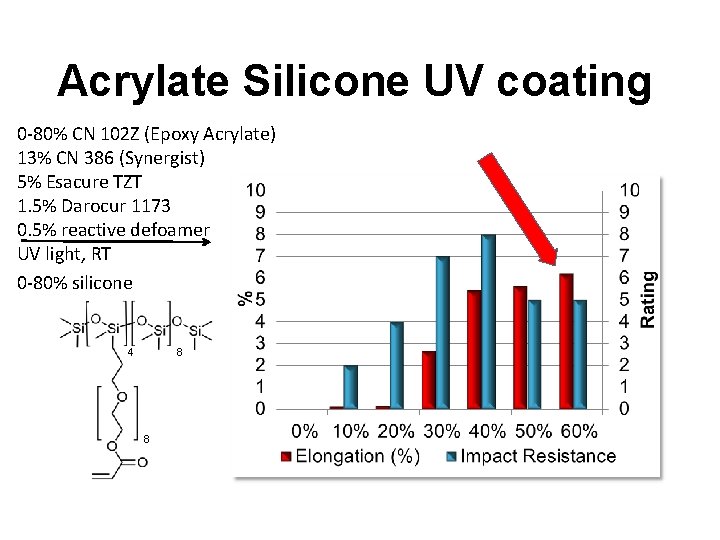
Acrylate Silicone UV coating 0 -80% CN 102 Z (Epoxy Acrylate) 13% CN 386 (Synergist) 5% Esacure TZT 1. 5% Darocur 1173 0. 5% reactive defoamer UV light, RT 0 -80% silicone 4 8 8
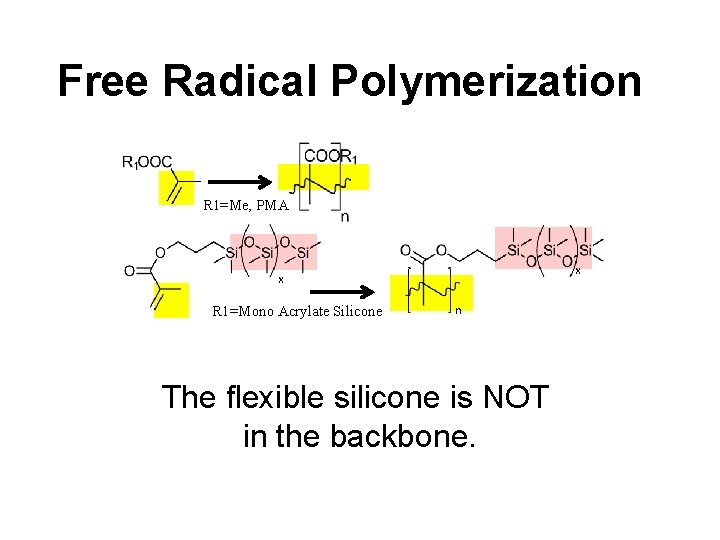
Free Radical Polymerization R 1=Me, PMA x x R 1=Mono Acrylate Silicone n The flexible silicone is NOT in the backbone.
Polymers from Thiol Ene Reaction R 1=organic x R 1=Silicone x x x R 1=Silicone R 2=MQT Resin x The flexible silicone is in the backbone. x
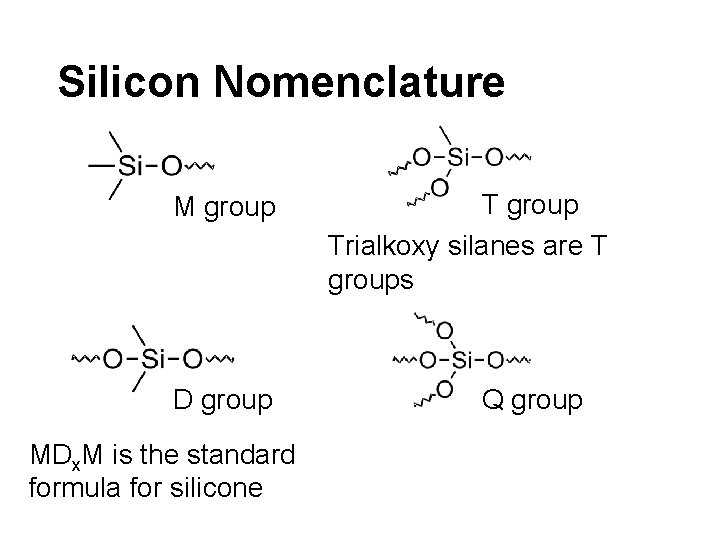
Silicon Nomenclature M group D group MDx. M is the standard formula for silicone T group Trialkoxy silanes are T groups Q group
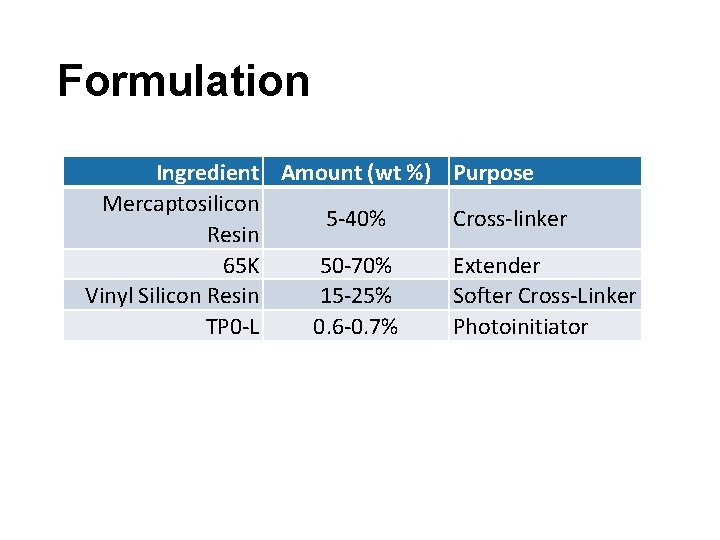
Formulation Ingredient Amount (wt %) Purpose Mercaptosilicon 5 -40% Cross-linker Resin 65 K 50 -70% Extender Vinyl Silicon Resin 15 -25% Softer Cross-Linker TP 0 -L 0. 6 -0. 7% Photoinitiator
MQT(SH) Silicon Resins x y z
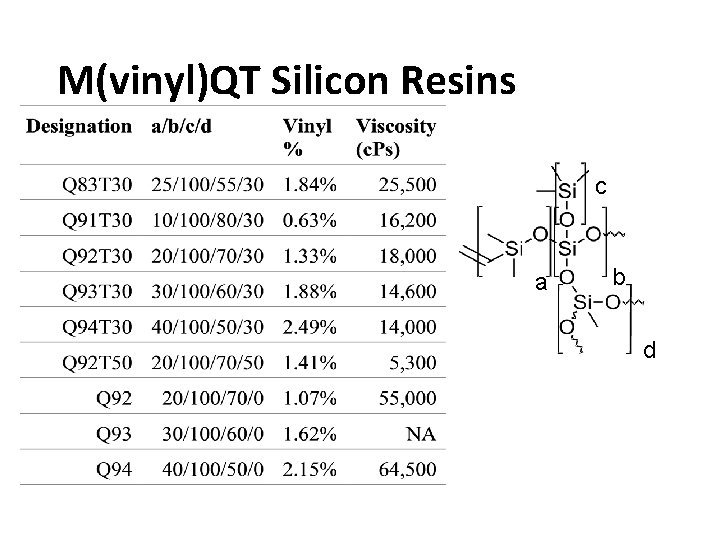
M(vinyl)QT Silicon Resins c a b d
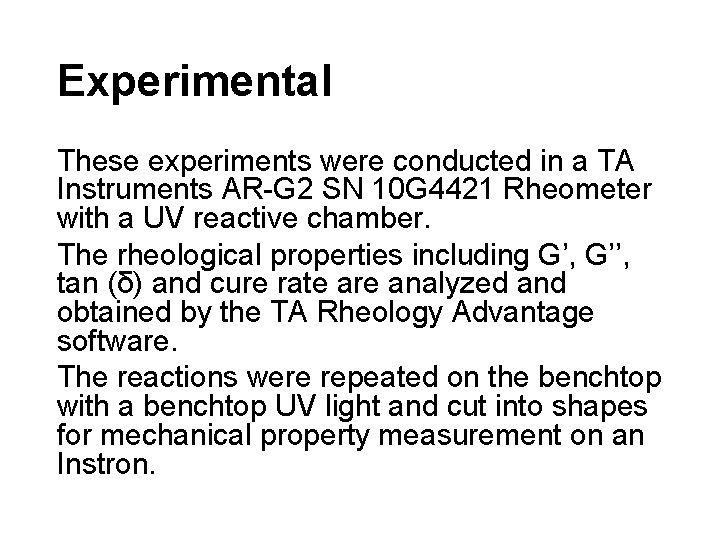
Experimental These experiments were conducted in a TA Instruments AR-G 2 SN 10 G 4421 Rheometer with a UV reactive chamber. The rheological properties including G’, G’’, tan (δ) and cure rate are analyzed and obtained by the TA Rheology Advantage software. The reactions were repeated on the benchtop with a benchtop UV light and cut into shapes for mechanical property measurement on an Instron.
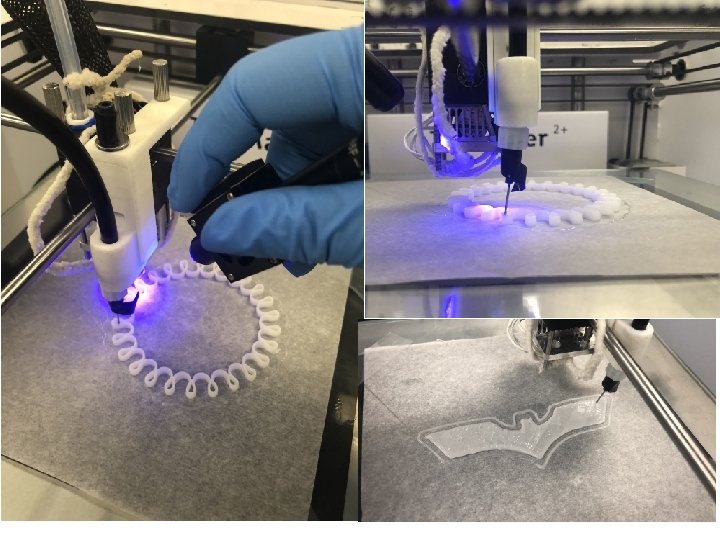
3 D Printing We used an Ulti. Maker 2+ FMD from Sturctra 3 D for 3 D printing of the SH formulations due to the relatively high viscosity. This is a thermal cured printer so we attached a UV lamp to the print head to effect UV curing or held the light by hand.
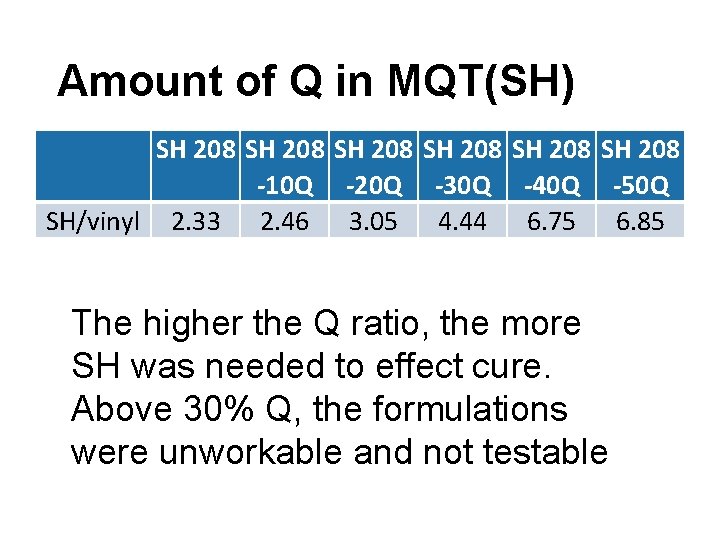
SH/Vinyl Ratio SH 208 SH/vinyl 2. 33 SH 20810 Q 2. 46 SH 20820 Q 3. 05 We determined the optimum SH/Vinyl ratio for each Q/T ratio SH 20830 Q 4. 44 x SH 20840 Q 6. 75 y SH 20850 Q 6. 85 z
Example SH 208 (0 Q)
Amount of Q in MQT(SH) SH 208 SH 208 -10 Q -20 Q -30 Q -40 Q -50 Q SH/vinyl 2. 33 2. 46 3. 05 4. 44 6. 75 6. 85 The higher the Q ratio, the more SH was needed to effect cure. Above 30% Q, the formulations were unworkable and not testable
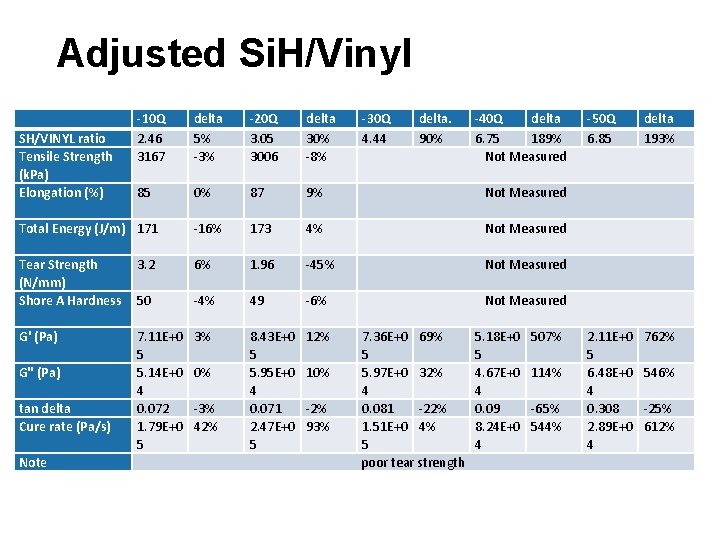
Adjusted Si. H/Vinyl SH/VINYL ratio Tensile Strength (k. Pa) Elongation (%) -10 Q 2. 46 3167 delta 5% -3% -20 Q 3. 05 3006 delta 30% -8% 85 0% 87 9% -30 Q 4. 44 delta. 90% -40 Q delta 6. 75 189% Not Measured -50 Q 6. 85 delta 193% 2. 11 E+0 5 6. 48 E+0 4 0. 308 2. 89 E+0 4 762% Total Energy (J/m) 171 -16% 173 4% Not Measured Tear Strength (N/mm) Shore A Hardness G' (Pa) G" (Pa) tan delta Cure rate (Pa/s) Note 3. 2 6% 1. 96 -45% Not Measured 50 7. 11 E+0 5 5. 14 E+0 4 0. 072 1. 79 E+0 5 -4% 3% 0% -3% 42% 49 8. 43 E+0 5 5. 95 E+0 4 0. 071 2. 47 E+0 5 -6% 12% 10% -2% 93% Not Measured 7. 36 E+0 69% 5 5. 97 E+0 32% 4 0. 081 -22% 1. 51 E+0 4% 5 poor tear strength 5. 18 E+0 5 4. 67 E+0 4 0. 09 8. 24 E+0 4 507% 114% -65% 544% 546% -25% 612%
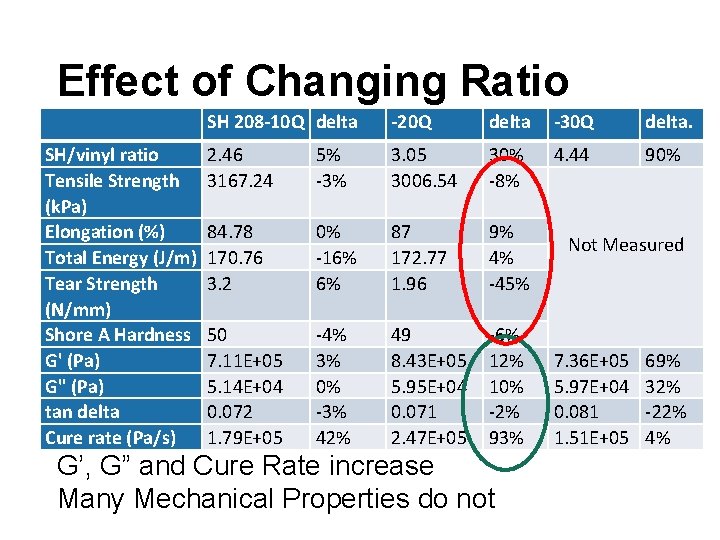
Effect of Changing Ratio SH 208 -10 Q delta -20 Q delta -30 Q delta. SH/vinyl ratio Tensile Strength (k. Pa) Elongation (%) Total Energy (J/m) Tear Strength (N/mm) Shore A Hardness G' (Pa) G" (Pa) tan delta Cure rate (Pa/s) 2. 46 3167. 24 5% -3% 3. 05 3006. 54 30% -8% 4. 44 90% 84. 78 170. 76 3. 2 0% -16% 6% 87 172. 77 1. 96 9% 4% -45% 50 7. 11 E+05 5. 14 E+04 0. 072 1. 79 E+05 -4% 3% 0% -3% 42% 49 8. 43 E+05 5. 95 E+04 0. 071 2. 47 E+05 -6% 12% 10% -2% 93% G’, G” and Cure Rate increase Many Mechanical Properties do not Not Measured 7. 36 E+05 5. 97 E+04 0. 081 1. 51 E+05 69% 32% -22% 4%
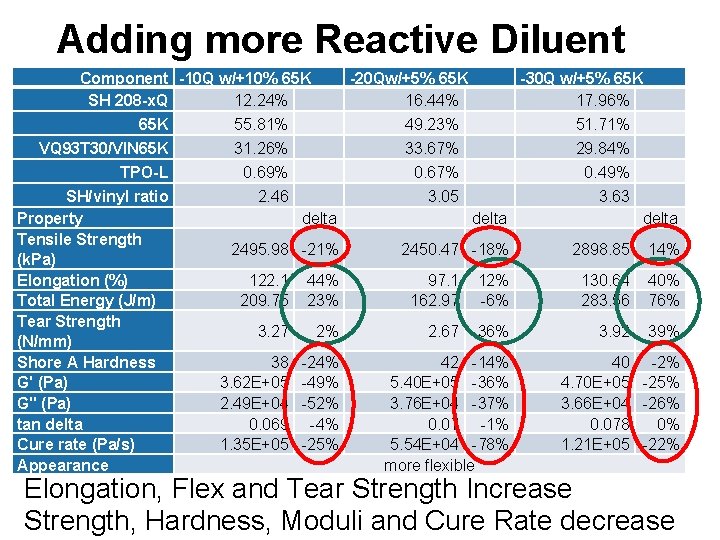
Adding more Reactive Diluent Component -10 Q w/+10% 65 K SH 208 -x. Q 12. 24% 65 K 55. 81% VQ 93 T 30/VIN 65 K TPO-L SH/vinyl ratio Property Tensile Strength (k. Pa) Elongation (%) Total Energy (J/m) Tear Strength (N/mm) Shore A Hardness G' (Pa) G" (Pa) tan delta Cure rate (Pa/s) Appearance -20 Qw/+5% 65 K 16. 44% 49. 23% -30 Q w/+5% 65 K 17. 96% 51. 71% 31. 26% 0. 69% 2. 46 delta 33. 67% 0. 67% 3. 05 delta 29. 84% 0. 49% 3. 63 delta 2495. 98 -21% 2450. 47 -18% 2898. 85 14% 122. 1 209. 75 44% 23% 97. 1 162. 97 12% -6% 130. 64 283. 56 40% 76% 3. 27 2% 2. 67 36% 3. 92 39% 38 3. 62 E+05 2. 49 E+04 0. 069 1. 35 E+05 -24% -49% -52% -4% -25% 42 -14% 5. 40 E+05 -36% 3. 76 E+04 -37% 0. 07 -1% 5. 54 E+04 -78% more flexible 40 -2% 4. 70 E+05 -25% 3. 66 E+04 -26% 0. 078 0% 1. 21 E+05 -22% Elongation, Flex and Tear Strength Increase Strength, Hardness, Moduli and Cure Rate decrease
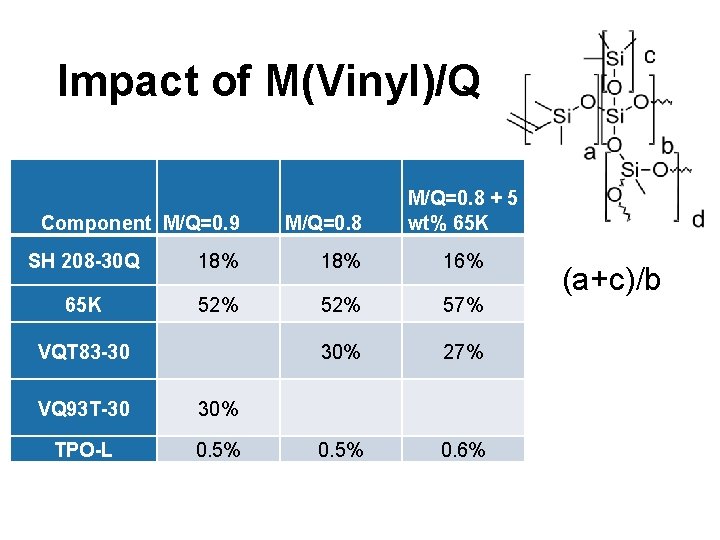
Impact of M(Vinyl)/Q Component M/Q=0. 9 M/Q=0. 8 + 5 wt% 65 K SH 208 -30 Q 18% 16% 65 K 52% 57% 30% 27% 0. 5% 0. 6% VQT 83 -30 VQ 93 T-30 30% TPO-L 0. 5% (a+c)/b
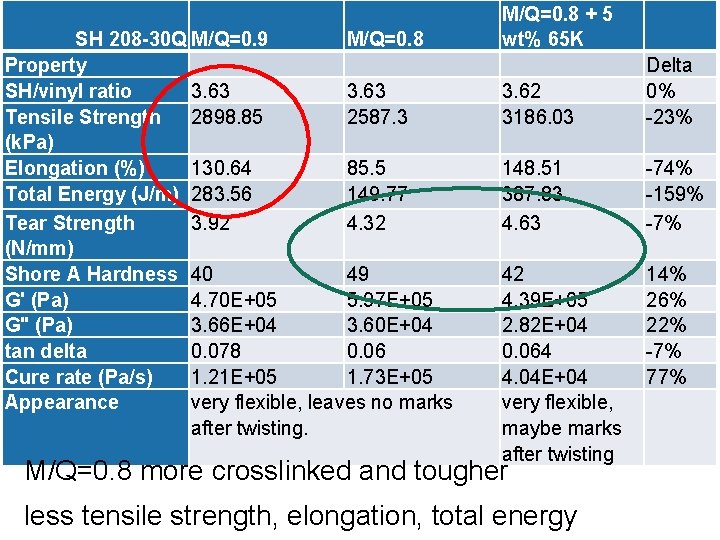
SH 208 -30 Q M/Q=0. 9 M/Q=0. 8 Property SH/vinyl ratio 3. 63 Tensile Strength 2898. 85 2587. 3 (k. Pa) Elongation (%) 130. 64 85. 5 Total Energy (J/m) 283. 56 149. 77 Tear Strength 3. 92 4. 32 (N/mm) Shore A Hardness 40 49 G' (Pa) 4. 70 E+05 5. 97 E+05 G" (Pa) 3. 66 E+04 3. 60 E+04 tan delta 0. 078 0. 06 Cure rate (Pa/s) 1. 21 E+05 1. 73 E+05 Appearance very flexible, leaves no marks after twisting. M/Q=0. 8 + 5 wt% 65 K 3. 62 3186. 03 Delta 0% -23% 148. 51 387. 83 4. 63 -74% -159% -7% 42 4. 39 E+05 2. 82 E+04 0. 064 4. 04 E+04 very flexible, maybe marks after twisting 14% 26% 22% -7% 77% M/Q=0. 8 more crosslinked and tougher less tensile strength, elongation, total energy
Impact of Diluent Vinyl Content Component 0. 060% vinyl SH 208 -30 Q 20. 8% 65 K (0. 060% vinyl) 42. 6% 65 K (0. 078% vinyl) VQT 83 -30/65 K 35. 9% TPO-L 0. 6% x 0. 078% vinyl 21. 0% 42. 5% 35. 9% 0. 6%
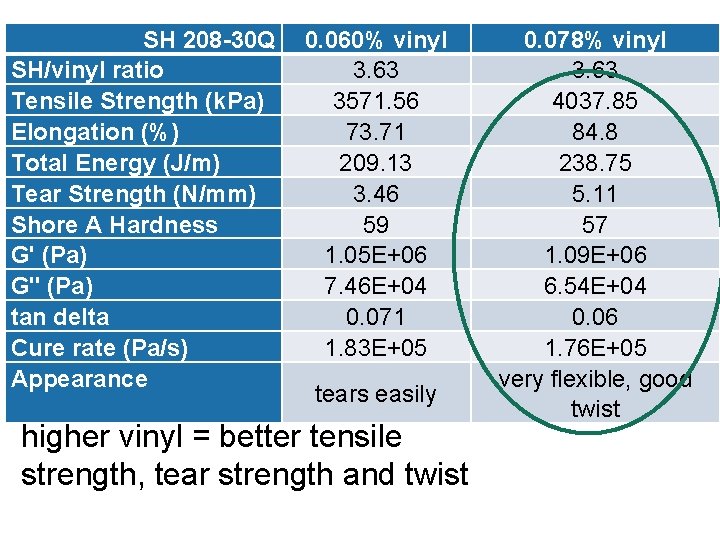
SH 208 -30 Q SH/vinyl ratio Tensile Strength (k. Pa) Elongation (%) Total Energy (J/m) Tear Strength (N/mm) Shore A Hardness G' (Pa) G" (Pa) tan delta Cure rate (Pa/s) Appearance 0. 060% vinyl 3. 63 3571. 56 73. 71 209. 13 3. 46 59 1. 05 E+06 7. 46 E+04 0. 071 1. 83 E+05 tears easily higher vinyl = better tensile strength, tear strength and twist 0. 078% vinyl 3. 63 4037. 85 84. 8 238. 75 5. 11 57 1. 09 E+06 6. 54 E+04 0. 06 1. 76 E+05 very flexible, good twist
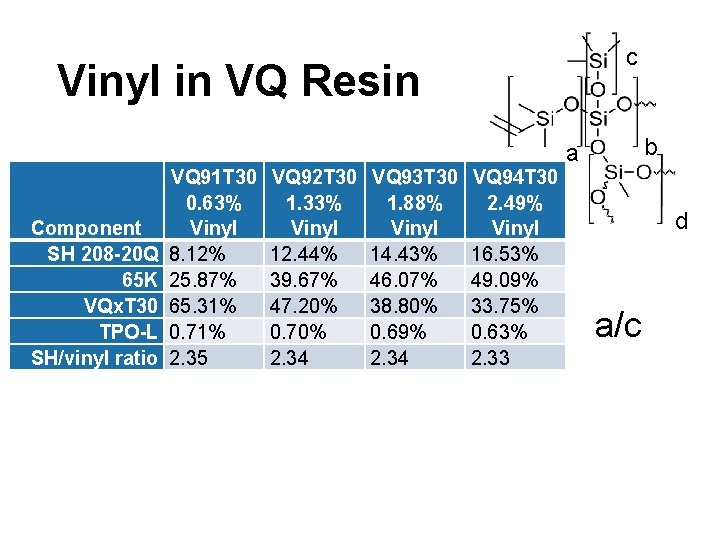
c Vinyl in VQ Resin Component SH 208 -20 Q 65 K VQx. T 30 TPO-L SH/vinyl ratio VQ 91 T 30 0. 63% Vinyl 8. 12% 25. 87% 65. 31% 0. 71% 2. 35 VQ 92 T 30 1. 33% Vinyl 12. 44% 39. 67% 47. 20% 0. 70% 2. 34 VQ 93 T 30 1. 88% Vinyl 14. 43% 46. 07% 38. 80% 0. 69% 2. 34 VQ 94 T 30 2. 49% Vinyl 16. 53% 49. 09% 33. 75% 0. 63% 2. 33 b a d a/c
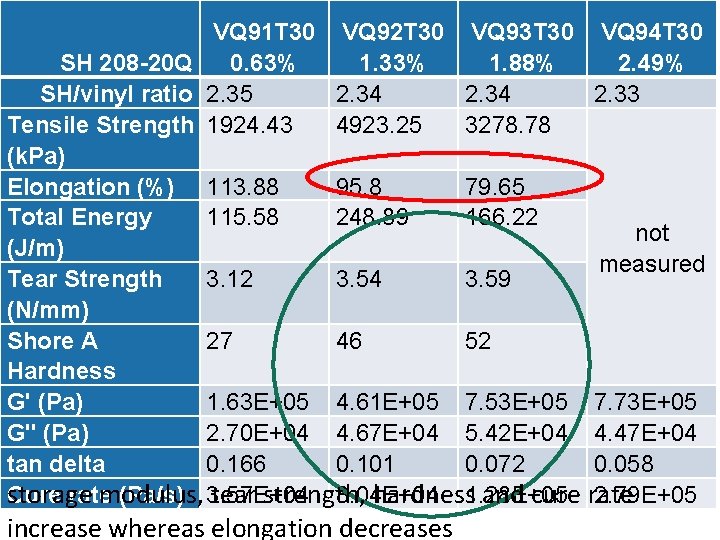
VQ 91 T 30 VQ 92 T 30 VQ 93 T 30 VQ 94 T 30 SH 208 -20 Q 0. 63% 1. 33% 1. 88% 2. 49% SH/vinyl ratio 2. 35 2. 34 2. 33 Tensile Strength 1924. 43 4923. 25 3278. 78 (k. Pa) Elongation (%) 113. 88 95. 8 79. 65 Total Energy 115. 58 248. 89 166. 22 not (J/m) measured Tear Strength 3. 12 3. 54 3. 59 (N/mm) Shore A 27 46 52 Hardness G' (Pa) 1. 63 E+05 4. 61 E+05 7. 53 E+05 7. 73 E+05 G" (Pa) 2. 70 E+04 4. 67 E+04 5. 42 E+04 4. 47 E+04 tan delta 0. 166 0. 101 0. 072 0. 058 Cure rate (Pa/s) 3. 57 E+04 8. 04 E+04 1. 28 E+05 2. 79 E+05 storage modulus, tear strength, hardness and cure rate Vinyl in VQ Resin increase whereas elongation decreases
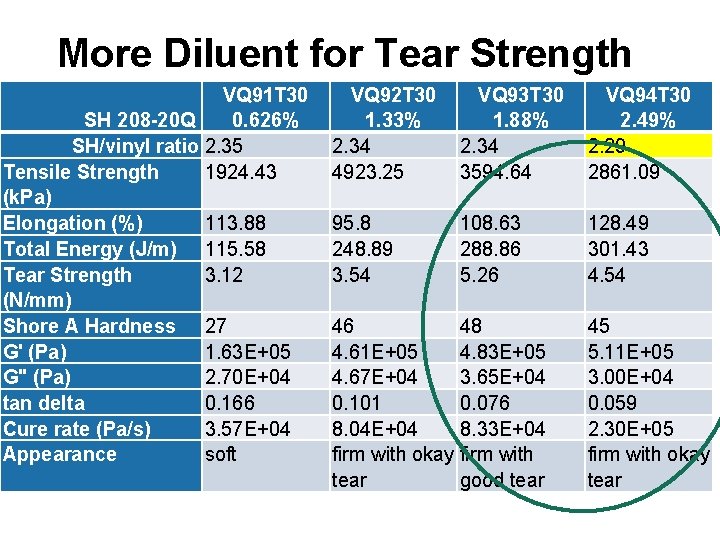
More Diluent for Tear Strength VQ 91 T 30 SH 208 -20 Q 0. 626% SH/vinyl ratio 2. 35 Tensile Strength 1924. 43 (k. Pa) Elongation (%) 113. 88 Total Energy (J/m) 115. 58 Tear Strength 3. 12 (N/mm) Shore A Hardness 27 G' (Pa) 1. 63 E+05 G" (Pa) 2. 70 E+04 tan delta 0. 166 Cure rate (Pa/s) 3. 57 E+04 Appearance soft VQ 92 T 30 VQ 93 T 30 VQ 94 T 30 1. 33% 1. 88% 2. 49% 2. 34 2. 29 4923. 25 3594. 64 2861. 09 95. 8 248. 89 3. 54 108. 63 288. 86 5. 26 46 48 4. 61 E+05 4. 83 E+05 4. 67 E+04 3. 65 E+04 0. 101 0. 076 8. 04 E+04 8. 33 E+04 firm with okay firm with tear good tear 128. 49 301. 43 4. 54 45 5. 11 E+05 3. 00 E+04 0. 059 2. 30 E+05 firm with okay tear
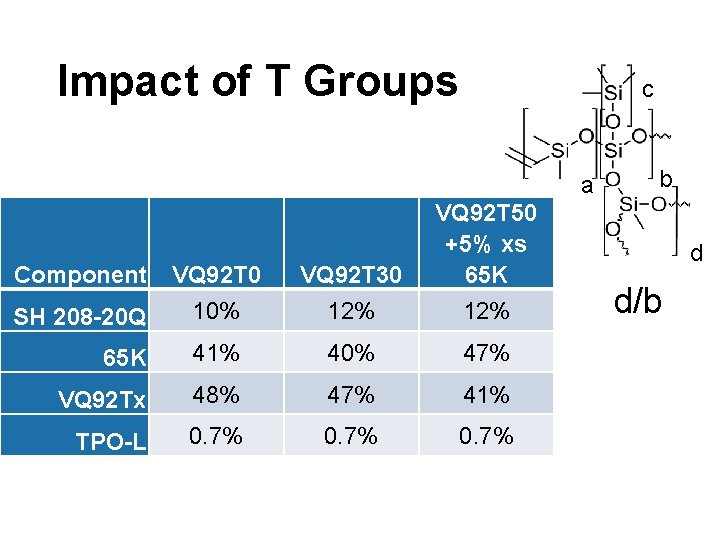
Impact of T Groups c a Component VQ 92 T 0 VQ 92 T 30 VQ 92 T 50 +5% xs 65 K SH 208 -20 Q 10% 12% 65 K 41% 40% 47% VQ 92 Tx 48% 47% 41% TPO-L 0. 7% b d d/b
SH 208 -20 Q SH/vinyl ratio Tensile Strength (k. Pa) Elongation (%) Total Energy (J/m) Tear Strength (N/mm) Shore A Hardness G' (Pa) G" (Pa) tan delta Cure rate (Pa/s) Appearance VQ 92 T 0 2. 32 VQ 92 T 30 2. 34 VQ 92 T 30 +5% xs 65 K 2. 32 VQ 92 T 50 +5% xs 65 K 2. 33 5524. 11 4923. 25 4293. 6 2816. 47 87 95. 8 111. 49 105. 43 284. 75 248. 89 288. 53 163. 51 4. 9 3. 54 3. 46 3. 17 58 46 44 31 9. 14 E+05 7. 28 E+04 0. 08 4. 61 E+05 4. 67 E+04 0. 101 4. 25 E+05 3. 56 E+04 0. 084 2. 22 E+05 1. 68 E+04 0. 076 3. 19 E+05 8. 04 E+04 1. 06 E+05 5. 27 E+04 Firm, can be Tough. Can twisted without Break after Soft, break be twisted. break twisting upon twisting T groups lowers mechanical and rheological properties
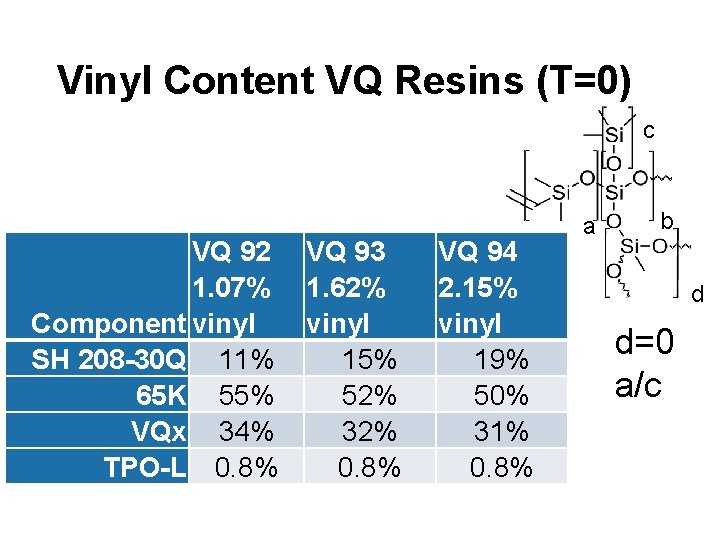
Vinyl Content VQ Resins (T=0) c VQ 92 VQ 93 1. 07% 1. 62% Component vinyl SH 208 -30 Q 11% 15% 65 K 55% 52% VQx 34% 32% TPO-L 0. 8% VQ 94 2. 15% vinyl 19% 50% 31% 0. 8% a b d d=0 a/c
SH 208 -30 Q VQ 92 (1. 07%) SH/vinyl ratio 3. 21 Tensile Strength 3957. 38 (k. Pa) Elongation (%) 156. 51 Total Energy 550. 25 (J/m) Tear Strength 6. 95 (N/mm) Shore A 44 Hardness G' (Pa) 4. 71 E+05 G" (Pa) 3. 47 E+04 tan delta 0. 074 Cure rate (Pa/s) 1. 21 E+05 Appearance Very tough flexible, white VQ 93 (1. 62%) VQ 94 (2. 15%) 3. 23 3. 21 1642. 08 2907. 32 Vinyl Content VQ Resins (T=0) 65. 09 79. 41 75. 2 185. 8 3. 8 4. 84 50 56 7. 20 E+05 4. 35 E+04 0. 06 1. 70 E+05 1. 26 E+06 6. 90 E+04 0. 055 1. 84 E+05 breaks upon twisting
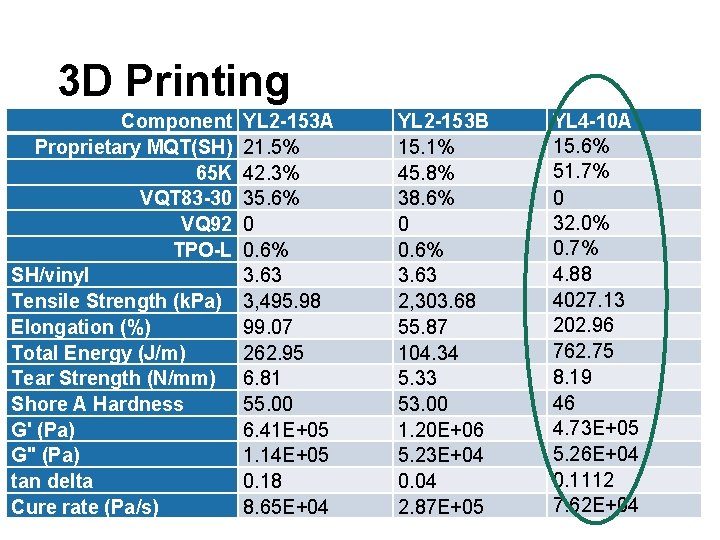
3 D Printing Component Proprietary MQT(SH) 65 K VQT 83 -30 VQ 92 TPO-L SH/vinyl Tensile Strength (k. Pa) Elongation (%) Total Energy (J/m) Tear Strength (N/mm) Shore A Hardness G' (Pa) G" (Pa) tan delta Cure rate (Pa/s) YL 2 -153 A 21. 5% 42. 3% 35. 6% 0 0. 6% 3. 63 3, 495. 98 99. 07 262. 95 6. 81 55. 00 6. 41 E+05 1. 14 E+05 0. 18 8. 65 E+04 YL 2 -153 B 15. 1% 45. 8% 38. 6% 0 0. 6% 3. 63 2, 303. 68 55. 87 104. 34 5. 33 53. 00 1. 20 E+06 5. 23 E+04 0. 04 2. 87 E+05 YL 4 -10 A 15. 6% 51. 7% 0 32. 0% 0. 7% 4. 88 4027. 13 202. 96 762. 75 8. 19 46 4. 73 E+05 5. 26 E+04 0. 1112 7. 62 E+04
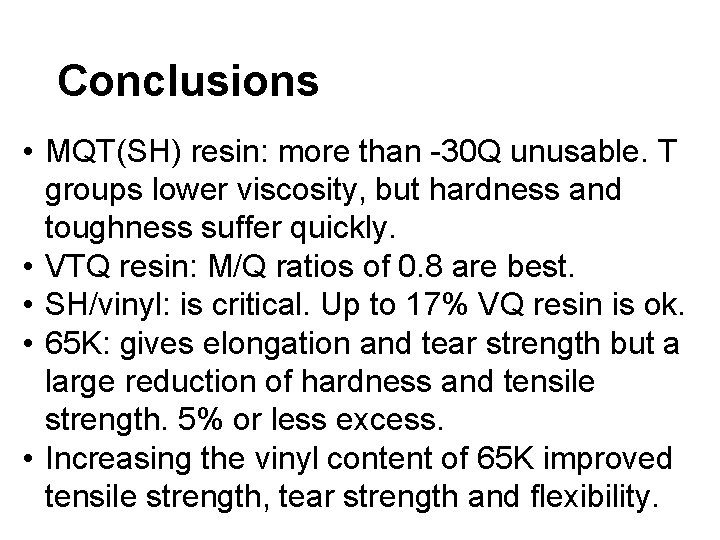
Conclusions • MQT(SH) resin: more than -30 Q unusable. T groups lower viscosity, but hardness and toughness suffer quickly. • VTQ resin: M/Q ratios of 0. 8 are best. • SH/vinyl: is critical. Up to 17% VQ resin is ok. • 65 K: gives elongation and tear strength but a large reduction of hardness and tensile strength. 5% or less excess. • Increasing the vinyl content of 65 K improved tensile strength, tear strength and flexibility.
Conclusions • We developed formulations which were: • up to 200% elongation • Shore A hardness of 59 • Tear Strength of 8 • Further optimization of this work into a commercial product will be guided by the conclusions on this report and customer’s needs.
Than k You