Nizhni Novgorod State University Faculty of Computational Mathematics



- Slides: 14
Nizhni Novgorod State University Faculty of Computational Mathematics and Cybernetics Information Technologies Laboratory Parallel Implementation of the Probabilistic Network Library (PNL) Labutina A. Software department
Project Goals • Implement a general purpose toolbox for working with probabilistic network models • Open source project placed on the Web-site Source. Forge to provide easy access for research and contributions 2
Project Team • Development: – Intel Russia Research Center • Victor Eruhimov Igor Chikalov, Anton Pegushin, Maria Lyashko, Alexander Brusin, Denis Lagno, Vasily Tarasov, Sergey Molinov – University of Nizhni Novgorod • Sergey Belov, Victor Gergel, Alexander Sysoev, Olga Abrosimova, Anna Labutina, Andrei Senin, Roman Vinogradov, Alexander Gergel, Elena Chernyshova, Alexey Bader, Sergey Sidorov • Management: Gary Bradski, Denver Dash, Intel Santa Clara, Microprocessor Research Lab • Validation and Developmment – Intel China Research Center – Intel Architecture Laboratory • Consultant: Kevin Murphy, MIT AI lab 3
PNL Functionality • Probabilistic Networks – – – Bayesian Networks (BNet) Dynamic Bayesian Networks (DBN) Markov Random Fields (MRF) Limited Memory Influence Diagrams (LIMID) Diagnostics Networks • Probabilistic Distributions – Discrete (tabular) • Dense representation • Sparse representation (hash) – Multivariate Gaussian, Conditional Multivariate Gaussian – Decision tree – Softmax (including sigmoid distribution) 4
Inference and Decision Making • Exact and Approximate Inference Engines – – – – Naïve Bayesian inference engine Junction tree inference engine Loopy believe propagation Gibbs sampling 1. 5 junction tree (DBN) BK inference Variational approximation • Decision Making – Single policy updating (LIMID) – Value of information (diagnostic networks) 5
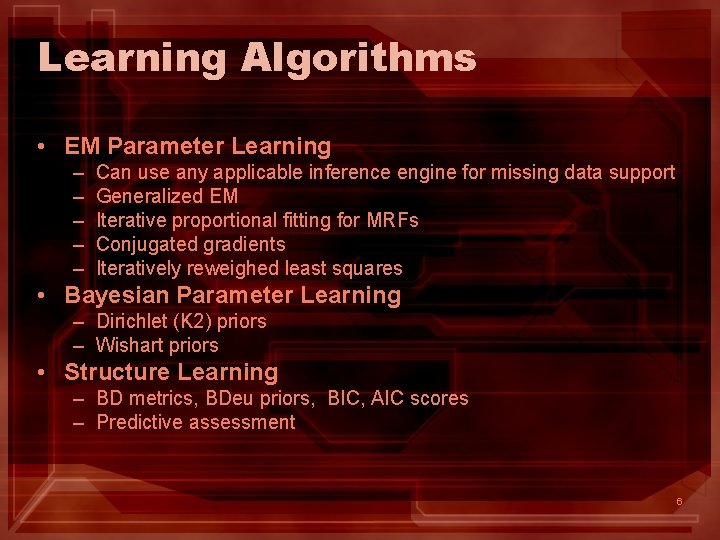
Learning Algorithms • EM Parameter Learning – – – Can use any applicable inference engine for missing data support Generalized EM Iterative proportional fitting for MRFs Conjugated gradients Iteratively reweighed least squares • Bayesian Parameter Learning – Dirichlet (K 2) priors – Wishart priors • Structure Learning – BD metrics, BDeu priors, BIC, AIC scores – Predictive assessment 6
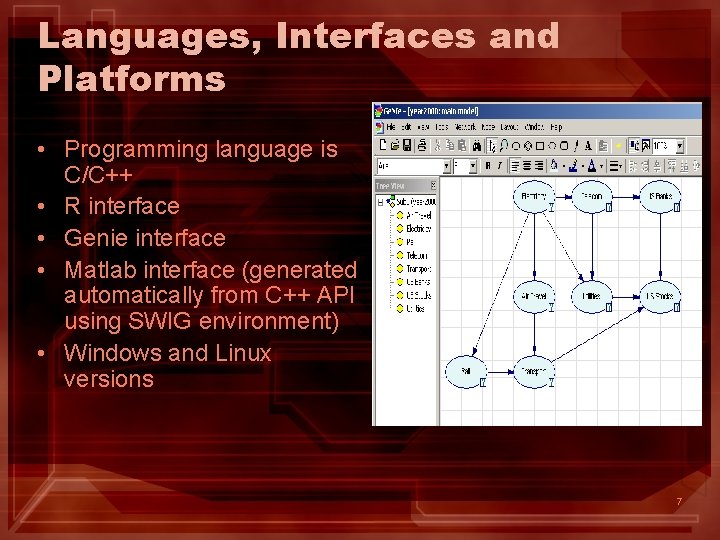
Languages, Interfaces and Platforms • Programming language is C/C++ • R interface • Genie interface • Matlab interface (generated automatically from C++ API using SWIG environment) • Windows and Linux versions 7
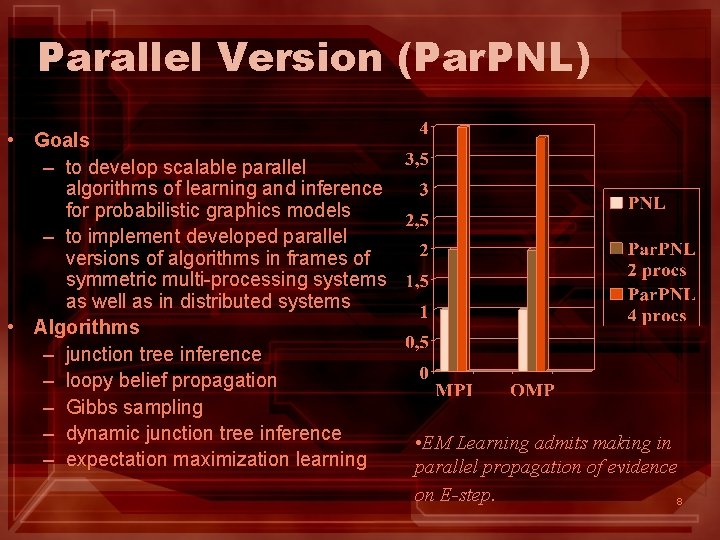
Parallel Version (Par. PNL) • Goals – to develop scalable parallel algorithms of learning and inference for probabilistic graphics models – to implement developed parallel versions of algorithms in frames of symmetric multi-processing systems as well as in distributed systems • Algorithms – junction tree inference – loopy belief propagation – Gibbs sampling – dynamic junction tree inference – expectation maximization learning • EM Learning admits making in parallel propagation of evidence on E-step. 8
PNL High Level API PNL example PNL High example const int num. Of. Nds = 4; int num. Of. Nbrs[num. Of. Nds] = { 2, 2, 2, 2 }; int nbrs 0[] = { 1, 2 }; Bayes. Net net; int nbrs 1[] = { 0, 3 }; net. Add. Node(discrete^"Cloudy Sprinkler Rain Wet. Grass", "true false"); int nbrs 2[] = { 0, 3 }; net. Add. Arc("Cloudy", "Sprinkler Rain"); int nbrs 3[] = { 1, 2 }; net. Add. Arc("Sprinkler Rain", "Wet. Grass"); int *nbrs[] = { nbrs 0, nbrs 1, nbrs 2, nbrs 3 }; ENeighbor. Type nbrs. Types 0[] = { nt. Child, nt. Child }; ENeighbor. Type nbrs. Types 1[] = { nt. Parent, nt. Child }; net. Set. PTabular("Cloudy^true Cloudy^false", "0. 6 0. 4"); net. Set. PTabular("Sprinkler^true Sprinkler^false", "0. 1 0. 9", "Cloudy^true"); ENeighbor. Type nbrs. Types 2[] = { nt. Parent, nt. Child }; net. Set. PTabular("Sprinkler^true Sprinkler^false", "0. 5", "Cloudy^false"); ENeighbor. Type nbrs. Types 3[] = { nt. Parent, nt. Parent }; net. Set. PTabular("Wet. Grass^true Wet. Grass^false", "0. 99 0. 01", "Rain^true Sprinkler^true "); ENeighbor. Type *nbrs. Types[] = { nbrs. Types 0, nbrs. Types 1, nbrs. Types 2, nbrs. Types 3 }; net. Set. PTabular("Wet. Grass^true Wet. Grass^false", "0. 9 0. 1", "Sprinkler^true Rain^false"); p. Graph = CGraph: : Create( num. Of. Nds, num. Of. Nbrs, nbrs. Types ); net. Set. PTabular("Wet. Grass^true Wet. Grass^false", "0. 9 0. 1", "Sprinkler^false Rain^true"); node. Type. Vector node. Types; net. Set. PTabular("Wet. Grass^true Wet. Grass^false", "0. 0 1. 0", "Sprinkler^false Rain^false"); CNode. Type nt(1, 2); net. Set. PTabular("Rain^true Rain^false", "0. 3 0. 7", "Cloudy^true"); node. Types. push_back(nt); net. Set. PTabular("Rain^true Rain^false", "0. 5", "Cloudy^false"); int. Vector node. Association; node. Association. assign(num. Of. Nds, 0); CBNet* p. BNet = CBNet: : Create( num. Of. Nds, node. Types, node. Association, p. Graph ); p. BNet->Alloc. Factors(); float table 0[] = { 0. 5 f, 0. 5 f }; float table 1[] = { 0. 5 f, 0. 9 f, 0. 1 f }; float table 2[] = { 0. 8 f, 0. 2 f, 0. 8 f }; float table 3[] = { 1. 0 f, 0. 1 f, 0. 9 f, 0. 01 f, 0. 99 f }; float* table[] = { table 0, table 1, table 2, table 3 }; for( int i = 0; i < num. Of. Nds; ++i ) { p. BNet->Alloc. Factor(i); CFactor* p. Factor = p. BNet->Get. Factor(i); p. Factor->Alloc. Matrix( table[i], mat. Table ); } 9
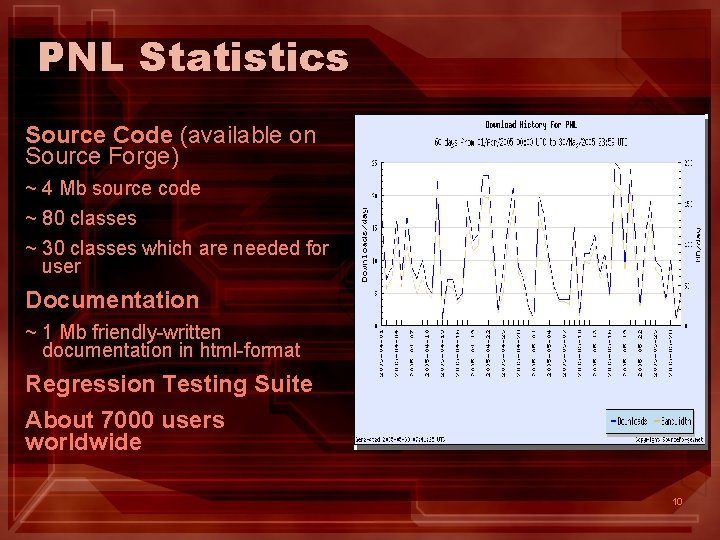
PNL Statistics Source Code (available on Source Forge) ~ 4 Mb source code ~ 80 classes ~ 30 classes which are needed for user Documentation ~ 1 Mb friendly-written documentation in html-format Regression Testing Suite About 7000 users worldwide 10
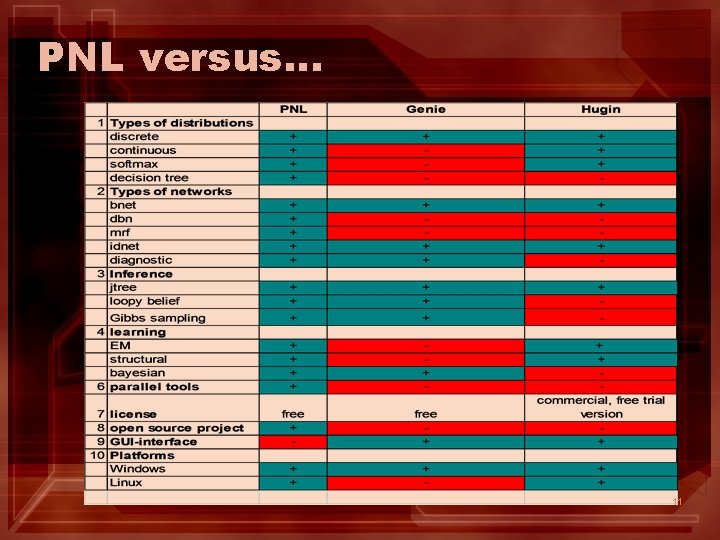
PNL versus… 11
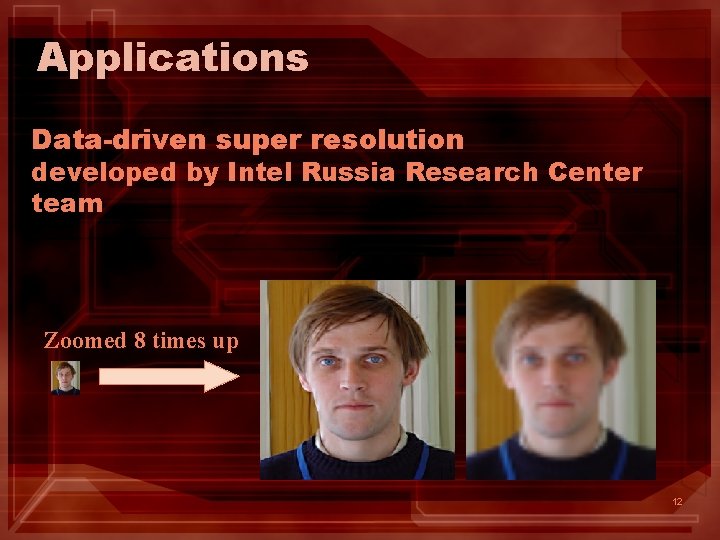
Applications Data-driven super resolution developed by Intel Russia Research Center team Zoomed 8 times up 12
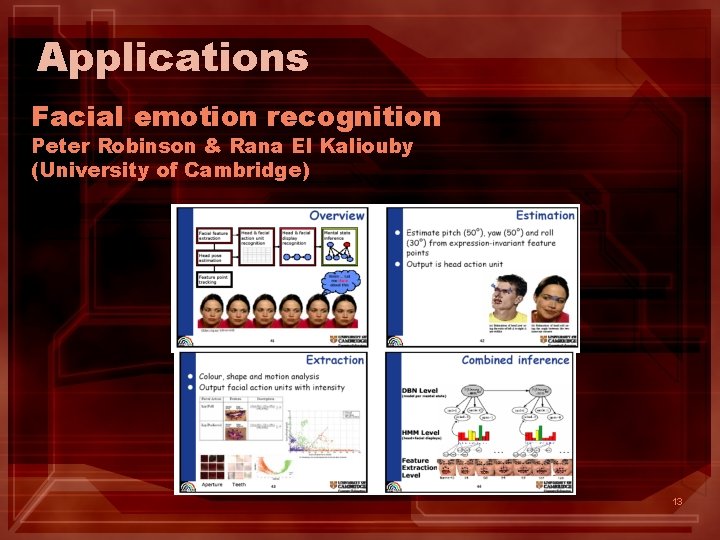
Applications Facial emotion recognition Peter Robinson & Rana El Kaliouby (University of Cambridge) 13
Contact info http: //eng. itlab. unn. ru/? dir=139 http: //www. sourceforge. net/projects/openpnl 14